

The Tax-Saving Dividend Retirement Formula in One Book
 |
Description
Book Introduction
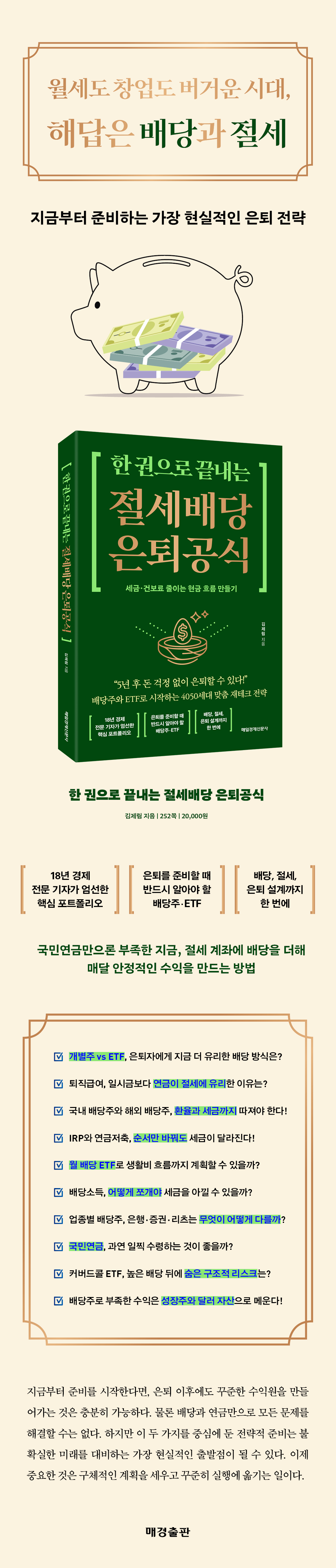
“You can retire in 5 years without worrying about money!”
A tailored investment strategy for the 40-50 age group, starting with dividend stocks and ETFs.
As retirement approaches, my worries deepen.
No matter how much I calculate, the national pension is woefully inadequate, and my retirement allowance seems like it will run out soon.
Many say that earning monthly rental income is not as easy as it sounds, and that starting a business is risky.
So how should we plan for retirement? The author, who has been an economics journalist for 18 years, suggests "tax-saving dividend investing" as the most practical solution, starting now. In "The Tax-Saving Dividend Retirement Formula: Complete in One Volume," he publishes the book.
This book contains investment strategies that create a stable cash flow while reducing the burden of taxes and health insurance premiums.
This guide details how to utilize dividend income as a "fourth pension" to supplement the insufficient national pension and retirement pension, how to maximize profits through tax-saving accounts, and even how to construct a monthly dividend ETF portfolio that generates cash flow like rent.
It's okay if you only have five years left until retirement.
This book focuses on strategies that can be quickly implemented like a quick plan, and is structured so that anyone can follow it, from office workers in their 40s and 50s to those who have already retired but are anxious about their retirement.
This one book is all you need to create your own investment formula with tax savings and dividends.
A tailored investment strategy for the 40-50 age group, starting with dividend stocks and ETFs.
As retirement approaches, my worries deepen.
No matter how much I calculate, the national pension is woefully inadequate, and my retirement allowance seems like it will run out soon.
Many say that earning monthly rental income is not as easy as it sounds, and that starting a business is risky.
So how should we plan for retirement? The author, who has been an economics journalist for 18 years, suggests "tax-saving dividend investing" as the most practical solution, starting now. In "The Tax-Saving Dividend Retirement Formula: Complete in One Volume," he publishes the book.
This book contains investment strategies that create a stable cash flow while reducing the burden of taxes and health insurance premiums.
This guide details how to utilize dividend income as a "fourth pension" to supplement the insufficient national pension and retirement pension, how to maximize profits through tax-saving accounts, and even how to construct a monthly dividend ETF portfolio that generates cash flow like rent.
It's okay if you only have five years left until retirement.
This book focuses on strategies that can be quickly implemented like a quick plan, and is structured so that anyone can follow it, from office workers in their 40s and 50s to those who have already retired but are anxious about their retirement.
This one book is all you need to create your own investment formula with tax savings and dividends.
- You can preview some of the book's contents.
Preview
index
[Introduction] Surviving in a Society Forced to Retire
Chapter 1.
Prepare for retirement with dividend investing
In an era where it's difficult to pay rent or start a business
Can you live on national pension and retirement pay alone?
Five Reasons Why Dividends Are Better Than Pensions
Dividend investments that ensure cash flow after retirement
Dividend Investing: The First Step to Practice
[Know This!] Four Things You Must Check Before Retirement Investment
Chapter 2.
Customized dividend investment strategies for each generation
The Golden Time for Retirement Planning: 5-Year Investment Planning
Your 40s - A Time to Build Up Compensation Through Tax Savings and Savings
50s - Plan for the next 10 years before receiving your national pension.
60s - Tax preparation by pension income bracket is key.
[Know This!] Taxes on retirement benefits vary depending on how you receive them.
Chapter 3.
Dividend Investments: Which One Should You Choose?
Domestic stocks vs. hateful stocks
Popular foreign stocks
Regular monthly dividend vs.
Annual dividends received when forgotten
Bored Bank Stocks vs.
Securities and telecommunications stocks with many upsides
If you are confident, individual stocks vs.
ETFs with many choices
SCHD vs.
US Dividend Dow Jones Series ETF
Slow and steady funds vs.
Fast and flexible ETF??
Chapter 4.
Health insurance premiums and taxes: hidden dangers that eat away at returns
Differences in Returns Based on the Retirement Strategies of Three Managers
Health insurance premiums and taxes continue to rise even after retirement
Dividend strategies for those in their 50s, different from those of MZ
ISA: A Retirees' Powerful Tax Saving Weapon
Avoiding the health insurance premium bomb
Is separate taxation better or comprehensive taxation better?
[Know this!] If you want to grow your pension faster, use ISA conversion contributions.
Chapter 5.
Risky products popular with retirees
The Two Faces of Ultra-High Dividend Covered Call ETFs
Brazilian Bonds: The Lure of High Interest Rates and the Currency Trap
ELS Maturity Repayment Returns as a Tax Bomb
REITs: The Hidden Capital Increase Risk Behind High Dividends
IPO Investing: No More "Table Myths"
[Know this!] Long-term bonds can be as risky as stocks
Chapter 6.
Fill the Dividend Gap: Gold, the Dollar, and Growth Stocks
Gold investment with no taxes and rising prices
With the stock market shaky, trust the dollar and the yen.
A spoonful of growth potential with dividend stability
Complete liquidation of government bonds for individual investment
[Know This!] Even if the dividend tax exemption disappears, why you should still hold foreign ETFs.
Chapter 7.
How to manage retirement funds and utilize national pension
Should I receive my retirement benefits as a lump sum or as a pension?
How to manage your retirement pension account
How will I receive my pension?
Roll on its own, automatic investment default option
Don't break the national pension!
Is early receipt of national pension the right answer?
The more years you delay, the more you receive in deferred pension.
A Lifetime Pension Built on a Home [Know This!] You Can Receive a Housing Pension Even with an Expensive Home
[Appendix 1] Five Numbers Retirees Need to Know
[Appendix 2] 10 Websites to Visit Frequently If You're Thinking About Retirement
Chapter 1.
Prepare for retirement with dividend investing
In an era where it's difficult to pay rent or start a business
Can you live on national pension and retirement pay alone?
Five Reasons Why Dividends Are Better Than Pensions
Dividend investments that ensure cash flow after retirement
Dividend Investing: The First Step to Practice
[Know This!] Four Things You Must Check Before Retirement Investment
Chapter 2.
Customized dividend investment strategies for each generation
The Golden Time for Retirement Planning: 5-Year Investment Planning
Your 40s - A Time to Build Up Compensation Through Tax Savings and Savings
50s - Plan for the next 10 years before receiving your national pension.
60s - Tax preparation by pension income bracket is key.
[Know This!] Taxes on retirement benefits vary depending on how you receive them.
Chapter 3.
Dividend Investments: Which One Should You Choose?
Domestic stocks vs. hateful stocks
Popular foreign stocks
Regular monthly dividend vs.
Annual dividends received when forgotten
Bored Bank Stocks vs.
Securities and telecommunications stocks with many upsides
If you are confident, individual stocks vs.
ETFs with many choices
SCHD vs.
US Dividend Dow Jones Series ETF
Slow and steady funds vs.
Fast and flexible ETF??
Chapter 4.
Health insurance premiums and taxes: hidden dangers that eat away at returns
Differences in Returns Based on the Retirement Strategies of Three Managers
Health insurance premiums and taxes continue to rise even after retirement
Dividend strategies for those in their 50s, different from those of MZ
ISA: A Retirees' Powerful Tax Saving Weapon
Avoiding the health insurance premium bomb
Is separate taxation better or comprehensive taxation better?
[Know this!] If you want to grow your pension faster, use ISA conversion contributions.
Chapter 5.
Risky products popular with retirees
The Two Faces of Ultra-High Dividend Covered Call ETFs
Brazilian Bonds: The Lure of High Interest Rates and the Currency Trap
ELS Maturity Repayment Returns as a Tax Bomb
REITs: The Hidden Capital Increase Risk Behind High Dividends
IPO Investing: No More "Table Myths"
[Know this!] Long-term bonds can be as risky as stocks
Chapter 6.
Fill the Dividend Gap: Gold, the Dollar, and Growth Stocks
Gold investment with no taxes and rising prices
With the stock market shaky, trust the dollar and the yen.
A spoonful of growth potential with dividend stability
Complete liquidation of government bonds for individual investment
[Know This!] Even if the dividend tax exemption disappears, why you should still hold foreign ETFs.
Chapter 7.
How to manage retirement funds and utilize national pension
Should I receive my retirement benefits as a lump sum or as a pension?
How to manage your retirement pension account
How will I receive my pension?
Roll on its own, automatic investment default option
Don't break the national pension!
Is early receipt of national pension the right answer?
The more years you delay, the more you receive in deferred pension.
A Lifetime Pension Built on a Home [Know This!] You Can Receive a Housing Pension Even with an Expensive Home
[Appendix 1] Five Numbers Retirees Need to Know
[Appendix 2] 10 Websites to Visit Frequently If You're Thinking About Retirement
Detailed image
Into the book
The concerns faced by those approaching retirement are not light.
Many questions arise: how will we spend our remaining time, how will we manage our health, how will we maintain social relationships, etc.
But among them, the most pressing problem is definitely money.
According to a survey conducted by Mirae Asset Investment & Pension Center on approximately 400 retired men and women in their 50s or older, financial management was cited as the top regret for not preparing in advance before retirement.
The regrets about the post-retirement job plans that followed were also deeply connected to economic issues.
Except for a small number of people who have thoroughly prepared for retirement, there is no disagreement that the biggest concern facing retirement is ultimately 'money.'
---From "In an era where it is difficult to pay rent and start a business"
To maximize your returns within a short period of five years, you should actively utilize tax-saving accounts that allow you to enjoy the benefits of compound interest.
Of course, five years is a relatively short period of time to experience the effects of compound interest, but tax-saving accounts such as pension accounts and ISAs have annual contribution limits, so it is important to fill up to the limit every year if possible.
A pension account that combines pension savings and IRP can receive a tax deduction of up to 9 million won per year, and a maximum deposit of 18 million won can be made.
One of the biggest advantages of pension accounts, in particular, is that dividend income is exempt from tax.
For example, funds or ETFs that invest in foreign indices such as the S&P 500 or NASDAQ are subject to a 15.4% tax on capital gains, which are considered dividend income. However, this tax does not apply to pension accounts.
---From "The Golden Time for Retirement Preparation: 5-Year Investment Planning"
In 2024, major domestic banks, starting with Shinhan Financial Group, announced value-up measures one after another, leading to a significant rebound in their stock prices. Major banks, including KB Financial Group, Shinhan Financial Group, Hana Financial Group, Woori Financial Group, and JB Financial Group, are all implementing a "quarterly equal dividend" policy, distributing a fixed amount of dividends each quarter.
This has the advantage of increasing dividend predictability from the investor's perspective.
Bank stocks have seen significant price increases, driven by the 2024 value-up program and expectations of additional shareholder returns in 2025. However, dividend yields remain in the 3-6% range. KB Financial Group and Shinhan Financial Group each offer dividend yields in the 3% range, Hana Financial Group in the 5% range, and Woori Financial Group and Industrial Bank of Korea in the 6% range.
---「Boring Bank Stocks vs.
Among the stocks and telecommunications stocks with many upsides,
Separate taxation is often advantageous for dividend income.
If you choose comprehensive taxation, you will be subject to health insurance premiums and the tax rate may also increase.
The comprehensive income tax rate starts at a minimum of 6%, but a higher rate than the withholding tax rate (14%) is applied to amounts exceeding 20 million won.
Items subject to separate taxation generally have lower tax rates.
Representative examples include financial income exceeding the tax-free limit in an ISA account (tax rate 9.9%) and pension income generated from a pension account.
Pension income is subject to a pension income tax rate of 3.3% to 5.5%.
Retirement allowances are also subject to separate taxation, but it should be noted that in this case, a progressive tax rate may be applied rather than a single tax rate.
---“Is separate taxation better or comprehensive taxation better?”
According to data from the Korea Deposit Insurance Corporation's Savero, Yildmax's covered call ETFs were so popular that they were ranked among the top 30 net buyers by Seohak Ants.
Not only retirees but also investors looking to steadily accumulate investment funds have sought out the YieldMax ETF.
The biggest reason for its popularity was its high dividend yield, which made it easy to ignore even a slight drop in stock price.
While the annual dividend yield of domestic covered call ETFs is at most in the 10% range, the annual dividend yield of Yildmax's ultra-high dividend ETF exceeds 100%.
When the prices of U.S. tech stocks and Bitcoin surged, the stock prices of covered call ETFs also rose, and their dividends also increased.
However, as the US stock market began to correct in February 2025, the true face of ultra-high-dividend covered call ETFs began to be revealed.
It suffered a double whammy of a reduction in monthly dividends and a sharp drop in stock prices.
Ultimately, concerns that high dividends from ultra-high-dividend covered call ETFs were paid out at the expense of principal have become reality.
Many questions arise: how will we spend our remaining time, how will we manage our health, how will we maintain social relationships, etc.
But among them, the most pressing problem is definitely money.
According to a survey conducted by Mirae Asset Investment & Pension Center on approximately 400 retired men and women in their 50s or older, financial management was cited as the top regret for not preparing in advance before retirement.
The regrets about the post-retirement job plans that followed were also deeply connected to economic issues.
Except for a small number of people who have thoroughly prepared for retirement, there is no disagreement that the biggest concern facing retirement is ultimately 'money.'
---From "In an era where it is difficult to pay rent and start a business"
To maximize your returns within a short period of five years, you should actively utilize tax-saving accounts that allow you to enjoy the benefits of compound interest.
Of course, five years is a relatively short period of time to experience the effects of compound interest, but tax-saving accounts such as pension accounts and ISAs have annual contribution limits, so it is important to fill up to the limit every year if possible.
A pension account that combines pension savings and IRP can receive a tax deduction of up to 9 million won per year, and a maximum deposit of 18 million won can be made.
One of the biggest advantages of pension accounts, in particular, is that dividend income is exempt from tax.
For example, funds or ETFs that invest in foreign indices such as the S&P 500 or NASDAQ are subject to a 15.4% tax on capital gains, which are considered dividend income. However, this tax does not apply to pension accounts.
---From "The Golden Time for Retirement Preparation: 5-Year Investment Planning"
In 2024, major domestic banks, starting with Shinhan Financial Group, announced value-up measures one after another, leading to a significant rebound in their stock prices. Major banks, including KB Financial Group, Shinhan Financial Group, Hana Financial Group, Woori Financial Group, and JB Financial Group, are all implementing a "quarterly equal dividend" policy, distributing a fixed amount of dividends each quarter.
This has the advantage of increasing dividend predictability from the investor's perspective.
Bank stocks have seen significant price increases, driven by the 2024 value-up program and expectations of additional shareholder returns in 2025. However, dividend yields remain in the 3-6% range. KB Financial Group and Shinhan Financial Group each offer dividend yields in the 3% range, Hana Financial Group in the 5% range, and Woori Financial Group and Industrial Bank of Korea in the 6% range.
---「Boring Bank Stocks vs.
Among the stocks and telecommunications stocks with many upsides,
Separate taxation is often advantageous for dividend income.
If you choose comprehensive taxation, you will be subject to health insurance premiums and the tax rate may also increase.
The comprehensive income tax rate starts at a minimum of 6%, but a higher rate than the withholding tax rate (14%) is applied to amounts exceeding 20 million won.
Items subject to separate taxation generally have lower tax rates.
Representative examples include financial income exceeding the tax-free limit in an ISA account (tax rate 9.9%) and pension income generated from a pension account.
Pension income is subject to a pension income tax rate of 3.3% to 5.5%.
Retirement allowances are also subject to separate taxation, but it should be noted that in this case, a progressive tax rate may be applied rather than a single tax rate.
---“Is separate taxation better or comprehensive taxation better?”
According to data from the Korea Deposit Insurance Corporation's Savero, Yildmax's covered call ETFs were so popular that they were ranked among the top 30 net buyers by Seohak Ants.
Not only retirees but also investors looking to steadily accumulate investment funds have sought out the YieldMax ETF.
The biggest reason for its popularity was its high dividend yield, which made it easy to ignore even a slight drop in stock price.
While the annual dividend yield of domestic covered call ETFs is at most in the 10% range, the annual dividend yield of Yildmax's ultra-high dividend ETF exceeds 100%.
When the prices of U.S. tech stocks and Bitcoin surged, the stock prices of covered call ETFs also rose, and their dividends also increased.
However, as the US stock market began to correct in February 2025, the true face of ultra-high-dividend covered call ETFs began to be revealed.
It suffered a double whammy of a reduction in monthly dividends and a sharp drop in stock prices.
Ultimately, concerns that high dividends from ultra-high-dividend covered call ETFs were paid out at the expense of principal have become reality.
---From "The Two Faces of Ultra-High Dividend Covered Call ETFs"
Publisher's Review
A Relaxed Retirement with Dividends and Tax Savings
In an era of insufficient retirement funds and delayed pension payments, the answer lies in dividends and tax-saving strategies.
The most realistic investment plan to prepare from now on!
The reality is that both national pension and retirement allowance are insufficient.
A retirement strategy that creates monthly cash flow with tax-saving dividends!
A couple needs about 2.96 million won per month to maintain a decent standard of living after retirement.
Assuming you receive an annual interest rate of 2.5%, you would need about 1.5 billion won to make that amount possible.
But the reality is much colder.
The average national pension is only 660,000 won per month, and the average retirement allowance is only 120 million won.
Moreover, starting a business carries a high risk of failure, the monthly rental income is not as high as expected, and owning real estate only increases the burden of taxes and health insurance premiums.
"The Tax-Saving Dividend Retirement Formula in One Book" is a book for retirees and prospective retirees who have these realistic concerns.
Rather than a theory or a theoretical method, it contains clear and realistic strategies that anyone can implement right now.
The key is to leverage tax-advantaged pension savings and ISA accounts to invest in dividend ETFs and generate a steady monthly cash flow.
Dividend investing allows you to generate immediate returns without having to wait a long time, like with the National Pension Service, and even saves on taxes and health insurance premiums.
Dividend Strategies Using ETFs and Designing a Profit Stream That's Ready to Use
Dividends are often perceived as something you receive once a year, but by utilizing ETFs, you can create a structure that generates income monthly or even biweekly.
This book provides detailed guidance on how to design a system that allows you to receive dividends twice a month by combining ETFs with different dividend payment dates.
This structure does more than simply increase the number of profits.
It also helps reduce the burden of health insurance premiums by distributing income.
Your actual cash flow will vary depending on how you generate and receive revenue.
We also covered a wealth of points to keep in mind when choosing ETF products.
This book thoroughly explains essential information for practical investment, including the structure of covered call ETFs, fee comparisons, and whether or not they are hedged. Beyond simply listing products, it also provides practical criteria and examples to help readers construct their own portfolios.
Resilience is more important than profitability.
Why High-Risk Products Are Dangerous for Retirees
Are products boasting high returns like covered call ETFs, Brazilian bonds, and REITs truly suitable for retirees? This book warns that focusing solely on high dividend yields can lead to unexpected risks, such as increased health insurance premiums or loss of principal.
Covered call ETFs, in particular, offer high dividend yields, but they can suffer significant principal losses when stock prices fall, so a cautious approach is necessary.
It also illustrates, through real-world examples, that even products boasting seemingly impressive returns, such as Brazilian bonds, public offerings, and long-term bonds, have hidden risks.
The author emphasizes that retirees should prioritize asset selection based on "resilience," or the possibility of recovery after a crisis, rather than on returns.
More important than temporary gains is the ability of an asset to recover over time.
The key to financial well-being after retirement is resilience.
It's not too late to retire even if you have five years left.
Includes generational strategies and immediately actionable scenarios.
This book is not your typical financial advice book.
It provides specific scenarios on what strategies to adopt for each generation, such as those in their 40s, 50s, and 60s.
For example, for those in their 50s, we suggest a 'monthly dividend-centered cash flow strategy' to fill the income gap before receiving national pension, and for those in their 60s, we suggest an 'income design by tax bracket' to reduce the burden of health insurance premiums.
The strength of this book is that it goes beyond simply offering advice on which product is good, and instead provides specific approach strategies for each time period and situation.
It also contains a wealth of practical tips, such as "How to Use Multiple Tax-Saving Accounts" and "Income Distribution Strategies with Your Spouse," making it a practical guidebook.
If you're a prospective retiree with five years left until retirement, you can actively utilize your pension savings and ISA accounts now to take advantage of tax deductions and steadily build long-term dividend-paying assets to solidify your retirement cash flow.
In an era of insufficient retirement funds and delayed pension payments, the answer lies in dividends and tax-saving strategies.
The most realistic investment plan to prepare from now on!
The reality is that both national pension and retirement allowance are insufficient.
A retirement strategy that creates monthly cash flow with tax-saving dividends!
A couple needs about 2.96 million won per month to maintain a decent standard of living after retirement.
Assuming you receive an annual interest rate of 2.5%, you would need about 1.5 billion won to make that amount possible.
But the reality is much colder.
The average national pension is only 660,000 won per month, and the average retirement allowance is only 120 million won.
Moreover, starting a business carries a high risk of failure, the monthly rental income is not as high as expected, and owning real estate only increases the burden of taxes and health insurance premiums.
"The Tax-Saving Dividend Retirement Formula in One Book" is a book for retirees and prospective retirees who have these realistic concerns.
Rather than a theory or a theoretical method, it contains clear and realistic strategies that anyone can implement right now.
The key is to leverage tax-advantaged pension savings and ISA accounts to invest in dividend ETFs and generate a steady monthly cash flow.
Dividend investing allows you to generate immediate returns without having to wait a long time, like with the National Pension Service, and even saves on taxes and health insurance premiums.
Dividend Strategies Using ETFs and Designing a Profit Stream That's Ready to Use
Dividends are often perceived as something you receive once a year, but by utilizing ETFs, you can create a structure that generates income monthly or even biweekly.
This book provides detailed guidance on how to design a system that allows you to receive dividends twice a month by combining ETFs with different dividend payment dates.
This structure does more than simply increase the number of profits.
It also helps reduce the burden of health insurance premiums by distributing income.
Your actual cash flow will vary depending on how you generate and receive revenue.
We also covered a wealth of points to keep in mind when choosing ETF products.
This book thoroughly explains essential information for practical investment, including the structure of covered call ETFs, fee comparisons, and whether or not they are hedged. Beyond simply listing products, it also provides practical criteria and examples to help readers construct their own portfolios.
Resilience is more important than profitability.
Why High-Risk Products Are Dangerous for Retirees
Are products boasting high returns like covered call ETFs, Brazilian bonds, and REITs truly suitable for retirees? This book warns that focusing solely on high dividend yields can lead to unexpected risks, such as increased health insurance premiums or loss of principal.
Covered call ETFs, in particular, offer high dividend yields, but they can suffer significant principal losses when stock prices fall, so a cautious approach is necessary.
It also illustrates, through real-world examples, that even products boasting seemingly impressive returns, such as Brazilian bonds, public offerings, and long-term bonds, have hidden risks.
The author emphasizes that retirees should prioritize asset selection based on "resilience," or the possibility of recovery after a crisis, rather than on returns.
More important than temporary gains is the ability of an asset to recover over time.
The key to financial well-being after retirement is resilience.
It's not too late to retire even if you have five years left.
Includes generational strategies and immediately actionable scenarios.
This book is not your typical financial advice book.
It provides specific scenarios on what strategies to adopt for each generation, such as those in their 40s, 50s, and 60s.
For example, for those in their 50s, we suggest a 'monthly dividend-centered cash flow strategy' to fill the income gap before receiving national pension, and for those in their 60s, we suggest an 'income design by tax bracket' to reduce the burden of health insurance premiums.
The strength of this book is that it goes beyond simply offering advice on which product is good, and instead provides specific approach strategies for each time period and situation.
It also contains a wealth of practical tips, such as "How to Use Multiple Tax-Saving Accounts" and "Income Distribution Strategies with Your Spouse," making it a practical guidebook.
If you're a prospective retiree with five years left until retirement, you can actively utilize your pension savings and ISA accounts now to take advantage of tax deductions and steadily build long-term dividend-paying assets to solidify your retirement cash flow.
GOODS SPECIFICS
- Date of issue: July 4, 2025
- Page count, weight, size: 252 pages | 476g | 152*225*17mm
- ISBN13: 9791164847884
- ISBN10: 1164847880
You may also like
카테고리
korean


korean

![GQ KOREA Mark (Monthly): December [2025]](http://librairie.coreenne.fr/cdn/shop/files/8ef265dbbfbf186523ed75ba7319009d.jpg?v=1765340328&width=3840)


