

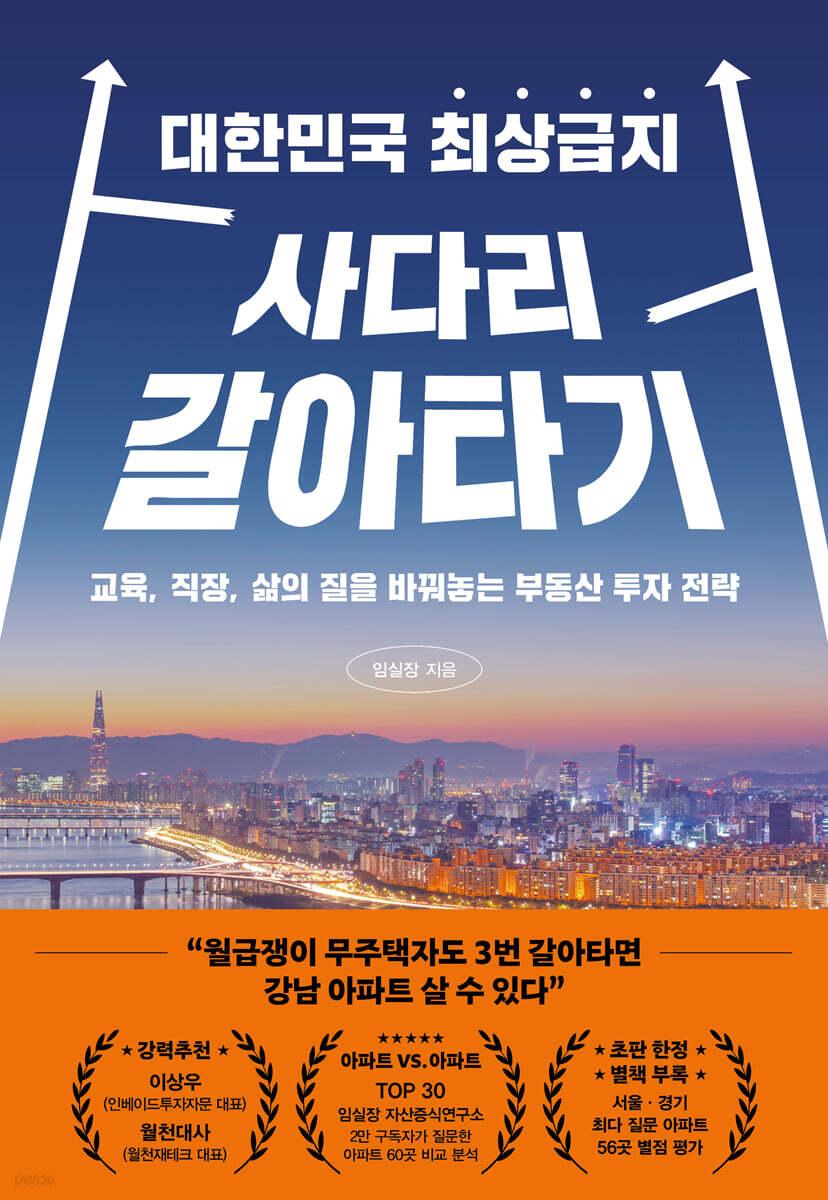
Climbing the ladder to the top-tier Korean market
 |
Description
Book Introduction
Even a salaried worker without a home can change houses 3 times.
“You can buy an apartment in Gangnam.”
Transfer to the best location in the shortest time
Pay attention to the investment know-how of Director Lim, an ordinary office worker!
In his late twenties, the author realized the harsh reality that a corporate ID card doesn't take responsibility for one's life, and jumped into financial investment.
Although I have experience with financial investments like stocks and Bitcoin, I ultimately realized that to achieve true financial freedom in South Korea, I needed to invest in real estate.
The three strategic investments he has made over the past nine years since starting out as a homeless person include ‘reconstruction apartments along the Han River,’ ‘small apartments in Gangnam-gu,’ and ‘real estate in major redevelopment areas in Seoul.’
And through these three real estate swaps, his assets experienced an explosive quantum jump in wealth.
Author Lim Sil-jang clearly presents three strategies that ordinary office workers must implement to successfully invest in real estate.
First, because the value of your first home affects your investments 10 years from now, you should buy a home in a well-located area even if it means going out of your way to do so. Second, real investment begins with buying an investment home that you don't live in. Third, you should set a goal of moving to a top-tier location with the best location, such as the Han River, rather than simply a luxury location, to achieve asset growth.
Additionally, not all Gangnam areas have the same value, and the future best location will be centered around the Han River, based on an analysis of the '2040 Seoul Urban Basic Plan'.
And the methods and conditions for switching to these top-tier locations are explained in detail through real-life investment examples.
In addition, [Im Sil-jang's Asset Growth Research Institute] has compared apartments, which is the most frequently asked question by 20,000 subscribers, with 'Apartment VS.
The 30th episode of 'Apartment' was covered in Chapter 3 of Part 3, and in the appendix of the special volume, the 56 apartments that subscribers were most curious about in terms of future value were analyzed in terms of redevelopment project performance and actual occupancy value, and a star rating out of 4 stars was included.
In this book, the author proposes a realistic real estate investment method that allows you to maximize your assets, starting from scratch. He also clearly outlines the essential preparations for intensively increasing your wealth in the future Korean real estate market.
“You can buy an apartment in Gangnam.”
Transfer to the best location in the shortest time
Pay attention to the investment know-how of Director Lim, an ordinary office worker!
In his late twenties, the author realized the harsh reality that a corporate ID card doesn't take responsibility for one's life, and jumped into financial investment.
Although I have experience with financial investments like stocks and Bitcoin, I ultimately realized that to achieve true financial freedom in South Korea, I needed to invest in real estate.
The three strategic investments he has made over the past nine years since starting out as a homeless person include ‘reconstruction apartments along the Han River,’ ‘small apartments in Gangnam-gu,’ and ‘real estate in major redevelopment areas in Seoul.’
And through these three real estate swaps, his assets experienced an explosive quantum jump in wealth.
Author Lim Sil-jang clearly presents three strategies that ordinary office workers must implement to successfully invest in real estate.
First, because the value of your first home affects your investments 10 years from now, you should buy a home in a well-located area even if it means going out of your way to do so. Second, real investment begins with buying an investment home that you don't live in. Third, you should set a goal of moving to a top-tier location with the best location, such as the Han River, rather than simply a luxury location, to achieve asset growth.
Additionally, not all Gangnam areas have the same value, and the future best location will be centered around the Han River, based on an analysis of the '2040 Seoul Urban Basic Plan'.
And the methods and conditions for switching to these top-tier locations are explained in detail through real-life investment examples.
In addition, [Im Sil-jang's Asset Growth Research Institute] has compared apartments, which is the most frequently asked question by 20,000 subscribers, with 'Apartment VS.
The 30th episode of 'Apartment' was covered in Chapter 3 of Part 3, and in the appendix of the special volume, the 56 apartments that subscribers were most curious about in terms of future value were analyzed in terms of redevelopment project performance and actual occupancy value, and a star rating out of 4 stars was included.
In this book, the author proposes a realistic real estate investment method that allows you to maximize your assets, starting from scratch. He also clearly outlines the essential preparations for intensively increasing your wealth in the future Korean real estate market.
- You can preview some of the book's contents.
Preview
index
Prologue Do you have these three things?
Part 1.
30-something office workers, transform into real estate tycoons.
(INTRO: For true life sovereignty, home ownership)
Chapter 1: How do you want to live?
Memories of deprivation that are still vivid
The Great Voyage to Multi-Homeownership through Transfer
Securing a solid seed fund and attitude toward salary
From initial setup to selection of excellent pipes
Chapter 2.
The goal of education is ultimately to create networks.
Increasing my value at the crossroads of choice and judgment
How long will we live with leverage?
Your first investment should be in Seoul real estate.
Act with the heart of a beast
Part 2.
Hi-Pass Real Estate Investment Strategy to Get to the Top
(There is no wrong answer when it comes to parking assets along the Han River.)
Chapter 1: Step 1: Find a Home for Me (N)
3 Principles for Buying Your First Home
The quality of your first registration determines your next 10 years.
Finding a Newlywed Home in the Heart of Seoul's Subway Line 3
Chapter 2: Build a Two-Step Investment Home (N+1)
Two Principles for Gap Investing After Buying Your First Home
N+1 built on savings and more savings
Our company's stock receipt and Yongsan-gu's initial redevelopment
Chapter 3: Step 3: Change to the best location with a view of the Han River (GOAL)
Perception change regarding top-tier land
Director Im's Three Principles for Changing Jobs
Changing to a higher level ① Checking materials
Switching to a higher-level position ② Buy first, sell later strategy
Changing to a higher level ③ Forest manager and judgment
Switching to a higher-level position ④ The most difficult performance art: selling real estate
Switching to a higher-level position ⑤ Reinvestment through leverage
The ultimate destination of investment is in sight.
Part 3.
So, when and where should you buy and make the quantum jump?
(The Reality and Truth of the INTRO Advanced Land Transfer Strategy)
Chapter 1: Optimal Advance Timing
Bull market, don't burn me too quickly in the flames
In a bear market, sell low and buy even cheaper.
Aim your gun towards the Han River and Gangnam if possible.
Things to do before your child enters elementary school
Chapter 2: This is how to choose a smart one
Maximizing the quantum leap through reconstruction and redevelopment
Real-life solutions based on family members
Investment Guide by Seed Money Amount
Consider price relativity and recovery rates.
Chapter 3: Apartments vs.
Top 30 Apartments, What if There Are Two Left?
District | Daechi Hyundai 26 pyeong vs.
Bangbae Artzai 24 pyeong | Dogok Rexle 26 pyeong vs.
Jamsil Els 24 pyeong | Yeoksam-dong Raemian Grayton 2nd 24 pyeong vs.
Garak-dong Heliocity 33 pyeong | Ilwon-dong Pureunmaeul 31 pyeong vs.
Gwangjang-dong Geukdong 1st 31 pyeong | Mapo Raemian Prugio 25 pyeong vs.
e-Pyeonhansesang Oksu Park Hills 25 pyeong | Bangbae Hyundai 1cha 32 pyeong vs.
Olympic Family Town 31 pyeong | Raemian Songpa Pine Top 26 pyeong vs.
Bundang Demonstration Complex Samsung Hanshin 32 pyeong | Ichon-dong Hangaram 25 pyeong vs.
e-Pyeonhansesang Oksu Park Hills 25 pyeong | Jamwon-dong Shinhwa 22 pyeong vs.
Heukseok-dong Acro River Heim 25 pyeong | Geumho 16th District vs.
Shindang District 8 | Bundang Yangji 1st Complex Geumho 31 pyeong vs.
Gwangjang-dong Geukdong 2nd 31 pyeong | Ichon-dong Hangaram 25 pyeong vs.
Bangbae District 15 | Oksu Samsung 25 pyeong vs.
Raemian Gongdeok 3rd Complex, 25 pyeong | Eungbong-dong Daerim 1st Complex, 31 pyeong vs.
Songpa-dong Hanyang 2nd Complex 26 pyeong | Imun-dong Raemian La Grande 25 pyeong vs.
Haengdang Hanjin Town 25 pyeong | Geumho-dong Doosan 31 pyeong vs.
Oksu Samsung 25 pyeong | Sinchon Prugio 33 pyeong vs.
Namsan Town 32 pyeong | Bundang Neuti Village Civil Servant Complex 4 25 pyeong vs.
Gwangjang-dong Hyundai 9th Complex 33 pyeong | Dapsimni-dong Raemian Weave 34 pyeong vs.
Suseo-dong Magpie Village 14 pyeong | DMC Park View Zai 25 pyeong vs.
Lotte Castle Classia, 25 pyeong, Gilum-dong | Singeumho Parkzai, 24 pyeong vs.
Cheonggu e-Pyeonhansesang 25 pyeong | Bundang Cheongsol Halla 3 Complex 23 pyeong vs.
Geumho-dong Byeoksan 26 pyeong | Shingongdeok Samsung Raemian 2nd 24 pyeong vs.
Sangdo The Sharp 1st 25 pyeong | Misagangbyeon Center River 24 pyeong vs.
Songpa Dream Green Wiryeseong 24 Complex 22 pyeong | Yongin Sinjeong 1st Complex 25 pyeong vs.
Shinheung Station Sky Landers One 24 pyeong | Guseongnam e-Pyeonhansesang Geumbit Grand Maison 3rd Complex 24 pyeong vs.
Bundang Maehwa Village Civil Servant Complex 2, 24 pyeong | Sinchon Lucky 24 pyeong vs.
Natural Tranchae 23 Pyeong | Gayang/Deungchon Small vs. Large
Small-sized offset/intermediate
Without epilogue action, no outcome is achieved.
Special Appendix: A Complete Analysis Guide to the Future of Korea's Top-Rated Newspapers
01 2040 Seoul Urban Master Plan Explanation
02 Analysis of apartments by major area in Seoul and Gyeonggi (56 locations)
Part 1.
30-something office workers, transform into real estate tycoons.
(INTRO: For true life sovereignty, home ownership)
Chapter 1: How do you want to live?
Memories of deprivation that are still vivid
The Great Voyage to Multi-Homeownership through Transfer
Securing a solid seed fund and attitude toward salary
From initial setup to selection of excellent pipes
Chapter 2.
The goal of education is ultimately to create networks.
Increasing my value at the crossroads of choice and judgment
How long will we live with leverage?
Your first investment should be in Seoul real estate.
Act with the heart of a beast
Part 2.
Hi-Pass Real Estate Investment Strategy to Get to the Top
(There is no wrong answer when it comes to parking assets along the Han River.)
Chapter 1: Step 1: Find a Home for Me (N)
3 Principles for Buying Your First Home
The quality of your first registration determines your next 10 years.
Finding a Newlywed Home in the Heart of Seoul's Subway Line 3
Chapter 2: Build a Two-Step Investment Home (N+1)
Two Principles for Gap Investing After Buying Your First Home
N+1 built on savings and more savings
Our company's stock receipt and Yongsan-gu's initial redevelopment
Chapter 3: Step 3: Change to the best location with a view of the Han River (GOAL)
Perception change regarding top-tier land
Director Im's Three Principles for Changing Jobs
Changing to a higher level ① Checking materials
Switching to a higher-level position ② Buy first, sell later strategy
Changing to a higher level ③ Forest manager and judgment
Switching to a higher-level position ④ The most difficult performance art: selling real estate
Switching to a higher-level position ⑤ Reinvestment through leverage
The ultimate destination of investment is in sight.
Part 3.
So, when and where should you buy and make the quantum jump?
(The Reality and Truth of the INTRO Advanced Land Transfer Strategy)
Chapter 1: Optimal Advance Timing
Bull market, don't burn me too quickly in the flames
In a bear market, sell low and buy even cheaper.
Aim your gun towards the Han River and Gangnam if possible.
Things to do before your child enters elementary school
Chapter 2: This is how to choose a smart one
Maximizing the quantum leap through reconstruction and redevelopment
Real-life solutions based on family members
Investment Guide by Seed Money Amount
Consider price relativity and recovery rates.
Chapter 3: Apartments vs.
Top 30 Apartments, What if There Are Two Left?
District | Daechi Hyundai 26 pyeong vs.
Bangbae Artzai 24 pyeong | Dogok Rexle 26 pyeong vs.
Jamsil Els 24 pyeong | Yeoksam-dong Raemian Grayton 2nd 24 pyeong vs.
Garak-dong Heliocity 33 pyeong | Ilwon-dong Pureunmaeul 31 pyeong vs.
Gwangjang-dong Geukdong 1st 31 pyeong | Mapo Raemian Prugio 25 pyeong vs.
e-Pyeonhansesang Oksu Park Hills 25 pyeong | Bangbae Hyundai 1cha 32 pyeong vs.
Olympic Family Town 31 pyeong | Raemian Songpa Pine Top 26 pyeong vs.
Bundang Demonstration Complex Samsung Hanshin 32 pyeong | Ichon-dong Hangaram 25 pyeong vs.
e-Pyeonhansesang Oksu Park Hills 25 pyeong | Jamwon-dong Shinhwa 22 pyeong vs.
Heukseok-dong Acro River Heim 25 pyeong | Geumho 16th District vs.
Shindang District 8 | Bundang Yangji 1st Complex Geumho 31 pyeong vs.
Gwangjang-dong Geukdong 2nd 31 pyeong | Ichon-dong Hangaram 25 pyeong vs.
Bangbae District 15 | Oksu Samsung 25 pyeong vs.
Raemian Gongdeok 3rd Complex, 25 pyeong | Eungbong-dong Daerim 1st Complex, 31 pyeong vs.
Songpa-dong Hanyang 2nd Complex 26 pyeong | Imun-dong Raemian La Grande 25 pyeong vs.
Haengdang Hanjin Town 25 pyeong | Geumho-dong Doosan 31 pyeong vs.
Oksu Samsung 25 pyeong | Sinchon Prugio 33 pyeong vs.
Namsan Town 32 pyeong | Bundang Neuti Village Civil Servant Complex 4 25 pyeong vs.
Gwangjang-dong Hyundai 9th Complex 33 pyeong | Dapsimni-dong Raemian Weave 34 pyeong vs.
Suseo-dong Magpie Village 14 pyeong | DMC Park View Zai 25 pyeong vs.
Lotte Castle Classia, 25 pyeong, Gilum-dong | Singeumho Parkzai, 24 pyeong vs.
Cheonggu e-Pyeonhansesang 25 pyeong | Bundang Cheongsol Halla 3 Complex 23 pyeong vs.
Geumho-dong Byeoksan 26 pyeong | Shingongdeok Samsung Raemian 2nd 24 pyeong vs.
Sangdo The Sharp 1st 25 pyeong | Misagangbyeon Center River 24 pyeong vs.
Songpa Dream Green Wiryeseong 24 Complex 22 pyeong | Yongin Sinjeong 1st Complex 25 pyeong vs.
Shinheung Station Sky Landers One 24 pyeong | Guseongnam e-Pyeonhansesang Geumbit Grand Maison 3rd Complex 24 pyeong vs.
Bundang Maehwa Village Civil Servant Complex 2, 24 pyeong | Sinchon Lucky 24 pyeong vs.
Natural Tranchae 23 Pyeong | Gayang/Deungchon Small vs. Large
Small-sized offset/intermediate
Without epilogue action, no outcome is achieved.
Special Appendix: A Complete Analysis Guide to the Future of Korea's Top-Rated Newspapers
01 2040 Seoul Urban Master Plan Explanation
02 Analysis of apartments by major area in Seoul and Gyeonggi (56 locations)
Detailed image

Publisher's Review
“It made ordinary office workers into real estate tycoons.
"High-pass Real Estate Investment Strategy for Top-Rated Locations"
Know the three criteria for selecting the best land and implement a three-step investment strategy!
"Climbing the Ladder to Korea's Top-Class Real Estate" is divided into three main parts and explains real estate investment strategies that will dramatically increase your assets.
In particular, the author explains using his own investment cases as examples, helping readers without real estate investment experience to easily understand and put it into practice.
Part 1, [30-Year-Old Office Workers, Become Real Estate Wealthy], presents strategies for office workers in their 30s to achieve financial freedom, including real estate investment, particularly in Seoul's "prime-level" areas and "redevelopment," to become wealthy.
The author emphasizes that 'true sovereignty in life lies in home ownership' and that securing residential stability determines the fundamental stability and happiness of an individual's life.
In fact, the author has been diligently saving up seed money since his early days in society, and has strategically utilized reconstruction and redevelopment in central Seoul to significantly increase his assets.
As a representative example, the author successfully completed a 'transfer to a higher-end property' by purchasing an apartment in Oksu-dong as his first residence, and then sequentially purchasing a small apartment in Gaepo-dong, Gangnam-gu, and real estate in a major redevelopment area in Seoul.
In the process, he achieved a 'quantum jump' in real estate investment by moving into a redeveloped apartment along the Han River.
The author also suggests that the real estate market is rising at a rate that cannot be kept up with wages alone, and emphasizes the need for capital formation and investment strategies for office workers.
Ultimately, the author emphasizes that even without a home, if you invest in real estate with a clear strategy, you can secure an apartment in Gangnam. To achieve this, he urges you to make courageous and strategic investments with the "heart of the beast."
Part 2 [High-pass Real Estate Investment Strategy to the Top Level] presents a step-by-step investment strategy in three major stages (N→N+1→Top Level) with the goal of successfully moving to the "Top Level Area along the Han River."
[Step 1 (N): Buying a Home] emphasizes the ‘three principles’ of buying your first home: △location △liquidity △future value.
He explains that you should choose carefully, especially since the first house you register will determine your asset size for the next 10 years.
As a representative example, the author presents his experience of purchasing a newlywed home in the 'center of Seoul Subway Line 3', emphasizing the importance of securing a home in a key area from the beginning.
[Step 2 (N+1): Securing a Second Investment Home] advises that after securing your first home, you begin investing in earnest starting with your second home.
In particular, the author explains the two principles of the 'gap investment' method (△rental demand △development windfall), and presents specific examples of how the author personally increased his assets by securing his second and third investment homes through gap investment in Pyeongchon, Gyeonggi Province and Yongsan-gu, Seoul.
This highlights a practical investment method that allows you to continuously save for a second home after purchasing your first home.
[Step 3 (Goal): Moving to the best location along the Han River] This covers investing in the best location along the Han River, which is the ultimate goal.
To this end, we present ‘Director Lim’s 3 Principles for Top-Level Investment.’
△It suggests upgrading the location, △selling timing, and △leverage utilization, and explains △purchasing redeveloped/reconstructed properties with excellent locations, △investing in pre-sale rights to increase premiums, and △maximizing assets through accurate selling decisions.
The author presents a detailed introduction to the two most difficult real estate investment strategies: "selling" and "leveraging," based on a successful case study of real estate investment in Gangnam and other prime areas along the Han River, where this strategy was utilized to move to a top-tier location.
Part 3 [So, when and where should you buy to make a quantum jump?] presents a concrete 'real estate quantum jump strategy.'
Investment locations and timing should be determined based not only on location but also on the pace of redevelopment projects and the actual rate of increase in assets. Rather than simply focusing on the name "Gangnam," he advises choosing apartments with active redevelopment projects, even if their locations are somewhat less developed, to increase the speed of asset growth.
As a representative example, it presents data on apartment price fluctuations in Gangnam and Seocho-gu, and explains that the price increase rate of redevelopment and reconstruction complexes is significantly higher than that of general apartments.
In particular, he cites the case of redevelopment complexes such as Gangnam Samseong-dong Seogwang and Seocho Bangbae 13-gu where prices rose significantly in a short period of time from the second half of 2023 to March 2025, and emphasizes that early entry into apartments undergoing redevelopment projects is the key to achieving a successful quantum jump in real estate investment.
In addition, the author considers 'real estate investment timing' very important, and says that when the real estate market declines, good opportunities actually come.
We recommend a strategy of actively buying when prices are low in a bear market and then waiting for the market to rise to increase your assets. We also share an actual case where we made a quick decision during a real estate market decline and moved to a higher-end property.
This book provides a separate appendix.
This appendix, titled [A Complete Analysis Guide to the Future of Korea's Top-Class Land], contains a 132-page explanation of the 2040 Seoul Urban Basic Plan and an analysis of apartments in major areas of Seoul and Gyeonggi.
In the '2040 Seoul Urban Basic Plan Commentary', it is analyzed why the best areas are concentrated along the Han River and not just Gangnam, and where the best areas of the future will be, and in the 'Analysis of Apartments in Major Areas of Seoul and Gyeonggi', 56 apartments that the 20,000 subscribers of [Im Sil-jang Asset Growth Research Institute] were most curious about in terms of future value were selected and evaluated out of 4 stars based on redevelopment project feasibility and actual livability value, so that the value of the apartments can be understood at a glance.
“Sorrow, fear, longing
“These three things are essential for real estate investing!”
Real estate smiles on those who invest, not on those who study!
In the prologue, the author says that what enabled him to invest in real estate so aggressively was the sadness, fear, and desperation he felt while living as a 30-something office worker with no assets.
He recalls that growing up in Uijeongbu, Gyeonggi Province, he was driven by the sorrow he had to endure because he literally had no home in Seoul, the fear that his company could abandon him at any time, and the desperate need to protect his family with his own strength.
It is by no means easy for an ordinary office worker to become a real estate investor.
The author emphasizes that the key to success or failure in real estate investment lies in fierce "action" and clear strategy, that is, bold action focused on practice rather than theory.
Furthermore, it defines real estate investment not as a simple economic activity, but as an essential process for securing quality of life and true sovereignty, and provides readers with practical solutions that can be put into practice immediately through a three-step roadmap: "Owning a home → Second investment home → Moving to a prime location along the Han River."
Through this book, readers will learn specific methods for "when, where, and how" to invest, and ultimately, learn how to lay the foundation for financial freedom and a better life through a "quantum jump to the top."
"High-pass Real Estate Investment Strategy for Top-Rated Locations"
Know the three criteria for selecting the best land and implement a three-step investment strategy!
"Climbing the Ladder to Korea's Top-Class Real Estate" is divided into three main parts and explains real estate investment strategies that will dramatically increase your assets.
In particular, the author explains using his own investment cases as examples, helping readers without real estate investment experience to easily understand and put it into practice.
Part 1, [30-Year-Old Office Workers, Become Real Estate Wealthy], presents strategies for office workers in their 30s to achieve financial freedom, including real estate investment, particularly in Seoul's "prime-level" areas and "redevelopment," to become wealthy.
The author emphasizes that 'true sovereignty in life lies in home ownership' and that securing residential stability determines the fundamental stability and happiness of an individual's life.
In fact, the author has been diligently saving up seed money since his early days in society, and has strategically utilized reconstruction and redevelopment in central Seoul to significantly increase his assets.
As a representative example, the author successfully completed a 'transfer to a higher-end property' by purchasing an apartment in Oksu-dong as his first residence, and then sequentially purchasing a small apartment in Gaepo-dong, Gangnam-gu, and real estate in a major redevelopment area in Seoul.
In the process, he achieved a 'quantum jump' in real estate investment by moving into a redeveloped apartment along the Han River.
The author also suggests that the real estate market is rising at a rate that cannot be kept up with wages alone, and emphasizes the need for capital formation and investment strategies for office workers.
Ultimately, the author emphasizes that even without a home, if you invest in real estate with a clear strategy, you can secure an apartment in Gangnam. To achieve this, he urges you to make courageous and strategic investments with the "heart of the beast."
Part 2 [High-pass Real Estate Investment Strategy to the Top Level] presents a step-by-step investment strategy in three major stages (N→N+1→Top Level) with the goal of successfully moving to the "Top Level Area along the Han River."
[Step 1 (N): Buying a Home] emphasizes the ‘three principles’ of buying your first home: △location △liquidity △future value.
He explains that you should choose carefully, especially since the first house you register will determine your asset size for the next 10 years.
As a representative example, the author presents his experience of purchasing a newlywed home in the 'center of Seoul Subway Line 3', emphasizing the importance of securing a home in a key area from the beginning.
[Step 2 (N+1): Securing a Second Investment Home] advises that after securing your first home, you begin investing in earnest starting with your second home.
In particular, the author explains the two principles of the 'gap investment' method (△rental demand △development windfall), and presents specific examples of how the author personally increased his assets by securing his second and third investment homes through gap investment in Pyeongchon, Gyeonggi Province and Yongsan-gu, Seoul.
This highlights a practical investment method that allows you to continuously save for a second home after purchasing your first home.
[Step 3 (Goal): Moving to the best location along the Han River] This covers investing in the best location along the Han River, which is the ultimate goal.
To this end, we present ‘Director Lim’s 3 Principles for Top-Level Investment.’
△It suggests upgrading the location, △selling timing, and △leverage utilization, and explains △purchasing redeveloped/reconstructed properties with excellent locations, △investing in pre-sale rights to increase premiums, and △maximizing assets through accurate selling decisions.
The author presents a detailed introduction to the two most difficult real estate investment strategies: "selling" and "leveraging," based on a successful case study of real estate investment in Gangnam and other prime areas along the Han River, where this strategy was utilized to move to a top-tier location.
Part 3 [So, when and where should you buy to make a quantum jump?] presents a concrete 'real estate quantum jump strategy.'
Investment locations and timing should be determined based not only on location but also on the pace of redevelopment projects and the actual rate of increase in assets. Rather than simply focusing on the name "Gangnam," he advises choosing apartments with active redevelopment projects, even if their locations are somewhat less developed, to increase the speed of asset growth.
As a representative example, it presents data on apartment price fluctuations in Gangnam and Seocho-gu, and explains that the price increase rate of redevelopment and reconstruction complexes is significantly higher than that of general apartments.
In particular, he cites the case of redevelopment complexes such as Gangnam Samseong-dong Seogwang and Seocho Bangbae 13-gu where prices rose significantly in a short period of time from the second half of 2023 to March 2025, and emphasizes that early entry into apartments undergoing redevelopment projects is the key to achieving a successful quantum jump in real estate investment.
In addition, the author considers 'real estate investment timing' very important, and says that when the real estate market declines, good opportunities actually come.
We recommend a strategy of actively buying when prices are low in a bear market and then waiting for the market to rise to increase your assets. We also share an actual case where we made a quick decision during a real estate market decline and moved to a higher-end property.
This book provides a separate appendix.
This appendix, titled [A Complete Analysis Guide to the Future of Korea's Top-Class Land], contains a 132-page explanation of the 2040 Seoul Urban Basic Plan and an analysis of apartments in major areas of Seoul and Gyeonggi.
In the '2040 Seoul Urban Basic Plan Commentary', it is analyzed why the best areas are concentrated along the Han River and not just Gangnam, and where the best areas of the future will be, and in the 'Analysis of Apartments in Major Areas of Seoul and Gyeonggi', 56 apartments that the 20,000 subscribers of [Im Sil-jang Asset Growth Research Institute] were most curious about in terms of future value were selected and evaluated out of 4 stars based on redevelopment project feasibility and actual livability value, so that the value of the apartments can be understood at a glance.
“Sorrow, fear, longing
“These three things are essential for real estate investing!”
Real estate smiles on those who invest, not on those who study!
In the prologue, the author says that what enabled him to invest in real estate so aggressively was the sadness, fear, and desperation he felt while living as a 30-something office worker with no assets.
He recalls that growing up in Uijeongbu, Gyeonggi Province, he was driven by the sorrow he had to endure because he literally had no home in Seoul, the fear that his company could abandon him at any time, and the desperate need to protect his family with his own strength.
It is by no means easy for an ordinary office worker to become a real estate investor.
The author emphasizes that the key to success or failure in real estate investment lies in fierce "action" and clear strategy, that is, bold action focused on practice rather than theory.
Furthermore, it defines real estate investment not as a simple economic activity, but as an essential process for securing quality of life and true sovereignty, and provides readers with practical solutions that can be put into practice immediately through a three-step roadmap: "Owning a home → Second investment home → Moving to a prime location along the Han River."
Through this book, readers will learn specific methods for "when, where, and how" to invest, and ultimately, learn how to lay the foundation for financial freedom and a better life through a "quantum jump to the top."
GOODS SPECIFICS
- Date of issue: July 7, 2025
- Page count, weight, size: 264 pages | 184g | 145*210*18mm
- ISBN13: 9791169851459
- ISBN10: 1169851452
You may also like
카테고리
korean


korean

![GQ KOREA Mark (Monthly): December [2025]](http://librairie.coreenne.fr/cdn/shop/files/8ef265dbbfbf186523ed75ba7319009d.jpg?v=1765340328&width=3840)


