

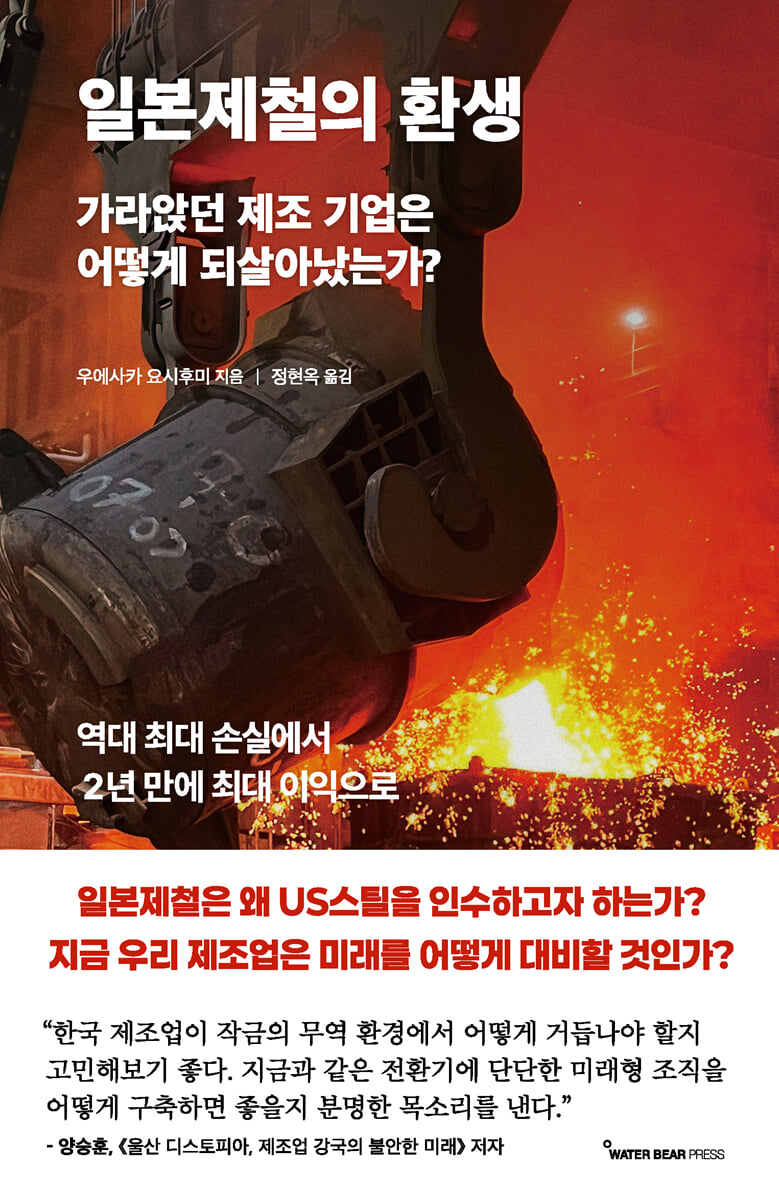
The reincarnation of Nippon Steel
 |
Description
Book Introduction
From record loss to record profit in two years
How did Nippon Steel, a manufacturing company on the verge of collapse, come back to life?
A Clue to Overcoming the Manufacturing Crisis and the Era of Global Supply Chain Restructuring
Nippon Steel, a representative Japanese steel company and manufacturing company.
Along with the crisis in the manufacturing industry as a whole, Nippon Steel's management situation also began to deteriorate rapidly from 2018 to 2019.
Can a manufacturing industry, with its large scale and extensive facilities, which makes it difficult to change, truly adapt to changing circumstances and overcome crises? Nippon Steel has done so.
And it did so while posting its highest ever profit less than two years after reporting its largest ever loss.
A veteran economic reporter specializing in the manufacturing industry meticulously covered Nippon Steel and vividly captured its splendid revival.
At the center, of course, is Eiji Hashimoto, who took office as president in 2019, and the book begins with his reforms and leadership.
But it doesn't stop there, and the efforts of many executives and staff are carefully introduced.
The message of this story is not limited to Japanese steel and steel companies.
If heavy Japanese steel can do it, then there is no reason why other manufacturers cannot.
So, this book also provides a clue to thinking about the direction to overcome the crisis in the manufacturing industry.
How did Nippon Steel, a manufacturing company on the verge of collapse, come back to life?
A Clue to Overcoming the Manufacturing Crisis and the Era of Global Supply Chain Restructuring
Nippon Steel, a representative Japanese steel company and manufacturing company.
Along with the crisis in the manufacturing industry as a whole, Nippon Steel's management situation also began to deteriorate rapidly from 2018 to 2019.
Can a manufacturing industry, with its large scale and extensive facilities, which makes it difficult to change, truly adapt to changing circumstances and overcome crises? Nippon Steel has done so.
And it did so while posting its highest ever profit less than two years after reporting its largest ever loss.
A veteran economic reporter specializing in the manufacturing industry meticulously covered Nippon Steel and vividly captured its splendid revival.
At the center, of course, is Eiji Hashimoto, who took office as president in 2019, and the book begins with his reforms and leadership.
But it doesn't stop there, and the efforts of many executives and staff are carefully introduced.
The message of this story is not limited to Japanese steel and steel companies.
If heavy Japanese steel can do it, then there is no reason why other manufacturers cannot.
So, this book also provides a clue to thinking about the direction to overcome the crisis in the manufacturing industry.
- You can preview some of the book's contents.
Preview
index
Recommendation
To begin with
prolog
【Column】 Japanese Steel at a Glance
1.
A meticulous and bold restructuring: Five blast furnaces will be reduced, and 32 lines will be shut down.
Departure from the swamp
Declaration of a V-shaped recovery within two years
The shock of the complete closure of the Kure district
Unusual appointments for reform
Beyond 'Black Friday'
2.
A life-threatening sales reform: No supply without higher prices.
Break out of your loser mentality
A frontal breakthrough with a straight line
Achieving a V-shaped recovery with two wheels
3.
The Art of Getting Things Done: Succeeding India's Largest M&A Ever
A once-in-a-lifetime opportunity that rolled in
The most urgent thing is speed, Ultra C input
Navigating the Muddy Litigation
Acquisition approval.
As the largest integrated steel mill overseas
4.
The Vision of Global 3.0: Seeing Opportunities in the Foundations of Other Countries' Industries
A new blast furnace in India
You can even join hands with your competitors
Moves to acquire US Steel
The obsession that led to exile
Towards a reversal of overseas and domestic production
【Column】 A Dancing Steel Mill Experience from India
5.
The Equation for Winning with Advanced Steel: Massive Investment in Domestic Steel Mills
Large-scale investment for qualitative transformation
How to Counter a Powerful Rival: Gigacast Technology
【Column】The Hidden Product: The Secret of High-Alloy Oil Tanks
6.
The Challenge of Carbon Neutrality: Fundamentally Transforming Steelmaking
Hydrogen instead of coke, tame the bucking horse
Searching for a test track far across the sea
So it's time to throw away the sign
The crisis of defeat in the green transition
7.
Building a Resilient Constitution: Tackling the Post-Reform Challenges
The Side Effects of Structural Reform: Resilience Strategies Put to the Test
Lack of experience resulting from reduced trouble
Goromen from all over the country gather to solve the problem.
8.
Building a Stable Supply Chain: Investing Hugely in Resource Development Companies
Secure high-quality raw materials for decarbonization.
Into the era of 30 to 70 fixed costs vs. variable costs
【Column】For a New Breeze
9.
Between Wildness and Reason: Who is Eiji Hashimoto?
A young man who asks the essence
Ask Hashimoto about the Asian market.
Portrait of an Unwavering Leader
Interview with Eiji Hashimoto, President of Nippon Steel
In conclusion
To begin with
prolog
【Column】 Japanese Steel at a Glance
1.
A meticulous and bold restructuring: Five blast furnaces will be reduced, and 32 lines will be shut down.
Departure from the swamp
Declaration of a V-shaped recovery within two years
The shock of the complete closure of the Kure district
Unusual appointments for reform
Beyond 'Black Friday'
2.
A life-threatening sales reform: No supply without higher prices.
Break out of your loser mentality
A frontal breakthrough with a straight line
Achieving a V-shaped recovery with two wheels
3.
The Art of Getting Things Done: Succeeding India's Largest M&A Ever
A once-in-a-lifetime opportunity that rolled in
The most urgent thing is speed, Ultra C input
Navigating the Muddy Litigation
Acquisition approval.
As the largest integrated steel mill overseas
4.
The Vision of Global 3.0: Seeing Opportunities in the Foundations of Other Countries' Industries
A new blast furnace in India
You can even join hands with your competitors
Moves to acquire US Steel
The obsession that led to exile
Towards a reversal of overseas and domestic production
【Column】 A Dancing Steel Mill Experience from India
5.
The Equation for Winning with Advanced Steel: Massive Investment in Domestic Steel Mills
Large-scale investment for qualitative transformation
How to Counter a Powerful Rival: Gigacast Technology
【Column】The Hidden Product: The Secret of High-Alloy Oil Tanks
6.
The Challenge of Carbon Neutrality: Fundamentally Transforming Steelmaking
Hydrogen instead of coke, tame the bucking horse
Searching for a test track far across the sea
So it's time to throw away the sign
The crisis of defeat in the green transition
7.
Building a Resilient Constitution: Tackling the Post-Reform Challenges
The Side Effects of Structural Reform: Resilience Strategies Put to the Test
Lack of experience resulting from reduced trouble
Goromen from all over the country gather to solve the problem.
8.
Building a Stable Supply Chain: Investing Hugely in Resource Development Companies
Secure high-quality raw materials for decarbonization.
Into the era of 30 to 70 fixed costs vs. variable costs
【Column】For a New Breeze
9.
Between Wildness and Reason: Who is Eiji Hashimoto?
A young man who asks the essence
Ask Hashimoto about the Asian market.
Portrait of an Unwavering Leader
Interview with Eiji Hashimoto, President of Nippon Steel
In conclusion
Detailed image

Publisher's Review
Can the manufacturing industry, in crisis, be revived?
In today's world, where the importance of cutting-edge technologies, including AI, is increasing, and the status of so-called "traditional manufacturing" or the "old economy" is declining, is it possible to revive manufacturing companies that have already entered a decline? Is it even meaningful? And if so, how should it be achieved? In Korea, where many people still depend on traditional manufacturing industries like steel and shipbuilding for their livelihoods, these are crucial and urgent questions.
This book shows how Nippon Steel, a leading Japanese steel company that faced such concerns before Korea, answered this question.
Why Nippon Steel? Nippon Steel, founded in 1901 as the Yawata Steel Works, merged with Fuji Steel, and then with Sumitomo Metal Industries in 2012, forming Japan's largest and best steel company.
However, the company has been mired in losses since 2018 and reported its largest loss ever in 2019, raising alarm bells for Japan's manufacturing industry.
If a company as dull and recalcitrant as the steel industry can be revived, isn't there hope for other manufacturing industries?
The author is a veteran economic journalist with a long-standing interest in Japan's manufacturing industry. He has been covering Nippon Steel and published this book since 2022.
Because “I saw hope.”
He says this:
“The story of Nippon Steel’s reincarnation dates back to 2019, when Eiji Hashimoto took office as president.
The company's mainstay, the Japanese domestic steel business, was plummeting into deficit and showing no signs of recovery.
It depicts the unknown struggles of President Hashimoto and his employees who overcame such adversity and achieved transformation.
Their story was an inspiring documentary that gave us the courage to bring about new change.”
What innovations are needed for manufacturing companies to grow?
Nippon Steel recorded a loss of approximately 430 billion yen (approximately 4.27 trillion won) from 2019 to March 2020.
It had already reported a large deficit the previous year, and in May 2020 it announced its worst-ever results.
However, in the March 2022 financial year ending two years after Eiji Hashimoto took office as chairman of Nippon Steel in 2019 and promoted reforms across various sectors, the company recorded a net profit of 640 billion yen (approximately 6.2 trillion won).
How on earth did Nippon Steel survive? Professor Yang Seung-hoon of Kyungnam University, who examined the reality of manufacturing and the future of South Korea, a country that has lost its growth engine, in his book "Ulsan Dystopia: The Unstable Future of a Manufacturing Powerhouse," recommends the book and summarizes it as follows:
“If you look closely, it contains everything that could be found in ‘management innovation classics’ published by the Harvard Business Review and others.
Considering future marketability and current efficiency, we reviewed business downsizing, relied on quality to recalibrate steel prices and settlement methods in negotiations with customers, and, considering mutual benefits, persuaded overseas partners to speed up the acquisition process.
By leveraging and investing in the right people for the right future, we have bridged the gap between our diverse workplaces and siloed organizations through mutual learning within existing production processes.
Through this process, Nippon Steel overcame three consecutive years of losses and used the profits recovered through restructuring and price increases to fund mergers and acquisitions of Indian shipyards and to transition to decarbonization.
All of these processes combined have led to a current situation where we can once again improve efficiency, foster a dynamic organizational culture, and explore technological innovation.
Although there was some organizational resistance, as expected during the process of restructuring and innovation, President Hashimoto, who held the helm of the giant ship, steadfastly resolved the issue by focusing on execution.
This book contains specific examples of successful restructuring and innovation in Japan's long-standing manufacturing industry.
“In today’s trade environment, this is a good place to think about how Korea’s manufacturing industry, which has become entrenched after 50 years of heavy and chemical industrialization, should be reborn.”
How should companies respond to the fluctuations and turmoil in the international economy?
This book contains specific steps on how manufacturing companies can survive through desirable management innovation.
But that's not the only thing to note about Nippon Steel.
In December 2023, Nippon Steel surprised not only Koreans but the entire world by announcing that it would acquire U.S. Steel for approximately $14.1 billion (approximately 20.6 trillion won).
Why would Nippon Steel, which already boasts the world's fourth-largest steel production, offer to acquire the third-largest U.S. steel company at a significant cost and on favorable terms (such as retaining all jobs)?
If you follow the author's detailed account of Nippon Steel's progress, you will come to understand the reason.
To understand Nippon Steel's attempt to acquire US Steel, we must first look at its previous acquisition of Essar Steel, which it had done in partnership with Europe's ArcelorMittal for 9.3634 trillion won.
It was a difficult acquisition that was successful, even though it overcame several legal difficulties.
Why did they take on an Indian steel company despite all the difficulties they faced?
The author's analysis is that this contained Nippon Steel's desperate vision to "transform itself into an insider and overcome the rough waves of protectionism."
"Global 3.0 is a form of vertical integration from the upper to lower processes, taking root overseas.
"AM/NS India is a great first step towards moving away from the existing international division of labor model based in Japan and not being obsessed with 'Made in Japan,'" he added.
“India’s current state of explosive industrial expansion overlaps with Japan’s past period of rapid growth.
In such a situation, Nippon Steel, which has the genes that contributed to Japan's rise as a steelmaker, is preparing to become a subcontractor for India's key industries.
“The Global 3.0 that Nippon Steel is currently designing may be a task of taking responsibility for creating a nation that is a global growth power.”
Ultimately, the various reforms, including the restructuring of the domestic steel business, were not simply a means of reviving the company; they were also a cornerstone for responding to the changing international market. The acquisition of US Steel should be understood as an extension of this.
So, through this book, we can ask ourselves:
What vision should our manufacturing companies establish and implement to meet the demands of today's times? The case of Nippon Steel may offer some insight into this question.
In today's world, where the importance of cutting-edge technologies, including AI, is increasing, and the status of so-called "traditional manufacturing" or the "old economy" is declining, is it possible to revive manufacturing companies that have already entered a decline? Is it even meaningful? And if so, how should it be achieved? In Korea, where many people still depend on traditional manufacturing industries like steel and shipbuilding for their livelihoods, these are crucial and urgent questions.
This book shows how Nippon Steel, a leading Japanese steel company that faced such concerns before Korea, answered this question.
Why Nippon Steel? Nippon Steel, founded in 1901 as the Yawata Steel Works, merged with Fuji Steel, and then with Sumitomo Metal Industries in 2012, forming Japan's largest and best steel company.
However, the company has been mired in losses since 2018 and reported its largest loss ever in 2019, raising alarm bells for Japan's manufacturing industry.
If a company as dull and recalcitrant as the steel industry can be revived, isn't there hope for other manufacturing industries?
The author is a veteran economic journalist with a long-standing interest in Japan's manufacturing industry. He has been covering Nippon Steel and published this book since 2022.
Because “I saw hope.”
He says this:
“The story of Nippon Steel’s reincarnation dates back to 2019, when Eiji Hashimoto took office as president.
The company's mainstay, the Japanese domestic steel business, was plummeting into deficit and showing no signs of recovery.
It depicts the unknown struggles of President Hashimoto and his employees who overcame such adversity and achieved transformation.
Their story was an inspiring documentary that gave us the courage to bring about new change.”
What innovations are needed for manufacturing companies to grow?
Nippon Steel recorded a loss of approximately 430 billion yen (approximately 4.27 trillion won) from 2019 to March 2020.
It had already reported a large deficit the previous year, and in May 2020 it announced its worst-ever results.
However, in the March 2022 financial year ending two years after Eiji Hashimoto took office as chairman of Nippon Steel in 2019 and promoted reforms across various sectors, the company recorded a net profit of 640 billion yen (approximately 6.2 trillion won).
How on earth did Nippon Steel survive? Professor Yang Seung-hoon of Kyungnam University, who examined the reality of manufacturing and the future of South Korea, a country that has lost its growth engine, in his book "Ulsan Dystopia: The Unstable Future of a Manufacturing Powerhouse," recommends the book and summarizes it as follows:
“If you look closely, it contains everything that could be found in ‘management innovation classics’ published by the Harvard Business Review and others.
Considering future marketability and current efficiency, we reviewed business downsizing, relied on quality to recalibrate steel prices and settlement methods in negotiations with customers, and, considering mutual benefits, persuaded overseas partners to speed up the acquisition process.
By leveraging and investing in the right people for the right future, we have bridged the gap between our diverse workplaces and siloed organizations through mutual learning within existing production processes.
Through this process, Nippon Steel overcame three consecutive years of losses and used the profits recovered through restructuring and price increases to fund mergers and acquisitions of Indian shipyards and to transition to decarbonization.
All of these processes combined have led to a current situation where we can once again improve efficiency, foster a dynamic organizational culture, and explore technological innovation.
Although there was some organizational resistance, as expected during the process of restructuring and innovation, President Hashimoto, who held the helm of the giant ship, steadfastly resolved the issue by focusing on execution.
This book contains specific examples of successful restructuring and innovation in Japan's long-standing manufacturing industry.
“In today’s trade environment, this is a good place to think about how Korea’s manufacturing industry, which has become entrenched after 50 years of heavy and chemical industrialization, should be reborn.”
How should companies respond to the fluctuations and turmoil in the international economy?
This book contains specific steps on how manufacturing companies can survive through desirable management innovation.
But that's not the only thing to note about Nippon Steel.
In December 2023, Nippon Steel surprised not only Koreans but the entire world by announcing that it would acquire U.S. Steel for approximately $14.1 billion (approximately 20.6 trillion won).
Why would Nippon Steel, which already boasts the world's fourth-largest steel production, offer to acquire the third-largest U.S. steel company at a significant cost and on favorable terms (such as retaining all jobs)?
If you follow the author's detailed account of Nippon Steel's progress, you will come to understand the reason.
To understand Nippon Steel's attempt to acquire US Steel, we must first look at its previous acquisition of Essar Steel, which it had done in partnership with Europe's ArcelorMittal for 9.3634 trillion won.
It was a difficult acquisition that was successful, even though it overcame several legal difficulties.
Why did they take on an Indian steel company despite all the difficulties they faced?
The author's analysis is that this contained Nippon Steel's desperate vision to "transform itself into an insider and overcome the rough waves of protectionism."
"Global 3.0 is a form of vertical integration from the upper to lower processes, taking root overseas.
"AM/NS India is a great first step towards moving away from the existing international division of labor model based in Japan and not being obsessed with 'Made in Japan,'" he added.
“India’s current state of explosive industrial expansion overlaps with Japan’s past period of rapid growth.
In such a situation, Nippon Steel, which has the genes that contributed to Japan's rise as a steelmaker, is preparing to become a subcontractor for India's key industries.
“The Global 3.0 that Nippon Steel is currently designing may be a task of taking responsibility for creating a nation that is a global growth power.”
Ultimately, the various reforms, including the restructuring of the domestic steel business, were not simply a means of reviving the company; they were also a cornerstone for responding to the changing international market. The acquisition of US Steel should be understood as an extension of this.
So, through this book, we can ask ourselves:
What vision should our manufacturing companies establish and implement to meet the demands of today's times? The case of Nippon Steel may offer some insight into this question.
GOODS SPECIFICS
- Date of issue: April 28, 2025
- Page count, weight, size: 276 pages | 130*200*20mm
- ISBN13: 9791191484335
- ISBN10: 1191484335
You may also like
카테고리
korean


korean

![GQ KOREA Mark (Monthly): December [2025]](http://librairie.coreenne.fr/cdn/shop/files/8ef265dbbfbf186523ed75ba7319009d.jpg?v=1765340328&width=3840)


