

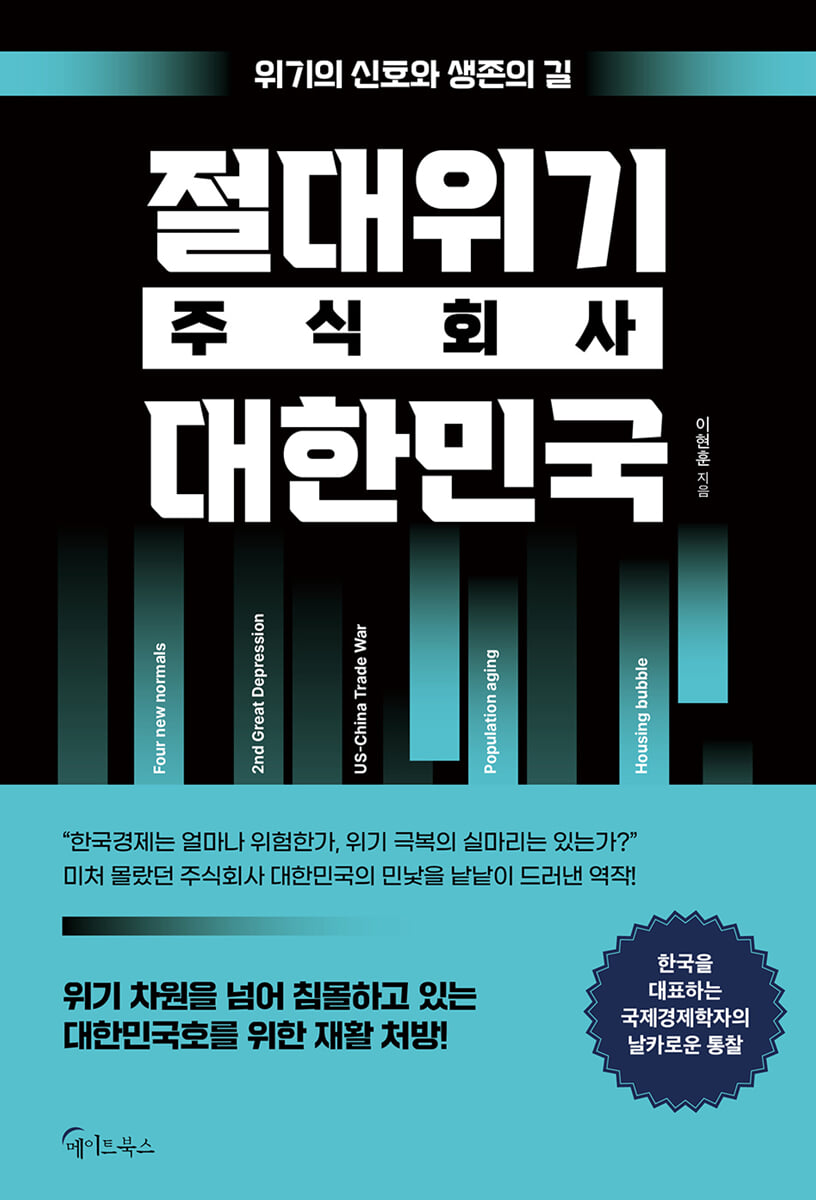
Absolute Crisis Co., Ltd. Korea
 |
Description
Book Introduction
sinking
Rehabilitation prescription for the Republic of Korea!
The Korean economy is moving beyond "Peak Korea," which appears to indicate that Korea's growth has reached its peak, and is on the path of Japan's "Lost 30 Years."
Once a country that enjoyed rapid growth and garnered worldwide attention, it is now facing stagnation and a serious crisis.
As the world faces the most rapid pace of change in history, we enter the era of Trump 2.0, and the tariff war that led to the Great Depression a century ago is starting again.
The biggest problem here is that the Korean economy is not resilient enough to withstand this worst-case scenario of the global economy.
In this situation, what should we prepare and how should we prepare to survive?
The author, who has been active in various fields and written books as an international economist, wrote this book to publicize the fact that the Korean economy is currently in a dire situation and to suggest ways to revive the economy.
To prepare for the future, it is important to examine the complexly intertwined state of the Korean economy from various angles, verify objective figures, and understand our current position from a macro perspective.
This is because only then can we know the direction we should take as the global economy is shaken by new policies emerging in the Trump 2.0 era.
The author notes that the world is facing a massive transformation due to what he calls the "four new normals": the digital revolution, an aging population, social polarization, and the climate crisis.
Based on these factors, we examine the causes of the world's catastrophe.
It also dissects the structural problems of the Korean economy.
South Korea is facing a crisis due to a rapidly aging population, soaring housing prices and household debt, and a falling GDP growth rate.
The author explores why these problems are not improving but rather worsening, and proposes revolutionary measures that go beyond reform to revitalize Korea's economy.
We introduce policies that will be helpful to our country by citing overseas examples and suggest improvements in various areas that fit our reality.
The author says that in difficult times, we must return to the basics.
It is time for Korea to overcome its fear of change and leap forward into the future.
If you want to understand the current state of the Korean economy and find solutions, this book will provide you with answers.
Rehabilitation prescription for the Republic of Korea!
The Korean economy is moving beyond "Peak Korea," which appears to indicate that Korea's growth has reached its peak, and is on the path of Japan's "Lost 30 Years."
Once a country that enjoyed rapid growth and garnered worldwide attention, it is now facing stagnation and a serious crisis.
As the world faces the most rapid pace of change in history, we enter the era of Trump 2.0, and the tariff war that led to the Great Depression a century ago is starting again.
The biggest problem here is that the Korean economy is not resilient enough to withstand this worst-case scenario of the global economy.
In this situation, what should we prepare and how should we prepare to survive?
The author, who has been active in various fields and written books as an international economist, wrote this book to publicize the fact that the Korean economy is currently in a dire situation and to suggest ways to revive the economy.
To prepare for the future, it is important to examine the complexly intertwined state of the Korean economy from various angles, verify objective figures, and understand our current position from a macro perspective.
This is because only then can we know the direction we should take as the global economy is shaken by new policies emerging in the Trump 2.0 era.
The author notes that the world is facing a massive transformation due to what he calls the "four new normals": the digital revolution, an aging population, social polarization, and the climate crisis.
Based on these factors, we examine the causes of the world's catastrophe.
It also dissects the structural problems of the Korean economy.
South Korea is facing a crisis due to a rapidly aging population, soaring housing prices and household debt, and a falling GDP growth rate.
The author explores why these problems are not improving but rather worsening, and proposes revolutionary measures that go beyond reform to revitalize Korea's economy.
We introduce policies that will be helpful to our country by citing overseas examples and suggest improvements in various areas that fit our reality.
The author says that in difficult times, we must return to the basics.
It is time for Korea to overcome its fear of change and leap forward into the future.
If you want to understand the current state of the Korean economy and find solutions, this book will provide you with answers.
- You can preview some of the book's contents.
Preview
index
Entering_Let's make the crumbling Republic of Korea great again!
PART 1: Sapiens Facing Four New Normals
Chapter 1: The First New Normal: Digital Society
01 The Three Great Revolutions of Sapiens
02 Digital Immigrant Hyper-Connected Network
03 Cohabitation with Artificial Intelligence (AI) and Robots Begins
04 Semiconductor hegemony is global hegemony
05 The Popularization of Cryptocurrency as a Digital Gold Rush
Chapter 2: The Second New Normal: Aging Society
01 Rapid increase in human lifespan since the Industrial Revolution
02 The rapidly declining birth rate around the world
03 An aging society created by increasing life expectancy and declining birth rates
04 A human who became a god by creating AI
Chapter 3: The Third New Normal: A Polarized Society
01 Inequality in Agricultural and Industrial Societies
02 Polarization in the Digital Society
03 Polarization in an aging society
04 Political polarization that fosters conflict and confrontation
Chapter 4: The Fourth New Normal: The Climate Crisis
01 From the Holocene to the Anthropocene! The Sixth Mass Extinction Crisis
02 The climate crisis is never just
03 The core of the climate crisis is energy transition
04 The climate crisis is a food crisis
Chapter 5: Four New Normals, Four Swans
01 Digital Swan: A Blessing, But Could Also Be a Disaster
02 White Swan: When to Worry About Population Onus
03 Black Swan: The Deepening of Social Polarization
04 Green Swan: The Climate Crisis Directly Linked to Survival
PART 2: The Return of the Specter of the 'Great Depression'
Chapter 1: Make America Great Again
01 The Truth About American Hegemony We Never Knew
02 The core of American hegemony is dollar hegemony
Trump's Gamble to Protect the Dollar Hegemony
04 The Achilles' heel of the absolute powerhouse, the United States
Chapter 2: The Accelerating Japanization of the Chinese Economy
01 The US-China Hegemony Competition Driven by the Chinese Dream
02 The semiconductor war is at the heart of the US-China hegemony competition.
03 Why China Can't Beat the United States
04 Characteristics of Japan's 'Lost 30 Years'
05 The inevitable Japanization of the Chinese economy
Chapter 3: The Specter of the 'Great Depression' Conjured by Trump
01 Trump's tariff war and the return of mercantilism
02 A global trade war that could lead to an economic downturn
03 Scenario of a US-originated global depression in the Trump 2.0 era
04 The precarious Republic of Korea in the swirling waves
PART 3: South Korea Struggling with Diabetic Complications
Chapter 1: A Hopeless Population Society
01 Acute progeria, Korea Stock Company
02 The disaster of asymmetric population extinction becomes a reality.
03 Negative growth brought about by population onus
04 Serious social polarization brought about by aging population
Chapter 2: The Disaster That Will Befall a House Built on Debt
01 Seoul's most expensive housing prices in the world
02 The government's real estate policy has become poisonous.
03 Real estate policies that encourage people to borrow money to buy houses
04 Korea's household debt is the most dangerous in the world.
05 The serious aftereffects of a house built on debt
Chapter 3: Analog Education in a Digital Society
01 A college diploma that just has more numbers
02 Analog education solely for college entrance
03 The shabby status of Korea's prestigious universities
04 The Rush of Digital Talents Leaving Korea
PART 4: Emergency Prescription for the Republic of Korea
Chapter 1: Creating a Country Where People Want to Give Birth
01 Let's merge the Ministry of Gender Equality and Family and establish a new Ministry of Population and Family.
02 Provide stable jobs to young people.
03 Provide stable housing for young people and newlyweds.
04 Let's build a socially responsible childcare system.
05 Make work-life balance essential
Chapter 2: Creating a Nation Where Home is the Foundation of Life
01 The real estate market must stabilize downward.
02 The government should not intervene in the supply and demand of housing prices.
03 The property tax should be raised and the transaction tax should be lowered.
04 Singapore's Real Estate Policies We Must Learn
Chapter 3: Beyond Education Reform, We Need an Education Revolution
01 Six Principles of Educational Revolution in the Digital Age
02 Introduction of a penalty for repeaters of the College Scholastic Ability Test
03 National universities are operated in an integrated manner, while private universities are operated with complete autonomy.
04 A society where academic background and medical school do not guarantee a stable future
Let's go out and be willing to endure the tremendous determination, effort, and pain!
Americas
PART 1: Sapiens Facing Four New Normals
Chapter 1: The First New Normal: Digital Society
01 The Three Great Revolutions of Sapiens
02 Digital Immigrant Hyper-Connected Network
03 Cohabitation with Artificial Intelligence (AI) and Robots Begins
04 Semiconductor hegemony is global hegemony
05 The Popularization of Cryptocurrency as a Digital Gold Rush
Chapter 2: The Second New Normal: Aging Society
01 Rapid increase in human lifespan since the Industrial Revolution
02 The rapidly declining birth rate around the world
03 An aging society created by increasing life expectancy and declining birth rates
04 A human who became a god by creating AI
Chapter 3: The Third New Normal: A Polarized Society
01 Inequality in Agricultural and Industrial Societies
02 Polarization in the Digital Society
03 Polarization in an aging society
04 Political polarization that fosters conflict and confrontation
Chapter 4: The Fourth New Normal: The Climate Crisis
01 From the Holocene to the Anthropocene! The Sixth Mass Extinction Crisis
02 The climate crisis is never just
03 The core of the climate crisis is energy transition
04 The climate crisis is a food crisis
Chapter 5: Four New Normals, Four Swans
01 Digital Swan: A Blessing, But Could Also Be a Disaster
02 White Swan: When to Worry About Population Onus
03 Black Swan: The Deepening of Social Polarization
04 Green Swan: The Climate Crisis Directly Linked to Survival
PART 2: The Return of the Specter of the 'Great Depression'
Chapter 1: Make America Great Again
01 The Truth About American Hegemony We Never Knew
02 The core of American hegemony is dollar hegemony
Trump's Gamble to Protect the Dollar Hegemony
04 The Achilles' heel of the absolute powerhouse, the United States
Chapter 2: The Accelerating Japanization of the Chinese Economy
01 The US-China Hegemony Competition Driven by the Chinese Dream
02 The semiconductor war is at the heart of the US-China hegemony competition.
03 Why China Can't Beat the United States
04 Characteristics of Japan's 'Lost 30 Years'
05 The inevitable Japanization of the Chinese economy
Chapter 3: The Specter of the 'Great Depression' Conjured by Trump
01 Trump's tariff war and the return of mercantilism
02 A global trade war that could lead to an economic downturn
03 Scenario of a US-originated global depression in the Trump 2.0 era
04 The precarious Republic of Korea in the swirling waves
PART 3: South Korea Struggling with Diabetic Complications
Chapter 1: A Hopeless Population Society
01 Acute progeria, Korea Stock Company
02 The disaster of asymmetric population extinction becomes a reality.
03 Negative growth brought about by population onus
04 Serious social polarization brought about by aging population
Chapter 2: The Disaster That Will Befall a House Built on Debt
01 Seoul's most expensive housing prices in the world
02 The government's real estate policy has become poisonous.
03 Real estate policies that encourage people to borrow money to buy houses
04 Korea's household debt is the most dangerous in the world.
05 The serious aftereffects of a house built on debt
Chapter 3: Analog Education in a Digital Society
01 A college diploma that just has more numbers
02 Analog education solely for college entrance
03 The shabby status of Korea's prestigious universities
04 The Rush of Digital Talents Leaving Korea
PART 4: Emergency Prescription for the Republic of Korea
Chapter 1: Creating a Country Where People Want to Give Birth
01 Let's merge the Ministry of Gender Equality and Family and establish a new Ministry of Population and Family.
02 Provide stable jobs to young people.
03 Provide stable housing for young people and newlyweds.
04 Let's build a socially responsible childcare system.
05 Make work-life balance essential
Chapter 2: Creating a Nation Where Home is the Foundation of Life
01 The real estate market must stabilize downward.
02 The government should not intervene in the supply and demand of housing prices.
03 The property tax should be raised and the transaction tax should be lowered.
04 Singapore's Real Estate Policies We Must Learn
Chapter 3: Beyond Education Reform, We Need an Education Revolution
01 Six Principles of Educational Revolution in the Digital Age
02 Introduction of a penalty for repeaters of the College Scholastic Ability Test
03 National universities are operated in an integrated manner, while private universities are operated with complete autonomy.
04 A society where academic background and medical school do not guarantee a stable future
Let's go out and be willing to endure the tremendous determination, effort, and pain!
Americas
Detailed image

Into the book
As the digital revolution progresses, many companies are utilizing AI-robots in production and distribution.
Robots are now spreading not only to industry but also to the service sector.
Artificial intelligence is surpassing human intellectual capacity. As AI-robots replace both physical and mental labor, the importance of human labor will inevitably decline. The dividends of capitalists, the owners of AI-robots, will increase, while the relative income of workers will decrease.
Artificial intelligence will combine with robots to replace human labor in more and more fields.
Jobs like simple assembly are now something that humans will have to hand over to robots.
Instead, humans must do the high-tech work of building and controlling robots.
Those who fail to adapt to this new environment will be defeated at the end of the change.
Right now, AI robots are assisting humans, but eventually, humans will assist AI robots, and eventually, we may not even be able to assist AI robots.
Emerging countries also need to worry about losing jobs to AI and robots.
Because advanced countries can produce at lower costs while minimizing the employment of workers through digital technology, advanced companies that were in emerging countries will return to their home countries.
Then, workers in emerging countries will also lose their jobs.
--- From "PART 1: Sapiens Facing Four New Normals"
An increase in the number of elderly people in the total population means that the younger population has more people to support.
However, the young population is relatively decreasing.
Ultimately, as the number of elderly people that each young person must support continues to increase, the conflict between generations is intensifying over the question of 'how much the young population should bear the cost of social security such as pension insurance, and how much the elderly population should receive in benefits.'
Ultimately, in a society where human life expectancy increases and birth rates decrease, resulting in a significant increase in the proportion of the elderly in the total population, polarization among the elderly, as well as between the elderly and the younger population, that is, between generations, is bound to become a serious problem.
Long life may not be a blessing for individuals, and it may even be a disaster for society.
--- From "PART 1: Sapiens Facing Four New Normals"
The older generation has enjoyed material abundance and improved living standards through industrialization and economic development, but future generations will have to bear the cost of environmental destruction and the climate crisis that resulted from this process.
Especially as extreme weather events increase due to global warming, future generations are likely to have to live in even harsher environments.
Problems such as land flooding due to rising sea levels, frequent extreme weather events, ecosystem destruction, and food shortages pose serious threats to the survival and quality of life of future generations.
Moreover, policies and regulations aimed at addressing the climate crisis will become more stringent over time, potentially placing an economic burden and restrictions on the lives of younger generations.
For example, if energy use is restricted and carbon taxes and environmental regulations are strengthened to achieve carbon neutrality goals, it is likely that higher costs will be incurred than at present.
On the other hand, since the older generation enjoyed economic benefits before these policies were fully implemented, the issue of intergenerational equity inevitably arises.
--- From "PART 1: Sapiens Facing Four New Normals"
One of the most common misconceptions about America is that it is in decline.
The United States, once the world's sole G1 hegemon, has been pushed out by China and has become a G2, and will soon be challenged by emerging countries such as India.
In terms of purchasing power parity (PPP), the United States' share of the global economy has declined from 21% in 1990 to 16% in 2024. The decline in the United States' share of global GDP in PPP terms is due to the rapid growth of China and India, which have the largest populations and lower income and price levels.
However, in terms of market exchange rates, the U.S. economy's share of the global economy was 25% in the 1990s and will remain at 25% in 2024.
It fell to 21% in 2011 after the global financial crisis of 2008-2009, but has since risen again to around 25%.
In other words, the U.S. economy appeared to be in decline for a while after the global financial crisis, but it is now recovering.
China, which is challenging American hegemony, has a GDP of 18% of global GDP, still far behind the United States' 25%.
--- From "PART 2: The Return of the Ghost Called the 'Great Depression'"
For Trump, fair trade means only when exports and imports are equal.
The United States will not unilaterally run a trade deficit.
This would prevent the US dollar from being supplied to the world, and countries around the world would be unable to continue using the dollar as a currency for international transactions, as its value would skyrocket compared to their own currencies.
Ultimately, the goal of reducing the trade deficit through tariff increases in the Trump 2.0 era will inevitably conflict with the widening fiscal deficit resulting from lower corporate and income taxes.
In order to reduce the trade deficit, the fiscal deficit must also be reduced.
The Department of Government Effectiveness (DOGE), co-chaired by Elon Musk, is pledging to drastically reduce government spending, but most research institutes predict that the budget deficit will increase.
Moreover, if the trade deficit is reduced by raising tariffs, the supply of dollars in the international financial market will become insufficient, which will raise the dollar price, and many countries feeling the burden will try to find payment methods other than the dollar.
The alternative payment method at this time could be the euro or the Chinese yuan, but it is more likely to be Bitcoin.
--- From "PART 2: The Return of the Ghost Called the 'Great Depression'"
The hegemonic rivalry between the US and China, which possess the world's most powerful nuclear weapons, is also likely to become a proxy war through neighboring countries.
For example, a proxy war between hegemonic powers could break out again on the Korean Peninsula.
If North Korea carries out a military provocation, there is a possibility of indirect conflict as the United States and China support South Korea and North Korea, respectively.
Moreover, the possibility of armed conflict in Taiwan increases the likelihood that the conflict between the US and China will be expressed in the form of a proxy war.
In other words, if China invades Taiwan, the United States will engage in an indirect war with China by providing weapons and financial support, even if it does not directly participate in the war.
China's claims to sovereignty over the South China Sea are causing conflict with neighboring countries such as the Philippines, Vietnam, and Malaysia.
The United States is using freedom of navigation operations to check China in the South China Sea and support regional allies, which is also a proxy war in the US-China hegemony competition.
--- From "PART 2: The Return of the Ghost Called the 'Great Depression'"
President Trump is a revival of Reagan, now even more powerful.
Trump not only rebranded Reagan's MAGA, he further solidified it.
Trump is angry that globalism and free trade are causing the decline of American manufacturing and the suffering of the middle class.
Above all, they are angry that their trading partners are selling their goods to the U.S. market without limit, while they themselves are not buying American products.
This is why Trump is waging a tariff war.
Trump believes that trade is fair only when it is balanced.
In an interview with Time magazine during the campaign, Trump mentioned a conversation he had with German Chancellor Merkel during the Trump 1.0 era.
When Trump asked Chancellor Merkel, “How many Chevrolets are there in Berlin, Germany?” she replied, “None.”
Then Trump said, “That’s it.
He asked, “Is it fair that only we import a lot of German cars?”
Merkel then said, “It doesn’t seem fair.
But he replied, “No one has ever raised an issue about that.”
At the time, Trump said, "The European Union is not buying anything from the United States, including agricultural products and automobiles. It's like a one-way street and it's very cruel to the United States."
Trump 2.0's foreign and trade policy is 'America First,' which follows Trump 1.0.
For Trump, the criteria for an ally are not ideology or alliance, but only economic interests.
--- From "PART 2: The Return of the Ghost Called the 'Great Depression'"
The Korean economy has been greatly influenced by the global economic situation.
It was particularly greatly influenced by the economic situation in the United States.
There is even a saying that goes, “When America coughs, Korea catches the flu.”
Korea has experienced four economic crises since the 1970s.
In 1980, it recorded a minus 1.6% growth, in 1997, it recorded a minus 5.1% growth due to the foreign exchange crisis, and in 2008, it recorded a 0.8% growth due to the global financial crisis.
The fourth and final one is the minus 0.7% growth in 2020 due to the COVID-19 pandemic.
Except for 2020, all of them were related to the Fed's interest rate hikes.
--- From "PART 2: The Return of the Ghost Called the 'Great Depression'"
It is expected that by 2025, Korea will enter a super-aged society, with the proportion of the population aged 65 or older exceeding 20%.
In just seven years, we have moved from an aging society to a super-aged society.
This is also a world record.
Korea broke Japan's previous record of becoming a super-aged society in 2005, 11 years after entering an aging society in 1994.
The fundamental cause of population aging is the increase in life expectancy and the decline in birth rates.
However, since the increase in life expectancy occurs very slowly, the main cause of population aging is the rapid decline in the birth rate.
Even in 1970, when Statistics Korea began to survey birth rates, the total fertility rate (the average number of children a woman is expected to have during her childbearing years, aged 15 to 49) was 4.53, similar to the global average of 4.8, and 1.01 million children were born.
--- From "PART 3: South Korea Struggling with Diabetic Complications"
Many economists say that it is natural for economic growth to stagnate once a country becomes a developed country.
This refers to Japan and European countries.
However, despite being a superpower accounting for 25% of global GDP and a highly developed country with a per capita GDP of over $80,000, the United States has averaged an annual GDP growth rate of 2.5% since the 1970s.
The Bank of Korea projects that Korea's potential GDP growth rate will hit 0% in the mid-2030s and enter negative territory in the mid-2040s due to the aging population.
The fundamental way to avoid this demographic disaster is to increase the total fertility rate.
Even if we cannot raise it to 2.1, we must slow down the rate of population aging by raising it to at least the OECD level of 1.5.
To achieve this, we must comprehensively address issues such as job instability, housing instability, excessive private education, astronomical childcare costs, and the difficulty of balancing work and family life.
Another way to avoid a demographic catastrophe is to improve the quality of human resources faster than the rate of population aging.
To achieve this, we must go beyond reforming Korea's education system and transform it into a revolution.
--- From "PART 3: South Korea Struggling with Diabetic Complications"
The Bank of Korea announced research results showing that if the household debt-to-GDP ratio exceeds 80%, the growth rate declines and the likelihood of an economic recession within one to three years increases.
Bank of Korea Governor Lee Chang-yong has repeatedly stated that excessive household debt makes it difficult to lower interest rates, based on this research.
Furthermore, the governor has repeatedly argued that the government and politicians must face the fact that the policies of drastically easing real estate regulations to stimulate the economy in the short term are no longer effective, and that "it is time to break that cycle once and for all." As explained in Part 2, China has been implementing policies to intentionally burst its real estate bubble since the second half of 2021.
This is ensuring that investment resources are focused on high-tech businesses rather than real estate.
Because of this, construction investment and consumer demand have shrunk significantly in the short term, but in the medium to long term, restructuring is underway toward high-quality production and new quality production through 'new quality production capacity.'
However, it is truly worrying and regrettable that the government has further exacerbated the real estate bubble, which was expected to burst naturally in the second half of 2022, with its policy of encouraging people to "buy houses with debt."
--- From "PART 3: South Korea Struggling with Diabetic Complications"
In Korea, there is a strong perception that 'which university one enters determines a student's future and social success.'
That's why many parents put in a lot of effort to help their children get into prestigious universities.
They are influenced by the private education investments of other parents and are worried that their children will fall behind, so they compete to force more private education.
As a result, private education costs account for a large portion of household expenditures and are increasing every year.
Parents make great financial and psychological sacrifices for their children's education, and often feel both pride and guilt depending on their children's success.
This leads to social inequality between families that can afford private education and those that cannot.
Moreover, certain areas, such as Gangnam District 8, further exacerbate the educational gap between regions due to their excellent private education facilities and high entrance exam success rates.
An even bigger problem is that the current entrance exam-centered education system does not foster students' creativity, but rather stifles it.
College entrance exams are mainly evaluated based on the CSAT and school grades.
This forces students to focus on solving problems and finding the correct answers, forcing them to focus on memorization.
As a result, students focus on learning the skills of guessing the right answer rather than developing creative thinking.
--- From "PART 3: South Korea Struggling with Diabetic Complications"
Germany, where the total fertility rate exceeds 1.5, provides a child allowance (Kindergeld) of 250 euros (approximately 380,000 won) per month from birth until the age of 18. If the child is still looking for work, attending university, or undergoing vocational training after the age of 18, the payment is made until the age of 25.
Sweden, where the total fertility rate exceeds 1.6, provides a child allowance of 1,250 kronor (approximately 160,000 won) per month from birth until the age of 16.
Our country, whose situation is much worse than these countries, must be even bolder.
Some critics argue that providing monthly cash assistance would lead young couples to use it to pay off their mortgages, ultimately driving up home prices.
Some also criticize that this money will flow into the private education market, further exacerbating overheated competition.
Therefore, the youth allowance must be paid in the form of a voucher with a designated purpose.
--- From "PART 4 Emergency Prescription for the Republic of Korea"
When explaining why housing prices are high in Korea, the one thing that is always mentioned is that “there are too many people living there compared to the land area.”
In other words, because the population density is high, there is not enough land to build houses on, and the number of people that need to be accommodated is too high, so house prices are bound to be high.
South Korea's population density is 516 people per km2, ranking 25th in the world.
Macau is in first place, Monaco in second place, and Singapore in third place.
Singapore's population density is 8,250 people per km2, 16 times higher than that of South Korea.
However, according to Numbio, as of mid-2024, Singapore's apartment price-to-income ratio will be 18.7, which is 72% of Seoul's 25.8.
By the way, this is the average price for all apartments, and the prices of public apartments, where 80% of Singapore's population lives, are much lower.
--- From "PART 4 Emergency Prescription for the Republic of Korea"
In the digital society, traditional occupations are rapidly changing due to technological advancements and changes in economic structure.
In emerging fields like artificial intelligence (AI), data analysis, and creative content creation, individual technical skills, problem-solving abilities, and creativity are more important than university recognition.
In a digital society, we need the ability to analyze complex problems and solve them creatively.
It also requires the ability to continuously learn new skills and knowledge and the ability to collaborate with people from diverse cultures and backgrounds.
The mindset centered on prestigious universities is not only out of step with the times, but is also an inefficient structure that suppresses the potential of individuals and society.
In a digital society, individual capabilities, creativity, and a willingness to continuously learn are more important assets than academic background.
Therefore, Korean society must move beyond its academic background-centric mindset and establish new standards of success that respect diversity and individual value.
Robots are now spreading not only to industry but also to the service sector.
Artificial intelligence is surpassing human intellectual capacity. As AI-robots replace both physical and mental labor, the importance of human labor will inevitably decline. The dividends of capitalists, the owners of AI-robots, will increase, while the relative income of workers will decrease.
Artificial intelligence will combine with robots to replace human labor in more and more fields.
Jobs like simple assembly are now something that humans will have to hand over to robots.
Instead, humans must do the high-tech work of building and controlling robots.
Those who fail to adapt to this new environment will be defeated at the end of the change.
Right now, AI robots are assisting humans, but eventually, humans will assist AI robots, and eventually, we may not even be able to assist AI robots.
Emerging countries also need to worry about losing jobs to AI and robots.
Because advanced countries can produce at lower costs while minimizing the employment of workers through digital technology, advanced companies that were in emerging countries will return to their home countries.
Then, workers in emerging countries will also lose their jobs.
--- From "PART 1: Sapiens Facing Four New Normals"
An increase in the number of elderly people in the total population means that the younger population has more people to support.
However, the young population is relatively decreasing.
Ultimately, as the number of elderly people that each young person must support continues to increase, the conflict between generations is intensifying over the question of 'how much the young population should bear the cost of social security such as pension insurance, and how much the elderly population should receive in benefits.'
Ultimately, in a society where human life expectancy increases and birth rates decrease, resulting in a significant increase in the proportion of the elderly in the total population, polarization among the elderly, as well as between the elderly and the younger population, that is, between generations, is bound to become a serious problem.
Long life may not be a blessing for individuals, and it may even be a disaster for society.
--- From "PART 1: Sapiens Facing Four New Normals"
The older generation has enjoyed material abundance and improved living standards through industrialization and economic development, but future generations will have to bear the cost of environmental destruction and the climate crisis that resulted from this process.
Especially as extreme weather events increase due to global warming, future generations are likely to have to live in even harsher environments.
Problems such as land flooding due to rising sea levels, frequent extreme weather events, ecosystem destruction, and food shortages pose serious threats to the survival and quality of life of future generations.
Moreover, policies and regulations aimed at addressing the climate crisis will become more stringent over time, potentially placing an economic burden and restrictions on the lives of younger generations.
For example, if energy use is restricted and carbon taxes and environmental regulations are strengthened to achieve carbon neutrality goals, it is likely that higher costs will be incurred than at present.
On the other hand, since the older generation enjoyed economic benefits before these policies were fully implemented, the issue of intergenerational equity inevitably arises.
--- From "PART 1: Sapiens Facing Four New Normals"
One of the most common misconceptions about America is that it is in decline.
The United States, once the world's sole G1 hegemon, has been pushed out by China and has become a G2, and will soon be challenged by emerging countries such as India.
In terms of purchasing power parity (PPP), the United States' share of the global economy has declined from 21% in 1990 to 16% in 2024. The decline in the United States' share of global GDP in PPP terms is due to the rapid growth of China and India, which have the largest populations and lower income and price levels.
However, in terms of market exchange rates, the U.S. economy's share of the global economy was 25% in the 1990s and will remain at 25% in 2024.
It fell to 21% in 2011 after the global financial crisis of 2008-2009, but has since risen again to around 25%.
In other words, the U.S. economy appeared to be in decline for a while after the global financial crisis, but it is now recovering.
China, which is challenging American hegemony, has a GDP of 18% of global GDP, still far behind the United States' 25%.
--- From "PART 2: The Return of the Ghost Called the 'Great Depression'"
For Trump, fair trade means only when exports and imports are equal.
The United States will not unilaterally run a trade deficit.
This would prevent the US dollar from being supplied to the world, and countries around the world would be unable to continue using the dollar as a currency for international transactions, as its value would skyrocket compared to their own currencies.
Ultimately, the goal of reducing the trade deficit through tariff increases in the Trump 2.0 era will inevitably conflict with the widening fiscal deficit resulting from lower corporate and income taxes.
In order to reduce the trade deficit, the fiscal deficit must also be reduced.
The Department of Government Effectiveness (DOGE), co-chaired by Elon Musk, is pledging to drastically reduce government spending, but most research institutes predict that the budget deficit will increase.
Moreover, if the trade deficit is reduced by raising tariffs, the supply of dollars in the international financial market will become insufficient, which will raise the dollar price, and many countries feeling the burden will try to find payment methods other than the dollar.
The alternative payment method at this time could be the euro or the Chinese yuan, but it is more likely to be Bitcoin.
--- From "PART 2: The Return of the Ghost Called the 'Great Depression'"
The hegemonic rivalry between the US and China, which possess the world's most powerful nuclear weapons, is also likely to become a proxy war through neighboring countries.
For example, a proxy war between hegemonic powers could break out again on the Korean Peninsula.
If North Korea carries out a military provocation, there is a possibility of indirect conflict as the United States and China support South Korea and North Korea, respectively.
Moreover, the possibility of armed conflict in Taiwan increases the likelihood that the conflict between the US and China will be expressed in the form of a proxy war.
In other words, if China invades Taiwan, the United States will engage in an indirect war with China by providing weapons and financial support, even if it does not directly participate in the war.
China's claims to sovereignty over the South China Sea are causing conflict with neighboring countries such as the Philippines, Vietnam, and Malaysia.
The United States is using freedom of navigation operations to check China in the South China Sea and support regional allies, which is also a proxy war in the US-China hegemony competition.
--- From "PART 2: The Return of the Ghost Called the 'Great Depression'"
President Trump is a revival of Reagan, now even more powerful.
Trump not only rebranded Reagan's MAGA, he further solidified it.
Trump is angry that globalism and free trade are causing the decline of American manufacturing and the suffering of the middle class.
Above all, they are angry that their trading partners are selling their goods to the U.S. market without limit, while they themselves are not buying American products.
This is why Trump is waging a tariff war.
Trump believes that trade is fair only when it is balanced.
In an interview with Time magazine during the campaign, Trump mentioned a conversation he had with German Chancellor Merkel during the Trump 1.0 era.
When Trump asked Chancellor Merkel, “How many Chevrolets are there in Berlin, Germany?” she replied, “None.”
Then Trump said, “That’s it.
He asked, “Is it fair that only we import a lot of German cars?”
Merkel then said, “It doesn’t seem fair.
But he replied, “No one has ever raised an issue about that.”
At the time, Trump said, "The European Union is not buying anything from the United States, including agricultural products and automobiles. It's like a one-way street and it's very cruel to the United States."
Trump 2.0's foreign and trade policy is 'America First,' which follows Trump 1.0.
For Trump, the criteria for an ally are not ideology or alliance, but only economic interests.
--- From "PART 2: The Return of the Ghost Called the 'Great Depression'"
The Korean economy has been greatly influenced by the global economic situation.
It was particularly greatly influenced by the economic situation in the United States.
There is even a saying that goes, “When America coughs, Korea catches the flu.”
Korea has experienced four economic crises since the 1970s.
In 1980, it recorded a minus 1.6% growth, in 1997, it recorded a minus 5.1% growth due to the foreign exchange crisis, and in 2008, it recorded a 0.8% growth due to the global financial crisis.
The fourth and final one is the minus 0.7% growth in 2020 due to the COVID-19 pandemic.
Except for 2020, all of them were related to the Fed's interest rate hikes.
--- From "PART 2: The Return of the Ghost Called the 'Great Depression'"
It is expected that by 2025, Korea will enter a super-aged society, with the proportion of the population aged 65 or older exceeding 20%.
In just seven years, we have moved from an aging society to a super-aged society.
This is also a world record.
Korea broke Japan's previous record of becoming a super-aged society in 2005, 11 years after entering an aging society in 1994.
The fundamental cause of population aging is the increase in life expectancy and the decline in birth rates.
However, since the increase in life expectancy occurs very slowly, the main cause of population aging is the rapid decline in the birth rate.
Even in 1970, when Statistics Korea began to survey birth rates, the total fertility rate (the average number of children a woman is expected to have during her childbearing years, aged 15 to 49) was 4.53, similar to the global average of 4.8, and 1.01 million children were born.
--- From "PART 3: South Korea Struggling with Diabetic Complications"
Many economists say that it is natural for economic growth to stagnate once a country becomes a developed country.
This refers to Japan and European countries.
However, despite being a superpower accounting for 25% of global GDP and a highly developed country with a per capita GDP of over $80,000, the United States has averaged an annual GDP growth rate of 2.5% since the 1970s.
The Bank of Korea projects that Korea's potential GDP growth rate will hit 0% in the mid-2030s and enter negative territory in the mid-2040s due to the aging population.
The fundamental way to avoid this demographic disaster is to increase the total fertility rate.
Even if we cannot raise it to 2.1, we must slow down the rate of population aging by raising it to at least the OECD level of 1.5.
To achieve this, we must comprehensively address issues such as job instability, housing instability, excessive private education, astronomical childcare costs, and the difficulty of balancing work and family life.
Another way to avoid a demographic catastrophe is to improve the quality of human resources faster than the rate of population aging.
To achieve this, we must go beyond reforming Korea's education system and transform it into a revolution.
--- From "PART 3: South Korea Struggling with Diabetic Complications"
The Bank of Korea announced research results showing that if the household debt-to-GDP ratio exceeds 80%, the growth rate declines and the likelihood of an economic recession within one to three years increases.
Bank of Korea Governor Lee Chang-yong has repeatedly stated that excessive household debt makes it difficult to lower interest rates, based on this research.
Furthermore, the governor has repeatedly argued that the government and politicians must face the fact that the policies of drastically easing real estate regulations to stimulate the economy in the short term are no longer effective, and that "it is time to break that cycle once and for all." As explained in Part 2, China has been implementing policies to intentionally burst its real estate bubble since the second half of 2021.
This is ensuring that investment resources are focused on high-tech businesses rather than real estate.
Because of this, construction investment and consumer demand have shrunk significantly in the short term, but in the medium to long term, restructuring is underway toward high-quality production and new quality production through 'new quality production capacity.'
However, it is truly worrying and regrettable that the government has further exacerbated the real estate bubble, which was expected to burst naturally in the second half of 2022, with its policy of encouraging people to "buy houses with debt."
--- From "PART 3: South Korea Struggling with Diabetic Complications"
In Korea, there is a strong perception that 'which university one enters determines a student's future and social success.'
That's why many parents put in a lot of effort to help their children get into prestigious universities.
They are influenced by the private education investments of other parents and are worried that their children will fall behind, so they compete to force more private education.
As a result, private education costs account for a large portion of household expenditures and are increasing every year.
Parents make great financial and psychological sacrifices for their children's education, and often feel both pride and guilt depending on their children's success.
This leads to social inequality between families that can afford private education and those that cannot.
Moreover, certain areas, such as Gangnam District 8, further exacerbate the educational gap between regions due to their excellent private education facilities and high entrance exam success rates.
An even bigger problem is that the current entrance exam-centered education system does not foster students' creativity, but rather stifles it.
College entrance exams are mainly evaluated based on the CSAT and school grades.
This forces students to focus on solving problems and finding the correct answers, forcing them to focus on memorization.
As a result, students focus on learning the skills of guessing the right answer rather than developing creative thinking.
--- From "PART 3: South Korea Struggling with Diabetic Complications"
Germany, where the total fertility rate exceeds 1.5, provides a child allowance (Kindergeld) of 250 euros (approximately 380,000 won) per month from birth until the age of 18. If the child is still looking for work, attending university, or undergoing vocational training after the age of 18, the payment is made until the age of 25.
Sweden, where the total fertility rate exceeds 1.6, provides a child allowance of 1,250 kronor (approximately 160,000 won) per month from birth until the age of 16.
Our country, whose situation is much worse than these countries, must be even bolder.
Some critics argue that providing monthly cash assistance would lead young couples to use it to pay off their mortgages, ultimately driving up home prices.
Some also criticize that this money will flow into the private education market, further exacerbating overheated competition.
Therefore, the youth allowance must be paid in the form of a voucher with a designated purpose.
--- From "PART 4 Emergency Prescription for the Republic of Korea"
When explaining why housing prices are high in Korea, the one thing that is always mentioned is that “there are too many people living there compared to the land area.”
In other words, because the population density is high, there is not enough land to build houses on, and the number of people that need to be accommodated is too high, so house prices are bound to be high.
South Korea's population density is 516 people per km2, ranking 25th in the world.
Macau is in first place, Monaco in second place, and Singapore in third place.
Singapore's population density is 8,250 people per km2, 16 times higher than that of South Korea.
However, according to Numbio, as of mid-2024, Singapore's apartment price-to-income ratio will be 18.7, which is 72% of Seoul's 25.8.
By the way, this is the average price for all apartments, and the prices of public apartments, where 80% of Singapore's population lives, are much lower.
--- From "PART 4 Emergency Prescription for the Republic of Korea"
In the digital society, traditional occupations are rapidly changing due to technological advancements and changes in economic structure.
In emerging fields like artificial intelligence (AI), data analysis, and creative content creation, individual technical skills, problem-solving abilities, and creativity are more important than university recognition.
In a digital society, we need the ability to analyze complex problems and solve them creatively.
It also requires the ability to continuously learn new skills and knowledge and the ability to collaborate with people from diverse cultures and backgrounds.
The mindset centered on prestigious universities is not only out of step with the times, but is also an inefficient structure that suppresses the potential of individuals and society.
In a digital society, individual capabilities, creativity, and a willingness to continuously learn are more important assets than academic background.
Therefore, Korean society must move beyond its academic background-centric mindset and establish new standards of success that respect diversity and individual value.
--- From "PART 4 Emergency Prescription for the Republic of Korea"
Publisher's Review
Identifying the signs of crisis
Let's find a way to survive!
This book is divided into four parts.
In PART 1, 'Sapiens Facing the Four New Normals,' we examine the risks posed by the so-called 'four new normals': digital revolution, aging population, social polarization, and climate crisis.'
These four new normals are directly linked to our survival and can serve as signals that trigger social conflict.
PART 2, "The Return of the Specter of the Great Depression," explains the tremendous changes the world economy is undergoing today.
The world economy has enjoyed unprecedented prosperity over the past 30 years thanks to globalization.
But globalization is now coming to an end, he warns.
This is because social polarization emerged in the process of globalization, and the United States, feeling a sense of crisis due to the threat from China, began a full-scale trade war.
As the Trump 2.0 era begins, we look back at the past, seeing the resurgence of a century-old trade war, and predict the course of the hegemonic war that will begin between the United States and China.
We anticipate the political, diplomatic, and economic changes that will occur in the Trump 2.0 era, and examine the various risks it poses to Korea.
PART 3, 'South Korea Struggling with Diabetic Complications', dissects the structural problems of the Korean economy.
It focuses on major problems occurring in South Korea, such as an aging population, social polarization, household debt, and education issues.
As the population ages, the economy will inevitably lose its vitality.
It explains the disasters that an aging population will bring, such as negative growth and social polarization.
We also look at the issue of high housing prices, one of the causes of the aging population.
We examine and warn of the problems with real estate policies that drive up housing prices and the serious repercussions that will result from borrowing money to buy a home.
Meanwhile, we analyze the problems that prevent our country's educational environment from producing or retaining talented individuals.
By comparing with foreign countries, we can understand the reality of Korean education and sharply point out the problems in education policy.
Part 4, 'Emergency Prescription for the Republic of Korea, Inc.,' presents new social systems and policies necessary to overcome the problems discussed above and revitalize the Korean economy.
In times of crisis, we emphasize the need for revolutionary-level change.
To provide citizens with a sense of stability in childbirth and childcare, we are implementing various measures related to housing issues, childcare systems, and jobs.
To solve the housing price problem, we present examples from overseas and suggest realistic ways to provide housing to as many people as possible.
In terms of educational issues, we propose solutions to the college entrance exam, which is considered the most important issue in Korea, methods of university operation, and a system that can guarantee a stable future.
Let's find a way to survive!
This book is divided into four parts.
In PART 1, 'Sapiens Facing the Four New Normals,' we examine the risks posed by the so-called 'four new normals': digital revolution, aging population, social polarization, and climate crisis.'
These four new normals are directly linked to our survival and can serve as signals that trigger social conflict.
PART 2, "The Return of the Specter of the Great Depression," explains the tremendous changes the world economy is undergoing today.
The world economy has enjoyed unprecedented prosperity over the past 30 years thanks to globalization.
But globalization is now coming to an end, he warns.
This is because social polarization emerged in the process of globalization, and the United States, feeling a sense of crisis due to the threat from China, began a full-scale trade war.
As the Trump 2.0 era begins, we look back at the past, seeing the resurgence of a century-old trade war, and predict the course of the hegemonic war that will begin between the United States and China.
We anticipate the political, diplomatic, and economic changes that will occur in the Trump 2.0 era, and examine the various risks it poses to Korea.
PART 3, 'South Korea Struggling with Diabetic Complications', dissects the structural problems of the Korean economy.
It focuses on major problems occurring in South Korea, such as an aging population, social polarization, household debt, and education issues.
As the population ages, the economy will inevitably lose its vitality.
It explains the disasters that an aging population will bring, such as negative growth and social polarization.
We also look at the issue of high housing prices, one of the causes of the aging population.
We examine and warn of the problems with real estate policies that drive up housing prices and the serious repercussions that will result from borrowing money to buy a home.
Meanwhile, we analyze the problems that prevent our country's educational environment from producing or retaining talented individuals.
By comparing with foreign countries, we can understand the reality of Korean education and sharply point out the problems in education policy.
Part 4, 'Emergency Prescription for the Republic of Korea, Inc.,' presents new social systems and policies necessary to overcome the problems discussed above and revitalize the Korean economy.
In times of crisis, we emphasize the need for revolutionary-level change.
To provide citizens with a sense of stability in childbirth and childcare, we are implementing various measures related to housing issues, childcare systems, and jobs.
To solve the housing price problem, we present examples from overseas and suggest realistic ways to provide housing to as many people as possible.
In terms of educational issues, we propose solutions to the college entrance exam, which is considered the most important issue in Korea, methods of university operation, and a system that can guarantee a stable future.
GOODS SPECIFICS
- Date of issue: March 10, 2025
- Page count, weight, size: 388 pages | 600g | 153*225*25mm
- ISBN13: 9791160029291
- ISBN10: 1160029296
You may also like
카테고리
korean


korean

![GQ KOREA Mark (Monthly): December [2025]](http://librairie.coreenne.fr/cdn/shop/files/8ef265dbbfbf186523ed75ba7319009d.jpg?v=1765340328&width=3840)


