

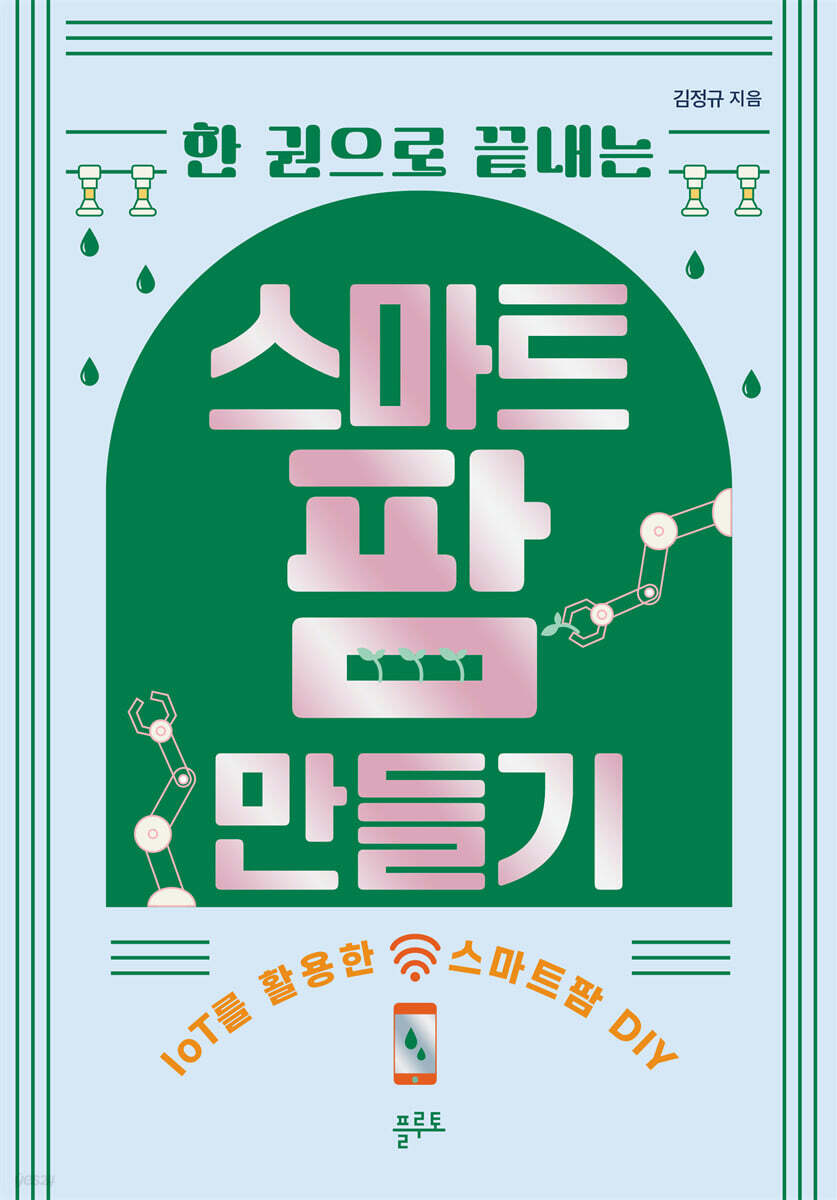
Building a Smart Farm in One Book
 |
Description
Book Introduction
Simple and inexpensive parts,
As an open source program
You can create your own smart farm!
Smart farms are attracting attention from young people, college students, farmers, and people who dream of returning to farming or rural life after retirement due to their economic feasibility and future potential.
A smart farm is an agricultural facility that combines cutting-edge technologies such as IoT, big data, artificial intelligence, and robots, as well as automated greenhouse devices that can be remotely controlled from anywhere via the Internet.
The author runs a smart farm and teaches smart farming to students and returning farmers.
"Building a Smart Farm in One Book" introduces the trends and importance of smart farm technology and clearly explains the advantages and challenges of smart farms in an era of population decline, climate change, agricultural changes, and the widespread adoption of advanced technology.
The core of this book is ‘DIY smart farm built with my own hands.’
With IoT, big data, a little IT technology, and inexpensive tools, you can create a truly amazing smart farm.
It has been said that experience is the best teacher.
By manipulating the microcontrollers, sensors, and actuators introduced in this book and following the open-source program settings, you will gain the confidence that you can build a smart farm on your own.
As an open source program
You can create your own smart farm!
Smart farms are attracting attention from young people, college students, farmers, and people who dream of returning to farming or rural life after retirement due to their economic feasibility and future potential.
A smart farm is an agricultural facility that combines cutting-edge technologies such as IoT, big data, artificial intelligence, and robots, as well as automated greenhouse devices that can be remotely controlled from anywhere via the Internet.
The author runs a smart farm and teaches smart farming to students and returning farmers.
"Building a Smart Farm in One Book" introduces the trends and importance of smart farm technology and clearly explains the advantages and challenges of smart farms in an era of population decline, climate change, agricultural changes, and the widespread adoption of advanced technology.
The core of this book is ‘DIY smart farm built with my own hands.’
With IoT, big data, a little IT technology, and inexpensive tools, you can create a truly amazing smart farm.
It has been said that experience is the best teacher.
By manipulating the microcontrollers, sensors, and actuators introduced in this book and following the open-source program settings, you will gain the confidence that you can build a smart farm on your own.
- You can preview some of the book's contents.
Preview
index
Author's Note
Chapter 1: A Beginner Farmer Gets to Know Smart Farms
1 What is a smart farm?
Definition of smart farm
IoT is the most important factor in building a smart farm.
The Role of Big Data, Artificial Intelligence, and Robots in Smart Farms
2. Why Smart Farms Are Needed
Smart farms that save time and effort
Smart farms that overcome climate change and extreme weather
Smart farms that accumulate useful data
3 As the world changes, smart farms change even more.
Changes in the agricultural environment
How will smart farms evolve?
Development of smart farm-related technologies
4 Preparation for operating a smart farm
Selecting crops suitable for smart farms and those with high profitability
Studying crop cultivation is the most basic of the basics.
Choosing a location and space to install a smart farm
How to Design Your Own Smart Farm Greenhouse
Elements required to build a smart farm system
How to Build Your Own Smart Farm System
5 Things to keep in mind when introducing and operating a smart farm
Average investment cost and profitability of smart farms
Problems in the introduction and operation of smart farms
Limitations of Smart Farm Greenhouse Facilities in the Domestic Market
6 Final Questions to Ask When Starting a Smart Farm
If you're not careful, you could end up with a smart farm full of love and hate.
Farming on a smart farm is also farming!
Limitations of smart farms based on vinyl greenhouses
Smart farms needed in an era of population decline
Chapter 2: Smart Farm Crop Cultivation and Hydroponics
1. Principles of plant growth and cultivation methods
Composition and functions of plants
Principles of photosynthesis and respiration
Plant growth process and cultivation environment management
The best conditions for plants to grow well
Characteristics of fertilizers and nutrients
2 Hydroponics in smart farms
Pros and Cons of Hydroponics
Solid culture medium method
Pure hydroponics method
Things to keep in mind when growing hydroponically in a smart farm
3 IoT-based smart farms
Definition and Concept of IoT
Why IoT is Essential for Smart Farms
How to build a smart farm IoT network
Smart Farm IoT Devices
4 The Value and Importance of Smart Farm Data
The meaning of smart farm data
The Value of Smart Farm Data
Smart farm data accumulation and management methods
5. Using Artificial Intelligence in Smart Farms
The Difference Between Programming and Artificial Intelligence
Deep Learning, Machine Learning, and Generative AI
Artificial intelligence used in smart farms
Smart farm artificial intelligence to be utilized in the future
Applying AI directly to smart farms
Chapter 3: How to Build Your Own Smart Farm
1. Establishing a Smart Farm Plan
2 Smart Farm Crop Home, Greenhouse
Definition and types of greenhouses
Conditions for determining the type of greenhouse
3. Understanding the Basics of Smart Farms and the Principles of Electricity
Voltage and current of smart farm devices
Smart farm control and relay that replaces the work of four people
Roles and types of relays
Roles and types of relay modules
5 Building a Full-Fledged Smart Farm
Greenhouse smart farm structure and electrical equipment
Preparing the materials needed to build a smart farm
Building a network for IoT smart farms
How to install firmware and set up Wi-Fi
How to Deal with Wi-Fi Setup Errors
6 Smart Farm DIY Tutorials
7. Hydroponic cultivation at home like a smart farm
Preparing the materials needed for smart home farming
Making a Plant Grower
Planting lettuce seedlings in seedbeds
Installing Plant Growth LEDs
Creating a Smart Home Farming System
Setting up Tasmota for smart home farming
Chapter 4: The Future and Future Path of Smart Farms
1. Smart Farm Experts and Roles by Field
Smart Farm Crop Cultivation and Management Expert
Smart Farm Installation and Facility Expert
Smart Farm Big Data and Artificial Intelligence Expert
2 How to Operate a Smart Farm Well
You must be able to recover your investment.
Talk to your crops and get familiar with your data.
Research and challenge various cultivation techniques.
Expand the capabilities of your smart farm.
3 Smart Farms as a Career and Occupation
Smart farm-related fields as future careers
Smart farm-related departments and career paths established at universities nationwide
Chapter 1: A Beginner Farmer Gets to Know Smart Farms
1 What is a smart farm?
Definition of smart farm
IoT is the most important factor in building a smart farm.
The Role of Big Data, Artificial Intelligence, and Robots in Smart Farms
2. Why Smart Farms Are Needed
Smart farms that save time and effort
Smart farms that overcome climate change and extreme weather
Smart farms that accumulate useful data
3 As the world changes, smart farms change even more.
Changes in the agricultural environment
How will smart farms evolve?
Development of smart farm-related technologies
4 Preparation for operating a smart farm
Selecting crops suitable for smart farms and those with high profitability
Studying crop cultivation is the most basic of the basics.
Choosing a location and space to install a smart farm
How to Design Your Own Smart Farm Greenhouse
Elements required to build a smart farm system
How to Build Your Own Smart Farm System
5 Things to keep in mind when introducing and operating a smart farm
Average investment cost and profitability of smart farms
Problems in the introduction and operation of smart farms
Limitations of Smart Farm Greenhouse Facilities in the Domestic Market
6 Final Questions to Ask When Starting a Smart Farm
If you're not careful, you could end up with a smart farm full of love and hate.
Farming on a smart farm is also farming!
Limitations of smart farms based on vinyl greenhouses
Smart farms needed in an era of population decline
Chapter 2: Smart Farm Crop Cultivation and Hydroponics
1. Principles of plant growth and cultivation methods
Composition and functions of plants
Principles of photosynthesis and respiration
Plant growth process and cultivation environment management
The best conditions for plants to grow well
Characteristics of fertilizers and nutrients
2 Hydroponics in smart farms
Pros and Cons of Hydroponics
Solid culture medium method
Pure hydroponics method
Things to keep in mind when growing hydroponically in a smart farm
3 IoT-based smart farms
Definition and Concept of IoT
Why IoT is Essential for Smart Farms
How to build a smart farm IoT network
Smart Farm IoT Devices
4 The Value and Importance of Smart Farm Data
The meaning of smart farm data
The Value of Smart Farm Data
Smart farm data accumulation and management methods
5. Using Artificial Intelligence in Smart Farms
The Difference Between Programming and Artificial Intelligence
Deep Learning, Machine Learning, and Generative AI
Artificial intelligence used in smart farms
Smart farm artificial intelligence to be utilized in the future
Applying AI directly to smart farms
Chapter 3: How to Build Your Own Smart Farm
1. Establishing a Smart Farm Plan
2 Smart Farm Crop Home, Greenhouse
Definition and types of greenhouses
Conditions for determining the type of greenhouse
3. Understanding the Basics of Smart Farms and the Principles of Electricity
Voltage and current of smart farm devices
Smart farm control and relay that replaces the work of four people
Roles and types of relays
Roles and types of relay modules
5 Building a Full-Fledged Smart Farm
Greenhouse smart farm structure and electrical equipment
Preparing the materials needed to build a smart farm
Building a network for IoT smart farms
How to install firmware and set up Wi-Fi
How to Deal with Wi-Fi Setup Errors
6 Smart Farm DIY Tutorials
7. Hydroponic cultivation at home like a smart farm
Preparing the materials needed for smart home farming
Making a Plant Grower
Planting lettuce seedlings in seedbeds
Installing Plant Growth LEDs
Creating a Smart Home Farming System
Setting up Tasmota for smart home farming
Chapter 4: The Future and Future Path of Smart Farms
1. Smart Farm Experts and Roles by Field
Smart Farm Crop Cultivation and Management Expert
Smart Farm Installation and Facility Expert
Smart Farm Big Data and Artificial Intelligence Expert
2 How to Operate a Smart Farm Well
You must be able to recover your investment.
Talk to your crops and get familiar with your data.
Research and challenge various cultivation techniques.
Expand the capabilities of your smart farm.
3 Smart Farms as a Career and Occupation
Smart farm-related fields as future careers
Smart farm-related departments and career paths established at universities nationwide
Into the book
A smart farm is an automated device that can be remotely controlled and a system that can also perform hydroponic cultivation.
It is an electrical and electronic device that can operate facilities in a farm or greenhouse remotely by connecting to the Internet, maintain an environment for crops to grow well in the greenhouse, and automatically supply water and nutrients for any type of cultivation method.
In other words, if the crop growth environment can be automatically or remotely controlled and managed using an Internet-connected device, it is a smart farm regardless of the size of the greenhouse and facility or the cultivation method.
--- p.16
Recently, climate change has become more severe due to the effects of global warming.
Crops have difficulty photosynthesizing sufficiently, and growth is slowed and various diseases are increasing as temperatures change too rapidly.
The frequency of physiological disorders, such as fruits not opening properly, is also increasing.
Even crops that grow well outdoors will not grow well if there are frequent heavy rains and heat waves in the summer, and even if they are harvested, their marketability will be low.
Smart farms operate their facilities and devices based on sensor values such as temperature, humidity, and sunlight in the greenhouse.
By comparing weather data from the Korea Meteorological Administration with measurement data from smart farms, the device is activated in advance before abnormal weather events such as heat waves and heavy rain occur, thereby controlling the growth period and stage of crops.
Accordingly, crop production and marketability can be increased, and stable production can be achieved regardless of the season.
--- p.21
In general, there are no specific crops suitable for smart farms.
In our country's smart farms, mainly leafy vegetables such as lettuce and cabbage and fruit vegetables such as tomatoes and strawberries are grown.
In the process of preparing a smart farm, a lot of time must be invested in crop selection.
This is because the size, structure and shape of the greenhouse (crop cultivation space), the functions and specifications of the smart farm system, crop cultivation methods and profits vary depending on the crop being grown.
Smart farms are customized systems.
Keep in mind that changing crops mid-season will incur additional costs and may require replacement of facilities.
--- p.28
Nowadays, control boards and devices with IoT functions are available on the market at low prices.
You can create your own smart farm that can control the greenhouse's actuators with this IoT control board.
Until now, the barrier to installing a smart farm system for the first time was that it required learning programming coding.
However, recently, free software has been developed that allows you to install software on control boards or devices by connecting them to a computer without coding, and easily connect to Wi-Fi.
For example, there's the ESP32 control board from Espressif Systems. By installing a control board or device equipped with an ESP32 chip and software called firmware, you can connect to temperature and humidity sensors and water temperature sensors to monitor their measured values.
Also, if connected to a driving device such as a greenhouse opener, the relay board, which is a control device, can be remotely controlled.
--- p.
39~40
Maintaining a precise greenhouse environment requires installing multiple sensors.
If these sensors are connected to a smart farm control system with wires, the wires will become longer, and errors in the measured values may also appear as a result of the longer wires.
In particular, interconnected vinyl greenhouses with multiple buildings are too large to install sensors.
So, regardless of the communication method, we use a method to connect the sensor or control device to the wireless Internet or an internal network (operating only by internal address when not connected to the Internet).
Costs are also reduced as virtually no wires are required other than those to power sensors and control devices.
--- p.83~84
Data accumulated in smart farms provides a variety of information.
It is possible to monitor various greenhouse environments, such as temperature deviations in the greenhouse, for a certain period of time and control them to an optimized environment.
You can immediately detect device malfunctions, sensor failures, errors, etc., so you can prevent problems in advance.
The ultimate goal of smart farms is to maintain a greenhouse environment suitable for crop growth.
Greenhouse environmental data accumulated while crops are growing is basic data that can be used to determine under what conditions crops grow well and when they bloom and ripen.
Just by analyzing and understanding this data well, you can create a better environment for growing crops in the future.
--- p.90
The smart farm control system consists of a control device and a central control device that controls it.
A control system is a system that monitors and controls a specific task or process using a computer or other means to obtain a desired result or value.
A control device is a device that changes or maintains a target state through manipulation or operation.
It is also a device that receives commands, processes input and output, performs calculations, and stores them in memory, just like a computer CPU.
The central control unit is a board composed of semiconductors such as IC chips or CPUs, and controls the control devices with programs or software.
The control unit performs simple functions, and the central control unit performs complex functions.
The central control unit of a large greenhouse uses a single-board computer such as a Raspberry Pi, while a small, single-acting greenhouse with IoT functions uses an ESP32-class MCU board.
--- p.117
Tasmota can be used with most sensors sold in online shopping malls.
Additionally, the commands required for automation are intuitive, and the forward and reverse rotation of the motor, timer function, and communication with external programs or servers can be easily and conveniently set.
Since you connect online and install the program, the installation process is relatively easy.
First, plug the micro 5-pin USB cable into the USB port on the ESP32 board, then connect the other end to your computer or laptop.
If your computer does not have drivers installed to recognize the ESP32 board, you may get an error message saying that your computer does not recognize it.
In this case, search for CH340 Driver on the portal site, download the CH340 driver executable file, and install it on your computer.
--- p.161
College students who develop an interest in smart farms while enrolled in school and wish to operate a smart farm or find employment at a company related to smart farm development and technology should find a connection between their major and smart farms and focus their studies on that field.
Smart farming is a comprehensive field of study, so there is no field that does not overlap.
Even if you don't go to a department related to agriculture or smart farms, it is advisable to prioritize your major and learn about smart farms.
For example, technologies related to smart farms and hydroponics are often developed based on technologies and principles from other fields.
As the hydroponics field develops, fertilizers specifically for hydroponics are being developed one after another.
If a student majoring in chemistry becomes interested in smart farms, he or she can get a job at a fertilizer company like this.
It is an electrical and electronic device that can operate facilities in a farm or greenhouse remotely by connecting to the Internet, maintain an environment for crops to grow well in the greenhouse, and automatically supply water and nutrients for any type of cultivation method.
In other words, if the crop growth environment can be automatically or remotely controlled and managed using an Internet-connected device, it is a smart farm regardless of the size of the greenhouse and facility or the cultivation method.
--- p.16
Recently, climate change has become more severe due to the effects of global warming.
Crops have difficulty photosynthesizing sufficiently, and growth is slowed and various diseases are increasing as temperatures change too rapidly.
The frequency of physiological disorders, such as fruits not opening properly, is also increasing.
Even crops that grow well outdoors will not grow well if there are frequent heavy rains and heat waves in the summer, and even if they are harvested, their marketability will be low.
Smart farms operate their facilities and devices based on sensor values such as temperature, humidity, and sunlight in the greenhouse.
By comparing weather data from the Korea Meteorological Administration with measurement data from smart farms, the device is activated in advance before abnormal weather events such as heat waves and heavy rain occur, thereby controlling the growth period and stage of crops.
Accordingly, crop production and marketability can be increased, and stable production can be achieved regardless of the season.
--- p.21
In general, there are no specific crops suitable for smart farms.
In our country's smart farms, mainly leafy vegetables such as lettuce and cabbage and fruit vegetables such as tomatoes and strawberries are grown.
In the process of preparing a smart farm, a lot of time must be invested in crop selection.
This is because the size, structure and shape of the greenhouse (crop cultivation space), the functions and specifications of the smart farm system, crop cultivation methods and profits vary depending on the crop being grown.
Smart farms are customized systems.
Keep in mind that changing crops mid-season will incur additional costs and may require replacement of facilities.
--- p.28
Nowadays, control boards and devices with IoT functions are available on the market at low prices.
You can create your own smart farm that can control the greenhouse's actuators with this IoT control board.
Until now, the barrier to installing a smart farm system for the first time was that it required learning programming coding.
However, recently, free software has been developed that allows you to install software on control boards or devices by connecting them to a computer without coding, and easily connect to Wi-Fi.
For example, there's the ESP32 control board from Espressif Systems. By installing a control board or device equipped with an ESP32 chip and software called firmware, you can connect to temperature and humidity sensors and water temperature sensors to monitor their measured values.
Also, if connected to a driving device such as a greenhouse opener, the relay board, which is a control device, can be remotely controlled.
--- p.
39~40
Maintaining a precise greenhouse environment requires installing multiple sensors.
If these sensors are connected to a smart farm control system with wires, the wires will become longer, and errors in the measured values may also appear as a result of the longer wires.
In particular, interconnected vinyl greenhouses with multiple buildings are too large to install sensors.
So, regardless of the communication method, we use a method to connect the sensor or control device to the wireless Internet or an internal network (operating only by internal address when not connected to the Internet).
Costs are also reduced as virtually no wires are required other than those to power sensors and control devices.
--- p.83~84
Data accumulated in smart farms provides a variety of information.
It is possible to monitor various greenhouse environments, such as temperature deviations in the greenhouse, for a certain period of time and control them to an optimized environment.
You can immediately detect device malfunctions, sensor failures, errors, etc., so you can prevent problems in advance.
The ultimate goal of smart farms is to maintain a greenhouse environment suitable for crop growth.
Greenhouse environmental data accumulated while crops are growing is basic data that can be used to determine under what conditions crops grow well and when they bloom and ripen.
Just by analyzing and understanding this data well, you can create a better environment for growing crops in the future.
--- p.90
The smart farm control system consists of a control device and a central control device that controls it.
A control system is a system that monitors and controls a specific task or process using a computer or other means to obtain a desired result or value.
A control device is a device that changes or maintains a target state through manipulation or operation.
It is also a device that receives commands, processes input and output, performs calculations, and stores them in memory, just like a computer CPU.
The central control unit is a board composed of semiconductors such as IC chips or CPUs, and controls the control devices with programs or software.
The control unit performs simple functions, and the central control unit performs complex functions.
The central control unit of a large greenhouse uses a single-board computer such as a Raspberry Pi, while a small, single-acting greenhouse with IoT functions uses an ESP32-class MCU board.
--- p.117
Tasmota can be used with most sensors sold in online shopping malls.
Additionally, the commands required for automation are intuitive, and the forward and reverse rotation of the motor, timer function, and communication with external programs or servers can be easily and conveniently set.
Since you connect online and install the program, the installation process is relatively easy.
First, plug the micro 5-pin USB cable into the USB port on the ESP32 board, then connect the other end to your computer or laptop.
If your computer does not have drivers installed to recognize the ESP32 board, you may get an error message saying that your computer does not recognize it.
In this case, search for CH340 Driver on the portal site, download the CH340 driver executable file, and install it on your computer.
--- p.161
College students who develop an interest in smart farms while enrolled in school and wish to operate a smart farm or find employment at a company related to smart farm development and technology should find a connection between their major and smart farms and focus their studies on that field.
Smart farming is a comprehensive field of study, so there is no field that does not overlap.
Even if you don't go to a department related to agriculture or smart farms, it is advisable to prioritize your major and learn about smart farms.
For example, technologies related to smart farms and hydroponics are often developed based on technologies and principles from other fields.
As the hydroponics field develops, fertilizers specifically for hydroponics are being developed one after another.
If a student majoring in chemistry becomes interested in smart farms, he or she can get a job at a fertilizer company like this.
--- p.241
Publisher's Review
The era of smart agriculture created by smart farms
Agriculture is the oldest industry in human history and is essential for survival.
However, as climate change worsens, quality and production fluctuate, and securing workers becomes more difficult due to the decline in the agricultural population.
To overcome this situation, agriculture is gradually transforming into an innovative and smart industry utilizing IoT, artificial intelligence, and robots.
When most people think of smart farms, they think of automated farms or crop cultivation technology that allows them to operate farm facilities using smartphones.
This is just one aspect of smart farming.
Smart farms are ultimately agricultural systems that operate around big data.
Its foundation is the Internet.
Smart farms are not standardized products that can be purchased in stores, as the size, shape, and configuration of the space where crops are grown vary.
It is a customized system that users can install by requesting an expert or customizing the equipment themselves to fit their growing space.
To operate a smart farm, you need space and facilities suitable for crop growth, and this space requires electrical and electronic devices based on the Internet of Things (IoT).
Therefore, it is necessary to understand the concept and network of IoT, the value and importance of data accumulated in smart farms, and the concept and technology of artificial intelligence, which is the final technological implementation stage of smart farms.
If you want to become a better smart farm expert, you must understand the relationship between knowledge and technology related to smart farms and acquire the skills step by step, starting from the basics.
"Building a Smart Farm in One Book" covers everything essential to building and operating a smart farm, from the relationship between social change and smart farm agriculture to concepts related to smart farms and related fields, and detailed explanations of smart farm IT technology and devices.
Simple and inexpensive components, open source programs
Smart farm built directly
The author of "Building a Smart Farm in One Book" runs a smart farm, develops and researches smart farm technology, and provides smart farm education and consulting to students and returning farmers.
We also run a YouTube channel and internet cafe to help anyone build a smart farm.
Through my various activities related to smart farming, I have met countless people who are interested in smart farming but only know it as a few simple technologies, or who want to start smart farming but don't know where to start.
"Building a Smart Farm in One Book" is designed so that those who are new to smart farming, dream of returning to farming or rural life using smart farming, or are considering a career in the smart farming field can follow the book's content and build their own smart farm.
Chapter 1, "Getting to Know Smart Farms for Beginner Farmers," explores the definition and concept of smart farms, why they are necessary in the agricultural sector, the pros and cons of smart farms, and what to watch out for when preparing for and operating a smart farm.
Crops grown in smart farms are also plants.
Chapter 2, 'Smart Farm Crop Cultivation and Hydroponics' explains the principles of plant growth, how to manage the plant cultivation environment, and explains the principles of hydroponics, which is currently the most widely used cultivation technique in smart farms.
Chapter 3, "How to Build Your Own Smart Farm," details all the processes and principles of "building your own smart farm," the core of this book.
Learn about the types of greenhouses and how to choose them, understand electrical and electronic principles, build an IoT network, and control various sensors and actuators.
In particular, in the Smart Farm DIY follow-up section, it provides easy-to-follow instructions on how to install and set up the open-source program Tasmota, how to set up temperature and humidity sensors, water temperature sensors, etc. to be connected to the ESP32 control board to control them, and how to set up various other functions.
It has been said that experience is the best teacher.
If you just follow this part, you will gain the confidence that you can build a smart farm on your own.
Finally, Chapter 4, "The Future and Future Path of Smart Farms," introduces experts and their roles in each field of smart farms, the conditions for young people interested in returning to farming or rural life to successfully operate smart farms, and career paths and jobs in the smart farm field that high school and college students interested in smart farms can pursue.
We need to know the pros and cons of smart farms accurately.
Can reduce failures
The phenomenon of worsening climate change due to global warming is a global problem.
Crops have difficulty photosynthesizing sufficiently, and growth is slowed and various diseases are increasing as temperatures change too rapidly.
Smart farms operate their facilities and devices based on sensor values such as temperature, humidity, and sunlight in the greenhouse.
It is to maintain the appropriate growing environment for crops, including temperature, humidity, and sunlight, in any climate.
Accordingly, crop production and marketability can be increased, and stable production can be achieved regardless of the season.
The aging and decline of the rural population is a phenomenon that is currently particularly severe in our country.
There are two key points in this issue.
One is to secure rural labor, and the other is to change agricultural management methods to prepare for the decline in production due to the decrease in demand for agricultural products.
Solutions to secure rural labor include smart agricultural machinery (autonomous driving) and large-scale farming.
We will also address production and demand issues with demand-tailored smart farms powered by artificial intelligence and robots.
In this respect, smart farms are becoming a driving force for the growth of agriculture in our country.
These days, our country is exporting container smart farms and plant factories to the Middle East.
People with smart farm-related skills can find jobs anywhere in the world.
As climate change and population decline become more serious, the future prospects and career potential of smart farming will continue to grow.
However, this does not mean that the future is all rosy.
You might think that smart farming would be a leisurely activity, but even with a smart farm, crop cultivation requires labor and time, and there is a considerable wait until harvest.
If pests or diseases occur, it can ruin the whole year's crops, so continuous observation is necessary.
We have invested a significant amount of money in smart farms, but there is also the problem that if crops are overproduced, prices will drop and income will be lower than initially expected.
"Building a Smart Farm in One Book" guides those new to smart farming to reduce the risk of failure and experience fewer trial and errors.
Agriculture is the oldest industry in human history and is essential for survival.
However, as climate change worsens, quality and production fluctuate, and securing workers becomes more difficult due to the decline in the agricultural population.
To overcome this situation, agriculture is gradually transforming into an innovative and smart industry utilizing IoT, artificial intelligence, and robots.
When most people think of smart farms, they think of automated farms or crop cultivation technology that allows them to operate farm facilities using smartphones.
This is just one aspect of smart farming.
Smart farms are ultimately agricultural systems that operate around big data.
Its foundation is the Internet.
Smart farms are not standardized products that can be purchased in stores, as the size, shape, and configuration of the space where crops are grown vary.
It is a customized system that users can install by requesting an expert or customizing the equipment themselves to fit their growing space.
To operate a smart farm, you need space and facilities suitable for crop growth, and this space requires electrical and electronic devices based on the Internet of Things (IoT).
Therefore, it is necessary to understand the concept and network of IoT, the value and importance of data accumulated in smart farms, and the concept and technology of artificial intelligence, which is the final technological implementation stage of smart farms.
If you want to become a better smart farm expert, you must understand the relationship between knowledge and technology related to smart farms and acquire the skills step by step, starting from the basics.
"Building a Smart Farm in One Book" covers everything essential to building and operating a smart farm, from the relationship between social change and smart farm agriculture to concepts related to smart farms and related fields, and detailed explanations of smart farm IT technology and devices.
Simple and inexpensive components, open source programs
Smart farm built directly
The author of "Building a Smart Farm in One Book" runs a smart farm, develops and researches smart farm technology, and provides smart farm education and consulting to students and returning farmers.
We also run a YouTube channel and internet cafe to help anyone build a smart farm.
Through my various activities related to smart farming, I have met countless people who are interested in smart farming but only know it as a few simple technologies, or who want to start smart farming but don't know where to start.
"Building a Smart Farm in One Book" is designed so that those who are new to smart farming, dream of returning to farming or rural life using smart farming, or are considering a career in the smart farming field can follow the book's content and build their own smart farm.
Chapter 1, "Getting to Know Smart Farms for Beginner Farmers," explores the definition and concept of smart farms, why they are necessary in the agricultural sector, the pros and cons of smart farms, and what to watch out for when preparing for and operating a smart farm.
Crops grown in smart farms are also plants.
Chapter 2, 'Smart Farm Crop Cultivation and Hydroponics' explains the principles of plant growth, how to manage the plant cultivation environment, and explains the principles of hydroponics, which is currently the most widely used cultivation technique in smart farms.
Chapter 3, "How to Build Your Own Smart Farm," details all the processes and principles of "building your own smart farm," the core of this book.
Learn about the types of greenhouses and how to choose them, understand electrical and electronic principles, build an IoT network, and control various sensors and actuators.
In particular, in the Smart Farm DIY follow-up section, it provides easy-to-follow instructions on how to install and set up the open-source program Tasmota, how to set up temperature and humidity sensors, water temperature sensors, etc. to be connected to the ESP32 control board to control them, and how to set up various other functions.
It has been said that experience is the best teacher.
If you just follow this part, you will gain the confidence that you can build a smart farm on your own.
Finally, Chapter 4, "The Future and Future Path of Smart Farms," introduces experts and their roles in each field of smart farms, the conditions for young people interested in returning to farming or rural life to successfully operate smart farms, and career paths and jobs in the smart farm field that high school and college students interested in smart farms can pursue.
We need to know the pros and cons of smart farms accurately.
Can reduce failures
The phenomenon of worsening climate change due to global warming is a global problem.
Crops have difficulty photosynthesizing sufficiently, and growth is slowed and various diseases are increasing as temperatures change too rapidly.
Smart farms operate their facilities and devices based on sensor values such as temperature, humidity, and sunlight in the greenhouse.
It is to maintain the appropriate growing environment for crops, including temperature, humidity, and sunlight, in any climate.
Accordingly, crop production and marketability can be increased, and stable production can be achieved regardless of the season.
The aging and decline of the rural population is a phenomenon that is currently particularly severe in our country.
There are two key points in this issue.
One is to secure rural labor, and the other is to change agricultural management methods to prepare for the decline in production due to the decrease in demand for agricultural products.
Solutions to secure rural labor include smart agricultural machinery (autonomous driving) and large-scale farming.
We will also address production and demand issues with demand-tailored smart farms powered by artificial intelligence and robots.
In this respect, smart farms are becoming a driving force for the growth of agriculture in our country.
These days, our country is exporting container smart farms and plant factories to the Middle East.
People with smart farm-related skills can find jobs anywhere in the world.
As climate change and population decline become more serious, the future prospects and career potential of smart farming will continue to grow.
However, this does not mean that the future is all rosy.
You might think that smart farming would be a leisurely activity, but even with a smart farm, crop cultivation requires labor and time, and there is a considerable wait until harvest.
If pests or diseases occur, it can ruin the whole year's crops, so continuous observation is necessary.
We have invested a significant amount of money in smart farms, but there is also the problem that if crops are overproduced, prices will drop and income will be lower than initially expected.
"Building a Smart Farm in One Book" guides those new to smart farming to reduce the risk of failure and experience fewer trial and errors.
GOODS SPECIFICS
- Date of issue: March 18, 2025
- Page count, weight, size: 244 pages | 418g | 162*232*17mm
- ISBN13: 9791188569809
You may also like
카테고리
korean


korean

![GQ KOREA Mark (Monthly): December [2025]](http://librairie.coreenne.fr/cdn/shop/files/8ef265dbbfbf186523ed75ba7319009d.jpg?v=1765340328&width=3840)


