

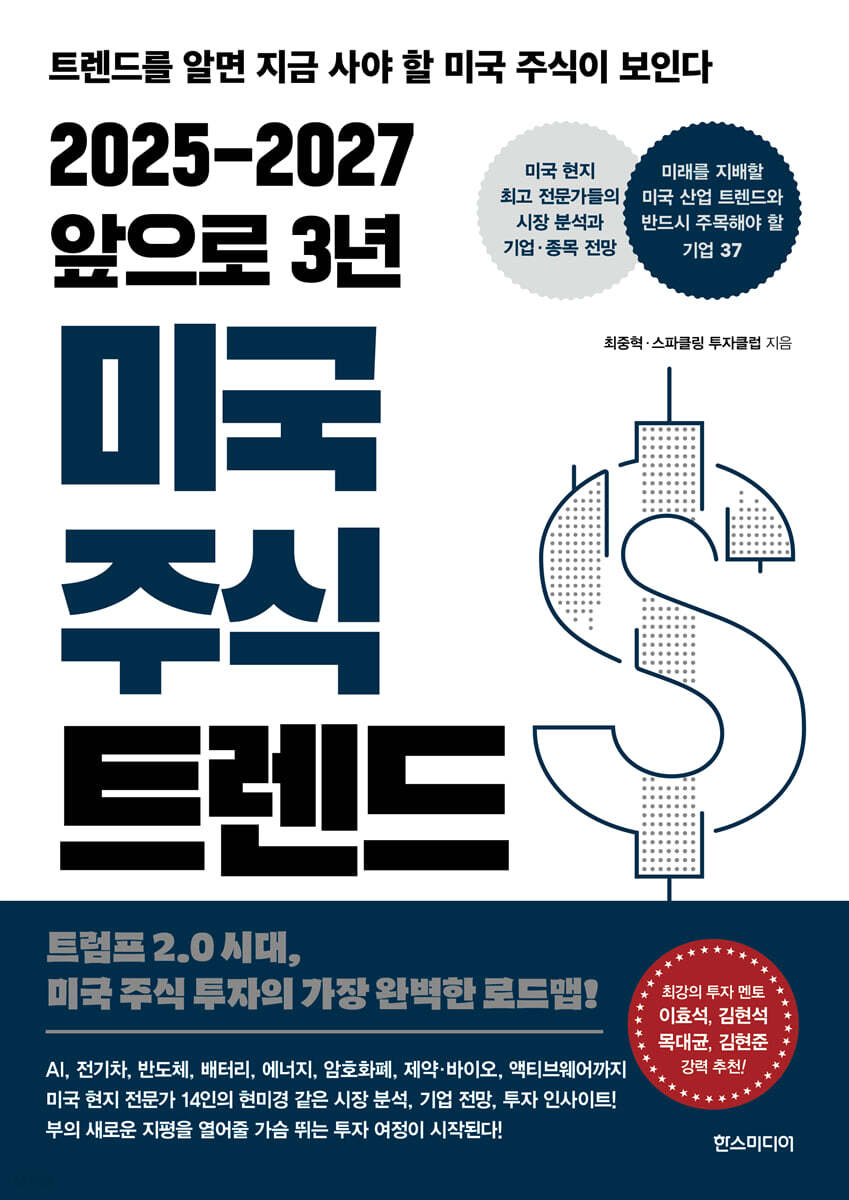
US Stock Trends for the Next Three Years, 2025-2027
 |
Description
Book Introduction
The Trump 2.0 era,
The most complete roadmap for investing in US stocks!
AI, electric vehicles, semiconductors, batteries, energy, cryptocurrency, pharmaceuticals/bio, and even activewear.
Microscopic market analysis, corporate outlook, and investment insights from 14 local US experts!
An exciting investment journey that will open new horizons for wealth begins!
As time passes and society changes rapidly, industry and investment trends change rapidly.
Therefore, to profit from investing in U.S. stocks, continuous interest in and study of U.S. trends is essential.
In other words, if you understand the US industrial trends, you can read the direction of US stocks.
In the new book, "US Stock Trends for the Next Three Years, 2025-2027," 14 experts based in the US divided US industries into seven categories and analyzed 12 sectors, three policy topics, and 37 companies that could be helpful for investment.
It also includes interviews with five industry experts to capture voices from the field.
In particular, 2025 is a year with great uncertainty regarding the policies the new administration will pursue, including tariffs, as the second Trump administration begins its term at the beginning of the year.
We need to be that cautious and respond quickly to policy changes.
The authors pondered these uncertainties and focused on the prospects for future industry trends.
This book, filled with painstaking market analysis and forecasts by local U.S. experts, will serve as a valuable compass for investors navigating the harsh and turbulent world of investment.
The most complete roadmap for investing in US stocks!
AI, electric vehicles, semiconductors, batteries, energy, cryptocurrency, pharmaceuticals/bio, and even activewear.
Microscopic market analysis, corporate outlook, and investment insights from 14 local US experts!
An exciting investment journey that will open new horizons for wealth begins!
As time passes and society changes rapidly, industry and investment trends change rapidly.
Therefore, to profit from investing in U.S. stocks, continuous interest in and study of U.S. trends is essential.
In other words, if you understand the US industrial trends, you can read the direction of US stocks.
In the new book, "US Stock Trends for the Next Three Years, 2025-2027," 14 experts based in the US divided US industries into seven categories and analyzed 12 sectors, three policy topics, and 37 companies that could be helpful for investment.
It also includes interviews with five industry experts to capture voices from the field.
In particular, 2025 is a year with great uncertainty regarding the policies the new administration will pursue, including tariffs, as the second Trump administration begins its term at the beginning of the year.
We need to be that cautious and respond quickly to policy changes.
The authors pondered these uncertainties and focused on the prospects for future industry trends.
This book, filled with painstaking market analysis and forecasts by local U.S. experts, will serve as a valuable compass for investors navigating the harsh and turbulent world of investment.
- You can preview some of the book's contents.
Preview
index
Introduction | The Most Complete Roadmap for Investing in US Stocks
CHAPTER 1: Electric Vehicles: Autonomous Driving Competitiveness Ultimately Leads to Sales
[Industry 1] Electric Vehicles: Despite a slump, autonomous driving is boosting competitiveness.
-Choi Jung-hyuk (CEO of Palo Alto Capital)
[Company 1] Tesla: 2025 is Tesla's Year
[Company 2] Rivian Automotive: Launches First Electric Pickup Truck, But Continues to Lose
CHAPTER 2 AI and Semiconductors: Driving Innovation in Our Lives
[Industry 1] Artificial Intelligence (AI): Our Second Fire - New Opportunities Driven by Generative AI and Integrated Technologies
-Choi Min-gyu (Lockheed Martin AI Principal Researcher & Tech Leader)
[Company 3] Palantir: From Data to Insight, Shaping the Future
[Company 4] C3.ai: A Pioneer in Enterprise AI Solutions
[Company 5] OpenAI: Pioneers in Generative AI
[Industry 2] AI Infrastructure: Infrastructure in the AI Era - A New Paradigm for Demand
-Lee Sang-jin (HPE Global Sales Strategy Manager)
[Company 6] Dell Technologies: A global leader in servers, storage, and PCs, it's targeting the AI market.
[Company 7] Cisco Systems: Will the world's leading supplier of global network equipment succeed in restructuring and restructuring thanks to artificial intelligence?
[Company 8] Supermicro: Can Supermicro, which has been fueled by AI demand, overcome the reefs of short-selling reports?
[Industry 3] Semiconductors: All innovations, including cloud computing, artificial intelligence, and autonomous driving, begin with semiconductors.
-Heo Jin (Senior Manager, Global Memory Manufacturer)
[Interview] The AI Data Center Solutions Market Has Great Growth Potential
-Park Jin-ho (CEO of Point2Technology)
[Company 9] NVIDIA: All Paths to AI Lead Together
[Company 10] Micron: The Pride of American Memory Semiconductors
[Company 11] Broadcom: A Challenger to NVIDIA's Stronghold
[Industry 4] Software as a Service (SaaS): Software Power Enhanced by AI
-Jo Jong-hee (JP Morgan Chase Consumer Marketing Analysis Strategy Manager)
[Company 12] Snowflake: A Leader in Cloud Databases
[Company 13] Salesforce: Beyond CRM, a Comprehensive Software Solutions Company
[Company 14] Databricks: A Cloud Data Solution with a Focus on AI Development
CHAPTER 3 Oil, Gas, and Low-Carbon Solutions: Shaping the Future of Energy
[Industry 1] Oil and Gas: Traditional Fossil Fuels: Turning the Need for a Stable Energy Supply into an Opportunity
-Kim Sang-won (Strategic Fit Partner)
[Interview] We are interested in oil projects with bright prospects for the natural gas business and high profitability and economic feasibility.
Michelle Kim (Global Energy Expert)
[Company 15] Suncor Energy: A leading Canadian company that has declared a focus on oil sands assets.
[Company 16] Code Energy: An upstream company that became a leader in Bakken through aggressive M&A.
[Company 17] BP: The British supermajor declares its transformation into an integrated energy company.
[Industry 2] Oil and Gas: Low-Carbon Solutions - The Most Realistic Choice for a Sustainable Future
-Jeong Cheol-gyun (Manager, AI & Reservoir Analysis Team, Schlumberger)
[Company 18] ExxonMobil: ExxonMobil's Low-Carbon Innovations for a Sustainable Future
[Company 19] Occidental Petroleum: A Challenge That Will Transform the Future - Oxy's Low-Carbon Technology Leadership
[Company 20] Linde: The world's largest multinational chemical company by market share and profits.
CHAPTER 4: The Power Grid and Energy Policy: Watch the Changes a Second Trump Term Will Bring
[Industry 1] America's Power Grid Infrastructure: Seeking Opportunities in Grid Expansion
Jeong Hye-won (CEO of Enog Consulting) and Lee Seon-gyeong (CEO of Green Ethos Lab)
[Company 21] Itron: A Market Leader in Smart Grid Solutions
[Company 22] Quanta Services: A Leading Infrastructure Solutions Provider
[Company 23] Constellation Energy: America's Largest Carbon-Free Energy Producer
[Policy 1] Bipartisan Infrastructure Act and Renewable Energy: Investment in infrastructure and renewable energy will continue.
-Lee Seon-gyeong (CEO of Green Etos Lab)
[Policy 2] The American Inflation Reduction Act: The Largest Climate Bill in U.S. History
-Choi Se-kyung (Lead, World Resources Institute (WRI))
[Interview] Clean energy industry will see the greatest growth.
-Christina DeConcini, Director, World Resources Institute
[Policy 3] The impact of the second term of the Trump administration on existing energy policies is limited.
Choi Se-kyung (Lead, World Resources Institute) and Lee Seon-kyung (CEO, Green Ethos Lab)
CHAPTER 5 Finance and Crypto: The Future of Traditional and New Finance
[Industry 1] Banks and Installment Finance: The Dilemma of Growth and Profitability in a Low-Interest Rate Era
-Lee Kyung-won (Senior Developer, American First Finance)
[Company 24] JPMorgan Chase: A Fortress Unshakeable in a Tough Financial Market
[Company 25] Affirm Holdings: A Leader in US Installment Finance
[Company 26] Clana: Clana is bigger than 'Clana (will it grow)'
[Industry 2] Cryptocurrency: Preparing for a New Leap Using Institutional Entry as a Springboard
Jeon Cheol-hee (Professor of Finance, Pennsylvania Commonwealth University)
[Interview] Creating New Value Through Complex, Multi-Tiered Connections
Choi Gong-pil (CEO of Digital Finance Center)
[Interview] The Potential to Fundamentally Transform the Global Economic System
-Oh Tae-min (CEO of Oh Tae-bus Co., Ltd.)
[Company 27] MicroStrategy: The Birth of an Empire - The World's Largest Bitcoin Accumulation Company
[Company 28] Coinbase Global: Bridging Traditional Finance and Cryptocurrency
[Company 29] Mining Companies: The Financialization of Electricity - The Wizards Who Turn Electricity into a Global Asset
CHAPTER 6: Pharmaceuticals and Biotech: Who Will Win from the Changes Driven by Tighter Regulation and New Technologies?
[Industry 1] Pharmaceuticals and Biotech: A New Horizon for an Industry Where Crisis and Innovation Coexist
Kim Si-hyeon (entrepreneur, former Genentech researcher)
[Company 30] Vertex Pharmaceuticals: A Rare Disease Powerhouse's New Global Leap
[Company 31] Merck & Co.: Preparing for a Leap Forward After Keytruda
[Company 32] Novo Nordisk: Europe's Largest Company Leading the War on Obesity
[Interview] The market for gene therapies, including CRISPR, is about to open.
-Park Hyo-min (Chief Technology Officer and Co-Founder of Jinedit)
CHAPTER 7 Activewear: Nike's Decline, Techwear Companies' Rise
[Industry 1] Sports Activewear: Innovation and Innovation: The Evolving US Activewear Market
-T.
John Kim (Lecturer, Washington University in St. Louis)
[Company 33] Onholding: Federer's Favorite Brands for the 2024 US Footwear Market
[Company 34] Lululemon Athletica: Beyond Yoga Wear to a Comprehensive Activewear Brand
[Company 35] Aloyoga: Vogue's #1 Trend Brand
[Company 36] Viewori: A Wellness Lifestyle Brand Following Aloyoga
[Company 37] Hydration Bottles: Taking Over Americans' Lives
Americas
CHAPTER 1: Electric Vehicles: Autonomous Driving Competitiveness Ultimately Leads to Sales
[Industry 1] Electric Vehicles: Despite a slump, autonomous driving is boosting competitiveness.
-Choi Jung-hyuk (CEO of Palo Alto Capital)
[Company 1] Tesla: 2025 is Tesla's Year
[Company 2] Rivian Automotive: Launches First Electric Pickup Truck, But Continues to Lose
CHAPTER 2 AI and Semiconductors: Driving Innovation in Our Lives
[Industry 1] Artificial Intelligence (AI): Our Second Fire - New Opportunities Driven by Generative AI and Integrated Technologies
-Choi Min-gyu (Lockheed Martin AI Principal Researcher & Tech Leader)
[Company 3] Palantir: From Data to Insight, Shaping the Future
[Company 4] C3.ai: A Pioneer in Enterprise AI Solutions
[Company 5] OpenAI: Pioneers in Generative AI
[Industry 2] AI Infrastructure: Infrastructure in the AI Era - A New Paradigm for Demand
-Lee Sang-jin (HPE Global Sales Strategy Manager)
[Company 6] Dell Technologies: A global leader in servers, storage, and PCs, it's targeting the AI market.
[Company 7] Cisco Systems: Will the world's leading supplier of global network equipment succeed in restructuring and restructuring thanks to artificial intelligence?
[Company 8] Supermicro: Can Supermicro, which has been fueled by AI demand, overcome the reefs of short-selling reports?
[Industry 3] Semiconductors: All innovations, including cloud computing, artificial intelligence, and autonomous driving, begin with semiconductors.
-Heo Jin (Senior Manager, Global Memory Manufacturer)
[Interview] The AI Data Center Solutions Market Has Great Growth Potential
-Park Jin-ho (CEO of Point2Technology)
[Company 9] NVIDIA: All Paths to AI Lead Together
[Company 10] Micron: The Pride of American Memory Semiconductors
[Company 11] Broadcom: A Challenger to NVIDIA's Stronghold
[Industry 4] Software as a Service (SaaS): Software Power Enhanced by AI
-Jo Jong-hee (JP Morgan Chase Consumer Marketing Analysis Strategy Manager)
[Company 12] Snowflake: A Leader in Cloud Databases
[Company 13] Salesforce: Beyond CRM, a Comprehensive Software Solutions Company
[Company 14] Databricks: A Cloud Data Solution with a Focus on AI Development
CHAPTER 3 Oil, Gas, and Low-Carbon Solutions: Shaping the Future of Energy
[Industry 1] Oil and Gas: Traditional Fossil Fuels: Turning the Need for a Stable Energy Supply into an Opportunity
-Kim Sang-won (Strategic Fit Partner)
[Interview] We are interested in oil projects with bright prospects for the natural gas business and high profitability and economic feasibility.
Michelle Kim (Global Energy Expert)
[Company 15] Suncor Energy: A leading Canadian company that has declared a focus on oil sands assets.
[Company 16] Code Energy: An upstream company that became a leader in Bakken through aggressive M&A.
[Company 17] BP: The British supermajor declares its transformation into an integrated energy company.
[Industry 2] Oil and Gas: Low-Carbon Solutions - The Most Realistic Choice for a Sustainable Future
-Jeong Cheol-gyun (Manager, AI & Reservoir Analysis Team, Schlumberger)
[Company 18] ExxonMobil: ExxonMobil's Low-Carbon Innovations for a Sustainable Future
[Company 19] Occidental Petroleum: A Challenge That Will Transform the Future - Oxy's Low-Carbon Technology Leadership
[Company 20] Linde: The world's largest multinational chemical company by market share and profits.
CHAPTER 4: The Power Grid and Energy Policy: Watch the Changes a Second Trump Term Will Bring
[Industry 1] America's Power Grid Infrastructure: Seeking Opportunities in Grid Expansion
Jeong Hye-won (CEO of Enog Consulting) and Lee Seon-gyeong (CEO of Green Ethos Lab)
[Company 21] Itron: A Market Leader in Smart Grid Solutions
[Company 22] Quanta Services: A Leading Infrastructure Solutions Provider
[Company 23] Constellation Energy: America's Largest Carbon-Free Energy Producer
[Policy 1] Bipartisan Infrastructure Act and Renewable Energy: Investment in infrastructure and renewable energy will continue.
-Lee Seon-gyeong (CEO of Green Etos Lab)
[Policy 2] The American Inflation Reduction Act: The Largest Climate Bill in U.S. History
-Choi Se-kyung (Lead, World Resources Institute (WRI))
[Interview] Clean energy industry will see the greatest growth.
-Christina DeConcini, Director, World Resources Institute
[Policy 3] The impact of the second term of the Trump administration on existing energy policies is limited.
Choi Se-kyung (Lead, World Resources Institute) and Lee Seon-kyung (CEO, Green Ethos Lab)
CHAPTER 5 Finance and Crypto: The Future of Traditional and New Finance
[Industry 1] Banks and Installment Finance: The Dilemma of Growth and Profitability in a Low-Interest Rate Era
-Lee Kyung-won (Senior Developer, American First Finance)
[Company 24] JPMorgan Chase: A Fortress Unshakeable in a Tough Financial Market
[Company 25] Affirm Holdings: A Leader in US Installment Finance
[Company 26] Clana: Clana is bigger than 'Clana (will it grow)'
[Industry 2] Cryptocurrency: Preparing for a New Leap Using Institutional Entry as a Springboard
Jeon Cheol-hee (Professor of Finance, Pennsylvania Commonwealth University)
[Interview] Creating New Value Through Complex, Multi-Tiered Connections
Choi Gong-pil (CEO of Digital Finance Center)
[Interview] The Potential to Fundamentally Transform the Global Economic System
-Oh Tae-min (CEO of Oh Tae-bus Co., Ltd.)
[Company 27] MicroStrategy: The Birth of an Empire - The World's Largest Bitcoin Accumulation Company
[Company 28] Coinbase Global: Bridging Traditional Finance and Cryptocurrency
[Company 29] Mining Companies: The Financialization of Electricity - The Wizards Who Turn Electricity into a Global Asset
CHAPTER 6: Pharmaceuticals and Biotech: Who Will Win from the Changes Driven by Tighter Regulation and New Technologies?
[Industry 1] Pharmaceuticals and Biotech: A New Horizon for an Industry Where Crisis and Innovation Coexist
Kim Si-hyeon (entrepreneur, former Genentech researcher)
[Company 30] Vertex Pharmaceuticals: A Rare Disease Powerhouse's New Global Leap
[Company 31] Merck & Co.: Preparing for a Leap Forward After Keytruda
[Company 32] Novo Nordisk: Europe's Largest Company Leading the War on Obesity
[Interview] The market for gene therapies, including CRISPR, is about to open.
-Park Hyo-min (Chief Technology Officer and Co-Founder of Jinedit)
CHAPTER 7 Activewear: Nike's Decline, Techwear Companies' Rise
[Industry 1] Sports Activewear: Innovation and Innovation: The Evolving US Activewear Market
-T.
John Kim (Lecturer, Washington University in St. Louis)
[Company 33] Onholding: Federer's Favorite Brands for the 2024 US Footwear Market
[Company 34] Lululemon Athletica: Beyond Yoga Wear to a Comprehensive Activewear Brand
[Company 35] Aloyoga: Vogue's #1 Trend Brand
[Company 36] Viewori: A Wellness Lifestyle Brand Following Aloyoga
[Company 37] Hydration Bottles: Taking Over Americans' Lives
Americas
Detailed image

Into the book
There are also predictions that Tesla could become the biggest beneficiary of Elon Musk, the CEO of Tesla who has become one of Trump's closest associates, reducing regulations on robotaxis during Trump's second term.
That's why we need to pay attention to the autonomous driving trend in 2025.
If Tesla launches a full-scale robotaxi service, the trust in Tesla's Full Self-Driving (FSD) will increase, which could lead to an increase in FSD subscriptions among new Tesla car buyers and existing car owners.
Moreover, as Tesla CEO Musk has repeatedly stated that he is in discussions with automakers for FSD licensing agreements, the base is expected to expand further.
--- From "Chapter 1 Electric Vehicles - [Industry 1] Electric Vehicles: Stagnant, but Improving Competitiveness Based on Autonomous Driving"
OpenAI generates significant revenue through ChatGPT and its APIs, but it still isn't enough to cover operating costs.
Projected revenues for 2024 are estimated at $3.7 billion, while operating expenses are expected to reach as high as $8.5 billion.
Given these financial losses, OpenAI needs to continuously raise cash.
Fortunately, the company was able to breathe a sigh of relief by raising $6.6 billion at a corporate valuation of $157 billion in October 2024.
--- From "Chapter 2 AI and Semiconductors - [Company 5] OpenAI: Pioneer of Generative Artificial Intelligence"
The Trump administration is expected to ease regulations on the oil and natural gas industry over the next four years.
This could further fuel the ongoing surge in US oil production, which is already reaching record highs, potentially leading to a potential oversupply and a subsequent drop in oil prices.
The biggest question is whether the Trump administration will actually reverse the Biden administration's economic stimulus and decarbonization policies, which were among its greatest achievements.
However, considering that these bills, which mainly focus on attracting capital investment in the U.S. and tax breaks, are in line with the overall policy direction of the Republican Party, that the main beneficiaries of the economic stimulus policy are Republican strongholds such as North Dakota, and that the policy advocates for “Made in USA” to counter China, which dominates the global electric vehicle market from battery raw material production to electric vehicle manufacturing, it is unlikely that these bills will be completely scrapped, although they may be partially revised.
--- From "Chapter 3 Oil, Gas, and Low-Carbon Solutions - [Industry 1] Oil, Gas, and Traditional Fossil Fuels: Turning the Need for a Stable Energy Supply into an Opportunity"
Financial lending companies, like other sectors, have jumped on the AI high-speed train.
We automate simple tasks like checking account balances and transaction history using chatbots and virtual assistants, and prevent fraud by identifying abnormal access and transaction patterns.
It also processes more data faster than traditional credit scoring models, enabling accurate credit scoring and risk management for customers.
Contactless technologies, which have rapidly grown during the pandemic, particularly online payments using apps to send and receive money, continue to expand their user base, and advancements in AI technology are expected to bring about even greater changes across the financial industry.
--- From "Chapter 5 Finance and Crypto - [Industry 1] Banks and Installment Finance: The Dilemma of Growth and Profitability in the Low-Interest Era"
Due to the nature of installment purchases, the main customer base is consumers who find it burdensome to pay in full or who do not have sufficient credit card limits.
The young people in their teens to mid-twenties, known as Generation Z (born in the mid-to-late 1990s to early 2010s), have been economically active for a short period of time, so their income is low and their credit scores are not high.
For customers with low credit card limits or who are unable to obtain a card, being able to purchase items through interest-free installments is clearly a huge benefit.
--- From "Chapter 5 Finance and Crypto - [Company 25] Affirm Holdings (AFRM): A Leader in US Installment Finance"
The biotech and pharmaceutical industries of 2025 will be a year of complex opportunities and challenges, driven by the intersection of technological innovation and strategic investment. The adoption of AI/ML technologies, the development of innovative therapeutics, and portfolio expansion through M&A will be key growth drivers.
However, global economic uncertainty and legal regulations will remain significant risk factors, requiring thorough preparation and strategic response.
2025 could be a leap forward for the biotech and pharmaceutical industries, but it will also be a year when the importance of risk management will be emphasized more than ever.
That's why we need to pay attention to the autonomous driving trend in 2025.
If Tesla launches a full-scale robotaxi service, the trust in Tesla's Full Self-Driving (FSD) will increase, which could lead to an increase in FSD subscriptions among new Tesla car buyers and existing car owners.
Moreover, as Tesla CEO Musk has repeatedly stated that he is in discussions with automakers for FSD licensing agreements, the base is expected to expand further.
--- From "Chapter 1 Electric Vehicles - [Industry 1] Electric Vehicles: Stagnant, but Improving Competitiveness Based on Autonomous Driving"
OpenAI generates significant revenue through ChatGPT and its APIs, but it still isn't enough to cover operating costs.
Projected revenues for 2024 are estimated at $3.7 billion, while operating expenses are expected to reach as high as $8.5 billion.
Given these financial losses, OpenAI needs to continuously raise cash.
Fortunately, the company was able to breathe a sigh of relief by raising $6.6 billion at a corporate valuation of $157 billion in October 2024.
--- From "Chapter 2 AI and Semiconductors - [Company 5] OpenAI: Pioneer of Generative Artificial Intelligence"
The Trump administration is expected to ease regulations on the oil and natural gas industry over the next four years.
This could further fuel the ongoing surge in US oil production, which is already reaching record highs, potentially leading to a potential oversupply and a subsequent drop in oil prices.
The biggest question is whether the Trump administration will actually reverse the Biden administration's economic stimulus and decarbonization policies, which were among its greatest achievements.
However, considering that these bills, which mainly focus on attracting capital investment in the U.S. and tax breaks, are in line with the overall policy direction of the Republican Party, that the main beneficiaries of the economic stimulus policy are Republican strongholds such as North Dakota, and that the policy advocates for “Made in USA” to counter China, which dominates the global electric vehicle market from battery raw material production to electric vehicle manufacturing, it is unlikely that these bills will be completely scrapped, although they may be partially revised.
--- From "Chapter 3 Oil, Gas, and Low-Carbon Solutions - [Industry 1] Oil, Gas, and Traditional Fossil Fuels: Turning the Need for a Stable Energy Supply into an Opportunity"
Financial lending companies, like other sectors, have jumped on the AI high-speed train.
We automate simple tasks like checking account balances and transaction history using chatbots and virtual assistants, and prevent fraud by identifying abnormal access and transaction patterns.
It also processes more data faster than traditional credit scoring models, enabling accurate credit scoring and risk management for customers.
Contactless technologies, which have rapidly grown during the pandemic, particularly online payments using apps to send and receive money, continue to expand their user base, and advancements in AI technology are expected to bring about even greater changes across the financial industry.
--- From "Chapter 5 Finance and Crypto - [Industry 1] Banks and Installment Finance: The Dilemma of Growth and Profitability in the Low-Interest Era"
Due to the nature of installment purchases, the main customer base is consumers who find it burdensome to pay in full or who do not have sufficient credit card limits.
The young people in their teens to mid-twenties, known as Generation Z (born in the mid-to-late 1990s to early 2010s), have been economically active for a short period of time, so their income is low and their credit scores are not high.
For customers with low credit card limits or who are unable to obtain a card, being able to purchase items through interest-free installments is clearly a huge benefit.
--- From "Chapter 5 Finance and Crypto - [Company 25] Affirm Holdings (AFRM): A Leader in US Installment Finance"
The biotech and pharmaceutical industries of 2025 will be a year of complex opportunities and challenges, driven by the intersection of technological innovation and strategic investment. The adoption of AI/ML technologies, the development of innovative therapeutics, and portfolio expansion through M&A will be key growth drivers.
However, global economic uncertainty and legal regulations will remain significant risk factors, requiring thorough preparation and strategic response.
2025 could be a leap forward for the biotech and pharmaceutical industries, but it will also be a year when the importance of risk management will be emphasized more than ever.
--- From "Chapter 6 Pharmaceuticals and Biotechnology - [Industry 1] Pharmaceuticals and Biotechnology: A New Horizon for an Industry Where Crisis and Innovation Coexist"
Publisher's Review
The Trump 2.0 era,
The most complete roadmap for investing in US stocks!
AI, electric vehicles, semiconductors, batteries, energy, cryptocurrency, pharmaceuticals/bio, and even activewear.
Microscopic market analysis, corporate outlook, and investment insights from 14 local US experts!
An exciting investment journey that will open new horizons for wealth begins!
As time passes and society changes rapidly, industry and investment trends change rapidly.
Therefore, to profit from investing in U.S. stocks, continuous interest in and study of U.S. trends is essential.
In other words, if you understand the US industrial trends, you can read the direction of US stocks.
In the new book, "US Stock Trends for the Next Three Years, 2025-2027," 14 experts based in the US divided US industries into seven categories and analyzed 12 sectors, three policy topics, and 37 companies that could be helpful for investment.
It also includes interviews with five industry experts to capture voices from the field.
In particular, 2025 is a year with great uncertainty regarding the policies the new administration will pursue, including tariffs, as the second Trump administration begins its term at the beginning of the year.
We need to be that cautious and respond quickly to policy changes.
The authors pondered these uncertainties and focused on the prospects for future industry trends.
This book, filled with painstaking market analysis and forecasts by local U.S. experts, will serve as a valuable compass for investors navigating the harsh and turbulent world of investment.
A group of the best investment experts
We searched all over the United States
The most complete US stock investment guide!
What trends will dominate the next three years?
Which companies will grow further?
How should I invest and with what strategy?
Clear and unparalleled insights into US industry trends and investment insights!
Korean investors' love for U.S. stocks is growing.
In 2024 alone, the total amount of US stock trading (the sum of purchase and sale amounts) invested in Korea reached a staggering $506.2 billion (approximately 745 trillion won).
This is an 85% increase over the previous year and the highest ever.
As of the end of 2024, Korean investors' holdings of U.S. stocks reached $117.8 billion (approximately 173 trillion won), a 73% increase from the previous year.
The reason Korean investors are turning away from the Korean stock market and flocking to the U.S. stock market is naturally because of its relatively high returns.
The strengthening of domestic securities firms' overseas stock platforms has made trading easier than before, and the ease of access to information on U.S. stocks has also contributed.
On the other hand, the domestic stock market's appeal has waned for various reasons, including weakening competitiveness of domestic companies, domestic political instability, and a lack of shareholder returns such as dividends and stock buybacks.
Interest in US stocks in Korea is higher than ever.
But in times like these, cool-headed analysis and outlook are important.
As time passes and society changes rapidly, industry and investment trends change rapidly.
Therefore, to profit from investing in U.S. stocks, continuous interest in and study of U.S. trends is essential.
In other words, if you understand the US industrial trends, you can read the direction of US stocks.
In the new book, "US Stock Trends for the Next Three Years, 2025-2027," 14 experts based in the US divided US industries into seven categories and analyzed 12 sectors, three policy topics, and 37 companies that could be helpful for investment.
It also includes interviews with five industry experts to capture voices from the field.
In particular, 2025 is a year with great uncertainty regarding the policies the new administration will pursue, including tariffs, as the second Trump administration begins its term at the beginning of the year.
We need to be that cautious and respond quickly to policy changes.
The authors pondered these uncertainties and focused on the prospects for future industry trends.
Additionally, this book analyzes not only listed companies but also unlisted companies within each industry.
Promising unlisted companies are already competing with listed companies in the field, so analyzing them alongside listed companies can provide insights that are difficult to glean from publicly available information alone, deepening your understanding of the industry.
Additionally, it is possible to actively prepare for investment in advance when these companies enter the public market in the future.
You are not required to invest in the industries and companies analyzed in this book.
The perspective from which this book is read may vary from reader to reader.
However, I've tried to include as many US industries and companies as possible that I felt were worth covering at the time of publication. Therefore, understanding US stock trends through this book will undoubtedly help you create the best investment opportunities.
[This book's unique point of difference!]
1 What trends are driving US stocks?
Analysis and outlook on industries and companies that investors must know now.
2 Golden investment insights from the front lines of Silicon Valley
Thorough analysis of both listed and promising unlisted companies.
3 In-depth insights from top experts working in the US
The most reliable compass for navigating the harsh world of investing.
The most complete roadmap for investing in US stocks!
AI, electric vehicles, semiconductors, batteries, energy, cryptocurrency, pharmaceuticals/bio, and even activewear.
Microscopic market analysis, corporate outlook, and investment insights from 14 local US experts!
An exciting investment journey that will open new horizons for wealth begins!
As time passes and society changes rapidly, industry and investment trends change rapidly.
Therefore, to profit from investing in U.S. stocks, continuous interest in and study of U.S. trends is essential.
In other words, if you understand the US industrial trends, you can read the direction of US stocks.
In the new book, "US Stock Trends for the Next Three Years, 2025-2027," 14 experts based in the US divided US industries into seven categories and analyzed 12 sectors, three policy topics, and 37 companies that could be helpful for investment.
It also includes interviews with five industry experts to capture voices from the field.
In particular, 2025 is a year with great uncertainty regarding the policies the new administration will pursue, including tariffs, as the second Trump administration begins its term at the beginning of the year.
We need to be that cautious and respond quickly to policy changes.
The authors pondered these uncertainties and focused on the prospects for future industry trends.
This book, filled with painstaking market analysis and forecasts by local U.S. experts, will serve as a valuable compass for investors navigating the harsh and turbulent world of investment.
A group of the best investment experts
We searched all over the United States
The most complete US stock investment guide!
What trends will dominate the next three years?
Which companies will grow further?
How should I invest and with what strategy?
Clear and unparalleled insights into US industry trends and investment insights!
Korean investors' love for U.S. stocks is growing.
In 2024 alone, the total amount of US stock trading (the sum of purchase and sale amounts) invested in Korea reached a staggering $506.2 billion (approximately 745 trillion won).
This is an 85% increase over the previous year and the highest ever.
As of the end of 2024, Korean investors' holdings of U.S. stocks reached $117.8 billion (approximately 173 trillion won), a 73% increase from the previous year.
The reason Korean investors are turning away from the Korean stock market and flocking to the U.S. stock market is naturally because of its relatively high returns.
The strengthening of domestic securities firms' overseas stock platforms has made trading easier than before, and the ease of access to information on U.S. stocks has also contributed.
On the other hand, the domestic stock market's appeal has waned for various reasons, including weakening competitiveness of domestic companies, domestic political instability, and a lack of shareholder returns such as dividends and stock buybacks.
Interest in US stocks in Korea is higher than ever.
But in times like these, cool-headed analysis and outlook are important.
As time passes and society changes rapidly, industry and investment trends change rapidly.
Therefore, to profit from investing in U.S. stocks, continuous interest in and study of U.S. trends is essential.
In other words, if you understand the US industrial trends, you can read the direction of US stocks.
In the new book, "US Stock Trends for the Next Three Years, 2025-2027," 14 experts based in the US divided US industries into seven categories and analyzed 12 sectors, three policy topics, and 37 companies that could be helpful for investment.
It also includes interviews with five industry experts to capture voices from the field.
In particular, 2025 is a year with great uncertainty regarding the policies the new administration will pursue, including tariffs, as the second Trump administration begins its term at the beginning of the year.
We need to be that cautious and respond quickly to policy changes.
The authors pondered these uncertainties and focused on the prospects for future industry trends.
Additionally, this book analyzes not only listed companies but also unlisted companies within each industry.
Promising unlisted companies are already competing with listed companies in the field, so analyzing them alongside listed companies can provide insights that are difficult to glean from publicly available information alone, deepening your understanding of the industry.
Additionally, it is possible to actively prepare for investment in advance when these companies enter the public market in the future.
You are not required to invest in the industries and companies analyzed in this book.
The perspective from which this book is read may vary from reader to reader.
However, I've tried to include as many US industries and companies as possible that I felt were worth covering at the time of publication. Therefore, understanding US stock trends through this book will undoubtedly help you create the best investment opportunities.
[This book's unique point of difference!]
1 What trends are driving US stocks?
Analysis and outlook on industries and companies that investors must know now.
2 Golden investment insights from the front lines of Silicon Valley
Thorough analysis of both listed and promising unlisted companies.
3 In-depth insights from top experts working in the US
The most reliable compass for navigating the harsh world of investing.
GOODS SPECIFICS
- Date of issue: February 14, 2025
- Page count, weight, size: 540 pages | 1,080g | 140*270*27mm
- ISBN13: 9791193712924
- ISBN10: 1193712920
You may also like
카테고리
korean


korean

![GQ KOREA Mark (Monthly): December [2025]](http://librairie.coreenne.fr/cdn/shop/files/8ef265dbbfbf186523ed75ba7319009d.jpg?v=1765340328&width=3840)


