

The future of work
 |
Description
Book Introduction
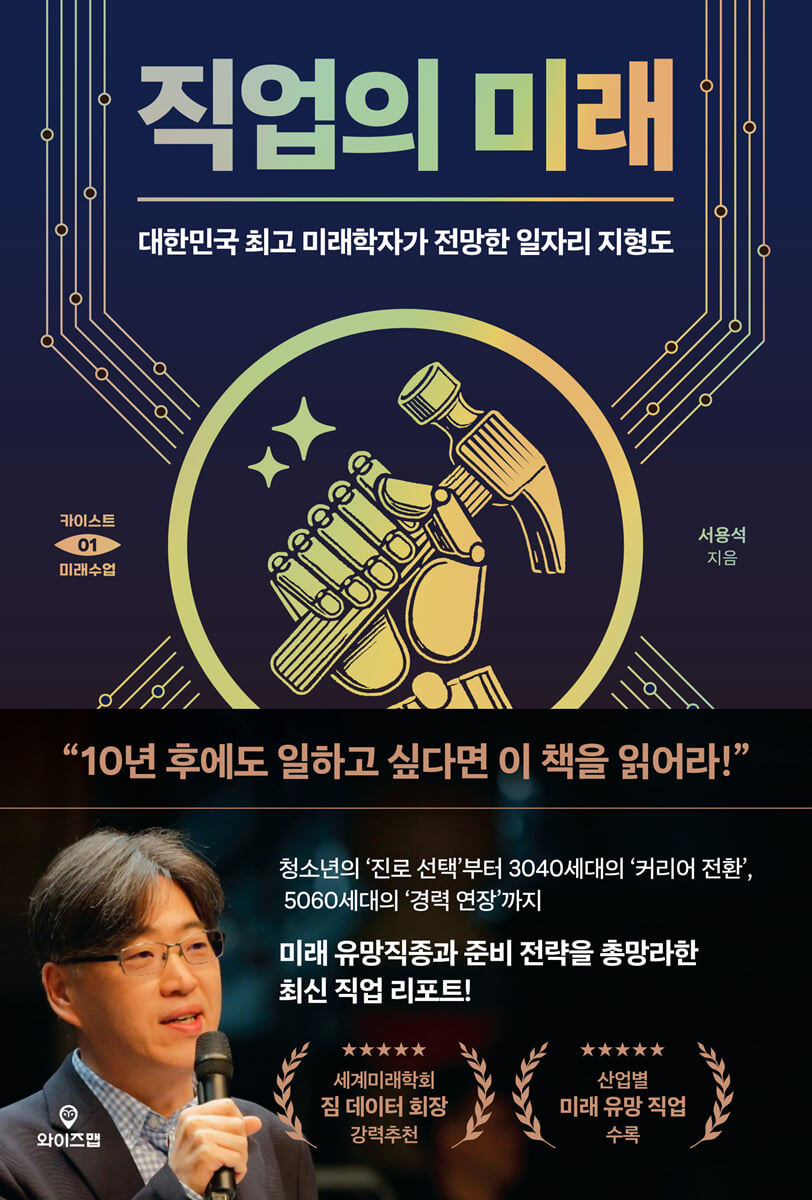
“If you still want to work in 10 years, read this book!”
From youth's "career choices" to the "career transition" of the 30-40 age group.
Even the 'career extension' of the 5060 generation
The latest career report, covering promising future careers and preparation strategies!
***Highly recommended by Jim Data, President of the World Futures Association, and Professor Lee Kwang-hyung, KAIST***
***Includes promising future jobs by industry***
A Great Job Transformation as Predicted by South Korea's Top Futurist
The "KAIST Future Class" series, featuring lectures by renowned scholars looking ahead to the next decade, opens with "The Future of Jobs."
For each individual, ‘occupation’ is a life-or-death choice that determines survival and is the root of social identity.
Everyone wants a job that is stable, pays well, and allows for self-fulfillment.
The problem is that such jobs are constantly changing and the skills required are also increasing.
The concept of a 'lifelong job' has now disappeared.
Many people express anxiety and curiosity about their jobs.
'How long can I make a living with this job?', 'Will being a doctor still be a promising career?', 'Is there no new job I can start as I get older?', 'What college major should my child choose to get the best job?'
There has never been an expert who could give a clear answer to such a life-changing question.
Professor Seo Yong-seok, Korea's most trusted futurologist, presents a clear vision for the future of work and careers.
Today, many jobs have been automated by AI and robots, and job opportunities are rapidly shrinking.
This is the opposite of what people expect when they want to work longer hours to make a living.
Both young people preparing for employment and middle-aged people looking for a second career are earnestly asking, "How should I make a living?"
But there's not all pessimism about jobs.
Because in this era of rapid change, jobs we could never have imagined are emerging.
Macroeconomic factors such as technological advancements, climate crisis, and demographic changes are rewriting the order of the world of work.
Only those who can read the times can discern between 'jobs in crisis' and 'jobs of opportunity.'
As every industry undergoes tectonic shifts, this book will guide you to careers that guarantee not only survival but also success.
From youth's "career choices" to the "career transition" of the 30-40 age group.
Even the 'career extension' of the 5060 generation
The latest career report, covering promising future careers and preparation strategies!
***Highly recommended by Jim Data, President of the World Futures Association, and Professor Lee Kwang-hyung, KAIST***
***Includes promising future jobs by industry***
A Great Job Transformation as Predicted by South Korea's Top Futurist
The "KAIST Future Class" series, featuring lectures by renowned scholars looking ahead to the next decade, opens with "The Future of Jobs."
For each individual, ‘occupation’ is a life-or-death choice that determines survival and is the root of social identity.
Everyone wants a job that is stable, pays well, and allows for self-fulfillment.
The problem is that such jobs are constantly changing and the skills required are also increasing.
The concept of a 'lifelong job' has now disappeared.
Many people express anxiety and curiosity about their jobs.
'How long can I make a living with this job?', 'Will being a doctor still be a promising career?', 'Is there no new job I can start as I get older?', 'What college major should my child choose to get the best job?'
There has never been an expert who could give a clear answer to such a life-changing question.
Professor Seo Yong-seok, Korea's most trusted futurologist, presents a clear vision for the future of work and careers.
Today, many jobs have been automated by AI and robots, and job opportunities are rapidly shrinking.
This is the opposite of what people expect when they want to work longer hours to make a living.
Both young people preparing for employment and middle-aged people looking for a second career are earnestly asking, "How should I make a living?"
But there's not all pessimism about jobs.
Because in this era of rapid change, jobs we could never have imagined are emerging.
Macroeconomic factors such as technological advancements, climate crisis, and demographic changes are rewriting the order of the world of work.
Only those who can read the times can discern between 'jobs in crisis' and 'jobs of opportunity.'
As every industry undergoes tectonic shifts, this book will guide you to careers that guarantee not only survival but also success.
- You can preview some of the book's contents.
Preview
index
Recommendation_Lee Kwang-hyung (KAIST Professor)
Special Preface by Jim Data (President of the World Future Society, Professor Emeritus, University of Hawaii)
Prologue_If your job doesn't exist in 10 years
Future Job Scenario: A Morning in a Middle-Class Family in 2040
Part 1.
A Brief History of Work and Occupations
1.
What is work
How do Eastern and Western labor views differ?
Work and occupations according to technological advancement
Part 2.
Three Structural Factors That Will Transform the Work Landscape
1.
Technological Advancement: The Wave of AI and Automation
Beyond automation and unmanned operation, into an era of intelligence
How far can AI go?
Hyper-Generative AI and Business Transformation
2.
Population Structure: Longevity in an Aging Society
The aging world
South Korea faces a red flag due to its extremely low birth rate.
The Correlation Between Population Structure and Future Jobs
3.
Climate Crisis: The Disaster of a "Boiling Earth"
Climate that threatens survival
The normalization of climate change and natural disasters
Carbon Neutrality and Corporate Income Statements
4.
Korea in the Era of Technological Hegemony Competition
From the Age of Geopolitics to the Age of Geopolitics
The world is now in a 'war for talent'
Part 3.
Promising industries and jobs of the future
1.
Disappeared and disappearing jobs
Occupations that existed in the past but have now disappeared
Jobs that are currently disappearing
Jobs that will disappear in the near future
Jobs that will survive in the future
2.
Promising future jobs that the times will create
Promising future industries and jobs driven by technological advancement
Promising future industries and occupations driven by demographic shifts
Promising future industries and jobs driven by the 'climate crisis'
3.
Promising careers in humanities, social sciences, arts, and physical education
Humanities and Social Sciences
Arts and Physical Education Department
The Future of the Culture and Entertainment Industry
4.
The future of today's popular jobs
Students' future aspirations
Part 4.
Preparing for future careers
1.
Five Job Skills Required by Future Society
emotional intelligence
Adaptability and resilience
critical thinking
creativity
technological literacy
2.
What should we prepare?
Check out new job trends
Choosing the Best Major
Reskilling and Upskilling
Career change
lifelong learning
3.
Career planning by life cycle
Middle and high school students preparing for college entrance exams
What Parents Need to Know About Preparing Their Children for Career
Fresh graduates taking their first steps into society
Middle-aged people in their 50s and 60s dreaming of a leap forward
4.
Choosing and Using Institutions for Career Preparation
Is college still important?
Pros and Cons of Studying Abroad: Vocational Training and Education Institutions
Appendix: The Role of Business and Government in Developing Future Talent
Epilogue: The Future is a Dynamic World
References
Special Preface by Jim Data (President of the World Future Society, Professor Emeritus, University of Hawaii)
Prologue_If your job doesn't exist in 10 years
Future Job Scenario: A Morning in a Middle-Class Family in 2040
Part 1.
A Brief History of Work and Occupations
1.
What is work
How do Eastern and Western labor views differ?
Work and occupations according to technological advancement
Part 2.
Three Structural Factors That Will Transform the Work Landscape
1.
Technological Advancement: The Wave of AI and Automation
Beyond automation and unmanned operation, into an era of intelligence
How far can AI go?
Hyper-Generative AI and Business Transformation
2.
Population Structure: Longevity in an Aging Society
The aging world
South Korea faces a red flag due to its extremely low birth rate.
The Correlation Between Population Structure and Future Jobs
3.
Climate Crisis: The Disaster of a "Boiling Earth"
Climate that threatens survival
The normalization of climate change and natural disasters
Carbon Neutrality and Corporate Income Statements
4.
Korea in the Era of Technological Hegemony Competition
From the Age of Geopolitics to the Age of Geopolitics
The world is now in a 'war for talent'
Part 3.
Promising industries and jobs of the future
1.
Disappeared and disappearing jobs
Occupations that existed in the past but have now disappeared
Jobs that are currently disappearing
Jobs that will disappear in the near future
Jobs that will survive in the future
2.
Promising future jobs that the times will create
Promising future industries and jobs driven by technological advancement
Promising future industries and occupations driven by demographic shifts
Promising future industries and jobs driven by the 'climate crisis'
3.
Promising careers in humanities, social sciences, arts, and physical education
Humanities and Social Sciences
Arts and Physical Education Department
The Future of the Culture and Entertainment Industry
4.
The future of today's popular jobs
Students' future aspirations
Part 4.
Preparing for future careers
1.
Five Job Skills Required by Future Society
emotional intelligence
Adaptability and resilience
critical thinking
creativity
technological literacy
2.
What should we prepare?
Check out new job trends
Choosing the Best Major
Reskilling and Upskilling
Career change
lifelong learning
3.
Career planning by life cycle
Middle and high school students preparing for college entrance exams
What Parents Need to Know About Preparing Their Children for Career
Fresh graduates taking their first steps into society
Middle-aged people in their 50s and 60s dreaming of a leap forward
4.
Choosing and Using Institutions for Career Preparation
Is college still important?
Pros and Cons of Studying Abroad: Vocational Training and Education Institutions
Appendix: The Role of Business and Government in Developing Future Talent
Epilogue: The Future is a Dynamic World
References
Detailed image

Into the book
The knowledge and skills we have now can become useless at any moment.
If we refuse to learn new things and are insensitive to change, our jobs may be in jeopardy at any time.
But there is no need to be discouraged.
We must become more competitive in line with the changing world.
As job roles are redefined and industries are restructured, individuals who can quickly adapt to new environments will survive in the working world.
Reskilling and upskilling will become more important than ever, and lifelong learning will become a necessity, not an option.
--- From "Prologue: What if your job doesn't exist in 10 years"
We are told that we should find joy and fulfillment in our work and pursue our values and self-actualization.
However, historically speaking, it is only very recently that 'work' has been portrayed in a positive light.
Since the beginning of civilization, work has always been considered 'painful'.
The value and meaning of work have changed over time, and their meanings also differ depending on civilization and culture.
(Omitted) The future view of labor will change with a focus on ‘technological advancement,’ and macroeconomic environments such as population structure and climate environment will also reconstruct the meaning of work.
In the future, it is expected that new labor values will emerge that harmonize individuals and society, work and play.
--- 「Part 1.
From “A Short History of Work and Professions”
Even today, a variety of smart devices and software that are fast, smart, and even cheap are providing capabilities once considered exclusively human.
Machines are rushing out of the factory to do marketing and sales, and even answer call center calls.
Following factory automation, even the service industry is being replaced by machines.
Even areas that once required highly specialized expertise, such as diagnosis, surgery, accounting, and legal services, are rapidly being encroached upon by AI.
This means that white-collar jobs may disappear in the near future.
“Machines will do that job starting tomorrow!” One day, we might suddenly hear something like this from our employer.
--- 「Part 2.
Among the “3 structural factors that will change the topography of work”
A decline in the working-age population means a decline in the labor force.
What can be inferred from this is the ‘alleviation of the unemployment problem.’
Our country's youth unemployment rate remained in the 7-8% range since the 2000s, peaking at 9.8% in 2017 before declining again to 5.9% in 2023.
The decline in the working-age population has already begun to be reflected in the alleviation of youth unemployment.
As of 2023, the population aged 25 to 29, which can be considered the working age group, is approximately 3.6 million.
The number of young employed people is estimated to decrease to 2.5 million in 2035, 2 million in 2045, and 1.63 million in 2048, when those born in 2023 enter the working age group.
Competition for jobs could be reduced, and young people in the future could find employment in a much more favorable environment than today.
However, there is one important variable here: job replacement by technology.
--- 「Part 2.
Among the “3 structural factors that will change the topography of work”
[Designer of a Good Death] In the coming era of low birth rates and high mortality, 'how to live' and 'how to end one's life' will become important topics.
This will soon lead to an interest in improving the quality of death along with the quality of life.
Because ‘well-dying’ is the completion and ultimate goal of ‘good life.’
'Good Death Designer' provides customized designs for customers to have a good death.
In addition to helping people prepare for death with their medical, legal, and financial plans, they also handle the practical tasks of writing wills and planning funerals.
Their role is also to provide emotional support and counseling to help people reconsider their negative perceptions of death.
So ultimately, we help our clients organize their lives the way they want and leave with peace and dignity.
--- 「Part 3.
Among the promising industries and occupations of the future
The most preferred occupation among middle and high school students is none other than ‘teacher.’
The role of teachers is changing significantly in response to rapidly changing educational environments, social conditions, and technological advancements.
While the role of teachers in the past was focused on imparting knowledge, teachers in the future will focus on personalizing students' learning experiences as facilitators, coaches, and mentors.
In today's world, we no longer rely on teachers; information and knowledge are readily accessible through the internet and digital platforms.
Teachers will now move beyond simply distributing information to become "learning designers" who facilitate students' independent learning and critical thinking.
Amid these changes, teachers are increasingly required to be versatile professionals who possess creative problem-solving skills, diverse technical competencies, and the ability to support students emotionally and socially.
--- 「Part 3.
From “Promising Industries and Jobs of the Future”
Traditionally, career changes were considered rare, but in this era of constant change, career changes will become the norm in the workplace.
In the age of automation and AI, the loss of jobs due to technology is an undeniable reality.
But we must also consider that as certain jobs disappear, new jobs will emerge that we cannot yet imagine.
In the future, rather than being fixated on one career, we will need to become lifelong learners and adapt to the new world of work.
Of course, to do so, we must continuously upgrade our technology and knowledge.
The traditional concept of career transitions will become less relevant in the future world of work, and multi-stage careers will become more prevalent.
A new concept of career is gaining traction, encompassing work, study, and even potential career breaks.
This shift reflects a shift in how we understand work from an employment-centric model to one that focuses on "employability"—the ability to obtain and maintain employment.
--- 「Part 4.
From “Preparing for Future Jobs”
In addition, there are various programs in which the government and businesses collaborate to cultivate talent suited to industrial needs.
For example, the 'Work-Study Program' is a program that allows students to receive on-the-job training (OJT) at a company and theoretical learning at school, allowing them to experience both learning and working at the same time.
Learners can receive training while receiving wages, and companies can develop talent by receiving training expenses support.
Major domestic corporations are also participating in this.
Another program is the 'K-Move School' operated by the Ministry of Employment and Labor and the Korea Human Resources Development Institute for Industry.
This is a program that supports overseas employment, providing young people with job training, language education, and cultural adaptation education necessary for overseas employment.
Its unique feature is that it links internships and employment with overseas companies in countries such as the United States, Japan, and Australia.
If we refuse to learn new things and are insensitive to change, our jobs may be in jeopardy at any time.
But there is no need to be discouraged.
We must become more competitive in line with the changing world.
As job roles are redefined and industries are restructured, individuals who can quickly adapt to new environments will survive in the working world.
Reskilling and upskilling will become more important than ever, and lifelong learning will become a necessity, not an option.
--- From "Prologue: What if your job doesn't exist in 10 years"
We are told that we should find joy and fulfillment in our work and pursue our values and self-actualization.
However, historically speaking, it is only very recently that 'work' has been portrayed in a positive light.
Since the beginning of civilization, work has always been considered 'painful'.
The value and meaning of work have changed over time, and their meanings also differ depending on civilization and culture.
(Omitted) The future view of labor will change with a focus on ‘technological advancement,’ and macroeconomic environments such as population structure and climate environment will also reconstruct the meaning of work.
In the future, it is expected that new labor values will emerge that harmonize individuals and society, work and play.
--- 「Part 1.
From “A Short History of Work and Professions”
Even today, a variety of smart devices and software that are fast, smart, and even cheap are providing capabilities once considered exclusively human.
Machines are rushing out of the factory to do marketing and sales, and even answer call center calls.
Following factory automation, even the service industry is being replaced by machines.
Even areas that once required highly specialized expertise, such as diagnosis, surgery, accounting, and legal services, are rapidly being encroached upon by AI.
This means that white-collar jobs may disappear in the near future.
“Machines will do that job starting tomorrow!” One day, we might suddenly hear something like this from our employer.
--- 「Part 2.
Among the “3 structural factors that will change the topography of work”
A decline in the working-age population means a decline in the labor force.
What can be inferred from this is the ‘alleviation of the unemployment problem.’
Our country's youth unemployment rate remained in the 7-8% range since the 2000s, peaking at 9.8% in 2017 before declining again to 5.9% in 2023.
The decline in the working-age population has already begun to be reflected in the alleviation of youth unemployment.
As of 2023, the population aged 25 to 29, which can be considered the working age group, is approximately 3.6 million.
The number of young employed people is estimated to decrease to 2.5 million in 2035, 2 million in 2045, and 1.63 million in 2048, when those born in 2023 enter the working age group.
Competition for jobs could be reduced, and young people in the future could find employment in a much more favorable environment than today.
However, there is one important variable here: job replacement by technology.
--- 「Part 2.
Among the “3 structural factors that will change the topography of work”
[Designer of a Good Death] In the coming era of low birth rates and high mortality, 'how to live' and 'how to end one's life' will become important topics.
This will soon lead to an interest in improving the quality of death along with the quality of life.
Because ‘well-dying’ is the completion and ultimate goal of ‘good life.’
'Good Death Designer' provides customized designs for customers to have a good death.
In addition to helping people prepare for death with their medical, legal, and financial plans, they also handle the practical tasks of writing wills and planning funerals.
Their role is also to provide emotional support and counseling to help people reconsider their negative perceptions of death.
So ultimately, we help our clients organize their lives the way they want and leave with peace and dignity.
--- 「Part 3.
Among the promising industries and occupations of the future
The most preferred occupation among middle and high school students is none other than ‘teacher.’
The role of teachers is changing significantly in response to rapidly changing educational environments, social conditions, and technological advancements.
While the role of teachers in the past was focused on imparting knowledge, teachers in the future will focus on personalizing students' learning experiences as facilitators, coaches, and mentors.
In today's world, we no longer rely on teachers; information and knowledge are readily accessible through the internet and digital platforms.
Teachers will now move beyond simply distributing information to become "learning designers" who facilitate students' independent learning and critical thinking.
Amid these changes, teachers are increasingly required to be versatile professionals who possess creative problem-solving skills, diverse technical competencies, and the ability to support students emotionally and socially.
--- 「Part 3.
From “Promising Industries and Jobs of the Future”
Traditionally, career changes were considered rare, but in this era of constant change, career changes will become the norm in the workplace.
In the age of automation and AI, the loss of jobs due to technology is an undeniable reality.
But we must also consider that as certain jobs disappear, new jobs will emerge that we cannot yet imagine.
In the future, rather than being fixated on one career, we will need to become lifelong learners and adapt to the new world of work.
Of course, to do so, we must continuously upgrade our technology and knowledge.
The traditional concept of career transitions will become less relevant in the future world of work, and multi-stage careers will become more prevalent.
A new concept of career is gaining traction, encompassing work, study, and even potential career breaks.
This shift reflects a shift in how we understand work from an employment-centric model to one that focuses on "employability"—the ability to obtain and maintain employment.
--- 「Part 4.
From “Preparing for Future Jobs”
In addition, there are various programs in which the government and businesses collaborate to cultivate talent suited to industrial needs.
For example, the 'Work-Study Program' is a program that allows students to receive on-the-job training (OJT) at a company and theoretical learning at school, allowing them to experience both learning and working at the same time.
Learners can receive training while receiving wages, and companies can develop talent by receiving training expenses support.
Major domestic corporations are also participating in this.
Another program is the 'K-Move School' operated by the Ministry of Employment and Labor and the Korea Human Resources Development Institute for Industry.
This is a program that supports overseas employment, providing young people with job training, language education, and cultural adaptation education necessary for overseas employment.
Its unique feature is that it links internships and employment with overseas companies in countries such as the United States, Japan, and Australia.
--- 「Part 4.
From “Preparing for Future Jobs”
From “Preparing for Future Jobs”
Publisher's Review
KAIST's Future Class: A Guide to the World 10 Years From Now
In an age of hyper-uncertainty and hyper-acceleration, knowing the 'future' is in itself a competitive advantage and survival skill.
The 'KAIST Future Class' series features KAIST's top experts forecasting the future of their respective fields and offering insights to help students prepare for change.
This is the latest class for those who want to go beyond predicting tomorrow and create it themselves.
The first book in the series, "The Future of Jobs," is the author's first solo book, a professor at KAIST's Graduate School of Future Strategy and a leading Korean futurologist.
He says that in the future, “it is not the person who knows the most, but the person who learns the most who will succeed,” and he lists “endless will to learn” and “flexible adaptability” as the capabilities of future talent.
Only by possessing these capabilities can we survive the structural changes that shake up jobs.
The great waves of our times, such as technological advancements, demographic changes, and the climate crisis, are destroying existing jobs while simultaneously creating new ones.
Many currently unfamiliar professions, such as 'good death designer,' 'human-machine collaboration manager,' 'cyborg psychotherapist,' and 'metaverse artist,' are expected to become promising.
From promising future careers to preparation strategies, all in one book.
This book is divided into four parts, ranging from the grand trends surrounding work to practical solutions that can be applied to life immediately.
Part 1 examines the history of work and occupations.
Traces how the meaning of work has changed with technological evolution from ancient times to the present.
Part 2 examines three structural factors that will reshape the work landscape. These include "technological advancements" led by AI, "demographic changes" centered around an aging population, and "climate crises" in the era of heatwaves, offering insights into global megatrends related to work.
Part 3 introduces promising future industries and occupations resulting from the preceding structural changes.
It explains emerging careers and the future prospects of currently popular careers across science, engineering, humanities, and arts.
In the final Part 4, we present realistic strategies for preparing for future careers.
It contains tips that can be applied immediately to your own situation, such as the five competencies required of future talent, career plans for each generation from youth to middle-aged, and how to choose a university and major.
"The Future of Jobs" is a future job strategy book that reduces vague anxiety about jobs in turbulent times.
Follow the insights of a futurist who sees the next 10 years and find a promising career that's perfect for you.
In an age of hyper-uncertainty and hyper-acceleration, knowing the 'future' is in itself a competitive advantage and survival skill.
The 'KAIST Future Class' series features KAIST's top experts forecasting the future of their respective fields and offering insights to help students prepare for change.
This is the latest class for those who want to go beyond predicting tomorrow and create it themselves.
The first book in the series, "The Future of Jobs," is the author's first solo book, a professor at KAIST's Graduate School of Future Strategy and a leading Korean futurologist.
He says that in the future, “it is not the person who knows the most, but the person who learns the most who will succeed,” and he lists “endless will to learn” and “flexible adaptability” as the capabilities of future talent.
Only by possessing these capabilities can we survive the structural changes that shake up jobs.
The great waves of our times, such as technological advancements, demographic changes, and the climate crisis, are destroying existing jobs while simultaneously creating new ones.
Many currently unfamiliar professions, such as 'good death designer,' 'human-machine collaboration manager,' 'cyborg psychotherapist,' and 'metaverse artist,' are expected to become promising.
From promising future careers to preparation strategies, all in one book.
This book is divided into four parts, ranging from the grand trends surrounding work to practical solutions that can be applied to life immediately.
Part 1 examines the history of work and occupations.
Traces how the meaning of work has changed with technological evolution from ancient times to the present.
Part 2 examines three structural factors that will reshape the work landscape. These include "technological advancements" led by AI, "demographic changes" centered around an aging population, and "climate crises" in the era of heatwaves, offering insights into global megatrends related to work.
Part 3 introduces promising future industries and occupations resulting from the preceding structural changes.
It explains emerging careers and the future prospects of currently popular careers across science, engineering, humanities, and arts.
In the final Part 4, we present realistic strategies for preparing for future careers.
It contains tips that can be applied immediately to your own situation, such as the five competencies required of future talent, career plans for each generation from youth to middle-aged, and how to choose a university and major.
"The Future of Jobs" is a future job strategy book that reduces vague anxiety about jobs in turbulent times.
Follow the insights of a futurist who sees the next 10 years and find a promising career that's perfect for you.
GOODS SPECIFICS
- Date of issue: February 15, 2025
- Page count, weight, size: 308 pages | 550g | 152*225*19mm
- ISBN13: 9791189328924
- ISBN10: 1189328925
You may also like
카테고리
korean


korean

![GQ KOREA Mark (Monthly): December [2025]](http://librairie.coreenne.fr/cdn/shop/files/8ef265dbbfbf186523ed75ba7319009d.jpg?v=1765340328&width=3840)


