

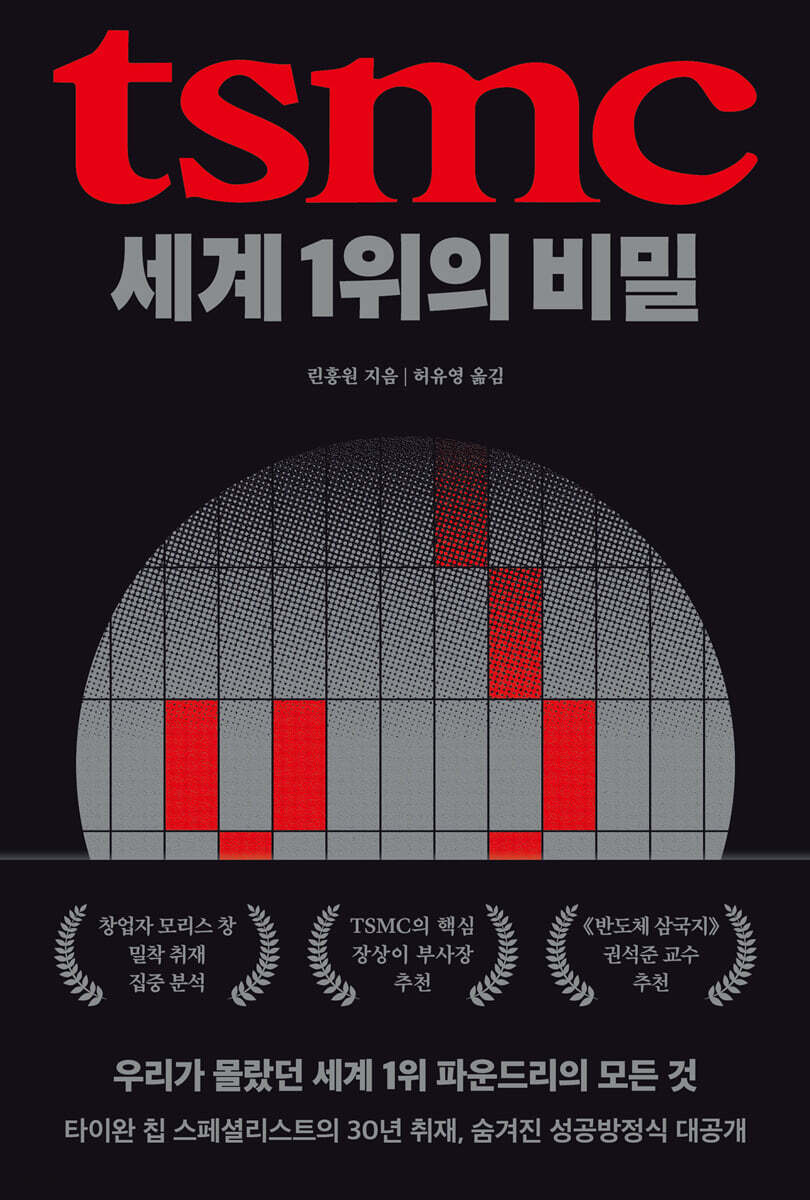
TSMC: The Secret to Being the World's No. 1
 |
Description
Book Introduction
Everything You Need to Know About the Taiwanese Semiconductor Company That's Dominating the World
The Vision and Strategy of TSMC, the Unrivaled Leader in the Semiconductor Industry
★Professor Kwon Seok-jun of Sungkyunkwan University and TSMC Vice President Jang Sang-i strongly recommend
TSMC is a Taiwanese semiconductor manufacturing company and is the world's overwhelming leader in semiconductor foundry (contract manufacturing).
It has grown into the world's leading foundry, producing the latest, most advanced semiconductor chips designed by companies such as Nvidia, Apple, and Qualcomm.
Big tech and global chip design companies are lining up to entrust manufacturing to TSMC, known for its high yields.
《TSMC, The Secret of the World's No. 1》 details the history of TSMC, from its founding to its development, crises, and overcoming them, now in its 37th year.
This book is captivating and covers the story of TSMC's struggles to rise to the top in the world, including the story of Morris Chang, a former vice president at Texas Instruments, a leading semiconductor company, returning to his home country to establish TSMC, his relationship and competitive landscape with Samsung, the fierce technological race with UMC, the biggest competitor in Taiwan, the transfer of TSMC's top engineer Liang Mengsong to Samsung and a Chinese semiconductor company, and the lawsuit against SMIC (a Chinese state-owned semiconductor company) for technology patent infringement.
Published in March 2024 under the title "TSMC's Secrets That Move the World", it garnered significant attention and detailed TSMC's success strategy, particularly its rare service spirit in the manufacturing industry and its unimaginable R&D passion.
From its early days, TSMC, where founder Maurice Chang put a lot of effort into recruiting engineers, has established an engineer-centric organizational structure.
Based on this, we focused on R&D to process customer orders with high yield and build international trust.
Based on its outstanding know-how in microprocessing, the company is solidifying its position even amid the US-China semiconductor war.
By aligning with Japan and establishing a factory in the United States, the company is minimizing the damage caused by US export sanctions on China, and its significance as a company that realizes the vision of Big Tech through manufacturing is shining.
Author Lin Hongwen is a true TSMC expert with 30 years of experience covering the tech industry, having interviewed Morris Chang in his first year as a reporter.
With Samsung Electronics facing a crisis, this book contains everything about TSMC, the world's top 10 company with a market capitalization of 1,400 trillion won and a 60% share of the foundry market, and the company the Korean semiconductor industry must strive to follow.
The Vision and Strategy of TSMC, the Unrivaled Leader in the Semiconductor Industry
★Professor Kwon Seok-jun of Sungkyunkwan University and TSMC Vice President Jang Sang-i strongly recommend
TSMC is a Taiwanese semiconductor manufacturing company and is the world's overwhelming leader in semiconductor foundry (contract manufacturing).
It has grown into the world's leading foundry, producing the latest, most advanced semiconductor chips designed by companies such as Nvidia, Apple, and Qualcomm.
Big tech and global chip design companies are lining up to entrust manufacturing to TSMC, known for its high yields.
《TSMC, The Secret of the World's No. 1》 details the history of TSMC, from its founding to its development, crises, and overcoming them, now in its 37th year.
This book is captivating and covers the story of TSMC's struggles to rise to the top in the world, including the story of Morris Chang, a former vice president at Texas Instruments, a leading semiconductor company, returning to his home country to establish TSMC, his relationship and competitive landscape with Samsung, the fierce technological race with UMC, the biggest competitor in Taiwan, the transfer of TSMC's top engineer Liang Mengsong to Samsung and a Chinese semiconductor company, and the lawsuit against SMIC (a Chinese state-owned semiconductor company) for technology patent infringement.
Published in March 2024 under the title "TSMC's Secrets That Move the World", it garnered significant attention and detailed TSMC's success strategy, particularly its rare service spirit in the manufacturing industry and its unimaginable R&D passion.
From its early days, TSMC, where founder Maurice Chang put a lot of effort into recruiting engineers, has established an engineer-centric organizational structure.
Based on this, we focused on R&D to process customer orders with high yield and build international trust.
Based on its outstanding know-how in microprocessing, the company is solidifying its position even amid the US-China semiconductor war.
By aligning with Japan and establishing a factory in the United States, the company is minimizing the damage caused by US export sanctions on China, and its significance as a company that realizes the vision of Big Tech through manufacturing is shining.
Author Lin Hongwen is a true TSMC expert with 30 years of experience covering the tech industry, having interviewed Morris Chang in his first year as a reporter.
With Samsung Electronics facing a crisis, this book contains everything about TSMC, the world's top 10 company with a market capitalization of 1,400 trillion won and a 60% share of the foundry market, and the company the Korean semiconductor industry must strive to follow.
- You can preview some of the book's contents.
Preview
index
Recommendation
TSMC: The Secret to Being No. 1 in the World poses a question to the Korean semiconductor industry.
Seokjun Kwon, Professor of Chemical Engineering at Sungkyunkwan University and author of "Three Kingdoms of Semiconductors"
Reporting definitive conclusions with a responsible attitude
Jang Sang-yi, former TSMC COO, current CSO of Foxconn Semiconductor Division
The Diary of an Observer Who Silently Watched Over the Growth of Large Corporations
Tsuyoshi Nojima, Japanese journalist
Preface to the Korean Edition | TSMC: Finding Greater Success Through Lessons from Failure
Introduction | A Radiance That Cannot Be Hidden: Which Side Should You Follow?
Introduction|A Brightly Shining Island
Part 1: Deployment and Strategy
Why my father recommended that I join TSMC/ Morris Chang said it was not wafer consignment manufacturing but 'silicon casting'/ Every step was a series of right choices/ A meritorious servant who should not be forgotten in the shadow of the military industry that protected the country/ Manufacturing must be made into a service industry to create high profits/ The two-headed carriage of the wafer industry is taking off/ TI-Acer and WSMC merge, clouds of a M&A war gather in Taiwan/ SMIC will not be a threat to TSMC/ Samsung is a threatening opponent, but not an admirable one/ The cause of the decline of the once-booming DRAM industry/ Building a winner's circle through a grand alliance/ Failing to succeed and then coming back to open a golden age/ Preventing the outflow of excellent talent/ Will TSMC's miracle creation continue?/ The outline of TSMC's three successors is revealed?
Part 2: Management and Administration
Everyone smells like Morris Chiang/ What you say is done, meetings are only meaningful/ The ‘supply chain elasticity’ of the Taiwanese semiconductor industry/ Frustrating competitors by winning in every way except price/ Shaking off cigarette ash, tearing up reports and shouting, ‘Get out!’/ How TSMC won the patent infringement lawsuit against SMIC/ Stopping talent poaching and preventing trade secret leaks/ Steak and whiskey at dinner the day before the board meeting/ Building a US factory: How will Taiwanese manage Americans?/ Not only ‘technological innovation’ but also ‘investment in technological innovation’ is important/ Long working hours, outdated software, stingy employee benefits
Part 3: Culture and DNA
A small clip from the visitor access control log/ From the first day of establishment to a global company/ Looking far ahead and quickly completing depreciation/ Why Taiwan became the world's number one foundry industry/ Even with a lot of money, words and actions are quiet and humble/ Only when there is competition can one's fighting spirit surge every day/ Taiwan's unique employee stock dividend system/ Choosing a successor based on ability, not connections/ Are first-class talents doing second-class work?/ Doing one's best in everything with sincerity and expertise
Part 4 R&D and Technology
A surprise attack / Why only four out of six R&D engineers remain / The 'Nighthawk Unit' that forgot to sleep in front of two gorillas / Building a higher wall with 7nm / A vast intellectual property warehouse hidden under the tip of the iceberg / Transforming into a learning organization through knowledge management / Infectious diseases, supply chain disruptions, war and supply chain expansion / A killer item that broke the limits of Moore's Law / The new ecosystem of Taiwan's IC design service and IP industry / The 20-year heyday from three perspectives / Are prestigious universities becoming TSMC's vocational training centers? / The biggest crisis facing Taiwan's semiconductor industry, a shortage of talent / The endgame of TSMC and Samsung? / Three trends and advance planning in the memory field
Part 5: Geopolitical Environment
Sanctions on China do not mean that the US will produce semiconductors again / Where are the semiconductors you use produced? / The US IC design industry and China's huge market / The catfish effect and the linkage effect / From Made in Taiwan to Made by Taiwan / Why is everything going to the US? It's for the customers! / Don't just look at the US, the highlight is Japan / JASM takes the lead and writes a new page for the Taiwan-Japan alliance / What's next for Taiwan-Japan semiconductor cooperation? / Reasons for the failure of the Japanese semiconductor industry / Will TSMC follow in the footsteps of the fallen Toshiba? / The US-China semiconductor war / Did Ren Zhengfei lose? / Why are we fighting? For whom are we fighting? / Is Taiwan's semiconductor industry really number one in the world?
Epilogue | Cherish the hard-earned achievements
Recommendation
TSMC when I was nineteen | He Ying-chi
The TSMC Path: The Success Model That Led Taiwan's Miracle | Lin Kunxi
Key to TSMC's Success: Building an Industrial Ecosystem That Enables Shared Prosperity | Shi Zhenrong
Respect for customers and foresight through the past|Cheongsja
TSMC: The Secret to Being No. 1 in the World poses a question to the Korean semiconductor industry.
Seokjun Kwon, Professor of Chemical Engineering at Sungkyunkwan University and author of "Three Kingdoms of Semiconductors"
Reporting definitive conclusions with a responsible attitude
Jang Sang-yi, former TSMC COO, current CSO of Foxconn Semiconductor Division
The Diary of an Observer Who Silently Watched Over the Growth of Large Corporations
Tsuyoshi Nojima, Japanese journalist
Preface to the Korean Edition | TSMC: Finding Greater Success Through Lessons from Failure
Introduction | A Radiance That Cannot Be Hidden: Which Side Should You Follow?
Introduction|A Brightly Shining Island
Part 1: Deployment and Strategy
Why my father recommended that I join TSMC/ Morris Chang said it was not wafer consignment manufacturing but 'silicon casting'/ Every step was a series of right choices/ A meritorious servant who should not be forgotten in the shadow of the military industry that protected the country/ Manufacturing must be made into a service industry to create high profits/ The two-headed carriage of the wafer industry is taking off/ TI-Acer and WSMC merge, clouds of a M&A war gather in Taiwan/ SMIC will not be a threat to TSMC/ Samsung is a threatening opponent, but not an admirable one/ The cause of the decline of the once-booming DRAM industry/ Building a winner's circle through a grand alliance/ Failing to succeed and then coming back to open a golden age/ Preventing the outflow of excellent talent/ Will TSMC's miracle creation continue?/ The outline of TSMC's three successors is revealed?
Part 2: Management and Administration
Everyone smells like Morris Chiang/ What you say is done, meetings are only meaningful/ The ‘supply chain elasticity’ of the Taiwanese semiconductor industry/ Frustrating competitors by winning in every way except price/ Shaking off cigarette ash, tearing up reports and shouting, ‘Get out!’/ How TSMC won the patent infringement lawsuit against SMIC/ Stopping talent poaching and preventing trade secret leaks/ Steak and whiskey at dinner the day before the board meeting/ Building a US factory: How will Taiwanese manage Americans?/ Not only ‘technological innovation’ but also ‘investment in technological innovation’ is important/ Long working hours, outdated software, stingy employee benefits
Part 3: Culture and DNA
A small clip from the visitor access control log/ From the first day of establishment to a global company/ Looking far ahead and quickly completing depreciation/ Why Taiwan became the world's number one foundry industry/ Even with a lot of money, words and actions are quiet and humble/ Only when there is competition can one's fighting spirit surge every day/ Taiwan's unique employee stock dividend system/ Choosing a successor based on ability, not connections/ Are first-class talents doing second-class work?/ Doing one's best in everything with sincerity and expertise
Part 4 R&D and Technology
A surprise attack / Why only four out of six R&D engineers remain / The 'Nighthawk Unit' that forgot to sleep in front of two gorillas / Building a higher wall with 7nm / A vast intellectual property warehouse hidden under the tip of the iceberg / Transforming into a learning organization through knowledge management / Infectious diseases, supply chain disruptions, war and supply chain expansion / A killer item that broke the limits of Moore's Law / The new ecosystem of Taiwan's IC design service and IP industry / The 20-year heyday from three perspectives / Are prestigious universities becoming TSMC's vocational training centers? / The biggest crisis facing Taiwan's semiconductor industry, a shortage of talent / The endgame of TSMC and Samsung? / Three trends and advance planning in the memory field
Part 5: Geopolitical Environment
Sanctions on China do not mean that the US will produce semiconductors again / Where are the semiconductors you use produced? / The US IC design industry and China's huge market / The catfish effect and the linkage effect / From Made in Taiwan to Made by Taiwan / Why is everything going to the US? It's for the customers! / Don't just look at the US, the highlight is Japan / JASM takes the lead and writes a new page for the Taiwan-Japan alliance / What's next for Taiwan-Japan semiconductor cooperation? / Reasons for the failure of the Japanese semiconductor industry / Will TSMC follow in the footsteps of the fallen Toshiba? / The US-China semiconductor war / Did Ren Zhengfei lose? / Why are we fighting? For whom are we fighting? / Is Taiwan's semiconductor industry really number one in the world?
Epilogue | Cherish the hard-earned achievements
Recommendation
TSMC when I was nineteen | He Ying-chi
The TSMC Path: The Success Model That Led Taiwan's Miracle | Lin Kunxi
Key to TSMC's Success: Building an Industrial Ecosystem That Enables Shared Prosperity | Shi Zhenrong
Respect for customers and foresight through the past|Cheongsja
Detailed image

Into the book
Another key secret to TSMC's success, as revealed in the book, is its R&D culture, which is in line with what Dr. Conrad Yang emphasized earlier. TSMC doesn't publish as many research papers in international journals as other integrated semiconductor manufacturers like Samsung Electronics or Intel.
This isn't because TSMC's researchers lack the paper-writing skills or data to compete with those at other companies, but rather because there's no need to disclose TSMC's technological know-how and data to the public. TSMC meticulously manages its extensive IP experience, solutions, and new material test data by converting them into IP, incorporating them into its portfolio of customer-specific chip designs.
--- p.15 「Recommendation.
From "TSMC, the Secret of World's No. 1": Questions for the Korean Semiconductor Industry
It is no exaggeration to say that semiconductors are synonymous with the Taiwanese economy and have become the country's most valuable asset.
Moreover, no one can deny that TSMC is at the center of semiconductors and the global economy.
TSMC, with a market capitalization of NT$12 trillion, always invests generously in facilities and R&D.
The era dominated by the three giants Samsung, Intel, and TSMC has passed, and TSMC has taken the lead in the race to miniaturization between 3nm and 2nm. TSMC has elevated Taiwan's standing on the global stage, earning it the nickname "Sacred Mountain of the Nation" (護國神山), creating a climate of "Taiwan must be protected" in the event of an emergency.
While we often discuss Taiwan, the semiconductor powerhouse, and TSMC, we actually know little about TSMC's history. The story behind TSMC's founding can only be gleaned from founder Morris Chang's autobiography or from TSMC's financial statements.
But what we need is information from someone who has personally witnessed TSMC's growth, and Lin Hongwen's book is exactly the valuable information we were looking for.
--- pp.24~25 「Recommendation.
From "The Diary of an Observer Who Silently Watched Over the Growth of Large Corporations"
How did Taiwan's semiconductor industry succeed? I believe there are several factors.
Over the past 40 years, as the global semiconductor industry has shifted from vertical integration to horizontal division of labor, Taiwan has seized the opportunity and adapted to the changes.
Moreover, most Taiwanese companies are engaged in foundry business without their own brands.
Companies that had their own brands spun off their brands and managed them independently.
Thanks to this, companies and customers were able to form a relationship of alliance rather than competition and pursue mutual growth.
--- p.30 Preface to the Korean edition.
From "TSMC Finds Greater Opportunities for Success Through Lessons from Failure"
Astute readers will have noticed that the English initials TSMC are sometimes written in lowercase as tsmc.
Why is that? Even British and American countries sometimes use lowercase letters for their own names for various reasons (such as to show respect).
But as far as I know, the reason TSMC uses lowercase letters is because the capital T has a suppressed feeling due to the long horizontal line, and the lowercase t has an image of breaking through and sticking its head out.
--- p.55 「Part 1 - Chapter 1.
From “Why my father recommended that I join TSMC”
TSMC positions itself as the "customer-satisfying contract manufacturing plant," attracting IC design companies without their own manufacturing facilities—so-called fabless companies—as clients. TSMC creates virtual factories, like homes for its customers. Customers can access TSMC-provided computer systems at any time with a password, allowing them to check the current wafer production status.
Just as FedEx customers can check the delivery status of their mail, they can check which TSMC factory the wafers they ordered are currently undergoing processing.
Additionally, TSMC's engineers actively solved customers' difficult problems as if they were employees of the customer company.
With just one phone call, a TSMC engineer would appear like a genie from Aladdin's lamp and solve the problem, which was better for the customer than building and producing the product themselves.
--- p.74 「Part 1 - Chapter 5.
“Manufacturing must be converted into a service industry to generate high profits.”
Intel manufactured all of its products in its own factories.
However, because there were not many production lines, as the old-generation process technology gradually matured, the number of products to be produced gradually decreased, making it difficult to manage the production lines of the old-generation process.
On the other hand, TSMC and UMC were able to receive orders from customers who needed older wafer processes, and since those older processes had already been depreciated, they became a great source of revenue for the companies.
TSMC has been able to improve its process technology to the highest level by dealing with the world's top customers such as Apple and Nvidia, while its older process was able to fill its production lines by finding suitable customers for automotive ICs and power ICs.
This is the high-efficiency, high-growth foundry business model.
--- pp.120~121 「Part 1 - Chapter 11.
From “Building a Winner Circle through the Grand Alliance”
A look at the three major forums TSMC hosts each year provides insight into TSMC's core competitiveness.
The first is the TSMC Technology Symposium, held every September.
This symposium, which is open to all customers and suppliers, will reveal TSMC's technology vision for the next few years, process technology mass production schedule, architecture, efficiency, power dissipation, speed, and other strengths.
These symposiums are primarily led by people in the sales, R&D, and operations departments, and recent symposiums have been attended by senior vice presidents in these fields, including Zhang Xiaoqiang, Luo Weiren, and Mi Yujie.
The second is the Open Innovation Platform (OIP) forum.
Held annually in October, this event primarily brings together companies across the IC design industry value chain, including electronic design automation, cloud computing, semiconductor design assets, and design service providers from TSMC's partner alliances, the DCA Design Center Alliance and the VCA Value Chain Alliance. The OIP Forum is hosted by TSMC's Design Technology Platform (DTP) division, founded by Cliff Hou.
The third is the Supply Chain Forum, held every year-end.
This forum invites TSMC's suppliers to select, award, and encourage suppliers who have contributed to improving TSMC's management efficiency through better services and lower prices.
The Supply Chain Forum is primarily managed by TSMC's Purchasing Department.
--- p.147 From "Part 1 - Chapter 15. The Outline of TSMC's Third Successor Revealed?"
It was only much later that TSMC learned through its customers that SMIC had allegedly copied TSMC's technology.
To secure evidence of patent infringement, TSMC first applied for an exit ban on former project manager Liu Yunchen in Taiwan, and also accused Liu Yunchen of leaking to SMIC the layout and design drawings of the 12-inch wafer factory, as well as data on the wafer manufacturing process and formulation.
Prosecutors who raided Liu Yunchen's home found on computer hard drives and email accounts that Italian-born Marco Mora, then COO of SMIC, had asked Liu Yunchen for a list of processes and equipment for TSMC's 12-inch wafer factory.
However, SMIC denied that it copied TSMC's technology.
--- p.192 From "Part 2 - Chapter 6. How TSMC Won the Patent Infringement Lawsuit Against SMIC"
At a June 2023 TSMC board meeting, when a reporter asked about some American employees' complaints about overtime and shift work, then-Chairman Mark Liu said quite frankly, "If you don't want to work overtime, you shouldn't be in this industry."
TSMC is the light of Taiwan, and will become a Taiwanese global company that possesses Taiwanese corporate culture and management style and demonstrates its competitive edge on the international stage.
In this era of shifting from "work hard" to "work smart," TSMC must embrace all criticism with the attitude of "correcting mistakes and working harder when there are none" to grow faster.
I believe Chairman Mark Liu and President Wei Zhejiang would agree with this idea if they were to lead TSMC into a golden age for the next decade.
--- p.227 「Part 2 - Chapter 11.
Long working hours, outdated software, and poor employee benefits
When discussing the success of Taiwan's semiconductor industry, there's one factor most people either don't know about or have never heard of.
This was Taiwan's super-powerful secret weapon: the employee stock dividend system.
This system was introduced to companies in the mid-1980s and was abolished in 2008, about 20 years later.
It is a system in which companies share a certain portion of the previous year's profits with their employees. Initially, some were paid in cash, but the distribution was mainly in stocks, like dividends.
As the stock market boomed and stock prices rose, this system proved to be very effective in boosting employee morale.
This system was a powerful weapon in scouting overseas talent or encouraging them to return to Korea and start their own businesses.
At the time, Taiwanese semiconductor companies could not afford to offer high salaries, making them unattractive enough for overseas talent to give up high salaries and return to Taiwan.
However, the revenue generated through this system more than compensates for the low salaries, so a large number of talented individuals return to Taiwan, providing an opportunity for the Taiwanese semiconductor industry to become globally competitive.
--- p.265 「Part 3 - Chapter 7.
Among Taiwan's unique employee stock dividend systems,
Although the R&D team was staffed with veterans such as Zhang Shangyi, Lin Benjian, Yang Guanglei, Sun Yuancheng, Liang Mengsong, and Wei Zhenhua, who were known as TSMC's "R&D Six Knights" at the time, senior management was somewhat skeptical of their decision to develop the technology on their own.
Then, their fighting spirit was further aroused, and they all went to see Chairman Morris Chang and persuaded him that they would definitely complete the mission.
This project was carried out at the Southern Science Complex wafer factory.
Jang Sang-i took overall command, and Wi Je-hwa, as the project manager, led about 20 people from the Shinju Science Complex to the Southern Science Complex.
Wei Zhen traveled between Tainan and Hsinchu every week to report progress to headquarters, and some 20 employees also left their families and stayed in Tainan for a year and a half to focus on technology development.
Wi Jeon-hwa said that he was so busy at the time that he was unable to be there for his wife when she was in a car accident, and he still feels sorry about that.
--- p.296 「Part 4 - Chapter 1.
From "A Striking Strike"
The 'Nighthawk Project' offered 400 R&D personnel the unprecedented conditions of '30% additional base pay and 50% performance bonus' and made them work 24 hours a day, 3 shifts without rest.
The workforce was divided into 'day shift', 'evening shift', and 'night shift', with each shift working in shifts of 8 hours each, focusing on developing 10 nanometer technology to shorten the learning curve.
Their goal was to completely overtake Samsung and Intel and become the world's number one company by 2016.
As we all know, TSMC's Nighthawk project was a huge success.
Apple's iPhone 6s series A9 processor chip was produced half by Samsung and half by TSMC, but after the 'chip gate' (a controversy over Samsung chips generating more heat than TSMC chips) broke out, Apple decided to order all A10 processor chips after the A9 from TSMC in 2016.
The Nighthawk Project was a complete success.
In 2022, Samsung began mass production of 3nm processes ahead of TSMC. While TSMC entered mass production later than Samsung, it surpassed Samsung in yield and lead times, and even further outpaced Intel, whose 10nm process technology development was lagging behind. TSMC has begun to gain a significant lead over its two competitors.
--- p.304 「Part 4 - Chapter 3.
From "Nighthawk Unit" that forgot to sleep in front of two gorillas
From the U.S. perspective, the Chinese government's indiscriminate cash injection into its semiconductor industry and its expansion into various industries, including weapons, IT, and military, already pose a serious threat to American hegemony.
Taiwan does not want any country to seize and wield hegemony.
But it is also in Taiwan's interest to agree to US regulations on China, as Taiwanese companies are the ones most directly affected as China gradually attempts to swallow up not only the low-end market but also the upper-tier market.
--- p.382 「Part 5 - Chapter 1.
Sanctions on China do not mean the U.S. will start producing semiconductors again.
The United States and China each seek to build resilient supply chains and achieve self-sufficiency by gathering friendly allies.
It appears that this situation of confrontation between the two powers will continue for the next 10 years or so.
Of course, the US has a much greater advantage, as there are more countries on the US side and they are all semiconductor powerhouses.
Because the United States restricts the export of advanced technologies and equipment to China, it is very difficult and time-consuming for China to develop advanced processes, forcing China to actively expand into mature process fields.
With imports of IC design software and advanced semiconductor technology equipment blocked, China is striving to achieve its goal of domestic production through its own technological development.
--- p.389 「Part 5 - Chapter 2.
Where are the semiconductors you use produced?
TSMC's investment in the United States could also have a very positive impact on the industrial chain and related effects of U.S. semiconductor production.
In fact, all industries are in a competitive cooperative relationship.
While they compete, there are bound to be areas of cooperation. TSMC has over 10,000 suppliers. TSMC's establishment of a US plant will enhance the capabilities of American manufacturing, and if TSMC's suppliers continue to enter the US market, it will play a significant role in expanding a healthy supply chain.
Additionally, all American manufacturers will benefit from the integration of Intel, Samsung, Texas Instruments, and Micron, and will benefit from a complete supply chain.
--- p.405 「Part 5 - Chapter 4.
From “Catfish Effect and Association Effect”
TSMC is currently carrying out large-scale investment projects in the United States, China, and Japan, but JASM is the only joint venture established between TSMC and a customer, making it particularly significant.
Since this plant will manufacture CMOS image sensors and automotive semiconductors for Sony and Denso on a contract basis and supply them entirely to specific customers, the Japanese company's investment is significant in that it guarantees a mutually beneficial business relationship.
--- p.421 「Part 5 - Chapter 7.
"Don't just look at the United States, the highlight is Japan"
Not only Taiwanese foundries but also Korean companies are bound to be affected by the US-China semiconductor war.
The impact on Korea will likely be no less severe than that on Taiwan, and the repercussions could be even greater and more widespread.
This is because Samsung and Hynix have actively invested in the Chinese market and received various preferential benefits from the Chinese government, and exports to China account for 40 percent of the total sales of the Korean semiconductor industry.
On the other hand, TSMC's exports to China account for less than 10 percent of its total sales, while the U.S. accounts for more than 60 percent.
South Korea, which is much more dependent on the Chinese market than Taiwan, is expected to be hit harder by these Chinese sanctions.
Moreover, tensions between North and South Korea are no less severe than those in the Taiwan Strait due to North Korea's continued missile launches near South Korea and Japan, and since most of Samsung's foundry plants are located in South Korea, there will likely be considerable pressure from the U.S. government to build a plant in the United States.
This isn't because TSMC's researchers lack the paper-writing skills or data to compete with those at other companies, but rather because there's no need to disclose TSMC's technological know-how and data to the public. TSMC meticulously manages its extensive IP experience, solutions, and new material test data by converting them into IP, incorporating them into its portfolio of customer-specific chip designs.
--- p.15 「Recommendation.
From "TSMC, the Secret of World's No. 1": Questions for the Korean Semiconductor Industry
It is no exaggeration to say that semiconductors are synonymous with the Taiwanese economy and have become the country's most valuable asset.
Moreover, no one can deny that TSMC is at the center of semiconductors and the global economy.
TSMC, with a market capitalization of NT$12 trillion, always invests generously in facilities and R&D.
The era dominated by the three giants Samsung, Intel, and TSMC has passed, and TSMC has taken the lead in the race to miniaturization between 3nm and 2nm. TSMC has elevated Taiwan's standing on the global stage, earning it the nickname "Sacred Mountain of the Nation" (護國神山), creating a climate of "Taiwan must be protected" in the event of an emergency.
While we often discuss Taiwan, the semiconductor powerhouse, and TSMC, we actually know little about TSMC's history. The story behind TSMC's founding can only be gleaned from founder Morris Chang's autobiography or from TSMC's financial statements.
But what we need is information from someone who has personally witnessed TSMC's growth, and Lin Hongwen's book is exactly the valuable information we were looking for.
--- pp.24~25 「Recommendation.
From "The Diary of an Observer Who Silently Watched Over the Growth of Large Corporations"
How did Taiwan's semiconductor industry succeed? I believe there are several factors.
Over the past 40 years, as the global semiconductor industry has shifted from vertical integration to horizontal division of labor, Taiwan has seized the opportunity and adapted to the changes.
Moreover, most Taiwanese companies are engaged in foundry business without their own brands.
Companies that had their own brands spun off their brands and managed them independently.
Thanks to this, companies and customers were able to form a relationship of alliance rather than competition and pursue mutual growth.
--- p.30 Preface to the Korean edition.
From "TSMC Finds Greater Opportunities for Success Through Lessons from Failure"
Astute readers will have noticed that the English initials TSMC are sometimes written in lowercase as tsmc.
Why is that? Even British and American countries sometimes use lowercase letters for their own names for various reasons (such as to show respect).
But as far as I know, the reason TSMC uses lowercase letters is because the capital T has a suppressed feeling due to the long horizontal line, and the lowercase t has an image of breaking through and sticking its head out.
--- p.55 「Part 1 - Chapter 1.
From “Why my father recommended that I join TSMC”
TSMC positions itself as the "customer-satisfying contract manufacturing plant," attracting IC design companies without their own manufacturing facilities—so-called fabless companies—as clients. TSMC creates virtual factories, like homes for its customers. Customers can access TSMC-provided computer systems at any time with a password, allowing them to check the current wafer production status.
Just as FedEx customers can check the delivery status of their mail, they can check which TSMC factory the wafers they ordered are currently undergoing processing.
Additionally, TSMC's engineers actively solved customers' difficult problems as if they were employees of the customer company.
With just one phone call, a TSMC engineer would appear like a genie from Aladdin's lamp and solve the problem, which was better for the customer than building and producing the product themselves.
--- p.74 「Part 1 - Chapter 5.
“Manufacturing must be converted into a service industry to generate high profits.”
Intel manufactured all of its products in its own factories.
However, because there were not many production lines, as the old-generation process technology gradually matured, the number of products to be produced gradually decreased, making it difficult to manage the production lines of the old-generation process.
On the other hand, TSMC and UMC were able to receive orders from customers who needed older wafer processes, and since those older processes had already been depreciated, they became a great source of revenue for the companies.
TSMC has been able to improve its process technology to the highest level by dealing with the world's top customers such as Apple and Nvidia, while its older process was able to fill its production lines by finding suitable customers for automotive ICs and power ICs.
This is the high-efficiency, high-growth foundry business model.
--- pp.120~121 「Part 1 - Chapter 11.
From “Building a Winner Circle through the Grand Alliance”
A look at the three major forums TSMC hosts each year provides insight into TSMC's core competitiveness.
The first is the TSMC Technology Symposium, held every September.
This symposium, which is open to all customers and suppliers, will reveal TSMC's technology vision for the next few years, process technology mass production schedule, architecture, efficiency, power dissipation, speed, and other strengths.
These symposiums are primarily led by people in the sales, R&D, and operations departments, and recent symposiums have been attended by senior vice presidents in these fields, including Zhang Xiaoqiang, Luo Weiren, and Mi Yujie.
The second is the Open Innovation Platform (OIP) forum.
Held annually in October, this event primarily brings together companies across the IC design industry value chain, including electronic design automation, cloud computing, semiconductor design assets, and design service providers from TSMC's partner alliances, the DCA Design Center Alliance and the VCA Value Chain Alliance. The OIP Forum is hosted by TSMC's Design Technology Platform (DTP) division, founded by Cliff Hou.
The third is the Supply Chain Forum, held every year-end.
This forum invites TSMC's suppliers to select, award, and encourage suppliers who have contributed to improving TSMC's management efficiency through better services and lower prices.
The Supply Chain Forum is primarily managed by TSMC's Purchasing Department.
--- p.147 From "Part 1 - Chapter 15. The Outline of TSMC's Third Successor Revealed?"
It was only much later that TSMC learned through its customers that SMIC had allegedly copied TSMC's technology.
To secure evidence of patent infringement, TSMC first applied for an exit ban on former project manager Liu Yunchen in Taiwan, and also accused Liu Yunchen of leaking to SMIC the layout and design drawings of the 12-inch wafer factory, as well as data on the wafer manufacturing process and formulation.
Prosecutors who raided Liu Yunchen's home found on computer hard drives and email accounts that Italian-born Marco Mora, then COO of SMIC, had asked Liu Yunchen for a list of processes and equipment for TSMC's 12-inch wafer factory.
However, SMIC denied that it copied TSMC's technology.
--- p.192 From "Part 2 - Chapter 6. How TSMC Won the Patent Infringement Lawsuit Against SMIC"
At a June 2023 TSMC board meeting, when a reporter asked about some American employees' complaints about overtime and shift work, then-Chairman Mark Liu said quite frankly, "If you don't want to work overtime, you shouldn't be in this industry."
TSMC is the light of Taiwan, and will become a Taiwanese global company that possesses Taiwanese corporate culture and management style and demonstrates its competitive edge on the international stage.
In this era of shifting from "work hard" to "work smart," TSMC must embrace all criticism with the attitude of "correcting mistakes and working harder when there are none" to grow faster.
I believe Chairman Mark Liu and President Wei Zhejiang would agree with this idea if they were to lead TSMC into a golden age for the next decade.
--- p.227 「Part 2 - Chapter 11.
Long working hours, outdated software, and poor employee benefits
When discussing the success of Taiwan's semiconductor industry, there's one factor most people either don't know about or have never heard of.
This was Taiwan's super-powerful secret weapon: the employee stock dividend system.
This system was introduced to companies in the mid-1980s and was abolished in 2008, about 20 years later.
It is a system in which companies share a certain portion of the previous year's profits with their employees. Initially, some were paid in cash, but the distribution was mainly in stocks, like dividends.
As the stock market boomed and stock prices rose, this system proved to be very effective in boosting employee morale.
This system was a powerful weapon in scouting overseas talent or encouraging them to return to Korea and start their own businesses.
At the time, Taiwanese semiconductor companies could not afford to offer high salaries, making them unattractive enough for overseas talent to give up high salaries and return to Taiwan.
However, the revenue generated through this system more than compensates for the low salaries, so a large number of talented individuals return to Taiwan, providing an opportunity for the Taiwanese semiconductor industry to become globally competitive.
--- p.265 「Part 3 - Chapter 7.
Among Taiwan's unique employee stock dividend systems,
Although the R&D team was staffed with veterans such as Zhang Shangyi, Lin Benjian, Yang Guanglei, Sun Yuancheng, Liang Mengsong, and Wei Zhenhua, who were known as TSMC's "R&D Six Knights" at the time, senior management was somewhat skeptical of their decision to develop the technology on their own.
Then, their fighting spirit was further aroused, and they all went to see Chairman Morris Chang and persuaded him that they would definitely complete the mission.
This project was carried out at the Southern Science Complex wafer factory.
Jang Sang-i took overall command, and Wi Je-hwa, as the project manager, led about 20 people from the Shinju Science Complex to the Southern Science Complex.
Wei Zhen traveled between Tainan and Hsinchu every week to report progress to headquarters, and some 20 employees also left their families and stayed in Tainan for a year and a half to focus on technology development.
Wi Jeon-hwa said that he was so busy at the time that he was unable to be there for his wife when she was in a car accident, and he still feels sorry about that.
--- p.296 「Part 4 - Chapter 1.
From "A Striking Strike"
The 'Nighthawk Project' offered 400 R&D personnel the unprecedented conditions of '30% additional base pay and 50% performance bonus' and made them work 24 hours a day, 3 shifts without rest.
The workforce was divided into 'day shift', 'evening shift', and 'night shift', with each shift working in shifts of 8 hours each, focusing on developing 10 nanometer technology to shorten the learning curve.
Their goal was to completely overtake Samsung and Intel and become the world's number one company by 2016.
As we all know, TSMC's Nighthawk project was a huge success.
Apple's iPhone 6s series A9 processor chip was produced half by Samsung and half by TSMC, but after the 'chip gate' (a controversy over Samsung chips generating more heat than TSMC chips) broke out, Apple decided to order all A10 processor chips after the A9 from TSMC in 2016.
The Nighthawk Project was a complete success.
In 2022, Samsung began mass production of 3nm processes ahead of TSMC. While TSMC entered mass production later than Samsung, it surpassed Samsung in yield and lead times, and even further outpaced Intel, whose 10nm process technology development was lagging behind. TSMC has begun to gain a significant lead over its two competitors.
--- p.304 「Part 4 - Chapter 3.
From "Nighthawk Unit" that forgot to sleep in front of two gorillas
From the U.S. perspective, the Chinese government's indiscriminate cash injection into its semiconductor industry and its expansion into various industries, including weapons, IT, and military, already pose a serious threat to American hegemony.
Taiwan does not want any country to seize and wield hegemony.
But it is also in Taiwan's interest to agree to US regulations on China, as Taiwanese companies are the ones most directly affected as China gradually attempts to swallow up not only the low-end market but also the upper-tier market.
--- p.382 「Part 5 - Chapter 1.
Sanctions on China do not mean the U.S. will start producing semiconductors again.
The United States and China each seek to build resilient supply chains and achieve self-sufficiency by gathering friendly allies.
It appears that this situation of confrontation between the two powers will continue for the next 10 years or so.
Of course, the US has a much greater advantage, as there are more countries on the US side and they are all semiconductor powerhouses.
Because the United States restricts the export of advanced technologies and equipment to China, it is very difficult and time-consuming for China to develop advanced processes, forcing China to actively expand into mature process fields.
With imports of IC design software and advanced semiconductor technology equipment blocked, China is striving to achieve its goal of domestic production through its own technological development.
--- p.389 「Part 5 - Chapter 2.
Where are the semiconductors you use produced?
TSMC's investment in the United States could also have a very positive impact on the industrial chain and related effects of U.S. semiconductor production.
In fact, all industries are in a competitive cooperative relationship.
While they compete, there are bound to be areas of cooperation. TSMC has over 10,000 suppliers. TSMC's establishment of a US plant will enhance the capabilities of American manufacturing, and if TSMC's suppliers continue to enter the US market, it will play a significant role in expanding a healthy supply chain.
Additionally, all American manufacturers will benefit from the integration of Intel, Samsung, Texas Instruments, and Micron, and will benefit from a complete supply chain.
--- p.405 「Part 5 - Chapter 4.
From “Catfish Effect and Association Effect”
TSMC is currently carrying out large-scale investment projects in the United States, China, and Japan, but JASM is the only joint venture established between TSMC and a customer, making it particularly significant.
Since this plant will manufacture CMOS image sensors and automotive semiconductors for Sony and Denso on a contract basis and supply them entirely to specific customers, the Japanese company's investment is significant in that it guarantees a mutually beneficial business relationship.
--- p.421 「Part 5 - Chapter 7.
"Don't just look at the United States, the highlight is Japan"
Not only Taiwanese foundries but also Korean companies are bound to be affected by the US-China semiconductor war.
The impact on Korea will likely be no less severe than that on Taiwan, and the repercussions could be even greater and more widespread.
This is because Samsung and Hynix have actively invested in the Chinese market and received various preferential benefits from the Chinese government, and exports to China account for 40 percent of the total sales of the Korean semiconductor industry.
On the other hand, TSMC's exports to China account for less than 10 percent of its total sales, while the U.S. accounts for more than 60 percent.
South Korea, which is much more dependent on the Chinese market than Taiwan, is expected to be hit harder by these Chinese sanctions.
Moreover, tensions between North and South Korea are no less severe than those in the Taiwan Strait due to North Korea's continued missile launches near South Korea and Japan, and since most of Samsung's foundry plants are located in South Korea, there will likely be considerable pressure from the U.S. government to build a plant in the United States.
--- p.449 From "Part 5 - Chapter 11. Will TSMC Follow in the Footsteps of the Failed Toshiba?"
Publisher's Review
What kind of company is TSMC?
Taiwan's best weapon, combining national strength
What kind of company is TSMC?
Semiconductor foundry, Taiwan's representative company, world's number one, describes this company.
When it comes to semiconductor sales, one might wonder if Samsung isn't also competing for the world's top spot. Unlike Samsung and SK Hynix, which have strengths in the memory sector within the fragmented semiconductor industry, TSMC specializes in producing non-memory semiconductors on order.
A company that contracts to manufacture semiconductors is called a "foundry." TSMC has grown into the world's leading foundry, producing cutting-edge semiconductor chips designed by companies like Nvidia, Apple, and Qualcomm.
Big tech and global chip design companies are lining up to entrust manufacturing to TSMC, known for its high yields.
TSMC recently reported a 54% year-on-year increase in net profit for the third quarter, reaching 14 trillion won.
The company achieved an earnings surprise with its impressive performance, and its global foundry market share is overwhelmingly first with 62% of sales in the second quarter of 2024.
Samsung Electronics ranked second with 11 percent, but its semiconductor design and foundry divisions recorded losses in the third quarter.
What these numbers tell us is this: if we want to have the last laugh in the semiconductor war, we need to dig into TSMC and discover its secrets to success.
The official name of TSMC is Taiwan Semiconductor Manufacturing Company.
It is called 'Taijidian Electric Power' locally and is a dream job for everyone, not just those in science and engineering.
TSMC, a source of pride for Taiwan, received 48 percent of its initial capital from the government, while Philips contributed 27 percent.
Philips later sold all of its shares, and the Taiwanese government now owns a 6 percent stake.
TSMC is now a private company with more than 70 percent of its shares held by foreigners.
《TSMC, The Secret of the World's No. 1》 details the history of TSMC, from its founding to its development, crises, and overcoming them, now in its 37th year.
This book is captivating and covers the story of TSMC's struggles to rise to the top in the world, including the story of Morris Chang, a former vice president at Texas Instruments, a leading semiconductor company, returning to his home country to establish TSMC, his relationship and competitive landscape with Samsung, the fierce technological race with UMC, the biggest competitor in Taiwan, the transfer of TSMC's top engineer Liang Mengsong to Samsung and a Chinese semiconductor company, and the lawsuit against SMIC (a Chinese state-owned semiconductor company) for technology patent infringement.
Professor Kwon Seok-jun of the Department of Chemical Engineering at Sungkyunkwan University, a semiconductor expert who wrote the recommendation, read the book and commented, “At a time when Samsung Electronics’ crisis is being reported daily and skepticism about the sustainability of the Korean semiconductor industry is dominating the media, this book could provide valuable hints on Korea’s future economic development strategy as well as ways to secure competitiveness in the semiconductor industry.”
Author Lin Hongwen is a high-tech and semiconductor industry expert who previously served as deputy editor-in-chief of Taiwan's leading economic journal, Business Today (published weekly), and now serves as an advisor.
In his first year in the media world, he interviewed TSMC founder and former chairman Morris Chang, and is also known as the reporter who covered the photos taken for the "R&D 6 Knights," a historical document about TSMC.
He is a TSMC expert who has closely covered the influential figures who drive TSMC for decades.
Published in Taiwan in 2023, TSMC, the Secret of the World's No. 1 was published in Japan in March 2024 under the title TSMC 世界を動かすヒミツ, the Secret that Moves the World, and attracted great attention.
TSMC's Success Strategy
Manufacturing like a service industry.
And life-threatening R&D
TSMC has pioneered a new paradigm in semiconductor manufacturing and has led the industry through its customer-centric business model and innovative technology development. Journalist Lin Hongwen, who has covered TSMC for over 30 years since its founding, has written a book that explores TSMC's founding and early challenges, management strategies and talent acquisition methods, corporate culture and engineer-centric organizational structure, key technological advancements and global partnerships, and strategies for navigating the US-China semiconductor war and geopolitical tensions.
Part 1: Deployment and Strategy - Covers the background of TSMC's establishment and the M&A war among semiconductor companies in Taiwan.
Part 2: Management and Administration - Covers founder Maurice Chang's commitment to securing talent and investing boldly in technological innovation.
Part 3: Culture and DNA - Employee Stock Dividend Plan, Short Term Equipment Lifespan, The Virtue of Humility, and the Dedication of Engineers.
Part 4: R&D and Technology - Covers TSMC's advanced technological development and its passion for R&D investment.
Part 5: Geopolitical Environment - Covers US sanctions on China, the failure of Japan's semiconductor industry, and TSMC's establishment of an overseas foundry plant.
As a semiconductor contract manufacturing company, TSMC has always focused on customer customization.
This is in contrast to Samsung Electronics, which is having difficulty developing its foundry business due to its own brand power.
Customers who design and manufacture semiconductor chips are reluctant to entrust their work to Samsung, their competitor. TSMC has focused on its foundry business, dedicating itself to R&D to improving yields and advancing finer processes. When it developed the 130nm copper process in 2000, which defeated IBM, its engineers voluntarily left their families for a year and a half to dedicate themselves to R&D, giving their all.
In 2016, when developing the 10nm process to fend off the pursuit of Samsung and Intel, the company offered its 400 R&D personnel an exceptionally generous condition: "30% additional base pay and 50% performance bonus," and made them work 24 hours a day, in three shifts, without rest.
As a result, the company achieved the feat of securing orders for all of Apple's A10 processor chips.
What can we discover when we compare TSMC's technological advancements with Samsung Electronics' current situation, which has brought back its workforce from its US factories and taken a step back from foundry investments?
In the era of the US-China trade war and AI, isn't the message that semiconductor companies should pursue life-or-death R&D?
Trump's second term follows the US-China semiconductor war.
How will TSMC and Taiwan navigate this crisis?
With Donald Trump's election as the 47th President of the United States, a second Trump administration is just around the corner.
Having survived the shooting and having no concerns about a second term, Trump appears to have nothing to fear.
His remark that Taiwan should pay for security costs like insurance to the United States caused TSMC's stock price to fall by 2% and the entire semiconductor market to falter.
Protectionism that favors only the United States, and America First, as reflected in the slogan "Make America Great Again," are creating anxiety in the semiconductor industry ecosystem, where division of labor is established across the globe.
South Korea's Samsung Electronics and Taiwan's TSMC have invested heavily in building factories in Texas and Arizona, respectively, to meet local production pressures and receive subsidies from the United States.
However, with the election of Trump, who is negative about subsidies for foreign companies, a red light has been turned on for the success of entering the US market.
The US-China semiconductor war, triggered by the Biden administration's restrictions on semiconductor exports to China, may intensify further during Trump's second term.
As if anticipating this situation, author Lin Hongwen addresses the ‘geopolitical environment’ in the final fifth part.
First, we propose a solution to overcome the crisis through cooperation with Japan.
“Although Japan’s market share in semiconductor production has plummeted, it still holds a leading position in the global market in semiconductor equipment, silicon wafers, chemicals, and materials.”
For example, TSMC claims that it can only produce chips for Apple if it has image sensors from Sony. TSMC even established JASM, a joint venture with Sony and Denso in Kyushu, Japan.
Is this an attempt to counter the United States through a Taiwan-Japan alliance? The author argues no.
It is a choice for Japan, a premium customer.
This makes sense when you think about TSMC's strategy of successfully treating manufacturing like a service industry.
Moreover, considering that one of the reasons why TSMC's Arizona plant is having difficulty operating smoothly is the different work culture in Taiwan, namely the aversion to overtime, it can be seen that investing in Japan is a rational choice.
Japan has had relatively low wages due to stagnant wage growth for a long time.
There is also the advantage of being able to operate factories at lower production costs compared to the United States.
He also points out that the collapse of Japan's semiconductor industry was not due to past U.S. sanctions, but rather to a lack of R&D and the rapid rise of Korea, and that Japan should be used as a lesson.
The author is quite positive about the outlook for US sanctions. His main point is that TSMC and its US customers share a shared destiny. TSMC has built trust with its customers in the foundry sector, leveraging its service-oriented mindset.
In addition, the company is dedicated to R&D and holds a market share of over 60 percent.
Because of its overwhelming manufacturing capabilities, big tech customers like Nvidia and Apple will rely on TSMC to produce chips to ensure the quality of their products.
If the supply of chips is disrupted due to US sanctions, US companies will also suffer damage in all directions.
The semiconductor industry's division of labor structure, established to improve efficiency and productivity, seems to imply the necessity of mutual growth.
Here we can find hints on how to survive US sanctions.
Finally, the author suggests that the competitive landscape with China will continue through his analysis of Huawei.
Huawei is growing its sales by designing products using only chips produced in China, thereby withstanding U.S. sanctions.
Huawei's case is consistent with TSMC's constant emphasis on the importance of R&D.
Taiwan's best weapon, combining national strength
What kind of company is TSMC?
Semiconductor foundry, Taiwan's representative company, world's number one, describes this company.
When it comes to semiconductor sales, one might wonder if Samsung isn't also competing for the world's top spot. Unlike Samsung and SK Hynix, which have strengths in the memory sector within the fragmented semiconductor industry, TSMC specializes in producing non-memory semiconductors on order.
A company that contracts to manufacture semiconductors is called a "foundry." TSMC has grown into the world's leading foundry, producing cutting-edge semiconductor chips designed by companies like Nvidia, Apple, and Qualcomm.
Big tech and global chip design companies are lining up to entrust manufacturing to TSMC, known for its high yields.
TSMC recently reported a 54% year-on-year increase in net profit for the third quarter, reaching 14 trillion won.
The company achieved an earnings surprise with its impressive performance, and its global foundry market share is overwhelmingly first with 62% of sales in the second quarter of 2024.
Samsung Electronics ranked second with 11 percent, but its semiconductor design and foundry divisions recorded losses in the third quarter.
What these numbers tell us is this: if we want to have the last laugh in the semiconductor war, we need to dig into TSMC and discover its secrets to success.
The official name of TSMC is Taiwan Semiconductor Manufacturing Company.
It is called 'Taijidian Electric Power' locally and is a dream job for everyone, not just those in science and engineering.
TSMC, a source of pride for Taiwan, received 48 percent of its initial capital from the government, while Philips contributed 27 percent.
Philips later sold all of its shares, and the Taiwanese government now owns a 6 percent stake.
TSMC is now a private company with more than 70 percent of its shares held by foreigners.
《TSMC, The Secret of the World's No. 1》 details the history of TSMC, from its founding to its development, crises, and overcoming them, now in its 37th year.
This book is captivating and covers the story of TSMC's struggles to rise to the top in the world, including the story of Morris Chang, a former vice president at Texas Instruments, a leading semiconductor company, returning to his home country to establish TSMC, his relationship and competitive landscape with Samsung, the fierce technological race with UMC, the biggest competitor in Taiwan, the transfer of TSMC's top engineer Liang Mengsong to Samsung and a Chinese semiconductor company, and the lawsuit against SMIC (a Chinese state-owned semiconductor company) for technology patent infringement.
Professor Kwon Seok-jun of the Department of Chemical Engineering at Sungkyunkwan University, a semiconductor expert who wrote the recommendation, read the book and commented, “At a time when Samsung Electronics’ crisis is being reported daily and skepticism about the sustainability of the Korean semiconductor industry is dominating the media, this book could provide valuable hints on Korea’s future economic development strategy as well as ways to secure competitiveness in the semiconductor industry.”
Author Lin Hongwen is a high-tech and semiconductor industry expert who previously served as deputy editor-in-chief of Taiwan's leading economic journal, Business Today (published weekly), and now serves as an advisor.
In his first year in the media world, he interviewed TSMC founder and former chairman Morris Chang, and is also known as the reporter who covered the photos taken for the "R&D 6 Knights," a historical document about TSMC.
He is a TSMC expert who has closely covered the influential figures who drive TSMC for decades.
Published in Taiwan in 2023, TSMC, the Secret of the World's No. 1 was published in Japan in March 2024 under the title TSMC 世界を動かすヒミツ, the Secret that Moves the World, and attracted great attention.
TSMC's Success Strategy
Manufacturing like a service industry.
And life-threatening R&D
TSMC has pioneered a new paradigm in semiconductor manufacturing and has led the industry through its customer-centric business model and innovative technology development. Journalist Lin Hongwen, who has covered TSMC for over 30 years since its founding, has written a book that explores TSMC's founding and early challenges, management strategies and talent acquisition methods, corporate culture and engineer-centric organizational structure, key technological advancements and global partnerships, and strategies for navigating the US-China semiconductor war and geopolitical tensions.
Part 1: Deployment and Strategy - Covers the background of TSMC's establishment and the M&A war among semiconductor companies in Taiwan.
Part 2: Management and Administration - Covers founder Maurice Chang's commitment to securing talent and investing boldly in technological innovation.
Part 3: Culture and DNA - Employee Stock Dividend Plan, Short Term Equipment Lifespan, The Virtue of Humility, and the Dedication of Engineers.
Part 4: R&D and Technology - Covers TSMC's advanced technological development and its passion for R&D investment.
Part 5: Geopolitical Environment - Covers US sanctions on China, the failure of Japan's semiconductor industry, and TSMC's establishment of an overseas foundry plant.
As a semiconductor contract manufacturing company, TSMC has always focused on customer customization.
This is in contrast to Samsung Electronics, which is having difficulty developing its foundry business due to its own brand power.
Customers who design and manufacture semiconductor chips are reluctant to entrust their work to Samsung, their competitor. TSMC has focused on its foundry business, dedicating itself to R&D to improving yields and advancing finer processes. When it developed the 130nm copper process in 2000, which defeated IBM, its engineers voluntarily left their families for a year and a half to dedicate themselves to R&D, giving their all.
In 2016, when developing the 10nm process to fend off the pursuit of Samsung and Intel, the company offered its 400 R&D personnel an exceptionally generous condition: "30% additional base pay and 50% performance bonus," and made them work 24 hours a day, in three shifts, without rest.
As a result, the company achieved the feat of securing orders for all of Apple's A10 processor chips.
What can we discover when we compare TSMC's technological advancements with Samsung Electronics' current situation, which has brought back its workforce from its US factories and taken a step back from foundry investments?
In the era of the US-China trade war and AI, isn't the message that semiconductor companies should pursue life-or-death R&D?
Trump's second term follows the US-China semiconductor war.
How will TSMC and Taiwan navigate this crisis?
With Donald Trump's election as the 47th President of the United States, a second Trump administration is just around the corner.
Having survived the shooting and having no concerns about a second term, Trump appears to have nothing to fear.
His remark that Taiwan should pay for security costs like insurance to the United States caused TSMC's stock price to fall by 2% and the entire semiconductor market to falter.
Protectionism that favors only the United States, and America First, as reflected in the slogan "Make America Great Again," are creating anxiety in the semiconductor industry ecosystem, where division of labor is established across the globe.
South Korea's Samsung Electronics and Taiwan's TSMC have invested heavily in building factories in Texas and Arizona, respectively, to meet local production pressures and receive subsidies from the United States.
However, with the election of Trump, who is negative about subsidies for foreign companies, a red light has been turned on for the success of entering the US market.
The US-China semiconductor war, triggered by the Biden administration's restrictions on semiconductor exports to China, may intensify further during Trump's second term.
As if anticipating this situation, author Lin Hongwen addresses the ‘geopolitical environment’ in the final fifth part.
First, we propose a solution to overcome the crisis through cooperation with Japan.
“Although Japan’s market share in semiconductor production has plummeted, it still holds a leading position in the global market in semiconductor equipment, silicon wafers, chemicals, and materials.”
For example, TSMC claims that it can only produce chips for Apple if it has image sensors from Sony. TSMC even established JASM, a joint venture with Sony and Denso in Kyushu, Japan.
Is this an attempt to counter the United States through a Taiwan-Japan alliance? The author argues no.
It is a choice for Japan, a premium customer.
This makes sense when you think about TSMC's strategy of successfully treating manufacturing like a service industry.
Moreover, considering that one of the reasons why TSMC's Arizona plant is having difficulty operating smoothly is the different work culture in Taiwan, namely the aversion to overtime, it can be seen that investing in Japan is a rational choice.
Japan has had relatively low wages due to stagnant wage growth for a long time.
There is also the advantage of being able to operate factories at lower production costs compared to the United States.
He also points out that the collapse of Japan's semiconductor industry was not due to past U.S. sanctions, but rather to a lack of R&D and the rapid rise of Korea, and that Japan should be used as a lesson.
The author is quite positive about the outlook for US sanctions. His main point is that TSMC and its US customers share a shared destiny. TSMC has built trust with its customers in the foundry sector, leveraging its service-oriented mindset.
In addition, the company is dedicated to R&D and holds a market share of over 60 percent.
Because of its overwhelming manufacturing capabilities, big tech customers like Nvidia and Apple will rely on TSMC to produce chips to ensure the quality of their products.
If the supply of chips is disrupted due to US sanctions, US companies will also suffer damage in all directions.
The semiconductor industry's division of labor structure, established to improve efficiency and productivity, seems to imply the necessity of mutual growth.
Here we can find hints on how to survive US sanctions.
Finally, the author suggests that the competitive landscape with China will continue through his analysis of Huawei.
Huawei is growing its sales by designing products using only chips produced in China, thereby withstanding U.S. sanctions.
Huawei's case is consistent with TSMC's constant emphasis on the importance of R&D.
GOODS SPECIFICS
- Date of issue: November 20, 2024
- Page count, weight, size: 496 pages | 152*225*20mm
- ISBN13: 9791193166789
- ISBN10: 1193166780
You may also like
카테고리
korean


korean

![GQ KOREA Mark (Monthly): December [2025]](http://librairie.coreenne.fr/cdn/shop/files/8ef265dbbfbf186523ed75ba7319009d.jpg?v=1765340328&width=3840)


