

Infinite wealth
 |
Description
Book Introduction
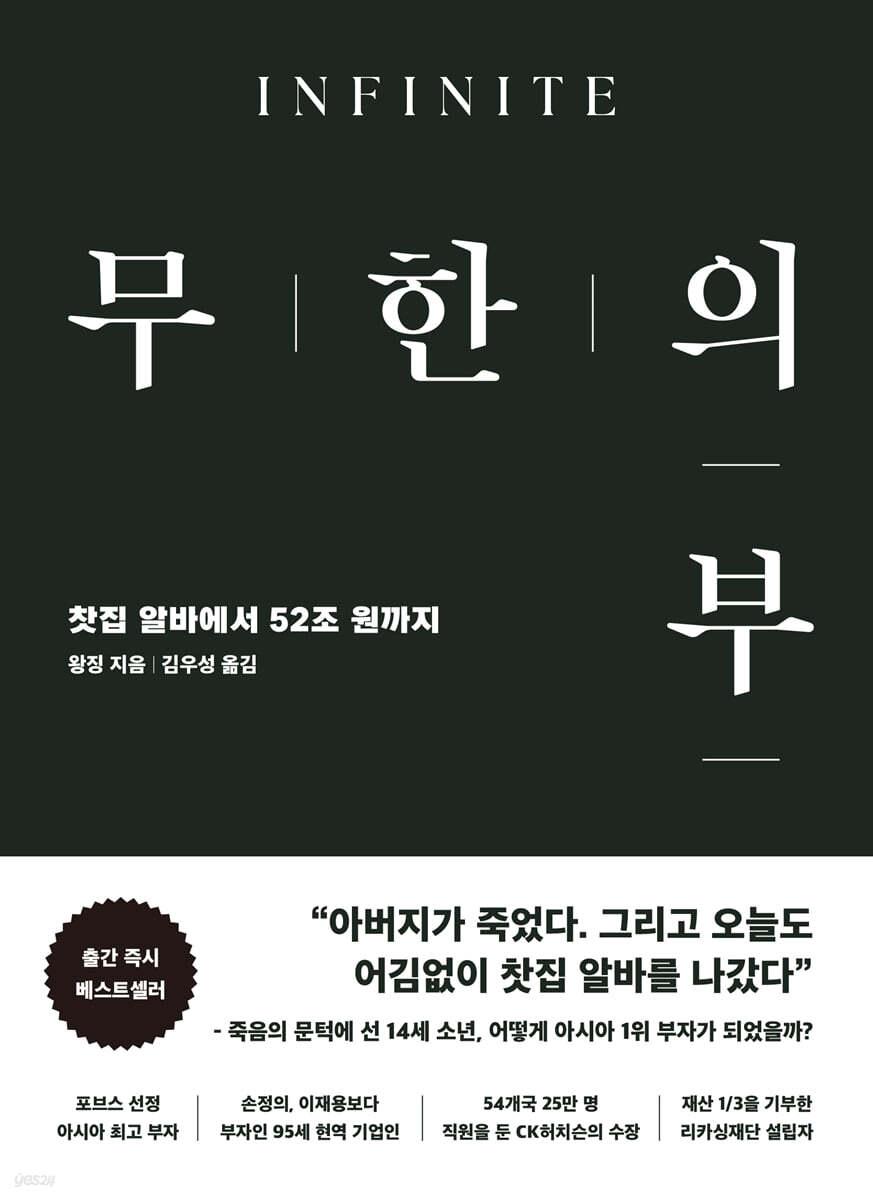
The shocking confession of Li Ka-shing, Asia's richest man.
“Building wealth is the easiest thing to do.”
When you think of "rich," who comes to mind? Tesla's Elon Musk? Microsoft's Bill Gates? You don't even have to go all the way to the United States.
There is Li Ka-shing, who grew up to be a world-class tycoon on an island smaller than Jeju Island.
He immigrated to Hong Kong as a war refugee at the age of 12, lost his father to tuberculosis at the age of 14, and dropped out of school.
He started out working in a tea shop to support his family, and now leads a business empire with 250,000 employees in 54 countries.
The market capitalization of the company he runs is 52 trillion won, which is equivalent to the annual budget of Seoul.
You could think of it this way.
“Isn’t it too far-fetched for someone like me to be a 52 trillion won billionaire?” But Li Ka-shing didn’t come from a silver spoon in his mouth.
His story is different: penniless, war-torn, and starting from the bottom, becoming a father at the age of 14.
"Infinite Wealth" tells the story of a boy who becomes the head of a household due to tuberculosis at the age of 14 and grows into a global business magnate.
This book introduces Li Ka-shing's journey from childhood to success as a global entrepreneur, as well as his investment principles and management philosophy.
The life of Li Ka-shing, whom Warren Buffett hailed as a "textbook of modern management," goes beyond mere boasting or talking about money.
As a man with assets worth 52 trillion won, it vividly shows the important decisions he made and his innovative business philosophy.
His constant passion, which continues to this day even in his 90s, makes readers think again about the true meaning of 'wealth'.
This book also contains 60 action plans to help you learn from Li Ka-shing's thinking.
If you practice them one by one, you will gain the ‘infinite power to build wealth.’
Embark on a journey to infinite wealth with Li Ka-shing's 60 life-changing questions.
“Building wealth is the easiest thing to do.”
When you think of "rich," who comes to mind? Tesla's Elon Musk? Microsoft's Bill Gates? You don't even have to go all the way to the United States.
There is Li Ka-shing, who grew up to be a world-class tycoon on an island smaller than Jeju Island.
He immigrated to Hong Kong as a war refugee at the age of 12, lost his father to tuberculosis at the age of 14, and dropped out of school.
He started out working in a tea shop to support his family, and now leads a business empire with 250,000 employees in 54 countries.
The market capitalization of the company he runs is 52 trillion won, which is equivalent to the annual budget of Seoul.
You could think of it this way.
“Isn’t it too far-fetched for someone like me to be a 52 trillion won billionaire?” But Li Ka-shing didn’t come from a silver spoon in his mouth.
His story is different: penniless, war-torn, and starting from the bottom, becoming a father at the age of 14.
"Infinite Wealth" tells the story of a boy who becomes the head of a household due to tuberculosis at the age of 14 and grows into a global business magnate.
This book introduces Li Ka-shing's journey from childhood to success as a global entrepreneur, as well as his investment principles and management philosophy.
The life of Li Ka-shing, whom Warren Buffett hailed as a "textbook of modern management," goes beyond mere boasting or talking about money.
As a man with assets worth 52 trillion won, it vividly shows the important decisions he made and his innovative business philosophy.
His constant passion, which continues to this day even in his 90s, makes readers think again about the true meaning of 'wealth'.
This book also contains 60 action plans to help you learn from Li Ka-shing's thinking.
If you practice them one by one, you will gain the ‘infinite power to build wealth.’
Embark on a journey to infinite wealth with Li Ka-shing's 60 life-changing questions.
- You can preview some of the book's contents.
Preview
index
introduction
From Tea Shop Part-Time Jobs to 52 Trillion Won, Seeing the Future with Survival Instinct
First word: suffering
Infinite power gained at age 14
In the fear of death at first step
How to converge to a 0% chance of failure using the 2-principle method
What happened while cleaning at someone else's company
Insight: How to accurately predict the future without spending a penny.
Second word: resignation letter
The meaning of looking at the world through a dichotomous lens
Great wealth depends on heaven, small wealth depends on people.
Stability: The principle of never failing until the age of 100. Crisis: How to overcome a life-or-death crisis. Opportunity: The lemon juice strategy for life's trials.
Even a perfectly prepared dish will spoil after a week.
Third word: trust
The equation of deception, deception, and trust
What is the difference between profiteering and stinginess?
The true meaning behind the words spoken with confidence
The 'no responsibility' strategy of favoritism
The Art of Foolish Honesty
Fourth word: potential
The Long-Term Implications of a Debt-Free Strategy in Developmental Life
An eye that reads the decisive moment
Don't pop the champagne, sit at your desk. How David crushed Goliath's head. To catch up with the master leader.
Fifth Word: Cooperation and Coexistence
The Difference Between Buying Antiques and Life
The cooperative factor spends its entire life looking only at its surroundings due to past wounds. Harmony is a value more important than permanence and invincibility.
Sixth word: embrace
Networks: Small streams gather to form a mighty river. No one rises without a noble person. Transformation: The difference between a CEO and a leader.
When the advance workers leave, the factory is covered in grass.
When the principle of balance is needed, and when it is not
The curious phenomenon that appears when the humble A acts like B.
Seventh word: opportunity
Insight Why Napoleon Was Wrong Finding the Center of Leverage Rather than Pulse Strength Stability One Solid Leg
Split My Investment Principles That Always Win
Eighth word: vision
When people laugh at the counter-currents and say they will fail
It is impossible to kill an eye-catching viper and obtain its eggs.
Where Does Long-Term Investing Patience Come From?
Five Principles for Building a Giant Oak Tree
How to Get Unlimited Credit: Tea Shop Job
Ninth Word: Control Stop Strategic Retreat
A choice that boldly goes against popular opinion
Perspective: Don't interpret partial failure as total failure. Survival may mean decline. Moderation: Why I never pick up the last coin.
Vision Buys Half of Britain
Tenth Word: Humility
Eyes for Foresight: Reading 30 Minutes a Day
Courage Invests in Electric Vehicles in 2010
Innovation: Facebook's 2007 investment decision made in 5 minutes
Mission: What good is it to live a hundred years if you live without value?
The three most profitable businesses of the future are:
Eleventh word: reduction
3 Principles for Handling Donations
Why I Never Get Into the Casino Business: Ethics: What kind of person do you consider perfect? Respect: Wealth gained through evil doesn't last.
Twelfth Word: Inner Wealth, Inner Growth
Recalling my part-time job at a tea house
Balanced Family: Never Share Wealth: Frugality: Aim for High Aspirations, Enjoy Low Blessings: Cooperation: Establish the Self First, Pursue Selflessness
Epilogue
Li Ka-shing's Action Plan 60: A Chronology of Li Ka-shing's Life and Business
From Tea Shop Part-Time Jobs to 52 Trillion Won, Seeing the Future with Survival Instinct
First word: suffering
Infinite power gained at age 14
In the fear of death at first step
How to converge to a 0% chance of failure using the 2-principle method
What happened while cleaning at someone else's company
Insight: How to accurately predict the future without spending a penny.
Second word: resignation letter
The meaning of looking at the world through a dichotomous lens
Great wealth depends on heaven, small wealth depends on people.
Stability: The principle of never failing until the age of 100. Crisis: How to overcome a life-or-death crisis. Opportunity: The lemon juice strategy for life's trials.
Even a perfectly prepared dish will spoil after a week.
Third word: trust
The equation of deception, deception, and trust
What is the difference between profiteering and stinginess?
The true meaning behind the words spoken with confidence
The 'no responsibility' strategy of favoritism
The Art of Foolish Honesty
Fourth word: potential
The Long-Term Implications of a Debt-Free Strategy in Developmental Life
An eye that reads the decisive moment
Don't pop the champagne, sit at your desk. How David crushed Goliath's head. To catch up with the master leader.
Fifth Word: Cooperation and Coexistence
The Difference Between Buying Antiques and Life
The cooperative factor spends its entire life looking only at its surroundings due to past wounds. Harmony is a value more important than permanence and invincibility.
Sixth word: embrace
Networks: Small streams gather to form a mighty river. No one rises without a noble person. Transformation: The difference between a CEO and a leader.
When the advance workers leave, the factory is covered in grass.
When the principle of balance is needed, and when it is not
The curious phenomenon that appears when the humble A acts like B.
Seventh word: opportunity
Insight Why Napoleon Was Wrong Finding the Center of Leverage Rather than Pulse Strength Stability One Solid Leg
Split My Investment Principles That Always Win
Eighth word: vision
When people laugh at the counter-currents and say they will fail
It is impossible to kill an eye-catching viper and obtain its eggs.
Where Does Long-Term Investing Patience Come From?
Five Principles for Building a Giant Oak Tree
How to Get Unlimited Credit: Tea Shop Job
Ninth Word: Control Stop Strategic Retreat
A choice that boldly goes against popular opinion
Perspective: Don't interpret partial failure as total failure. Survival may mean decline. Moderation: Why I never pick up the last coin.
Vision Buys Half of Britain
Tenth Word: Humility
Eyes for Foresight: Reading 30 Minutes a Day
Courage Invests in Electric Vehicles in 2010
Innovation: Facebook's 2007 investment decision made in 5 minutes
Mission: What good is it to live a hundred years if you live without value?
The three most profitable businesses of the future are:
Eleventh word: reduction
3 Principles for Handling Donations
Why I Never Get Into the Casino Business: Ethics: What kind of person do you consider perfect? Respect: Wealth gained through evil doesn't last.
Twelfth Word: Inner Wealth, Inner Growth
Recalling my part-time job at a tea house
Balanced Family: Never Share Wealth: Frugality: Aim for High Aspirations, Enjoy Low Blessings: Cooperation: Establish the Self First, Pursue Selflessness
Epilogue
Li Ka-shing's Action Plan 60: A Chronology of Li Ka-shing's Life and Business
Detailed image

Into the book
Although my goal of opening a watch shop is still a long way off, I feel I've learned almost everything I can here.
I had to suppress my opinions a lot to save face for my uncle.
If you continue to work here, you will be guaranteed a stable income and a comfortable life.
But one day I vaguely realized that this comfort could be limiting my growth.
So I made a bold decision.
To gain more experience, broaden my horizons, and constantly train myself.
I left my comfortable life behind and took on a new challenge for a better future.
--- p.33, from “2 Principles: How to Converge to 0% Failure Probability”
I decided that team harmony was more important in the long run.
I asked the company to adjust my bonus to the same level as the second-ranked salesperson.
Taking to heart the lesson that 'big trees get hit hard by the wind', he prioritized team harmony over individual performance.
If I had only thought about my own interests at that time, both the company and I would have collapsed.
--- p.38, from “Transcendence: What Happened While Cleaning at Someone Else’s Company”
What is the most precious thing in life? Is there anything more precious than youth? Many people avoid challenges because of poverty and lack of money.
Postpone.
How ridiculous! In fact, you yourself are a gold mine.
However, many people turn a blind eye to this fact and bury their potential.
--- p.48, from “Escape: The Meaning of Seeing the World Dichotomously”
The greatest role of knowledge is to improve insight and judgment.
Some people like to act on their intuition, but intuition is not a reliable compass.
As times continue to advance, we must continually acquire the latest information.
--- p.111, from “Timing: The Eyes that Read the Decisive Moment”
Many people overcome adversity, but find it difficult to retreat from the rapids.
Especially successful people.
They have always been successful, so they have a strong sense of pride and a strong desire to win, and they don't know how to retreat.
I was able to win because I knew how to retreat without being obsessed.
A man must be able to lift and put down objects.
Many people overcome adversity, but it is not easy to escape prosperity.
There is no such thing as a permanent business, only a profitable one.
You have to know when to give up.
--- p.134, from “Symbiosis: The Difference Between Buying Antiques and Life”
I am not a simple idealist.
Do not engage in any business that is unprofitable or that will result in loss.
Even if I have a grudge, I righteously help my rivals when they are in danger.
Because we prioritize trust above all else.
No matter what commercial competition I face or how hard I am hit, I never lose my will and always value harmony.
--- p.143, from “Harmony: Why I Lend Money Instead of Cutting Off the Enemy’s Head”
There is no business that is done purely alone.
The allure of the economy lies precisely in this complex web of human relationships.
One of the key secrets to my success has been attracting great people, building a diverse network, and leveraging it well.
These relationships have helped me achieve greater success.
--- p.163, from “Nobleman: No one rises without a nobleman”
The greatest role of knowledge is to sharpen one's vision and cultivate judgment.
Some people like to act based on their intuition.
However, intuition is not a reliable guide.
Times are constantly advancing, and we must not only keep pace with the changes, but also stay a few steps ahead.
We need to obtain and make decisions based on the fastest and most accurate information.
--- p.207, from “Countercurrent: When People Laugh at You for Failure”
More important than making money is building personal and corporate credit.
Credit is an asset that has infinite value, even though it does not appear on financial statements.
A mission-driven entrepreneur must walk an honest path.
I believe that money earned honestly is the most valuable.
I had to suppress my opinions a lot to save face for my uncle.
If you continue to work here, you will be guaranteed a stable income and a comfortable life.
But one day I vaguely realized that this comfort could be limiting my growth.
So I made a bold decision.
To gain more experience, broaden my horizons, and constantly train myself.
I left my comfortable life behind and took on a new challenge for a better future.
--- p.33, from “2 Principles: How to Converge to 0% Failure Probability”
I decided that team harmony was more important in the long run.
I asked the company to adjust my bonus to the same level as the second-ranked salesperson.
Taking to heart the lesson that 'big trees get hit hard by the wind', he prioritized team harmony over individual performance.
If I had only thought about my own interests at that time, both the company and I would have collapsed.
--- p.38, from “Transcendence: What Happened While Cleaning at Someone Else’s Company”
What is the most precious thing in life? Is there anything more precious than youth? Many people avoid challenges because of poverty and lack of money.
Postpone.
How ridiculous! In fact, you yourself are a gold mine.
However, many people turn a blind eye to this fact and bury their potential.
--- p.48, from “Escape: The Meaning of Seeing the World Dichotomously”
The greatest role of knowledge is to improve insight and judgment.
Some people like to act on their intuition, but intuition is not a reliable compass.
As times continue to advance, we must continually acquire the latest information.
--- p.111, from “Timing: The Eyes that Read the Decisive Moment”
Many people overcome adversity, but find it difficult to retreat from the rapids.
Especially successful people.
They have always been successful, so they have a strong sense of pride and a strong desire to win, and they don't know how to retreat.
I was able to win because I knew how to retreat without being obsessed.
A man must be able to lift and put down objects.
Many people overcome adversity, but it is not easy to escape prosperity.
There is no such thing as a permanent business, only a profitable one.
You have to know when to give up.
--- p.134, from “Symbiosis: The Difference Between Buying Antiques and Life”
I am not a simple idealist.
Do not engage in any business that is unprofitable or that will result in loss.
Even if I have a grudge, I righteously help my rivals when they are in danger.
Because we prioritize trust above all else.
No matter what commercial competition I face or how hard I am hit, I never lose my will and always value harmony.
--- p.143, from “Harmony: Why I Lend Money Instead of Cutting Off the Enemy’s Head”
There is no business that is done purely alone.
The allure of the economy lies precisely in this complex web of human relationships.
One of the key secrets to my success has been attracting great people, building a diverse network, and leveraging it well.
These relationships have helped me achieve greater success.
--- p.163, from “Nobleman: No one rises without a nobleman”
The greatest role of knowledge is to sharpen one's vision and cultivate judgment.
Some people like to act based on their intuition.
However, intuition is not a reliable guide.
Times are constantly advancing, and we must not only keep pace with the changes, but also stay a few steps ahead.
We need to obtain and make decisions based on the fastest and most accurate information.
--- p.207, from “Countercurrent: When People Laugh at You for Failure”
More important than making money is building personal and corporate credit.
Credit is an asset that has infinite value, even though it does not appear on financial statements.
A mission-driven entrepreneur must walk an honest path.
I believe that money earned honestly is the most valuable.
--- p.299, from "Selection: Why I Will Never Get Into the Casino Business"
Publisher's Review
The "Infinite Power of Wealth Building" That No One Tells You About
The Principle of Zero-Probability Failure: Why You Should Avoid Injustice More Than Loss
Rich people don't talk about money.
They discuss the principles that will improve life, business, and the world.
The same was true for Li Ka-shing, who was washing dishes and sweeping floors in a teahouse at the age of 14.
By observing the subtle changes in customers' facial expressions, I developed an eye for analyzing their tastes and behaviors.
Although he quit school to support his family, wherever he went became a place of learning.
Li Ka-shing's dream was to sleep soundly for three days and three nights, but in reality, he worked in a teahouse during the day and read used books at night.
Still, he never forgot what was more important than making money.
Even after returning from the brink of death due to tuberculosis, he did not hope for luck.
Even when he was struggling financially, he refused orders from customers he had dealt with at his previous job, and he refused to participate in unscrupulous businesses like casinos, no matter how profitable they were.
Personal and corporate credit was Li Ka-shing's most powerful weapon.
As a result of rejecting countless temptations, he acquired near-infinite wealth.
Do you want to be rich or do you want to be a noble person?
Just because someone has a lot of money doesn't mean they are a noble person.
"Once I earn enough money, I'll retire and enjoy life on my own." But is that really true? Li Ka-shing remained responsible for the plastics factory workers until the very end, even though they were no longer needed.
In a project that took a long time to complete, he chose friendship with a friend over his own reputation.
Even when his competitors were in crisis, he did not hesitate to help them.
If it was a startup developing technology that would contribute to the advancement of humanity, I would invest in it even if it meant taking on losses.
Believing that his wealth came from society, he set aside a third of his fortune and established a foundation.
Li Ka-shing says:
“If you use your time and money to make society a better place, you are already a valuable person.” Having a lot of money does not make you a valuable person, and having little money does not make you a less valuable person.
Building wealth is the easiest thing to do.
However, it is not easy to think of 'righteousness' in the face of enormous profits.
"Infinite Wealth" is not just a success story, but a story that overturns existing stereotypes about "wealth."
Having a lot of money doesn't make you a noble person.
A truly rich person is one who uses his time and money to make society a better place.
The Principle of Zero-Probability Failure: Why You Should Avoid Injustice More Than Loss
Rich people don't talk about money.
They discuss the principles that will improve life, business, and the world.
The same was true for Li Ka-shing, who was washing dishes and sweeping floors in a teahouse at the age of 14.
By observing the subtle changes in customers' facial expressions, I developed an eye for analyzing their tastes and behaviors.
Although he quit school to support his family, wherever he went became a place of learning.
Li Ka-shing's dream was to sleep soundly for three days and three nights, but in reality, he worked in a teahouse during the day and read used books at night.
Still, he never forgot what was more important than making money.
Even after returning from the brink of death due to tuberculosis, he did not hope for luck.
Even when he was struggling financially, he refused orders from customers he had dealt with at his previous job, and he refused to participate in unscrupulous businesses like casinos, no matter how profitable they were.
Personal and corporate credit was Li Ka-shing's most powerful weapon.
As a result of rejecting countless temptations, he acquired near-infinite wealth.
Do you want to be rich or do you want to be a noble person?
Just because someone has a lot of money doesn't mean they are a noble person.
"Once I earn enough money, I'll retire and enjoy life on my own." But is that really true? Li Ka-shing remained responsible for the plastics factory workers until the very end, even though they were no longer needed.
In a project that took a long time to complete, he chose friendship with a friend over his own reputation.
Even when his competitors were in crisis, he did not hesitate to help them.
If it was a startup developing technology that would contribute to the advancement of humanity, I would invest in it even if it meant taking on losses.
Believing that his wealth came from society, he set aside a third of his fortune and established a foundation.
Li Ka-shing says:
“If you use your time and money to make society a better place, you are already a valuable person.” Having a lot of money does not make you a valuable person, and having little money does not make you a less valuable person.
Building wealth is the easiest thing to do.
However, it is not easy to think of 'righteousness' in the face of enormous profits.
"Infinite Wealth" is not just a success story, but a story that overturns existing stereotypes about "wealth."
Having a lot of money doesn't make you a noble person.
A truly rich person is one who uses his time and money to make society a better place.
GOODS SPECIFICS
- Date of issue: October 16, 2024
- Page count, weight, size: 360 pages | 448g | 142*195*30mm
- ISBN13: 9791198713636
You may also like
카테고리
korean


korean

![GQ KOREA Mark (Monthly): December [2025]](http://librairie.coreenne.fr/cdn/shop/files/8ef265dbbfbf186523ed75ba7319009d.jpg?v=1765340328&width=3840)


