

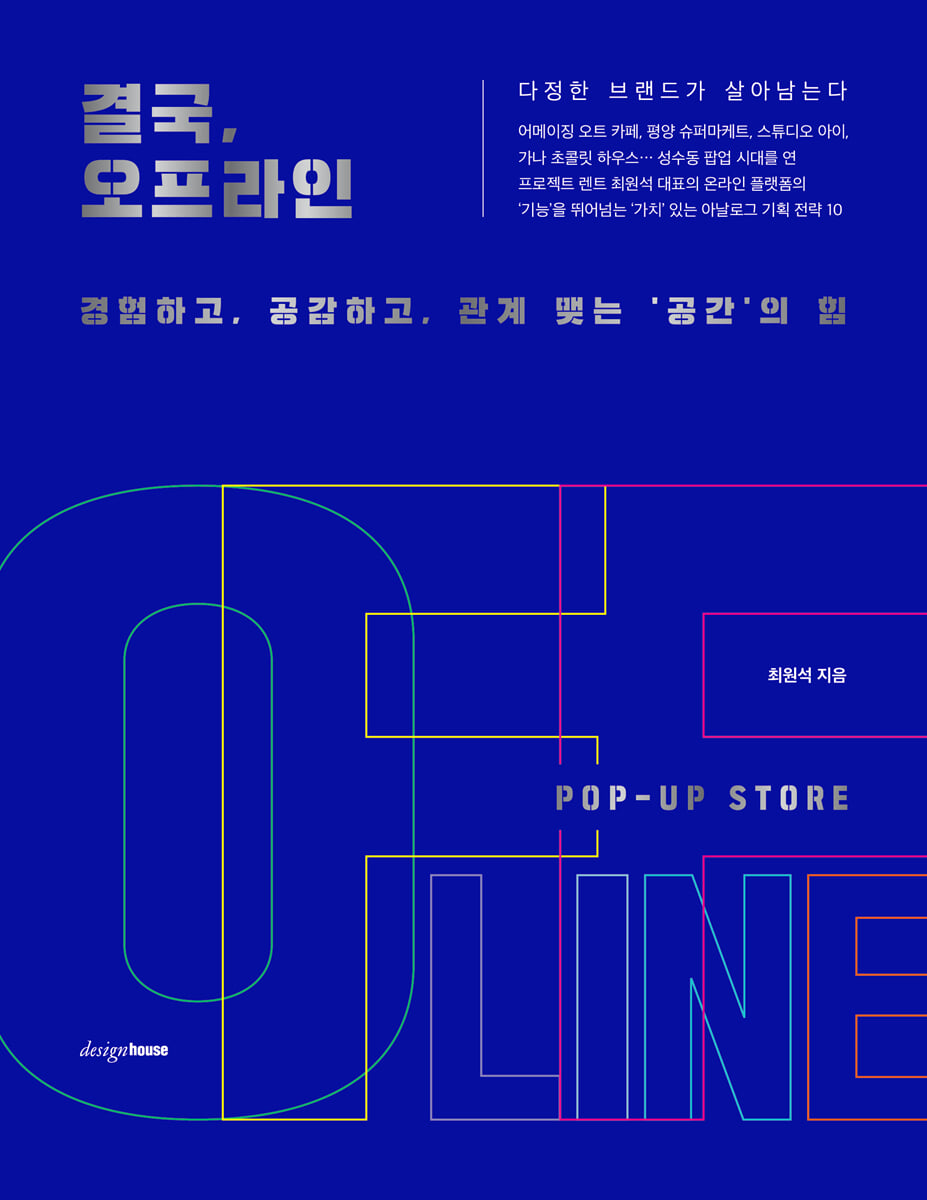
Finally, offline
 |
Description
Book Introduction
"Affectionate brands survive."
Amazing Oat Cafe, Pyongyang Supermarket, Studio i, Ghana Chocolate House…
Project Rent CEO Won-seok Choi, who opened the Seongsu-dong pop-up era
Going beyond the 'functions' of online platforms
10 Valuable Analog Planning Strategies
We live in an era where companies cannot survive by selling ‘products alone.’
Push marketing is not effective for the MZ generation, which has emerged as a new consumer power, and in a society overflowing with all kinds of media such as YouTube and OTT, traditional marketing channels such as ATL have lost their influence.
Pull marketing, which suggests experiences that customers voluntarily participate in and want to share, and word-of-mouth through channels that allow for genuine, person-to-person communication rather than advertising on broadcasting stations or newspapers, have become more persuasive.
Finding and engaging loyal customers—in other words, building your own fandom—has become more crucial than ever.
The surest way for a brand to build fans is to offer unique and rare 'experiences'.
And going one step further, we can use this as a basis to have a 'conversation' with customers, and make them 'empathize' with and 'trust' the brand's story.
This series of relationships can be formed most effectively in an ‘offline space.’
As with any human-to-human relationship, brands and people are much more likely to connect and discover their true value when they connect face-to-face offline rather than online.
But simply having a beautiful interior, expensive furniture and fixtures, and a space with good accessibility is not enough.
In the past, when supply was scarce, these elements alone were enough to capture the hearts of customers, but now we live in an era of oversupply.
In the recent past, when demand overwhelmed supply—when overpopulated populations competed for scarce goods—brands didn't need to bother trying to understand their consumers.
Whenever we created a new space or held a new product launch event, people would flock there on their own.
But now that the supplier-centric worldview is no longer functioning, even those fancy spaces built at great expense are rapidly losing visitors once the so-called "open red" disappears.
Despite the shift in market paradigm toward a consumer-centric approach, few suppliers ask questions like, “Who is this space for?”, “What kind of people will visit and spend time there?”, and “Can this space last for 50 years?” when designing a space.
Offline space is not a ‘store’
Let it function as 'media'!
A space that captivates the heart and draws the attention of the visitors.
10 laws hidden within it
These days, everyone is doing pop-ups.
Because consumers respond to pop-ups.
Moreover, pop-ups are the most cost-effective offline activity for maximizing engagement marketing (a marketing strategy that attempts to have meaningful conversations with customers through compelling content to strengthen customer-brand relationships) and increasing return on investment (ROI) from a marketing perspective.
What determines the value of a pop-up is its ‘purpose.’
The essential purpose of pop-ups is to build deep relationships between brands and consumers and to create meaningful changes in perception.
The power of brand communication pop-ups lies in making consumers who visit the space listen to the story the brand is telling, awakening them to a new side of the brand, and, through the chemical process of mutual communication, making them look forward to the brand's future.
"After All, Offline" is a book about pop-up-based marketing and brand communication, a hot topic among brands beloved by customers.
The author is a space producer and brand communicator who founded the offline platform 'Project Rent' in Seongsu-dong in 2018, a quiet neighborhood unlike today, and opened the door to the Seongsu pop-up era.
From collaborations with major corporations like Amazing Oat Cafe, Hyundai Motor Company's Studio i, and Ghana Chocolate House, to our own projects like Pyongyang Supermarket, Seongsu-dang, and 22Days, we have successfully planned and executed over 300 pop-ups.
In this book, he summarizes the ten laws hidden in spaces that captivate and captivate the heart, explaining how offline spaces can provide value that surpasses the convenience of online ones, the essence of a place that builds a close relationship with consumers, and the conditions for a space where people are willing to stay and find joy in discovery.
1.
Software is more important than hardware.
2.
Build your brand and context.
3.
Plan it as a place to become a 'tourist destination'.
4.
Retail is no longer just a place to buy and sell things.
5.
Fill in the temporary content.
6.
The human stories told through space breathe life into the brand.
7.
Don't force anything on the consumer.
8.
Offline is 'media'.
9.
The spatial experience becomes the brand itself.
10.
Measure the 'heart', not the 'number'.
We are now in an era of offline crisis.
Nevertheless, consumers still need offline.
The author's expertise, a leader at the forefront of the rapidly changing marketing landscape, will serve as an excellent guide for marketers seeking to discover the utility and potential unique to offline channels, as well as planners and business leaders seeking to design and operate brand spaces that attract customers.
Amazing Oat Cafe, Pyongyang Supermarket, Studio i, Ghana Chocolate House…
Project Rent CEO Won-seok Choi, who opened the Seongsu-dong pop-up era
Going beyond the 'functions' of online platforms
10 Valuable Analog Planning Strategies
We live in an era where companies cannot survive by selling ‘products alone.’
Push marketing is not effective for the MZ generation, which has emerged as a new consumer power, and in a society overflowing with all kinds of media such as YouTube and OTT, traditional marketing channels such as ATL have lost their influence.
Pull marketing, which suggests experiences that customers voluntarily participate in and want to share, and word-of-mouth through channels that allow for genuine, person-to-person communication rather than advertising on broadcasting stations or newspapers, have become more persuasive.
Finding and engaging loyal customers—in other words, building your own fandom—has become more crucial than ever.
The surest way for a brand to build fans is to offer unique and rare 'experiences'.
And going one step further, we can use this as a basis to have a 'conversation' with customers, and make them 'empathize' with and 'trust' the brand's story.
This series of relationships can be formed most effectively in an ‘offline space.’
As with any human-to-human relationship, brands and people are much more likely to connect and discover their true value when they connect face-to-face offline rather than online.
But simply having a beautiful interior, expensive furniture and fixtures, and a space with good accessibility is not enough.
In the past, when supply was scarce, these elements alone were enough to capture the hearts of customers, but now we live in an era of oversupply.
In the recent past, when demand overwhelmed supply—when overpopulated populations competed for scarce goods—brands didn't need to bother trying to understand their consumers.
Whenever we created a new space or held a new product launch event, people would flock there on their own.
But now that the supplier-centric worldview is no longer functioning, even those fancy spaces built at great expense are rapidly losing visitors once the so-called "open red" disappears.
Despite the shift in market paradigm toward a consumer-centric approach, few suppliers ask questions like, “Who is this space for?”, “What kind of people will visit and spend time there?”, and “Can this space last for 50 years?” when designing a space.
Offline space is not a ‘store’
Let it function as 'media'!
A space that captivates the heart and draws the attention of the visitors.
10 laws hidden within it
These days, everyone is doing pop-ups.
Because consumers respond to pop-ups.
Moreover, pop-ups are the most cost-effective offline activity for maximizing engagement marketing (a marketing strategy that attempts to have meaningful conversations with customers through compelling content to strengthen customer-brand relationships) and increasing return on investment (ROI) from a marketing perspective.
What determines the value of a pop-up is its ‘purpose.’
The essential purpose of pop-ups is to build deep relationships between brands and consumers and to create meaningful changes in perception.
The power of brand communication pop-ups lies in making consumers who visit the space listen to the story the brand is telling, awakening them to a new side of the brand, and, through the chemical process of mutual communication, making them look forward to the brand's future.
"After All, Offline" is a book about pop-up-based marketing and brand communication, a hot topic among brands beloved by customers.
The author is a space producer and brand communicator who founded the offline platform 'Project Rent' in Seongsu-dong in 2018, a quiet neighborhood unlike today, and opened the door to the Seongsu pop-up era.
From collaborations with major corporations like Amazing Oat Cafe, Hyundai Motor Company's Studio i, and Ghana Chocolate House, to our own projects like Pyongyang Supermarket, Seongsu-dang, and 22Days, we have successfully planned and executed over 300 pop-ups.
In this book, he summarizes the ten laws hidden in spaces that captivate and captivate the heart, explaining how offline spaces can provide value that surpasses the convenience of online ones, the essence of a place that builds a close relationship with consumers, and the conditions for a space where people are willing to stay and find joy in discovery.
1.
Software is more important than hardware.
2.
Build your brand and context.
3.
Plan it as a place to become a 'tourist destination'.
4.
Retail is no longer just a place to buy and sell things.
5.
Fill in the temporary content.
6.
The human stories told through space breathe life into the brand.
7.
Don't force anything on the consumer.
8.
Offline is 'media'.
9.
The spatial experience becomes the brand itself.
10.
Measure the 'heart', not the 'number'.
We are now in an era of offline crisis.
Nevertheless, consumers still need offline.
The author's expertise, a leader at the forefront of the rapidly changing marketing landscape, will serve as an excellent guide for marketers seeking to discover the utility and potential unique to offline channels, as well as planners and business leaders seeking to design and operate brand spaces that attract customers.
- You can preview some of the book's contents.
Preview
index
Introduction: Humans, Brands, and Offline
Tipping Point: A singularity in an era that has become a pop-up growth plate.
CHAPTER 1 CONTENTS Why Software Matters More Than Hardware
The driving force behind human emotions
The whole is greater than the sum of its parts.
A Content-Driven Shift in the Real Estate Paradigm
CHAPTER 2 CORE VALUE: THE IRREGULAR BACKGROUND OF A BRAND
Why Brands Need a Worldview
Age of Desire
Should we go to a cafe to drink coffee?
CHAPTER 3 THE GOAL A place that becomes a tourist destination
The Crisis of Megastores and a Breakthrough in Offline
The power of local
Why You Should Focus on Conversion Rates, Not Visit Rates
CHAPTER 4 ADVENTURE A place to experience the joy of escaping from everyday life
The playful nature of human beings
A place for enjoyable experiences in everyday life
The Joy of Ant Hell Space
CHAPTER 5 LIMIT Challenges Possible with Short Expiration Dates
The advantage of short-term time
The magic of a place that shakes common sense
Nomad Identity
CHAPTER 6 CONVERSATION: Communicating with Dense Stories
Building relationships with a verbal worldview
Space Identity for Communication
The power of rapport built through stories
CHAPTER 7 ENGAGEMENT Conditions for the space where people stay
Space design frame according to purpose
Time needed to establish relationships
Don't force it on consumers
CHAPTER 8 SYNESTHESIA: A Consumer Experience Completed Only Offline
Mediatized space
Do moments capture us, or do we capture moments?
Producer's capabilities
CHAPTER 9 SERVICED SPACE: A Communication-Based Thinking Transformation
A space designed solely for visitors
Every spatial experience is a brand.
Service attitude
CHAPTER 10 SINCERITY: The Most Important Thing in Brand Communication
The Data-Driven Paradox
The true feelings revealed through first-person perspective and investigation
How will you work: Authentic
Appendix: The Present and Future of Offline as Seen by Contemporary Business Players
References
Tipping Point: A singularity in an era that has become a pop-up growth plate.
CHAPTER 1 CONTENTS Why Software Matters More Than Hardware
The driving force behind human emotions
The whole is greater than the sum of its parts.
A Content-Driven Shift in the Real Estate Paradigm
CHAPTER 2 CORE VALUE: THE IRREGULAR BACKGROUND OF A BRAND
Why Brands Need a Worldview
Age of Desire
Should we go to a cafe to drink coffee?
CHAPTER 3 THE GOAL A place that becomes a tourist destination
The Crisis of Megastores and a Breakthrough in Offline
The power of local
Why You Should Focus on Conversion Rates, Not Visit Rates
CHAPTER 4 ADVENTURE A place to experience the joy of escaping from everyday life
The playful nature of human beings
A place for enjoyable experiences in everyday life
The Joy of Ant Hell Space
CHAPTER 5 LIMIT Challenges Possible with Short Expiration Dates
The advantage of short-term time
The magic of a place that shakes common sense
Nomad Identity
CHAPTER 6 CONVERSATION: Communicating with Dense Stories
Building relationships with a verbal worldview
Space Identity for Communication
The power of rapport built through stories
CHAPTER 7 ENGAGEMENT Conditions for the space where people stay
Space design frame according to purpose
Time needed to establish relationships
Don't force it on consumers
CHAPTER 8 SYNESTHESIA: A Consumer Experience Completed Only Offline
Mediatized space
Do moments capture us, or do we capture moments?
Producer's capabilities
CHAPTER 9 SERVICED SPACE: A Communication-Based Thinking Transformation
A space designed solely for visitors
Every spatial experience is a brand.
Service attitude
CHAPTER 10 SINCERITY: The Most Important Thing in Brand Communication
The Data-Driven Paradox
The true feelings revealed through first-person perspective and investigation
How will you work: Authentic
Appendix: The Present and Future of Offline as Seen by Contemporary Business Players
References
Detailed image

Into the book
Consumers were different before and after the advent of the World Wide Web, different before and after the popularization of smartphones, and completely different before and after the pandemic (what will consumers be like when generative AI becomes widely commercialized?).
It is simply bound by the language of social agreement called consumerism.
Just because the packaging is the same doesn't mean the contents are the same.
Whether you, the reader of this article, perceive the changes in the world or not, the fact remains that change itself has occurred and is ongoing.
The 'irrationality' of nature, which behavioral economics focuses on, better explains the thoughts, minds, and actions of today's consumers than the 'rationality' of reason, which traditional mainstream economics emphasizes.
A stuffed mindset cannot accept this phenomenon.
Accordingly, space, place, and offline have also changed.
Even real estate, the most insensitive and resistant to change, is becoming liquid.
What does this paradoxical phenomenon suggest?
A mechanical and conventional business mindset cannot respond to change, create meaningful value, or, above all, understand or communicate with consumers who have evolved along with the times.
--- From "Introduction: Humans, Brands, and Offline"
As consumers evolve, the role of micro-influencers has grown.
The information dissemination power of a person with good taste has become as powerful as that of a TV channel.
With the rise of Instagram, the speed of virality has increased dramatically, and a world has arrived where we can access information without being left out, simply by moving our eyes and fingers.
Within a week, the best restaurants in Seoul become famous nationwide, and curious people line up to visit the stores.
The inconvenient location or location is not the problem.
--- From "TIPPING POINT: A singularity of the era that became a pop-up growth plate"
The area in front of Ewha Womans University was bustling with people around the year 2000, but now it is so deserted that no one visits it.
The 4th Rent branch was located in front of Ewha Womans University instead of Seongsu with the intention of revitalizing the area with less foot traffic.
I wondered if there was any hope for the dead streets to come back to life, but I learned from experience that if the power of content is proven, that hope is not in vain.
It was a confidence I could have thanks to the 'Busan Coffee Week' pop-up.
(syncopation)
In Seoul, not Busan, did we sell the taste of coffee to Seoulites? Did we sell them their unique memories of Busan and their travel expectations? Our customers were those who longed to travel to Busan, those who remembered a delightful cup of coffee there, and those who were curious about Busan's coffee but had never been there.
--- From "Chapter 1 Content: Why Software is More Important Than Hardware"
The top priority of offline is to provide enjoyment to visitors.
In the same vein, pop-ups should provide a highly experiential retail environment.
It is important to present interesting content in a three-dimensional manner without giving the audience time to get bored.
We, who live each day without any special events, are fighting against the boredom of repetitive daily life.
When consumers discover an unexpected and surprising space beyond the clichés of an obvious space, they become engrossed in that space as if they were falling into an anthill.
In that context, I think one of the virtues that offline should pursue is unpredictability.
--- From "Chapter 4 Adventure: A Place to Feel the Joy of Escaping Everyday Life"
There was a time when a luxury brand, which could only be found in the yolk of an urban area, appeared in the middle of a desert and became a hot topic.
Prada Marfa, Prada's brand communication space, looks like a permanent store at first glance, but it doesn't sell anything.
This tightly closed space, sitting like an alien planet crash-landed on Texas's Interstate 90, was designed by Scandinavian artists Elmgreen & Dragset and built by architects Ronald Rael and Virginia San Fratello.
The contrast between the luxury brands that symbolize the extreme consumer culture of capitalism and the desolate and lonely atmosphere of the region creates a landscape with a strange charm.
People line up to come to this vast plain to see this scene, making it a tourist attraction.
If Prada Mafa had been installed in the middle of Times Square, would it have become a tourist attraction for nearly 20 years?
--- From "Limited to 5 chapters: Challenges possible due to short shelf life"
How can brands build strong bonds with consumers? First and foremost, time is absolutely essential for building rapport.
Most modern people are chronically pressed for time.
So how can companies secure the time of busy modern people?
It is said that the average time a person spends on interpersonal interactions is 41 minutes per day.
Is it possible to capture 41 minutes or more of a customer's time with online or TV advertising? Everyone now knows that online or TV advertising reach alone doesn't meaningfully capture consumers' time.
Ultimately, it is offline that captures consumers' time and strengthens engagement.
We don't pay any attention to the online banner ads that change daily, but when a new store opens in our neighborhood or around our workplace, we keep looking at it and want to stop by. That's what we normally do.
We've all had the experience of walking down a familiar street, seeing a new store, and saying, "I have to go there next time."
If we consider offline as an advertising medium, it is a platform with overwhelmingly superior cost-effectiveness compared to established media.
It is the everyday involvement that is embedded in people's real lives that gives influence its unique power.
It is simply bound by the language of social agreement called consumerism.
Just because the packaging is the same doesn't mean the contents are the same.
Whether you, the reader of this article, perceive the changes in the world or not, the fact remains that change itself has occurred and is ongoing.
The 'irrationality' of nature, which behavioral economics focuses on, better explains the thoughts, minds, and actions of today's consumers than the 'rationality' of reason, which traditional mainstream economics emphasizes.
A stuffed mindset cannot accept this phenomenon.
Accordingly, space, place, and offline have also changed.
Even real estate, the most insensitive and resistant to change, is becoming liquid.
What does this paradoxical phenomenon suggest?
A mechanical and conventional business mindset cannot respond to change, create meaningful value, or, above all, understand or communicate with consumers who have evolved along with the times.
--- From "Introduction: Humans, Brands, and Offline"
As consumers evolve, the role of micro-influencers has grown.
The information dissemination power of a person with good taste has become as powerful as that of a TV channel.
With the rise of Instagram, the speed of virality has increased dramatically, and a world has arrived where we can access information without being left out, simply by moving our eyes and fingers.
Within a week, the best restaurants in Seoul become famous nationwide, and curious people line up to visit the stores.
The inconvenient location or location is not the problem.
--- From "TIPPING POINT: A singularity of the era that became a pop-up growth plate"
The area in front of Ewha Womans University was bustling with people around the year 2000, but now it is so deserted that no one visits it.
The 4th Rent branch was located in front of Ewha Womans University instead of Seongsu with the intention of revitalizing the area with less foot traffic.
I wondered if there was any hope for the dead streets to come back to life, but I learned from experience that if the power of content is proven, that hope is not in vain.
It was a confidence I could have thanks to the 'Busan Coffee Week' pop-up.
(syncopation)
In Seoul, not Busan, did we sell the taste of coffee to Seoulites? Did we sell them their unique memories of Busan and their travel expectations? Our customers were those who longed to travel to Busan, those who remembered a delightful cup of coffee there, and those who were curious about Busan's coffee but had never been there.
--- From "Chapter 1 Content: Why Software is More Important Than Hardware"
The top priority of offline is to provide enjoyment to visitors.
In the same vein, pop-ups should provide a highly experiential retail environment.
It is important to present interesting content in a three-dimensional manner without giving the audience time to get bored.
We, who live each day without any special events, are fighting against the boredom of repetitive daily life.
When consumers discover an unexpected and surprising space beyond the clichés of an obvious space, they become engrossed in that space as if they were falling into an anthill.
In that context, I think one of the virtues that offline should pursue is unpredictability.
--- From "Chapter 4 Adventure: A Place to Feel the Joy of Escaping Everyday Life"
There was a time when a luxury brand, which could only be found in the yolk of an urban area, appeared in the middle of a desert and became a hot topic.
Prada Marfa, Prada's brand communication space, looks like a permanent store at first glance, but it doesn't sell anything.
This tightly closed space, sitting like an alien planet crash-landed on Texas's Interstate 90, was designed by Scandinavian artists Elmgreen & Dragset and built by architects Ronald Rael and Virginia San Fratello.
The contrast between the luxury brands that symbolize the extreme consumer culture of capitalism and the desolate and lonely atmosphere of the region creates a landscape with a strange charm.
People line up to come to this vast plain to see this scene, making it a tourist attraction.
If Prada Mafa had been installed in the middle of Times Square, would it have become a tourist attraction for nearly 20 years?
--- From "Limited to 5 chapters: Challenges possible due to short shelf life"
How can brands build strong bonds with consumers? First and foremost, time is absolutely essential for building rapport.
Most modern people are chronically pressed for time.
So how can companies secure the time of busy modern people?
It is said that the average time a person spends on interpersonal interactions is 41 minutes per day.
Is it possible to capture 41 minutes or more of a customer's time with online or TV advertising? Everyone now knows that online or TV advertising reach alone doesn't meaningfully capture consumers' time.
Ultimately, it is offline that captures consumers' time and strengthens engagement.
We don't pay any attention to the online banner ads that change daily, but when a new store opens in our neighborhood or around our workplace, we keep looking at it and want to stop by. That's what we normally do.
We've all had the experience of walking down a familiar street, seeing a new store, and saying, "I have to go there next time."
If we consider offline as an advertising medium, it is a platform with overwhelmingly superior cost-effectiveness compared to established media.
It is the everyday involvement that is embedded in people's real lives that gives influence its unique power.
--- From "Chapter 7 Engagement: Conditions of the Space Where People Stay"
Publisher's Review
Offline,
Connecting with living brands
A space for real experiences
Food, clothing, shelter and comfort.
Brands abound in every area of life.
Choosing between countless options, being chosen by customers among many alternatives, is difficult for both the user and the provider.
Companies seek to strengthen engagement by creating various mechanisms to connect consumers and brands through meaningful customer experiences and sustain relationships.
However, as customers' expectations become increasingly higher and the monopoly power of media channels weakens, it is difficult to estimate the return on investment.
In these times, offline and pop-up stores are not just places for sales.
It is an important medium that enables direct interaction between brands and consumers and provides brand experiences.
These more sophisticated spaces, post-endemic, showcase the brand in its most attractive way.
Moreover, it plays a role in strengthening emotional connections with customers and increasing brand loyalty through personalized and customized experiences.
It is possible to revitalize the brand through different locations, and through spatial production, it is possible to maximize or reverse the existing image.
It is possible to expand experiences by connecting physical space and virtual worlds, so it is also possible to plan projects that transcend the constraints of space and time.
Online content alone is not enough to provide people with a sufficient brand experience.
In these days when it's hard to see the love you're receiving no matter how much you raise your hand, offline and pop-up channels play a crucial role in marketing and brand strategy, helping establish a unique and differentiated position in the market.
The combination of offline and digital platforms can be a catalyst for interpreting customer experiences from a multifaceted perspective and increasing the depth and density of the experience.
Marketers and designers tasked with creating experiences must break down the barriers between online and offline experiences by planning to complement and strengthen the two, while simultaneously discovering the distinct appeal of each world.
Customer data collected online must be analyzed and utilized for offline optimization, and data flow must be enabled in both directions.
It is important to design immersive experiences that cross the boundaries between online and offline using various technologies, including augmented reality (AR), virtual reality (VR), and the Internet of Things (IoT).
You can also extend your pop-up experience online by using services like SNS to share and connect experiences.
This allows customers to connect with brands anytime, anywhere, and participate in communities they can't meet in physical spaces.
Of course, for dramatic immersion and the rarity of real-space experiences, brand experiences can be designed to block connections and allow users to experience the moment alone.
Ultimately, what matters is the connectivity of communication.
For those creating experiences, pop-up stores are exciting, but they require a deep understanding of their target audience and continuous exploration of ways to create experiences that are unfamiliar yet familiar, independent yet connected.
To do that, the creator must not stop experiencing various things.
Project Rent, which utilizes pop-up stores as a brand content platform, directly and effectively conveys the brand's story to customers through pop-ups.
Rent reinterprets the potential unique to offline spaces, creating nuanced experiential value and increasing the density of interactions between brands and customers.
It provides a powerful, temporary yet unique and memorable experience, and strongly positions the brand in the customer's mind.
People who have visited pop-ups created by Rent spread the experience virally within their networks.
This expands the brand's customer base.
Not only does it strengthen existing relationships, it also creates loose connections with unexpected potential customers, evolving your brand.
More than 'useful'
In an era where things with 'meaning' are loved,
How Project Rents Win Customers' Hearts
There are even voices arguing that pop-ups are useless due to the proliferation of pop-ups.
However, I believe that if you properly create a close experience between the brand and the customer, the brand's sustainability before and after the pop-up will change.
As the saying goes, “seeing is believing,” actual experience has tremendous power for humans who are equipped with synesthesia beyond the five senses.
The unique appeal and differentiation of Rent's pop-ups lies in the diverse use of devices that allow brands to directly and intimately convey their message to customers, depending on the context.
We convey the brand's values and philosophy to customers through true stories that are sometimes novel, sometimes bold, and filled with surprise and sincerity.
The power of Project Rent lies in maximizing the charm of Seongsu-dong, where stories of the past, present, and future, the familiar and the unfamiliar, the rough and the delicate coexist and create a chemical reaction of experience.
Rather than being an independent indoor space, Rent considers the ripple effect of a place that connects to the outside world, and weaves the brand story into local culture to present a unique experience.
Such nuanced experiential strategies are impossible without a deep understanding of the brand's context and its customers.
The most important thing to keep in mind in a spatial experience is appropriate hospitality during the journey from outside the brand space to inside (the journey is not a segmented point, but a connected line).
Moments of hospitality are created by a complex harmony of the visible and the invisible, the tangible and the intangible.
Whether or not there is a direct connection between the two is similar to the use or non-use of certain instruments at the right time for the orchestra's perfection.
For a pop-up to become more than just a temporary event, but a vital space that contributes to the sustainability and growth of a brand, visitors must first be entertained.
We must grasp the spatiality and cultural context surrounding the space, and present unexpected variations across permanent and special exhibitions.
To do that, you need a conductor who can see the big picture and pay attention to even the smallest details.
CEO Choi Won-seok is a top-notch conductor, and Project Rent is the perfect stage for the conductor to demonstrate his abilities.
CEO Won-seok Choi, who prepares pop-ups in collaboration with new brands, works with the heart and mind of the founder and manager who created the brand.
He is a player who understands the world surrounding a brand and creates compelling touchpoints that enable the audience to fully embrace the story the brand wants to convey.
We do not stage stories that deviate from the essence or that will be forgotten after the moment has passed.
I think it's possible because he's been practicing enjoying various experiences, discovering narratives within them, and creating relationships for a long time.
As technology advances, humans seek more human experiences.
In a world where online and offline are interconnected, diverse experiences enrich our daily lives. Therefore, we look forward to the stories of tomorrow created by Project Rent, a marketing platform that sells experiences while aiming to be an offline magazine.
- Choi So-hyun, Head of Naver Design and Marketing (from the appendix)
Connecting with living brands
A space for real experiences
Food, clothing, shelter and comfort.
Brands abound in every area of life.
Choosing between countless options, being chosen by customers among many alternatives, is difficult for both the user and the provider.
Companies seek to strengthen engagement by creating various mechanisms to connect consumers and brands through meaningful customer experiences and sustain relationships.
However, as customers' expectations become increasingly higher and the monopoly power of media channels weakens, it is difficult to estimate the return on investment.
In these times, offline and pop-up stores are not just places for sales.
It is an important medium that enables direct interaction between brands and consumers and provides brand experiences.
These more sophisticated spaces, post-endemic, showcase the brand in its most attractive way.
Moreover, it plays a role in strengthening emotional connections with customers and increasing brand loyalty through personalized and customized experiences.
It is possible to revitalize the brand through different locations, and through spatial production, it is possible to maximize or reverse the existing image.
It is possible to expand experiences by connecting physical space and virtual worlds, so it is also possible to plan projects that transcend the constraints of space and time.
Online content alone is not enough to provide people with a sufficient brand experience.
In these days when it's hard to see the love you're receiving no matter how much you raise your hand, offline and pop-up channels play a crucial role in marketing and brand strategy, helping establish a unique and differentiated position in the market.
The combination of offline and digital platforms can be a catalyst for interpreting customer experiences from a multifaceted perspective and increasing the depth and density of the experience.
Marketers and designers tasked with creating experiences must break down the barriers between online and offline experiences by planning to complement and strengthen the two, while simultaneously discovering the distinct appeal of each world.
Customer data collected online must be analyzed and utilized for offline optimization, and data flow must be enabled in both directions.
It is important to design immersive experiences that cross the boundaries between online and offline using various technologies, including augmented reality (AR), virtual reality (VR), and the Internet of Things (IoT).
You can also extend your pop-up experience online by using services like SNS to share and connect experiences.
This allows customers to connect with brands anytime, anywhere, and participate in communities they can't meet in physical spaces.
Of course, for dramatic immersion and the rarity of real-space experiences, brand experiences can be designed to block connections and allow users to experience the moment alone.
Ultimately, what matters is the connectivity of communication.
For those creating experiences, pop-up stores are exciting, but they require a deep understanding of their target audience and continuous exploration of ways to create experiences that are unfamiliar yet familiar, independent yet connected.
To do that, the creator must not stop experiencing various things.
Project Rent, which utilizes pop-up stores as a brand content platform, directly and effectively conveys the brand's story to customers through pop-ups.
Rent reinterprets the potential unique to offline spaces, creating nuanced experiential value and increasing the density of interactions between brands and customers.
It provides a powerful, temporary yet unique and memorable experience, and strongly positions the brand in the customer's mind.
People who have visited pop-ups created by Rent spread the experience virally within their networks.
This expands the brand's customer base.
Not only does it strengthen existing relationships, it also creates loose connections with unexpected potential customers, evolving your brand.
More than 'useful'
In an era where things with 'meaning' are loved,
How Project Rents Win Customers' Hearts
There are even voices arguing that pop-ups are useless due to the proliferation of pop-ups.
However, I believe that if you properly create a close experience between the brand and the customer, the brand's sustainability before and after the pop-up will change.
As the saying goes, “seeing is believing,” actual experience has tremendous power for humans who are equipped with synesthesia beyond the five senses.
The unique appeal and differentiation of Rent's pop-ups lies in the diverse use of devices that allow brands to directly and intimately convey their message to customers, depending on the context.
We convey the brand's values and philosophy to customers through true stories that are sometimes novel, sometimes bold, and filled with surprise and sincerity.
The power of Project Rent lies in maximizing the charm of Seongsu-dong, where stories of the past, present, and future, the familiar and the unfamiliar, the rough and the delicate coexist and create a chemical reaction of experience.
Rather than being an independent indoor space, Rent considers the ripple effect of a place that connects to the outside world, and weaves the brand story into local culture to present a unique experience.
Such nuanced experiential strategies are impossible without a deep understanding of the brand's context and its customers.
The most important thing to keep in mind in a spatial experience is appropriate hospitality during the journey from outside the brand space to inside (the journey is not a segmented point, but a connected line).
Moments of hospitality are created by a complex harmony of the visible and the invisible, the tangible and the intangible.
Whether or not there is a direct connection between the two is similar to the use or non-use of certain instruments at the right time for the orchestra's perfection.
For a pop-up to become more than just a temporary event, but a vital space that contributes to the sustainability and growth of a brand, visitors must first be entertained.
We must grasp the spatiality and cultural context surrounding the space, and present unexpected variations across permanent and special exhibitions.
To do that, you need a conductor who can see the big picture and pay attention to even the smallest details.
CEO Choi Won-seok is a top-notch conductor, and Project Rent is the perfect stage for the conductor to demonstrate his abilities.
CEO Won-seok Choi, who prepares pop-ups in collaboration with new brands, works with the heart and mind of the founder and manager who created the brand.
He is a player who understands the world surrounding a brand and creates compelling touchpoints that enable the audience to fully embrace the story the brand wants to convey.
We do not stage stories that deviate from the essence or that will be forgotten after the moment has passed.
I think it's possible because he's been practicing enjoying various experiences, discovering narratives within them, and creating relationships for a long time.
As technology advances, humans seek more human experiences.
In a world where online and offline are interconnected, diverse experiences enrich our daily lives. Therefore, we look forward to the stories of tomorrow created by Project Rent, a marketing platform that sells experiences while aiming to be an offline magazine.
- Choi So-hyun, Head of Naver Design and Marketing (from the appendix)
GOODS SPECIFICS
- Date of issue: May 24, 2024
- Page count, weight, size: 264 pages | 626g | 152*225*19mm
- ISBN13: 9788970417912
- ISBN10: 8970417915
You may also like
카테고리
korean


korean

![ELLE 엘르 스페셜 에디션 A형 : 12월 [2025]](http://librairie.coreenne.fr/cdn/shop/files/b8e27a3de6c9538896439686c6b0e8fb.jpg?v=1766436872&width=3840)


