

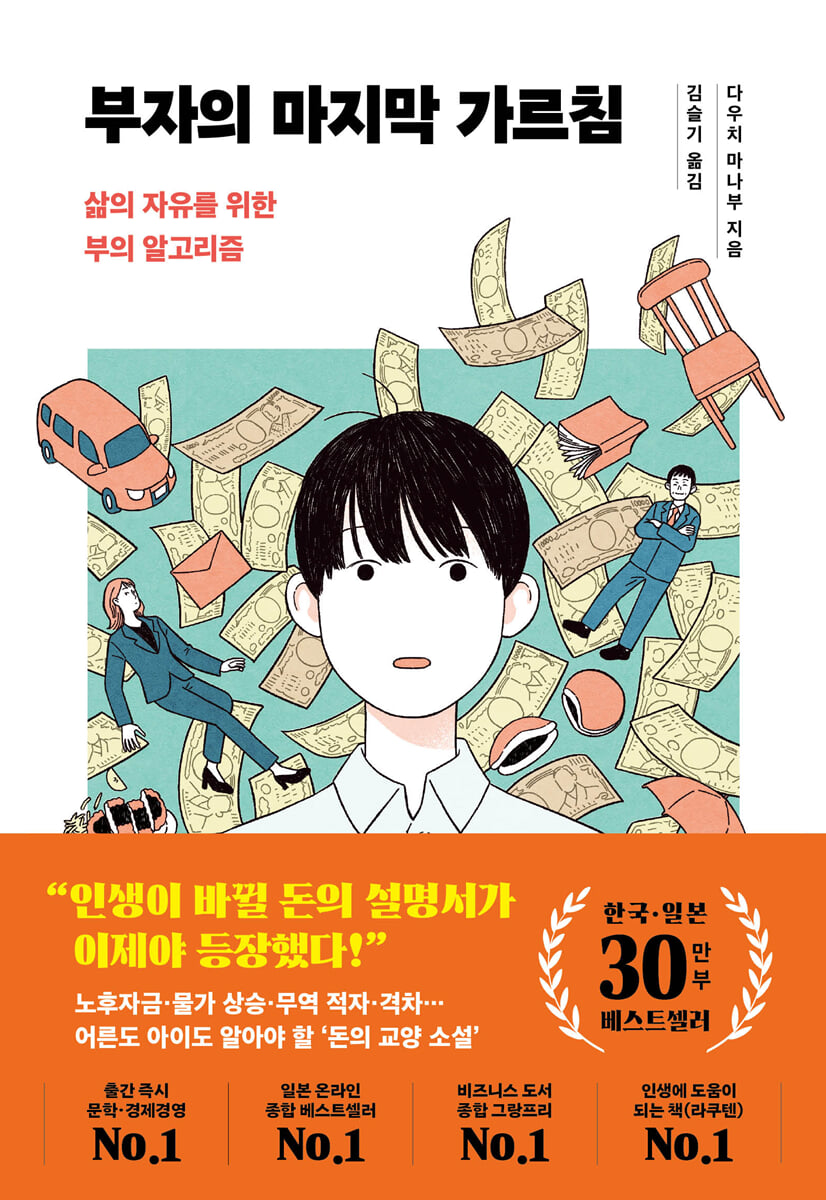
The Rich Man's Last Lesson (300,000 copies reprinted)
 |
Description
Book Introduction
★★★ Korea? Japan: Over 300,000 copies sold! A hot steady seller!
★★★ Amazon Japan's #1 overall bestseller!
★★★ #1 bestseller in economics, management, and literature immediately after its release in Korea
★★★ Readers' Choice Business Book Grand Prix 2024 Overall Grand Prix 1st Place!
★★★ The #1 book that will help you in life!
"The Last Lessons of the Rich," a steady bestseller in Korea and Japan, is back with a reissue to celebrate its 300,000th copy sale.
This book, which is breaking records every year as the #1 overall book on Amazon Japan, #1 in the Literature/Economics/Management category on domestic online bookstores, #1 in the Readers' Choice Business Overall Grand Prix, and #1 in Books That Will Help You in Life, is a "money education novel" that provides a panoramic view of everything about money that both adults and children need to know, written by Manabu Tauchi, a financial expert from Goldman Sachs and a social finance educator who actively lectures and writes.
The author wrote this book with the hope that those who pursue wealth but cannot shake off their ignorance and fear of money will become true masters of their lives and money.
So the book delves into the real economic issues of everyday life by examining the fundamental structures that make us work and move money.
This is why adults who live anxious lives, trying not to be defeated by money, and teenagers who consider money to be their highest value, confess that they took out books to learn the common sense of money and ended up learning about the human mind.
The 1,500 Amazon reviews from readers who chose this book speak volumes about its value.
The story, "The Last Lesson of a Rich Man," begins with a boy and a young woman who meet by chance in front of a mansion on a rainy day. The rich man, who has amassed enormous wealth through investments, calls them "Boss" and asks them to solve three riddles about money.
The promise that solving all the riddles will make one the heir to the mansion draws not only the two guests but also the readers into the mystery of money.
The three riddles of 'Money itself has no value', 'There are no problems that money can solve', and 'Even if everyone saves money together, it is meaningless' do not stop at shedding new light on the problems of old age and pensions that everyone in modern society is concerned about, as well as the low birth rate, national debt, and overheated real estate and stock prices, but also present new perspectives for solving them.
And by discovering the wealth algorithm hidden beyond a society reorganized by money, you will face the moment when you become the true master of money.
★★★ Amazon Japan's #1 overall bestseller!
★★★ #1 bestseller in economics, management, and literature immediately after its release in Korea
★★★ Readers' Choice Business Book Grand Prix 2024 Overall Grand Prix 1st Place!
★★★ The #1 book that will help you in life!
"The Last Lessons of the Rich," a steady bestseller in Korea and Japan, is back with a reissue to celebrate its 300,000th copy sale.
This book, which is breaking records every year as the #1 overall book on Amazon Japan, #1 in the Literature/Economics/Management category on domestic online bookstores, #1 in the Readers' Choice Business Overall Grand Prix, and #1 in Books That Will Help You in Life, is a "money education novel" that provides a panoramic view of everything about money that both adults and children need to know, written by Manabu Tauchi, a financial expert from Goldman Sachs and a social finance educator who actively lectures and writes.
The author wrote this book with the hope that those who pursue wealth but cannot shake off their ignorance and fear of money will become true masters of their lives and money.
So the book delves into the real economic issues of everyday life by examining the fundamental structures that make us work and move money.
This is why adults who live anxious lives, trying not to be defeated by money, and teenagers who consider money to be their highest value, confess that they took out books to learn the common sense of money and ended up learning about the human mind.
The 1,500 Amazon reviews from readers who chose this book speak volumes about its value.
The story, "The Last Lesson of a Rich Man," begins with a boy and a young woman who meet by chance in front of a mansion on a rainy day. The rich man, who has amassed enormous wealth through investments, calls them "Boss" and asks them to solve three riddles about money.
The promise that solving all the riddles will make one the heir to the mansion draws not only the two guests but also the readers into the mystery of money.
The three riddles of 'Money itself has no value', 'There are no problems that money can solve', and 'Even if everyone saves money together, it is meaningless' do not stop at shedding new light on the problems of old age and pensions that everyone in modern society is concerned about, as well as the low birth rate, national debt, and overheated real estate and stock prices, but also present new perspectives for solving them.
And by discovering the wealth algorithm hidden beyond a society reorganized by money, you will face the moment when you become the true master of money.
- You can preview some of the book's contents.
Preview
index
Prologue? Children who know neither society nor love
1.
The first riddle about money? Money itself has no value.
Money Burning | Tickets You Can Throw Away | The History of Gold and Desire | People Satisfied with Difficult Words | How to Sell Water for 10,000 Yen | The Secret Hidden in Taxes | Instant Home Bills | The Moment When Trump Cards and a Wad of Bills Look the Same | The Society That Money Expands | The Identity of the Boss
2.
The second riddle about money? There are no problems that money can solve.
Money is not great | The problem-solving power of a million yen and a donut | There are people beyond money | The unsolvable problem passed on to others | The power of money is the power of choice | Nanami's circumstances | The end of a country overconfident in money | Productivity that cannot be filled with paper money | A good economy called Gyeongsejeongseojeongmin | Modern society obsessed with points | Conditions for eliminating useless work
3.
The third riddle about money? Even if we all save up money, it's meaningless.
The heliocentric theory of money | Streets where you can't spend money on holidays | A game of musical chairs with 120 million people | Money that can't be called | The human connection that money hides | What to stockpile for the future | Value can't be measured by price | The difference between internal and external value | Money stolen from each other and a shared future
4.
The Mystery of the Gap? There's No Villain to Defeat
Boss and Angel Investing | The Gap Between Investment and the World | The Gap Between Money and Life | The Wealthy Who Are Bridging the Gap | Youth Creates the Future | Beyond Money Research Institute | The Future Chosen by Investment and Consumption | The Culprit Who Creates the Gap | The Rise of Redistribution | The Heavy Burden of the Past and the Hope for the Future
5.
The Mystery of Society? In the future, only gifts will do.
Debt that won't become a future debt | People working inside and outside | Coveted deposits and rejected debt | The gap within the same generation | Time doesn't return | The future of a country that can't work | The real deficit that will become the bill of the future | The world is made of gifts
6.
The final riddle? We are not alone.
Epilogue? Love delivered six years later
References
1.
The first riddle about money? Money itself has no value.
Money Burning | Tickets You Can Throw Away | The History of Gold and Desire | People Satisfied with Difficult Words | How to Sell Water for 10,000 Yen | The Secret Hidden in Taxes | Instant Home Bills | The Moment When Trump Cards and a Wad of Bills Look the Same | The Society That Money Expands | The Identity of the Boss
2.
The second riddle about money? There are no problems that money can solve.
Money is not great | The problem-solving power of a million yen and a donut | There are people beyond money | The unsolvable problem passed on to others | The power of money is the power of choice | Nanami's circumstances | The end of a country overconfident in money | Productivity that cannot be filled with paper money | A good economy called Gyeongsejeongseojeongmin | Modern society obsessed with points | Conditions for eliminating useless work
3.
The third riddle about money? Even if we all save up money, it's meaningless.
The heliocentric theory of money | Streets where you can't spend money on holidays | A game of musical chairs with 120 million people | Money that can't be called | The human connection that money hides | What to stockpile for the future | Value can't be measured by price | The difference between internal and external value | Money stolen from each other and a shared future
4.
The Mystery of the Gap? There's No Villain to Defeat
Boss and Angel Investing | The Gap Between Investment and the World | The Gap Between Money and Life | The Wealthy Who Are Bridging the Gap | Youth Creates the Future | Beyond Money Research Institute | The Future Chosen by Investment and Consumption | The Culprit Who Creates the Gap | The Rise of Redistribution | The Heavy Burden of the Past and the Hope for the Future
5.
The Mystery of Society? In the future, only gifts will do.
Debt that won't become a future debt | People working inside and outside | Coveted deposits and rejected debt | The gap within the same generation | Time doesn't return | The future of a country that can't work | The real deficit that will become the bill of the future | The world is made of gifts
6.
The final riddle? We are not alone.
Epilogue? Love delivered six years later
References
Detailed image

Into the book
Those who have are cunning.
So I want to make money too.
That was Yuto's honest feeling.
I thought this guy would teach me how to make money.
But he started talking about something that was difficult to understand, something called 'the identity of money'.
I thought I was caught up in something strange, but I felt as excited as if I had boarded an express train with no known destination.
--- p.9
Following her, Yuto also slid into the Western-style building.
I quickly closed the large door to prevent the pouring rain from pouring in.
As soon as the door closed, the sound of heavy rain became distant.
Inside the building, a heterogeneous air and time flowed.
The high-ceilinged entrance hall was covered with crimson carpet and extended into corridors on either side.
There were several expensive-looking paintings hanging on the wall.
Not only the exterior, but also the interior was exactly like the rich mansion that Yuto had pictured in his mind while reading mystery novels.
Heavy rain, Western-style buildings where the wealthy live, and alchemy.
It feels like something is going to happen.
--- p.14
“I think it’s a nice-sounding statement that people live by helping each other.
When times are tough, money is what helps.
“To survive, you have no choice but to rely on money.”
Nanami seems to have some strong beliefs.
It also seems like he is encouraging himself by speaking slowly.
The boss was taking in every word she said with affectionate eyes.
And Nanami spoke with emphasis at the end.
“So I want to make money.”
--- p.65
“If you can’t choose, money loses its power.
Even if the government increases its budget to focus on education, it is useless if there are no teachers in schools.
Money can only be great when those who work for it have a choice.
“When a disaster strikes and fewer people are able to work, they will realize the powerlessness of money.”
“That’s definitely true.
When a big earthquake strikes, I feel grateful that stores are open for business.
“The COVID-19 pandemic was also the catalyst for the use of the term ‘essential personnel.’”
“Having the ability to choose is important in everyday life.
“At that time, there was no one who could make it, so there was no choice.”
No matter how much money you have, the world won't turn if there are no workers.
--- p.87
It is said that 30 years ago, the working generation population was five times larger than the elderly population.
The burden is not great because five people are responsible for one elderly person.
But now, two people are responsible for one elderly person.
So the two people in the illustration had a pained expression on their faces.
The shock deepened as Yuto turned the pages of the book.
It is said that in 30 years, a whopping 1.3 people will have to take care of each elderly person.
--- p.115
“Using people more than necessary is a crime against society.”
The boss's words were filled with enthusiasm.
The 300 million yen invested will be paid to researchers working at the company and to those who build equipment purchased by the company.
A total of 300 million yen worth of labor is invested.
If they can't earn more than that amount, then their labor isn't providing enough value to people.
And the boss declared:
“If there is no prospect of making money, there is no need to make them work.”
--- p.170
“We are fascinated by money, whether we like it or not.
If we get rid of this thing called money, the economic landscape will look completely different.
(……) The economy has developed to this extent thanks to donations.
We think of ourselves as exchanging goods or labor for money.
But in reality, it's all about giving or receiving gifts.
“Because we are so fascinated by money, giving has become seen as an exchange.”
So I want to make money too.
That was Yuto's honest feeling.
I thought this guy would teach me how to make money.
But he started talking about something that was difficult to understand, something called 'the identity of money'.
I thought I was caught up in something strange, but I felt as excited as if I had boarded an express train with no known destination.
--- p.9
Following her, Yuto also slid into the Western-style building.
I quickly closed the large door to prevent the pouring rain from pouring in.
As soon as the door closed, the sound of heavy rain became distant.
Inside the building, a heterogeneous air and time flowed.
The high-ceilinged entrance hall was covered with crimson carpet and extended into corridors on either side.
There were several expensive-looking paintings hanging on the wall.
Not only the exterior, but also the interior was exactly like the rich mansion that Yuto had pictured in his mind while reading mystery novels.
Heavy rain, Western-style buildings where the wealthy live, and alchemy.
It feels like something is going to happen.
--- p.14
“I think it’s a nice-sounding statement that people live by helping each other.
When times are tough, money is what helps.
“To survive, you have no choice but to rely on money.”
Nanami seems to have some strong beliefs.
It also seems like he is encouraging himself by speaking slowly.
The boss was taking in every word she said with affectionate eyes.
And Nanami spoke with emphasis at the end.
“So I want to make money.”
--- p.65
“If you can’t choose, money loses its power.
Even if the government increases its budget to focus on education, it is useless if there are no teachers in schools.
Money can only be great when those who work for it have a choice.
“When a disaster strikes and fewer people are able to work, they will realize the powerlessness of money.”
“That’s definitely true.
When a big earthquake strikes, I feel grateful that stores are open for business.
“The COVID-19 pandemic was also the catalyst for the use of the term ‘essential personnel.’”
“Having the ability to choose is important in everyday life.
“At that time, there was no one who could make it, so there was no choice.”
No matter how much money you have, the world won't turn if there are no workers.
--- p.87
It is said that 30 years ago, the working generation population was five times larger than the elderly population.
The burden is not great because five people are responsible for one elderly person.
But now, two people are responsible for one elderly person.
So the two people in the illustration had a pained expression on their faces.
The shock deepened as Yuto turned the pages of the book.
It is said that in 30 years, a whopping 1.3 people will have to take care of each elderly person.
--- p.115
“Using people more than necessary is a crime against society.”
The boss's words were filled with enthusiasm.
The 300 million yen invested will be paid to researchers working at the company and to those who build equipment purchased by the company.
A total of 300 million yen worth of labor is invested.
If they can't earn more than that amount, then their labor isn't providing enough value to people.
And the boss declared:
“If there is no prospect of making money, there is no need to make them work.”
--- p.170
“We are fascinated by money, whether we like it or not.
If we get rid of this thing called money, the economic landscape will look completely different.
(……) The economy has developed to this extent thanks to donations.
We think of ourselves as exchanging goods or labor for money.
But in reality, it's all about giving or receiving gifts.
“Because we are so fascinated by money, giving has become seen as an exchange.”
--- p.218
Publisher's Review
“The life-changing money guide has finally arrived!”
Are you ready to learn from the rich?
“It is easy to come across in daily life, but in reality,
An in-depth look at currency, a subject we often misunderstand!
It is such a warm and precious book.
I recommend reading it.”
-Writer Oh Geon-yeong (Team Leader, WM Promotion Department, Shinhan Bank)
★ The easiest way to clear the vague fog about money
★ A strange and rare book that teaches you about love through money!
The book, "The Last Lessons of the Rich," by Manabu Dauch, a bestselling author who worked at Goldman Sachs, the pinnacle of capitalism, for 16 years, has been published.
Not only is it surprising that this is a novel about money written by a financial expert, but it also delivers a unique message never before seen in the field of economics and management, raising readers' expectations and leading to the distribution of 30,000 copies to bookstores before publication.
After its publication, it immediately took first place in the literature and economics and management categories on Amazon Japan, selling 150,000 copies in just 90 days.
Why is "The Last Lessons of a Rich Man" so beloved, despite its continued reader trust and favorable reviews?
This book began when the author, who traded Japanese government bonds and interest rate derivatives, made hundreds of billions to trillions of yen every day, was asked by a friend what he really wanted to do.
The author's will to reveal the truth about 'real money' while questioning a society obsessed with various money games is reflected in the book.
And the story gradually breaks down our common sense about money, focusing on the phenomenon of people and society being alienated from all economic activities that occur within society.
The three riddles that the mysterious rich old man poses to the main characters are also the message that runs through the book.
"Money itself has no value." "There are no problems that money can solve." "Even if we all save up money, it's meaningless." As we work together to solve these seemingly intricate problems, we soon find ourselves letting go of our blind faith in numbers and asking ourselves how we can live as "masters of money" without being swayed by them.
This is followed by serious consideration of what we can do right now.
Those who are struggling with the question, "What should I work for?" will find themselves working even harder on something in the future.
This book is like a gift that will warm the reader's heart, with a touching twist waiting in the latter half of the story.
Are you ready to learn from the rich?
“It is easy to come across in daily life, but in reality,
An in-depth look at currency, a subject we often misunderstand!
It is such a warm and precious book.
I recommend reading it.”
-Writer Oh Geon-yeong (Team Leader, WM Promotion Department, Shinhan Bank)
★ The easiest way to clear the vague fog about money
★ A strange and rare book that teaches you about love through money!
The book, "The Last Lessons of the Rich," by Manabu Dauch, a bestselling author who worked at Goldman Sachs, the pinnacle of capitalism, for 16 years, has been published.
Not only is it surprising that this is a novel about money written by a financial expert, but it also delivers a unique message never before seen in the field of economics and management, raising readers' expectations and leading to the distribution of 30,000 copies to bookstores before publication.
After its publication, it immediately took first place in the literature and economics and management categories on Amazon Japan, selling 150,000 copies in just 90 days.
Why is "The Last Lessons of a Rich Man" so beloved, despite its continued reader trust and favorable reviews?
This book began when the author, who traded Japanese government bonds and interest rate derivatives, made hundreds of billions to trillions of yen every day, was asked by a friend what he really wanted to do.
The author's will to reveal the truth about 'real money' while questioning a society obsessed with various money games is reflected in the book.
And the story gradually breaks down our common sense about money, focusing on the phenomenon of people and society being alienated from all economic activities that occur within society.
The three riddles that the mysterious rich old man poses to the main characters are also the message that runs through the book.
"Money itself has no value." "There are no problems that money can solve." "Even if we all save up money, it's meaningless." As we work together to solve these seemingly intricate problems, we soon find ourselves letting go of our blind faith in numbers and asking ourselves how we can live as "masters of money" without being swayed by them.
This is followed by serious consideration of what we can do right now.
Those who are struggling with the question, "What should I work for?" will find themselves working even harder on something in the future.
This book is like a gift that will warm the reader's heart, with a touching twist waiting in the latter half of the story.
GOODS SPECIFICS
- Date of issue: May 22, 2024
- Page count, weight, size: 272 pages | 408g | 130*190*22mm
- ISBN13: 9791193937068
- ISBN10: 119393706X
You may also like
카테고리
korean


korean

![GQ KOREA Mark (Monthly): December [2025]](http://librairie.coreenne.fr/cdn/shop/files/8ef265dbbfbf186523ed75ba7319009d.jpg?v=1765340328&width=3840)


