

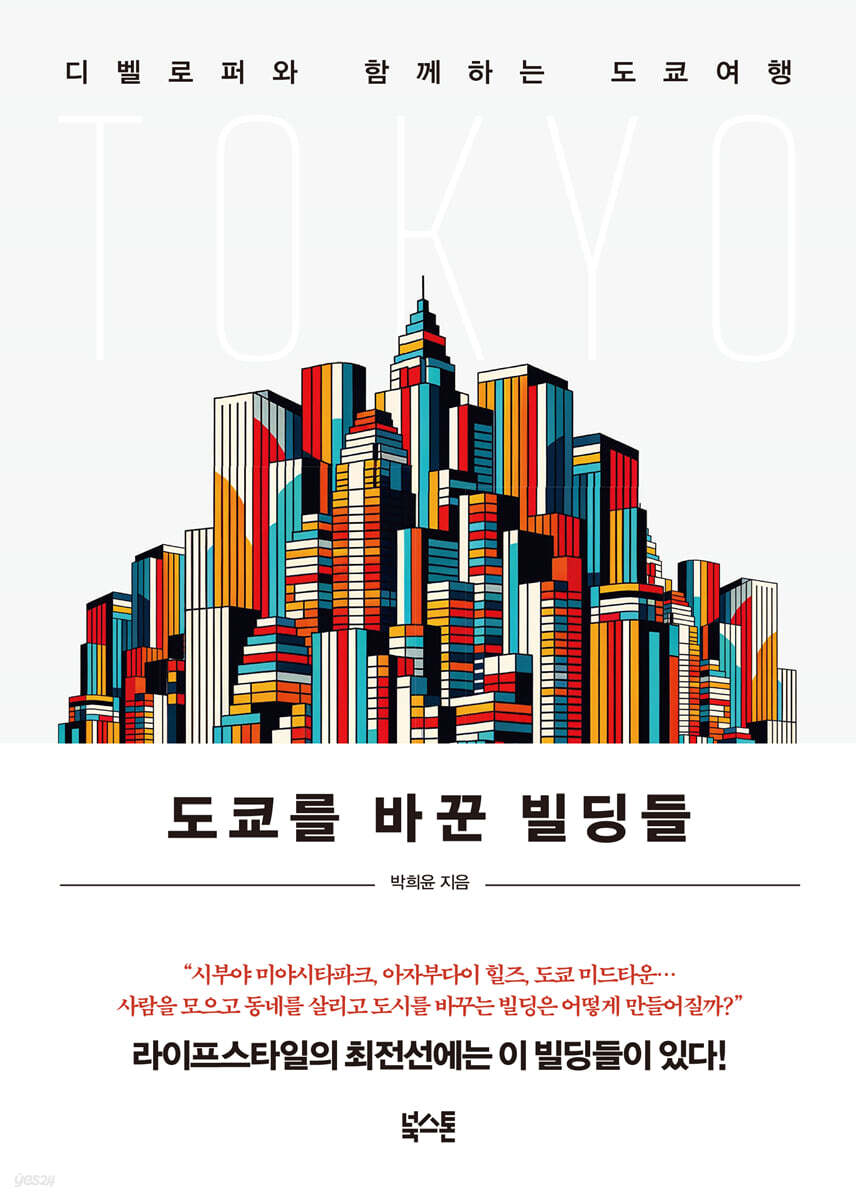
Buildings that changed Tokyo
 |
Description
Book Introduction
The Birth, Evolution, and Future of Tokyo as Seen Through the Eyes of an Urban Developer
A New Tokyo Journey with Developers
Why should we go to Tokyo now? From Tokyo to Paris, New York, London, and even Seoul, competition between cities, not nations, has begun in earnest since the pandemic.
Among them, Tokyo stands out.
Tokyo, which is being reborn as a compact city with recent developments such as the opening of Azabudai Hills, is said to be the solution to overcoming the economic recession through the "Great Tokyo Remodeling."
"Buildings That Changed Tokyo" explores the future and competitiveness of the city of Tokyo through ten must-see areas in Tokyo and the buildings that serve as their central focus.
Why are these buildings at the forefront of lifestyle? How are platforms created where talent, businesses, and capital converge? How do cities become new businesses? This book is the perfect guide for those seeking insights into urban planning and business, and for those who wish to explore Tokyo through the eyes of an urban developer.
A New Tokyo Journey with Developers
Why should we go to Tokyo now? From Tokyo to Paris, New York, London, and even Seoul, competition between cities, not nations, has begun in earnest since the pandemic.
Among them, Tokyo stands out.
Tokyo, which is being reborn as a compact city with recent developments such as the opening of Azabudai Hills, is said to be the solution to overcoming the economic recession through the "Great Tokyo Remodeling."
"Buildings That Changed Tokyo" explores the future and competitiveness of the city of Tokyo through ten must-see areas in Tokyo and the buildings that serve as their central focus.
Why are these buildings at the forefront of lifestyle? How are platforms created where talent, businesses, and capital converge? How do cities become new businesses? This book is the perfect guide for those seeking insights into urban planning and business, and for those who wish to explore Tokyo through the eyes of an urban developer.
- You can preview some of the book's contents.
Preview
index
PROLOGUE.
In search of the charm of the city called Tokyo
PART 1.
The third city center born with the changing times
CHAPTER 1.
The completion of the "Hills" series, a city model proposing the future: Azabudai Hills.
CHAPTER 2.
From a neighborhood of old men to a global new city: Toranomon Hills
CHAPTER 3.
A symbol of Japanese urban development, visited by 800 million people over 20 years: Roppongi Hills
CHAPTER 4.
The ultimate urban regeneration flagship, boasting both commercial viability and marketability: Tokyo Midtown.
PART 2.
A street reborn based on historical content
CHAPTER 5.
The face and entrance of Tokyo: Marunouchi Marunouchi Building and Tokyo Station
CHAPTER 6.
Reviving a Forgotten City Center with Edo-era Content: Nihonbashi Coredo
CHAPTER 7. LVMH's Best Brand Building in Ginza: Ginza Six
PART 3.
A unique neighborhood that offers a unique lifestyle
CHAPTER 8.
The small buildings that made Omotesando a mecca for fashion culture: From First and Laforet Harajuku
CHAPTER 9.
Completion of Shibuya, the Entertainment City: Miyashita Park and Shibuya Stream
CHAPTER 10.
Offering a Solution to the End of Offline Retail: Futakotamagawa Takashimaya Shopping Center
EPILOGUE.
Developers, the people who create and grow cities
In search of the charm of the city called Tokyo
PART 1.
The third city center born with the changing times
CHAPTER 1.
The completion of the "Hills" series, a city model proposing the future: Azabudai Hills.
CHAPTER 2.
From a neighborhood of old men to a global new city: Toranomon Hills
CHAPTER 3.
A symbol of Japanese urban development, visited by 800 million people over 20 years: Roppongi Hills
CHAPTER 4.
The ultimate urban regeneration flagship, boasting both commercial viability and marketability: Tokyo Midtown.
PART 2.
A street reborn based on historical content
CHAPTER 5.
The face and entrance of Tokyo: Marunouchi Marunouchi Building and Tokyo Station
CHAPTER 6.
Reviving a Forgotten City Center with Edo-era Content: Nihonbashi Coredo
CHAPTER 7. LVMH's Best Brand Building in Ginza: Ginza Six
PART 3.
A unique neighborhood that offers a unique lifestyle
CHAPTER 8.
The small buildings that made Omotesando a mecca for fashion culture: From First and Laforet Harajuku
CHAPTER 9.
Completion of Shibuya, the Entertainment City: Miyashita Park and Shibuya Stream
CHAPTER 10.
Offering a Solution to the End of Offline Retail: Futakotamagawa Takashimaya Shopping Center
EPILOGUE.
Developers, the people who create and grow cities
Into the book
Azabudai Hills is the future of Mori Building's long-honed vertical green city model, and is a further step forward from the culmination of its green space plans.
The concept of Azabudai Hills is a square-like neighborhood surrounded by nature that connects people.
To create an environment where the city and nature are in harmony by surrounding it with overwhelming greenery, we organized small, subdivided lots into one large site, as was done with existing hills.
A central plaza was designed as a place for people to gather and disperse, and a seamless landscape was planned to connect this place with the surrounding area.
This is the exact opposite approach to conventional urban development, which places buildings first and then turns the remaining space into green space.
---From "Completion of the 'Hills' Series, a City Model Proposing the Future"
There are several reasons why Roppongi Hills is considered a success, but the main reason was that it had a clear goal and concept from the beginning.
Usually, even if there is a concept, it is often added after completion.
In the end, Ark Hills is more like something that was added after it was completed.
Moreover, large-scale complex development projects involve complex interests and are prone to unexpected variables.
Roppongi Hills is particularly significant in that it has constantly pondered and implemented the question, "How can we become a world-class cultural center?" even amidst the turbulent times.
So how should urban development be conceived to fit the concept of a "cultural city"? Mori Building, in creating Roppongi Hills, thoroughly embraced "collaboration" and implemented it accordingly.
In fact, the city itself is a collaboration of countless people.
Mori Building believed that the process of diverse people with different ideas coming together and interacting would become a trend that would create a good city.
---From "A symbol of Japanese urban development visited by 800 million people over 20 years"
The first reason why Korean visitors rate Tokyo Midtown higher than Roppongi Hills is the comfort provided by the lush greenery.
The actual green space is not much different from Roppongi Hills, but the sense of vastness is different because the existing Hinokicho Park and the green space within the Midtown site are connected as one body.
Additionally, by concentrating all the green space in one place, the actual floor area for construction was reduced, thereby reducing construction costs.
Like the concept of 'Diversity on the Green', it is a complex city built in a large green park that is hard to find in the city center.
---Among the "best urban regeneration flagships with both business and marketability"
"What kind of new stores should be introduced to revitalize Nihonbashi, a declining area filled with only small and medium-sized offices and frequented only by senior citizens?" Mitsui Fudosan succeeded in finding the answer nearby.
Looking around, I saw that the old stores that had grown up in this area with them were like old friends, and in a way, they were the best stores that had all the new values that mature consumers were looking for.
Products and services that reflect the philosophy and sincerity of the creator, consideration for the environment, and the history and individuality of the region.
Although Nihonbashi is said to have declined, it was once the best commercial district in Edo, so there were many old shops that cherished these values.
---From "Reviving a Forgotten City Center with Edo Period Content"
What's the source of creativity? Sitting in an office isn't likely to produce brilliant ideas, and spending all day wandering around doesn't necessarily equate to productive results.
In the past, cities were classified by function according to modern urban planning ideas, but recently, places where people can work, live, and play all in one place are welcomed.
Hamano had noticed this point early on.
He wanted to create a place where people could enjoy themselves, work, and live 24 hours a day by reuniting work, residence, and pleasure.
If this succeeds, I am confident that this area will grow into a sophisticated neighborhood for mature adults, different from the youth-oriented Harajuku.
The building was named 'From First' to convey the meaning of creating a new neighborhood from here.
---From "The small building that created Omotesando, the mecca of fashion culture"
Shibuya has developed into a bustling area and fashion hub boasting the highest daily foot traffic in Japan, with 3.3 million people, and "Tokyu Kids" cannot be left out.
Just as during Korea's period of rapid economic growth, the high-income and middle-class population moved from Gangbuk to Gangnam, Bundang, Pangyo, and other areas, creating and flourishing a new culture, so too in Japan, people who made their living on the Tokyu Railway developed new trends and their own unique culture.
They were called Tokyu Kids, similar to Gangnam Kids, and their center was Shibuya.
---From "Completion of Entertainment City Shibuya"
Building on the success of Ark Hills, Japan's first large-scale mixed-use redevelopment project, Mori Building sought an urban development model suitable for East Asian metropolises, and created the Hills series.
At Roppongi Hills, we sought to find new methodologies, such as creating a city where architecture and the external environment are integrated while connecting with the existing neighborhood, and town management for sustainable revitalization.
Tokyo Midtown was a clever model of a compact city that overcame high land prices, presented by Mitsui Fudosan in a new era of urban regeneration.
In other words, what is more noteworthy in the development projects that have transformed Tokyo is not the hardware itself, but the inner workings of the projects, and the new lifestyles each urban model proposes.
The concept of Azabudai Hills is a square-like neighborhood surrounded by nature that connects people.
To create an environment where the city and nature are in harmony by surrounding it with overwhelming greenery, we organized small, subdivided lots into one large site, as was done with existing hills.
A central plaza was designed as a place for people to gather and disperse, and a seamless landscape was planned to connect this place with the surrounding area.
This is the exact opposite approach to conventional urban development, which places buildings first and then turns the remaining space into green space.
---From "Completion of the 'Hills' Series, a City Model Proposing the Future"
There are several reasons why Roppongi Hills is considered a success, but the main reason was that it had a clear goal and concept from the beginning.
Usually, even if there is a concept, it is often added after completion.
In the end, Ark Hills is more like something that was added after it was completed.
Moreover, large-scale complex development projects involve complex interests and are prone to unexpected variables.
Roppongi Hills is particularly significant in that it has constantly pondered and implemented the question, "How can we become a world-class cultural center?" even amidst the turbulent times.
So how should urban development be conceived to fit the concept of a "cultural city"? Mori Building, in creating Roppongi Hills, thoroughly embraced "collaboration" and implemented it accordingly.
In fact, the city itself is a collaboration of countless people.
Mori Building believed that the process of diverse people with different ideas coming together and interacting would become a trend that would create a good city.
---From "A symbol of Japanese urban development visited by 800 million people over 20 years"
The first reason why Korean visitors rate Tokyo Midtown higher than Roppongi Hills is the comfort provided by the lush greenery.
The actual green space is not much different from Roppongi Hills, but the sense of vastness is different because the existing Hinokicho Park and the green space within the Midtown site are connected as one body.
Additionally, by concentrating all the green space in one place, the actual floor area for construction was reduced, thereby reducing construction costs.
Like the concept of 'Diversity on the Green', it is a complex city built in a large green park that is hard to find in the city center.
---Among the "best urban regeneration flagships with both business and marketability"
"What kind of new stores should be introduced to revitalize Nihonbashi, a declining area filled with only small and medium-sized offices and frequented only by senior citizens?" Mitsui Fudosan succeeded in finding the answer nearby.
Looking around, I saw that the old stores that had grown up in this area with them were like old friends, and in a way, they were the best stores that had all the new values that mature consumers were looking for.
Products and services that reflect the philosophy and sincerity of the creator, consideration for the environment, and the history and individuality of the region.
Although Nihonbashi is said to have declined, it was once the best commercial district in Edo, so there were many old shops that cherished these values.
---From "Reviving a Forgotten City Center with Edo Period Content"
What's the source of creativity? Sitting in an office isn't likely to produce brilliant ideas, and spending all day wandering around doesn't necessarily equate to productive results.
In the past, cities were classified by function according to modern urban planning ideas, but recently, places where people can work, live, and play all in one place are welcomed.
Hamano had noticed this point early on.
He wanted to create a place where people could enjoy themselves, work, and live 24 hours a day by reuniting work, residence, and pleasure.
If this succeeds, I am confident that this area will grow into a sophisticated neighborhood for mature adults, different from the youth-oriented Harajuku.
The building was named 'From First' to convey the meaning of creating a new neighborhood from here.
---From "The small building that created Omotesando, the mecca of fashion culture"
Shibuya has developed into a bustling area and fashion hub boasting the highest daily foot traffic in Japan, with 3.3 million people, and "Tokyu Kids" cannot be left out.
Just as during Korea's period of rapid economic growth, the high-income and middle-class population moved from Gangbuk to Gangnam, Bundang, Pangyo, and other areas, creating and flourishing a new culture, so too in Japan, people who made their living on the Tokyu Railway developed new trends and their own unique culture.
They were called Tokyu Kids, similar to Gangnam Kids, and their center was Shibuya.
---From "Completion of Entertainment City Shibuya"
Building on the success of Ark Hills, Japan's first large-scale mixed-use redevelopment project, Mori Building sought an urban development model suitable for East Asian metropolises, and created the Hills series.
At Roppongi Hills, we sought to find new methodologies, such as creating a city where architecture and the external environment are integrated while connecting with the existing neighborhood, and town management for sustainable revitalization.
Tokyo Midtown was a clever model of a compact city that overcame high land prices, presented by Mitsui Fudosan in a new era of urban regeneration.
In other words, what is more noteworthy in the development projects that have transformed Tokyo is not the hardware itself, but the inner workings of the projects, and the new lifestyles each urban model proposes.
---From the "Epilogue"
Publisher's Review
Shibuya Miyashita Park, Azabudai Hills, Tokyo Midtown...
How can we create buildings that bring people together, revitalize neighborhoods, and transform cities?
Tokyo has changed recently.
Tokyo, once criticized as no longer attractive due to its inability to overcome population problems and a long-term recession, surprisingly rose to the fourth most visited city by global travelers after the pandemic.
A point to note is that Tokyo is visited not only by simple tourists, but also by people from various fields, including global companies, investors, planners, and IT professionals.
At the heart of these changes lies Tokyo's meticulous plan to become a "compact city."
Author Park Hee-yoon, who has worked in Tokyo and Seoul for over 20 years as a developer revitalizing cities and neighborhoods, says this is the result of a strategy called the "Tokyo Great Remodeling."
To overcome low growth, we must develop a global city that represents the country, and Tokyo has successfully led "urban regeneration" fit for the new era.
From this perspective, this book covers 10 must-see areas (neighborhoods) in Tokyo and the buildings that serve as their centers.
Although I mentioned buildings from a developer's perspective, the term "buildings" here does not simply mean buildings, but rather constructive builders that have an impact on society, and are places with a significant presence.
The author argues that if we can create regions and neighborhoods that offer ample opportunities for work, learning, eating, resting, and enjoying life, while each possessing its own unique charm, creative talent, businesses, and capital will naturally flock to them.
Recently, there has been a growing number of companies seeking to build spaces targeting specific customers or brands seeking to compete with content optimized for specific regions.
This book, which captures the evolution and charm of representative Tokyo areas such as Shibuya, Ginza, Roppongi, Omotesando, Marunouchi, and Nihonbashi, is the optimal guide for those planning to use the city as a springboard, and is the first case study to fully demonstrate the process of turning a city into a business platform.
Additionally, it will provide city travelers with an opportunity to look at and understand the city from a different perspective than before.
Why should we know about the 'city brand' called Tokyo?
A book that explores cities where opportunities and learning exist.
The criteria for selecting the 10 areas (neighborhoods) and buildings in “Buildings that Changed Tokyo” are as follows.
Has it consistently evolved with the times? Has it grown based on unique local content? Are there places or buildings with enough impact to bring people together and transform the neighborhood? Is there a clear entity or person responsible for creating that place or building? Has it consistently maintained its local identity and developed a lifestyle alongside its residents?
Based on these criteria, we looked into, divided, and grouped Tokyo.
First, it deals with the birth of the 'third city center' that has come with the changing times.
We take a close look at how central Tokyo, from Toranomon to Azabu-dai to Roppongi, has transformed into a new urban model, examining the process and impact.
The story of the recently popular Hills series, the completed version of 'Azabudai Hills', and the Mori Building are also covered here.
Next, we looked at how Marunouchi and Nihonbashi, which have been downtown since the Edo period, and Ginza, the center of commerce and brands, were reborn based on historical content.
Lastly, it captures the evolution and present of unique neighborhoods that suggest new lifestyles, such as Omotesando, Shibuya, and Futakotamagawa.
As we follow the stories behind the development and neighborhoods that have evolved to fit their respective identities, we once again realize how the city of Tokyo became a global brand.
Building a building that never ceases to be a place for people and content, fostering a neighborhood, and enhancing the value of a region require a truly diverse plan, but the author's message that runs through the book is consistent.
“The low-growth era is not an era where everything you make sells. You have to make it ‘properly’ to sell and sustain your business.
To achieve this, creative talent, businesses, and capital must come together, and cities with a good work and living environment and infrastructure, such as culture and the environment, will inevitably have an absolute advantage in global competition.”
Cities are like organisms; their value and potential change depending on how we create them.
Moreover, there is no place with as many opportunities and things to learn as a city.
This book offers answers to the questions of why we should look into the city of Tokyo now, and how we can find the city model that suits us.
How can we create buildings that bring people together, revitalize neighborhoods, and transform cities?
Tokyo has changed recently.
Tokyo, once criticized as no longer attractive due to its inability to overcome population problems and a long-term recession, surprisingly rose to the fourth most visited city by global travelers after the pandemic.
A point to note is that Tokyo is visited not only by simple tourists, but also by people from various fields, including global companies, investors, planners, and IT professionals.
At the heart of these changes lies Tokyo's meticulous plan to become a "compact city."
Author Park Hee-yoon, who has worked in Tokyo and Seoul for over 20 years as a developer revitalizing cities and neighborhoods, says this is the result of a strategy called the "Tokyo Great Remodeling."
To overcome low growth, we must develop a global city that represents the country, and Tokyo has successfully led "urban regeneration" fit for the new era.
From this perspective, this book covers 10 must-see areas (neighborhoods) in Tokyo and the buildings that serve as their centers.
Although I mentioned buildings from a developer's perspective, the term "buildings" here does not simply mean buildings, but rather constructive builders that have an impact on society, and are places with a significant presence.
The author argues that if we can create regions and neighborhoods that offer ample opportunities for work, learning, eating, resting, and enjoying life, while each possessing its own unique charm, creative talent, businesses, and capital will naturally flock to them.
Recently, there has been a growing number of companies seeking to build spaces targeting specific customers or brands seeking to compete with content optimized for specific regions.
This book, which captures the evolution and charm of representative Tokyo areas such as Shibuya, Ginza, Roppongi, Omotesando, Marunouchi, and Nihonbashi, is the optimal guide for those planning to use the city as a springboard, and is the first case study to fully demonstrate the process of turning a city into a business platform.
Additionally, it will provide city travelers with an opportunity to look at and understand the city from a different perspective than before.
Why should we know about the 'city brand' called Tokyo?
A book that explores cities where opportunities and learning exist.
The criteria for selecting the 10 areas (neighborhoods) and buildings in “Buildings that Changed Tokyo” are as follows.
Has it consistently evolved with the times? Has it grown based on unique local content? Are there places or buildings with enough impact to bring people together and transform the neighborhood? Is there a clear entity or person responsible for creating that place or building? Has it consistently maintained its local identity and developed a lifestyle alongside its residents?
Based on these criteria, we looked into, divided, and grouped Tokyo.
First, it deals with the birth of the 'third city center' that has come with the changing times.
We take a close look at how central Tokyo, from Toranomon to Azabu-dai to Roppongi, has transformed into a new urban model, examining the process and impact.
The story of the recently popular Hills series, the completed version of 'Azabudai Hills', and the Mori Building are also covered here.
Next, we looked at how Marunouchi and Nihonbashi, which have been downtown since the Edo period, and Ginza, the center of commerce and brands, were reborn based on historical content.
Lastly, it captures the evolution and present of unique neighborhoods that suggest new lifestyles, such as Omotesando, Shibuya, and Futakotamagawa.
As we follow the stories behind the development and neighborhoods that have evolved to fit their respective identities, we once again realize how the city of Tokyo became a global brand.
Building a building that never ceases to be a place for people and content, fostering a neighborhood, and enhancing the value of a region require a truly diverse plan, but the author's message that runs through the book is consistent.
“The low-growth era is not an era where everything you make sells. You have to make it ‘properly’ to sell and sustain your business.
To achieve this, creative talent, businesses, and capital must come together, and cities with a good work and living environment and infrastructure, such as culture and the environment, will inevitably have an absolute advantage in global competition.”
Cities are like organisms; their value and potential change depending on how we create them.
Moreover, there is no place with as many opportunities and things to learn as a city.
This book offers answers to the questions of why we should look into the city of Tokyo now, and how we can find the city model that suits us.
GOODS SPECIFICS
- Date of issue: March 18, 2024
- Page count, weight, size: 296 pages | 388g | 144*202*18mm
- ISBN13: 9791193063323
- ISBN10: 1193063329
You may also like
카테고리
korean


korean

![GQ KOREA Mark (Monthly): December [2025]](http://librairie.coreenne.fr/cdn/shop/files/8ef265dbbfbf186523ed75ba7319009d.jpg?v=1765340328&width=3840)


