

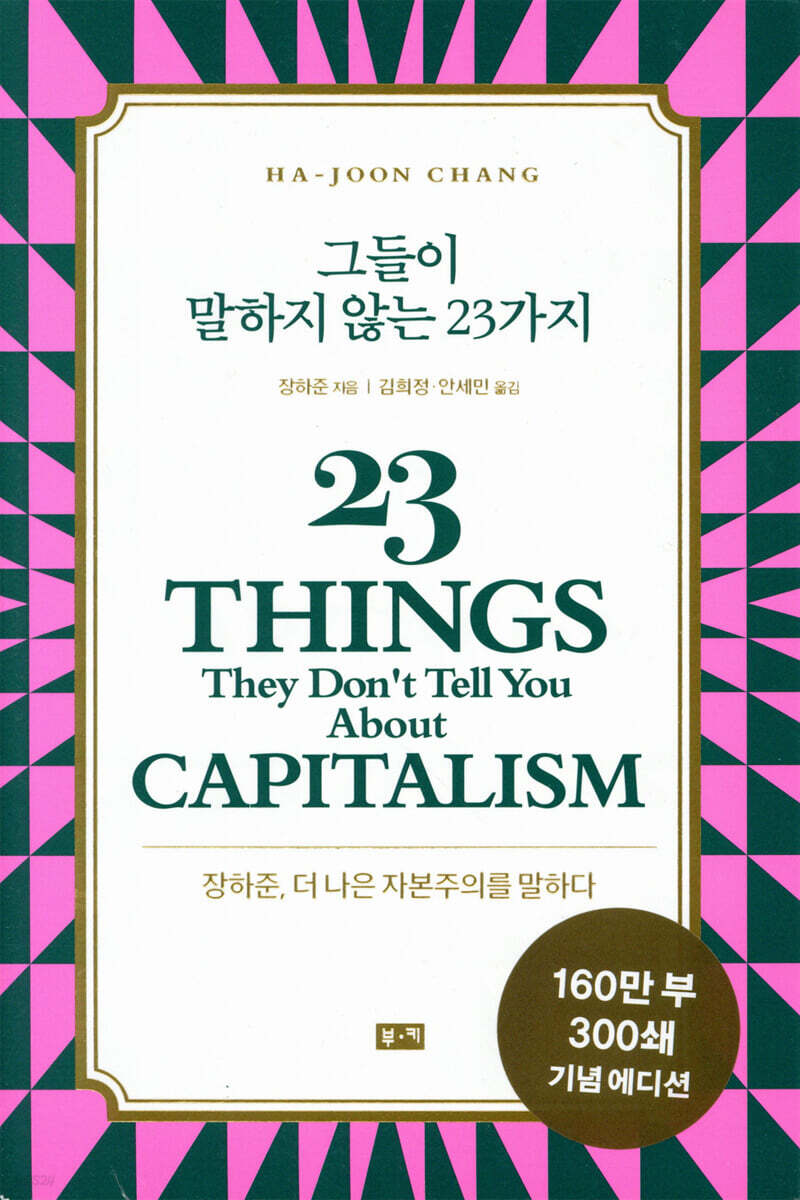
23 Things They Don't Tell You
 |
Description
Book Introduction
"True capitalism" economic knowledge that empowers you as an economic citizen!
Should corporations only care about the interests of their owners? If the rich get richer, will the rest of us benefit? Is the skyrocketing compensation of executives, as seen in the United States, simply a reflection of their productivity? Do policies that favor corporations also have positive economic outcomes? Do government intervention in the market and expanded welfare programs hinder economic development? Will increased education make a country wealthier? Is it impossible to develop effective economic policies without excellent economists?
This book is a story of a 'better' capitalism told by world-renowned economist Professor Ha-Joon Chang.
The author argues that capitalism, despite its numerous problems and limitations, is the best economic system humanity has ever created.
The problem, however, is the specific capitalist system that has dominated the world for the past 30 years: 'free market' capitalism.
Exercising your "rights as an economic citizen" and demanding that decision makers choose the right path doesn't necessarily require specialized knowledge.
The author emphasizes that one can talk about economic issues by knowing only the key principles and basic facts.
In this book, the author imparts valuable knowledge to ordinary people who cannot properly communicate due to a lack of economic knowledge, while also informing them about "true capitalism," not the current faulty capitalism, and explaining the economic principles necessary for people to actively exercise their "rights as economic citizens."
Should corporations only care about the interests of their owners? If the rich get richer, will the rest of us benefit? Is the skyrocketing compensation of executives, as seen in the United States, simply a reflection of their productivity? Do policies that favor corporations also have positive economic outcomes? Do government intervention in the market and expanded welfare programs hinder economic development? Will increased education make a country wealthier? Is it impossible to develop effective economic policies without excellent economists?
This book is a story of a 'better' capitalism told by world-renowned economist Professor Ha-Joon Chang.
The author argues that capitalism, despite its numerous problems and limitations, is the best economic system humanity has ever created.
The problem, however, is the specific capitalist system that has dominated the world for the past 30 years: 'free market' capitalism.
Exercising your "rights as an economic citizen" and demanding that decision makers choose the right path doesn't necessarily require specialized knowledge.
The author emphasizes that one can talk about economic issues by knowing only the key principles and basic facts.
In this book, the author imparts valuable knowledge to ordinary people who cannot properly communicate due to a lack of economic knowledge, while also informing them about "true capitalism," not the current faulty capitalism, and explaining the economic principles necessary for people to actively exercise their "rights as economic citizens."
- You can preview some of the book's contents.
Preview
index
introduction
Thing 1: There is no such thing as a free market.
Thing 2: Companies should not be run solely for the benefit of their owners.
Thing 3: In wealthy countries, people get paid more for the work they do.
Thing 4: Washing machines changed the world more than the Internet.
Thing 5: Expecting the worst often leads to the worst.
Thing 6: Macroeconomic stability did not lead to global economic stability.
Thing 7: Few countries have become rich through free-market policies.
Thing 8: Capital also has a nationality
Thing 9: We Are Not Living in a Post-Industrial Age
Thing 10: The United States is not the richest country in the world.
Thing 11: Africa's Underdevelopment Is Not Its Fate
Thing 12: Even the government can pick promising candidates.
Thing 13: Making the rich richer doesn't make us all richer.
Thing 14: American executives are paid too much.
Thing 15: People in poor countries are more entrepreneurial than those in rich countries.
Thing 16: We're not smart enough to leave everything to the market.
Thing 17: More education doesn't make a country better off.
Thing 18: What's Good for GM Isn't Always Good for America
Thing 19: We still live in a planned economy
Thing 20: Equality of Opportunity Isn't Always Fair
Thing 21: Big government makes people more receptive to change.
Thing 22: Financial markets need to be less efficient.
Thing 23: You don't need good economists to make good economic policy.
conclusion
Author's Note
Search
Thing 1: There is no such thing as a free market.
Thing 2: Companies should not be run solely for the benefit of their owners.
Thing 3: In wealthy countries, people get paid more for the work they do.
Thing 4: Washing machines changed the world more than the Internet.
Thing 5: Expecting the worst often leads to the worst.
Thing 6: Macroeconomic stability did not lead to global economic stability.
Thing 7: Few countries have become rich through free-market policies.
Thing 8: Capital also has a nationality
Thing 9: We Are Not Living in a Post-Industrial Age
Thing 10: The United States is not the richest country in the world.
Thing 11: Africa's Underdevelopment Is Not Its Fate
Thing 12: Even the government can pick promising candidates.
Thing 13: Making the rich richer doesn't make us all richer.
Thing 14: American executives are paid too much.
Thing 15: People in poor countries are more entrepreneurial than those in rich countries.
Thing 16: We're not smart enough to leave everything to the market.
Thing 17: More education doesn't make a country better off.
Thing 18: What's Good for GM Isn't Always Good for America
Thing 19: We still live in a planned economy
Thing 20: Equality of Opportunity Isn't Always Fair
Thing 21: Big government makes people more receptive to change.
Thing 22: Financial markets need to be less efficient.
Thing 23: You don't need good economists to make good economic policy.
conclusion
Author's Note
Search
Detailed image

Into the book
This book seeks to demonstrate that the facts sold as "truth" by free-market theorists are not necessarily self-serving, but are based on flawed assumptions and distorted perspectives.
That is, my purpose is to tell several important truths about capitalism that free market advocates do not tell.
However, this book is not an anti-capitalist statement.
Criticizing free market ideology does not mean opposing capitalism itself.
I believe that, despite its numerous problems and limitations, capitalism is the best economic system humanity has ever created.
I just want to criticize a specific capitalist system that has dominated the world for the past 30 years: free market capitalism.
A free market system is not the only way to run capitalism, and as the performance record of the last 30 years shows, it is certainly not the best way.
This book shows that capitalism must be made into a better system, and that there is a way to make it so.
---From the "Preface"
The United States fought a civil war over the freedom of the slave trade. (Of course, disagreements over the free trade of goods, namely tariffs, also played a role in the outbreak of the civil war.) Britain waged the Opium War against China to ensure the free trade of opium.
The regulation of free trade in child labor, mentioned above, was also made possible by the struggles of social reformers.
Efforts to outlaw the free buying and selling of public office and voting rights met with fierce opposition from political parties that operated by buying voters and doling out public offices to zealous members.
This practice has disappeared due to reformist political movements, electoral reforms, and improvements in regulations governing the appointment of public officials.
Recognizing that market boundaries are ambiguous and that there is no way to objectively determine them allows us to realize that economics is not a science like physics or chemistry, but a political act.
Of course, economists who believe in free markets would like us to believe that we can scientifically determine the correct boundaries of the market, but that is wrong.
If the boundaries of the subject of study cannot be scientifically determined, it cannot be called scientific research.
As we have seen, opposition to new regulations amounts to insisting on maintaining the status quo, no matter how unfair some may point it out.
Moreover, the argument for abolishing existing regulations is no different from saying that we should expand the market area, and since the market operates on the principle of one dollar, one vote, it means giving more power to those with money.
Therefore, when free-market economists oppose the introduction of certain regulations on the grounds that they restrict market freedom, they are merely expressing their political views that they are denying the rights that are supposed to be protected by those regulations.
---From "Thing 1: There is no such thing as a free market"
Soon after Jack Welch's speech, shareholder value maximization became the zeitgeist of American business.
Initially, this principle seemed like a really good idea for both managers and shareholders.
The share of profits in U.S. national income had been declining since the 1960s, but began to rise sharply in the mid-1980s and has continued to increase since then.
Shareholders received a larger share of the profits as dividends and benefited from rising stock prices.
Accordingly, the proportion of dividends in total corporate profits in the U.S. was around 35-45 percent from the 1950s to the 1970s, but has been steadily increasing since the late 1970s and is now around 60 percent.
In the process, executives' compensation soared through the roof (see Thing 14).
However, shareholders, who were happy with the ever-rising stock price and generous dividends, did not question the compensation of executives.
This behavior spread very easily in countries like the UK, where corporate governance structures and management cultures were similar to those of the US, but took a little longer to spread in countries where this was not the case.
This 'unholy alliance' formed between professional managers and shareholders was sustained by funds exploited from other stakeholders in the company.
(This is precisely why the spread of such unholy alliances was slower in non-Anglo-American advanced countries where the influence of other stakeholders was relatively strong.) Jobs were mercilessly cut, and countless workers were laid off and then rehired as non-union members with lower wages and almost no benefits.
Wage increases were suppressed through, or even the threat of, offshoring or relocating facilities to low-wage countries like China or India, leaving suppliers and their employees under constant pressure to lower unit prices.
Governments have also been under constant pressure to lower corporate taxes and expand subsidies, with threats to relocate facilities to countries with lower corporate taxes and more corporate subsidies.
As a result, income inequality has become extreme, and the majority of Americans and British citizens cannot participate in the superficial prosperity without incurring unprecedented debt (see Thing 13).
---From "Thing 2: Companies should not be run for the benefit of their owners"
Simply put, poor people in poor countries are no better off than those in the same profession in rich countries.
It is the rich in poor countries who are actually failing to do their part.
The country is poor because of their relatively low productivity.
Therefore, the complaint of the rich that the country is poor because of the poor is groundless.
Before complaining that the poor are dragging their entire country down, the rich in poor countries should consider why they have not been able to pull their entire country up like the rich in rich countries.
Finally, a word of caution is in order, lest the rich in rich countries become too smug about the high wages their own poor can enjoy thanks to their high productivity.
Even in areas where individuals in rich countries are substantially more productive than individuals in poor countries doing similar work, the gap is often due to differences in systems rather than individual abilities.
The fact that some individuals in rich countries can be hundreds of times more productive than workers in the same occupations in poor countries cannot be explained simply by their intelligence or better education.
They can achieve such results because they live in an economic environment with better technology, better organization, better institutions and physical infrastructure.
And all of this is the product of collective effort accumulated over generations (see Thing 15, 17).
---From "Thing 3: In wealthy countries, you get paid a lot for the work you do"
Some developed countries, especially the United States and the United Kingdom, have been so captivated by the information and communication technology revolution represented by the Internet that they have mistakenly assumed that "old-fashioned" manufacturing is no longer necessary and that all that is needed is ideas.
Accordingly, many countries blindly believed that the era of 'post-industrial society' had arrived and neglected manufacturing, weakening their own economies (see Thing 9).
What's more concerning is that as people in developed countries become fascinated with the Internet, the digital divide between developed and developing countries has become an international issue, and many companies, charities, and individuals are donating large sums of money to equip developing countries with computers and Internet facilities.
But is bridging the information gap truly what developing countries desperately need? Providing every child in developing countries with a laptop and establishing internet centers in every rural village would certainly help.
But wouldn't providing funding to dig wells, install electricity, and purchase washing machines, even if it seems tedious, actually go a long way toward improving the lives of people in developing countries? Wells, electricity, and washing machines aren't necessarily more important than computers or the internet.
I simply want to point out that many donors give money to programs that seem good without carefully evaluating the long-term benefits that could be reaped if the money were used for other purposes, comparing the costs to the benefits.
---From "Thing 4: Washing machines changed the world more than the Internet"
There is also ample evidence systematically demonstrating that self-interest is not the only motivation for economic activity.
Selfishness may be the most important motivation, but it is not the only one.
Honesty, self-respect, altruism, love, compassion, faith, a sense of duty, righteousness, loyalty, public morality, and patriotism are all important factors that determine our actions.
As the example of Kobe Steel shows, successful companies are built on trust and loyalty rather than suspicion and selfishness.
If you think this is a peculiar example found only in Japan, the "land of worker ants," just look at any management guidebook or autobiography of a successful entrepreneur published in the West.
Is there a single management book that advises successful managers to constantly be suspicious of employees who shirk or cheat? Most books probably devote significant space to how to build empathy with employees, change their perspectives, articulate a vision, and foster teamwork.
A good manager knows that people are not narrow-minded robots who pursue only their own interests.
He also knows that everyone has good and bad sides, and that the secret to good management lies in maximizing the good sides of each employee and changing their bad sides.
---From "Thing 5: Expecting the worst leads to the worst results"
It is no coincidence that price stability (i.e. low inflation) coexists with economic instability factors that are not expressed in prices, such as frequent financial crises and increasing job insecurity.
Because these phenomena are all products of the same free market policy.
In the aforementioned study, Rogoff and Reinhart argue that there is a close relationship between the proportion of countries that experience financial crises and the degree to which they allow free international capital movements.
Free-market economists, who believe that capital can be used more efficiently if it can move freely across borders, consider the free international movement of capital another important goal (see Thing 22).
Accordingly, free-market advocates have consistently pressured all countries to open their capital markets (although they have recently begun to adopt a more flexible stance toward developing countries).
The rise in job insecurity is also a direct result of free market policies.
The employment instability that emerged as high unemployment rates in advanced countries in the 1980s was the result of tight macroeconomic policies implemented to curb inflation.
Between the 1990s and the financial crisis of 2008, unemployment declined, but the risk of involuntary termination and the proportion of short-term employment increased, while the nature of work changed frequently and its intensity often increased.
This all happened because the regulations on the labor market were changed with the intention of increasing the flexibility of the labor market and thus increasing the efficiency of the economy.
A set of policies within the free-market policy package, also known as the neoliberal policy package, emphasize low inflation, free capital mobility, and high job insecurity (expressed under the rhetoric of labor market flexibility).
Fundamentally, these policies are designed to protect the interests of financial asset holders.
The emphasis on suppressing inflation is because the returns on financial assets are mostly fixed in nominal terms, so when prices rise, the returns decrease relatively.
---From "Thing 6: Macroeconomic stability did not lead to global economic stability"
Just as the United States was one of the most protectionist countries in the world during its economic boom from the 1830s to the 1940s, Britain was also one of the most protectionist countries during its economic growth, from the 1720s to the 1850s.
Among modern advanced countries, there are few that have not used protectionist and subsidy policies to protect infant industries.
Many countries, including Japan, Finland, and South Korea, have strictly regulated foreign investment.
From the 1930s to the 1980s, Finland officially classified companies with more than 20 percent foreign ownership as "risky."
Several countries, including France, Austria, Finland, Singapore, and Taiwan, have established state-owned enterprises to foster key industries.
Singapore, known for its free trade policies and welcoming foreign investment, has state-owned enterprises accounting for over 20 percent of its GDP, double the global average of 10 percent.
Among the countries that have become wealthy today, there are not many that have done a good job of protecting the intellectual property rights of foreigners.
There were many countries that allowed domestic citizens to patent foreign inventions in their own names.
---From "Thing 7: Few countries have become rich through free market policies"
Even in the manufacturing sector, which is arguably the simplest of corporate activities and therefore the easiest to relocate overseas, most multinational corporations still have a solid production base in their home countries.
There are exceptions, such as Nestlé, which produces most of its products abroad, but these are very rare.
Among U.S.-based multinational corporations, manufacturers produce less than one-third of their total overseas production, and Japanese companies produce less than 10 percent of their total overseas production.
While this proportion has been increasing rapidly in Europe in recent years, given that most of European companies' overseas production takes place within Europe, this phenomenon is more appropriately understood as a process of European companies creating new companies suited to the new nation of the European Union rather than a genuine transcendence of nationality.
Simply put, there are very few truly multinational companies.
The majority of companies still do most of their production in their home countries.
In particular, strategic decision-making and advanced research and development activities take place in the home country.
The expression "borderless world" is a gross exaggeration.
---From "Thing 8: Capital also has a nationality"
In short, the main reason for the decline in the manufacturing share of GDP in rich countries is not, as many people believe, a relative decline in demand for manufactured goods.
It is not because imports of manufactured goods from China or other developing countries have increased significantly.
The significant impact of these imported products is limited to a few sectors.
The so-called deindustrialization phenomenon occurred because the prices of manufactured products relatively fell due to rapid productivity increases in the manufacturing sector.
So, while citizens of rich countries may be living in a "post-industrial society" from an employment perspective, from a production perspective, the importance of manufacturing in these economies has not yet diminished to the point where they would declare themselves a "post-industrial society."
---From "Thing 9: We Are Not Living in a Post-Industrial Age"
First of all, just because the average income is higher than in other countries, it doesn't mean that all Americans are better off than people in other countries.
This may or may not be true depending on how equal the income distribution is.
In any country, the average income cannot accurately predict how its citizens live, but the more unequal the income distribution in a country, the more difficult it is to estimate the lives of its citizens based on average income.
Considering that the United States has the most severe income distribution inequality among developed countries, it can be assumed that the number of people in the United States living below the average standard of living estimated by the country's per capita national income is higher than in other countries.
Other indicators of living standards also indirectly support this conjecture.
For example, the United States has the highest average income in the world based on purchasing power parity, yet it ranks only 30th in health indicators such as life expectancy and infant mortality rate.
(Of course, one could argue that this problem is exacerbated by America's inefficient healthcare system, but let's not get into that.) The per capita average prison population in the United States is eight times that of Europe and twelve times that of Japan, suggesting a much higher crime rate and a much higher proportion of the poorest population than in other developed countries.
---From "Thing 10: America is not the richest country in the world"
The structural adjustment program and other programs that followed, such as the Poverty Reduction Strategy Papers (PRSPs) with different names but the same content, resulted in a stagnation of African economies with no growth (in terms of per capita income) for 30 years.
During the 1980s and 1990s, per capita income in sub-Saharan African countries fell by about 0.7 percent per year.
Although growth began to pick up in the 2000s, the economic downturn of the past two decades has resulted in an average annual increase in per capita national income of only 0.2 percent between 1980 and 2009.
Ultimately, this means that after 30 years of "better" policies, namely free market policies, Africa's per capita income remains at the same level as in 1980.
Ultimately, the so-called structural factors are nothing more than an excuse put forth by free-market economists.
When their preferred policies failed to produce good results, they were forced to find other explanations for Africa's stagnation, or rather, its decline (which is now over, but is effectively a recession, except that growth rates have picked up in recent years thanks to increased demand for primary goods).
It was unacceptable that the very 'correct' policy they had put forward was the cause of their failure.
It is no coincidence that the argument that Africa's meager economic performance is due to structural problems began to gain traction only after growth stalled in the early 1980s.
---From "Thing 11: Africa's Underdevelopment Is Not Its Fate"
As I've explained in more detail elsewhere in this book (see Thing 7, 19 for the most detailed explanation), Korea is not the only country where the government has done a good job of picking promising candidates.
Other countries that achieved the East Asian economic miracle did similar things.
The South Korean government's method of selecting promising players was essentially learned from Japan, although slightly more aggressive means were employed.
Taiwanese and Singaporean government officials, although using slightly different methods, were no less active in actively intervening and successfully selecting promising candidates than Korea.
More importantly, successfully identifying promising candidates is not the exclusive domain of East Asian governments.
For example, in the late 20th century, governments such as France, Finland, Norway, and Austria successfully planned and directed industrial development through protectionist policies, subsidies, and investment by state-owned enterprises.
Even the U.S. government, which pretends never to have mobilized industrial policy, provided large-scale support for research and development after World War II to encourage the development of specific industries.
Computers, semiconductors, aircraft, the Internet, and biotechnology are all representative industrial fields that have developed thanks to the U.S. government's support for research and development.
Even in the late 19th and early 20th centuries, when government industrial policies were much weaker in terms of organization and effectiveness than in the early 20th century, there are many examples of countries that have now become wealthy successfully developing specific industries through tariffs, subsidies, licensing, and regulations (see Thing 7).
---From "Thing 12: Even the Government Can Pick Promising Stocks"
Capitalism did not collapse even after the rich began to be heavily taxed.
Rather, capitalism has become more robust thanks to high taxes.
After World War II, most wealthy capitalist countries adopted progressive tax systems and increased social welfare spending.
Despite this, or perhaps partly because of it, the rich capitalist countries achieved their highest growth rates on record between 1950 and 1973 (see Thing 21).
We call this period the 'golden age of capitalism'.
Before the Golden Age, per capita national income in wealthy capitalist countries grew at about 1 to 1.5 percent per year.
But during the Golden Age, per capita income grew by 2 to 3 percent in the United States and Britain, 4 to 5 percent in Western Europe, and 8 percent in Japan.
Since then, these countries have never recorded higher growth rates than this one.
But when growth rates in wealthy capitalist countries began to decline in the mid-1970s, free-marketeers resurrected the stale logic of the 19th century, convincing the world that the shrinking share of income going to the "investing class" was the cause of the decline in growth.
---From "Thing 13: Making the rich richer doesn't make us all richer"
But if American CEOs are worth anywhere from two to twenty times more (compared to Swiss CEOs, excluding stock options) to twenty times more (compared to Japanese CEOs, including stock options) than their counterparts abroad, why do American companies lag behind their Japanese and European counterparts in so many industries? One might wonder if the lower absolute compensation of Japanese and European CEOs is due to the fact that their average salaries are lower than in the United States.
However, wage levels in Japan and European countries are almost similar to those in the United States.
The average worker's salary in 13 countries surveyed by the Economic Policy Institute in 2005 was 85 percent of that in the United States.
Among them, Japanese workers received 91 percent of what American workers received, while Japanese CEOs received only 25 percent of what American CEOs received, excluding stock options.
Swiss and German workers actually earned more than their American counterparts, earning 130 percent and 106 percent of the average American worker's compensation, respectively, while their CEOs earned only 55 percent and 64 percent of the American average.
Moreover, this figure excludes stock options, which American CEOs receive in much greater amounts.5 This suggests that American executives are overpaid.
While American workers earn only 15 percent more than their counterparts in other countries, CEOs earn between twice as much (compared to Switzerland, excluding stock options) and as much as twenty times as much (compared to Japan, including stock options).
Yet, the performance of American companies is often comparable to or inferior to that of their Japanese and European competitors.
---From "Thing 14: American Executives Are Paid Too Much"
From this perspective, it can be interpreted that the poverty of developing countries is due to a lack of entrepreneurial spirit in those countries.
People from rich countries who have traveled to developing countries talk about it.
Look at all the people sitting in the shade of the trees, drinking tea all day long. Truly, a country like that needs enterprising and proactive people, people with an entrepreneurial spirit, to get out of poverty.
But anyone from a developing country or who has lived there for any length of time knows that developing countries are teeming with entrepreneurial spirit.
The streets of poor countries are filled with people of all ages and genders selling every imaginable commodity.
You can even buy things you never thought money could buy.
In many poor countries, you can buy things like a front-row seat in a long line at a U.S. embassy visa counter, having your car "guarded," the right to set up a street corner stall and sell food, and even a spot to crouch and beg.
The people who sell these services are likely to be professional line-setters in front of the American embassy, thugs who will vandalize your parked car if you don't pay, corrupt police chiefs, and local gangsters.
Regardless of form, aren't they all examples of extreme human creativity and entrepreneurship? The entrepreneurial spirit of people in developed countries simply can't keep up with theirs.
---From "Thing 15: People in poor countries have a stronger entrepreneurial spirit than people in rich countries"
It is significant that even fund managers, financial experts, executives of big banks (including some of the world's largest, such as HSBC in the UK and Santander in Spain), and world-class universities (such as New York University and Bard College, which have many world-renowned economics professors) fell for the same fraud that Madoff perpetrated.
The problem isn't just the existence of fraudsters like Madoff and Alan Stanford.
Even in legitimate financial industries, there were countless instances where bankers and other financial experts were unable to properly grasp the situation.
In the summer of 2008, a banker shocked British Chancellor of the Exchequer Alistair Darling by saying, “From now on, we will only lend when we know the risks involved.”
So does that mean they were lending money without even understanding the risks? There are even more shocking cases.
According to media reports, just six months before the American insurance giant AIG went bankrupt (it was bailed out by the U.S. government in the fall of 2008), the company's Chief Financial Officer (CFO) Joe Cassano said:
“It may sound frivolous, but it’s hard to imagine a scenario where we could lose even a dollar on credit default swaps.” Not long after this statement was made, AIG went bankrupt, not because of its core insurance business, but because of a $441 billion loss on credit default swaps.
Most readers, especially American taxpayers who have to pay for the massive financial disasters Cassano perpetrated, will be reluctant to laugh off his "irrelevant remarks."
How can we possibly accept economic theory, which is based solely on the assumption that humans are rational, when even Nobel laureates in financial economics, bank presidents, high-flying fund managers, prestigious universities, and the world's smartest celebrities don't understand what they're doing?
Ultimately, we cannot help but conclude that we humans are not smart enough to leave everything to the market.
What does this conclusion imply for us? If we're not smart enough to leave everything to the market, is it possible to regulate it? The answer is yes.
No, it's actually more than that.
In many cases, regulation is necessary precisely because we are not smart enough.
---From "Thing 16: We Are Not Smart Enough to Leave Everything to the Market"
Besides education, there are many factors that determine a country's economic performance.
However, looking at the examples mentioned above, one cannot help but question the myth that education, among other factors, was the main factor in the East Asian economic miracle.
While East Asian countries did not have high levels of education in the early stages of their economic development, countries like the Philippines and Argentina did not perform well economically despite having higher levels of education.
In stark contrast to this, the case of sub-Saharan African countries shows that increased investment in education does not necessarily lead to better economic outcomes.
Between 1980 and 2004, the region's illiteracy rate showed a marked decline, falling from 60 percent to 39 percent, while per capita national income fell by 0.3 percent annually during the same period.
If education were as important to economic development as most people believe, this could never happen.
The evidence that education has a marginally positive impact on economic growth is not limited to extreme cases like the East Asian countries or sub-Saharan African countries cited here, but is a more general phenomenon.
In a 2004 paper titled “Where Has All the Education Gone?” by Professor Lant Pritchett, a long-time World Bank employee and Harvard University economics professor, examines whether education has had a positive effect on economic growth, based on data collected from dozens of developed and developing countries between 1960 and 1987.
In this widely cited paper, Professor Pritchett concluded that there was little evidence that higher education levels promoted economic growth.
---From "Thing 17: More education does not make a country better off"
This decision may have been the best option, at least from GM's perspective, at least at the time it was made.
After all, with minimal effort, the life of the company could be extended by several decades.
But this choice was bad for the rest of the American economy. The enormous cost to American taxpayers of bailing out GM is a stark testament to this.
Instead of lobbying for protectionism, buying up smaller competitors, and reaching out to finance, America would have been better served if someone had forced GM to invest in the technology and equipment needed to build better cars.
More importantly, even those measures that allowed GM to avoid its difficulties with minimal effort ultimately proved unhealthy for the company.
Of course, this is only true if you don't equate GM with its management and its constantly shifting shareholder base. GM's management has squeezed relatively weaker stakeholders—workers, subcontractors, and their employees—by failing to invest in productivity improvements, generating high profits and reaping absurdly high compensation in return. Meanwhile, they've silenced shareholders with dividends and stock buybacks that are so high they've jeopardized GM's future.
Shareholders were also not at all concerned about this phenomenon and, in fact, encouraged such practices.
This is because most of these shareholders were floating shareholders, uninterested in the company's long-term future, and could easily exit if things got worse. GM's case offers a valuable lesson about the potential conflict between corporate interests and national interests.
In other words, what is good for a company, no matter how important it may be, may not be good for the country.
Additionally, this case shows that the stakeholders that make up a company can also conflict with each other.
What is good for some stakeholders, such as management or short-term shareholders, may not be good for others, such as workers or suppliers.
What this means is that what's good for a company in the short term may not be good for it in the long run—what's good for GM today may not be good for GM tomorrow.
---From "Thing 18: What's Good for GM Isn't Always Good for America"
The virtual disappearance of the communist system does not mean that economic planning no longer exists.
This is because governments in capitalist countries also plan their economies, although not in the comprehensive way that central planning authorities in communist countries pursued.
Even in a capitalist economy, there are situations where central planning is more efficient, such as during wartime.
For example, the major capitalist countries during World War II, including the United States, Britain, and Germany, simply did not use the name planned economy; they planned everything centrally.
But more importantly, many capitalist countries have successfully used 'guided planning'.
This refers to the method by which the government in a capitalist country sets broad goals for key economic variables, such as investment in strategic projects, development of social infrastructure, and export promotion, and then strives to achieve those goals through cooperation, rather than conflict, with the private sector.
Unlike central planning systems, the goals of guided planning are not legally binding, as the word "guided" implies.
However, the government strives to achieve its policy goals by using various carrots, such as subsidies and market exclusivity, and sticks, such as various regulations and financial pressure through state-owned banks.
During the 1950s and 1960s, France overtook Britain as Europe's second-largest industrial power, thanks to successful investment expansion and technological innovation through induction programs.
Other European countries, such as Finland, Norway, and Austria, also achieved economic advancement through similar methods between the 1950s and 1970s.
Japan, Korea, and Taiwan, which achieved the East Asian miracle, also utilized induction planning between the 1950s and 1980s.
That doesn't mean that all countries that have drawn up a plan have been successful.
Because there are cases like India.
But these success stories from Europe and Asia show that some forms of economic planning are compatible with the capitalist system and, in some cases, can even promote its development.
Moreover, even if the governments of most capitalist countries do not explicitly plan for the entire economy, even if only inductively, it is true that they do plan and implement policies for key sectors, and these policies ultimately affect the entire economy (see Thing 12).
---From "Thing 19: We Still Live in a Planned Economy"
If we tax the rich too much to fund welfare programs, they will lose the incentive to create wealth, and if we guarantee them a minimum standard of living regardless of how hard they work or whether they work at all, the poor will lose the incentive to work (see Thing 21).
Free-market economists argue that attempts to reduce inequality of outcomes ultimately harm everyone for precisely this reason.
It goes without saying that excessive pursuit of equality of outcome, like Mao Zedong's cooperative farms, where there was no correlation between effort put in and results obtained, has a negative impact on people's desire to work.
This is also unfair.
However, I believe that to create a truly fair society, it is essential to achieve some degree of equality of outcomes.
The problem is that to benefit from equally given opportunities, you must have the ability to take advantage of them.
For example, black South Africans now have the same guaranteed access to high-paying jobs as whites, but without the right education, it's of no use.
Black people can now get into prestigious colleges that were once exclusively white, but if they come from poor schools with unqualified teachers who can't read or write, their chances of getting into a prestigious university are still slim.
---From "Thing 20: Equality of Opportunity Isn't Always Fair"
How do economic growth rates differ across countries with different welfare systems? As explained earlier, the conventional wisdom is that a smaller welfare system leads to a more dynamic economy.
However, the actual visible evidence does not support this conventional wisdom.
Until the 1980s, the United States had a much lower growth rate than many European countries, despite having a less developed welfare system.
In 1980, public social spending accounted for 19.9 percent of GDP in the 15 EU countries, while it was only 13.3 percent in the United States.
In Sweden, the rate reached 28.6 percent, in the Netherlands 24.1 percent, and in Germany (West Germany) 23 percent.
Yet, between 1950 and 1987, the United States grew more slowly than any European country.
During this period, the growth rate of per capita national income was 3.8 percent per year in Germany, 2.7 percent in Sweden, and 2.5 percent in the Netherlands, while the United States recorded only 1.9 percent per year.
Of course, the size of a country's welfare system is only one of many factors that determine its economic performance, but these figures demonstrate that a well-established welfare system does not necessarily prevent a country from achieving a high growth rate.
---From "Thing 21: Big Government Makes People More Acceptable to Change"
What is noteworthy here is that the same real assets – the houses that were initially used as collateral for home mortgage loans, and the economic activities of their owners – were used again and again to ‘derive’ new assets.
But no matter how ingenious the financial products, whether these assets can ultimately deliver the expected returns ultimately depends on whether the hundreds of thousands of workers and small business owners who initially took out the collateral loans repay their loans on time.
Ultimately, the result of the so-called financial innovation is that the entire building is now shaky, having been built endlessly high on top of a foundation of real assets.
(Of course, the foundation of real assets itself is partially expanded and strengthened through financial activities.
But the important thing is that the building is getting taller than the foundation can handle, so let's focus on that issue for now.) If you only build a building taller without expanding the foundation, the possibility of the building collapsing will also increase.
The problem doesn't end here; it gets worse.
In the case of financial products, the more they become "derivatives," the further they become from the real assets that ultimately support them, and as a result, it becomes increasingly difficult to accurately price the derivative financial product.
This not only means increasing the number of floors in an existing building without reinforcing the foundation, but it is also no different from using materials of uncertain quality as the number of floors increases.
In that context, it is not surprising that Warren Buffett, an American investor famous for his thoroughly realistic investment principles, called derivatives “weapons of financial mass destruction” even before their destructive power was revealed during the 2008 financial crisis.
---From "Thing 22: Financial Markets Need to Be Less Efficient"
For the past two decades, we've heard repeatedly from incredibly qualified experts—from Nobel laureates in economics and the world's top financial regulators to talented young investment bankers with economics degrees from the world's most prestigious universities—that the global economy is doing just fine.
We also heard that economists had finally discovered the magic formula for rapid growth and low inflation.
People talked about a "Goldilocks" economy that was just right: not too hot, not too cold.
Former Federal Reserve Chairman Alan Greenspan, who oversaw the world's most powerful economy for over two decades, both in terms of monetary size and ideological influence, was hailed as a "maestro," as the Watergate-famous journalist Bob Woodward put it in his biography.
His successor, Ben Bernanke, talked about taming inflation and achieving a "Great Moderation" without the extreme economic fluctuations (see Thing 6).
So it must have been a real mystery to everyone, including the Queen, who had been counting on the clever economists to figure things out, that things could have gone so terribly wrong.
How could these brilliant people, with degrees from prestigious universities and armed head to toe with arcane mathematical equations, be so wrong?
That is, my purpose is to tell several important truths about capitalism that free market advocates do not tell.
However, this book is not an anti-capitalist statement.
Criticizing free market ideology does not mean opposing capitalism itself.
I believe that, despite its numerous problems and limitations, capitalism is the best economic system humanity has ever created.
I just want to criticize a specific capitalist system that has dominated the world for the past 30 years: free market capitalism.
A free market system is not the only way to run capitalism, and as the performance record of the last 30 years shows, it is certainly not the best way.
This book shows that capitalism must be made into a better system, and that there is a way to make it so.
---From the "Preface"
The United States fought a civil war over the freedom of the slave trade. (Of course, disagreements over the free trade of goods, namely tariffs, also played a role in the outbreak of the civil war.) Britain waged the Opium War against China to ensure the free trade of opium.
The regulation of free trade in child labor, mentioned above, was also made possible by the struggles of social reformers.
Efforts to outlaw the free buying and selling of public office and voting rights met with fierce opposition from political parties that operated by buying voters and doling out public offices to zealous members.
This practice has disappeared due to reformist political movements, electoral reforms, and improvements in regulations governing the appointment of public officials.
Recognizing that market boundaries are ambiguous and that there is no way to objectively determine them allows us to realize that economics is not a science like physics or chemistry, but a political act.
Of course, economists who believe in free markets would like us to believe that we can scientifically determine the correct boundaries of the market, but that is wrong.
If the boundaries of the subject of study cannot be scientifically determined, it cannot be called scientific research.
As we have seen, opposition to new regulations amounts to insisting on maintaining the status quo, no matter how unfair some may point it out.
Moreover, the argument for abolishing existing regulations is no different from saying that we should expand the market area, and since the market operates on the principle of one dollar, one vote, it means giving more power to those with money.
Therefore, when free-market economists oppose the introduction of certain regulations on the grounds that they restrict market freedom, they are merely expressing their political views that they are denying the rights that are supposed to be protected by those regulations.
---From "Thing 1: There is no such thing as a free market"
Soon after Jack Welch's speech, shareholder value maximization became the zeitgeist of American business.
Initially, this principle seemed like a really good idea for both managers and shareholders.
The share of profits in U.S. national income had been declining since the 1960s, but began to rise sharply in the mid-1980s and has continued to increase since then.
Shareholders received a larger share of the profits as dividends and benefited from rising stock prices.
Accordingly, the proportion of dividends in total corporate profits in the U.S. was around 35-45 percent from the 1950s to the 1970s, but has been steadily increasing since the late 1970s and is now around 60 percent.
In the process, executives' compensation soared through the roof (see Thing 14).
However, shareholders, who were happy with the ever-rising stock price and generous dividends, did not question the compensation of executives.
This behavior spread very easily in countries like the UK, where corporate governance structures and management cultures were similar to those of the US, but took a little longer to spread in countries where this was not the case.
This 'unholy alliance' formed between professional managers and shareholders was sustained by funds exploited from other stakeholders in the company.
(This is precisely why the spread of such unholy alliances was slower in non-Anglo-American advanced countries where the influence of other stakeholders was relatively strong.) Jobs were mercilessly cut, and countless workers were laid off and then rehired as non-union members with lower wages and almost no benefits.
Wage increases were suppressed through, or even the threat of, offshoring or relocating facilities to low-wage countries like China or India, leaving suppliers and their employees under constant pressure to lower unit prices.
Governments have also been under constant pressure to lower corporate taxes and expand subsidies, with threats to relocate facilities to countries with lower corporate taxes and more corporate subsidies.
As a result, income inequality has become extreme, and the majority of Americans and British citizens cannot participate in the superficial prosperity without incurring unprecedented debt (see Thing 13).
---From "Thing 2: Companies should not be run for the benefit of their owners"
Simply put, poor people in poor countries are no better off than those in the same profession in rich countries.
It is the rich in poor countries who are actually failing to do their part.
The country is poor because of their relatively low productivity.
Therefore, the complaint of the rich that the country is poor because of the poor is groundless.
Before complaining that the poor are dragging their entire country down, the rich in poor countries should consider why they have not been able to pull their entire country up like the rich in rich countries.
Finally, a word of caution is in order, lest the rich in rich countries become too smug about the high wages their own poor can enjoy thanks to their high productivity.
Even in areas where individuals in rich countries are substantially more productive than individuals in poor countries doing similar work, the gap is often due to differences in systems rather than individual abilities.
The fact that some individuals in rich countries can be hundreds of times more productive than workers in the same occupations in poor countries cannot be explained simply by their intelligence or better education.
They can achieve such results because they live in an economic environment with better technology, better organization, better institutions and physical infrastructure.
And all of this is the product of collective effort accumulated over generations (see Thing 15, 17).
---From "Thing 3: In wealthy countries, you get paid a lot for the work you do"
Some developed countries, especially the United States and the United Kingdom, have been so captivated by the information and communication technology revolution represented by the Internet that they have mistakenly assumed that "old-fashioned" manufacturing is no longer necessary and that all that is needed is ideas.
Accordingly, many countries blindly believed that the era of 'post-industrial society' had arrived and neglected manufacturing, weakening their own economies (see Thing 9).
What's more concerning is that as people in developed countries become fascinated with the Internet, the digital divide between developed and developing countries has become an international issue, and many companies, charities, and individuals are donating large sums of money to equip developing countries with computers and Internet facilities.
But is bridging the information gap truly what developing countries desperately need? Providing every child in developing countries with a laptop and establishing internet centers in every rural village would certainly help.
But wouldn't providing funding to dig wells, install electricity, and purchase washing machines, even if it seems tedious, actually go a long way toward improving the lives of people in developing countries? Wells, electricity, and washing machines aren't necessarily more important than computers or the internet.
I simply want to point out that many donors give money to programs that seem good without carefully evaluating the long-term benefits that could be reaped if the money were used for other purposes, comparing the costs to the benefits.
---From "Thing 4: Washing machines changed the world more than the Internet"
There is also ample evidence systematically demonstrating that self-interest is not the only motivation for economic activity.
Selfishness may be the most important motivation, but it is not the only one.
Honesty, self-respect, altruism, love, compassion, faith, a sense of duty, righteousness, loyalty, public morality, and patriotism are all important factors that determine our actions.
As the example of Kobe Steel shows, successful companies are built on trust and loyalty rather than suspicion and selfishness.
If you think this is a peculiar example found only in Japan, the "land of worker ants," just look at any management guidebook or autobiography of a successful entrepreneur published in the West.
Is there a single management book that advises successful managers to constantly be suspicious of employees who shirk or cheat? Most books probably devote significant space to how to build empathy with employees, change their perspectives, articulate a vision, and foster teamwork.
A good manager knows that people are not narrow-minded robots who pursue only their own interests.
He also knows that everyone has good and bad sides, and that the secret to good management lies in maximizing the good sides of each employee and changing their bad sides.
---From "Thing 5: Expecting the worst leads to the worst results"
It is no coincidence that price stability (i.e. low inflation) coexists with economic instability factors that are not expressed in prices, such as frequent financial crises and increasing job insecurity.
Because these phenomena are all products of the same free market policy.
In the aforementioned study, Rogoff and Reinhart argue that there is a close relationship between the proportion of countries that experience financial crises and the degree to which they allow free international capital movements.
Free-market economists, who believe that capital can be used more efficiently if it can move freely across borders, consider the free international movement of capital another important goal (see Thing 22).
Accordingly, free-market advocates have consistently pressured all countries to open their capital markets (although they have recently begun to adopt a more flexible stance toward developing countries).
The rise in job insecurity is also a direct result of free market policies.
The employment instability that emerged as high unemployment rates in advanced countries in the 1980s was the result of tight macroeconomic policies implemented to curb inflation.
Between the 1990s and the financial crisis of 2008, unemployment declined, but the risk of involuntary termination and the proportion of short-term employment increased, while the nature of work changed frequently and its intensity often increased.
This all happened because the regulations on the labor market were changed with the intention of increasing the flexibility of the labor market and thus increasing the efficiency of the economy.
A set of policies within the free-market policy package, also known as the neoliberal policy package, emphasize low inflation, free capital mobility, and high job insecurity (expressed under the rhetoric of labor market flexibility).
Fundamentally, these policies are designed to protect the interests of financial asset holders.
The emphasis on suppressing inflation is because the returns on financial assets are mostly fixed in nominal terms, so when prices rise, the returns decrease relatively.
---From "Thing 6: Macroeconomic stability did not lead to global economic stability"
Just as the United States was one of the most protectionist countries in the world during its economic boom from the 1830s to the 1940s, Britain was also one of the most protectionist countries during its economic growth, from the 1720s to the 1850s.
Among modern advanced countries, there are few that have not used protectionist and subsidy policies to protect infant industries.
Many countries, including Japan, Finland, and South Korea, have strictly regulated foreign investment.
From the 1930s to the 1980s, Finland officially classified companies with more than 20 percent foreign ownership as "risky."
Several countries, including France, Austria, Finland, Singapore, and Taiwan, have established state-owned enterprises to foster key industries.
Singapore, known for its free trade policies and welcoming foreign investment, has state-owned enterprises accounting for over 20 percent of its GDP, double the global average of 10 percent.
Among the countries that have become wealthy today, there are not many that have done a good job of protecting the intellectual property rights of foreigners.
There were many countries that allowed domestic citizens to patent foreign inventions in their own names.
---From "Thing 7: Few countries have become rich through free market policies"
Even in the manufacturing sector, which is arguably the simplest of corporate activities and therefore the easiest to relocate overseas, most multinational corporations still have a solid production base in their home countries.
There are exceptions, such as Nestlé, which produces most of its products abroad, but these are very rare.
Among U.S.-based multinational corporations, manufacturers produce less than one-third of their total overseas production, and Japanese companies produce less than 10 percent of their total overseas production.
While this proportion has been increasing rapidly in Europe in recent years, given that most of European companies' overseas production takes place within Europe, this phenomenon is more appropriately understood as a process of European companies creating new companies suited to the new nation of the European Union rather than a genuine transcendence of nationality.
Simply put, there are very few truly multinational companies.
The majority of companies still do most of their production in their home countries.
In particular, strategic decision-making and advanced research and development activities take place in the home country.
The expression "borderless world" is a gross exaggeration.
---From "Thing 8: Capital also has a nationality"
In short, the main reason for the decline in the manufacturing share of GDP in rich countries is not, as many people believe, a relative decline in demand for manufactured goods.
It is not because imports of manufactured goods from China or other developing countries have increased significantly.
The significant impact of these imported products is limited to a few sectors.
The so-called deindustrialization phenomenon occurred because the prices of manufactured products relatively fell due to rapid productivity increases in the manufacturing sector.
So, while citizens of rich countries may be living in a "post-industrial society" from an employment perspective, from a production perspective, the importance of manufacturing in these economies has not yet diminished to the point where they would declare themselves a "post-industrial society."
---From "Thing 9: We Are Not Living in a Post-Industrial Age"
First of all, just because the average income is higher than in other countries, it doesn't mean that all Americans are better off than people in other countries.
This may or may not be true depending on how equal the income distribution is.
In any country, the average income cannot accurately predict how its citizens live, but the more unequal the income distribution in a country, the more difficult it is to estimate the lives of its citizens based on average income.
Considering that the United States has the most severe income distribution inequality among developed countries, it can be assumed that the number of people in the United States living below the average standard of living estimated by the country's per capita national income is higher than in other countries.
Other indicators of living standards also indirectly support this conjecture.
For example, the United States has the highest average income in the world based on purchasing power parity, yet it ranks only 30th in health indicators such as life expectancy and infant mortality rate.
(Of course, one could argue that this problem is exacerbated by America's inefficient healthcare system, but let's not get into that.) The per capita average prison population in the United States is eight times that of Europe and twelve times that of Japan, suggesting a much higher crime rate and a much higher proportion of the poorest population than in other developed countries.
---From "Thing 10: America is not the richest country in the world"
The structural adjustment program and other programs that followed, such as the Poverty Reduction Strategy Papers (PRSPs) with different names but the same content, resulted in a stagnation of African economies with no growth (in terms of per capita income) for 30 years.
During the 1980s and 1990s, per capita income in sub-Saharan African countries fell by about 0.7 percent per year.
Although growth began to pick up in the 2000s, the economic downturn of the past two decades has resulted in an average annual increase in per capita national income of only 0.2 percent between 1980 and 2009.
Ultimately, this means that after 30 years of "better" policies, namely free market policies, Africa's per capita income remains at the same level as in 1980.
Ultimately, the so-called structural factors are nothing more than an excuse put forth by free-market economists.
When their preferred policies failed to produce good results, they were forced to find other explanations for Africa's stagnation, or rather, its decline (which is now over, but is effectively a recession, except that growth rates have picked up in recent years thanks to increased demand for primary goods).
It was unacceptable that the very 'correct' policy they had put forward was the cause of their failure.
It is no coincidence that the argument that Africa's meager economic performance is due to structural problems began to gain traction only after growth stalled in the early 1980s.
---From "Thing 11: Africa's Underdevelopment Is Not Its Fate"
As I've explained in more detail elsewhere in this book (see Thing 7, 19 for the most detailed explanation), Korea is not the only country where the government has done a good job of picking promising candidates.
Other countries that achieved the East Asian economic miracle did similar things.
The South Korean government's method of selecting promising players was essentially learned from Japan, although slightly more aggressive means were employed.
Taiwanese and Singaporean government officials, although using slightly different methods, were no less active in actively intervening and successfully selecting promising candidates than Korea.
More importantly, successfully identifying promising candidates is not the exclusive domain of East Asian governments.
For example, in the late 20th century, governments such as France, Finland, Norway, and Austria successfully planned and directed industrial development through protectionist policies, subsidies, and investment by state-owned enterprises.
Even the U.S. government, which pretends never to have mobilized industrial policy, provided large-scale support for research and development after World War II to encourage the development of specific industries.
Computers, semiconductors, aircraft, the Internet, and biotechnology are all representative industrial fields that have developed thanks to the U.S. government's support for research and development.
Even in the late 19th and early 20th centuries, when government industrial policies were much weaker in terms of organization and effectiveness than in the early 20th century, there are many examples of countries that have now become wealthy successfully developing specific industries through tariffs, subsidies, licensing, and regulations (see Thing 7).
---From "Thing 12: Even the Government Can Pick Promising Stocks"
Capitalism did not collapse even after the rich began to be heavily taxed.
Rather, capitalism has become more robust thanks to high taxes.
After World War II, most wealthy capitalist countries adopted progressive tax systems and increased social welfare spending.
Despite this, or perhaps partly because of it, the rich capitalist countries achieved their highest growth rates on record between 1950 and 1973 (see Thing 21).
We call this period the 'golden age of capitalism'.
Before the Golden Age, per capita national income in wealthy capitalist countries grew at about 1 to 1.5 percent per year.
But during the Golden Age, per capita income grew by 2 to 3 percent in the United States and Britain, 4 to 5 percent in Western Europe, and 8 percent in Japan.
Since then, these countries have never recorded higher growth rates than this one.
But when growth rates in wealthy capitalist countries began to decline in the mid-1970s, free-marketeers resurrected the stale logic of the 19th century, convincing the world that the shrinking share of income going to the "investing class" was the cause of the decline in growth.
---From "Thing 13: Making the rich richer doesn't make us all richer"
But if American CEOs are worth anywhere from two to twenty times more (compared to Swiss CEOs, excluding stock options) to twenty times more (compared to Japanese CEOs, including stock options) than their counterparts abroad, why do American companies lag behind their Japanese and European counterparts in so many industries? One might wonder if the lower absolute compensation of Japanese and European CEOs is due to the fact that their average salaries are lower than in the United States.
However, wage levels in Japan and European countries are almost similar to those in the United States.
The average worker's salary in 13 countries surveyed by the Economic Policy Institute in 2005 was 85 percent of that in the United States.
Among them, Japanese workers received 91 percent of what American workers received, while Japanese CEOs received only 25 percent of what American CEOs received, excluding stock options.
Swiss and German workers actually earned more than their American counterparts, earning 130 percent and 106 percent of the average American worker's compensation, respectively, while their CEOs earned only 55 percent and 64 percent of the American average.
Moreover, this figure excludes stock options, which American CEOs receive in much greater amounts.5 This suggests that American executives are overpaid.
While American workers earn only 15 percent more than their counterparts in other countries, CEOs earn between twice as much (compared to Switzerland, excluding stock options) and as much as twenty times as much (compared to Japan, including stock options).
Yet, the performance of American companies is often comparable to or inferior to that of their Japanese and European competitors.
---From "Thing 14: American Executives Are Paid Too Much"
From this perspective, it can be interpreted that the poverty of developing countries is due to a lack of entrepreneurial spirit in those countries.
People from rich countries who have traveled to developing countries talk about it.
Look at all the people sitting in the shade of the trees, drinking tea all day long. Truly, a country like that needs enterprising and proactive people, people with an entrepreneurial spirit, to get out of poverty.
But anyone from a developing country or who has lived there for any length of time knows that developing countries are teeming with entrepreneurial spirit.
The streets of poor countries are filled with people of all ages and genders selling every imaginable commodity.
You can even buy things you never thought money could buy.
In many poor countries, you can buy things like a front-row seat in a long line at a U.S. embassy visa counter, having your car "guarded," the right to set up a street corner stall and sell food, and even a spot to crouch and beg.
The people who sell these services are likely to be professional line-setters in front of the American embassy, thugs who will vandalize your parked car if you don't pay, corrupt police chiefs, and local gangsters.
Regardless of form, aren't they all examples of extreme human creativity and entrepreneurship? The entrepreneurial spirit of people in developed countries simply can't keep up with theirs.
---From "Thing 15: People in poor countries have a stronger entrepreneurial spirit than people in rich countries"
It is significant that even fund managers, financial experts, executives of big banks (including some of the world's largest, such as HSBC in the UK and Santander in Spain), and world-class universities (such as New York University and Bard College, which have many world-renowned economics professors) fell for the same fraud that Madoff perpetrated.
The problem isn't just the existence of fraudsters like Madoff and Alan Stanford.
Even in legitimate financial industries, there were countless instances where bankers and other financial experts were unable to properly grasp the situation.
In the summer of 2008, a banker shocked British Chancellor of the Exchequer Alistair Darling by saying, “From now on, we will only lend when we know the risks involved.”
So does that mean they were lending money without even understanding the risks? There are even more shocking cases.
According to media reports, just six months before the American insurance giant AIG went bankrupt (it was bailed out by the U.S. government in the fall of 2008), the company's Chief Financial Officer (CFO) Joe Cassano said:
“It may sound frivolous, but it’s hard to imagine a scenario where we could lose even a dollar on credit default swaps.” Not long after this statement was made, AIG went bankrupt, not because of its core insurance business, but because of a $441 billion loss on credit default swaps.
Most readers, especially American taxpayers who have to pay for the massive financial disasters Cassano perpetrated, will be reluctant to laugh off his "irrelevant remarks."
How can we possibly accept economic theory, which is based solely on the assumption that humans are rational, when even Nobel laureates in financial economics, bank presidents, high-flying fund managers, prestigious universities, and the world's smartest celebrities don't understand what they're doing?
Ultimately, we cannot help but conclude that we humans are not smart enough to leave everything to the market.
What does this conclusion imply for us? If we're not smart enough to leave everything to the market, is it possible to regulate it? The answer is yes.
No, it's actually more than that.
In many cases, regulation is necessary precisely because we are not smart enough.
---From "Thing 16: We Are Not Smart Enough to Leave Everything to the Market"
Besides education, there are many factors that determine a country's economic performance.
However, looking at the examples mentioned above, one cannot help but question the myth that education, among other factors, was the main factor in the East Asian economic miracle.
While East Asian countries did not have high levels of education in the early stages of their economic development, countries like the Philippines and Argentina did not perform well economically despite having higher levels of education.
In stark contrast to this, the case of sub-Saharan African countries shows that increased investment in education does not necessarily lead to better economic outcomes.
Between 1980 and 2004, the region's illiteracy rate showed a marked decline, falling from 60 percent to 39 percent, while per capita national income fell by 0.3 percent annually during the same period.
If education were as important to economic development as most people believe, this could never happen.
The evidence that education has a marginally positive impact on economic growth is not limited to extreme cases like the East Asian countries or sub-Saharan African countries cited here, but is a more general phenomenon.
In a 2004 paper titled “Where Has All the Education Gone?” by Professor Lant Pritchett, a long-time World Bank employee and Harvard University economics professor, examines whether education has had a positive effect on economic growth, based on data collected from dozens of developed and developing countries between 1960 and 1987.
In this widely cited paper, Professor Pritchett concluded that there was little evidence that higher education levels promoted economic growth.
---From "Thing 17: More education does not make a country better off"
This decision may have been the best option, at least from GM's perspective, at least at the time it was made.
After all, with minimal effort, the life of the company could be extended by several decades.
But this choice was bad for the rest of the American economy. The enormous cost to American taxpayers of bailing out GM is a stark testament to this.
Instead of lobbying for protectionism, buying up smaller competitors, and reaching out to finance, America would have been better served if someone had forced GM to invest in the technology and equipment needed to build better cars.
More importantly, even those measures that allowed GM to avoid its difficulties with minimal effort ultimately proved unhealthy for the company.
Of course, this is only true if you don't equate GM with its management and its constantly shifting shareholder base. GM's management has squeezed relatively weaker stakeholders—workers, subcontractors, and their employees—by failing to invest in productivity improvements, generating high profits and reaping absurdly high compensation in return. Meanwhile, they've silenced shareholders with dividends and stock buybacks that are so high they've jeopardized GM's future.
Shareholders were also not at all concerned about this phenomenon and, in fact, encouraged such practices.
This is because most of these shareholders were floating shareholders, uninterested in the company's long-term future, and could easily exit if things got worse. GM's case offers a valuable lesson about the potential conflict between corporate interests and national interests.
In other words, what is good for a company, no matter how important it may be, may not be good for the country.
Additionally, this case shows that the stakeholders that make up a company can also conflict with each other.
What is good for some stakeholders, such as management or short-term shareholders, may not be good for others, such as workers or suppliers.
What this means is that what's good for a company in the short term may not be good for it in the long run—what's good for GM today may not be good for GM tomorrow.
---From "Thing 18: What's Good for GM Isn't Always Good for America"
The virtual disappearance of the communist system does not mean that economic planning no longer exists.
This is because governments in capitalist countries also plan their economies, although not in the comprehensive way that central planning authorities in communist countries pursued.
Even in a capitalist economy, there are situations where central planning is more efficient, such as during wartime.
For example, the major capitalist countries during World War II, including the United States, Britain, and Germany, simply did not use the name planned economy; they planned everything centrally.
But more importantly, many capitalist countries have successfully used 'guided planning'.
This refers to the method by which the government in a capitalist country sets broad goals for key economic variables, such as investment in strategic projects, development of social infrastructure, and export promotion, and then strives to achieve those goals through cooperation, rather than conflict, with the private sector.
Unlike central planning systems, the goals of guided planning are not legally binding, as the word "guided" implies.
However, the government strives to achieve its policy goals by using various carrots, such as subsidies and market exclusivity, and sticks, such as various regulations and financial pressure through state-owned banks.
During the 1950s and 1960s, France overtook Britain as Europe's second-largest industrial power, thanks to successful investment expansion and technological innovation through induction programs.
Other European countries, such as Finland, Norway, and Austria, also achieved economic advancement through similar methods between the 1950s and 1970s.
Japan, Korea, and Taiwan, which achieved the East Asian miracle, also utilized induction planning between the 1950s and 1980s.
That doesn't mean that all countries that have drawn up a plan have been successful.
Because there are cases like India.
But these success stories from Europe and Asia show that some forms of economic planning are compatible with the capitalist system and, in some cases, can even promote its development.
Moreover, even if the governments of most capitalist countries do not explicitly plan for the entire economy, even if only inductively, it is true that they do plan and implement policies for key sectors, and these policies ultimately affect the entire economy (see Thing 12).
---From "Thing 19: We Still Live in a Planned Economy"
If we tax the rich too much to fund welfare programs, they will lose the incentive to create wealth, and if we guarantee them a minimum standard of living regardless of how hard they work or whether they work at all, the poor will lose the incentive to work (see Thing 21).
Free-market economists argue that attempts to reduce inequality of outcomes ultimately harm everyone for precisely this reason.
It goes without saying that excessive pursuit of equality of outcome, like Mao Zedong's cooperative farms, where there was no correlation between effort put in and results obtained, has a negative impact on people's desire to work.
This is also unfair.
However, I believe that to create a truly fair society, it is essential to achieve some degree of equality of outcomes.
The problem is that to benefit from equally given opportunities, you must have the ability to take advantage of them.
For example, black South Africans now have the same guaranteed access to high-paying jobs as whites, but without the right education, it's of no use.
Black people can now get into prestigious colleges that were once exclusively white, but if they come from poor schools with unqualified teachers who can't read or write, their chances of getting into a prestigious university are still slim.
---From "Thing 20: Equality of Opportunity Isn't Always Fair"
How do economic growth rates differ across countries with different welfare systems? As explained earlier, the conventional wisdom is that a smaller welfare system leads to a more dynamic economy.
However, the actual visible evidence does not support this conventional wisdom.
Until the 1980s, the United States had a much lower growth rate than many European countries, despite having a less developed welfare system.
In 1980, public social spending accounted for 19.9 percent of GDP in the 15 EU countries, while it was only 13.3 percent in the United States.
In Sweden, the rate reached 28.6 percent, in the Netherlands 24.1 percent, and in Germany (West Germany) 23 percent.
Yet, between 1950 and 1987, the United States grew more slowly than any European country.
During this period, the growth rate of per capita national income was 3.8 percent per year in Germany, 2.7 percent in Sweden, and 2.5 percent in the Netherlands, while the United States recorded only 1.9 percent per year.
Of course, the size of a country's welfare system is only one of many factors that determine its economic performance, but these figures demonstrate that a well-established welfare system does not necessarily prevent a country from achieving a high growth rate.
---From "Thing 21: Big Government Makes People More Acceptable to Change"
What is noteworthy here is that the same real assets – the houses that were initially used as collateral for home mortgage loans, and the economic activities of their owners – were used again and again to ‘derive’ new assets.
But no matter how ingenious the financial products, whether these assets can ultimately deliver the expected returns ultimately depends on whether the hundreds of thousands of workers and small business owners who initially took out the collateral loans repay their loans on time.
Ultimately, the result of the so-called financial innovation is that the entire building is now shaky, having been built endlessly high on top of a foundation of real assets.
(Of course, the foundation of real assets itself is partially expanded and strengthened through financial activities.
But the important thing is that the building is getting taller than the foundation can handle, so let's focus on that issue for now.) If you only build a building taller without expanding the foundation, the possibility of the building collapsing will also increase.
The problem doesn't end here; it gets worse.
In the case of financial products, the more they become "derivatives," the further they become from the real assets that ultimately support them, and as a result, it becomes increasingly difficult to accurately price the derivative financial product.
This not only means increasing the number of floors in an existing building without reinforcing the foundation, but it is also no different from using materials of uncertain quality as the number of floors increases.
In that context, it is not surprising that Warren Buffett, an American investor famous for his thoroughly realistic investment principles, called derivatives “weapons of financial mass destruction” even before their destructive power was revealed during the 2008 financial crisis.
---From "Thing 22: Financial Markets Need to Be Less Efficient"
For the past two decades, we've heard repeatedly from incredibly qualified experts—from Nobel laureates in economics and the world's top financial regulators to talented young investment bankers with economics degrees from the world's most prestigious universities—that the global economy is doing just fine.
We also heard that economists had finally discovered the magic formula for rapid growth and low inflation.
People talked about a "Goldilocks" economy that was just right: not too hot, not too cold.
Former Federal Reserve Chairman Alan Greenspan, who oversaw the world's most powerful economy for over two decades, both in terms of monetary size and ideological influence, was hailed as a "maestro," as the Watergate-famous journalist Bob Woodward put it in his biography.
His successor, Ben Bernanke, talked about taming inflation and achieving a "Great Moderation" without the extreme economic fluctuations (see Thing 6).
So it must have been a real mystery to everyone, including the Queen, who had been counting on the clever economists to figure things out, that things could have gone so terribly wrong.
How could these brilliant people, with degrees from prestigious universities and armed head to toe with arcane mathematical equations, be so wrong?
---From "Thing 23: You Don't Need Good Economists to Develop Good Economic Policy"
Publisher's Review
* 2010 Kyobo Aladdin Interpark Book of the Year
* 2010 Donga Sisa In Chosun JoongAng Pressian Hankyoreh Book of the Year
* 2010 Kyobo Bookstore Maeil Business Newspaper Best Books
* 2010 Maeil Business Newspaper Bestseller List from 18 Bookstores, first with a perfect score of 500 points
* 2011 Yes24 Book of the Year, Interpark Best Book
* 2011 Korea Publication Ethics Committee Book of the Month
* 2011 Korea Economic Education Association Recommended Books for Economic Education
* KBS Book Reading Night Recommended Books
* #1 overall bestseller
You don't need to be an expert to talk about economic issues!
Since the 2008 global financial crisis, many have begun to question the way the economy is run.
However, it is not easy for ordinary people who have not majored in economics to talk about economic issues.
Finding the right answer requires knowledge of numerous technical issues, which are often so complex that even experts have differing opinions.
For example, how many of us have the time or background to thoroughly study the expertise required to accurately assess the effectiveness of toxic asset rescue measures, the necessity of the G20, the pros and cons of bank nationalization, or the appropriate level of executive compensation? So, when we delve further into issues like African poverty, the role of international organizations like the World Trade Organization (WTO), the International Monetary Fund (IMF), and the World Bank, or the capital ratios required by the Bank for International Settlements, frankly, most people are left speechless.
However, Professor Ha-Joon Chang advises in this book that “understanding how the world works and actively exercising what I call ‘rights as economic citizens’ to demand that decision-makers choose the right path does not require advanced expertise.”
“If you think about it, we make all kinds of judgments every day without any professional knowledge.
Even if you're not an epidemiologist, isn't it common knowledge that food factories, butcher shops, and restaurants should have high hygiene standards?
Making decisions about the economy is no different.
“Once you know the key principles and basic facts, you can make good decisions even without detailed expert knowledge.”
If we don't want to fall victim to other people's bad decisions...
According to Professor Ha-Joon Chang, capitalism is “the best economic system humanity has ever created, despite its numerous problems and limitations.”
The problem is simply “the particular capitalist system that has dominated the world for the past 30 years or so: free-market capitalism.”
To make this clear—that the free market system is not the only way to run capitalism, nor is it the best way, as the performance of the last 30 years shows—and to show that capitalism can and must be made better, Professor Jang wrote this book.
As the author says, “The world we live in is not the best of all the worlds that humans can create.” If we had made different decisions in the past, we would be living in a different world now.
“Considering these points, we must examine whether the decisions made by the rich and powerful are based on solid evidence and sound logic.
Only then can we demand that businesses, governments, and international organizations act appropriately.
Those who have the power to make decisions say that no matter how unfortunate or unfair the situation may be, it was inevitable that it came to that and therefore there is no way to change it.” To avoid being victims of their decisions, we must actively exercise our rights as economic citizens.
A treasure trove of "real capitalist stories" and "essential economic knowledge."
In that sense, this book is a treasure trove of 'essential economic knowledge' for ordinary people who feel 'this isn't right...' in their daily lives but cannot express it properly due to a lack of economic knowledge, and it is a collection of stories that inform us about 'real capitalism' rather than the current faulty capitalism.
At the same time, it is an 'introductory book to economics' that explains the working principles of the economy necessary for people to actively exercise their 'rights as economic citizens'.
So how can we effectively read this book? Here's a method recommended by the author.
You unfold the table of contents and choose the part you want to read first.
In such cases, this book becomes '23 stories that open your mind to the economy and economics' that are intellectually interesting and heartbreaking.
Moreover, doing so is the best way to study economics and read this book in accordance with the author's intention.
In the introduction, the author says:
“Ninety-five percent of economics is common sense made complicated.
The remaining 5 percent is not very specialized, but the underlying logic can be explained in simple terms.
…because I believe that the best way to learn economic principles is to apply them to problems that most interest readers.
Therefore, instead of explaining the technical aspects systematically like an economics textbook, I chose to explain them only when they are relevant to the topic I want to discuss.” Through this book, we will experience the amazing magic of economics and economics becoming common knowledge for all of us, rather than the exclusive domain of experts.
* 2010 Donga Sisa In Chosun JoongAng Pressian Hankyoreh Book of the Year
* 2010 Kyobo Bookstore Maeil Business Newspaper Best Books
* 2010 Maeil Business Newspaper Bestseller List from 18 Bookstores, first with a perfect score of 500 points
* 2011 Yes24 Book of the Year, Interpark Best Book
* 2011 Korea Publication Ethics Committee Book of the Month
* 2011 Korea Economic Education Association Recommended Books for Economic Education
* KBS Book Reading Night Recommended Books
* #1 overall bestseller
You don't need to be an expert to talk about economic issues!
Since the 2008 global financial crisis, many have begun to question the way the economy is run.
However, it is not easy for ordinary people who have not majored in economics to talk about economic issues.
Finding the right answer requires knowledge of numerous technical issues, which are often so complex that even experts have differing opinions.
For example, how many of us have the time or background to thoroughly study the expertise required to accurately assess the effectiveness of toxic asset rescue measures, the necessity of the G20, the pros and cons of bank nationalization, or the appropriate level of executive compensation? So, when we delve further into issues like African poverty, the role of international organizations like the World Trade Organization (WTO), the International Monetary Fund (IMF), and the World Bank, or the capital ratios required by the Bank for International Settlements, frankly, most people are left speechless.
However, Professor Ha-Joon Chang advises in this book that “understanding how the world works and actively exercising what I call ‘rights as economic citizens’ to demand that decision-makers choose the right path does not require advanced expertise.”
“If you think about it, we make all kinds of judgments every day without any professional knowledge.
Even if you're not an epidemiologist, isn't it common knowledge that food factories, butcher shops, and restaurants should have high hygiene standards?
Making decisions about the economy is no different.
“Once you know the key principles and basic facts, you can make good decisions even without detailed expert knowledge.”
If we don't want to fall victim to other people's bad decisions...
According to Professor Ha-Joon Chang, capitalism is “the best economic system humanity has ever created, despite its numerous problems and limitations.”
The problem is simply “the particular capitalist system that has dominated the world for the past 30 years or so: free-market capitalism.”
To make this clear—that the free market system is not the only way to run capitalism, nor is it the best way, as the performance of the last 30 years shows—and to show that capitalism can and must be made better, Professor Jang wrote this book.
As the author says, “The world we live in is not the best of all the worlds that humans can create.” If we had made different decisions in the past, we would be living in a different world now.
“Considering these points, we must examine whether the decisions made by the rich and powerful are based on solid evidence and sound logic.
Only then can we demand that businesses, governments, and international organizations act appropriately.
Those who have the power to make decisions say that no matter how unfortunate or unfair the situation may be, it was inevitable that it came to that and therefore there is no way to change it.” To avoid being victims of their decisions, we must actively exercise our rights as economic citizens.
A treasure trove of "real capitalist stories" and "essential economic knowledge."
In that sense, this book is a treasure trove of 'essential economic knowledge' for ordinary people who feel 'this isn't right...' in their daily lives but cannot express it properly due to a lack of economic knowledge, and it is a collection of stories that inform us about 'real capitalism' rather than the current faulty capitalism.
At the same time, it is an 'introductory book to economics' that explains the working principles of the economy necessary for people to actively exercise their 'rights as economic citizens'.
So how can we effectively read this book? Here's a method recommended by the author.
You unfold the table of contents and choose the part you want to read first.
In such cases, this book becomes '23 stories that open your mind to the economy and economics' that are intellectually interesting and heartbreaking.
Moreover, doing so is the best way to study economics and read this book in accordance with the author's intention.
In the introduction, the author says:
“Ninety-five percent of economics is common sense made complicated.
The remaining 5 percent is not very specialized, but the underlying logic can be explained in simple terms.
…because I believe that the best way to learn economic principles is to apply them to problems that most interest readers.
Therefore, instead of explaining the technical aspects systematically like an economics textbook, I chose to explain them only when they are relevant to the topic I want to discuss.” Through this book, we will experience the amazing magic of economics and economics becoming common knowledge for all of us, rather than the exclusive domain of experts.
GOODS SPECIFICS
- Date of issue: March 30, 2023
- Page count, weight, size: 368 pages | 552g | 152*225*18mm
- ISBN13: 9788960519756
- ISBN10: 8960519758
You may also like
카테고리
korean


korean

![GQ KOREA Mark (Monthly): December [2025]](http://librairie.coreenne.fr/cdn/shop/files/8ef265dbbfbf186523ed75ba7319009d.jpg?v=1765340328&width=3840)


