

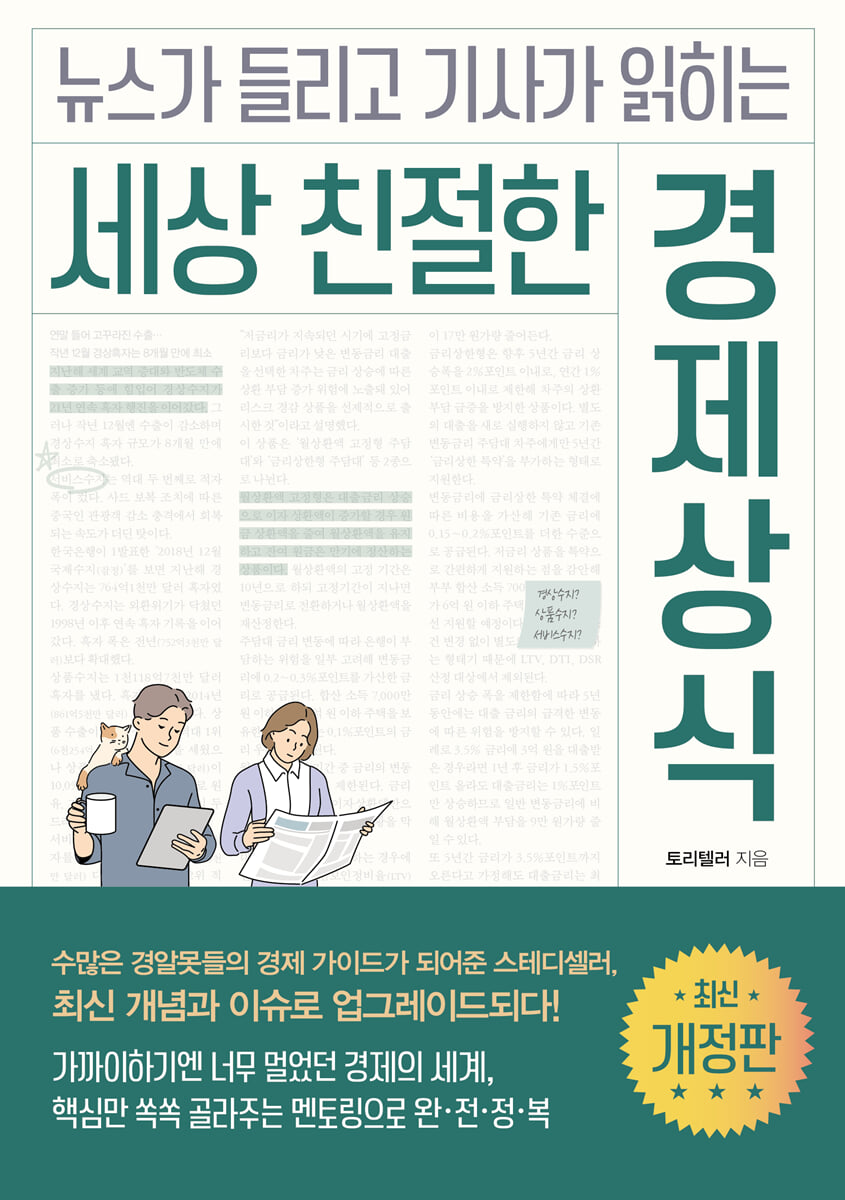
World-friendly economic common sense
 |
Description
Book Introduction
A steady seller that has served as an economic guide for countless "economic idiots," now upgraded with the latest concepts and issues!
The most friendly economic story that empowers you to read the world.
In recent years, domestic and international economic situations have been going from one extreme to the other.
Amidst the unprecedented investment boom of 2020, the stock market witnessed a remarkable surge in individual investors, the so-called "Donghak Ant Movement," while in the real estate market, housing prices soared through the roof, defying all regulations.
And this upward trend is quickly fading as the U.S. begins its aggressive interest rate hikes in earnest in 2022.
Warnings of stagflation continue, along with projections that the economy will become even more difficult in the future.
In this rapidly changing environment, the economic story from 2019, when “The World’s Friendly Economic Sense” was first published, has already become a thing of the distant past(?).
You can tell this just by looking at the headlines of the articles cited in the book.
The first edition covered tightening real estate regulations, Brexit, and bullish signals from the stock market, which are in stark contrast to today's situation.
We have published a revised edition to complement these areas and to address newly emerging or emerging issues and concepts.
This included deregulation aimed at revitalizing the stagnant real estate market, the sudden frustration of retail investors, and events in the virtual asset market. It also included the aftermath of the ongoing Russia-Ukraine War and the escalating US-China conflict, all of which contributed to the unstable international situation.
The news stories in this book reflect the times they were reported, but the economic principles they contain permeate the past, present, and future.
Economic news will continue to pour in, but to properly interpret it, it's crucial to understand the principles behind it and develop the ability to effectively apply them to your own life.
This book will serve as a solid guide for economic beginners who want such skills.
The most friendly economic story that empowers you to read the world.
In recent years, domestic and international economic situations have been going from one extreme to the other.
Amidst the unprecedented investment boom of 2020, the stock market witnessed a remarkable surge in individual investors, the so-called "Donghak Ant Movement," while in the real estate market, housing prices soared through the roof, defying all regulations.
And this upward trend is quickly fading as the U.S. begins its aggressive interest rate hikes in earnest in 2022.
Warnings of stagflation continue, along with projections that the economy will become even more difficult in the future.
In this rapidly changing environment, the economic story from 2019, when “The World’s Friendly Economic Sense” was first published, has already become a thing of the distant past(?).
You can tell this just by looking at the headlines of the articles cited in the book.
The first edition covered tightening real estate regulations, Brexit, and bullish signals from the stock market, which are in stark contrast to today's situation.
We have published a revised edition to complement these areas and to address newly emerging or emerging issues and concepts.
This included deregulation aimed at revitalizing the stagnant real estate market, the sudden frustration of retail investors, and events in the virtual asset market. It also included the aftermath of the ongoing Russia-Ukraine War and the escalating US-China conflict, all of which contributed to the unstable international situation.
The news stories in this book reflect the times they were reported, but the economic principles they contain permeate the past, present, and future.
Economic news will continue to pour in, but to properly interpret it, it's crucial to understand the principles behind it and develop the ability to effectively apply them to your own life.
This book will serve as a solid guide for economic beginners who want such skills.
- You can preview some of the book's contents.
Preview
index
Preface to the Revised Edition: The World Changes Really Fast 4
Prologue: Facts You Know and Facts You Should Know 8
Chapter 1 What is a 'game'?
When you're curious about the game, check out your friends' spending habits. 27
The Basics of Economics: Seeing Food as Food 33
A work created by three protagonists, Economy 45
* To understand the game, become familiar with the "index" instead of the "feel" 52
Chapter 2: Interest Rates as a Signal for Economic Behavior
When you borrow money, you have to pay a fee to use the money. 57
Loans are like alcohol 64
The market sets interest rates, while the government sets the standard for interest rates. 73
* What can interest rates tell you? 81
Chapter 3: Difficulty of Making a Living and Prices
There was a time when taking the bus cost 100 won. 87
How to avoid inflation? 95
Should the minimum wage be raised? Or not? 108
Chapter 4: Real Estate is a Place to Live and a Thing to Buy
Knowing how to read real estate can help you understand the Korean economy. 113
How on earth can I afford an apartment? 128
Let's Live Smartly in Jeonsei 135
Closing of real estate tax 146
* Korea's Strange Real Estate Stories 155
Chapter 5: Dungeon in Reality: The Stock Market
Two Ways to Make Money in Stocks 161
The stock market fluctuates from blue to red, then back to 168.
If you're going to do it anyway, let's broaden our horizons and aim for the global market. 176
* Even the stock market has its moments of pause 192
Chapter 6: The Fundamentals of Trade: Exchange Rates and Tariffs
How much is 1 dollar worth in Korean won? 197
The true power of exchange rates is demonstrated in trade. 205
Tariffs are a very powerful weapon in trade disputes. 215
* The Impact of Faraway Wars on Us 224
Chapter 7: Our Economy Through the Eyes of Economic Entities
The most important thing when reading economics is perspective 229
Employment and employment, which are directly related to livelihood and are even more important, are 235
Resolving employment isn't the end of it. 242
Our Glass Wallet Story 252
* Virtual Assets: The Complex and Subtle Story 266
Epilogue: Let's Explore My Economic Story 268
Appendix: Important Core Economic Knowledge
275 Concepts Organized for Reading Economic Articles in One Go
Additional Economic Facts: Kostolany's Egg Model 286
Prologue: Facts You Know and Facts You Should Know 8
Chapter 1 What is a 'game'?
When you're curious about the game, check out your friends' spending habits. 27
The Basics of Economics: Seeing Food as Food 33
A work created by three protagonists, Economy 45
* To understand the game, become familiar with the "index" instead of the "feel" 52
Chapter 2: Interest Rates as a Signal for Economic Behavior
When you borrow money, you have to pay a fee to use the money. 57
Loans are like alcohol 64
The market sets interest rates, while the government sets the standard for interest rates. 73
* What can interest rates tell you? 81
Chapter 3: Difficulty of Making a Living and Prices
There was a time when taking the bus cost 100 won. 87
How to avoid inflation? 95
Should the minimum wage be raised? Or not? 108
Chapter 4: Real Estate is a Place to Live and a Thing to Buy
Knowing how to read real estate can help you understand the Korean economy. 113
How on earth can I afford an apartment? 128
Let's Live Smartly in Jeonsei 135
Closing of real estate tax 146
* Korea's Strange Real Estate Stories 155
Chapter 5: Dungeon in Reality: The Stock Market
Two Ways to Make Money in Stocks 161
The stock market fluctuates from blue to red, then back to 168.
If you're going to do it anyway, let's broaden our horizons and aim for the global market. 176
* Even the stock market has its moments of pause 192
Chapter 6: The Fundamentals of Trade: Exchange Rates and Tariffs
How much is 1 dollar worth in Korean won? 197
The true power of exchange rates is demonstrated in trade. 205
Tariffs are a very powerful weapon in trade disputes. 215
* The Impact of Faraway Wars on Us 224
Chapter 7: Our Economy Through the Eyes of Economic Entities
The most important thing when reading economics is perspective 229
Employment and employment, which are directly related to livelihood and are even more important, are 235
Resolving employment isn't the end of it. 242
Our Glass Wallet Story 252
* Virtual Assets: The Complex and Subtle Story 266
Epilogue: Let's Explore My Economic Story 268
Appendix: Important Core Economic Knowledge
275 Concepts Organized for Reading Economic Articles in One Go
Additional Economic Facts: Kostolany's Egg Model 286
Detailed image
Into the book
For those new to economics, including those just starting out in society, I would like to advise them to read economic articles, take an interest in the current situation, and save money.
Freshmen in society don't have their own framework yet.
This means that there is still an opportunity to establish a proper framework.
If you have the right framework during this period, you can avoid a disaster, if not a huge hit.
You need to invest time now to create your own framework.
---p.11
'Good economy' means that people around you are spending more, and 'bad economy' means that people around you are closing their wallets.
To expand a little further, 'good economic conditions' means that the owner of the restaurant I go to is making a lot of money.
This is because people with more money are more likely to go to restaurants and buy food.
---p.27
To understand the overall game, you need to be able to gauge both 'offense' and 'defense'.
On the offensive side, you can check GDP, and on the defensive side, you can check debt.
If your defense is a mess, it's hard to win even if you're good at offense.
In a situation where you keep giving up points to the opponent no matter how many times you score, the most urgent task is to strengthen your defense.
Therefore, in order to achieve steady economic growth, debt must be reduced.
---p.38~39
A country's economy can be seen as a work of art created by three main actors: households, businesses, and the government.
The reason all three subjects are main characters is because if any one of them becomes a sidekick, a great work cannot be created.
---p.45
When we rent a bike, we pay.
The money paid at this time is called a usage fee or (rental) fee.
The amount is usually quoted per hour, such as '1,000 won per hour'.
Okay, let's exchange the bike for money here.
When you borrow money, you pay a usage fee, just like when you rent a bicycle.
---p.57
If we compare the flow of the economy to a car, the market interest rate is the speed at which the car runs, and the benchmark interest rate is the accelerator and brake that control the car's speed.
The Bank of Korea is behind the wheel of this car.
The people are passengers in the back seat.
Passengers demand that drivers arrive at their destination safely and on time.
---p.74
If apartment prices continue to rise without end, those who do not own an apartment will not be able to accumulate wealth no matter how hard they try, and wealth inequality will only worsen.
Therefore, the government limits the eligibility for apartments to ensure a certain level of wealth expansion potential, thereby ensuring that opportunities are shared as fairly as possible.
The apartment ‘subscription’ system is also one of these policies.
---p.121
There are two main ways to purchase an apartment: purchasing a new apartment through a sale and purchasing an old apartment through a purchase sale. Regardless of the method, a loan is almost inevitable.
Therefore, by looking at the trend of increase in housing mortgage loans, we can gauge whether the real estate market will be active or stagnant.
---p.129
In the market, prices change according to supply and demand, but in the stock market, supply is almost limited.
Although there are times when supply changes, such as when a company is newly listed or delisted, it is generally safe to say that the market moves according to demand.
---p.168
The Foreigners and Agencies are the clans that form the highest-level parties.
Top-level inspectors, wizards, healers, and more gather to hunt bosses (high-yield stocks) in dungeons (stock markets).
They are experts who wear powerful weapons and defensive tools that have been reinforced numerous times.
They subdue the boss and obtain great items (profits).
On the other hand, ants are the so-called 'newbies' who have just started the game and bravely run through the dungeons with a dagger in hand.
---p.175
There are many factors that affect our country's exports and imports.
Incidents like the decline in Chinese tourists or the surge in oil prices are constantly occurring.
Analyzing the process in detail is a very complex task, so the current account is simply the result organized into numbers.
---p.208
Trade also follows market principles.
At this point, some countries may feel they are losing out because of trade.
In that case, 'trade barriers' are erected.
A typical way to erect trade barriers is through tariffs.
---p.215
As we enter the mobile era where articles are posted and read in real time, the purification capabilities of reporters and media have significantly declined.
Inevitably, readers have to select and filter what they read.
---p.230
The article provided as an example summarizes the current job situation.
There are many job seekers who say, "I want to work," but there are also many companies who complain, saying, "There are no workers."
It seems like it would be easy if people who want to work went to places that need people to work, but people don't go.
Why is that?
---p.240
News and articles should be thought of as the blueprint needed to complete the overall picture.
When you try to draw something, it is difficult to just draw it without anything.
However, if there is a sketch that someone else has drawn, it becomes much easier to develop your own perspective and style on top of it.
Reading an article is a process of borrowing the help of others to get the overall outline.
Freshmen in society don't have their own framework yet.
This means that there is still an opportunity to establish a proper framework.
If you have the right framework during this period, you can avoid a disaster, if not a huge hit.
You need to invest time now to create your own framework.
---p.11
'Good economy' means that people around you are spending more, and 'bad economy' means that people around you are closing their wallets.
To expand a little further, 'good economic conditions' means that the owner of the restaurant I go to is making a lot of money.
This is because people with more money are more likely to go to restaurants and buy food.
---p.27
To understand the overall game, you need to be able to gauge both 'offense' and 'defense'.
On the offensive side, you can check GDP, and on the defensive side, you can check debt.
If your defense is a mess, it's hard to win even if you're good at offense.
In a situation where you keep giving up points to the opponent no matter how many times you score, the most urgent task is to strengthen your defense.
Therefore, in order to achieve steady economic growth, debt must be reduced.
---p.38~39
A country's economy can be seen as a work of art created by three main actors: households, businesses, and the government.
The reason all three subjects are main characters is because if any one of them becomes a sidekick, a great work cannot be created.
---p.45
When we rent a bike, we pay.
The money paid at this time is called a usage fee or (rental) fee.
The amount is usually quoted per hour, such as '1,000 won per hour'.
Okay, let's exchange the bike for money here.
When you borrow money, you pay a usage fee, just like when you rent a bicycle.
---p.57
If we compare the flow of the economy to a car, the market interest rate is the speed at which the car runs, and the benchmark interest rate is the accelerator and brake that control the car's speed.
The Bank of Korea is behind the wheel of this car.
The people are passengers in the back seat.
Passengers demand that drivers arrive at their destination safely and on time.
---p.74
If apartment prices continue to rise without end, those who do not own an apartment will not be able to accumulate wealth no matter how hard they try, and wealth inequality will only worsen.
Therefore, the government limits the eligibility for apartments to ensure a certain level of wealth expansion potential, thereby ensuring that opportunities are shared as fairly as possible.
The apartment ‘subscription’ system is also one of these policies.
---p.121
There are two main ways to purchase an apartment: purchasing a new apartment through a sale and purchasing an old apartment through a purchase sale. Regardless of the method, a loan is almost inevitable.
Therefore, by looking at the trend of increase in housing mortgage loans, we can gauge whether the real estate market will be active or stagnant.
---p.129
In the market, prices change according to supply and demand, but in the stock market, supply is almost limited.
Although there are times when supply changes, such as when a company is newly listed or delisted, it is generally safe to say that the market moves according to demand.
---p.168
The Foreigners and Agencies are the clans that form the highest-level parties.
Top-level inspectors, wizards, healers, and more gather to hunt bosses (high-yield stocks) in dungeons (stock markets).
They are experts who wear powerful weapons and defensive tools that have been reinforced numerous times.
They subdue the boss and obtain great items (profits).
On the other hand, ants are the so-called 'newbies' who have just started the game and bravely run through the dungeons with a dagger in hand.
---p.175
There are many factors that affect our country's exports and imports.
Incidents like the decline in Chinese tourists or the surge in oil prices are constantly occurring.
Analyzing the process in detail is a very complex task, so the current account is simply the result organized into numbers.
---p.208
Trade also follows market principles.
At this point, some countries may feel they are losing out because of trade.
In that case, 'trade barriers' are erected.
A typical way to erect trade barriers is through tariffs.
---p.215
As we enter the mobile era where articles are posted and read in real time, the purification capabilities of reporters and media have significantly declined.
Inevitably, readers have to select and filter what they read.
---p.230
The article provided as an example summarizes the current job situation.
There are many job seekers who say, "I want to work," but there are also many companies who complain, saying, "There are no workers."
It seems like it would be easy if people who want to work went to places that need people to work, but people don't go.
Why is that?
---p.240
News and articles should be thought of as the blueprint needed to complete the overall picture.
When you try to draw something, it is difficult to just draw it without anything.
However, if there is a sketch that someone else has drawn, it becomes much easier to develop your own perspective and style on top of it.
Reading an article is a process of borrowing the help of others to get the overall outline.
---p.258
Publisher's Review
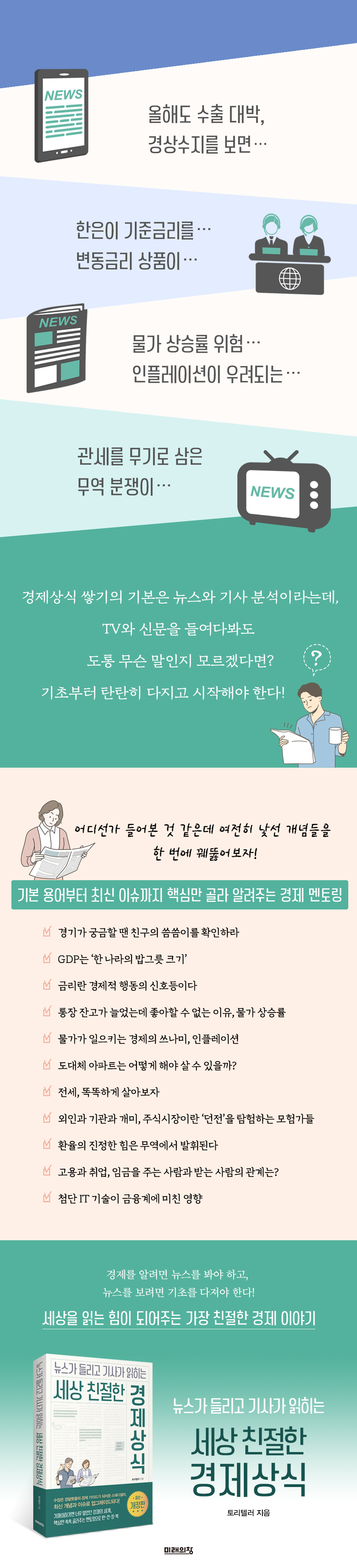
You need to know this much to be able to read economic articles!
Core mentoring for those who want to understand the economy
It is an undeniable fact that our lives and the economy are inextricably linked.
In order to understand the society I belong to and to 'eat well and live well' in that society, I need to know about the economy.
At this time, the method commonly recommended as the first step in studying economics is 'reading economic articles'.
But will you suddenly understand concepts you weren't aware of just by watching the news one day? Will the economic trends unfold before your eyes as you read? The author of this book emphasizes the need to be wary of the negative consequences of reading articles unprepared.
If you just blindly pour in information without any basis, the economy may feel more difficult, and you may be swayed this way and that depending on the tone of the article.
So, I've compiled the essential economic knowledge and concepts needed to properly read economic news and articles into one book.
Easy to learn, easy to apply!
Complex concepts are easily understood with perfect explanations.
The economy doesn't just work according to theory.
This is because so many different factors are intricately intertwined, and unexpected variables pop up everywhere.
Therefore, we should focus more on being able to apply concepts to situations rather than memorizing theoretical definitions.
The author uses familiar analogies to help readers easily grasp and apply concepts. Reading these perfectly articulate explanations—like GDP to a rice bowl, interest rates to a traffic light, the current account balance to a report card, and the stock market to a game dungeon—will naturally bring you closer to the economy.
We have also included plenty of actual article headlines so that you can apply the concepts in practice, not just understand them.
By the time you finish the last chapter of this book, you'll be able to guess the overall context of an article just by looking at its headline.
News and articles don't end there!
The real economy is visible only when viewed by 'my' own standards.
By watching the news and reading articles, you can understand the ever-changing domestic and international economic trends.
However, analyzing the content is not the entire point of reading economic articles.
It is as important to establish your own standards for judging the economy as it is to understand the current situation and predict the future.
This is especially true for college students, job seekers, and those just starting out in society who have not yet developed a framework for viewing the economy.
This book presents various perspectives depending on the situation and economic entity.
Sometimes it gives us food for thought from the perspective of a worker receiving wages, sometimes from the perspective of a consumer purchasing a product, and sometimes from the perspective of a government seeking to maintain market balance.
Let's choose the perspective that suits you and deepen our understanding.
This book will be a solid support for those of you who are entering the world of economics.
Core mentoring for those who want to understand the economy
It is an undeniable fact that our lives and the economy are inextricably linked.
In order to understand the society I belong to and to 'eat well and live well' in that society, I need to know about the economy.
At this time, the method commonly recommended as the first step in studying economics is 'reading economic articles'.
But will you suddenly understand concepts you weren't aware of just by watching the news one day? Will the economic trends unfold before your eyes as you read? The author of this book emphasizes the need to be wary of the negative consequences of reading articles unprepared.
If you just blindly pour in information without any basis, the economy may feel more difficult, and you may be swayed this way and that depending on the tone of the article.
So, I've compiled the essential economic knowledge and concepts needed to properly read economic news and articles into one book.
Easy to learn, easy to apply!
Complex concepts are easily understood with perfect explanations.
The economy doesn't just work according to theory.
This is because so many different factors are intricately intertwined, and unexpected variables pop up everywhere.
Therefore, we should focus more on being able to apply concepts to situations rather than memorizing theoretical definitions.
The author uses familiar analogies to help readers easily grasp and apply concepts. Reading these perfectly articulate explanations—like GDP to a rice bowl, interest rates to a traffic light, the current account balance to a report card, and the stock market to a game dungeon—will naturally bring you closer to the economy.
We have also included plenty of actual article headlines so that you can apply the concepts in practice, not just understand them.
By the time you finish the last chapter of this book, you'll be able to guess the overall context of an article just by looking at its headline.
News and articles don't end there!
The real economy is visible only when viewed by 'my' own standards.
By watching the news and reading articles, you can understand the ever-changing domestic and international economic trends.
However, analyzing the content is not the entire point of reading economic articles.
It is as important to establish your own standards for judging the economy as it is to understand the current situation and predict the future.
This is especially true for college students, job seekers, and those just starting out in society who have not yet developed a framework for viewing the economy.
This book presents various perspectives depending on the situation and economic entity.
Sometimes it gives us food for thought from the perspective of a worker receiving wages, sometimes from the perspective of a consumer purchasing a product, and sometimes from the perspective of a government seeking to maintain market balance.
Let's choose the perspective that suits you and deepen our understanding.
This book will be a solid support for those of you who are entering the world of economics.
GOODS SPECIFICS
- Date of issue: March 23, 2023
- Page count, weight, size: 296 pages | 474g | 148*210*18mm
- ISBN13: 9791192519494
- ISBN10: 1192519493
You may also like
카테고리
korean


korean

![GQ KOREA Mark (Monthly): December [2025]](http://librairie.coreenne.fr/cdn/shop/files/8ef265dbbfbf186523ed75ba7319009d.jpg?v=1765340328&width=3840)


