

Positioning
 |
Description
Book Introduction
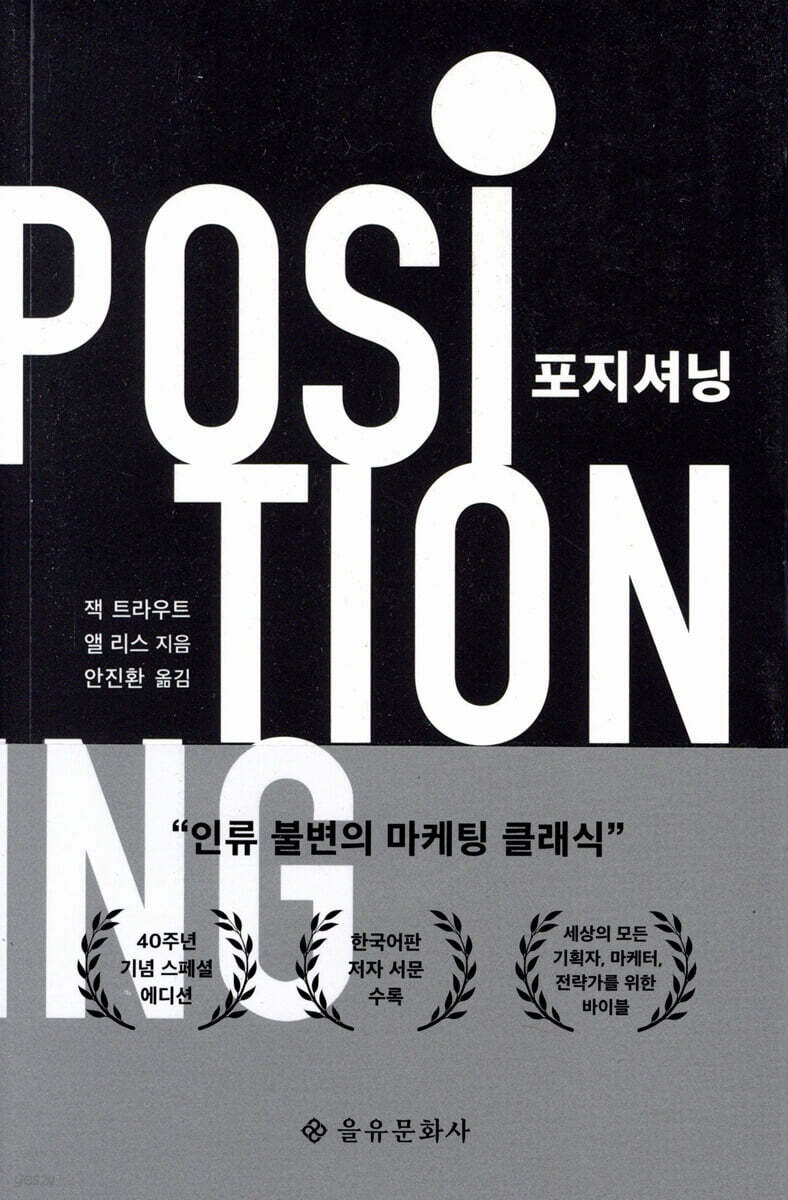
"Positioning," the bible of the advertising and marketing industry, is being republished to commemorate its 40th anniversary.
This book, co-written in 1981 by American advertising expert Jack Trout and marketing expert Al Ries, created a global sensation by presenting a groundbreaking communication strategy of establishing a 'position' in the minds of potential customers.
The Korean version, first published by Eulyoo Publishing in 2002, has maintained its reputation as a must-read for marketing even after about 20 years.
The special edition commemorating the 40th anniversary of the publication, available only in Korea, enhances the value of the book with a new format for portability and a special foreword by author Alice Ries.
This book, co-written in 1981 by American advertising expert Jack Trout and marketing expert Al Ries, created a global sensation by presenting a groundbreaking communication strategy of establishing a 'position' in the minds of potential customers.
The Korean version, first published by Eulyoo Publishing in 2002, has maintained its reputation as a must-read for marketing even after about 20 years.
The special edition commemorating the 40th anniversary of the publication, available only in Korea, enhances the value of the book with a new format for portability and a special foreword by author Alice Ries.
- You can preview some of the book's contents.
Preview
index
Translator's Note / 40th Anniversary Preface
Entering
1.
What is positioning?
2.
Attack on the mind
3.
Entry into the mind
4.
Little Ladder of the Mind
5.
The destination cannot be reached from the current location.
6.
Positioning as an industry leader
7.
Pursuer's positioning
8.
Repositioning against competitors
9.
The power of a name
10.
The Trap of Meaningless Names
11.
The trap of free riding
12.
The Pitfalls of Line Extension
13.
When line extension is effective
14.
Corporate Positioning: The Case of Monsanto
15.
National Positioning: The Case of Belgium
16.
Product Positioning: For Milk Dose
17.
Service Positioning: For Mailgram
18.
Long Island Bank's Positioning
19.
Positioning of the Catholic Church
20.
Positioning yourself and your career
21.
Six Steps to Success
22.
The right positioning game
Entering
1.
What is positioning?
2.
Attack on the mind
3.
Entry into the mind
4.
Little Ladder of the Mind
5.
The destination cannot be reached from the current location.
6.
Positioning as an industry leader
7.
Pursuer's positioning
8.
Repositioning against competitors
9.
The power of a name
10.
The Trap of Meaningless Names
11.
The trap of free riding
12.
The Pitfalls of Line Extension
13.
When line extension is effective
14.
Corporate Positioning: The Case of Monsanto
15.
National Positioning: The Case of Belgium
16.
Product Positioning: For Milk Dose
17.
Service Positioning: For Mailgram
18.
Long Island Bank's Positioning
19.
Positioning of the Catholic Church
20.
Positioning yourself and your career
21.
Six Steps to Success
22.
The right positioning game
Detailed image
Into the book
The starting point of positioning is the product.
It starts with one product, one service, one company, one organization, or one individual.
Maybe it starts with yourself.
But positioning isn't about taking action with your product; it's about taking action in the minds of your potential customers.
That is, it positions the product in the minds of potential customers.
Therefore, it is incorrect to view this concept as ‘product positioning.’
Because it doesn't actually do anything to the product itself.
--- p.21
The Avis campaign will long be remembered in marketing history as a classic example of creating a counter position.
Avis deployed a positioning strategy against the leader.
“Avis is only number two in the rental car industry.
But why do customers use us? Because we work harder.” At the time, Avis had been in the red for 13 consecutive years.
However, after admitting that it was in second place, it began to turn a profit.
--- p.78
The media is constantly looking for new and fresh faces.
The most effective way to deal with the media is to remain anonymous until you are fully ready to reveal yourself, and then use it to your full advantage when you do.
And it should always be kept in mind that the purpose is not promotion or communication itself, but rather to establish a position in the consumer's mind.
An unknown company with an unknown product can gain more from publicity than a company with a well-known product.
--- p.218
Frank Sinatra Jr. is one of the most unfortunate names to have been left behind when it comes to line extensions.
He is no different from a batter who stands at the plate with two strikeouts.
The name Frank Sinatra Jr. evokes this thought in the audience:
'I'm not as good at singing as my father.' And remember, people tend to listen to what they expect.
How could he surpass his father?
It starts with one product, one service, one company, one organization, or one individual.
Maybe it starts with yourself.
But positioning isn't about taking action with your product; it's about taking action in the minds of your potential customers.
That is, it positions the product in the minds of potential customers.
Therefore, it is incorrect to view this concept as ‘product positioning.’
Because it doesn't actually do anything to the product itself.
--- p.21
The Avis campaign will long be remembered in marketing history as a classic example of creating a counter position.
Avis deployed a positioning strategy against the leader.
“Avis is only number two in the rental car industry.
But why do customers use us? Because we work harder.” At the time, Avis had been in the red for 13 consecutive years.
However, after admitting that it was in second place, it began to turn a profit.
--- p.78
The media is constantly looking for new and fresh faces.
The most effective way to deal with the media is to remain anonymous until you are fully ready to reveal yourself, and then use it to your full advantage when you do.
And it should always be kept in mind that the purpose is not promotion or communication itself, but rather to establish a position in the consumer's mind.
An unknown company with an unknown product can gain more from publicity than a company with a well-known product.
--- p.218
Frank Sinatra Jr. is one of the most unfortunate names to have been left behind when it comes to line extensions.
He is no different from a batter who stands at the plate with two strikeouts.
The name Frank Sinatra Jr. evokes this thought in the audience:
'I'm not as good at singing as my father.' And remember, people tend to listen to what they expect.
How could he surpass his father?
--- p.344~345
Publisher's Review
Two marketing experts spread the word around the world
A Groundbreaking Communication Strategy: Positioning
Modern society is over-communication.
A vast amount of information is pouring out from various media, and the public selects and consumes various pieces of information.
Companies obsessed with pursuing profits worry about effective communication to ensure that their products are chosen.
"What must I do to make my product popular with customers?" For a time, companies in the past were stuck in the simplistic mindset that the only solution was a "good product" or a "different product."
The real change came in the latter half of the 20th century when the concept of 'positioning' emerged.
'Positioning' is a communication strategy that establishes a 'position' in the minds of potential customers.
Rather than focusing on providing the best product or service, we focus on injecting and maintaining the right message into the consumer's mind.
Rather than simply inserting new information into the customer's mind, it is important to manipulate various contents in the person's head to achieve the desired effect.
This positioning concept has become even more important in modern times, intertwined with the question of 'what kind of product sales strategy should be established in the age of information overload?'
The two marketing strategists who were the first to emphasize this concept were Jack Trout and Al Ries.
In 1981, they compiled the concept of positioning into a book of the same name, drawing on their extensive practical experience and meticulous analytical skills.
Since then, as the amount of information has exploded and the value of communication has increased, "Positioning" has become a must-read for all modern people.
'Win or lose is already decided by positioning.'
The 'Must-Win' Know-How for Everyone, from Businesses to Individuals
In this book, the two authors explain the value and effectiveness of positioning with numerous examples.
Real-world examples of products, brands, companies, or individuals fill almost every page.
The protagonists and their stories are diverse, including Avis, which acknowledged its second place in the rental car industry and returned to profitability, IBM, which tried to challenge the copier market but failed, and politician John McCain, who proved the publicity benefits of anonymity.
These abundant examples are the greatest strength and attractive point of this book.
According to the authors, companies must consider their own strengths and weaknesses as well as those of their competitors when considering their positioning.
And you must strive to be the first to enter the minds of your potential customers and become a leader in your field.
It goes without saying that we must devise and implement a strategy to avoid being left behind by latecomers.
However, if you are pushed out, you must develop a different strategy than the leader.
You need to find areas that are barren in the consumer's mind or reposition your competitors to create a niche.
In this positioning process, it is important to avoid the traps of so-called "meaningless names," "free riding," and "line extensions."
The authors caution against using initials to create meaningless names to shorten complex and long names, hoping to ride the hype of a leader product to achieve success again, or hastily using existing product names for new products.
The wit and sense that the two authors frequently display between the lines makes this warning even more persuasive.
In the latter part of the book, the authors explain in chapters how positioning can be effective across various categories, including companies, countries, products, and services.
And finally, he argues that positioning can be applied to each of us individually.
Their message is to define who you are, not be afraid to make mistakes, choose the right name, avoid the trap of line extensions, and make good use of your company, your boss, your friends, your ideas and beliefs, and even yourself.
With a sensuous format and a special preface by the author
40th Anniversary Special Edition
"Positioning" has been widely read worldwide for the past 40 years, establishing itself as a timeless marketing bible.
The revised edition, published in 2001 to commemorate the 20th anniversary of the book, also received a great response, especially the comments added by the authors as footnotes along with the illustrations, which appealed to young readers.
Here, the two authors openly discuss how market conditions changed between 1981 and 2001, whether their judgments were right or wrong, and what their outlook is for the future.
The 40th anniversary special edition coming out this time is a special project that will only be carried out in Korea.
In the past, the format was adjusted to be almost square to respect the original text, thereby increasing portability, and the design of the additional comments in the revised edition was changed to blend naturally with the original text.
This could be considered a form of 'positioning' to appeal to the younger generation in line with the current publishing industry trends.
Above all, the special preface written by author Al Ries for this Korean edition further enhances the value of this special edition.
In the preface, he expresses his unwavering confidence, saying, “Forty years have passed since ‘Positioning’ was first published, but its principles remain valid.”
As the basis for this confidence lies in the content itself, which is both persuasive and entertaining, the impact of this book as a "canon of advertising and marketing" will continue into the future.
It's amazing how a book published so long ago still has so many applications.
This book is of great help to marketers, managers, and even ordinary individuals.
- Yes24 Reader Reviews
As I read the book, I was amazed by the authors' foresight.
A must-read for anyone studying marketing and advertising!
- Kyobo Bookstore Reader Reviews
A Groundbreaking Communication Strategy: Positioning
Modern society is over-communication.
A vast amount of information is pouring out from various media, and the public selects and consumes various pieces of information.
Companies obsessed with pursuing profits worry about effective communication to ensure that their products are chosen.
"What must I do to make my product popular with customers?" For a time, companies in the past were stuck in the simplistic mindset that the only solution was a "good product" or a "different product."
The real change came in the latter half of the 20th century when the concept of 'positioning' emerged.
'Positioning' is a communication strategy that establishes a 'position' in the minds of potential customers.
Rather than focusing on providing the best product or service, we focus on injecting and maintaining the right message into the consumer's mind.
Rather than simply inserting new information into the customer's mind, it is important to manipulate various contents in the person's head to achieve the desired effect.
This positioning concept has become even more important in modern times, intertwined with the question of 'what kind of product sales strategy should be established in the age of information overload?'
The two marketing strategists who were the first to emphasize this concept were Jack Trout and Al Ries.
In 1981, they compiled the concept of positioning into a book of the same name, drawing on their extensive practical experience and meticulous analytical skills.
Since then, as the amount of information has exploded and the value of communication has increased, "Positioning" has become a must-read for all modern people.
'Win or lose is already decided by positioning.'
The 'Must-Win' Know-How for Everyone, from Businesses to Individuals
In this book, the two authors explain the value and effectiveness of positioning with numerous examples.
Real-world examples of products, brands, companies, or individuals fill almost every page.
The protagonists and their stories are diverse, including Avis, which acknowledged its second place in the rental car industry and returned to profitability, IBM, which tried to challenge the copier market but failed, and politician John McCain, who proved the publicity benefits of anonymity.
These abundant examples are the greatest strength and attractive point of this book.
According to the authors, companies must consider their own strengths and weaknesses as well as those of their competitors when considering their positioning.
And you must strive to be the first to enter the minds of your potential customers and become a leader in your field.
It goes without saying that we must devise and implement a strategy to avoid being left behind by latecomers.
However, if you are pushed out, you must develop a different strategy than the leader.
You need to find areas that are barren in the consumer's mind or reposition your competitors to create a niche.
In this positioning process, it is important to avoid the traps of so-called "meaningless names," "free riding," and "line extensions."
The authors caution against using initials to create meaningless names to shorten complex and long names, hoping to ride the hype of a leader product to achieve success again, or hastily using existing product names for new products.
The wit and sense that the two authors frequently display between the lines makes this warning even more persuasive.
In the latter part of the book, the authors explain in chapters how positioning can be effective across various categories, including companies, countries, products, and services.
And finally, he argues that positioning can be applied to each of us individually.
Their message is to define who you are, not be afraid to make mistakes, choose the right name, avoid the trap of line extensions, and make good use of your company, your boss, your friends, your ideas and beliefs, and even yourself.
With a sensuous format and a special preface by the author
40th Anniversary Special Edition
"Positioning" has been widely read worldwide for the past 40 years, establishing itself as a timeless marketing bible.
The revised edition, published in 2001 to commemorate the 20th anniversary of the book, also received a great response, especially the comments added by the authors as footnotes along with the illustrations, which appealed to young readers.
Here, the two authors openly discuss how market conditions changed between 1981 and 2001, whether their judgments were right or wrong, and what their outlook is for the future.
The 40th anniversary special edition coming out this time is a special project that will only be carried out in Korea.
In the past, the format was adjusted to be almost square to respect the original text, thereby increasing portability, and the design of the additional comments in the revised edition was changed to blend naturally with the original text.
This could be considered a form of 'positioning' to appeal to the younger generation in line with the current publishing industry trends.
Above all, the special preface written by author Al Ries for this Korean edition further enhances the value of this special edition.
In the preface, he expresses his unwavering confidence, saying, “Forty years have passed since ‘Positioning’ was first published, but its principles remain valid.”
As the basis for this confidence lies in the content itself, which is both persuasive and entertaining, the impact of this book as a "canon of advertising and marketing" will continue into the future.
It's amazing how a book published so long ago still has so many applications.
This book is of great help to marketers, managers, and even ordinary individuals.
- Yes24 Reader Reviews
As I read the book, I was amazed by the authors' foresight.
A must-read for anyone studying marketing and advertising!
- Kyobo Bookstore Reader Reviews
GOODS SPECIFICS
- Publication date: March 30, 2021
- Page count, weight, size: 387 pages | 410g | 126*190*22mm
- ISBN13: 9788932474403
- ISBN10: 8932474400
You may also like
카테고리
korean


korean

![GQ KOREA Mark (Monthly): December [2025]](http://librairie.coreenne.fr/cdn/shop/files/8ef265dbbfbf186523ed75ba7319009d.jpg?v=1765340328&width=3840)


