

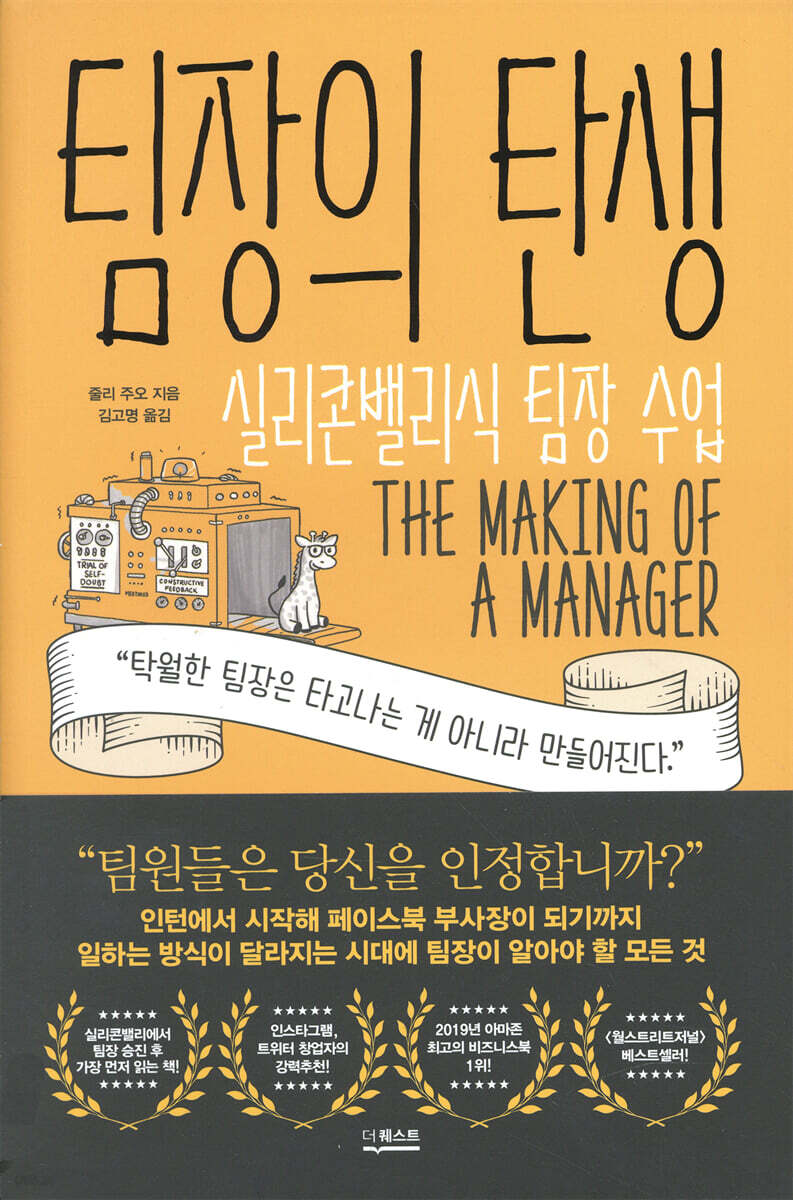
The Birth of a Team Leader
 |
Description
Book Introduction
- A word from MD
- This is a book that made me, the youngest employee, dream of becoming a team leader.
Because it provides accurate guidelines for behavior as a team leader regarding various events that occur in the company.
If I keep doing this, I think I can become an excellent manager.
Trust, honesty.
If you're curious about other team leader virtues, open this book.
- Economic Management MD Kang Min-ji
In Silicon Valley
How Team Leaders Are Born and Grow
Even in this era where Generation Z is entering the workforce and the way we work is changing, managers are emerging everywhere.
But if you continue to assign tasks, deliver feedback, and lead meetings in the same way as before, you might unknowingly end up with your entire team leaving the company.
This book is about 'Everything a Beginner Team Leader Needs to Know in a Changing World' written by Julie Zhuo, who started as a Facebook intern, became a team leader in three years, and is currently the Vice President of Design.
The author, who had no experience managing people, learned all the know-how he learned through trial and error as he became a manager at one of the fastest-growing companies in Silicon Valley, including how to hire high-performing people, create meaningful meetings for everyone, and maintain good teamwork while achieving outstanding results.
If you've just added a single team member, or if you've been a team leader for years but still find people management difficult, this book will provide clear answers.
How Team Leaders Are Born and Grow
Even in this era where Generation Z is entering the workforce and the way we work is changing, managers are emerging everywhere.
But if you continue to assign tasks, deliver feedback, and lead meetings in the same way as before, you might unknowingly end up with your entire team leaving the company.
This book is about 'Everything a Beginner Team Leader Needs to Know in a Changing World' written by Julie Zhuo, who started as a Facebook intern, became a team leader in three years, and is currently the Vice President of Design.
The author, who had no experience managing people, learned all the know-how he learned through trial and error as he became a manager at one of the fastest-growing companies in Silicon Valley, including how to hire high-performing people, create meaningful meetings for everyone, and maintain good teamwork while achieving outstanding results.
If you've just added a single team member, or if you've been a team leader for years but still find people management difficult, this book will provide clear answers.
- You can preview some of the book's contents.
Preview
index
Prologue: Great team leaders aren't born, they're made.
Chapter 1.
What on earth is management?
Chapter 2.
The first three months after being promoted to team leader
Chapter 3.
How to lead a small team?
Chapter 4.
The Art of Good Feedback
Chapter 5.
Self-Management Tips for Team Leaders
Chapter 6.
What makes a great meeting?
Chapter 7.
Who should I vote for?
Chapter 8.
What Makes a High-Performing Team
Chapter 9.
How to Lead a Growing Team
Chapter 10.
Creating a Good Organizational Culture
Epilogue: The journey to becoming an outstanding team leader is only 1 percent complete.
annotation
Chapter 1.
What on earth is management?
Chapter 2.
The first three months after being promoted to team leader
Chapter 3.
How to lead a small team?
Chapter 4.
The Art of Good Feedback
Chapter 5.
Self-Management Tips for Team Leaders
Chapter 6.
What makes a great meeting?
Chapter 7.
Who should I vote for?
Chapter 8.
What Makes a High-Performing Team
Chapter 9.
How to Lead a Growing Team
Chapter 10.
Creating a Good Organizational Culture
Epilogue: The journey to becoming an outstanding team leader is only 1 percent complete.
annotation
Detailed image

Into the book
In 2012, I was promoted to Design Director, reporting directly to Chief Product Officer Chris Cox.
I remember asking him early on how he evaluated managers.
He smiled and replied, “It’s simple.”
There were two main criteria by which he evaluated our team: one was performance.
Does our team produce valuable, usable, and polished design work? Another factor was our team's strengths and satisfaction.
Am I selecting and developing my team members well? Are our team members working together happily and effectively? The first criterion was our current performance, and the second was whether we were preparing for outstanding performance in the future.
I have been using Chris's evaluation method ever since to evaluate my managers.
--- 「Chapter 1.
From "What is Management?"
There exists a fantasy in the world about "solo power users" who look down on others while being treated as heroes for their unique abilities.
Sherlock Holmes is portrayed as a charming character like Iron Man, but in reality, no matter how good he is, he is the type of person you would not want on your team.
Their mere presence diminishes the capabilities of the rest of the team.
I've worked with someone like that before.
He was a very creative and productive person, but he always thought he was right, so when a subordinate offered a different opinion, he would scold them by saying things like, "You better watch your step."
The team members tried to avoid being involved with him in any way.
To borrow a phrase from someone, it was because “I was a person who thought everyone else was a fool.”
He had to spend a tremendous amount of time trying to calm the war of nerves that was brewing between him and the other team members.
Looking back now, the toxic energy he gave off really had a negative impact on the team.
But at the time, I was still an inexperienced manager and didn't know that important fact.
I couldn't see the problem properly, thinking, 'But it's still going to break down into one thing.'
I later learned that the team could only grow if a capable player left.
When a capable player leaves, the void will be felt immediately, but the dark clouds hanging over the team will lift.
Team members can relax and collaborate with open minds, improving overall team productivity and performance.
And I also learned that there are people in this world who are not only talented but also humble and considerate.
So, you can set the bar high for collaboration skills.
No, you have to hold it high.
There are definitely people with good personalities and abilities in the world.
Never compromise with people who think that if they are good, they can trample on others.
--- 「Chapter 2.
From "How to Lead a Small Team"
How should you deliver bad news about a decision? For example, if someone has been appointed to a coveted position, a team member has been removed from a project, or a team member has been removed from the team, you should bring up that issue immediately.
“I decided to leave this project to someone else.”
You are the decision maker.
So, we must speak clearly and without leaving any room for discussion.
There were many times in the past when I couldn't do that.
Because I didn't want to be the one to bring bad news.
So I said it as if team members could also express their opinions.
“Let’s talk about who we should entrust the Z project to.
I don't think you'll have time.
You're already in charge of X and Y.
So, what do you think, "Z should be handled by someone else?" It's dishonest to act as if your team member has a say in a situation where you won't change your mind no matter what they say.
What if a team member responds, "Is that time available?" You start listing reasons why you're the right person for the job? Then you'll have to quickly come up with yet another excuse, and your teammate will feel like you're ignoring their opinion.
Your team members may not agree with your feedback or decisions.
That's okay though.
As a manager, keep in mind that there are some decisions you have full control over.
You are ultimately responsible for the team's performance, and you may have more information than your team members or differ from them in your perspective on the right path forward.
--- 「Chapter 4.
From “The Art of Good Feedback”
To do well in an interview, you need to be clear about what you want to know about the candidate.
I once interviewed a candidate (let's call him Mason) who seemed scared and timid.
Mason had difficulty making eye contact, often gasped for breath while speaking, and often repeated the same words.
But I had questions prepared to find out about his abilities and experience.
How did you set your goals for the ○○ project? What was the most challenging problem you've faced so far, and how did you solve it? Can you honestly describe your strengths and weaknesses (and admit that one of your weaknesses is communication)? These questions allowed me to understand Mason's problem-solving style, and he delivered a more detailed and in-depth answer than the other candidates.
Only you can decide what to ask.
Because only you know what you are looking for.
Especially in positions that require a high level of expertise, specialized questions are required.
If you're not sure where to start, check out my most frequently asked questions.
What types of challenges excite you? Why? Can you describe your favorite projects? (▶ This will help you understand what the applicant is passionate about.)
What do you consider your greatest strength? What areas do people around you think you need to improve in? (▶ Learn how applicants evaluate themselves and identify their strengths and weaknesses.)
- Imagine three years from now.
How would you like to change compared to now? (▶ This shows the applicant's aspirations, how goal-oriented they are, and how much self-reflection they have.)
What was the most difficult conflict you faced in the past year? How did it end, and what did you learn from it? (▶ This will help you understand how the applicant works with others and handles conflict.)
I remember asking him early on how he evaluated managers.
He smiled and replied, “It’s simple.”
There were two main criteria by which he evaluated our team: one was performance.
Does our team produce valuable, usable, and polished design work? Another factor was our team's strengths and satisfaction.
Am I selecting and developing my team members well? Are our team members working together happily and effectively? The first criterion was our current performance, and the second was whether we were preparing for outstanding performance in the future.
I have been using Chris's evaluation method ever since to evaluate my managers.
--- 「Chapter 1.
From "What is Management?"
There exists a fantasy in the world about "solo power users" who look down on others while being treated as heroes for their unique abilities.
Sherlock Holmes is portrayed as a charming character like Iron Man, but in reality, no matter how good he is, he is the type of person you would not want on your team.
Their mere presence diminishes the capabilities of the rest of the team.
I've worked with someone like that before.
He was a very creative and productive person, but he always thought he was right, so when a subordinate offered a different opinion, he would scold them by saying things like, "You better watch your step."
The team members tried to avoid being involved with him in any way.
To borrow a phrase from someone, it was because “I was a person who thought everyone else was a fool.”
He had to spend a tremendous amount of time trying to calm the war of nerves that was brewing between him and the other team members.
Looking back now, the toxic energy he gave off really had a negative impact on the team.
But at the time, I was still an inexperienced manager and didn't know that important fact.
I couldn't see the problem properly, thinking, 'But it's still going to break down into one thing.'
I later learned that the team could only grow if a capable player left.
When a capable player leaves, the void will be felt immediately, but the dark clouds hanging over the team will lift.
Team members can relax and collaborate with open minds, improving overall team productivity and performance.
And I also learned that there are people in this world who are not only talented but also humble and considerate.
So, you can set the bar high for collaboration skills.
No, you have to hold it high.
There are definitely people with good personalities and abilities in the world.
Never compromise with people who think that if they are good, they can trample on others.
--- 「Chapter 2.
From "How to Lead a Small Team"
How should you deliver bad news about a decision? For example, if someone has been appointed to a coveted position, a team member has been removed from a project, or a team member has been removed from the team, you should bring up that issue immediately.
“I decided to leave this project to someone else.”
You are the decision maker.
So, we must speak clearly and without leaving any room for discussion.
There were many times in the past when I couldn't do that.
Because I didn't want to be the one to bring bad news.
So I said it as if team members could also express their opinions.
“Let’s talk about who we should entrust the Z project to.
I don't think you'll have time.
You're already in charge of X and Y.
So, what do you think, "Z should be handled by someone else?" It's dishonest to act as if your team member has a say in a situation where you won't change your mind no matter what they say.
What if a team member responds, "Is that time available?" You start listing reasons why you're the right person for the job? Then you'll have to quickly come up with yet another excuse, and your teammate will feel like you're ignoring their opinion.
Your team members may not agree with your feedback or decisions.
That's okay though.
As a manager, keep in mind that there are some decisions you have full control over.
You are ultimately responsible for the team's performance, and you may have more information than your team members or differ from them in your perspective on the right path forward.
--- 「Chapter 4.
From “The Art of Good Feedback”
To do well in an interview, you need to be clear about what you want to know about the candidate.
I once interviewed a candidate (let's call him Mason) who seemed scared and timid.
Mason had difficulty making eye contact, often gasped for breath while speaking, and often repeated the same words.
But I had questions prepared to find out about his abilities and experience.
How did you set your goals for the ○○ project? What was the most challenging problem you've faced so far, and how did you solve it? Can you honestly describe your strengths and weaknesses (and admit that one of your weaknesses is communication)? These questions allowed me to understand Mason's problem-solving style, and he delivered a more detailed and in-depth answer than the other candidates.
Only you can decide what to ask.
Because only you know what you are looking for.
Especially in positions that require a high level of expertise, specialized questions are required.
If you're not sure where to start, check out my most frequently asked questions.
What types of challenges excite you? Why? Can you describe your favorite projects? (▶ This will help you understand what the applicant is passionate about.)
What do you consider your greatest strength? What areas do people around you think you need to improve in? (▶ Learn how applicants evaluate themselves and identify their strengths and weaknesses.)
- Imagine three years from now.
How would you like to change compared to now? (▶ This shows the applicant's aspirations, how goal-oriented they are, and how much self-reflection they have.)
What was the most difficult conflict you faced in the past year? How did it end, and what did you learn from it? (▶ This will help you understand how the applicant works with others and handles conflict.)
--- 「Chapter 7.
From "Who should I choose?"
From "Who should I choose?"
Publisher's Review
Why should you choose a good team leader?
Why should you be a good team leader?
Why build a good team?
In response, Bill Gates said:
“Ultimately, the fight between companies is a fight between ‘people.’
“The way people operate is the most important key.”
This is an era where you can achieve great results even if you work alone.
It has become easier to make money from home using various social media platforms.
In some ways, working alone might be more comfortable and efficient in this day and age.
If you work alone, you can monopolize the profits.
But why do we insist on working together? Because when people work together, they can achieve results that could never be achieved alone.
1 is just 1, but 1+1 can turn into 3, 4, or something bigger, not just 2.
And only those who believe that together they can create greater things can become leaders who lead outstanding teams.
'I've become a team leader, but what should I do first?'
To the countless team leaders who think
We have never learned how to be a good team leader.
This is because they grew up in a culture where they were accustomed to the hierarchical system of “If you do something, do it,” and did not communicate properly, receive proper recognition, and grow together.
But if you've become a team leader in this era where Generation Z is entering the workforce and the way we work is changing, it's time to change.
Julie Zhuo, who started as an intern, became a team leader in three years, and is currently the Vice President of Design at Facebook, wrote "The Birth of a Team Leader", a guide for new team leaders that honestly and clearly describes how to become a good team leader in this era.
From tips that can be immediately applied by those who have just become team leaders to the serious considerations that leaders must take as they move from being responsible for one or two team members to becoming senior managers in charge of multiple teams, the author's real-life experiences of success and failure, as well as his insights, are all reflected in this book.
The Best Team Leadership Lessons in Silicon Valley
A little over a decade ago, Facebook was a startup boasting tremendous growth.
The author, who became a team leader at a young age in a rapidly expanding company, was anxious and nervous about his first managerial role.
And as I faced the duties of a manager that I had only vaguely imagined, I began asking several senior team leaders, reading books, and experiencing things in person, such as what makes an excellent team leader and what needs to be done to make a team excellent.
And I organized the content into this book for the benefit of junior team leaders who have similar concerns.
This book consists of 10 chapters, organized chronologically from beginner to veteran team leader.
1.
What is management? A manager is not just someone who makes decisions, but someone who sets goals, creates a team that can work together, and creates the 'process' to make it happen.
2.
The first three months after being promoted to team leader - A team leader's initial life will differ depending on whether they were promoted internally or hired externally.
You must be prepared to fit into the team according to your circumstances.
3.
How to lead a small team? - Every team leader starts out with a team of one or two members.
If your team is small, you must create an environment that fosters healthy trust and collaboration.
4.
The Art of Giving Good Feedback - The most difficult thing for new team leaders is delivering good feedback.
It presents techniques for providing feedback and wise criticism to avoid receiving strange results.
5.
Self-Management Tips for Team Leaders - Team Leaders Are Not Gods
Learn how to acknowledge your own shortcomings and deal flexibly with criticism from others.
6.
What Makes a Great Meeting? - Many people spend a significant portion of their workday in meetings.
Here are some meeting tips to help you avoid wasting everyone's time.
7.
Who should I hire? - You can build a team that works well only by hiring people who work well.
The other is the biggest harm to the team.
8.
What makes a high-performing team? A team leader must set clear goals and clearly assign responsibility for tasks according to priority. This will prevent the ship from going over the mountain.
9.
How to Lead a Growing Team - If your team is growing rapidly and expanding in size, it's time to appropriately appoint subordinates and delegate authority and responsibility.
Now is the time for even rookie team leaders to grow.
10.
Creating a good organizational culture - Culture changes people's behavior, and those behaviors combine to change results.
How far a team goes depends on the countless micro-actions team members perform every moment of every day.
In an era where the way we work is changing,
How to communicate properly, respect each other, and grow together
"The Birth of a Team Leader" is not a book you read once and put on the bookshelf.
This book is recommended to be read in at least three ways.
First, read it from beginning to end.
If you become a team leader, you will have a general idea of what you will have to worry about in the future.
Second, when something happens in the team, we read excerpts to find solutions.
You'll get specific tips on how to break bad news to your team, how to give effective performance feedback, what questions to ask a career interviewer, and how to lead an effective brainstorming meeting.
Third, read with people in similar positions.
Even if they are the same team leader, their feelings and thoughts can differ depending on what kind of people the team members are and what kind of work situation they are in.
If you share your own situation and that of others through discussion and think about how to apply the book's contents to each individual, you can become a truly 'excellent team leader'!
For those who have team members born in the 90s, for whom individualism and fairness are the keywords, those who want to create a team that respects each other unlike the senior generation of the 60s and 70s, and those who have never experienced a good role model for a team leader, this book will clearly show you what the ideal team leader looks like.
Why should you be a good team leader?
Why build a good team?
In response, Bill Gates said:
“Ultimately, the fight between companies is a fight between ‘people.’
“The way people operate is the most important key.”
This is an era where you can achieve great results even if you work alone.
It has become easier to make money from home using various social media platforms.
In some ways, working alone might be more comfortable and efficient in this day and age.
If you work alone, you can monopolize the profits.
But why do we insist on working together? Because when people work together, they can achieve results that could never be achieved alone.
1 is just 1, but 1+1 can turn into 3, 4, or something bigger, not just 2.
And only those who believe that together they can create greater things can become leaders who lead outstanding teams.
'I've become a team leader, but what should I do first?'
To the countless team leaders who think
We have never learned how to be a good team leader.
This is because they grew up in a culture where they were accustomed to the hierarchical system of “If you do something, do it,” and did not communicate properly, receive proper recognition, and grow together.
But if you've become a team leader in this era where Generation Z is entering the workforce and the way we work is changing, it's time to change.
Julie Zhuo, who started as an intern, became a team leader in three years, and is currently the Vice President of Design at Facebook, wrote "The Birth of a Team Leader", a guide for new team leaders that honestly and clearly describes how to become a good team leader in this era.
From tips that can be immediately applied by those who have just become team leaders to the serious considerations that leaders must take as they move from being responsible for one or two team members to becoming senior managers in charge of multiple teams, the author's real-life experiences of success and failure, as well as his insights, are all reflected in this book.
The Best Team Leadership Lessons in Silicon Valley
A little over a decade ago, Facebook was a startup boasting tremendous growth.
The author, who became a team leader at a young age in a rapidly expanding company, was anxious and nervous about his first managerial role.
And as I faced the duties of a manager that I had only vaguely imagined, I began asking several senior team leaders, reading books, and experiencing things in person, such as what makes an excellent team leader and what needs to be done to make a team excellent.
And I organized the content into this book for the benefit of junior team leaders who have similar concerns.
This book consists of 10 chapters, organized chronologically from beginner to veteran team leader.
1.
What is management? A manager is not just someone who makes decisions, but someone who sets goals, creates a team that can work together, and creates the 'process' to make it happen.
2.
The first three months after being promoted to team leader - A team leader's initial life will differ depending on whether they were promoted internally or hired externally.
You must be prepared to fit into the team according to your circumstances.
3.
How to lead a small team? - Every team leader starts out with a team of one or two members.
If your team is small, you must create an environment that fosters healthy trust and collaboration.
4.
The Art of Giving Good Feedback - The most difficult thing for new team leaders is delivering good feedback.
It presents techniques for providing feedback and wise criticism to avoid receiving strange results.
5.
Self-Management Tips for Team Leaders - Team Leaders Are Not Gods
Learn how to acknowledge your own shortcomings and deal flexibly with criticism from others.
6.
What Makes a Great Meeting? - Many people spend a significant portion of their workday in meetings.
Here are some meeting tips to help you avoid wasting everyone's time.
7.
Who should I hire? - You can build a team that works well only by hiring people who work well.
The other is the biggest harm to the team.
8.
What makes a high-performing team? A team leader must set clear goals and clearly assign responsibility for tasks according to priority. This will prevent the ship from going over the mountain.
9.
How to Lead a Growing Team - If your team is growing rapidly and expanding in size, it's time to appropriately appoint subordinates and delegate authority and responsibility.
Now is the time for even rookie team leaders to grow.
10.
Creating a good organizational culture - Culture changes people's behavior, and those behaviors combine to change results.
How far a team goes depends on the countless micro-actions team members perform every moment of every day.
In an era where the way we work is changing,
How to communicate properly, respect each other, and grow together
"The Birth of a Team Leader" is not a book you read once and put on the bookshelf.
This book is recommended to be read in at least three ways.
First, read it from beginning to end.
If you become a team leader, you will have a general idea of what you will have to worry about in the future.
Second, when something happens in the team, we read excerpts to find solutions.
You'll get specific tips on how to break bad news to your team, how to give effective performance feedback, what questions to ask a career interviewer, and how to lead an effective brainstorming meeting.
Third, read with people in similar positions.
Even if they are the same team leader, their feelings and thoughts can differ depending on what kind of people the team members are and what kind of work situation they are in.
If you share your own situation and that of others through discussion and think about how to apply the book's contents to each individual, you can become a truly 'excellent team leader'!
For those who have team members born in the 90s, for whom individualism and fairness are the keywords, those who want to create a team that respects each other unlike the senior generation of the 60s and 70s, and those who have never experienced a good role model for a team leader, this book will clearly show you what the ideal team leader looks like.
GOODS SPECIFICS
- Date of publication: September 14, 2020
- Page count, weight, size: 344 pages | 586g | 145*218*30mm
- ISBN13: 9791165212681
- ISBN10: 1165212684
You may also like
카테고리
korean


korean

![GQ KOREA Mark (Monthly): December [2025]](http://librairie.coreenne.fr/cdn/shop/files/8ef265dbbfbf186523ed75ba7319009d.jpg?v=1765340328&width=3840)


