

How We Gained 18,000% in Stocks
 |
Description
Book Introduction
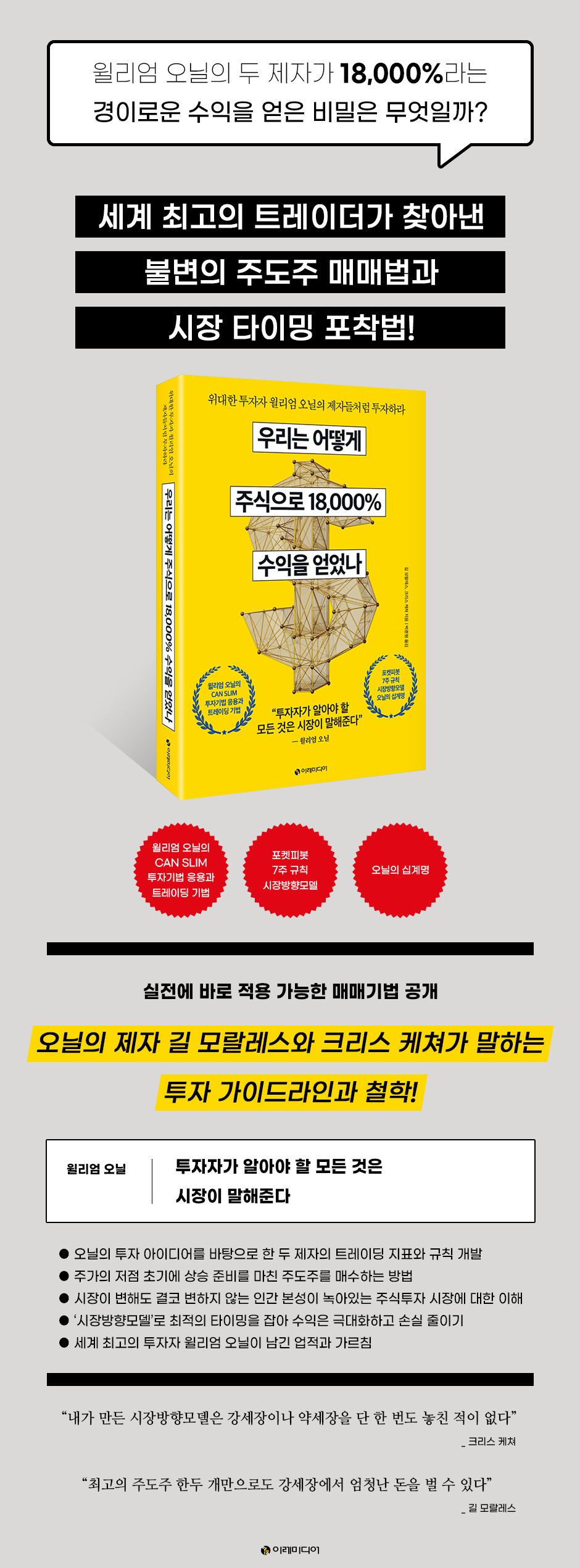
How did William O'Neil's two disciples achieve a staggering 18,000% return?
The world's best traders have discovered timeless stock trading strategies and how to spot market timing. William O'Neil is a legendary investor who became the youngest member of the New York Stock Exchange at the age of thirty. He is considered a master of growth stock investing, developing the CANSLIM trading method that combines fundamental and technical analysis to invest in volatile and rising stocks. Gil Morales and Chris Kacher, who learned about investing from him, developed their own trading indicators and rules based on O'Neil's investment ideas, achieving an astonishing total return of over 18,000%. They created detailed rules for O'Neill's investment method and devised their own rules using the signals sent by the market. For example, while general investors have a habit of buying when the stock price breaks through the low point and rises, they have figured out a way to buy leading stocks that are ready to rise in the early stages of the stock price low point. |
- You can preview some of the book's contents.
Preview
index
Chapter 1: O'Neill's Investment Techniques
Excellent investment techniques are developed over generations.
Prepare, study, and practice
Don't buy cheap stocks, buy expensive stocks.
Stop water riding!
Cut your losses as quickly as possible.
Sell slowly in a rising market: Wait until the stock price has risen sufficiently.
Concentrated investment
Support from top stocks and institutional investors
chart patterns
Livermore's Pivotal Point vs.
O'Neill's pivot point
Timing the Market: Knowing When to Enter and When to Exit
Emotions and Predictions
Expert opinions, news, and information
Overtrading
O'Neill's Investment Method: Fundamental Analysis + Technical Analysis
conclusion
Chapter 2: How Chris Kacher Achieved an 18,000% Return
Step into the investment market
1996: Making Money with Y2K Stocks
1997: Making Money Despite the Asian Financial Crisis
1998: Investor Discouragement
1999: The stock market bubble is growing.
2000: The market bubble finally bursts.
2001: Lessons from Short Selling
From 2002 to Now: The Jagged Sideways Market and the Birth of the Pocket Pivot
Chapter 3: How Gil Morales Achieved an 11,000% Return
Early failures become a blessing in disguise
Rocket-like stock price rise
Entering the 1,000% yield range
Oracle Bubble
Patience and a cautious eye
All obstacles disappear
Verisign, like seasoning in soup
Endure without thinking
Sell at the high point
Themes in Success Stories
The Secret Ingredients for Success
Chapter 4 Failure is the mother of success
What we need is courage, persistence and patience.
To succeed, you must let go of your pride.
Learn from our mistakes
Problem, situation, solution
conclusion
Chapter 5: The Secrets of Trading
Dr.
K's Lab: The Excellence of Pocket Pivot
Pocket Pivot's characteristics
Defining Pocket Pivot Buy Points
Pocket Pivots and Traditional Breakout Buying Points
Buy from Pocket
Hunting from the ground with Pocket Pivot
Persistent Pocket Pivot: Utilizing the 10-Day Moving Average
Pocket Pivots that are incomplete or should be avoided
Using the moving average as a selling standard
Dr.
K's Lab: Buying When Leading Stocks Gap Up
Selling techniques using the 10-day and 50-day moving averages
Investing requires mobilizing all your skills.
conclusion
Chapter 6: How to Ride the Bear Market Wave
Short selling timing techniques
Golden Rule of Short Selling
Short selling pattern
Rocket stock short selling
conclusion
Chapter 7 Dr.
K's market direction model
Market timing
Chart example
Stealing the Secrets of the Market Direction Model
Timing Model FAQ
conclusion
Chapter 8: O'Neill's Ten Commandments
misunderstanding
Survive without pride
1.
Never be swayed
2.
Don't trade in fear
3.
Keep your enemies closer than your friends
4.
Never stop learning and improving
5.
Never talk about your own stocks
6.
Don't be too fond of the best position
7.
First, look at the weekly chart.
Next, look at the daily chart.
Ignore the intraday charts
8.
Find the best stocks.
Next, find a way to buy big.
9.
Always be careful when sleeping with someone.
10.
Always be crazy focused
conclusion
Chapter 9 In O'Neill's Trenches
1997~1998
1999~2000
2001-2002, the worst bear market
2003-2005, bull market
conclusion
Chapter 10: Investing is Life, Life is Investment
Ed Seykota: Technology for Every Trader in the World
Eckhart Tolle: Live in the Moment
Esther Hicks: The Law of Attraction
Jack Canfield: The Struggle to Optimize the Individual
Psychological Checklist: Questions to Ask Yourself
Commonalities
conclusion
Appendix: Dr.
50 Recommended Investment Books by K
Excellent investment techniques are developed over generations.
Prepare, study, and practice
Don't buy cheap stocks, buy expensive stocks.
Stop water riding!
Cut your losses as quickly as possible.
Sell slowly in a rising market: Wait until the stock price has risen sufficiently.
Concentrated investment
Support from top stocks and institutional investors
chart patterns
Livermore's Pivotal Point vs.
O'Neill's pivot point
Timing the Market: Knowing When to Enter and When to Exit
Emotions and Predictions
Expert opinions, news, and information
Overtrading
O'Neill's Investment Method: Fundamental Analysis + Technical Analysis
conclusion
Chapter 2: How Chris Kacher Achieved an 18,000% Return
Step into the investment market
1996: Making Money with Y2K Stocks
1997: Making Money Despite the Asian Financial Crisis
1998: Investor Discouragement
1999: The stock market bubble is growing.
2000: The market bubble finally bursts.
2001: Lessons from Short Selling
From 2002 to Now: The Jagged Sideways Market and the Birth of the Pocket Pivot
Chapter 3: How Gil Morales Achieved an 11,000% Return
Early failures become a blessing in disguise
Rocket-like stock price rise
Entering the 1,000% yield range
Oracle Bubble
Patience and a cautious eye
All obstacles disappear
Verisign, like seasoning in soup
Endure without thinking
Sell at the high point
Themes in Success Stories
The Secret Ingredients for Success
Chapter 4 Failure is the mother of success
What we need is courage, persistence and patience.
To succeed, you must let go of your pride.
Learn from our mistakes
Problem, situation, solution
conclusion
Chapter 5: The Secrets of Trading
Dr.
K's Lab: The Excellence of Pocket Pivot
Pocket Pivot's characteristics
Defining Pocket Pivot Buy Points
Pocket Pivots and Traditional Breakout Buying Points
Buy from Pocket
Hunting from the ground with Pocket Pivot
Persistent Pocket Pivot: Utilizing the 10-Day Moving Average
Pocket Pivots that are incomplete or should be avoided
Using the moving average as a selling standard
Dr.
K's Lab: Buying When Leading Stocks Gap Up
Selling techniques using the 10-day and 50-day moving averages
Investing requires mobilizing all your skills.
conclusion
Chapter 6: How to Ride the Bear Market Wave
Short selling timing techniques
Golden Rule of Short Selling
Short selling pattern
Rocket stock short selling
conclusion
Chapter 7 Dr.
K's market direction model
Market timing
Chart example
Stealing the Secrets of the Market Direction Model
Timing Model FAQ
conclusion
Chapter 8: O'Neill's Ten Commandments
misunderstanding
Survive without pride
1.
Never be swayed
2.
Don't trade in fear
3.
Keep your enemies closer than your friends
4.
Never stop learning and improving
5.
Never talk about your own stocks
6.
Don't be too fond of the best position
7.
First, look at the weekly chart.
Next, look at the daily chart.
Ignore the intraday charts
8.
Find the best stocks.
Next, find a way to buy big.
9.
Always be careful when sleeping with someone.
10.
Always be crazy focused
conclusion
Chapter 9 In O'Neill's Trenches
1997~1998
1999~2000
2001-2002, the worst bear market
2003-2005, bull market
conclusion
Chapter 10: Investing is Life, Life is Investment
Ed Seykota: Technology for Every Trader in the World
Eckhart Tolle: Live in the Moment
Esther Hicks: The Law of Attraction
Jack Canfield: The Struggle to Optimize the Individual
Psychological Checklist: Questions to Ask Yourself
Commonalities
conclusion
Appendix: Dr.
50 Recommended Investment Books by K
Detailed image
Publisher's Review
Learn stock investing from the world's best traders!
Learn how to spot the best buy signals and even master the selling rules of top traders.
William J. O'Neill and the William O'Neill Company
It would be a golden opportunity for stock investors to make money if they could learn how to trade from the world's best traders (O'Neil+Co., Inc.).
In particular, O'Neill's CAN SLIM investment method is famous for creating great wealth by utilizing both individual and institutional investors.
The practice of focusing on a few stocks by considering factors such as corporate fundamentals, chart patterns, market trends, and sector cycles has significantly influenced the trading practices of many investors to this day.
His disciples, Dr. Gil Morales and Dr. Chris Kacher, spent decades observing the markets while working at William O'Neil Company, further developing O'Neil's principles and investing themselves, creating their own practical, detailed rules.
Dr. Chris Kacher used both fundamental and technical analysis when buying stocks, and relied on technical analysis when selling.
In particular, Pocket Pivot is a signal that can be used to capture and utilize optimal buying opportunities with low risk by detecting buying and purchasing signals from institutional investors before a specific stock breaks through its low or consolidation phase and begins to rise.
It was perfectly applicable to the market from the 1970s to the 1990s, and is known to be a very useful trading method even in the recent market.
Another useful feature of Pocket Pivot is its ability to identify buying opportunities for small-cap stocks with low trading volume, liquidity, and low stock prices, making them difficult to invest in. Furthermore, these trading ideas provide readily available insights for current market participants.
Another notable strength of this book is that it covers in detail not only buying but also selling rules.
It can be of great help to current investors, as it provides a glimpse into the technical and psychological foundations of how to maximize profits.
Market Timing - The Art of Trading with Just One or Two Leading Stocks at the Optimal Time
Don't miss out on investment opportunities by identifying the right mid-term market direction!
Anyone who has the skills to determine the most ideal buying and selling times when investing in stocks will inevitably make a profit.
But systematically designing a model that tells us the 'optimal' time is a whole other problem.
Although it should be based on a rational and logical system, many timing models on the market tend to rely too much on past data.
Recently, there has been a growing number of services that claim to provide accurate stock investment timing based on artificial intelligence algorithms. However, most of these services are based on unknown data and lack logical explanations.
However, if used correctly, a proper market timing model can play a role in maximizing profits and minimizing losses.
Gil Morales and Chris Kacher also credit the market direction model as the reason they were able to participate in the market and record huge profits.
In other words, it is very important to predict the mid- to long-term market direction and then make investments.
In particular, he says, being able to capture the direction of a bull market and invest in the best leading stocks can be a way to dramatically increase returns.
Even an experienced investor like William O'Neil can sometimes fail in the markets.
O'Neill is unrivaled in discerning the intrinsic quality of a stock, but he sometimes struggles.
Therefore, strictly adhering to statistically proven rules based on major market indices and trading volume can also be a key investment method.
In other words, readers can gain a sufficient understanding of the market timing methods introduced in this book and use them as a foundation for developing an objective perspective to create their own timing model.
Lessons from failure and the laws of psychological investing from legendary traders.
William O'Neil is arguably the most accomplished survivor in the world of investment banking, having survived for over 50 years.
As someone who has overcome all kinds of difficulties and persevered, I have personally witnessed and experienced countless cases of investment success and failure.
In particular, it is said that investors who have a dangerous mentality and are unable to control their money are at risk of ultimately self-destructing.
In the world of investing, we must learn how much psychological factors influence trading and how to deal with them.
"How We Made 18,000% Returns on Stocks" not only includes the trading rules that O'Neil emphasizes, but also includes "O'Neil's Ten Commandments," providing an opportunity to solidify the psychological aspects of trading in addition to the rules.
Moreover, even traders who have achieved historic returns have experienced numerous failures, and they detail their failures in this book.
That is, it helps market investors control their psychology and behavior by revealing their failures.
-Never be swayed
-Don't trade in fear.
-Keep your enemies closer than your friends.
-Never stop learning and improving.
-Never talk about your own stocks.
-Don't be too happy about being in the best position.
-Look at the weekly chart first.
Next, look at the daily chart.
Ignore the intraday charts
-Find the best stocks.
Next, find a way to buy big.
-Always be careful when sleeping with someone.
-Always be crazy focused
Learn how to spot the best buy signals and even master the selling rules of top traders.
William J. O'Neill and the William O'Neill Company
It would be a golden opportunity for stock investors to make money if they could learn how to trade from the world's best traders (O'Neil+Co., Inc.).
In particular, O'Neill's CAN SLIM investment method is famous for creating great wealth by utilizing both individual and institutional investors.
The practice of focusing on a few stocks by considering factors such as corporate fundamentals, chart patterns, market trends, and sector cycles has significantly influenced the trading practices of many investors to this day.
His disciples, Dr. Gil Morales and Dr. Chris Kacher, spent decades observing the markets while working at William O'Neil Company, further developing O'Neil's principles and investing themselves, creating their own practical, detailed rules.
Dr. Chris Kacher used both fundamental and technical analysis when buying stocks, and relied on technical analysis when selling.
In particular, Pocket Pivot is a signal that can be used to capture and utilize optimal buying opportunities with low risk by detecting buying and purchasing signals from institutional investors before a specific stock breaks through its low or consolidation phase and begins to rise.
It was perfectly applicable to the market from the 1970s to the 1990s, and is known to be a very useful trading method even in the recent market.
Another useful feature of Pocket Pivot is its ability to identify buying opportunities for small-cap stocks with low trading volume, liquidity, and low stock prices, making them difficult to invest in. Furthermore, these trading ideas provide readily available insights for current market participants.
Another notable strength of this book is that it covers in detail not only buying but also selling rules.
It can be of great help to current investors, as it provides a glimpse into the technical and psychological foundations of how to maximize profits.
Market Timing - The Art of Trading with Just One or Two Leading Stocks at the Optimal Time
Don't miss out on investment opportunities by identifying the right mid-term market direction!
Anyone who has the skills to determine the most ideal buying and selling times when investing in stocks will inevitably make a profit.
But systematically designing a model that tells us the 'optimal' time is a whole other problem.
Although it should be based on a rational and logical system, many timing models on the market tend to rely too much on past data.
Recently, there has been a growing number of services that claim to provide accurate stock investment timing based on artificial intelligence algorithms. However, most of these services are based on unknown data and lack logical explanations.
However, if used correctly, a proper market timing model can play a role in maximizing profits and minimizing losses.
Gil Morales and Chris Kacher also credit the market direction model as the reason they were able to participate in the market and record huge profits.
In other words, it is very important to predict the mid- to long-term market direction and then make investments.
In particular, he says, being able to capture the direction of a bull market and invest in the best leading stocks can be a way to dramatically increase returns.
Even an experienced investor like William O'Neil can sometimes fail in the markets.
O'Neill is unrivaled in discerning the intrinsic quality of a stock, but he sometimes struggles.
Therefore, strictly adhering to statistically proven rules based on major market indices and trading volume can also be a key investment method.
In other words, readers can gain a sufficient understanding of the market timing methods introduced in this book and use them as a foundation for developing an objective perspective to create their own timing model.
Lessons from failure and the laws of psychological investing from legendary traders.
William O'Neil is arguably the most accomplished survivor in the world of investment banking, having survived for over 50 years.
As someone who has overcome all kinds of difficulties and persevered, I have personally witnessed and experienced countless cases of investment success and failure.
In particular, it is said that investors who have a dangerous mentality and are unable to control their money are at risk of ultimately self-destructing.
In the world of investing, we must learn how much psychological factors influence trading and how to deal with them.
"How We Made 18,000% Returns on Stocks" not only includes the trading rules that O'Neil emphasizes, but also includes "O'Neil's Ten Commandments," providing an opportunity to solidify the psychological aspects of trading in addition to the rules.
Moreover, even traders who have achieved historic returns have experienced numerous failures, and they detail their failures in this book.
That is, it helps market investors control their psychology and behavior by revealing their failures.
-Never be swayed
-Don't trade in fear.
-Keep your enemies closer than your friends.
-Never stop learning and improving.
-Never talk about your own stocks.
-Don't be too happy about being in the best position.
-Look at the weekly chart first.
Next, look at the daily chart.
Ignore the intraday charts
-Find the best stocks.
Next, find a way to buy big.
-Always be careful when sleeping with someone.
-Always be crazy focused
GOODS SPECIFICS
- Date of issue: September 3, 2020
- Page count, weight, size: 488 pages | 828g | 176*248*30mm
- ISBN13: 9791188279845
- ISBN10: 118827984X
You may also like
카테고리
korean


korean

![GQ KOREA Mark (Monthly): December [2025]](http://librairie.coreenne.fr/cdn/shop/files/8ef265dbbfbf186523ed75ba7319009d.jpg?v=1765340328&width=3840)


