

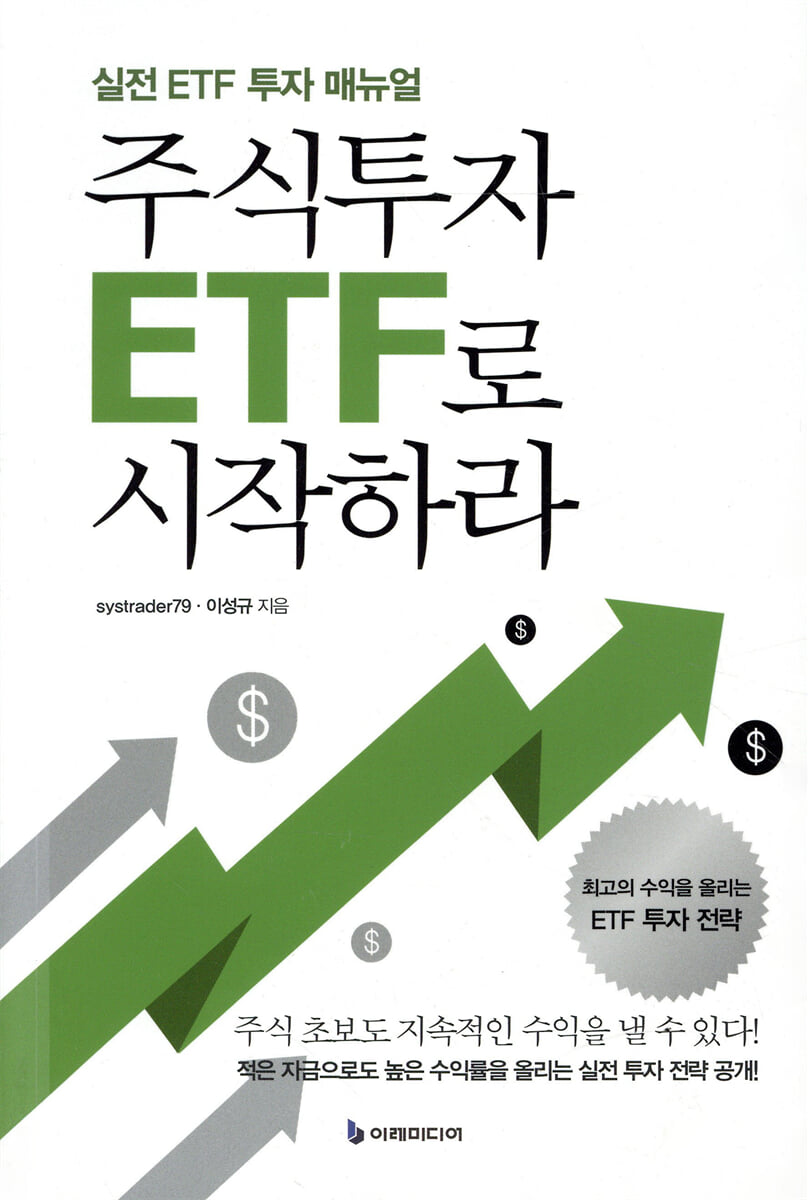
Start investing in stocks with ETFs.
 |
Description
Book Introduction
We reveal a strategy that anyone can use to generate consistent profits in an easy and simple way!
Your own winning DIY based on data-verified strategies
Let's build a portfolio!
Still, countless individual investors fall prey to the market due to irrational decision-making.
Most people either go all-in on a specific stock and suffer huge losses, or lose money while investing in blue-chip stocks.
If you've ever wondered, "Is there a stable investment with high returns?" then ETF investing is the answer.
ETFs (Exchange Traded Funds) are the safest and most ideal investment vehicle for diversifying investments by bundling numerous stocks into one.
"Start Stock Investment with ETFs" provides a simple and easy-to-understand explanation of ETFs, a global investment trend, and their investment strategies.
If you are a beginner in stocks, you can learn how to establish investment basics and strategies in one go.
Moreover, professional stock investors can use this book to review thoroughly verified data-based results and establish or revise their own investment strategies.
Additionally, we introduce the MPAA strategy, which summarizes the advantages of investment strategies, and help you follow the investment simulation step by step.
Now, all that's left is to learn objective and rational investment methods through "Start Stock Investment with ETFs," establish your own strategy, and achieve absolute returns.
Your own winning DIY based on data-verified strategies
Let's build a portfolio!
Still, countless individual investors fall prey to the market due to irrational decision-making.
Most people either go all-in on a specific stock and suffer huge losses, or lose money while investing in blue-chip stocks.
If you've ever wondered, "Is there a stable investment with high returns?" then ETF investing is the answer.
ETFs (Exchange Traded Funds) are the safest and most ideal investment vehicle for diversifying investments by bundling numerous stocks into one.
"Start Stock Investment with ETFs" provides a simple and easy-to-understand explanation of ETFs, a global investment trend, and their investment strategies.
If you are a beginner in stocks, you can learn how to establish investment basics and strategies in one go.
Moreover, professional stock investors can use this book to review thoroughly verified data-based results and establish or revise their own investment strategies.
Additionally, we introduce the MPAA strategy, which summarizes the advantages of investment strategies, and help you follow the investment simulation step by step.
Now, all that's left is to learn objective and rational investment methods through "Start Stock Investment with ETFs," establish your own strategy, and achieve absolute returns.
- You can preview some of the book's contents.
Preview
index
Recommendation
Author's Preface 1
Author's Preface 2
Starting the book
Part 1.
Investing Basics: 4 Ways to Reduce Losses in Stocks
1.
Diversification
2-1.
Mixing with different asset classes
2-2.
Mixing different asset classes
3.
Portfolio rebalancing
4-1.
Adjusting investment proportions according to market conditions (trend following)
4-2.
Adjusting investment proportions according to market conditions (trend following)
Things to Know Before Investing in ETFs
Part 2.
Practical Investment Strategy
1.
Hold after purchase
2.
Accumulative investment strategy
3.
Circular accumulation investment strategy
4.
Stock: Cash (or Bonds) 1:1 Mixed Strategy
5.
Stocks: Bond Volatility Control Strategies (Volatility, Inverse Weighting, and Risk Balancing Strategies)
6.
Absolute Momentum Strategy
7.
Ensemble strategy
Part 3.
Advanced Investment Strategies_How to Beat the Market
1.
Smart Beta Strategy
2.
The Basics of Volatility Control Strategies
3.
Volatility Control Strategy
4.
Volatility Momentum Blended Strategy 1
5.
Volatility Momentum Blended Strategy 2
Part 4. Short-Term Trading Ideas Using ETFs
Volatility Breakout Short-Term Strategy
Short-term trading market timing
A Simple Secret to Beating Hedge Fund Managers: Stop Losses and Money Management
Key Principles for Success in Long-Term Investing
Concluding remarks
Author's Preface 1
Author's Preface 2
Starting the book
Part 1.
Investing Basics: 4 Ways to Reduce Losses in Stocks
1.
Diversification
2-1.
Mixing with different asset classes
2-2.
Mixing different asset classes
3.
Portfolio rebalancing
4-1.
Adjusting investment proportions according to market conditions (trend following)
4-2.
Adjusting investment proportions according to market conditions (trend following)
Things to Know Before Investing in ETFs
Part 2.
Practical Investment Strategy
1.
Hold after purchase
2.
Accumulative investment strategy
3.
Circular accumulation investment strategy
4.
Stock: Cash (or Bonds) 1:1 Mixed Strategy
5.
Stocks: Bond Volatility Control Strategies (Volatility, Inverse Weighting, and Risk Balancing Strategies)
6.
Absolute Momentum Strategy
7.
Ensemble strategy
Part 3.
Advanced Investment Strategies_How to Beat the Market
1.
Smart Beta Strategy
2.
The Basics of Volatility Control Strategies
3.
Volatility Control Strategy
4.
Volatility Momentum Blended Strategy 1
5.
Volatility Momentum Blended Strategy 2
Part 4. Short-Term Trading Ideas Using ETFs
Volatility Breakout Short-Term Strategy
Short-term trading market timing
A Simple Secret to Beating Hedge Fund Managers: Stop Losses and Money Management
Key Principles for Success in Long-Term Investing
Concluding remarks
Publisher's Review
ETFs that anyone can easily and safely invest in based on portfolio theory
It is difficult for the vast majority of individual investors, as well as all stock investors, to accurately predict the future.
So, while it is possible to make a profit, it is also inevitable to avoid losses completely.
Once you have a loss, you need to make a much larger profit based on the principle of profit and loss asymmetry, which is by no means an easy task.
Moreover, to increase stock returns that move with compound interest, volatility must be low, but the reality is that the stocks and operations are simply immature.
Most investors are in a similar situation.
So, let's turn our attention to ETF investment, a global investment trend that institutional investors are also focusing on.
ETF stands for Exchange Traded Fund, also known as an "exchange-traded fund." ETFs are the safest and most ideal investment vehicle for diversifying investments by bundling numerous stocks into a single basket.
Simply put, by purchasing one share of an ETF that uses the KOSPI index as an investment asset, you gain the effect of evenly diversifying your investment across hundreds of high-quality stocks listed on the Korean KOSPI market.
This is an innovative way for individual investors with small investment amounts to diversify their investments across numerous large, blue-chip stocks with just one ETF share.
In addition, products comprised of various asset classes, such as stocks (market indices, sectors, and smart beta), bonds, foreign exchange, and commodities, can be bought and sold just like stocks, and the portfolio can be directly checked, providing high transparency.
In addition, there is the advantage of being exempt from the 0.3% transaction tax imposed on stock trading.
In other words, rather than going all-in on one or two individual stocks, start investing in stocks through ETFs that diversify your investments across a variety of stocks.
Unlike other books, "Start Stock Investment with ETFs" doesn't advocate abstract investment philosophies or propose unproven strategies.
Guides readers to the most reasonable investments based on quantitative data.
Anyone can achieve high returns by properly understanding ETFs through this book and slowly following the strategies.
The problem isn't the stock, it's the management.
Individual investors spend days and days researching and selecting stocks.
When the stock index rises, the price of the selected stock may rise briefly.
But on days when the index drops even a little, all the stocks I own fall simultaneously as if they had made a promise.
This is a problem that cannot be reduced by diversifying investments into individual stocks, and cannot be solved by diversifying stocks alone.
This is because most ordinary investors are not only inexperienced in selecting investment items, but also have virtually no strategies for short-term and long-term management.
"Start Stock Investment with ETFs" offers a solution to these problems.
The author introduces a management method that reduces risk and increases returns by diversifying investments in assets that move unrelated to stocks, like selling straw sandals and wooden clogs in equal amounts to consider sunny and rainy days.
Furthermore, ETFs are a viable investment strategy, allowing individual investors to learn how to dramatically reduce risk.
Let's delve into the investment strategies the two authors of "Start Stock Investment with ETFs" provide, and examine how they validate them.
In doing so, you will eventually be able to establish your own operating strategy, which will lay the foundation for more stable and high performance.
Advanced investment strategies that beat the market, from smart beta to volatility-momentum blended strategies.
"Start Stock Investment with ETFs" is a quantitative investment book thoroughly data-driven.
Therefore, the biggest advantage is that readers can establish their own operating strategies and actually implement them.
Each chapter objectively and rationally explains operational strategies, and the usefulness of each strategy is proven through verification.
This is the result of the two authors' persistent backtesting and study of papers and articles.
Chapter 1 of "Start Stock Investment with ETFs" discusses the "loss limitation" strategy, which individual investors often misunderstand or overlook.
Chapter 2, "Practical Investment Strategies," delves into seven operational strategies through actual simulations, comparing them, and helping readers find the optimal investment strategy for themselves.
In particular, Chapter 3, "Advanced Investment Strategies - How to Beat the Market," covers everything from smart beta strategies to volatility momentum blended strategies and MPAA strategies, making it useful even for stock market experts.
In addition, it provides detailed guidance on Python-based simulation methods, helping you test your own investment strategies.
It is difficult for the vast majority of individual investors, as well as all stock investors, to accurately predict the future.
So, while it is possible to make a profit, it is also inevitable to avoid losses completely.
Once you have a loss, you need to make a much larger profit based on the principle of profit and loss asymmetry, which is by no means an easy task.
Moreover, to increase stock returns that move with compound interest, volatility must be low, but the reality is that the stocks and operations are simply immature.
Most investors are in a similar situation.
So, let's turn our attention to ETF investment, a global investment trend that institutional investors are also focusing on.
ETF stands for Exchange Traded Fund, also known as an "exchange-traded fund." ETFs are the safest and most ideal investment vehicle for diversifying investments by bundling numerous stocks into a single basket.
Simply put, by purchasing one share of an ETF that uses the KOSPI index as an investment asset, you gain the effect of evenly diversifying your investment across hundreds of high-quality stocks listed on the Korean KOSPI market.
This is an innovative way for individual investors with small investment amounts to diversify their investments across numerous large, blue-chip stocks with just one ETF share.
In addition, products comprised of various asset classes, such as stocks (market indices, sectors, and smart beta), bonds, foreign exchange, and commodities, can be bought and sold just like stocks, and the portfolio can be directly checked, providing high transparency.
In addition, there is the advantage of being exempt from the 0.3% transaction tax imposed on stock trading.
In other words, rather than going all-in on one or two individual stocks, start investing in stocks through ETFs that diversify your investments across a variety of stocks.
Unlike other books, "Start Stock Investment with ETFs" doesn't advocate abstract investment philosophies or propose unproven strategies.
Guides readers to the most reasonable investments based on quantitative data.
Anyone can achieve high returns by properly understanding ETFs through this book and slowly following the strategies.
The problem isn't the stock, it's the management.
Individual investors spend days and days researching and selecting stocks.
When the stock index rises, the price of the selected stock may rise briefly.
But on days when the index drops even a little, all the stocks I own fall simultaneously as if they had made a promise.
This is a problem that cannot be reduced by diversifying investments into individual stocks, and cannot be solved by diversifying stocks alone.
This is because most ordinary investors are not only inexperienced in selecting investment items, but also have virtually no strategies for short-term and long-term management.
"Start Stock Investment with ETFs" offers a solution to these problems.
The author introduces a management method that reduces risk and increases returns by diversifying investments in assets that move unrelated to stocks, like selling straw sandals and wooden clogs in equal amounts to consider sunny and rainy days.
Furthermore, ETFs are a viable investment strategy, allowing individual investors to learn how to dramatically reduce risk.
Let's delve into the investment strategies the two authors of "Start Stock Investment with ETFs" provide, and examine how they validate them.
In doing so, you will eventually be able to establish your own operating strategy, which will lay the foundation for more stable and high performance.
Advanced investment strategies that beat the market, from smart beta to volatility-momentum blended strategies.
"Start Stock Investment with ETFs" is a quantitative investment book thoroughly data-driven.
Therefore, the biggest advantage is that readers can establish their own operating strategies and actually implement them.
Each chapter objectively and rationally explains operational strategies, and the usefulness of each strategy is proven through verification.
This is the result of the two authors' persistent backtesting and study of papers and articles.
Chapter 1 of "Start Stock Investment with ETFs" discusses the "loss limitation" strategy, which individual investors often misunderstand or overlook.
Chapter 2, "Practical Investment Strategies," delves into seven operational strategies through actual simulations, comparing them, and helping readers find the optimal investment strategy for themselves.
In particular, Chapter 3, "Advanced Investment Strategies - How to Beat the Market," covers everything from smart beta strategies to volatility momentum blended strategies and MPAA strategies, making it useful even for stock market experts.
In addition, it provides detailed guidance on Python-based simulation methods, helping you test your own investment strategies.
GOODS SPECIFICS
- Date of issue: February 5, 2018
- Page count, weight, size: 393 pages | 705g | 153*224*24mm
- ISBN13: 9791188279104
- ISBN10: 1188279106
You may also like
카테고리
korean


korean

![GQ KOREA Mark (Monthly): December [2025]](http://librairie.coreenne.fr/cdn/shop/files/8ef265dbbfbf186523ed75ba7319009d.jpg?v=1765340328&width=3840)


