

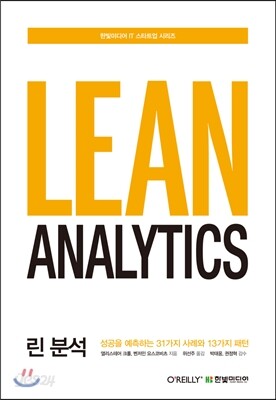
Lean Analysis
 |
Description
Book Introduction
Using examples, we explain the key indicators that guide startups to success.
If you've learned how to quickly establish a business process, identify the highest risk factors in your business, and then modify your business with "The Lean Startup: The IT Entrepreneurship Guide that Shook Silicon Valley" (Hanbit Media, 2012), this book will help you measure your business's progress, ask the most important questions at this point, and quickly get clear answers.
If you've learned how to quickly establish a business process, identify the highest risk factors in your business, and then modify your business with "The Lean Startup: The IT Entrepreneurship Guide that Shook Silicon Valley" (Hanbit Media, 2012), this book will help you measure your business's progress, ask the most important questions at this point, and quickly get clear answers.
- You can preview some of the book's contents.
Preview
index
PART I Don't turn a blind eye
CHAPTER 1 We Are All Liars
__Lean Startup Movement
__Poke a hole in the reality distortion field
CHAPTER 2 Various indicators
__What is a good indicator?
__Qualitative and quantitative indicators
__Illegible indicators and real indicators
__Exploration and Reporting Indicators
__Leading and Lagging Indicators
__Correlation indicators and causal indicators
__Goal Modification
Customer segmentation, cohorts, A/B testing, and multivariate analysis
__Lean Analysis Cycle
__[Assignment] Evaluating the metrics you track
CHAPTER 3 What to do
__Rin Canvas
__What should I do?
__[Assignment] Creating a Lean Canvas
CHAPTER 4 Data-Driven and Data-Referenced Approaches
Lean Startups and High Vision
PART II Finding the Right Indicator for Your Situation
CHAPTER 5 Various Analysis Systems
Dave McClure's Pirate Index
Eric Ries' Growth Engine
__Ash Moriah's Lean Canvas
__Shaun Ellis' Startup Growth Pyramid
__long funnel
__Lean Analysis Steps and Gates
CHAPTER 6 The One Most Important Indicator
__Four Reasons Why You Should Use One Key Metric
__Setting target criteria
__squeaky toy
__[Assignment] - Determine your OMTM
CHAPTER 7 What kind of business are you in?
About __user
__Business Model Flipbook
__Six Business Models
__[Assignment] Find your business model
CHAPTER 8 BUSINESS MODEL 1: E-commerce
__Practical examples
__Combination of offline and online
__Visualizing e-commerce business
__Note: Traditional e-commerce and subscription-based e-commerce
__Key points
CHAPTER 9 BUSINESS MODEL 2: SaaS
__Engagement Measurement
__churn rate
Visualizing SaaS Businesses
__Note: Partial payment, tiered services, and other pricing models
__Key points
CHAPTER 10 BUSINESS MODEL 3: FREE MOBILE APP
__Number of app installations
__Average Revenue Per User
__Percentage of users who spend money
__churn rate
__Visualizing the Mobile App Business
__Note: In-app purchases and advertising
CHAPTER 11 BUSINESS MODEL 4: MEDIA SITE
__Ad Viewers and Bounce Rate
__Advertising inventory
__Advertising fee
__The trade-off between content and advertising
__Visualizing the Media Business
__Caution: Hidden affiliates, default click-through rates, ad blocking, content paywalls
__Key points
CHAPTER 12 BUSINESS MODEL 5: USER-GENERATED CONTENT
__Visitor Engagement
__Content creation and interaction
__Changes in the Engagement Funnel
__The value of the generated content
__Content sharing and viral effects
__Effect of the notification function
__Visualization of UGC business
__Note: Indirect creation of content
__Key points
CHAPTER 13 BUSINESS MODEL 6: 2-Sided Marketplace
__Increase in buyers and sellers
__Increase in registered products
__Buyer's Search
Conversion rates and customer segmentation
__Buyer and Seller Reviews
Visualizing a Two-Sided Marketplace
__Caution: Chicken or egg, fraud prevention, transaction maintenance, auctions
__Key points
CHAPTER 14 BUSINESS STAGES
__Determine what stage your business is at.
CHAPTER 15 STEP 1: Empathy
__Indicator of empathy level
__This is the best idea! (How to find a problem worth solving)
__Finding a problem to solve (problem verification method)
__Convergent problem interview and divergent problem interview
__How do you know if a problem is really, really uncomfortable?
__How are people solving problems now?
Are there enough people who care about this issue (understanding the market)?
__How to make people aware of the problem
__Customer's daily life
__Quantitative Analysis
__Build before you build (How to validate your solution)
__Before announcing the MVP
__Determining the components of an MVP
__MVP Evaluation
__Summary of Empathy Stages
__[Task] Can I move on to the next step?
CHAPTER 16 STEP 2: ATTRACTION
__MVP's attractiveness
__Iterative improvement of MVP
__Pursuing a hasty viral effect
__The goal is user retention!
__How to handle user feedback
__Minimum Survival Vision
__Problem - Solution Canvas
__Summary of the attraction stages
__[Task 1] Can you move to the next step?
__[Task 2] Have you identified the most important issue?
CHAPTER 17 STEP 3: VIRAL EFFECT
__Three Ways Viral Effects Work
__Key indicators of the viral effect stage
__Indicators other than viral coefficient
__Measuring Viral Patterns
__Growth Hacking
Summary of Viral Effect Stages
__[Task] Can we move to the sales stage?
CHAPTER 18 STEP 4: SALES
__Key indicators at the sales stage
__coin machine
__Finding sales patterns
__Customer Lifetime Value 〉Customer Acquisition Cost
__Market/Product Fit
__Criteria for break-even point
__Sales Stage Summary
CHAPTER 19 STEP 5: EXPANSION
__Trap in the middle
__Indicators of the expansion phase
Is the business model right?
__Finding norms while expanding
__Summary of Expansion Steps
CHAPTER 20: Metrics to track are determined by business model and stage.
PART III GOAL STANDARDS
CHAPTER 21 Current Situation
__Average is not enough
__Appropriate indicator value
__growth rate
__Number of participating users
__price index
__Customer acquisition cost
__viral effect
__The Mailing List Effect
__Uptime and reliability
__Website Engagement
__Web Performance
__[Assignment] Set your own goal standards
CHAPTER 22 E-Commerce: Target Standards
__Purchase conversion rate
__Cart abandonment rate
__Search effect
CHAPTER 23 SaaS: Target Criteria
__Subscribe to paid service
__Partially Paid Model vs. Paid Model
__Upward sales and sales growth
__churn rate
CHAPTER 24 FREE MOBILE APPS: OBJECTIVES
__Mobile Download
__Size of the mobile app
__Mobile customer acquisition costs
__App launch rate
__Active Mobile User Percentage
__Percentage of mobile users who spend money
__Average daily active user revenue
__Average monthly revenue per mobile user
__Average revenue per spending user
__Mobile app rating ratio
__Mobile Customer Lifetime Value
CHAPTER 25 MEDIA SITES: OBJECTIVES
__click-through rate
__sessions to clicks ratio
__Referrer
__share
CHAPTER 26 USER-GENERATED CONTENT: OBJECTIVES
__Content upload success rate
__Daily website stay time
__Changes in the Engagement Funnel
__Spam and bad content
CHAPTER 27 Two-Sided Marketplaces: Target Criteria
__Transaction size
__Top 10 List
CHAPTER 28 When there is no target standard
PART VI Practical Applications of Lean Analysis
CHAPTER 29 THE ENTERPRISE MARKET
__Why are corporate customers different?
__Product already in use
__The Life Cycle of a B2B Startup
__So what indicators are important?
__The point: B2B startups are still startups.
CHAPTER 30: The Entrepreneur Within
__Scope of Control and Railway Business
__Are you changing or innovating to prevent change?
__BCG matrix
Working with the support of __executives
__Lean Analysis Steps for Intrapreneurs
CHAPTER 31 CONCLUSION: BEYOND THE STARTUP
How to Create a Data-Centric Corporate Culture
__APPENDIX A Terms frequently used in this book
__APPENDIX B References and Recommended Reading
Collection of case studies
Airbnb Photo Service - Growth Within Growth
__What is a Concierge MVP?
Circle of Moms: Exploring the Path to Success
__High Score House's definition of 'active user'
__Moz tracks fewer KPIs to focus more
__Solar focuses on a few key metrics
Wine Express Increases Revenue Per Visitor by 41%
__Back Appify's Customer Life Cycle Learning
ClearFit's user base grows tenfold after discontinuing its monthly subscription service.
__Indicators watched by Duproprio
__Cloud9 IDE Interviews with Existing Customers
LikeBright Selected for Techstars Program Using MechanicalTuck
__LocalMind, using Twitter
__StaticPixel, removes a step in the ordering process
__Quidick Changes How Users Are Added
How Rally Software Implemented New Features Lean
__VNN Solves Business Problems Using the Problem-Solution Canvas
__Timehop Experiments with Content Sharing to Achieve Viral Effects
__Parse.ly and its shift to boosting sales
__Move from the buffer, attraction stage (past the sales stage) to the expansion stage
__WP Engine Discovers a 2% Cancellation Rate
__Socialite Discovers the Fundamentals of Pricing Policy
__OfficeDrop's Key Metric: Paid User Churn Rate
__Sincerely Learns the Difficulty of Reaching Mobile Customers
__JFL Gags Beat YouTube
__Reddit (1) - From Links to Communities
__Reddit (2) - Creating a Reddit Gold Service
__Indicators tracked by Itchi
How Corradiant Discovered the Market
__Sweeper abandons chemical approach
__Doritos, choose your flavor
__EMI, Understanding Customers Using Data
CHAPTER 1 We Are All Liars
__Lean Startup Movement
__Poke a hole in the reality distortion field
CHAPTER 2 Various indicators
__What is a good indicator?
__Qualitative and quantitative indicators
__Illegible indicators and real indicators
__Exploration and Reporting Indicators
__Leading and Lagging Indicators
__Correlation indicators and causal indicators
__Goal Modification
Customer segmentation, cohorts, A/B testing, and multivariate analysis
__Lean Analysis Cycle
__[Assignment] Evaluating the metrics you track
CHAPTER 3 What to do
__Rin Canvas
__What should I do?
__[Assignment] Creating a Lean Canvas
CHAPTER 4 Data-Driven and Data-Referenced Approaches
Lean Startups and High Vision
PART II Finding the Right Indicator for Your Situation
CHAPTER 5 Various Analysis Systems
Dave McClure's Pirate Index
Eric Ries' Growth Engine
__Ash Moriah's Lean Canvas
__Shaun Ellis' Startup Growth Pyramid
__long funnel
__Lean Analysis Steps and Gates
CHAPTER 6 The One Most Important Indicator
__Four Reasons Why You Should Use One Key Metric
__Setting target criteria
__squeaky toy
__[Assignment] - Determine your OMTM
CHAPTER 7 What kind of business are you in?
About __user
__Business Model Flipbook
__Six Business Models
__[Assignment] Find your business model
CHAPTER 8 BUSINESS MODEL 1: E-commerce
__Practical examples
__Combination of offline and online
__Visualizing e-commerce business
__Note: Traditional e-commerce and subscription-based e-commerce
__Key points
CHAPTER 9 BUSINESS MODEL 2: SaaS
__Engagement Measurement
__churn rate
Visualizing SaaS Businesses
__Note: Partial payment, tiered services, and other pricing models
__Key points
CHAPTER 10 BUSINESS MODEL 3: FREE MOBILE APP
__Number of app installations
__Average Revenue Per User
__Percentage of users who spend money
__churn rate
__Visualizing the Mobile App Business
__Note: In-app purchases and advertising
CHAPTER 11 BUSINESS MODEL 4: MEDIA SITE
__Ad Viewers and Bounce Rate
__Advertising inventory
__Advertising fee
__The trade-off between content and advertising
__Visualizing the Media Business
__Caution: Hidden affiliates, default click-through rates, ad blocking, content paywalls
__Key points
CHAPTER 12 BUSINESS MODEL 5: USER-GENERATED CONTENT
__Visitor Engagement
__Content creation and interaction
__Changes in the Engagement Funnel
__The value of the generated content
__Content sharing and viral effects
__Effect of the notification function
__Visualization of UGC business
__Note: Indirect creation of content
__Key points
CHAPTER 13 BUSINESS MODEL 6: 2-Sided Marketplace
__Increase in buyers and sellers
__Increase in registered products
__Buyer's Search
Conversion rates and customer segmentation
__Buyer and Seller Reviews
Visualizing a Two-Sided Marketplace
__Caution: Chicken or egg, fraud prevention, transaction maintenance, auctions
__Key points
CHAPTER 14 BUSINESS STAGES
__Determine what stage your business is at.
CHAPTER 15 STEP 1: Empathy
__Indicator of empathy level
__This is the best idea! (How to find a problem worth solving)
__Finding a problem to solve (problem verification method)
__Convergent problem interview and divergent problem interview
__How do you know if a problem is really, really uncomfortable?
__How are people solving problems now?
Are there enough people who care about this issue (understanding the market)?
__How to make people aware of the problem
__Customer's daily life
__Quantitative Analysis
__Build before you build (How to validate your solution)
__Before announcing the MVP
__Determining the components of an MVP
__MVP Evaluation
__Summary of Empathy Stages
__[Task] Can I move on to the next step?
CHAPTER 16 STEP 2: ATTRACTION
__MVP's attractiveness
__Iterative improvement of MVP
__Pursuing a hasty viral effect
__The goal is user retention!
__How to handle user feedback
__Minimum Survival Vision
__Problem - Solution Canvas
__Summary of the attraction stages
__[Task 1] Can you move to the next step?
__[Task 2] Have you identified the most important issue?
CHAPTER 17 STEP 3: VIRAL EFFECT
__Three Ways Viral Effects Work
__Key indicators of the viral effect stage
__Indicators other than viral coefficient
__Measuring Viral Patterns
__Growth Hacking
Summary of Viral Effect Stages
__[Task] Can we move to the sales stage?
CHAPTER 18 STEP 4: SALES
__Key indicators at the sales stage
__coin machine
__Finding sales patterns
__Customer Lifetime Value 〉Customer Acquisition Cost
__Market/Product Fit
__Criteria for break-even point
__Sales Stage Summary
CHAPTER 19 STEP 5: EXPANSION
__Trap in the middle
__Indicators of the expansion phase
Is the business model right?
__Finding norms while expanding
__Summary of Expansion Steps
CHAPTER 20: Metrics to track are determined by business model and stage.
PART III GOAL STANDARDS
CHAPTER 21 Current Situation
__Average is not enough
__Appropriate indicator value
__growth rate
__Number of participating users
__price index
__Customer acquisition cost
__viral effect
__The Mailing List Effect
__Uptime and reliability
__Website Engagement
__Web Performance
__[Assignment] Set your own goal standards
CHAPTER 22 E-Commerce: Target Standards
__Purchase conversion rate
__Cart abandonment rate
__Search effect
CHAPTER 23 SaaS: Target Criteria
__Subscribe to paid service
__Partially Paid Model vs. Paid Model
__Upward sales and sales growth
__churn rate
CHAPTER 24 FREE MOBILE APPS: OBJECTIVES
__Mobile Download
__Size of the mobile app
__Mobile customer acquisition costs
__App launch rate
__Active Mobile User Percentage
__Percentage of mobile users who spend money
__Average daily active user revenue
__Average monthly revenue per mobile user
__Average revenue per spending user
__Mobile app rating ratio
__Mobile Customer Lifetime Value
CHAPTER 25 MEDIA SITES: OBJECTIVES
__click-through rate
__sessions to clicks ratio
__Referrer
__share
CHAPTER 26 USER-GENERATED CONTENT: OBJECTIVES
__Content upload success rate
__Daily website stay time
__Changes in the Engagement Funnel
__Spam and bad content
CHAPTER 27 Two-Sided Marketplaces: Target Criteria
__Transaction size
__Top 10 List
CHAPTER 28 When there is no target standard
PART VI Practical Applications of Lean Analysis
CHAPTER 29 THE ENTERPRISE MARKET
__Why are corporate customers different?
__Product already in use
__The Life Cycle of a B2B Startup
__So what indicators are important?
__The point: B2B startups are still startups.
CHAPTER 30: The Entrepreneur Within
__Scope of Control and Railway Business
__Are you changing or innovating to prevent change?
__BCG matrix
Working with the support of __executives
__Lean Analysis Steps for Intrapreneurs
CHAPTER 31 CONCLUSION: BEYOND THE STARTUP
How to Create a Data-Centric Corporate Culture
__APPENDIX A Terms frequently used in this book
__APPENDIX B References and Recommended Reading
Collection of case studies
Airbnb Photo Service - Growth Within Growth
__What is a Concierge MVP?
Circle of Moms: Exploring the Path to Success
__High Score House's definition of 'active user'
__Moz tracks fewer KPIs to focus more
__Solar focuses on a few key metrics
Wine Express Increases Revenue Per Visitor by 41%
__Back Appify's Customer Life Cycle Learning
ClearFit's user base grows tenfold after discontinuing its monthly subscription service.
__Indicators watched by Duproprio
__Cloud9 IDE Interviews with Existing Customers
LikeBright Selected for Techstars Program Using MechanicalTuck
__LocalMind, using Twitter
__StaticPixel, removes a step in the ordering process
__Quidick Changes How Users Are Added
How Rally Software Implemented New Features Lean
__VNN Solves Business Problems Using the Problem-Solution Canvas
__Timehop Experiments with Content Sharing to Achieve Viral Effects
__Parse.ly and its shift to boosting sales
__Move from the buffer, attraction stage (past the sales stage) to the expansion stage
__WP Engine Discovers a 2% Cancellation Rate
__Socialite Discovers the Fundamentals of Pricing Policy
__OfficeDrop's Key Metric: Paid User Churn Rate
__Sincerely Learns the Difficulty of Reaching Mobile Customers
__JFL Gags Beat YouTube
__Reddit (1) - From Links to Communities
__Reddit (2) - Creating a Reddit Gold Service
__Indicators tracked by Itchi
How Corradiant Discovered the Market
__Sweeper abandons chemical approach
__Doritos, choose your flavor
__EMI, Understanding Customers Using Data
Into the book
Author's Preface
The Lean Startup movement is raising alarms among many entrepreneurs.
This exercise helps you identify the riskiest areas of your business plan and then find ways to mitigate them through rapid, iterative learning cycles.
The movement's motto can be summed up in one sentence: "Don't sell what you can make; make what sells."
This means figuring out what people want to buy.
Unfortunately, it's difficult to know what people really want.
Even you don't know what you want.
Even when people tell you what they want, they often say what they think you want to hear rather than what they really mean (http://www.forbes.com/sites/jerrymclaughlin/2012/05/01/would-you-do-this-to-boost-sales-by-20-or-more/).
Moreover, most entrepreneurs have strong preconceptions about what other people think.
These preconceptions influence entrepreneurs' decisions in one way or another.
That's why analysis is necessary.
When you measure something, you can explain why it is so.
Of course, then we are forced to face an inconvenient truth.
Instead, you don't have to waste time and money creating products that no one wants.
"The Lean Startup: A Guide to the IT Startups That Shook Silicon Valley" (Hanbit Media, 2012) helps you structure your business process, identify the riskiest parts of your business, and quickly identify those areas so you can modify them.
This book can be used to measure the progress of such businesses, ask the most important questions, and get clear answers quickly.
This book will teach you how to determine your business model and growth stage.
And we'll show you how to find the single most important metric right now, and how to determine your target criteria so you know when to step on the gas and when to slam on the brakes.
Lean analytics will serve as a dashboard for any business, no matter what stage it's at, helping you identify the real problems that need solving, understand your customers, decide what to build, and position your company for sale.
Applying Lean Analytics won't necessarily make you act on data, but it will put data front and center, making it harder to ignore it and avoiding decisions that are completely disconnected from the data.
Translator's Preface
Recently, the 'lean startup' has been gaining attention as a way to start and run a business.
This book covers data analysis and decision-making, which are essential in practice when working with this 'lean management' approach.
Entrepreneurs sometimes get so caught up in their own self-hypnosis that they fail to notice the signs of failure lurking everywhere, and continue to push themselves toward the precipice.
A data-driven approach is needed to prevent this.
Data-driven here means not just collecting and analyzing data, but also ensuring that the results are effectively reflected in the company's decisions and actions.
This book covers a wealth of data, or indicators, that must be considered to run a data-driven online business.
The two authors of this book say that there are different metrics that should be prioritized depending on the business model and current stage of the business.
This book broadly categorizes online businesses into six business models: e-commerce, SaaS, mobile apps, media sites, user-generated content, and two-sided marketplaces.
Additionally, the business stages of a startup are divided into five stages: empathy stage, attraction stage, viral effect stage, sales stage, and expansion stage.
This book covers the most important objectives, or "key indicators," that should be considered for each of the five business stages for each of these six business models.
If you don't know what your most important key metrics are—what numbers to focus on at each stage of your business—you won't be able to decide where and how to allocate your organization's resources.
If a business model that falls under the "user-generated content" model focuses on "sales" rather than "number of visitors" or "number of content" from the initial stages, it will not only be difficult to build a solid foundation for the business, but it will also increase the likelihood of failing by wasting resources in the wrong areas.
Second, this book goes beyond simply presenting "key indicators" and provides benchmarks for judging whether the goals of those indicators have been achieved.
For example, how do you know whether the target for a metric like "membership" should be 1 million or 10 million? A 2% monthly membership churn rate is truly industry average, excellent, or poor. Without these benchmarks, even if you have data on the metric's value, you won't be able to determine whether you need to improve it further or shift your focus to another metric.
The authors of this book conducted extensive research and interviews with companies to obtain specific, real-world metrics for industry averages and individual companies.
This valuable resource alone will be of great help to readers' businesses.
Living life or running a business is not easy.
Even if you work hard, there are times when you look back and find yourself going in circles or heading in the wrong direction without even realizing it.
There are often times when we are satisfied with the fact that we are just running hard without knowing where we are going.
At such times, looking back and seeing if you have properly determined your goals (indicators) and the criteria for judging goal achievement (indicator benchmarks) and whether you are moving in the direction you have decided on will be of great help in improving the situation.
Good luck.
_Hypocrisy
Preface by the editor
In fact, one line is enough to write a review of this book.
“Starting a startup without reading ‘Lean Analysis’ is like going into battle without a helmet.”
Or should we say, “It’s like jumping into a minefield without a mine detector”?
Starting a startup is akin to the ancient art of navigation.
Without even looking at the map, the target is vaguely visible beyond the horizon.
All I can do to know where I am now is to measure the relative positions of myself and the sun and stars each day.
If you've been sailing for three days and nights without looking at the sun, stars, or clouds, the result is likely to be 'you've already gone too far to turn back and are lost.'
"Lean Analysis" neatly and systematically presents the most effective methods for startups to understand "where they are now."
This book is incredibly effective.
Again, if you're a startup, this book is a must-read!
_Park Tae-woong, former KTH Vice President
The way startups operate is constantly changing.
Looking only at outdated metrics like user count or UV/PV and wondering why your business isn't doing well is like trying to crack a watermelon with a blindfold on.
With the advancement of technology, the analysis of these indicators has also developed in various ways.
Many startups pitch to VCs for investment, and when they do, the questions VCs ask are mostly similar, such as CR / CLV / CAC / ARPU / DAU, etc.
No, if you are a startup that is already in service, it is better not to pitch without this kind of content.
On what basis can we say that we are growing well?
This book provides detailed, case-based information on various techniques for checking exactly what is working well and what is lacking by observing how your service changes every day.
Anyone preparing to launch a startup, or even someone already in service, should definitely read this book.
Jeong-hyeok Kwon, CTO of Lezhin Entertainment and adjunct professor of multimedia engineering at Hansung University
The Lean Startup movement is raising alarms among many entrepreneurs.
This exercise helps you identify the riskiest areas of your business plan and then find ways to mitigate them through rapid, iterative learning cycles.
The movement's motto can be summed up in one sentence: "Don't sell what you can make; make what sells."
This means figuring out what people want to buy.
Unfortunately, it's difficult to know what people really want.
Even you don't know what you want.
Even when people tell you what they want, they often say what they think you want to hear rather than what they really mean (http://www.forbes.com/sites/jerrymclaughlin/2012/05/01/would-you-do-this-to-boost-sales-by-20-or-more/).
Moreover, most entrepreneurs have strong preconceptions about what other people think.
These preconceptions influence entrepreneurs' decisions in one way or another.
That's why analysis is necessary.
When you measure something, you can explain why it is so.
Of course, then we are forced to face an inconvenient truth.
Instead, you don't have to waste time and money creating products that no one wants.
"The Lean Startup: A Guide to the IT Startups That Shook Silicon Valley" (Hanbit Media, 2012) helps you structure your business process, identify the riskiest parts of your business, and quickly identify those areas so you can modify them.
This book can be used to measure the progress of such businesses, ask the most important questions, and get clear answers quickly.
This book will teach you how to determine your business model and growth stage.
And we'll show you how to find the single most important metric right now, and how to determine your target criteria so you know when to step on the gas and when to slam on the brakes.
Lean analytics will serve as a dashboard for any business, no matter what stage it's at, helping you identify the real problems that need solving, understand your customers, decide what to build, and position your company for sale.
Applying Lean Analytics won't necessarily make you act on data, but it will put data front and center, making it harder to ignore it and avoiding decisions that are completely disconnected from the data.
Translator's Preface
Recently, the 'lean startup' has been gaining attention as a way to start and run a business.
This book covers data analysis and decision-making, which are essential in practice when working with this 'lean management' approach.
Entrepreneurs sometimes get so caught up in their own self-hypnosis that they fail to notice the signs of failure lurking everywhere, and continue to push themselves toward the precipice.
A data-driven approach is needed to prevent this.
Data-driven here means not just collecting and analyzing data, but also ensuring that the results are effectively reflected in the company's decisions and actions.
This book covers a wealth of data, or indicators, that must be considered to run a data-driven online business.
The two authors of this book say that there are different metrics that should be prioritized depending on the business model and current stage of the business.
This book broadly categorizes online businesses into six business models: e-commerce, SaaS, mobile apps, media sites, user-generated content, and two-sided marketplaces.
Additionally, the business stages of a startup are divided into five stages: empathy stage, attraction stage, viral effect stage, sales stage, and expansion stage.
This book covers the most important objectives, or "key indicators," that should be considered for each of the five business stages for each of these six business models.
If you don't know what your most important key metrics are—what numbers to focus on at each stage of your business—you won't be able to decide where and how to allocate your organization's resources.
If a business model that falls under the "user-generated content" model focuses on "sales" rather than "number of visitors" or "number of content" from the initial stages, it will not only be difficult to build a solid foundation for the business, but it will also increase the likelihood of failing by wasting resources in the wrong areas.
Second, this book goes beyond simply presenting "key indicators" and provides benchmarks for judging whether the goals of those indicators have been achieved.
For example, how do you know whether the target for a metric like "membership" should be 1 million or 10 million? A 2% monthly membership churn rate is truly industry average, excellent, or poor. Without these benchmarks, even if you have data on the metric's value, you won't be able to determine whether you need to improve it further or shift your focus to another metric.
The authors of this book conducted extensive research and interviews with companies to obtain specific, real-world metrics for industry averages and individual companies.
This valuable resource alone will be of great help to readers' businesses.
Living life or running a business is not easy.
Even if you work hard, there are times when you look back and find yourself going in circles or heading in the wrong direction without even realizing it.
There are often times when we are satisfied with the fact that we are just running hard without knowing where we are going.
At such times, looking back and seeing if you have properly determined your goals (indicators) and the criteria for judging goal achievement (indicator benchmarks) and whether you are moving in the direction you have decided on will be of great help in improving the situation.
Good luck.
_Hypocrisy
Preface by the editor
In fact, one line is enough to write a review of this book.
“Starting a startup without reading ‘Lean Analysis’ is like going into battle without a helmet.”
Or should we say, “It’s like jumping into a minefield without a mine detector”?
Starting a startup is akin to the ancient art of navigation.
Without even looking at the map, the target is vaguely visible beyond the horizon.
All I can do to know where I am now is to measure the relative positions of myself and the sun and stars each day.
If you've been sailing for three days and nights without looking at the sun, stars, or clouds, the result is likely to be 'you've already gone too far to turn back and are lost.'
"Lean Analysis" neatly and systematically presents the most effective methods for startups to understand "where they are now."
This book is incredibly effective.
Again, if you're a startup, this book is a must-read!
_Park Tae-woong, former KTH Vice President
The way startups operate is constantly changing.
Looking only at outdated metrics like user count or UV/PV and wondering why your business isn't doing well is like trying to crack a watermelon with a blindfold on.
With the advancement of technology, the analysis of these indicators has also developed in various ways.
Many startups pitch to VCs for investment, and when they do, the questions VCs ask are mostly similar, such as CR / CLV / CAC / ARPU / DAU, etc.
No, if you are a startup that is already in service, it is better not to pitch without this kind of content.
On what basis can we say that we are growing well?
This book provides detailed, case-based information on various techniques for checking exactly what is working well and what is lacking by observing how your service changes every day.
Anyone preparing to launch a startup, or even someone already in service, should definitely read this book.
Jeong-hyeok Kwon, CTO of Lezhin Entertainment and adjunct professor of multimedia engineering at Hansung University
--- From the text
Publisher's Review
Key points presented in this book
We will explain, with examples, the key indicators that guide startups to success.
Features and Benefits of This Book
ㆍExplanation of basic analysis concepts and data-based thinking methods
ㆍProvides readers with the best method through explanations of six business models.
ㆍExplanation of the baseline and target method for key indicators that can be used to understand the current status of each startup.
What kind of readers is this book for?
ㆍEntrepreneurs who dream of innovation
Web analyst
Data Scientist
ㆍEveryone who dreams of systemic innovation in the society they belong to.
Book Features (Book Cover Text)
The third installment of Eric Ries' Lean Startup series.
If you've mastered the quick learning curve of establishing a business process, identifying the highest-risk elements in your business, and then revising them with "The Lean Startup: The IT Entrepreneur's Guide to Rocking Silicon Valley" (Hanbit Media, 2012), this book will help you measure your business's progress, ask the most important questions at this point, and quickly get clear answers!
Learn how to determine your business model and growth stage through Lean Analysis, identify the most important metrics for your business at this point, and apply them appropriately from time to time.
By reading and learning the 31 case studies, 13 patterns, and 14 challenges, your business will be one step closer to success.
We will explain, with examples, the key indicators that guide startups to success.
Features and Benefits of This Book
ㆍExplanation of basic analysis concepts and data-based thinking methods
ㆍProvides readers with the best method through explanations of six business models.
ㆍExplanation of the baseline and target method for key indicators that can be used to understand the current status of each startup.
What kind of readers is this book for?
ㆍEntrepreneurs who dream of innovation
Web analyst
Data Scientist
ㆍEveryone who dreams of systemic innovation in the society they belong to.
Book Features (Book Cover Text)
The third installment of Eric Ries' Lean Startup series.
If you've mastered the quick learning curve of establishing a business process, identifying the highest-risk elements in your business, and then revising them with "The Lean Startup: The IT Entrepreneur's Guide to Rocking Silicon Valley" (Hanbit Media, 2012), this book will help you measure your business's progress, ask the most important questions at this point, and quickly get clear answers!
Learn how to determine your business model and growth stage through Lean Analysis, identify the most important metrics for your business at this point, and apply them appropriately from time to time.
By reading and learning the 31 case studies, 13 patterns, and 14 challenges, your business will be one step closer to success.
GOODS SPECIFICS
- Date of issue: January 6, 2014
- Page count, weight, size: 488 pages | 710g | 153*223*30mm
- ISBN13: 9788968480690
- ISBN10: 8968480699
You may also like
카테고리
korean


korean

![GQ KOREA Mark (Monthly): December [2025]](http://librairie.coreenne.fr/cdn/shop/files/8ef265dbbfbf186523ed75ba7319009d.jpg?v=1765340328&width=3840)


