

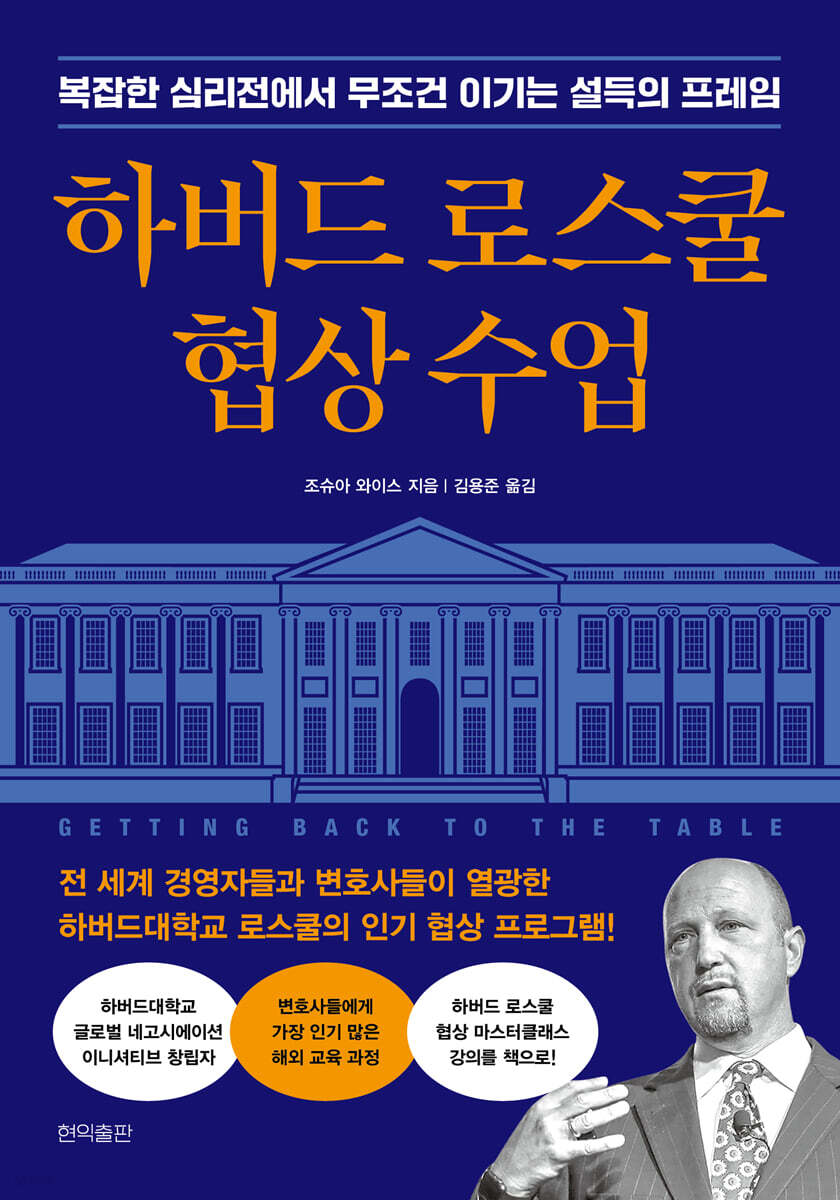
Harvard Law School Negotiation Class
 |
Description
Book Introduction
Harvard University's Negotiation Class Now Available in Book Format!
An advanced course for negotiators who transform negotiations with strategy and analysis!
How do these individuals, who manage to turn contract terms to their advantage even in unfavorable negotiation situations and ultimately achieve their desired outcome, dominate the negotiation process? The Harvard Negotiation Program (HNP), a program attended by negotiation experts from around the world, is an advanced training program jointly designed by negotiation experts from top academic institutions such as Harvard Law School, Harvard Kennedy School, and the Massachusetts Institute of Technology.
This program, which only a select few can participate in after a rigorous selection process each year, consists of a curriculum that identifies the interests and obstacles of negotiation and develops strategies based on various negotiation scenarios.
"Harvard Law School Negotiation Class" is a book that compiles the global negotiation know-how of Professor Joshua Weiss, founder of Harvard University's Global Negotiation Initiative (GNI) and senior research fellow at the Harvard Negotiation Program (HNP).
The author presents a "five-step framework" based on his experience successfully leading international negotiation projects, advising companies such as General Motors, Microsoft, UN agencies, and U.S. and Canadian government agencies.
Through this, we delve into the essence of negotiation, which is to achieve the desired result rather than an ambiguous agreement in complex and difficult negotiation situations.
The key to negotiation is not a verbal battle, but a structural understanding of the negotiation.
Let's use this five-step framework—acceptance, analysis, insight, weakness removal, and return to the negotiating table—to understand and design the dynamics of negotiation, becoming a more confident and strategic negotiator. This practical guide will serve as a powerful bargaining chip for CEOs, lawyers, leaders, planners, salespeople, and anyone who fears negotiation in their daily lives.
An advanced course for negotiators who transform negotiations with strategy and analysis!
How do these individuals, who manage to turn contract terms to their advantage even in unfavorable negotiation situations and ultimately achieve their desired outcome, dominate the negotiation process? The Harvard Negotiation Program (HNP), a program attended by negotiation experts from around the world, is an advanced training program jointly designed by negotiation experts from top academic institutions such as Harvard Law School, Harvard Kennedy School, and the Massachusetts Institute of Technology.
This program, which only a select few can participate in after a rigorous selection process each year, consists of a curriculum that identifies the interests and obstacles of negotiation and develops strategies based on various negotiation scenarios.
"Harvard Law School Negotiation Class" is a book that compiles the global negotiation know-how of Professor Joshua Weiss, founder of Harvard University's Global Negotiation Initiative (GNI) and senior research fellow at the Harvard Negotiation Program (HNP).
The author presents a "five-step framework" based on his experience successfully leading international negotiation projects, advising companies such as General Motors, Microsoft, UN agencies, and U.S. and Canadian government agencies.
Through this, we delve into the essence of negotiation, which is to achieve the desired result rather than an ambiguous agreement in complex and difficult negotiation situations.
The key to negotiation is not a verbal battle, but a structural understanding of the negotiation.
Let's use this five-step framework—acceptance, analysis, insight, weakness removal, and return to the negotiating table—to understand and design the dynamics of negotiation, becoming a more confident and strategic negotiator. This practical guide will serve as a powerful bargaining chip for CEOs, lawyers, leaders, planners, salespeople, and anyone who fears negotiation in their daily lives.
index
introduction
Failed Introduction Negotiations, Resilience, and the Five-Step Framework
Negotiations failed
Resilient negotiator
A 5-Step Framework for Returning to the Negotiating Table
Chapter 1.
Types and severity of negotiation failures
Types of failure
The severity of failure
Chapter 2.
What Hinders Learning After a Failed Negotiation
Passing the buck
Bias and inference
unreflective experience
loss aversion
Lack of a systematic approach
Chapter 3.
If negotiations fail, what do we do now?
Chapter 4.
Step 1 - Accept
Chapter 5.
Step 2 - Analyze
Forest Question
Tree Question
Chapter 6.
Step 3 - Gaining the Right Insights
Chapter 7.
Step 4 - Letting Go of Weaknesses
Is compromise the best solution?
Should emotions be excluded?
Should an agreement be reached at any cost?
Is negotiation a zero-sum game?
Should both sides be dissatisfied?
Are great negotiators born or made?
Is the key to success intuition, not preparation?
Are the words 'always' and 'never' valid?
Chapter 8.
Step 5 - Return to the Negotiating Table
Self-awareness and emotional management
Expand your knowledge needed for negotiation
A new perspective and adaptability to uncertainty
Reassessing the Negotiation Environment and Three Persuasion Techniques
Chapter 9.
Look back to move forward
Appendix A: Bias
Appendix B: Games
Acknowledgements
Failed Introduction Negotiations, Resilience, and the Five-Step Framework
Negotiations failed
Resilient negotiator
A 5-Step Framework for Returning to the Negotiating Table
Chapter 1.
Types and severity of negotiation failures
Types of failure
The severity of failure
Chapter 2.
What Hinders Learning After a Failed Negotiation
Passing the buck
Bias and inference
unreflective experience
loss aversion
Lack of a systematic approach
Chapter 3.
If negotiations fail, what do we do now?
Chapter 4.
Step 1 - Accept
Chapter 5.
Step 2 - Analyze
Forest Question
Tree Question
Chapter 6.
Step 3 - Gaining the Right Insights
Chapter 7.
Step 4 - Letting Go of Weaknesses
Is compromise the best solution?
Should emotions be excluded?
Should an agreement be reached at any cost?
Is negotiation a zero-sum game?
Should both sides be dissatisfied?
Are great negotiators born or made?
Is the key to success intuition, not preparation?
Are the words 'always' and 'never' valid?
Chapter 8.
Step 5 - Return to the Negotiating Table
Self-awareness and emotional management
Expand your knowledge needed for negotiation
A new perspective and adaptability to uncertainty
Reassessing the Negotiation Environment and Three Persuasion Techniques
Chapter 9.
Look back to move forward
Appendix A: Bias
Appendix B: Games
Acknowledgements
Detailed image

Into the book
The purpose of negotiation is not simply to reach an agreement, but to maximize the goals and interests of the negotiating parties.
In practice, situations often arise where both parties reach an agreement in negotiations but fail to meet their objectives, and in such situations the agreement should be considered a failure.
---p.48 Chapter 1.
From “Types and Severity of Negotiation Failure”
It's a very natural reaction to feel angry when you fail.
Because I didn't get what I wanted.
When anger wells up, it's important to take a moment to step back and reflect on why you're feeling that way.
Rationally, you might think, “Let’s just move on,” but your emotional self won’t easily move on until things are sorted out.
Why are you angry? Is it because you haven't achieved your goals, or because your reputation or other aspects of your identity have been damaged? Whatever the reason, you need to identify the cause and resolve your emotions.
Only when you have completed that process are you ready to move on to the next step.
---p.103 Chapter 4.
Step 1: Acceptance
Did the break help prevent conflict from escalating? If so, in what specific areas? Conversely, was the break interpreted as a negative signal, causing further problems in the negotiation?
---p.135 Chapter 5.
Step 2: Analyze
Transference can occur when you unconsciously recall past experiences from your negotiating partner or the negotiation situation itself, and these negative associations can interfere with your negotiation approach.
The other party may appear similar to someone you have negotiated with in the past in terms of appearance, speech, or behavior, or similarities may be found in the negotiation situation.
This tendency is especially pronounced when there is a large power imbalance in the negotiation.
---p.160 Chapter 6.
Step 3: Getting the Right Insights
Unfortunately, many people struggle to become stronger negotiators because of the misconceptions and approaches they've learned about negotiation from various sources.
The strategy suggested at this stage is to actively discard the things that are holding us back.
---p.168 Chapter 7.
Step 4: Letting Go of Weaknesses
Curiosity is also very useful in figuring out what needs to be understood as the negotiation progresses.
People with a curiosity-driven mindset are much more likely to discover the heart of a problem.
Because curiosity is linked to focusing on questions and trying to learn what you don't know.
Being genuinely curious about your negotiator helps shift the conversation from "your story and my story" to "our story," and moves you toward your goals in two powerful ways: by building respect and likability.
Respect and likeability facilitate problem solving by enabling open dialogue and enhancing the ability to persuade others.
In practice, situations often arise where both parties reach an agreement in negotiations but fail to meet their objectives, and in such situations the agreement should be considered a failure.
---p.48 Chapter 1.
From “Types and Severity of Negotiation Failure”
It's a very natural reaction to feel angry when you fail.
Because I didn't get what I wanted.
When anger wells up, it's important to take a moment to step back and reflect on why you're feeling that way.
Rationally, you might think, “Let’s just move on,” but your emotional self won’t easily move on until things are sorted out.
Why are you angry? Is it because you haven't achieved your goals, or because your reputation or other aspects of your identity have been damaged? Whatever the reason, you need to identify the cause and resolve your emotions.
Only when you have completed that process are you ready to move on to the next step.
---p.103 Chapter 4.
Step 1: Acceptance
Did the break help prevent conflict from escalating? If so, in what specific areas? Conversely, was the break interpreted as a negative signal, causing further problems in the negotiation?
---p.135 Chapter 5.
Step 2: Analyze
Transference can occur when you unconsciously recall past experiences from your negotiating partner or the negotiation situation itself, and these negative associations can interfere with your negotiation approach.
The other party may appear similar to someone you have negotiated with in the past in terms of appearance, speech, or behavior, or similarities may be found in the negotiation situation.
This tendency is especially pronounced when there is a large power imbalance in the negotiation.
---p.160 Chapter 6.
Step 3: Getting the Right Insights
Unfortunately, many people struggle to become stronger negotiators because of the misconceptions and approaches they've learned about negotiation from various sources.
The strategy suggested at this stage is to actively discard the things that are holding us back.
---p.168 Chapter 7.
Step 4: Letting Go of Weaknesses
Curiosity is also very useful in figuring out what needs to be understood as the negotiation progresses.
People with a curiosity-driven mindset are much more likely to discover the heart of a problem.
Because curiosity is linked to focusing on questions and trying to learn what you don't know.
Being genuinely curious about your negotiator helps shift the conversation from "your story and my story" to "our story," and moves you toward your goals in two powerful ways: by building respect and likability.
Respect and likeability facilitate problem solving by enabling open dialogue and enhancing the ability to persuade others.
---p.207 Chapter 8.
Step 5: Return to the Negotiating Table
Step 5: Return to the Negotiating Table
Publisher's Review
Harvard Law School's popular negotiation lecture, which has attracted lawyers and executives around the world!
The Science of Negotiation: Getting What You Want in Complex Dynamics
Harvard Law School's negotiation class is not just a theoretical lecture.
Designed by Dr. Joshua Weiss, author of "Harvard Law School Negotiation," this program is a hands-on, hands-on curriculum that brings together lawyers, law students, corporate executives, diplomats, non-profit leaders, and other professionals from diverse fields to engage in intense discussions and simulations.
What makes this course so popular worldwide is its structure, which is based on real-life negotiation situations.
Students form teams in a virtual negotiation scenario, develop strategies, discuss them, and analyze the results. This process allows them to understand and internalize the essence and pitfalls of negotiation.
Author Joshua Weiss is a leading authority on negotiation, founder of Harvard University's Global Negotiation Initiative (GNI), and senior fellow at the Harvard Negotiation Program (HNP).
The author has accumulated expertise in various negotiation situations, providing advice on business negotiations as well as international negotiations, and has included this knowledge in this book.
This book goes beyond simply teaching you how to say something, offering deep insights into how to analyze the dynamics of negotiation and ultimately achieve your desired outcome.
Is the 'negotiation technique' you knew really true?
How to get what you want in tough and demanding negotiations!
The ongoing tug-of-war and war of nerves at the negotiating table is much more complex and arduous than one might think.
So, what is needed to avoid ambiguous agreements in this tricky psychological warfare and achieve the desired outcome? Many of the formulas that many negotiators believe constitute "negotiation techniques" are often flawed insights that cannot be applied to all negotiations.
This is because negotiation is not a matter of a single formula, but rather a matter of dynamic relationships involving intertwined variables.
Negotiations involve a variety of dynamics, including the number of issues, the number of participants, the personalities and negotiation styles of the participants, power imbalances, and cultural, gender, and generational factors. Therefore, consistently applying the negotiation techniques you believe to be true to every negotiation will not yield the desired results.
In fact, author Joshua Weiss believes that every negotiation is unique and finds clues even in the complex negotiation conditions such as local culture, B2B transaction timeframe, B2C structure, and the need to maintain relationships.
Ultimately, a strong negotiator is someone who has the power to read and design the structure of the negotiation at their table.
"Harvard Law School Negotiation Class" offers practical methods for understanding the essence of negotiation amidst various variables and flexibly adjusting strategies according to the situation.
The moment you close this book, your words will become powerful!
A practical negotiation bible born at the intersection of law, psychology, and strategy!
"Harvard Law School Negotiation Class" sharply challenges deep-rooted misconceptions about negotiation and raises questions.
Is compromise the best solution? Should emotions always be left out? Should agreement be reached at all costs? Is negotiation a zero-sum game? Are great negotiators born or nurtured? This book challenges the stereotypes surrounding negotiation and provides readers with a detailed five-step framework to analyze their own negotiations.
First, you must accept the outcome of the negotiation, which is not what you wanted (Step 1), analyze the overall perspective and the detailed dynamics (Step 2), gain the right insight (Step 3), boldly discard faulty beliefs and behaviors (Step 4), and ultimately return to the negotiating table as a stronger negotiator (Step 5).
It contains a variety of negotiation cases applicable to real-world situations, such as business transactions, legal disputes, car sales, real estate transactions, and salary negotiations, which is enough to develop a practical sense.
Right now, it's time to check your negotiation skills.
The Science of Negotiation: Getting What You Want in Complex Dynamics
Harvard Law School's negotiation class is not just a theoretical lecture.
Designed by Dr. Joshua Weiss, author of "Harvard Law School Negotiation," this program is a hands-on, hands-on curriculum that brings together lawyers, law students, corporate executives, diplomats, non-profit leaders, and other professionals from diverse fields to engage in intense discussions and simulations.
What makes this course so popular worldwide is its structure, which is based on real-life negotiation situations.
Students form teams in a virtual negotiation scenario, develop strategies, discuss them, and analyze the results. This process allows them to understand and internalize the essence and pitfalls of negotiation.
Author Joshua Weiss is a leading authority on negotiation, founder of Harvard University's Global Negotiation Initiative (GNI), and senior fellow at the Harvard Negotiation Program (HNP).
The author has accumulated expertise in various negotiation situations, providing advice on business negotiations as well as international negotiations, and has included this knowledge in this book.
This book goes beyond simply teaching you how to say something, offering deep insights into how to analyze the dynamics of negotiation and ultimately achieve your desired outcome.
Is the 'negotiation technique' you knew really true?
How to get what you want in tough and demanding negotiations!
The ongoing tug-of-war and war of nerves at the negotiating table is much more complex and arduous than one might think.
So, what is needed to avoid ambiguous agreements in this tricky psychological warfare and achieve the desired outcome? Many of the formulas that many negotiators believe constitute "negotiation techniques" are often flawed insights that cannot be applied to all negotiations.
This is because negotiation is not a matter of a single formula, but rather a matter of dynamic relationships involving intertwined variables.
Negotiations involve a variety of dynamics, including the number of issues, the number of participants, the personalities and negotiation styles of the participants, power imbalances, and cultural, gender, and generational factors. Therefore, consistently applying the negotiation techniques you believe to be true to every negotiation will not yield the desired results.
In fact, author Joshua Weiss believes that every negotiation is unique and finds clues even in the complex negotiation conditions such as local culture, B2B transaction timeframe, B2C structure, and the need to maintain relationships.
Ultimately, a strong negotiator is someone who has the power to read and design the structure of the negotiation at their table.
"Harvard Law School Negotiation Class" offers practical methods for understanding the essence of negotiation amidst various variables and flexibly adjusting strategies according to the situation.
The moment you close this book, your words will become powerful!
A practical negotiation bible born at the intersection of law, psychology, and strategy!
"Harvard Law School Negotiation Class" sharply challenges deep-rooted misconceptions about negotiation and raises questions.
Is compromise the best solution? Should emotions always be left out? Should agreement be reached at all costs? Is negotiation a zero-sum game? Are great negotiators born or nurtured? This book challenges the stereotypes surrounding negotiation and provides readers with a detailed five-step framework to analyze their own negotiations.
First, you must accept the outcome of the negotiation, which is not what you wanted (Step 1), analyze the overall perspective and the detailed dynamics (Step 2), gain the right insight (Step 3), boldly discard faulty beliefs and behaviors (Step 4), and ultimately return to the negotiating table as a stronger negotiator (Step 5).
It contains a variety of negotiation cases applicable to real-world situations, such as business transactions, legal disputes, car sales, real estate transactions, and salary negotiations, which is enough to develop a practical sense.
Right now, it's time to check your negotiation skills.
GOODS SPECIFICS
- Date of issue: October 20, 2025
- Page count, weight, size: 242 pages | 140*200*16mm
- ISBN13: 9791194793359
- ISBN10: 1194793355
You may also like
카테고리
korean


korean

![GQ KOREA Mark (Monthly): December [2025]](http://librairie.coreenne.fr/cdn/shop/files/8ef265dbbfbf186523ed75ba7319009d.jpg?v=1765340328&width=3840)


