

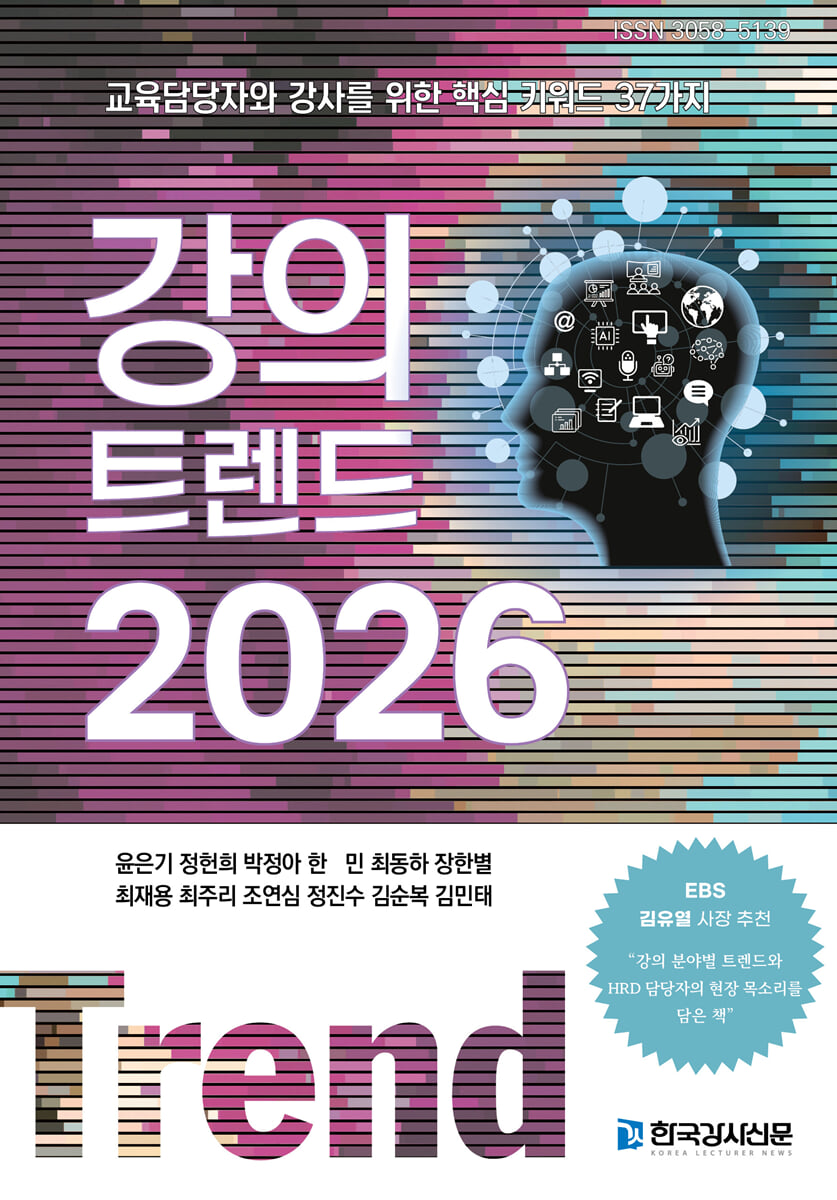
Lecture Trends 2026
 |
Description
Book Introduction
Predicting lecture trends for 2026
"Lecture Trends 2026" is a book that documents the rapidly changing trends in corporate training and tells the stories of those who are shaping the educational landscape.
This book introduces the teaching know-how and teaching trends of the best instructors in each field.
It includes examples from the lecture field, '5 things to keep in mind when giving lectures,' 'Lecture trend hashtags at a glance,' and '5 key questions,' so that readers can easily understand and utilize the flow.
By following the key questions, you can guess the lecture trends for 2026, and the answers are specifically provided in the text.
This year in particular, we met with educators in person and captured their vivid voices.
We took a close look at the concerns of those who plan and recruit lectures, and how companies are responding to change.
While it may not represent all companies and fields, the accumulated experience will provide clear insights to other organizations.
"Lecture Trends 2026" explores the essence of education that motivates learners and drives change.
It is expected to provide practical insights and actionable strategies to both educators and instructors.
"Lecture Trends 2026" is a book that documents the rapidly changing trends in corporate training and tells the stories of those who are shaping the educational landscape.
This book introduces the teaching know-how and teaching trends of the best instructors in each field.
It includes examples from the lecture field, '5 things to keep in mind when giving lectures,' 'Lecture trend hashtags at a glance,' and '5 key questions,' so that readers can easily understand and utilize the flow.
By following the key questions, you can guess the lecture trends for 2026, and the answers are specifically provided in the text.
This year in particular, we met with educators in person and captured their vivid voices.
We took a close look at the concerns of those who plan and recruit lectures, and how companies are responding to change.
While it may not represent all companies and fields, the accumulated experience will provide clear insights to other organizations.
"Lecture Trends 2026" explores the essence of education that motivates learners and drives change.
It is expected to provide practical insights and actionable strategies to both educators and instructors.
- You can preview some of the book's contents.
Preview
index
Prologue: Sang-hyung Han: "The Era of AI and Hyper-Personalization: The Sustainability of Education"
(Han Sang-hyung, publisher of the Korea Instructor Newspaper)
01 Jeong Heon-hee | Corporate Training Trends for 2026, According to an Education Manager
02 Yoon Eun-ki | The Era of Collaborative Management Has Arrived
03 Park Jeong-ah | Surviving Organizations: Focus on Adaptive Leadership!
04 Han Min | Focus on "Relational Humanities" in the Age of Alone
05 Choi Dong-ha | Team Changes and Team Coaching in the AI Era
06 Jang Han-byeol | Infosignals and Emosignals in the Era of Hybrid Communication
07 Choi Jae-yong | The AI Video Production Revolution: The Future Has Begun
08 Choi Joo-ri | Wineflow: Bringing Emotions to a Knowledge-Overflowing Organization
09 Jo Yeon-sim | The Future of Instructor Branding in the Age of the Expert Economy
10. Jeong Jin-su | In the era of AI and digital transformation, social media platforms instructors must prepare for.
11 Kim Soon-bok | The Renaissance of Experience: Why Middle-aged and Older Instructors Are Being Selected in the AI Era
12 Kim Min-tae | One-point lessons from instructor to instructor
Epilogue: Jeong Heon-hee: "Education deepens when shared, and knowledge grows when shared."
(Jeong Heon-hee, Head of the Instructor Business Division, Korea Instructor Newspaper)
(Han Sang-hyung, publisher of the Korea Instructor Newspaper)
01 Jeong Heon-hee | Corporate Training Trends for 2026, According to an Education Manager
02 Yoon Eun-ki | The Era of Collaborative Management Has Arrived
03 Park Jeong-ah | Surviving Organizations: Focus on Adaptive Leadership!
04 Han Min | Focus on "Relational Humanities" in the Age of Alone
05 Choi Dong-ha | Team Changes and Team Coaching in the AI Era
06 Jang Han-byeol | Infosignals and Emosignals in the Era of Hybrid Communication
07 Choi Jae-yong | The AI Video Production Revolution: The Future Has Begun
08 Choi Joo-ri | Wineflow: Bringing Emotions to a Knowledge-Overflowing Organization
09 Jo Yeon-sim | The Future of Instructor Branding in the Age of the Expert Economy
10. Jeong Jin-su | In the era of AI and digital transformation, social media platforms instructors must prepare for.
11 Kim Soon-bok | The Renaissance of Experience: Why Middle-aged and Older Instructors Are Being Selected in the AI Era
12 Kim Min-tae | One-point lessons from instructor to instructor
Epilogue: Jeong Heon-hee: "Education deepens when shared, and knowledge grows when shared."
(Jeong Heon-hee, Head of the Instructor Business Division, Korea Instructor Newspaper)
Detailed image

Into the book
Educators no longer passively accept external content. They leverage HR platforms, developer conferences, and industry trend reports to identify trends and connect them with the capabilities their organizations need.
Since then, we have been developing our execution capabilities by ‘directly designing’ customized content that fits the organization.
Generative AI, machine learning, and digital literacy, in particular, are rapidly evolving topics.
The more topics like this one are covered, the more evident the movement is to design education with a focus on practical relevance and applicability to the field.
This trend also affects instructors.
Understanding the latest trends is fundamental.
It requires the ability to implement it into a real learning experience.
The ability to plan lectures that are closely aligned with the field, such as practical training and workshop design tailored to the organizational context, is becoming increasingly important.
--- p.33
To effectively manage collaboration, you need to hire and train collaborative talent.
We need people who can do well on their own, but are even better together.
Managers who lead collaborative management must also transform into collaborative leaders, or polymath CEOs.
A polymath CEO is someone who has expertise in various fields, but knows how to connect and integrate them to create new value.
--- p.62
There is no right answer to adaptive leadership training, but this is how I approach it.
The order is analysis through diagnosis → workshop for experimentation → transfer after learning.
It is a structure that allows learners to diagnose their own work tendencies and leadership styles, experiment with relationships and work situations in actual organizations, and transfer learning based on the results.
--- p.87
The workplace, where the work and roles of various organizations and individuals interact, is also a place that functions based on various human relationships.
Although there are limitations such as given tasks, assigned roles, and limited space and time, there are definitely relationships that can be actively and proactively utilized within them.
Companies should focus on relationships not simply for the sake of conforming to the organization or looking good to superiors, but for the sake of a healthier and more efficient organization and the personal growth of individuals.
--- p.130
While there are concerns that the coach's role in team coaching in the AI era may be diminishing, the current trend is for AI to function more as a partner to the coach. AI excels at processing massive amounts of data and recognizing patterns, while human coaches excel at interpreting context and communicating empathically.
--- p.148
Communication skills in the hybrid work era come from strategically designing and training words and emotions.
Words are a moving force.
And that power lies with those who know how to design accurately and connect warmly.
In the future, communication strategies that plan words, design context, and connect emotions will have a greater impact on organizational performance.
--- p.190
The scope of application of AI video production technology is very broad.
In the marketing field, AI videos are being used to effectively attract consumer attention when launching new products.
Tools like Sora enable advertisers to create high-quality ads in a short period of time.
This is a markedly different approach from the traditional advertising production model.
AI video production technology is also bringing innovation to the lecture field.
Instructors can now produce high-quality lecture content without the need for complex filming equipment. AI-generated visual aids enhance learners' understanding and provide a more effective learning experience.
--- p.200
Wine Content has been running practical content for emotional recovery and healing, such as the 'Make Your Own Signature Sangria' program, for several years.
Recently, we have been expanding the scope of content from experiential to practical to strategic, focusing on practical educational goals such as job immersion, emotional communication, and strengthening teamwork.
--- p.225
In an era where AI is replacing fundamental aspects of knowledge transfer, AI personal branding is essential for instructors to thrive and thrive.
It is a holistic system for redefining, expanding, and monetizing your unique value as an educator in the digital age.
As AI technology advances, the boundaries between instructors and AI will continue to be redefined.
To continue to create value and exert influence in this environment, the ability to actively design and brand the relationship between instructors and AI will become a key competitive advantage. Successful instructors in the AI era will not be those who oppose AI, but those who master how to dance with it. --- p.265
Social media is a powerful tool for demonstrating instructors' expertise and a platform for creating teaching opportunities.
However, just as it's important to utilize social media effectively, it's equally important to avoid misuse. How you manage your social media channels can impact your image, credibility, and opportunities as an instructor.
--- p.295
In the 2026 education market, the greatest asset of middle-aged and older instructors is their decades of accumulated experience.
However, these experiences do not automatically gain value.
The ability to reconstruct past experiences into a form that current and future learners can understand and utilize is the core competency of middle-aged and older instructors.
--- p.318
No matter how much AI develops, they are proving that machines cannot replace human experience and sincerity toward others.
These 10 instructors have shown that the job of an instructor is not simply to be a 'speaker' but to be a 'life-changer'.
An instructor's ability is not about PPT or flashy skills.
It depended on how authentically you shared your experiences, how much you considered your audience, and how much you constantly strived to grow.
This was the biggest lesson I learned from meeting them.
I hope you all have the same experience as me.
Since then, we have been developing our execution capabilities by ‘directly designing’ customized content that fits the organization.
Generative AI, machine learning, and digital literacy, in particular, are rapidly evolving topics.
The more topics like this one are covered, the more evident the movement is to design education with a focus on practical relevance and applicability to the field.
This trend also affects instructors.
Understanding the latest trends is fundamental.
It requires the ability to implement it into a real learning experience.
The ability to plan lectures that are closely aligned with the field, such as practical training and workshop design tailored to the organizational context, is becoming increasingly important.
--- p.33
To effectively manage collaboration, you need to hire and train collaborative talent.
We need people who can do well on their own, but are even better together.
Managers who lead collaborative management must also transform into collaborative leaders, or polymath CEOs.
A polymath CEO is someone who has expertise in various fields, but knows how to connect and integrate them to create new value.
--- p.62
There is no right answer to adaptive leadership training, but this is how I approach it.
The order is analysis through diagnosis → workshop for experimentation → transfer after learning.
It is a structure that allows learners to diagnose their own work tendencies and leadership styles, experiment with relationships and work situations in actual organizations, and transfer learning based on the results.
--- p.87
The workplace, where the work and roles of various organizations and individuals interact, is also a place that functions based on various human relationships.
Although there are limitations such as given tasks, assigned roles, and limited space and time, there are definitely relationships that can be actively and proactively utilized within them.
Companies should focus on relationships not simply for the sake of conforming to the organization or looking good to superiors, but for the sake of a healthier and more efficient organization and the personal growth of individuals.
--- p.130
While there are concerns that the coach's role in team coaching in the AI era may be diminishing, the current trend is for AI to function more as a partner to the coach. AI excels at processing massive amounts of data and recognizing patterns, while human coaches excel at interpreting context and communicating empathically.
--- p.148
Communication skills in the hybrid work era come from strategically designing and training words and emotions.
Words are a moving force.
And that power lies with those who know how to design accurately and connect warmly.
In the future, communication strategies that plan words, design context, and connect emotions will have a greater impact on organizational performance.
--- p.190
The scope of application of AI video production technology is very broad.
In the marketing field, AI videos are being used to effectively attract consumer attention when launching new products.
Tools like Sora enable advertisers to create high-quality ads in a short period of time.
This is a markedly different approach from the traditional advertising production model.
AI video production technology is also bringing innovation to the lecture field.
Instructors can now produce high-quality lecture content without the need for complex filming equipment. AI-generated visual aids enhance learners' understanding and provide a more effective learning experience.
--- p.200
Wine Content has been running practical content for emotional recovery and healing, such as the 'Make Your Own Signature Sangria' program, for several years.
Recently, we have been expanding the scope of content from experiential to practical to strategic, focusing on practical educational goals such as job immersion, emotional communication, and strengthening teamwork.
--- p.225
In an era where AI is replacing fundamental aspects of knowledge transfer, AI personal branding is essential for instructors to thrive and thrive.
It is a holistic system for redefining, expanding, and monetizing your unique value as an educator in the digital age.
As AI technology advances, the boundaries between instructors and AI will continue to be redefined.
To continue to create value and exert influence in this environment, the ability to actively design and brand the relationship between instructors and AI will become a key competitive advantage. Successful instructors in the AI era will not be those who oppose AI, but those who master how to dance with it. --- p.265
Social media is a powerful tool for demonstrating instructors' expertise and a platform for creating teaching opportunities.
However, just as it's important to utilize social media effectively, it's equally important to avoid misuse. How you manage your social media channels can impact your image, credibility, and opportunities as an instructor.
--- p.295
In the 2026 education market, the greatest asset of middle-aged and older instructors is their decades of accumulated experience.
However, these experiences do not automatically gain value.
The ability to reconstruct past experiences into a form that current and future learners can understand and utilize is the core competency of middle-aged and older instructors.
--- p.318
No matter how much AI develops, they are proving that machines cannot replace human experience and sincerity toward others.
These 10 instructors have shown that the job of an instructor is not simply to be a 'speaker' but to be a 'life-changer'.
An instructor's ability is not about PPT or flashy skills.
It depended on how authentically you shared your experiences, how much you considered your audience, and how much you constantly strived to grow.
This was the biggest lesson I learned from meeting them.
I hope you all have the same experience as me.
--- p.341
Publisher's Review
37 Key Keywords for Educators and Instructors
The Era of Generative AI and Hyper-Personalization! Lecture Trend Forecast for 2026
What will be the corporate training trends and trends in each lecture field in 2026? This book, "Lecture Trends 2026," provides answers to these questions.
Top instructors active in various fields present their teaching know-how and insights based on the vividness of actual classroom experiences.
Yoon Eun-ki's "The Age of Collaborative Management Has Arrived" offers clear answers to the following questions: What is the X-Revolution? What causes hyper-performance and hyper-risk? How can collaborative management be effective? What are collaborative talents and polymath CEOs? What is the role of hyper-collaboration and the collaborative coordinator?
In Jeong Heon-hee's "2026 Corporate Training Trends: From an Educator," he examines the key keywords that educators preparing for 2026 should pay attention to and how generative AI is driving real change in corporate training.
In this era of hyper-personalization, we explore how corporate training is designing "tailored growth" for its members.
In particular, it provides answers to the questions of what are the main concerns faced by educators in the field, what strategies are being used to address them, and what instructors are preferred.
Park Jeong-ah's "Surviving Organizations: Focus on Adaptive Leadership!" guides us through the leadership strategies needed to navigate the changing world. What is the concept of adaptive leadership, and why is it so crucial in today's world? How can leaders cultivate strong social skills and connective power?
In Hanmin's "Focus on 'Relational Humanities' in the Age of Alone," he clearly addresses why relationships are becoming so important in this hyper-individualized era. Why do people need to form relationships? Why are lectures on relational humanities necessary in business?
Dong-Ha Choi's "Team Transformation and Team Coaching in the AI Era" delves into how the structure and function of teams in modern organizations are evolving in the AI era. What role should team coaching play within these changes? What competencies and approaches should coaches possess to successfully utilize AI in team coaching? What are the differences between team coaching and team coaching lectures, and how should they be prepared? What are the future directions for team coaching and team coaching lectures to adapt to the changing digital environment?
Jang Han-byeol's "Infosignals and Emosignals in the Era of Hybrid Communication" explores how communication is changing in the era of hybrid work. Why has hybrid communication become more than just a communication tool; it's become an organizational survival strategy? How does "infosignals" clarify communication? Can collaboration continue without emotionless digital conversations and "emosignals"? How can infosignals and emosignals become strategic communication systems for organizations? This book explores these questions and offers clear answers.
Choi Jae-yong's "AI Video Production Revolution: The Future Has Begun Now" offers practical answers to these questions: Why is AI video production becoming increasingly important to businesses? How is AI video production technology transforming the content market? Why is AI video production training necessary for businesses? What are the key AI video production topics that should be covered in corporate lectures? How will AI video production training evolve in the future?
Choi Joo-ri's "Wine Flow: Letting Emotions Flow in Knowledge-Overflowing Organizations" offers appropriate answers to these questions: Despite the abundance of knowledge, why do organizations remain stagnant? Why are "emotions" and "experiences" so crucial in corporate training today? Why should organizations rethink emotion-based learning in the era of hyper-personalization? What educational function can "wine" play in emotional recovery and relationship building? What potential does "Wine Flow" offer as a method for structuring organizational training to foster emotional flow?
Jo Yeon-sim's "Instructor Branding in the Expert Economy" delves into the following questions: What should instructors do in the expert economy? What is personal branding 2.0, and how does it differ from traditional branding? What opportunities does digital reputation branding offer instructors? How can instructors strengthen their brands to achieve digital charisma? Why is AI personal branding necessary in the teaching environment?
In "The Era of AI and Digital Transformation: Social Media Strategies for Instructors," Jeong Jin-su explores how the social media lecture market has evolved, and what do the current changes mean? In 2026, amidst the shifts of generative AI and the digital landscape, how will the social media lecture market be restructured? How can instructors leverage digital trends to transform teaching opportunities? What criteria should guide the selection and utilization of each social media platform for instructor branding and content strategy? What competencies will instructors need to maintain their competitive edge in the future?
In "Renaissance of Experience: Why Middle-aged and Older Instructors Are Being Selected in the AI Era," Kim Soon-bok presents realistic and concrete answers to these questions: In an era where AI is replacing so many things, why is the experience of middle-aged and older instructors absolutely impossible to replicate? How should we market their experience to MZ generation learners? How can middle-aged and older instructors, often less tech-savvy, leverage AI tools to enhance their competitiveness? How can middle-aged and older instructors serve as "translators" in organizations where intergenerational conflict is severe? For those seeking a second career as an instructor after retirement, what experiences should they prioritize for content creation?
Kim Min-tae's "One-Point Lesson from Instructor to Instructor" offers meaningful reflections on the secrets of the best instructors in each field.
In particular, the results show that most of the best instructors have a common denominator of 'failure', a philosophy of sharing content, an audience-centered mindset, a perspective on the AI era, and authenticity, which are noteworthy.
The Era of Generative AI and Hyper-Personalization! Lecture Trend Forecast for 2026
What will be the corporate training trends and trends in each lecture field in 2026? This book, "Lecture Trends 2026," provides answers to these questions.
Top instructors active in various fields present their teaching know-how and insights based on the vividness of actual classroom experiences.
Yoon Eun-ki's "The Age of Collaborative Management Has Arrived" offers clear answers to the following questions: What is the X-Revolution? What causes hyper-performance and hyper-risk? How can collaborative management be effective? What are collaborative talents and polymath CEOs? What is the role of hyper-collaboration and the collaborative coordinator?
In Jeong Heon-hee's "2026 Corporate Training Trends: From an Educator," he examines the key keywords that educators preparing for 2026 should pay attention to and how generative AI is driving real change in corporate training.
In this era of hyper-personalization, we explore how corporate training is designing "tailored growth" for its members.
In particular, it provides answers to the questions of what are the main concerns faced by educators in the field, what strategies are being used to address them, and what instructors are preferred.
Park Jeong-ah's "Surviving Organizations: Focus on Adaptive Leadership!" guides us through the leadership strategies needed to navigate the changing world. What is the concept of adaptive leadership, and why is it so crucial in today's world? How can leaders cultivate strong social skills and connective power?
In Hanmin's "Focus on 'Relational Humanities' in the Age of Alone," he clearly addresses why relationships are becoming so important in this hyper-individualized era. Why do people need to form relationships? Why are lectures on relational humanities necessary in business?
Dong-Ha Choi's "Team Transformation and Team Coaching in the AI Era" delves into how the structure and function of teams in modern organizations are evolving in the AI era. What role should team coaching play within these changes? What competencies and approaches should coaches possess to successfully utilize AI in team coaching? What are the differences between team coaching and team coaching lectures, and how should they be prepared? What are the future directions for team coaching and team coaching lectures to adapt to the changing digital environment?
Jang Han-byeol's "Infosignals and Emosignals in the Era of Hybrid Communication" explores how communication is changing in the era of hybrid work. Why has hybrid communication become more than just a communication tool; it's become an organizational survival strategy? How does "infosignals" clarify communication? Can collaboration continue without emotionless digital conversations and "emosignals"? How can infosignals and emosignals become strategic communication systems for organizations? This book explores these questions and offers clear answers.
Choi Jae-yong's "AI Video Production Revolution: The Future Has Begun Now" offers practical answers to these questions: Why is AI video production becoming increasingly important to businesses? How is AI video production technology transforming the content market? Why is AI video production training necessary for businesses? What are the key AI video production topics that should be covered in corporate lectures? How will AI video production training evolve in the future?
Choi Joo-ri's "Wine Flow: Letting Emotions Flow in Knowledge-Overflowing Organizations" offers appropriate answers to these questions: Despite the abundance of knowledge, why do organizations remain stagnant? Why are "emotions" and "experiences" so crucial in corporate training today? Why should organizations rethink emotion-based learning in the era of hyper-personalization? What educational function can "wine" play in emotional recovery and relationship building? What potential does "Wine Flow" offer as a method for structuring organizational training to foster emotional flow?
Jo Yeon-sim's "Instructor Branding in the Expert Economy" delves into the following questions: What should instructors do in the expert economy? What is personal branding 2.0, and how does it differ from traditional branding? What opportunities does digital reputation branding offer instructors? How can instructors strengthen their brands to achieve digital charisma? Why is AI personal branding necessary in the teaching environment?
In "The Era of AI and Digital Transformation: Social Media Strategies for Instructors," Jeong Jin-su explores how the social media lecture market has evolved, and what do the current changes mean? In 2026, amidst the shifts of generative AI and the digital landscape, how will the social media lecture market be restructured? How can instructors leverage digital trends to transform teaching opportunities? What criteria should guide the selection and utilization of each social media platform for instructor branding and content strategy? What competencies will instructors need to maintain their competitive edge in the future?
In "Renaissance of Experience: Why Middle-aged and Older Instructors Are Being Selected in the AI Era," Kim Soon-bok presents realistic and concrete answers to these questions: In an era where AI is replacing so many things, why is the experience of middle-aged and older instructors absolutely impossible to replicate? How should we market their experience to MZ generation learners? How can middle-aged and older instructors, often less tech-savvy, leverage AI tools to enhance their competitiveness? How can middle-aged and older instructors serve as "translators" in organizations where intergenerational conflict is severe? For those seeking a second career as an instructor after retirement, what experiences should they prioritize for content creation?
Kim Min-tae's "One-Point Lesson from Instructor to Instructor" offers meaningful reflections on the secrets of the best instructors in each field.
In particular, the results show that most of the best instructors have a common denominator of 'failure', a philosophy of sharing content, an audience-centered mindset, a perspective on the AI era, and authenticity, which are noteworthy.
GOODS SPECIFICS
- Date of issue: October 29, 2025
- Page count, weight, size: 392 pages | 150*215*30mm
- ISBN13: 9791197034862
You may also like
카테고리
korean


korean

![GQ KOREA Mark (Monthly): December [2025]](http://librairie.coreenne.fr/cdn/shop/files/8ef265dbbfbf186523ed75ba7319009d.jpg?v=1765340328&width=3840)


