

non-mainstream project
 |
Description
Book Introduction
★Milla Nonna Jang Myeong-suk's Highly Recommended Book★
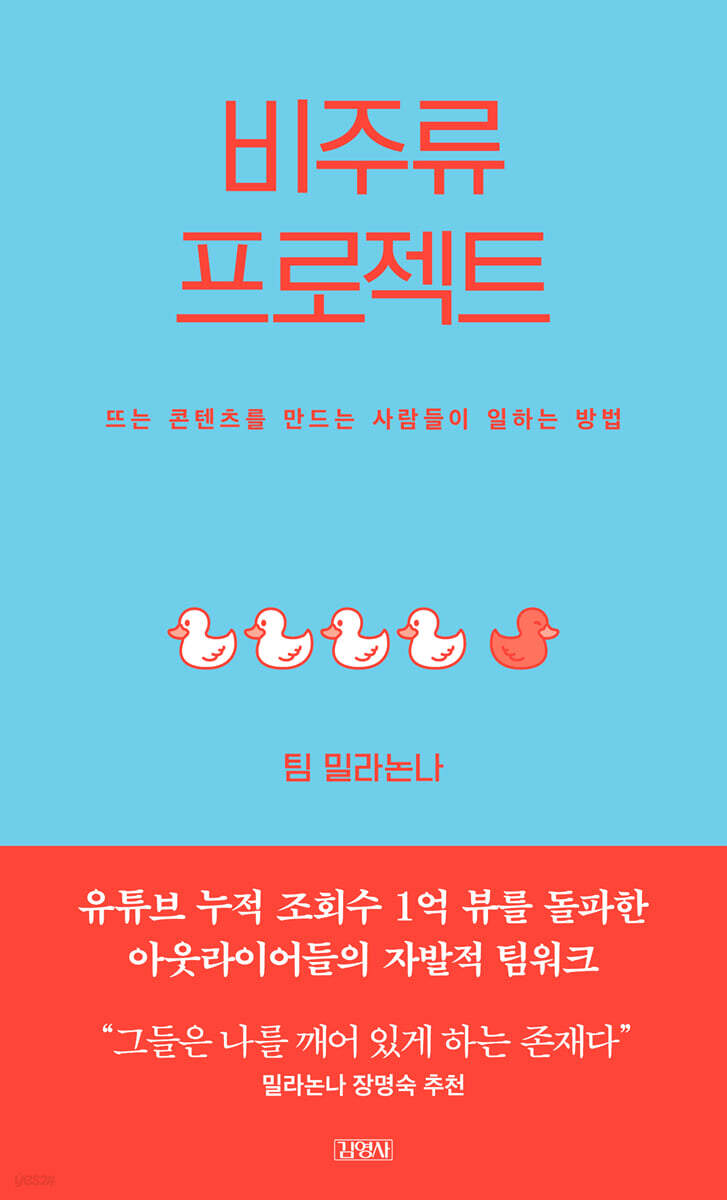
How do outliers with over 140 million YouTube views work?
From Team Milanonna's content planning methods to workplace survival tips.
A must-read for all professionals who want to live an ordinary yet special life.
“This book condenses the seven years of work of a seven-member content special forces team, from starting from zero to creating a channel with 100 million views.
I admire their cohesiveness, which produces results as dense as well-molded clay.
(…) They are the ones who keep me awake and on edge.
“In their professional spirit of creating content with a creative desire and dedicating themselves to it, I once again feel that passion, rather than recognition, is the secret to success.” _Milla Nonna Jang Myeong-suk Highly recommended
With over 140 million cumulative YouTube views and over 1 million subscribers, "Milanonna," "Pearl Jieng," and "Jeongheehada," which illuminate the lives of adults in this era and are enjoyed by people from their teens to their 70s, were produced. How did the "different MZ" who shattered the stereotype of "today's MZ" work? How do the fringes of an organization become mainstream, become new standards, and survive?
"Non-mainstream Projects" vividly demonstrates how spontaneity can become a driving force for a team and foster a "sense of work" and "sensitivity to relationships" within an organization through a process of respecting each other's differences, colliding, experimenting, failing, and ultimately succeeding.
From corporate employees to startup frontier workers, salaried workers to freelancers, and employees to executives, this book contains 'useful laws of work to know.'
This book awakens the attitude, method, and sense of working separately and together for those who begin and continue the adventure called work.
It tells stories that overturn common sense and the rules of how to do things well, such as not avoiding the question “why,” detecting and designing for failure, pushing your senses even when it’s uncomfortable, holding on to the thoughts of a few for longer than the flow of the majority, sharing pain rather than watching it, becoming a real team after fighting, and building good relationships rather than being good seniors and juniors.
How do outliers with over 140 million YouTube views work?
From Team Milanonna's content planning methods to workplace survival tips.
A must-read for all professionals who want to live an ordinary yet special life.
“This book condenses the seven years of work of a seven-member content special forces team, from starting from zero to creating a channel with 100 million views.
I admire their cohesiveness, which produces results as dense as well-molded clay.
(…) They are the ones who keep me awake and on edge.
“In their professional spirit of creating content with a creative desire and dedicating themselves to it, I once again feel that passion, rather than recognition, is the secret to success.” _Milla Nonna Jang Myeong-suk Highly recommended
With over 140 million cumulative YouTube views and over 1 million subscribers, "Milanonna," "Pearl Jieng," and "Jeongheehada," which illuminate the lives of adults in this era and are enjoyed by people from their teens to their 70s, were produced. How did the "different MZ" who shattered the stereotype of "today's MZ" work? How do the fringes of an organization become mainstream, become new standards, and survive?
"Non-mainstream Projects" vividly demonstrates how spontaneity can become a driving force for a team and foster a "sense of work" and "sensitivity to relationships" within an organization through a process of respecting each other's differences, colliding, experimenting, failing, and ultimately succeeding.
From corporate employees to startup frontier workers, salaried workers to freelancers, and employees to executives, this book contains 'useful laws of work to know.'
This book awakens the attitude, method, and sense of working separately and together for those who begin and continue the adventure called work.
It tells stories that overturn common sense and the rules of how to do things well, such as not avoiding the question “why,” detecting and designing for failure, pushing your senses even when it’s uncomfortable, holding on to the thoughts of a few for longer than the flow of the majority, sharing pain rather than watching it, becoming a real team after fighting, and building good relationships rather than being good seniors and juniors.
- You can preview some of the book's contents.
Preview
index
Prologue: Why We Document Teamwork
1 Start
How to open the first board
#1 A team suddenly formed one day
#2 First mission: Draw on a full canvas.
#3 The ground called YouTube
#4 There is no such thing as a big picture, start with the small picture.
#5 PD and planner
#6 “I’ll try.”
#7 Fanboys and Fandom
2. Understand
How to become a team by bumping into and shaking
#8 You have to fight to find out
#9 When you are swayed by competition
#10 People Who Endure “Why?”
#11 How to send an SOS signal
#12 Coexistence of Planned J and Improvisational P
#13 Unspoken Meeting
#14 The feeling of pushing through discomfort
#15 Teamwork where everyone contributes in their own way
3 Run
How to move to our own rhythm
#16 If you conform, you will be eliminated.
#17 Why I Talk to Milanonna Every Night
#18 Why Work with Senior Creators?
#19 Things to consider when starting a YouTube channel
#20 The Secret to Calling a Fandom
#21 Not all seniors are the same
#22 The moment that gives everyone goosebumps
#23 Detect and design for failure
#24 “Have you tried it?”
#25 Starting from 0
#26 I've never done it before, but I'm trying to do it.
4 skills
How to make things go smoothly
#27 The Secret of Views, Number of Trials
#28 Each character, each speed
#29 Make people like what they like
#30 Idea Generation Routine
#31 Weight of the first project
#32 A conversation that connects ideas
#33 A date, not a company dinner
#34 What Leaders Don't Say
5 Growth
How to grow within the company, not outside it
#35 Secretly working overtime
#36 Protecting Your Team in an Organization
#37 The desire of an honest person to escape
#38 Separation of work and life? Match!
#39 Share the pain without observing it.
#40 Resilience
#41 Old fart? What's that?
#42 Just win the next game
#43 How to deal with complaints from team members
6th Regiment
How to create tomorrow together
#44 Imagine when we broke up
#45 Detours and Shortcuts
#46 Ordinary and Extraordinary
#47 Comfort from PD Na Young-seok
#48 You take charge of the project
#49 Everyone has days when they want to write a resignation letter.
#50 There is no such thing as a good senior or a good junior.
Epilogue: We are all someone's next.
1 Start
How to open the first board
#1 A team suddenly formed one day
#2 First mission: Draw on a full canvas.
#3 The ground called YouTube
#4 There is no such thing as a big picture, start with the small picture.
#5 PD and planner
#6 “I’ll try.”
#7 Fanboys and Fandom
2. Understand
How to become a team by bumping into and shaking
#8 You have to fight to find out
#9 When you are swayed by competition
#10 People Who Endure “Why?”
#11 How to send an SOS signal
#12 Coexistence of Planned J and Improvisational P
#13 Unspoken Meeting
#14 The feeling of pushing through discomfort
#15 Teamwork where everyone contributes in their own way
3 Run
How to move to our own rhythm
#16 If you conform, you will be eliminated.
#17 Why I Talk to Milanonna Every Night
#18 Why Work with Senior Creators?
#19 Things to consider when starting a YouTube channel
#20 The Secret to Calling a Fandom
#21 Not all seniors are the same
#22 The moment that gives everyone goosebumps
#23 Detect and design for failure
#24 “Have you tried it?”
#25 Starting from 0
#26 I've never done it before, but I'm trying to do it.
4 skills
How to make things go smoothly
#27 The Secret of Views, Number of Trials
#28 Each character, each speed
#29 Make people like what they like
#30 Idea Generation Routine
#31 Weight of the first project
#32 A conversation that connects ideas
#33 A date, not a company dinner
#34 What Leaders Don't Say
5 Growth
How to grow within the company, not outside it
#35 Secretly working overtime
#36 Protecting Your Team in an Organization
#37 The desire of an honest person to escape
#38 Separation of work and life? Match!
#39 Share the pain without observing it.
#40 Resilience
#41 Old fart? What's that?
#42 Just win the next game
#43 How to deal with complaints from team members
6th Regiment
How to create tomorrow together
#44 Imagine when we broke up
#45 Detours and Shortcuts
#46 Ordinary and Extraordinary
#47 Comfort from PD Na Young-seok
#48 You take charge of the project
#49 Everyone has days when they want to write a resignation letter.
#50 There is no such thing as a good senior or a good junior.
Epilogue: We are all someone's next.
Detailed image

Into the book
We were all beginners.
Because we didn't know what the right answer was, we clashed more and debated more often.
At that time, YouTube was a completely unknown world to us, an uncultivated field.
We were in a situation where we didn't know where to change first.
But having no experience was actually a freedom.
We weren't bound by convention and it was okay to fail.
That freedom made us fly fast.
--- p.32, from “YouTube as a Ground”
A team is not a collection of tasks, but a network of relationships that enable different people to grow.
A new beginning isn't just about taking on new tasks; it's also about building relationships and creating a culture.
Everyone is afraid of taking the first step.
If you don't rush and want to slowly seep into the team, time will take care of everything else.
--- p.48~49, from “I’ll try”
For differences to become the 'foundation of teamwork' rather than a source of conflict, trust is paramount.
Moving without a plan creates confusion, and being stubborn without improvisation leads to a loss of flexibility.
Content creation is always a journey between those two points.
--- p.82, from “Coexistence of Planned J and Improvisational P”
It's okay if not everyone takes the initiative.
Even if they don't say much or express their emotions easily, someone is quietly observing the team.
(…) Teamwork is about respecting each other’s different contributions.
This difference actually makes our team more flexible and broad.
--- p.94~95, from “Teamwork where each person contributes in their own way”
The question “Have you tried it?” is not a simple confirmation.
In many cases, our experiences serve as an important basis for our judgment.
Experience makes a man humble, imagination makes a man brave.
Between experience and imagination, our place is always somewhere in between.
--- p.143, from “Have you tried it?”
I don't try to seem fair.
Instead, try to be accurate.
For those who are good at receiving fastballs, we offer fastballs, and for those who are used to breaking balls, we offer flexible suggestions.
For some people, “I’m lacking here” is motivation, while for others, it’s better to start with “You did a good job.”
Leaders realize at some point.
Saying the same thing to everyone is no different than saying it to no one.
It's said and pitched a little differently.
Because we know that it is not ‘discrimination’ but ‘optimization’.
--- p.199, from “What Leaders Don’t Say”
“As time goes by, achievements are forgotten, but capabilities remain.
“If you think of it as something that is accumulating for yourself, rather than something to show off to others, then that time will not be wasted.” --- p.216, from “The Honest Person’s Desire to Escape”
When someone is having a hard time, instead of just watching their pain, naturally walk towards it to the extent that you can handle it.
It is a sensitivity that reacts quickly to the pain of others.
The team will definitely become stronger as more people with such sensitivity join in.
--- p.226, from “Sharing Suffering Instead of Watching It”
Work diligently, share what you know with your juniors, and learn and fill in what you don't know.
If there is an axis that sets standards through actions that are invisible but clear, it has greater power than any instructions or regulations.
--- p.236, from "Old Man? What's That?"
“We all live with regrets about the paths we didn’t take.
Maybe it's because I haven't been there that it looks beautiful."
--- p.260, from “Detours and Shortcuts”
We judge ourselves by narrowing our standards, and sometimes we use the extraordinary qualities of others as a standard to diminish our own.
But even doing something silently can become extraordinary over time.
--- p.264, from “The Ordinary and the Extraordinary”
When we look back on the days we worked together, what remains are not the performance scores but the traces of our relationship.
Because we didn't know what the right answer was, we clashed more and debated more often.
At that time, YouTube was a completely unknown world to us, an uncultivated field.
We were in a situation where we didn't know where to change first.
But having no experience was actually a freedom.
We weren't bound by convention and it was okay to fail.
That freedom made us fly fast.
--- p.32, from “YouTube as a Ground”
A team is not a collection of tasks, but a network of relationships that enable different people to grow.
A new beginning isn't just about taking on new tasks; it's also about building relationships and creating a culture.
Everyone is afraid of taking the first step.
If you don't rush and want to slowly seep into the team, time will take care of everything else.
--- p.48~49, from “I’ll try”
For differences to become the 'foundation of teamwork' rather than a source of conflict, trust is paramount.
Moving without a plan creates confusion, and being stubborn without improvisation leads to a loss of flexibility.
Content creation is always a journey between those two points.
--- p.82, from “Coexistence of Planned J and Improvisational P”
It's okay if not everyone takes the initiative.
Even if they don't say much or express their emotions easily, someone is quietly observing the team.
(…) Teamwork is about respecting each other’s different contributions.
This difference actually makes our team more flexible and broad.
--- p.94~95, from “Teamwork where each person contributes in their own way”
The question “Have you tried it?” is not a simple confirmation.
In many cases, our experiences serve as an important basis for our judgment.
Experience makes a man humble, imagination makes a man brave.
Between experience and imagination, our place is always somewhere in between.
--- p.143, from “Have you tried it?”
I don't try to seem fair.
Instead, try to be accurate.
For those who are good at receiving fastballs, we offer fastballs, and for those who are used to breaking balls, we offer flexible suggestions.
For some people, “I’m lacking here” is motivation, while for others, it’s better to start with “You did a good job.”
Leaders realize at some point.
Saying the same thing to everyone is no different than saying it to no one.
It's said and pitched a little differently.
Because we know that it is not ‘discrimination’ but ‘optimization’.
--- p.199, from “What Leaders Don’t Say”
“As time goes by, achievements are forgotten, but capabilities remain.
“If you think of it as something that is accumulating for yourself, rather than something to show off to others, then that time will not be wasted.” --- p.216, from “The Honest Person’s Desire to Escape”
When someone is having a hard time, instead of just watching their pain, naturally walk towards it to the extent that you can handle it.
It is a sensitivity that reacts quickly to the pain of others.
The team will definitely become stronger as more people with such sensitivity join in.
--- p.226, from “Sharing Suffering Instead of Watching It”
Work diligently, share what you know with your juniors, and learn and fill in what you don't know.
If there is an axis that sets standards through actions that are invisible but clear, it has greater power than any instructions or regulations.
--- p.236, from "Old Man? What's That?"
“We all live with regrets about the paths we didn’t take.
Maybe it's because I haven't been there that it looks beautiful."
--- p.260, from “Detours and Shortcuts”
We judge ourselves by narrowing our standards, and sometimes we use the extraordinary qualities of others as a standard to diminish our own.
But even doing something silently can become extraordinary over time.
--- p.264, from “The Ordinary and the Extraordinary”
When we look back on the days we worked together, what remains are not the performance scores but the traces of our relationship.
--- p.283-284, from “There is no such thing as a good senior or a good junior”
Publisher's Review
How do we work with good sense?
What does that mean and how much can it change?
The law of bold, realistic, and unconventional work
From creating content that inspires 'Team Milanonna' to awakening a sense of purpose in work.
"There's no office worker who doesn't wonder how the non-mainstream survives in an organization."
The shock when seniors appeared on social networking services (hereinafter referred to as SNS) that are considered to be exclusive to young people, such as YouTube, TikTok, and Instagram, was definitely due to the unfamiliarity.
In this world, made up of many societies, both large and small, we are each secretly assigned a place to live.
Just as there is already a 'no kids zone' where various discourses are taking place, the virtual internet world called SNS was a space represented as a 'no senior zone'.
In this way, the emergence of ‘senior creators’ in this space where ‘youth’ is the mainstream was a clear rebellion from the non-mainstream.
《Non-mainstream Project》 is the story of non-mainstream people who willingly jumped into the mainstream world.
When representative senior YouTube channels, such as Milanonna, Pearl Jieng, and Jeongheehada, decided to enter the unfamiliar field of senior content, half of their teams were in their 20s, and the other half were in their 30s.
Although they were still far from reaching senior status, they chose an unfamiliar 'time' rather than the familiar youth, and the time they chose presented a new indicator to the 2040 generation who are concerned about aging.
A seven-year story of going from fringe to mainstream, from zero to over 140 million cumulative views.
How was Team Milanonna, which changed the content landscape, born and grew?
The book "Non-Mainstream Project," which contains bold and practical work laws that all office workers should know, has been published by Kim Young-sa.
One day, from a team that was suddenly formed, he became a solid backbone of the company.
“I took an unfamiliar path, and it changed a lot.”
'Team Milanonna' was a team that was suddenly formed one day.
It was a turbulent time for new media, centered around YouTube. Even those who had considered it a breeze were jumping into the YouTube boom.
In fact, it was the existing media companies that were the last to respond.
As the number of giant one-person creators whose value surpasses that of corporations increased and TV viewership ratings no longer served as a metric for determining the success of content, 'Team Milanonna' was formed with Team Leader Lee Gyeong-shin, who had been an editor for 12 years, at the center.
It was already a red ocean, and even if it was too late, I thought it was better than being late again.
Saying it was sudden was no excuse.
A company is a place where you have to “move when you receive an order, or rather, a transfer order,” and once you decide to stay at the company, this is a rule and guideline you have to follow.
And so began the voyage of 'Team Milanonna'.
Part 1: How to Play the First Board tells the story of seven members who suddenly become a team one day and grow into a true team.
From reorganizing the existing company channel, which was just a bunch of videos piled up in a chaotic manner without any categorization, to the anecdote of moving like a “rookie coach and rookie player,” the first step taken with the power of “I’ll try it,” to the beginning of the “fan activity” that became the team’s ignition point, we talk about “firsts” written with respect for each person’s experience and method.
Part 2: Understanding: "How to Become a Team Through Bumping and Shaking" tells the story of overcoming conflict within an organization and becoming a stronger team.
Even if an action is out of consideration for the other person, if the intention is not conveyed accurately, it can sometimes leave a scar.
The way to overcome it is simple.
All you need is the courage to “speak out about misunderstandings” and “the capacity to put aside hierarchy and apologize first,” as well as an environment conducive to dialogue.
Even if you are momentarily overcome by a competitive spirit, acknowledging that it is not directed at the other person but rather your own desire for growth, sharing the concerns of your teammates, and pushing forward without fear of "discomfort"—all of these are ultimately resolved through communication.
Part 3: Execution: "How to Move to Our Own Rhythm" tells the story of how the in-house video team, which was making "ordinary investigative videos," transformed into an original YouTube content team with over 140 million cumulative views.
Their method is clear.
Instead of conforming to the given reality, they constantly ask questions, and when they receive an answer, they push forward with confidence.
Even after receiving the answer of 'senior creator content', Milanonna, Pearl Jieng, and Jeongheehada are now practicing 'how to move forward differently' with the conviction that "not all seniors are the same."
Part 4: Skills: How to Make Things Work Well introduces the YouTube work skills the team developed after seven years of trial and error.
YouTube is a battle for views.
“There are many cases where a video that was carefully made stops at 10,000 views, while a video that was easily shot and uploaded can get over 1 million views.”
Because of this, YouTube creators have no choice but to rely on algorithms that can increase their views.
They also cry and laugh at the algorithm.
They say algorithms are luck, but there are things you can do to “get lucky.”
The 4th part contains the work achievements and team growth of 'Team Milanonna'.
As teams and channels grow, their members also grow, both individually and together.
Part 5: Growth: “How to Grow Inside the Company, Not Outside” talks about growth within the company.
Even though no one asked them to, they voluntarily 'work overtime secretly' for their own growth, they worry about work-life balance, 'burnout' that comes from doing their best, and even the attitude of focusing on the next attempt rather than being disappointed when they fail, all of these things show that individual member growth is "turning a team into a 'trustworthy space.'"
Lastly, Part 6: Solidarity: "How to Create Tomorrow Together" is a story about the solidarity and future of the team we have worked with so far.
Although they are a team that has built friendship, trust, and achievements together for seven years, change will come to them as well.
Like many young people working, they often stop and waver in the face of time and change, whether it's regret about their past dreams of working at a broadcasting station, regret about their lack of bright ideas, or concerns about an uncertain future.
A team cannot last forever.
However, rather than worrying about the current reality, they want to make an effort for each other with the mindset that “people who know how to break up treat the present more sincerely.”
“When we look back on the days we worked together, what remains are not the performance scores, but the traces of our relationship.”
Instead of comfortable repetition, a clear challenge
“We are all someone’s next.”
《Non-mainstream Project》 is a story of challenge and growth for those who willingly chose to become non-mainstream.
Believing that “we are all someone’s next,” they chose the “road less traveled” over the familiar.
Believing that it is a way to connect “the past” to “the present life” and a bridge from one generation to the next, we have gone through repeated conflicts, experiments, failures, and achievements.
This process soon proves that spontaneity becomes the driving force of a team, and that an attitude of respect for differences becomes the force that fosters a 'sense of work' and 'sensitivity to relationships' within an organization.
Instead of following the safe path of those who have gone before, the journey of those who have forged their own uncertain future may seem like "this is all I can do?" to some, but the traces of relationships and strong solidarity left behind as they grew together are achievements that will last longer than any other achievement, and they offer courage and inspiration to today's readers for tomorrow.
I hope that this book, like the recommendation from Milanonna Jang Myeong-suk, who has been with Team Milanonna from the beginning to the present, will provide refreshing inspiration to all office workers.
“In life, there are rivers to cross and mountains to climb.
“I recommend this book to young professionals who face challenges and minefields, who want to wisely solve problems, and who need fresh inspiration and stimulation.”
What does that mean and how much can it change?
The law of bold, realistic, and unconventional work
From creating content that inspires 'Team Milanonna' to awakening a sense of purpose in work.
"There's no office worker who doesn't wonder how the non-mainstream survives in an organization."
The shock when seniors appeared on social networking services (hereinafter referred to as SNS) that are considered to be exclusive to young people, such as YouTube, TikTok, and Instagram, was definitely due to the unfamiliarity.
In this world, made up of many societies, both large and small, we are each secretly assigned a place to live.
Just as there is already a 'no kids zone' where various discourses are taking place, the virtual internet world called SNS was a space represented as a 'no senior zone'.
In this way, the emergence of ‘senior creators’ in this space where ‘youth’ is the mainstream was a clear rebellion from the non-mainstream.
《Non-mainstream Project》 is the story of non-mainstream people who willingly jumped into the mainstream world.
When representative senior YouTube channels, such as Milanonna, Pearl Jieng, and Jeongheehada, decided to enter the unfamiliar field of senior content, half of their teams were in their 20s, and the other half were in their 30s.
Although they were still far from reaching senior status, they chose an unfamiliar 'time' rather than the familiar youth, and the time they chose presented a new indicator to the 2040 generation who are concerned about aging.
A seven-year story of going from fringe to mainstream, from zero to over 140 million cumulative views.
How was Team Milanonna, which changed the content landscape, born and grew?
The book "Non-Mainstream Project," which contains bold and practical work laws that all office workers should know, has been published by Kim Young-sa.
One day, from a team that was suddenly formed, he became a solid backbone of the company.
“I took an unfamiliar path, and it changed a lot.”
'Team Milanonna' was a team that was suddenly formed one day.
It was a turbulent time for new media, centered around YouTube. Even those who had considered it a breeze were jumping into the YouTube boom.
In fact, it was the existing media companies that were the last to respond.
As the number of giant one-person creators whose value surpasses that of corporations increased and TV viewership ratings no longer served as a metric for determining the success of content, 'Team Milanonna' was formed with Team Leader Lee Gyeong-shin, who had been an editor for 12 years, at the center.
It was already a red ocean, and even if it was too late, I thought it was better than being late again.
Saying it was sudden was no excuse.
A company is a place where you have to “move when you receive an order, or rather, a transfer order,” and once you decide to stay at the company, this is a rule and guideline you have to follow.
And so began the voyage of 'Team Milanonna'.
Part 1: How to Play the First Board tells the story of seven members who suddenly become a team one day and grow into a true team.
From reorganizing the existing company channel, which was just a bunch of videos piled up in a chaotic manner without any categorization, to the anecdote of moving like a “rookie coach and rookie player,” the first step taken with the power of “I’ll try it,” to the beginning of the “fan activity” that became the team’s ignition point, we talk about “firsts” written with respect for each person’s experience and method.
Part 2: Understanding: "How to Become a Team Through Bumping and Shaking" tells the story of overcoming conflict within an organization and becoming a stronger team.
Even if an action is out of consideration for the other person, if the intention is not conveyed accurately, it can sometimes leave a scar.
The way to overcome it is simple.
All you need is the courage to “speak out about misunderstandings” and “the capacity to put aside hierarchy and apologize first,” as well as an environment conducive to dialogue.
Even if you are momentarily overcome by a competitive spirit, acknowledging that it is not directed at the other person but rather your own desire for growth, sharing the concerns of your teammates, and pushing forward without fear of "discomfort"—all of these are ultimately resolved through communication.
Part 3: Execution: "How to Move to Our Own Rhythm" tells the story of how the in-house video team, which was making "ordinary investigative videos," transformed into an original YouTube content team with over 140 million cumulative views.
Their method is clear.
Instead of conforming to the given reality, they constantly ask questions, and when they receive an answer, they push forward with confidence.
Even after receiving the answer of 'senior creator content', Milanonna, Pearl Jieng, and Jeongheehada are now practicing 'how to move forward differently' with the conviction that "not all seniors are the same."
Part 4: Skills: How to Make Things Work Well introduces the YouTube work skills the team developed after seven years of trial and error.
YouTube is a battle for views.
“There are many cases where a video that was carefully made stops at 10,000 views, while a video that was easily shot and uploaded can get over 1 million views.”
Because of this, YouTube creators have no choice but to rely on algorithms that can increase their views.
They also cry and laugh at the algorithm.
They say algorithms are luck, but there are things you can do to “get lucky.”
The 4th part contains the work achievements and team growth of 'Team Milanonna'.
As teams and channels grow, their members also grow, both individually and together.
Part 5: Growth: “How to Grow Inside the Company, Not Outside” talks about growth within the company.
Even though no one asked them to, they voluntarily 'work overtime secretly' for their own growth, they worry about work-life balance, 'burnout' that comes from doing their best, and even the attitude of focusing on the next attempt rather than being disappointed when they fail, all of these things show that individual member growth is "turning a team into a 'trustworthy space.'"
Lastly, Part 6: Solidarity: "How to Create Tomorrow Together" is a story about the solidarity and future of the team we have worked with so far.
Although they are a team that has built friendship, trust, and achievements together for seven years, change will come to them as well.
Like many young people working, they often stop and waver in the face of time and change, whether it's regret about their past dreams of working at a broadcasting station, regret about their lack of bright ideas, or concerns about an uncertain future.
A team cannot last forever.
However, rather than worrying about the current reality, they want to make an effort for each other with the mindset that “people who know how to break up treat the present more sincerely.”
“When we look back on the days we worked together, what remains are not the performance scores, but the traces of our relationship.”
Instead of comfortable repetition, a clear challenge
“We are all someone’s next.”
《Non-mainstream Project》 is a story of challenge and growth for those who willingly chose to become non-mainstream.
Believing that “we are all someone’s next,” they chose the “road less traveled” over the familiar.
Believing that it is a way to connect “the past” to “the present life” and a bridge from one generation to the next, we have gone through repeated conflicts, experiments, failures, and achievements.
This process soon proves that spontaneity becomes the driving force of a team, and that an attitude of respect for differences becomes the force that fosters a 'sense of work' and 'sensitivity to relationships' within an organization.
Instead of following the safe path of those who have gone before, the journey of those who have forged their own uncertain future may seem like "this is all I can do?" to some, but the traces of relationships and strong solidarity left behind as they grew together are achievements that will last longer than any other achievement, and they offer courage and inspiration to today's readers for tomorrow.
I hope that this book, like the recommendation from Milanonna Jang Myeong-suk, who has been with Team Milanonna from the beginning to the present, will provide refreshing inspiration to all office workers.
“In life, there are rivers to cross and mountains to climb.
“I recommend this book to young professionals who face challenges and minefields, who want to wisely solve problems, and who need fresh inspiration and stimulation.”
GOODS SPECIFICS
- Date of issue: September 8, 2025
- Page count, weight, size: 288 pages | 123*203*20mm
- ISBN13: 9791173323331
- ISBN10: 1173323333
You may also like
카테고리
korean


korean

![GQ KOREA Mark (Monthly): December [2025]](http://librairie.coreenne.fr/cdn/shop/files/8ef265dbbfbf186523ed75ba7319009d.jpg?v=1765340328&width=3840)


