

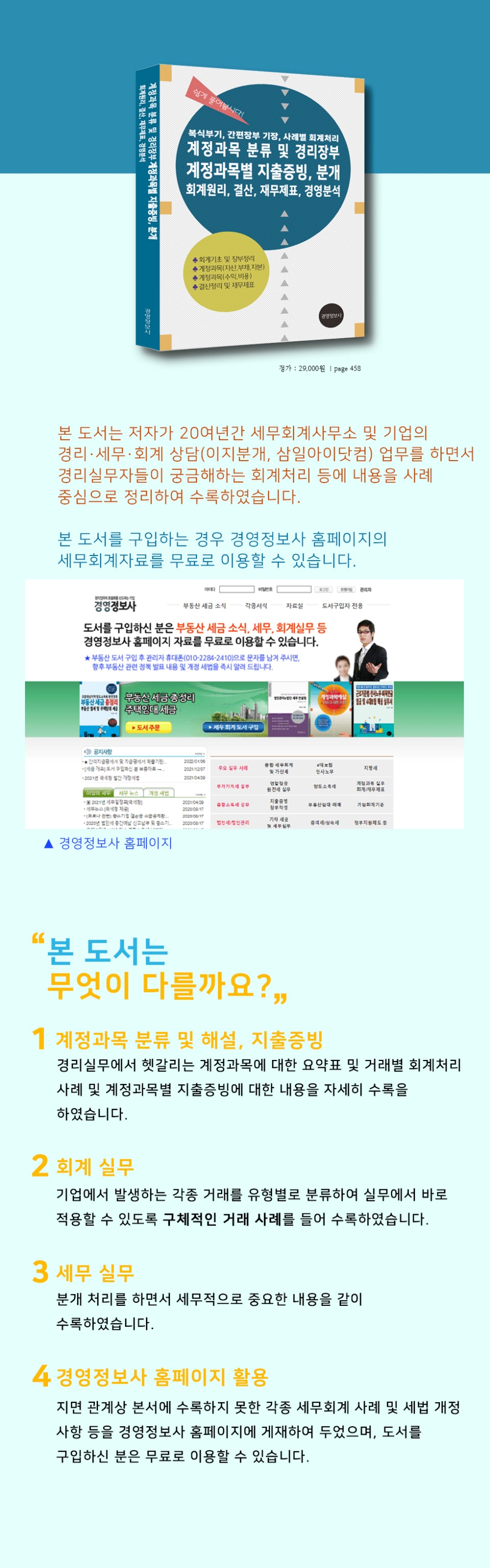
Account classification and accounting ledger, expenditure documentation by account, accounting principles, closing accounts, financial statements, and management analysis
 |
Description
Book Introduction
This book was compiled for practitioners in charge of accounting practices in small and medium-sized enterprises, and, as much as possible, narrative explanations are omitted, and explanations are given based on cases.
After completing specialized training in commercial bookkeeping and accounting and actually taking on accounting duties at a company, you will encounter various complex transaction cases that you did not learn through training, and you may waste a lot of time not being able to find a way to handle certain issues.
The author manages 'Easy Accounting', a professional consulting website for accounting and tax affairs that provides answers to such difficulties, and analyzed the content of the inquiries. This book is organized by chapter to provide the easiest practical approach to the preprocessing of accounting work.
This book provides case studies of the more difficult aspects of accounting practices, and has made every effort to ensure that it can be conveniently applied in practice.
This book may not be able to answer all your questions about corporate accounting, but I believe it will be helpful in many areas.
· Part 1: Accounting Principles and Bookkeeping
· Part 2 Accounting Subjects
· Part 3: Settlement of Accounts and Financial Statements
After completing specialized training in commercial bookkeeping and accounting and actually taking on accounting duties at a company, you will encounter various complex transaction cases that you did not learn through training, and you may waste a lot of time not being able to find a way to handle certain issues.
The author manages 'Easy Accounting', a professional consulting website for accounting and tax affairs that provides answers to such difficulties, and analyzed the content of the inquiries. This book is organized by chapter to provide the easiest practical approach to the preprocessing of accounting work.
This book provides case studies of the more difficult aspects of accounting practices, and has made every effort to ensure that it can be conveniently applied in practice.
This book may not be able to answer all your questions about corporate accounting, but I believe it will be helpful in many areas.
· Part 1: Accounting Principles and Bookkeeping
· Part 2 Accounting Subjects
· Part 3: Settlement of Accounts and Financial Statements
index
Chapter Ⅰ Accounting Principles and Bookkeeping
Chapter 1 Business Owner's Bookkeeping, Double-Entry Bookkeeping, and Simple Bookkeeping
[1] Business owner's bookkeeping
Businesses subject to double-entry bookkeeping
Tax adjustment and disposition of profits and losses on disposal of tangible assets for individual business owners
[2] Differences in bookkeeping between corporations and individual business owners, etc.
[3] Income of corporate and individual business owners
Chapter 2 Accounting Fundamentals
[1] Double-entry bookkeeping
[Case] Profit and Loss Calculation
Beginning balance sheet, income statement, and ending balance sheet
[2] Transactions, accounting transactions and non-transactions
[3] Transaction records and value-added tax classification
[4] Fiscal year and external audit target corporation, corporate accounting standards
Corporation subject to external audit
Corporate Accounting Standards [Korea Accounting Standards Board]
Chapter 3 Basic Accounting
[1] Understanding account subjects
[2] Account subjects that are easy to confuse
Accounts receivable (asset) and accounts receivable (asset)
Accounts payable (liabilities), accounts payable (liabilities), accrued expenses (liabilities)
Prepaid funds (asset), prepaid expenses (asset)
Miscellaneous expenses (selling and administrative expenses), miscellaneous losses (non-operating losses)
Raw materials (assets) and raw material costs (manufacturing expenses)
Costs associated with the acquisition of assets
[3] Account subject classification table
Current assets
Non-current assets
Current liabilities
non-current liabilities
Capital, withdrawals
Sales, cost of goods sold, manufacturing costs
Selling and administrative expenses
Non-operating income
Non-operating expenses
Corporate tax expense
Chapter 4: Preparation of vouchers and ledgers
[1] Receipt
Deposit slip
Withdrawal slip
Substitute voucher
How to create deposit and withdrawal slips, and how to create replacement slips
How to store tax invoices and transaction statements
[2] Bookkeeping process
Transaction occurrence, resentment
The process of recording transactions and preparing ledgers and financial statements
General Ledger Posting
How to write auxiliary records and expenditure resolutions
Chapter 5 Preparation of auxiliary ledgers
[1] Cash receipt and receipt ledger and examples of cash receipt and receipt ledger preparation
[2] Sales ledger and sales representative ledger
Transaction statement and monthly total tax invoice
Sales and collection process
Examples of writing sales ledgers and sales account ledgers
[3] Purchase and purchase location director
Example of preparing a purchase ledger and purchase order ledger
[4] Inventory Asset Receipt and Payment Department
Example of preparing inventory receipts and payments book
[5] Example of entering a receivable bill and writing a receivable bill
Receipt of bills, transfer of bills, discounting, and maturity collection
Occurrence and recovery of dishonored bills, write-off of bad debts, and bad debt tax deduction
[6] Example of entry of bill of exchange and preparation of bill of exchange
Chapter 6 Daily Schedule and Trial Balance
[1] Examples and methods of creating a daily schedule
[2] Case of trial balance and trial balance error correction, and preparation of a total balance trial balance
[3] Example of preparing a consolidated balance sheet
[4] Ledger
A ledger that records sales transactions
A ledger that records purchase transactions
A ledger that records various other transactions
Chapter Ⅱ Accounting Subjects
Chapter 1 Asset Account Subjects
[1] Current assets (current assets)
Cash and cash equivalents
checking account
CMA, MMF accounting treatment
short-term investment assets
Accounts Receivable (Accounts Receivable, Notes Receivable)
- Accounting for bill discounting
- Distinction between accounts receivable and accounts receivable
Securities
- Classification of securities, short-term trading securities, available-for-sale securities, held-to-maturity securities
- Accounting examples for listed securities
- Securities valuation and tax considerations
- Accounting for purchase and disposal of government bonds or public bonds
short-term loan
advance payment
- Payment and settlement of advance payments
- If you send money to the wrong business partner by mistake
- Tax considerations for short-term loans and advance payments to employees
Employee Loan (Short-term Bonds)
- Distinction between advance payment, employee loan, and advance payment
- Tax considerations for employee loans
- Housing loans for employees
imprest
- Management of advance payments at the site or department that received the advance payment
Receivables
- Accounting processing when VAT refund occurs
- Accounting processing when a refund is issued for the year-end settlement of health insurance premiums
advance payment
- Accounting processing when receiving a tax invoice upon payment of advance payment
Value-added tax payment
Prepaid tax
- Withholding and payment of bank interest income tax and local income tax
[2] Current assets (inventory assets)
Inventory Overview
- Types of inventory assets
- Inventory asset valuation method and valuation method report
- Calculation method of ending inventory quantity
- Inventory asset valuation if the inventory asset valuation method is not reported
goods
- Undelivered goods
- Purchase repurchase, purchase enuri, purchase discount
- Case study of accounting for goods and cost of sales
product
semi-finished products
raw materials
Work in progress
[3] Non-current assets (investment assets)
Long-term financial products
Long-term investment securities
Accounting for investment in the Construction Mutual Aid Association
long-term loan
[4] Non-current assets (tangible assets)
land
- Handling of legal fees and purchase tax related to land acquisition
- Documents proving land acquisition
building
- Calculation of acquisition price when acquiring land and buildings in bulk
- Tax accounting for building demolition and ironwork costs
Structure
- Distinction between buildings and structures
- Facility equipment and interior installation costs
mechanical devices
vehicle transporter
- Processing of purchase tax related to vehicle acquisition
- Accounting when selling a vehicle
Assets under construction
fixtures
Other tangible assets
[5] Non-current assets (intangible assets)
Intangible Asset Overview
- Depreciation of intangible assets
Goodwill
- Transfer of Goodwill and Tax Reporting
Industrial property rights
- Patent and patent transfer tax reporting
- Utility model right
- Chairman's rights, trademark rights
Development costs
- Distinguish between development costs, which are intangible assets, and current research and development costs, which are current expenses.
Other intangible assets
[6] Non-current assets (other non-current assets)
Long-term accounts receivable
security
dishonored bill
Chapter 2 Liabilities Account Subjects
[1] Current liabilities
Accounts Payable
- Classification of trade receivables by name (trade accounts payable, accounts payable, accrued expenses)
short-term borrowings
- Current account overdraft
- Withholding tax on personal loan borrowing and interest payments
- Overdraft account accounting
- Accounting for loans in another person's name
Accounts Payable
- Distinguish between accounts payable, accrued expenses, and trade receivables
Advance payment
- Receipt of advance payment and issuance of tax invoice before supply (delivery) of goods
Deposit
Unpaid expenses
VAT deposit
singer's fee
[2] Non-current liabilities
Private loan
long-term borrowings
- Distinction between short-term and long-term borrowings
Retirement benefit reserve liabilities
Retirement pension reserve liabilities
Chapter 3 Capital Accounting Subjects
[1] Capital
Capital and capital payment
Capital increase
- Submit a statement of stock price fluctuations and reflect capital changes in financial statements.
- Paid capital increase
- Face value issuance
- Premium issuance
- Free capital increase
- Withholding tax on dividend income and withholding tax timing in case of capital increase without payment
- Confirmation of ledger entries for capital increase
[2] Capital surplus
excess capitalization, capital gains, and treasury stock disposal profits
[3] Capital adjustment
Statement of changes in equity, stock discount and issuance premium, dividend construction interest
Treasury stock, dividends on unallocated stock
[4] Accumulated other comprehensive income
Valuation gains and losses on marketable securities
Overseas business conversion debit (or overseas business conversion debit)
[5] Retained earnings
Retained Earnings Overview
- Profit reserve
Profit capitalization process and dividend practice
- Earnings retained earnings carried forward, unappropriated earnings retained earnings, and earnings retained earnings carried forward
- Final dividend and interim dividend
- Disposal of retained earnings
- Accumulation of profit reserves
- Profit disposal in case no resolution is made on profit disposal at the end of the accounting period
Tax practices related to dividends
- Withholding tax on dividend income
- Capitalization of retained earnings (free capital increase) and tax issues
- Waiver of dividend rights
- Issuance and submission of dividend income withholding tax receipt
interim dividend
- Summary of final and interim dividends
Chapter 4 Revenue Account Subjects
[1] Sales
sales
- What should be deducted from sales
- Sales tax base under the Value Added Tax Act
[2] Non-operating income
interest income
- Collection and payment of interest income tax on deposit interest
- Treatment of accrued interest at the end of the accounting period
Dividend income
- Things to keep in mind regarding dividend income tax
Income rent
foreign exchange profits
Foreign currency translation gains
- Foreign exchange transaction practice processing
Gains on disposal of marketable securities
Securities valuation gains
Gains on disposal of investment assets
- Whether to record depreciation expense in the year of disposal of tangible assets
Gain on disposal of tangible assets
Customs duty refund
Sales promotion revenue
Government subsidy revenue
- National subsidy
- Handling of government subsidies received in connection with the acquisition of assets
- Handling of government subsidies received in relation to profits
- Inclusion of national subsidies in income and expenses for tax purposes
Profit from collection of write-off receivables
Electrical error correction profit
- If the electrical asset item is treated as an expense
- If the asset is missing from the ledger
Corporate tax refund amount
miscellaneous profits
Insurance profit
Debt forgiveness benefit
Gain on asset appreciation
Chapter 5 Expense Account Subjects
[1] Cost of sales
[2] Selling and administrative expenses
Salary and Wages
- Salary processing when the employer pays income tax and employee contributions for the four major insurances
- Account subjects related to salary payment
- Major non-taxable earned income
- Accounting for salary payment, income tax, and the collection and payment of the four major insurances
- Year-end tax settlement of earned income and 4 major insurance premiums for those who resign mid-term
- Year-end settlement of workers' health insurance premiums and employment and industrial accident compensation insurance premiums
Severance pay (retirement benefits)
miscellaneous
- Distinction between salary, wages, and miscellaneous pay
- Tax practice for daily workers
- Wage payment and supporting documents for daily workers
- Submission of the 'Work Content Confirmation Report' for daily workers
- Daily worker labor and four major insurance practices
Welfare expenses
- Treating employee welfare expenses as taxable wages
- Food subsidy paid in cash
- Employee gift account items, tax processing, and expenditure documentation
- Condolence money account items and expenditure documentation
- Account items and expenditure receipts for work clothes, etc.
Travel and transportation expenses
- Documents proving travel and transportation expenses
- Proof of expenditure for city travel expenses, intercity travel expenses, and overseas travel expenses
- Accounting for foreign currency exchange and return of remaining foreign currency when paying overseas travel expenses
entertainment expenses
- Documents proving entertainment expenses
- Proof of expenditure of condolence money for business partners
- Tax considerations for entertainment expenses
- Exclusion of entertainment expenses exceeding the limit from deductions
Communication costs
- Tax treatment of telecommunication expenses paid in a fixed amount
Water, electricity, and heating costs
Electricity cost
- Proof of electricity expenses for the rented building
- Electricity bill and proof of expenditure in the name of the landlord that the tenant actually paid
Taxes and public charges
- Taxes recognized as deductible and taxes not recognized as deductible
Depreciation expense
Payment of rent
- Method of receiving proof when receiving real estate rental services from a simplified taxpayer
Current research and development expenses
Repair costs
- Profitable expenditure (processed as repair expense account)
- Capital expenditures
premium
- Payment of vehicle insurance premiums and accounting of prepaid insurance premiums
- Accounting for payment of savings insurance premiums and guaranteed insurance premiums
Vehicle maintenance costs
- Vehicle maintenance cost account subject classification
- Whether expenses are recognized when an employee uses a vehicle owned by the employee for work and maintenance costs are paid
- Non-taxable vehicle maintenance costs
Transportation costs
Education and training expenses
- Documents proving expenditure of education and training expenses
- Payment of external lecture fees
Book printing costs
Meeting fees
Packaging cost
Office supplies expenses
Consumables cost, distinction between consumables and consumables cost
Payment fees
Storage fee
Advertising and promotional expenses
- Distinction between advertising and promotional expenses, entertainment expenses, and donations
- Website production cost account subject
Sales promotion expenses
Bad debt expense
Sample fee
Outsourcing processing costs and outsourcing expenses
Defect repair costs
miscellaneous expenses
[3] Non-operating expenses
interest expense
Foreign exchange loss
Foreign currency translation loss
donations
Loss on disposal of marketable securities
Loss on disposal of investment assets
Loss on disposal of tangible assets
Impairment loss on tangible assets
Electrical error correction loss
- If the electricity cost item is treated as an asset
- If the debt is omitted from the ledger
miscellaneous losses
Disaster loss
[4] Corporate tax expense
Corporate tax expense
Amount of corporate tax, etc. to be paid
Chapter Ⅲ Settlement.
Financial statements.
Proof of expenditure
Chapter 1: Settlement
[1] Settlement
[2] Why is the settlement process necessary?
[3] Settlement process
Preliminary procedures for settlement
- Preparation of a trial balance sheet
- Compare with auxiliary ledger
- Conduct inventory checks
- Settlement of accounts
- Preparation of settlement statement
Settlement main procedure
- Preparation of a total balance sheet after revision
- Closing of books and carryover
Preparation of financial statements
- Preparation of financial statements
- Preparation of income statement
- Preparation of retained earnings disposition statement
Chapter 2 Settlement of Accounts
[1] Calculation of cost of goods sold (wholesale and retail)
[2] Calculation of product manufacturing cost and cost of sales
Calculation of product manufacturing cost and cost of sales using comprehensive cost accounting
- Calculation of raw material costs
- Work-in-process calculation
- Calculation of end-of-period inventory value
- Calculation of ending inventory products
Calculation of manufacturing cost and cost of sales using individual cost calculation
[3] Depreciation expense accounting
Depreciation Overview
Depreciation Calculation Features
Depreciable assets
Depreciation method
- Intangible asset useful life table
- Table of standard useful life and useful life range for assets by industry
Depreciation calculation factors and calculation examples
Example of calculating depreciation expense for tangible fixed assets
[4] Establishment of retirement benefit reserve liabilities
Deduction of retirement allowance and tax adjustment
Retirement benefit reserve fund setting target and limit amount
[5] Deduction of retirement pension
Overview and Types of Retirement Pensions
- Defined contribution pension plan (DC)
- Defined Benefit Pension Plan (DB)
Retirement pension deduction
- Deduction of defined contribution pension (DC)
- Inclusion of defined benefit pension (DB) as deductible expense
[6] Bad debt reserve
Setting up a bad debt reserve
Receivables subject to bad debt reserve and amount set
Accounting for and offsetting bad debt reserves, and refunds
Accounting for allowance for bad debts
Range of bad debts
Accounting for occurrence of bad debt, write-off of bad debt, and bad debt tax deduction
[7] Other settlement matters
Cash shortage management
Prepaid expenses accounting
Accounting for unpaid expenses
Accounting for inventory impairment loss
Loss on valuation of inventory assets
Accounting for accrued revenue
Accounting for player revenue (deferral of revenue)
Securities valuation
Substitution of current long-term debt for long-term borrowings
Settlement of advance payments and advance payments
Accounting for corporate tax expenses
Substitution of retained earnings for net income
[8] Settlement Checklist
Chapter 3 Financial Statements
[1] Financial statements
[2] Usefulness of financial statements
[3] Types of financial statements
Chapter 4 Management Analysis
[1] Liquidity Analysis
Current ratio
Current ratio
[2] Stability analysis
Debt ratio
Equity ratio, fixed ratio
[3] Profitability Analysis
Sales operating profit ratio
Total capital operating profit ratio, sales gross profit ratio
[4] Significance of management analysis
Problems that can arise from neglecting business analysis
Chapter 5: Tax Accounting for Vehicles and Leases, Taxation Special Provisions for Business-Used Passenger Vehicles
[1] Tax accounting related to vehicles
Vehicle acquisition, acquisition tax, and public bond purchase
Deduction of vehicle transport equipment acquisition price and purchase tax
Vehicle purchase accounting
Vehicle sales
When selling a vehicle to an employee for a fee
[2] Tax accounting for sale of vehicle transport equipment and vehicle accidents
Accounting for sale of vehicle transport equipment
Tax accounting for profit and loss on disposal of vehicle transport equipment for self-employed individuals
Free vehicle transfer
Insurance premium processing in case of a car accident
[3] Rationalization of taxation on business-use passenger vehicles
Applicable vehicles, employee insurance, and related expenses
Employee-only car insurance subscription and expense recognition
Scope of expenses related to business vehicles
Deductible vehicle-related expenses if driving records are not kept
Maintenance costs for vehicles in the names of employees
Depreciation of business-use passenger vehicles
Depreciation expense limit and carryover deduction
Income disposal for depreciation expense exceeding the limit
Deduction of disposal loss when selling a business vehicle
Comparison of corporate and individual business vehicle expenses
[4] Financial Lease and Operating Lease Tax Accounting
Financial lease conditions (at least one of the following must be met)
Financial Lease Accounting Treatment
Sale and Lease
operating lease
Transfer of operating leased vehicles and issuance of tax invoices
User lease (VAT refund lease)
Chapter 6 Expense Proof and Regular Receipts
[1] Regular receipt
[2] Cases eligible for and not eligible for regular receipts
[3] Surcharge for non-receipt of regular receipt, etc.
[4] Receipt management and storage
Chapter 1 Business Owner's Bookkeeping, Double-Entry Bookkeeping, and Simple Bookkeeping
[1] Business owner's bookkeeping
Businesses subject to double-entry bookkeeping
Tax adjustment and disposition of profits and losses on disposal of tangible assets for individual business owners
[2] Differences in bookkeeping between corporations and individual business owners, etc.
[3] Income of corporate and individual business owners
Chapter 2 Accounting Fundamentals
[1] Double-entry bookkeeping
[Case] Profit and Loss Calculation
Beginning balance sheet, income statement, and ending balance sheet
[2] Transactions, accounting transactions and non-transactions
[3] Transaction records and value-added tax classification
[4] Fiscal year and external audit target corporation, corporate accounting standards
Corporation subject to external audit
Corporate Accounting Standards [Korea Accounting Standards Board]
Chapter 3 Basic Accounting
[1] Understanding account subjects
[2] Account subjects that are easy to confuse
Accounts receivable (asset) and accounts receivable (asset)
Accounts payable (liabilities), accounts payable (liabilities), accrued expenses (liabilities)
Prepaid funds (asset), prepaid expenses (asset)
Miscellaneous expenses (selling and administrative expenses), miscellaneous losses (non-operating losses)
Raw materials (assets) and raw material costs (manufacturing expenses)
Costs associated with the acquisition of assets
[3] Account subject classification table
Current assets
Non-current assets
Current liabilities
non-current liabilities
Capital, withdrawals
Sales, cost of goods sold, manufacturing costs
Selling and administrative expenses
Non-operating income
Non-operating expenses
Corporate tax expense
Chapter 4: Preparation of vouchers and ledgers
[1] Receipt
Deposit slip
Withdrawal slip
Substitute voucher
How to create deposit and withdrawal slips, and how to create replacement slips
How to store tax invoices and transaction statements
[2] Bookkeeping process
Transaction occurrence, resentment
The process of recording transactions and preparing ledgers and financial statements
General Ledger Posting
How to write auxiliary records and expenditure resolutions
Chapter 5 Preparation of auxiliary ledgers
[1] Cash receipt and receipt ledger and examples of cash receipt and receipt ledger preparation
[2] Sales ledger and sales representative ledger
Transaction statement and monthly total tax invoice
Sales and collection process
Examples of writing sales ledgers and sales account ledgers
[3] Purchase and purchase location director
Example of preparing a purchase ledger and purchase order ledger
[4] Inventory Asset Receipt and Payment Department
Example of preparing inventory receipts and payments book
[5] Example of entering a receivable bill and writing a receivable bill
Receipt of bills, transfer of bills, discounting, and maturity collection
Occurrence and recovery of dishonored bills, write-off of bad debts, and bad debt tax deduction
[6] Example of entry of bill of exchange and preparation of bill of exchange
Chapter 6 Daily Schedule and Trial Balance
[1] Examples and methods of creating a daily schedule
[2] Case of trial balance and trial balance error correction, and preparation of a total balance trial balance
[3] Example of preparing a consolidated balance sheet
[4] Ledger
A ledger that records sales transactions
A ledger that records purchase transactions
A ledger that records various other transactions
Chapter Ⅱ Accounting Subjects
Chapter 1 Asset Account Subjects
[1] Current assets (current assets)
Cash and cash equivalents
checking account
CMA, MMF accounting treatment
short-term investment assets
Accounts Receivable (Accounts Receivable, Notes Receivable)
- Accounting for bill discounting
- Distinction between accounts receivable and accounts receivable
Securities
- Classification of securities, short-term trading securities, available-for-sale securities, held-to-maturity securities
- Accounting examples for listed securities
- Securities valuation and tax considerations
- Accounting for purchase and disposal of government bonds or public bonds
short-term loan
advance payment
- Payment and settlement of advance payments
- If you send money to the wrong business partner by mistake
- Tax considerations for short-term loans and advance payments to employees
Employee Loan (Short-term Bonds)
- Distinction between advance payment, employee loan, and advance payment
- Tax considerations for employee loans
- Housing loans for employees
imprest
- Management of advance payments at the site or department that received the advance payment
Receivables
- Accounting processing when VAT refund occurs
- Accounting processing when a refund is issued for the year-end settlement of health insurance premiums
advance payment
- Accounting processing when receiving a tax invoice upon payment of advance payment
Value-added tax payment
Prepaid tax
- Withholding and payment of bank interest income tax and local income tax
[2] Current assets (inventory assets)
Inventory Overview
- Types of inventory assets
- Inventory asset valuation method and valuation method report
- Calculation method of ending inventory quantity
- Inventory asset valuation if the inventory asset valuation method is not reported
goods
- Undelivered goods
- Purchase repurchase, purchase enuri, purchase discount
- Case study of accounting for goods and cost of sales
product
semi-finished products
raw materials
Work in progress
[3] Non-current assets (investment assets)
Long-term financial products
Long-term investment securities
Accounting for investment in the Construction Mutual Aid Association
long-term loan
[4] Non-current assets (tangible assets)
land
- Handling of legal fees and purchase tax related to land acquisition
- Documents proving land acquisition
building
- Calculation of acquisition price when acquiring land and buildings in bulk
- Tax accounting for building demolition and ironwork costs
Structure
- Distinction between buildings and structures
- Facility equipment and interior installation costs
mechanical devices
vehicle transporter
- Processing of purchase tax related to vehicle acquisition
- Accounting when selling a vehicle
Assets under construction
fixtures
Other tangible assets
[5] Non-current assets (intangible assets)
Intangible Asset Overview
- Depreciation of intangible assets
Goodwill
- Transfer of Goodwill and Tax Reporting
Industrial property rights
- Patent and patent transfer tax reporting
- Utility model right
- Chairman's rights, trademark rights
Development costs
- Distinguish between development costs, which are intangible assets, and current research and development costs, which are current expenses.
Other intangible assets
[6] Non-current assets (other non-current assets)
Long-term accounts receivable
security
dishonored bill
Chapter 2 Liabilities Account Subjects
[1] Current liabilities
Accounts Payable
- Classification of trade receivables by name (trade accounts payable, accounts payable, accrued expenses)
short-term borrowings
- Current account overdraft
- Withholding tax on personal loan borrowing and interest payments
- Overdraft account accounting
- Accounting for loans in another person's name
Accounts Payable
- Distinguish between accounts payable, accrued expenses, and trade receivables
Advance payment
- Receipt of advance payment and issuance of tax invoice before supply (delivery) of goods
Deposit
Unpaid expenses
VAT deposit
singer's fee
[2] Non-current liabilities
Private loan
long-term borrowings
- Distinction between short-term and long-term borrowings
Retirement benefit reserve liabilities
Retirement pension reserve liabilities
Chapter 3 Capital Accounting Subjects
[1] Capital
Capital and capital payment
Capital increase
- Submit a statement of stock price fluctuations and reflect capital changes in financial statements.
- Paid capital increase
- Face value issuance
- Premium issuance
- Free capital increase
- Withholding tax on dividend income and withholding tax timing in case of capital increase without payment
- Confirmation of ledger entries for capital increase
[2] Capital surplus
excess capitalization, capital gains, and treasury stock disposal profits
[3] Capital adjustment
Statement of changes in equity, stock discount and issuance premium, dividend construction interest
Treasury stock, dividends on unallocated stock
[4] Accumulated other comprehensive income
Valuation gains and losses on marketable securities
Overseas business conversion debit (or overseas business conversion debit)
[5] Retained earnings
Retained Earnings Overview
- Profit reserve
Profit capitalization process and dividend practice
- Earnings retained earnings carried forward, unappropriated earnings retained earnings, and earnings retained earnings carried forward
- Final dividend and interim dividend
- Disposal of retained earnings
- Accumulation of profit reserves
- Profit disposal in case no resolution is made on profit disposal at the end of the accounting period
Tax practices related to dividends
- Withholding tax on dividend income
- Capitalization of retained earnings (free capital increase) and tax issues
- Waiver of dividend rights
- Issuance and submission of dividend income withholding tax receipt
interim dividend
- Summary of final and interim dividends
Chapter 4 Revenue Account Subjects
[1] Sales
sales
- What should be deducted from sales
- Sales tax base under the Value Added Tax Act
[2] Non-operating income
interest income
- Collection and payment of interest income tax on deposit interest
- Treatment of accrued interest at the end of the accounting period
Dividend income
- Things to keep in mind regarding dividend income tax
Income rent
foreign exchange profits
Foreign currency translation gains
- Foreign exchange transaction practice processing
Gains on disposal of marketable securities
Securities valuation gains
Gains on disposal of investment assets
- Whether to record depreciation expense in the year of disposal of tangible assets
Gain on disposal of tangible assets
Customs duty refund
Sales promotion revenue
Government subsidy revenue
- National subsidy
- Handling of government subsidies received in connection with the acquisition of assets
- Handling of government subsidies received in relation to profits
- Inclusion of national subsidies in income and expenses for tax purposes
Profit from collection of write-off receivables
Electrical error correction profit
- If the electrical asset item is treated as an expense
- If the asset is missing from the ledger
Corporate tax refund amount
miscellaneous profits
Insurance profit
Debt forgiveness benefit
Gain on asset appreciation
Chapter 5 Expense Account Subjects
[1] Cost of sales
[2] Selling and administrative expenses
Salary and Wages
- Salary processing when the employer pays income tax and employee contributions for the four major insurances
- Account subjects related to salary payment
- Major non-taxable earned income
- Accounting for salary payment, income tax, and the collection and payment of the four major insurances
- Year-end tax settlement of earned income and 4 major insurance premiums for those who resign mid-term
- Year-end settlement of workers' health insurance premiums and employment and industrial accident compensation insurance premiums
Severance pay (retirement benefits)
miscellaneous
- Distinction between salary, wages, and miscellaneous pay
- Tax practice for daily workers
- Wage payment and supporting documents for daily workers
- Submission of the 'Work Content Confirmation Report' for daily workers
- Daily worker labor and four major insurance practices
Welfare expenses
- Treating employee welfare expenses as taxable wages
- Food subsidy paid in cash
- Employee gift account items, tax processing, and expenditure documentation
- Condolence money account items and expenditure documentation
- Account items and expenditure receipts for work clothes, etc.
Travel and transportation expenses
- Documents proving travel and transportation expenses
- Proof of expenditure for city travel expenses, intercity travel expenses, and overseas travel expenses
- Accounting for foreign currency exchange and return of remaining foreign currency when paying overseas travel expenses
entertainment expenses
- Documents proving entertainment expenses
- Proof of expenditure of condolence money for business partners
- Tax considerations for entertainment expenses
- Exclusion of entertainment expenses exceeding the limit from deductions
Communication costs
- Tax treatment of telecommunication expenses paid in a fixed amount
Water, electricity, and heating costs
Electricity cost
- Proof of electricity expenses for the rented building
- Electricity bill and proof of expenditure in the name of the landlord that the tenant actually paid
Taxes and public charges
- Taxes recognized as deductible and taxes not recognized as deductible
Depreciation expense
Payment of rent
- Method of receiving proof when receiving real estate rental services from a simplified taxpayer
Current research and development expenses
Repair costs
- Profitable expenditure (processed as repair expense account)
- Capital expenditures
premium
- Payment of vehicle insurance premiums and accounting of prepaid insurance premiums
- Accounting for payment of savings insurance premiums and guaranteed insurance premiums
Vehicle maintenance costs
- Vehicle maintenance cost account subject classification
- Whether expenses are recognized when an employee uses a vehicle owned by the employee for work and maintenance costs are paid
- Non-taxable vehicle maintenance costs
Transportation costs
Education and training expenses
- Documents proving expenditure of education and training expenses
- Payment of external lecture fees
Book printing costs
Meeting fees
Packaging cost
Office supplies expenses
Consumables cost, distinction between consumables and consumables cost
Payment fees
Storage fee
Advertising and promotional expenses
- Distinction between advertising and promotional expenses, entertainment expenses, and donations
- Website production cost account subject
Sales promotion expenses
Bad debt expense
Sample fee
Outsourcing processing costs and outsourcing expenses
Defect repair costs
miscellaneous expenses
[3] Non-operating expenses
interest expense
Foreign exchange loss
Foreign currency translation loss
donations
Loss on disposal of marketable securities
Loss on disposal of investment assets
Loss on disposal of tangible assets
Impairment loss on tangible assets
Electrical error correction loss
- If the electricity cost item is treated as an asset
- If the debt is omitted from the ledger
miscellaneous losses
Disaster loss
[4] Corporate tax expense
Corporate tax expense
Amount of corporate tax, etc. to be paid
Chapter Ⅲ Settlement.
Financial statements.
Proof of expenditure
Chapter 1: Settlement
[1] Settlement
[2] Why is the settlement process necessary?
[3] Settlement process
Preliminary procedures for settlement
- Preparation of a trial balance sheet
- Compare with auxiliary ledger
- Conduct inventory checks
- Settlement of accounts
- Preparation of settlement statement
Settlement main procedure
- Preparation of a total balance sheet after revision
- Closing of books and carryover
Preparation of financial statements
- Preparation of financial statements
- Preparation of income statement
- Preparation of retained earnings disposition statement
Chapter 2 Settlement of Accounts
[1] Calculation of cost of goods sold (wholesale and retail)
[2] Calculation of product manufacturing cost and cost of sales
Calculation of product manufacturing cost and cost of sales using comprehensive cost accounting
- Calculation of raw material costs
- Work-in-process calculation
- Calculation of end-of-period inventory value
- Calculation of ending inventory products
Calculation of manufacturing cost and cost of sales using individual cost calculation
[3] Depreciation expense accounting
Depreciation Overview
Depreciation Calculation Features
Depreciable assets
Depreciation method
- Intangible asset useful life table
- Table of standard useful life and useful life range for assets by industry
Depreciation calculation factors and calculation examples
Example of calculating depreciation expense for tangible fixed assets
[4] Establishment of retirement benefit reserve liabilities
Deduction of retirement allowance and tax adjustment
Retirement benefit reserve fund setting target and limit amount
[5] Deduction of retirement pension
Overview and Types of Retirement Pensions
- Defined contribution pension plan (DC)
- Defined Benefit Pension Plan (DB)
Retirement pension deduction
- Deduction of defined contribution pension (DC)
- Inclusion of defined benefit pension (DB) as deductible expense
[6] Bad debt reserve
Setting up a bad debt reserve
Receivables subject to bad debt reserve and amount set
Accounting for and offsetting bad debt reserves, and refunds
Accounting for allowance for bad debts
Range of bad debts
Accounting for occurrence of bad debt, write-off of bad debt, and bad debt tax deduction
[7] Other settlement matters
Cash shortage management
Prepaid expenses accounting
Accounting for unpaid expenses
Accounting for inventory impairment loss
Loss on valuation of inventory assets
Accounting for accrued revenue
Accounting for player revenue (deferral of revenue)
Securities valuation
Substitution of current long-term debt for long-term borrowings
Settlement of advance payments and advance payments
Accounting for corporate tax expenses
Substitution of retained earnings for net income
[8] Settlement Checklist
Chapter 3 Financial Statements
[1] Financial statements
[2] Usefulness of financial statements
[3] Types of financial statements
Chapter 4 Management Analysis
[1] Liquidity Analysis
Current ratio
Current ratio
[2] Stability analysis
Debt ratio
Equity ratio, fixed ratio
[3] Profitability Analysis
Sales operating profit ratio
Total capital operating profit ratio, sales gross profit ratio
[4] Significance of management analysis
Problems that can arise from neglecting business analysis
Chapter 5: Tax Accounting for Vehicles and Leases, Taxation Special Provisions for Business-Used Passenger Vehicles
[1] Tax accounting related to vehicles
Vehicle acquisition, acquisition tax, and public bond purchase
Deduction of vehicle transport equipment acquisition price and purchase tax
Vehicle purchase accounting
Vehicle sales
When selling a vehicle to an employee for a fee
[2] Tax accounting for sale of vehicle transport equipment and vehicle accidents
Accounting for sale of vehicle transport equipment
Tax accounting for profit and loss on disposal of vehicle transport equipment for self-employed individuals
Free vehicle transfer
Insurance premium processing in case of a car accident
[3] Rationalization of taxation on business-use passenger vehicles
Applicable vehicles, employee insurance, and related expenses
Employee-only car insurance subscription and expense recognition
Scope of expenses related to business vehicles
Deductible vehicle-related expenses if driving records are not kept
Maintenance costs for vehicles in the names of employees
Depreciation of business-use passenger vehicles
Depreciation expense limit and carryover deduction
Income disposal for depreciation expense exceeding the limit
Deduction of disposal loss when selling a business vehicle
Comparison of corporate and individual business vehicle expenses
[4] Financial Lease and Operating Lease Tax Accounting
Financial lease conditions (at least one of the following must be met)
Financial Lease Accounting Treatment
Sale and Lease
operating lease
Transfer of operating leased vehicles and issuance of tax invoices
User lease (VAT refund lease)
Chapter 6 Expense Proof and Regular Receipts
[1] Regular receipt
[2] Cases eligible for and not eligible for regular receipts
[3] Surcharge for non-receipt of regular receipt, etc.
[4] Receipt management and storage
Detailed image
Into the book
· Account subjects that are easy to confuse
- Trade receivables (asset) and accounts receivable (asset)
The name of the receivable for selling goods and products and receiving the payment at a later date is 'accounts receivable', and the name of the receivable for disposing of non-current assets and receiving the payment at a later date is 'accounts receivable'.
- Accounts payable (liabilities), accounts payable (liabilities), accrued expenses (liabilities)
When purchasing goods on credit, the amount to be paid in the future is usually called 'credit accounts payable'.
However, in accounting principles, the name of credit is specified so that when inventory assets such as goods and raw materials are purchased on credit and the amount to be paid later is called 'credit payables', when non-current assets such as land, buildings, machinery and vehicles are purchased on credit, it is called 'accounts payable', and when expenses are not paid, it is called 'accounts payable'.
- Prepaid funds (asset), prepaid expenses (asset)
An advance payment is an amount paid in advance before receiving goods, etc.
On the other hand, in the case where a service is provided according to a certain contract and the price is paid but the service provision period has not yet expired at the time of settlement, the cost corresponding to the remaining service provision period is prepaid, and in order to accurately calculate the profit and loss for the period, the prepaid cost is replaced with the corresponding cost in the following year.
For example, there are unexpired amounts for insurance premiums, rent, interest expenses, and surety insurance premiums.
- Miscellaneous expenses (selling and administrative expenses), miscellaneous losses (non-operating losses)
Expenses that are small in amount and infrequently incurred, and are not classified as other expenses, are treated as ‘miscellaneous expenses’ and expenses that are not related to operating activities are treated as ‘miscellaneous losses’.
- Raw materials (assets) and raw material costs (manufacturing expenses)
Raw materials is an account subject that a manufacturing company handles when purchasing raw materials, materials, etc. used in the manufacture of products.
Raw materials are assets until they are used in the manufacture of a product, and are replaced with raw materials cost, which is a cost item, at the time they are used in the manufacture of a product.
- Costs related to the acquisition of assets
Costs such as transportation costs related to the acquisition of assets shall be calculated based on the acquisition price of the asset.
① If transportation costs are paid in connection with the purchase of goods or raw materials, the transportation costs are processed in the ‘Goods’ or ‘Raw Materials’ account.
② Expenses related to the acquisition of land, buildings, vehicles, etc. (land grading costs, registration tax, acquisition tax, legal fees, etc.) are included in the acquisition price of the relevant assets (land, buildings, vehicles, etc.).
③ All expenses related to the acquisition of imported goods (customs duties, insurance premiums, transportation costs, etc.) are processed as the acquisition price of the imported goods.
④ In principle, repair costs for depreciable assets such as machinery and equipment, buildings, etc. are treated as repair costs.
The cost of repairs that increase or improve the value or extend the useful life of an asset is treated as a capital expenditure in the machinery and equipment or building account. Such expenditures are called 'capital expenditures'.
· Vehicle transport equipment accounting examples
- Vehicle purchase and accounting
① 《Purchase of a cargo vehicle》 A contract was signed with Hyundai Motor Sales Co., Ltd. to purchase a commercial cargo vehicle, and the remaining balance, excluding the deposit of 1,200,000 won, was to be paid to Hyundai Capital Co., Ltd. in 24 monthly installments.
(Vehicle price 12,000,000 won, VAT 1,200,000 won)
6. Deposit of 12,000,000 won and other acquisition costs of 1,000,000 won (acquisition tax, certificate of deposit, safety association fee, recognition fee, credit loan fee, public bond purchase discount fee, etc.)
22 Withdraw and pay from Kookmin Bank's regular deposit.
Advance payment 1,200,000 / Savings deposit 2,200,000
Vehicle transport equipment 1,000,000
* In cases where government bonds, etc. are inevitably purchased in connection with the acquisition of tangible assets, the difference between the purchase price of the bonds and the present value assessed in accordance with corporate accounting standards may be considered the acquisition price.
② 《Receipt of tax invoice for vehicle purchase》 6.
25. Receive a purchase tax invoice for vehicle purchase.
(Supply price 12,000,000 won, tax 1,200,000 won)
Vehicle transport equipment 12,000,000 / Advance payment 1,200,000
Value added tax payment 1,200,000, unpaid amount 12,000,000
* When acquiring a non-commercial passenger vehicle, the purchase tax cannot be deducted, so the value-added tax payment is included in the acquisition price of the vehicle.
③ 《Vehicle Installment Principal and Interest Payment》 The vehicle installment principal of 500,000 won and installment interest of 80,000 won are automatically transferred from Kookmin Bank’s regular deposit account.
* Installment principal (500,000) = [Vehicle price (13,200,000) - Deposit (1,200,000)] ÷ 24 months
Accounts payable 500,000 / Savings deposit 580,000
Interest expense 80,000
- Public bond purchase and discount
Only the amount actually borne due to the purchase and discount of public bonds can be included in the vehicle transport cost.
However, if public bonds are purchased and discounted later rather than immediately, interest for the holding period will be incurred, and the accounting treatment for this is as follows.
① Purchase of Seoul Metropolitan Rapid Transit Bonds on November 12, 2012 for 1,860,000 won
Securities 1,860,000 / Savings 1,860,000
② After selling the 11/13 public bonds to a securities firm, deposit 1,644,550 won into the account.
[Details] Purchase price: 1,860,000 won, Selling price: 1,652,610 won, Prepaid interest: 1,830 won
Fee: 9,900 won, customer burden: 215,450 won
* Customer contribution (KRW 215,450): KRW 207,390 + KRW 9,900 - KRW 1,834
* Loss on disposal of marketable securities: ① Purchase amount (KRW 1,860,000) - ② Sale amount (KRW 1,652,610)
Savings: 1,644,550 / Marketable securities: 1,860,000
Loss on disposal of marketable securities: 207,390, interest income: 1,830
Payment fee 9,900
* Payment fees may be included in the loss on disposal of marketable securities.
- Accounting when selling a vehicle
《Vehicle Sale》 Sell the vehicle and issue a tax invoice.
The vehicle sales price of 4,400,000 won (including tax) is received in cash.
Book value 6,000,000 won = Acquisition price 14,000,000 won - Accumulated depreciation 8,000,000 won
Cash 4,400,000 / Vehicles 14,000,000
Accumulated depreciation 8,000,000 / VAT deposit 400,000
Loss on disposal of tangible assets 2,000,000
- Loss on disposal of tangible assets: Book value (KRW 6,000,000) - Disposal price (KRW 4,000,000)
- When disposing of a vehicle, it is not necessary to record depreciation expenses for the current period, but in the case of an intervening business operator, losses on disposal of tangible assets are not recognized as necessary expenses, so depreciation expenses up to the month of disposal are recorded.
· Miscellaneous wages (daily worker wages)
Miscellaneous wages refer to daily wages for daily workers whose employment period is less than 3 months (1 year in the construction industry).
A daily worker is a person who receives wages calculated based on the work performance of the day or hour in which work is provided, and who does not fall under any of the following:
* Workers other than construction workers and port workers who have been continuously employed by a specific employer for more than 3 months under an employment contract
* Unloading (port) workers: Those who do not receive wages on the days they work, but receive regular compensation for their work.
* Construction workers: Those who have been continuously employed by the same employer for more than one year.
If a person engaged in construction work has been continuously employed by the same employer for more than one year, withholding tax is withheld from the month in which the first anniversary date falls, as if the person were a regular wage earner.
- Distinction between salary, wages, and miscellaneous pay
* Salary: Wages for employees primarily engaged in sales and general management work.
* Wages: Wages for employees working in manufacturing production sites
* Miscellaneous wages: Labor costs (daily wages) for daily workers??
- 4 major insurance policies for daily workers
* Exemptions from health insurance: Daily workers employed for less than one month or part-time workers with less than 60 working hours per month
* Those excluded from National Pension subscription: Daily workers employed for less than one month or part-time workers with less than 60 working hours per month
* Exemptions from employment insurance: Workers whose monthly working hours are less than 60 hours
* Industrial Accident Insurance: All workers are eligible to subscribe.
- Tax reporting for daily workers
Obligation to submit daily worker payment statements (Article 164, Paragraph 1 of the Income Tax Act)
In the case of daily worker's employment income, if the employment contract ends during the taxable period, it must be submitted by the end of the month following the last month of the quarter in which the employment contract ends.
Therefore, when paying earned income to daily workers, a payment statement must be submitted by the end of the following month of the quarter (the end of February of the following year for earned income paid in the fourth quarter). If the statement is not submitted, a surcharge for failure to submit a payment statement equivalent to 2/100 of the payment amount must be levied.
- Miscellaneous wages proof documents
Obtain the signature of the person receiving the daily wages on the daily labor cost payment statement (or daily worker wage payment ledger) and attach a copy of the front and back of the resident registration card or resident registration certificate that can verify the daily worker's identity.
And keep documents that can verify payment (payment proof documents from a financial institution, such as a bankbook deposit slip).
- Case of miscellaneous accounting treatment
As of 2014, the amount of [(daily wage - 100,000 won) × 2.7%] is withheld from the daily wages of daily workers and reported and paid to the competent tax office by the 10th of the following month.
- Collection and payment of income tax for daily workers
For daily wages of 150,000 won or less, no earned income tax is levied as it is tax-exempt. For daily wages exceeding 100,000 won, 2.7% of the excess amount is withheld as earned income tax, and 10% of the earned income tax is withheld as local income tax. These must be reported and paid to the tax office in charge by the 10th day of the month following the payment date, and a payment statement must be submitted by the end of the month following the quarter in which the payment date falls.
- Calculating daily workers' income tax
(Daily payment amount - 150,000 won) × 6% - Tax deduction (Calculated tax amount × 55%)
① Daily wage - Non-taxable wage = Taxable wage
② Taxable wages - earned income deduction (KRW 150,000) = earned income tax base
③ Wage income tax base × withholding tax rate (6%) = Wage income tax amount
④ Calculated income tax - Calculated income tax credit (55% of calculated tax) = Daily worker withholding tax
- Local income tax on daily wages
Income tax × 10%
- Payment of daily worker income tax and local income tax
Daily workers must pay income tax and local income tax (10% of income tax) by the 10th day of the month following the month in which payment was made.
- Small-scale collection of daily wage income tax
Small-amount withholding tax is not collected if the total amount of income tax to be withheld for each income earner at the time of payment is less than KRW 1,000.
- Whether or not daily workers' overtime and night work allowances are taxable
In the case of daily workers engaged in production work (construction workers are not included), regardless of the monthly fixed salary, the salary received in addition to the regular wage due to overtime or night work (without limit) is exempt from taxation.
- Whether or not a spouse deduction is available if the spouse of a wage earner is a daily worker
Daily earned income is separately taxed income, and if the spouse of a wage earner is a daily worker, the spouse deduction can be received regardless of the spouse's daily earned income amount.
- Trade receivables (asset) and accounts receivable (asset)
The name of the receivable for selling goods and products and receiving the payment at a later date is 'accounts receivable', and the name of the receivable for disposing of non-current assets and receiving the payment at a later date is 'accounts receivable'.
- Accounts payable (liabilities), accounts payable (liabilities), accrued expenses (liabilities)
When purchasing goods on credit, the amount to be paid in the future is usually called 'credit accounts payable'.
However, in accounting principles, the name of credit is specified so that when inventory assets such as goods and raw materials are purchased on credit and the amount to be paid later is called 'credit payables', when non-current assets such as land, buildings, machinery and vehicles are purchased on credit, it is called 'accounts payable', and when expenses are not paid, it is called 'accounts payable'.
- Prepaid funds (asset), prepaid expenses (asset)
An advance payment is an amount paid in advance before receiving goods, etc.
On the other hand, in the case where a service is provided according to a certain contract and the price is paid but the service provision period has not yet expired at the time of settlement, the cost corresponding to the remaining service provision period is prepaid, and in order to accurately calculate the profit and loss for the period, the prepaid cost is replaced with the corresponding cost in the following year.
For example, there are unexpired amounts for insurance premiums, rent, interest expenses, and surety insurance premiums.
- Miscellaneous expenses (selling and administrative expenses), miscellaneous losses (non-operating losses)
Expenses that are small in amount and infrequently incurred, and are not classified as other expenses, are treated as ‘miscellaneous expenses’ and expenses that are not related to operating activities are treated as ‘miscellaneous losses’.
- Raw materials (assets) and raw material costs (manufacturing expenses)
Raw materials is an account subject that a manufacturing company handles when purchasing raw materials, materials, etc. used in the manufacture of products.
Raw materials are assets until they are used in the manufacture of a product, and are replaced with raw materials cost, which is a cost item, at the time they are used in the manufacture of a product.
- Costs related to the acquisition of assets
Costs such as transportation costs related to the acquisition of assets shall be calculated based on the acquisition price of the asset.
① If transportation costs are paid in connection with the purchase of goods or raw materials, the transportation costs are processed in the ‘Goods’ or ‘Raw Materials’ account.
② Expenses related to the acquisition of land, buildings, vehicles, etc. (land grading costs, registration tax, acquisition tax, legal fees, etc.) are included in the acquisition price of the relevant assets (land, buildings, vehicles, etc.).
③ All expenses related to the acquisition of imported goods (customs duties, insurance premiums, transportation costs, etc.) are processed as the acquisition price of the imported goods.
④ In principle, repair costs for depreciable assets such as machinery and equipment, buildings, etc. are treated as repair costs.
The cost of repairs that increase or improve the value or extend the useful life of an asset is treated as a capital expenditure in the machinery and equipment or building account. Such expenditures are called 'capital expenditures'.
· Vehicle transport equipment accounting examples
- Vehicle purchase and accounting
① 《Purchase of a cargo vehicle》 A contract was signed with Hyundai Motor Sales Co., Ltd. to purchase a commercial cargo vehicle, and the remaining balance, excluding the deposit of 1,200,000 won, was to be paid to Hyundai Capital Co., Ltd. in 24 monthly installments.
(Vehicle price 12,000,000 won, VAT 1,200,000 won)
6. Deposit of 12,000,000 won and other acquisition costs of 1,000,000 won (acquisition tax, certificate of deposit, safety association fee, recognition fee, credit loan fee, public bond purchase discount fee, etc.)
22 Withdraw and pay from Kookmin Bank's regular deposit.
Advance payment 1,200,000 / Savings deposit 2,200,000
Vehicle transport equipment 1,000,000
* In cases where government bonds, etc. are inevitably purchased in connection with the acquisition of tangible assets, the difference between the purchase price of the bonds and the present value assessed in accordance with corporate accounting standards may be considered the acquisition price.
② 《Receipt of tax invoice for vehicle purchase》 6.
25. Receive a purchase tax invoice for vehicle purchase.
(Supply price 12,000,000 won, tax 1,200,000 won)
Vehicle transport equipment 12,000,000 / Advance payment 1,200,000
Value added tax payment 1,200,000, unpaid amount 12,000,000
* When acquiring a non-commercial passenger vehicle, the purchase tax cannot be deducted, so the value-added tax payment is included in the acquisition price of the vehicle.
③ 《Vehicle Installment Principal and Interest Payment》 The vehicle installment principal of 500,000 won and installment interest of 80,000 won are automatically transferred from Kookmin Bank’s regular deposit account.
* Installment principal (500,000) = [Vehicle price (13,200,000) - Deposit (1,200,000)] ÷ 24 months
Accounts payable 500,000 / Savings deposit 580,000
Interest expense 80,000
- Public bond purchase and discount
Only the amount actually borne due to the purchase and discount of public bonds can be included in the vehicle transport cost.
However, if public bonds are purchased and discounted later rather than immediately, interest for the holding period will be incurred, and the accounting treatment for this is as follows.
① Purchase of Seoul Metropolitan Rapid Transit Bonds on November 12, 2012 for 1,860,000 won
Securities 1,860,000 / Savings 1,860,000
② After selling the 11/13 public bonds to a securities firm, deposit 1,644,550 won into the account.
[Details] Purchase price: 1,860,000 won, Selling price: 1,652,610 won, Prepaid interest: 1,830 won
Fee: 9,900 won, customer burden: 215,450 won
* Customer contribution (KRW 215,450): KRW 207,390 + KRW 9,900 - KRW 1,834
* Loss on disposal of marketable securities: ① Purchase amount (KRW 1,860,000) - ② Sale amount (KRW 1,652,610)
Savings: 1,644,550 / Marketable securities: 1,860,000
Loss on disposal of marketable securities: 207,390, interest income: 1,830
Payment fee 9,900
* Payment fees may be included in the loss on disposal of marketable securities.
- Accounting when selling a vehicle
《Vehicle Sale》 Sell the vehicle and issue a tax invoice.
The vehicle sales price of 4,400,000 won (including tax) is received in cash.
Book value 6,000,000 won = Acquisition price 14,000,000 won - Accumulated depreciation 8,000,000 won
Cash 4,400,000 / Vehicles 14,000,000
Accumulated depreciation 8,000,000 / VAT deposit 400,000
Loss on disposal of tangible assets 2,000,000
- Loss on disposal of tangible assets: Book value (KRW 6,000,000) - Disposal price (KRW 4,000,000)
- When disposing of a vehicle, it is not necessary to record depreciation expenses for the current period, but in the case of an intervening business operator, losses on disposal of tangible assets are not recognized as necessary expenses, so depreciation expenses up to the month of disposal are recorded.
· Miscellaneous wages (daily worker wages)
Miscellaneous wages refer to daily wages for daily workers whose employment period is less than 3 months (1 year in the construction industry).
A daily worker is a person who receives wages calculated based on the work performance of the day or hour in which work is provided, and who does not fall under any of the following:
* Workers other than construction workers and port workers who have been continuously employed by a specific employer for more than 3 months under an employment contract
* Unloading (port) workers: Those who do not receive wages on the days they work, but receive regular compensation for their work.
* Construction workers: Those who have been continuously employed by the same employer for more than one year.
If a person engaged in construction work has been continuously employed by the same employer for more than one year, withholding tax is withheld from the month in which the first anniversary date falls, as if the person were a regular wage earner.
- Distinction between salary, wages, and miscellaneous pay
* Salary: Wages for employees primarily engaged in sales and general management work.
* Wages: Wages for employees working in manufacturing production sites
* Miscellaneous wages: Labor costs (daily wages) for daily workers??
- 4 major insurance policies for daily workers
* Exemptions from health insurance: Daily workers employed for less than one month or part-time workers with less than 60 working hours per month
* Those excluded from National Pension subscription: Daily workers employed for less than one month or part-time workers with less than 60 working hours per month
* Exemptions from employment insurance: Workers whose monthly working hours are less than 60 hours
* Industrial Accident Insurance: All workers are eligible to subscribe.
- Tax reporting for daily workers
Obligation to submit daily worker payment statements (Article 164, Paragraph 1 of the Income Tax Act)
In the case of daily worker's employment income, if the employment contract ends during the taxable period, it must be submitted by the end of the month following the last month of the quarter in which the employment contract ends.
Therefore, when paying earned income to daily workers, a payment statement must be submitted by the end of the following month of the quarter (the end of February of the following year for earned income paid in the fourth quarter). If the statement is not submitted, a surcharge for failure to submit a payment statement equivalent to 2/100 of the payment amount must be levied.
- Miscellaneous wages proof documents
Obtain the signature of the person receiving the daily wages on the daily labor cost payment statement (or daily worker wage payment ledger) and attach a copy of the front and back of the resident registration card or resident registration certificate that can verify the daily worker's identity.
And keep documents that can verify payment (payment proof documents from a financial institution, such as a bankbook deposit slip).
- Case of miscellaneous accounting treatment
As of 2014, the amount of [(daily wage - 100,000 won) × 2.7%] is withheld from the daily wages of daily workers and reported and paid to the competent tax office by the 10th of the following month.
- Collection and payment of income tax for daily workers
For daily wages of 150,000 won or less, no earned income tax is levied as it is tax-exempt. For daily wages exceeding 100,000 won, 2.7% of the excess amount is withheld as earned income tax, and 10% of the earned income tax is withheld as local income tax. These must be reported and paid to the tax office in charge by the 10th day of the month following the payment date, and a payment statement must be submitted by the end of the month following the quarter in which the payment date falls.
- Calculating daily workers' income tax
(Daily payment amount - 150,000 won) × 6% - Tax deduction (Calculated tax amount × 55%)
① Daily wage - Non-taxable wage = Taxable wage
② Taxable wages - earned income deduction (KRW 150,000) = earned income tax base
③ Wage income tax base × withholding tax rate (6%) = Wage income tax amount
④ Calculated income tax - Calculated income tax credit (55% of calculated tax) = Daily worker withholding tax
- Local income tax on daily wages
Income tax × 10%
- Payment of daily worker income tax and local income tax
Daily workers must pay income tax and local income tax (10% of income tax) by the 10th day of the month following the month in which payment was made.
- Small-scale collection of daily wage income tax
Small-amount withholding tax is not collected if the total amount of income tax to be withheld for each income earner at the time of payment is less than KRW 1,000.
- Whether or not daily workers' overtime and night work allowances are taxable
In the case of daily workers engaged in production work (construction workers are not included), regardless of the monthly fixed salary, the salary received in addition to the regular wage due to overtime or night work (without limit) is exempt from taxation.
- Whether or not a spouse deduction is available if the spouse of a wage earner is a daily worker
Daily earned income is separately taxed income, and if the spouse of a wage earner is a daily worker, the spouse deduction can be received regardless of the spouse's daily earned income amount.
--- From the text
GOODS SPECIFICS
- Date of issue: August 18, 2025
- Page count, weight, size: 470 pages | 188*257*30mm
- ISBN13: 9791194479260
- ISBN10: 119447926X
You may also like
카테고리
korean


korean

![GQ KOREA Mark (Monthly): December [2025]](http://librairie.coreenne.fr/cdn/shop/files/8ef265dbbfbf186523ed75ba7319009d.jpg?v=1765340328&width=3840)


