

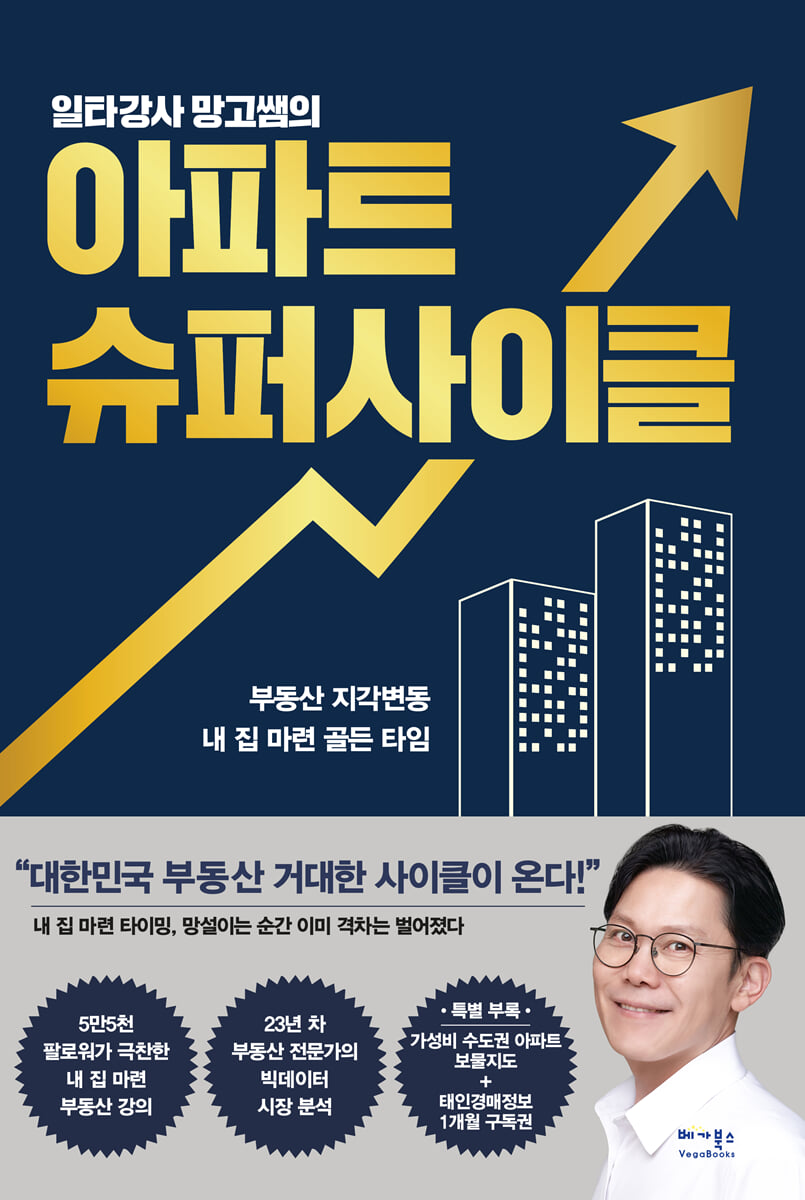
Daily Instructor Mango's Apartment Supercycle
 |
Description
Book Introduction
· Mango's real estate lecture on home ownership, raved about by 55,000 followers
· A practical real estate roadmap for the homeless, working people, newlyweds, and parents.
Big data investment strategy that penetrates markets, locations, and policies
Special Appendix
**A Complete Guide to Undervalued Apartments in Seoul's Core Areas**
** Mango Teacher Big Data Picks Treasure Map of Cost-Effective Apartments in the Metropolitan Area **
"In this era of changing times, this book cultivates the insight to see through the essence of the market without being swayed by the noise."
_YouTube's <Hurangi TV> Kim Jong-hoo strongly recommends
Now that everyone is anxious, this is the 'apartment super cycle'!
An Ordinary Salaried Worker Enters Gangnam Through Data
People who can't buy a house always find excuses first, such as, "I gave up because the house prices went up too much," or "I have no choice because the loan is blocked."
However, those who dream of owning a home must always seek opportunities under any circumstances.
Are you feeling lost in the uncertain real estate market? If so, this book is the perfect fit for you.
A realistic home ownership strategy book for a better life than now, 『Apartment Supercycle by Daily Instructor Mango』, has been published.
The author of this book is a real estate expert with 23 years of experience who started out as a salaried worker and eventually entered Gangnam after rigorous study and analysis.
The only thing he emphasizes is that house prices are not a feeling but something to be 'looked at with data.'
Emotions should not be involved in real estate.
By understanding market trends through practical data such as vacancy rates, unsold units, interest rates, the gap between jeonse and sales, and the recovery rate from peaks, and identifying the region and time that best suits your situation, you can secure a home that will experience long-term upward trends.
The author provides a detailed explanation of how to help office workers, newlyweds, and parents find their own answers when wondering "Where to buy?" by analyzing Seoul's key areas.
In addition, it presents a systematic method to find ‘my own Gangnam’ through practical analysis.
By following the key indicators that real estate experts actually refer to, readers will naturally develop their own unique perspective on the market.
Based on this perspective, taking into account the current government's regulations and supply/demand outlook, both end-users and investors can easily establish a real estate strategy tailored to their individual circumstances.
Owning a home is no longer a dream.
Even if you have little seed money or are new to real estate, anyone can do it with just this one book.
Now, it's time to stop worrying about "Is it right to buy this?" and start thinking about "Where, when, and why should I buy this?"
The author speaks confidently.
Now is the 'apartment super cycle' and the 'golden time' for owning a home.
Get on board your own Gangnam right now with Mango's practical real estate roadmap, a real estate expert and big data specialist!
· A practical real estate roadmap for the homeless, working people, newlyweds, and parents.
Big data investment strategy that penetrates markets, locations, and policies
Special Appendix
**A Complete Guide to Undervalued Apartments in Seoul's Core Areas**
** Mango Teacher Big Data Picks Treasure Map of Cost-Effective Apartments in the Metropolitan Area **
"In this era of changing times, this book cultivates the insight to see through the essence of the market without being swayed by the noise."
_YouTube's <Hurangi TV> Kim Jong-hoo strongly recommends
Now that everyone is anxious, this is the 'apartment super cycle'!
An Ordinary Salaried Worker Enters Gangnam Through Data
People who can't buy a house always find excuses first, such as, "I gave up because the house prices went up too much," or "I have no choice because the loan is blocked."
However, those who dream of owning a home must always seek opportunities under any circumstances.
Are you feeling lost in the uncertain real estate market? If so, this book is the perfect fit for you.
A realistic home ownership strategy book for a better life than now, 『Apartment Supercycle by Daily Instructor Mango』, has been published.
The author of this book is a real estate expert with 23 years of experience who started out as a salaried worker and eventually entered Gangnam after rigorous study and analysis.
The only thing he emphasizes is that house prices are not a feeling but something to be 'looked at with data.'
Emotions should not be involved in real estate.
By understanding market trends through practical data such as vacancy rates, unsold units, interest rates, the gap between jeonse and sales, and the recovery rate from peaks, and identifying the region and time that best suits your situation, you can secure a home that will experience long-term upward trends.
The author provides a detailed explanation of how to help office workers, newlyweds, and parents find their own answers when wondering "Where to buy?" by analyzing Seoul's key areas.
In addition, it presents a systematic method to find ‘my own Gangnam’ through practical analysis.
By following the key indicators that real estate experts actually refer to, readers will naturally develop their own unique perspective on the market.
Based on this perspective, taking into account the current government's regulations and supply/demand outlook, both end-users and investors can easily establish a real estate strategy tailored to their individual circumstances.
Owning a home is no longer a dream.
Even if you have little seed money or are new to real estate, anyone can do it with just this one book.
Now, it's time to stop worrying about "Is it right to buy this?" and start thinking about "Where, when, and why should I buy this?"
The author speaks confidently.
Now is the 'apartment super cycle' and the 'golden time' for owning a home.
Get on board your own Gangnam right now with Mango's practical real estate roadmap, a real estate expert and big data specialist!
- You can preview some of the book's contents.
Preview
index
Recommendation
Prologue | Owning a Home Changes Your Life
Chapter 1 | Buying a Home: It Starts with Money
Can I live my whole life without a home?
Investors Stand Between the Hot Fireplace and the Cold Cooler | Homes Are a Necessity and Your Ultimate Asset
The moment my house makes money for me
I decided to study the rules of money | Someone has to work for me | Money is still growing
There is no such thing as economic freedom
I wanted to invest | We invest our whole lives | Realistic ways to become rich | Know this and you can make money in real estate.
Chapter 2 | Rising Apartment Prices: The Data Tells Us
Bullish? Bearish? Those who have already decided
Position Determines Mood | How Much Will Real Estate Fall in 2023? | Market Insights Come from Data
Occupancy volume predicts future prices
The number of occupants shows the supply and demand of real estate | Understanding the right number of occupants determines the price | Gyeonggi Province, embracing Seoul | Incheon, the youngest city in the metropolitan area | Busan, the eldest of the metropolitan cities | Daegu, with its wide price fluctuations | Daejeon, a representative city in the central region | Gwangju, a city of gentle light | Ulsan, a mecca of heavy chemical industry | The secret to apartment prices lies in the number of occupants.
Unsold units showing the current market
Which apartments are unsold? | If you're curious about today's apartments, check out the unsold listings.
The cycle of sharp fluctuations in interest rates that adjust housing prices
Housing prices can't be explained solely by supply and demand | Interest rates are weighing on supply and demand | Interest rates are usually bearable
Real estate market in an economic crisis
Foreign Exchange Crisis: Abnormal Interest Rate Hikes | Financial Crisis: Falling Trading Prices and the Rise of Crazy Leases | COVID-19: Panic Buying by Young People | Market Laws Seen Through Three Crises
Is the increase in listings a sign of a decline?
There are many sellers, but few buyers | The real estate market defies common sense | Four reasons why prices don't fall even as inventory increases
The Real Estate Cycle: Short Downturns and Long Rebounds
Why are housing prices rising when the economy is struggling? | A recession is different from a crisis.
The Real Reason Gangnam Apartments Are Expensive
1.4% of households nationwide | Gangnam's warmth is spreading to the surrounding area.
Chapter 3 | Office Workers, Newlyweds, and Parents: So Where to Buy?
Where should I set up my home?
Interest rate cuts will continue through 2025 | Base rate and loan rates | Stocks and real estate are different.
Where is the home that office workers dream of?
Office workers spend a tenth of their lives on the road | Knowing the proximity to work is crucial for understanding real estate.
The New Powerhouses of Work-Life Neighborhoods: Dongjak vs. Yongsan
Dongjak, also known as Seobanpo | Yongsan, the center of everything
The Cities Chosen by Emerging Business Districts: Gwangmyeong vs. Suji
Gwangmyeong, a place that embraces both Gadi and Gudi | Suji, a place that draws attention from Pangyo residents
Money is bound to accumulate in school districts.
A Home for Growing Children | Neighborhoods Determine Apartment Prices | The School District Hurdles Effect | A Place to Pass, a Place to Stay
Seoul's top three school districts: Daechi-dong, Mok-dong, and Junggye-dong
Daechi-dong, a well-known school district | Mokdong, a 0.5-generation new town with academy districts | Junggye-dong, Gangbuk's last pride, Eunhaeng Intersection
Which area, Mapo or Seongdong, will become more expensive in the future?
Long-awaited project for redevelopment complexes: academy infrastructure | To attract high-income earners, improve academy infrastructure.
Buying a Home in an Era of Population Decline
The Era of a Total Fertility Rate of 0.75 | How Much Will the Actual Population Decrease? | Seoul's Population Is Declining | The Blind Spot of the Total Fertility Rate
People move to the core
Even in a low birth rate, the population continues to grow. | Building houses is essential for population growth. | Are people moving to Gyeonggi Province because Seoul's housing prices are high? | My smart home is in a prime location.
Chapter 4 | Choices for the Future: I Decided to Buy a House
Don't ask others if you can buy a house.
Is Now the Right Time to Buy a Home? | My Unwavering View
To live or to invest, that is the question.
It's difficult to capture both actual residence and investment. | Criteria for judgment: The timing of earnings observation.
I like rising apartments
Housing prices move along long-term issues | The real estate market has high transaction costs | Supply and demand and interest rates determine housing prices | The core of housing prices in the metropolitan area, as seen from supply and demand
There's an order to apartment building: The ABC theory
Confused about choosing a neighborhood? Solve it all in one place | Warmth flows through the subway | When Daechi rises, so does Gaepo | Prioritizing a Smart Home
Chapter 5 | Real Estate: Finding Your Own Gangnam
Let's set a budget that I can afford.
Know Your Operating Assets | How Much Can I Spend on a Home?
Real estate listing search at your fingertips
Find an Apartment That Fits Your Budget | Apartment Requirements That Fit Your Circumstances
Ending the sales gap on the web
Finding the Sales Gap with Hogangnono | Using the All-Purpose Website Real Mango Edu
[Practical] Finding Your Own Gangnam: Analysis of Songpa-gu
Analyzing the Apartment Market in Your Area | Topography Reveals People's Lives | Songpa-gu's Residential Areas and Legal Districts | The Key Is in Dense Apartment Areas | Apartment Geography: See the Forest for the Trees | Prices Create Hierarchies | Where Will Prices Rise When They Rise? | Apartment Age Predicts the Future
[Practical] Finding Your Own Gangnam: Songpa-gu Data Analysis
Data indicating supply and demand | First data for supply and demand: population and number of households | Second data for supply and demand: unsold housing | Third data for supply and demand: number of occupants | Fourth data for supply and demand: sales and lease | The first indicator of a rebound: recovery rate compared to the peak | A new high price in a seller's market
[Practical] Finding Your Own Gangnam: Analysis of Songpa-gu Locations
The Beginning of Location Analysis: Transportation and School Districts | Students Disappear as They Enter Higher Grades | Studying at School, Scoring at Private Institutes
[Practical] Finding Your Own Gangnam: Songpa-gu Redevelopment/Reconstruction
New Vitality in Redevelopment and Reconstruction | Geoyeo/Macheon-dong, Gangnam's Only New Town
[Practical] Finding Your Own Gangnam: Analysis of Price Ranges by Complex in Songpa-gu
You need to know the rankings to find your home | Garak-dong, where Heliocity is located | Geoyeo/Macheon-dong, the most affordable neighborhood in Songpa-gu | Munjeong-dong, led by Olympic Family Town | Bangi/Ogeum/Songpa-dong, with excellent academy infrastructure | Sincheon/Pungnap-dong, a prime location near Jamsil Station | Jangji-dong, the edge of Wirye New Town and Songpa | Jamsil-dong, the leader of Songpa
Chapter 6 | New Government Policy: Tailored Real Estate Investment Strategies in the Age of Regulation
Can regulations control housing prices?
Seoul's Land Transaction Permit Expansion Implementation | Gangnam District 3 and Yongsan District Redesignate Land Transaction Permit Expansion | Regulations Can't Change Direction
Analysis of the tongs! This is all you need to know about the Lee Jae-myung administration.
Will housing prices skyrocket as soon as a Democratic administration takes office? | Seoul's supply and demand are at a 40-year low, and interest rates are trending downward | Regulation isn't the president's responsibility.
Preview! The current administration's tailored real estate strategy
How to Wisely Deal with Regulation | The Inevitable Strengthening of Regulations on Multiple Homeowners | Real Demanders Can't Be Regulated Anyway | Blocking Housing in Regulated Areas Leads to Flow into Deregulated Areas
Epilogue | Home is where our family spends time.
Prologue | Owning a Home Changes Your Life
Chapter 1 | Buying a Home: It Starts with Money
Can I live my whole life without a home?
Investors Stand Between the Hot Fireplace and the Cold Cooler | Homes Are a Necessity and Your Ultimate Asset
The moment my house makes money for me
I decided to study the rules of money | Someone has to work for me | Money is still growing
There is no such thing as economic freedom
I wanted to invest | We invest our whole lives | Realistic ways to become rich | Know this and you can make money in real estate.
Chapter 2 | Rising Apartment Prices: The Data Tells Us
Bullish? Bearish? Those who have already decided
Position Determines Mood | How Much Will Real Estate Fall in 2023? | Market Insights Come from Data
Occupancy volume predicts future prices
The number of occupants shows the supply and demand of real estate | Understanding the right number of occupants determines the price | Gyeonggi Province, embracing Seoul | Incheon, the youngest city in the metropolitan area | Busan, the eldest of the metropolitan cities | Daegu, with its wide price fluctuations | Daejeon, a representative city in the central region | Gwangju, a city of gentle light | Ulsan, a mecca of heavy chemical industry | The secret to apartment prices lies in the number of occupants.
Unsold units showing the current market
Which apartments are unsold? | If you're curious about today's apartments, check out the unsold listings.
The cycle of sharp fluctuations in interest rates that adjust housing prices
Housing prices can't be explained solely by supply and demand | Interest rates are weighing on supply and demand | Interest rates are usually bearable
Real estate market in an economic crisis
Foreign Exchange Crisis: Abnormal Interest Rate Hikes | Financial Crisis: Falling Trading Prices and the Rise of Crazy Leases | COVID-19: Panic Buying by Young People | Market Laws Seen Through Three Crises
Is the increase in listings a sign of a decline?
There are many sellers, but few buyers | The real estate market defies common sense | Four reasons why prices don't fall even as inventory increases
The Real Estate Cycle: Short Downturns and Long Rebounds
Why are housing prices rising when the economy is struggling? | A recession is different from a crisis.
The Real Reason Gangnam Apartments Are Expensive
1.4% of households nationwide | Gangnam's warmth is spreading to the surrounding area.
Chapter 3 | Office Workers, Newlyweds, and Parents: So Where to Buy?
Where should I set up my home?
Interest rate cuts will continue through 2025 | Base rate and loan rates | Stocks and real estate are different.
Where is the home that office workers dream of?
Office workers spend a tenth of their lives on the road | Knowing the proximity to work is crucial for understanding real estate.
The New Powerhouses of Work-Life Neighborhoods: Dongjak vs. Yongsan
Dongjak, also known as Seobanpo | Yongsan, the center of everything
The Cities Chosen by Emerging Business Districts: Gwangmyeong vs. Suji
Gwangmyeong, a place that embraces both Gadi and Gudi | Suji, a place that draws attention from Pangyo residents
Money is bound to accumulate in school districts.
A Home for Growing Children | Neighborhoods Determine Apartment Prices | The School District Hurdles Effect | A Place to Pass, a Place to Stay
Seoul's top three school districts: Daechi-dong, Mok-dong, and Junggye-dong
Daechi-dong, a well-known school district | Mokdong, a 0.5-generation new town with academy districts | Junggye-dong, Gangbuk's last pride, Eunhaeng Intersection
Which area, Mapo or Seongdong, will become more expensive in the future?
Long-awaited project for redevelopment complexes: academy infrastructure | To attract high-income earners, improve academy infrastructure.
Buying a Home in an Era of Population Decline
The Era of a Total Fertility Rate of 0.75 | How Much Will the Actual Population Decrease? | Seoul's Population Is Declining | The Blind Spot of the Total Fertility Rate
People move to the core
Even in a low birth rate, the population continues to grow. | Building houses is essential for population growth. | Are people moving to Gyeonggi Province because Seoul's housing prices are high? | My smart home is in a prime location.
Chapter 4 | Choices for the Future: I Decided to Buy a House
Don't ask others if you can buy a house.
Is Now the Right Time to Buy a Home? | My Unwavering View
To live or to invest, that is the question.
It's difficult to capture both actual residence and investment. | Criteria for judgment: The timing of earnings observation.
I like rising apartments
Housing prices move along long-term issues | The real estate market has high transaction costs | Supply and demand and interest rates determine housing prices | The core of housing prices in the metropolitan area, as seen from supply and demand
There's an order to apartment building: The ABC theory
Confused about choosing a neighborhood? Solve it all in one place | Warmth flows through the subway | When Daechi rises, so does Gaepo | Prioritizing a Smart Home
Chapter 5 | Real Estate: Finding Your Own Gangnam
Let's set a budget that I can afford.
Know Your Operating Assets | How Much Can I Spend on a Home?
Real estate listing search at your fingertips
Find an Apartment That Fits Your Budget | Apartment Requirements That Fit Your Circumstances
Ending the sales gap on the web
Finding the Sales Gap with Hogangnono | Using the All-Purpose Website Real Mango Edu
[Practical] Finding Your Own Gangnam: Analysis of Songpa-gu
Analyzing the Apartment Market in Your Area | Topography Reveals People's Lives | Songpa-gu's Residential Areas and Legal Districts | The Key Is in Dense Apartment Areas | Apartment Geography: See the Forest for the Trees | Prices Create Hierarchies | Where Will Prices Rise When They Rise? | Apartment Age Predicts the Future
[Practical] Finding Your Own Gangnam: Songpa-gu Data Analysis
Data indicating supply and demand | First data for supply and demand: population and number of households | Second data for supply and demand: unsold housing | Third data for supply and demand: number of occupants | Fourth data for supply and demand: sales and lease | The first indicator of a rebound: recovery rate compared to the peak | A new high price in a seller's market
[Practical] Finding Your Own Gangnam: Analysis of Songpa-gu Locations
The Beginning of Location Analysis: Transportation and School Districts | Students Disappear as They Enter Higher Grades | Studying at School, Scoring at Private Institutes
[Practical] Finding Your Own Gangnam: Songpa-gu Redevelopment/Reconstruction
New Vitality in Redevelopment and Reconstruction | Geoyeo/Macheon-dong, Gangnam's Only New Town
[Practical] Finding Your Own Gangnam: Analysis of Price Ranges by Complex in Songpa-gu
You need to know the rankings to find your home | Garak-dong, where Heliocity is located | Geoyeo/Macheon-dong, the most affordable neighborhood in Songpa-gu | Munjeong-dong, led by Olympic Family Town | Bangi/Ogeum/Songpa-dong, with excellent academy infrastructure | Sincheon/Pungnap-dong, a prime location near Jamsil Station | Jangji-dong, the edge of Wirye New Town and Songpa | Jamsil-dong, the leader of Songpa
Chapter 6 | New Government Policy: Tailored Real Estate Investment Strategies in the Age of Regulation
Can regulations control housing prices?
Seoul's Land Transaction Permit Expansion Implementation | Gangnam District 3 and Yongsan District Redesignate Land Transaction Permit Expansion | Regulations Can't Change Direction
Analysis of the tongs! This is all you need to know about the Lee Jae-myung administration.
Will housing prices skyrocket as soon as a Democratic administration takes office? | Seoul's supply and demand are at a 40-year low, and interest rates are trending downward | Regulation isn't the president's responsibility.
Preview! The current administration's tailored real estate strategy
How to Wisely Deal with Regulation | The Inevitable Strengthening of Regulations on Multiple Homeowners | Real Demanders Can't Be Regulated Anyway | Blocking Housing in Regulated Areas Leads to Flow into Deregulated Areas
Epilogue | Home is where our family spends time.
Detailed image
.jpg)
Into the book
If we're determined to make money in real estate in a capitalist society, what should we continue to study? After much deliberation, I've ultimately narrowed it down to two things.
First, why do apartment prices rise and fall? It's important to understand how the real estate market, especially the apartment market, works.
Knowing this will allow you to develop a buying/selling strategy and turn 'luck' into skill.
Second, which apartment should I buy? Even if prices trend upward over the long term, some apartments will rise significantly, while others will rise less.
This phenomenon will only get worse over time.
To put it simply, you can buy a Hyundai apartment in Apgujeong.
But is this realistic? Absolutely not.
We need to choose an apartment that suits our circumstances in the most reasonable way.
---From "Chapter 1 | Buying a Home: Knowing Money Starts Here"
So where does the ability to view the market without being swayed by the surrounding atmosphere come from? That ability begins with observing data.
I started investing in apartments in my late 20s and owned two apartments in Seoul by my early 30s.
I felt proud as I watched the prices of houses continue to rise.
I was confident and thought about buying a house whenever I had money, but after the financial crisis in 2008, I realized that house prices could fall.
I bought an apartment, believing real estate was invincible and would continue to rise, but what's going on? For a while, my interest in real estate waned, and I tried to increase my income through business.
And as the real estate market began to warm up again, the first thing I started with was data, with the intention of not repeating the mistakes of the past.
---From "Chapter 2 | Rising Apartments: What the Data Says"
The author says that places with good transportation become places to pass through, and school districts become places to stay.
After diligently accumulating assets in a place with good transportation, when your children grow up, you choose a school district that matches your assets and income level and move there.
Areas that offer a better environment for children are highly competitive and not everyone can afford to go there.
Families with sufficient assets and income choose the best school district, while those without will choose the next best.
To put it simply, it means that the households will be divided into those who can pay 2 billion won for a house and those who can pay 1.5 billion won and move accordingly based on their assets.
---From "Chapter 3 | Office Workers, Newlyweds, Parents: So Where Should We Buy?"
I have likened the flow of house prices to a large rock.
If you put firewood under a large rock and light it, the fire will start to heat up from the bottom of the rock and gradually spread out.
As time passes, the entire stone turns red.
The house prices are similar.
Usually, Gangnam-gu and Seocho-gu start to rise, and the warmth spreads to surrounding areas such as Songpa, Yongsan, Seongdong, Dongjak, Gwangjin, and Gangdong.
It's the same principle as heating a stone.
When one place gets hot, the warmth spreads to its surroundings.
So there is an order in which house prices rise.
---From "Chapter 4 | Choices for the Future: I Decided to Buy a House"
So, what's the situation like at elementary schools in Wirye New Town? Wirye-dong is the administrative district in Songpa-gu with the youngest average age.
The number of students per class is higher than the Songpa-gu average, but the number of students tends to decrease as students advance to higher grades.
Why is this so? Perhaps parents of Songrye Elementary School students are considering sending their children to higher education, beyond middle school and high school, as they progress to higher grades. This mindset is believed to be the result of the declining student population in higher grades.
---From "Chapter 5 | Real Estate: Finding Your Own Gangnam"
When the Moon Jae-in administration designated a regulated or controlled area, people would go to the area right next to the designated regulated area and buy it, as if they were laughing at it.
In a way, it is an obvious result.
Liquidity is abundant and supply is scarce, but if the designation of a regulated area temporarily blocks demand in a region with high growth, the money will inevitably go to the unregulated area.
When a regulated area is designated in this way, demand is concentrated in the surrounding area, and when a nearby area is designated as a regulated area again, demand is concentrated in the surrounding area again, completing a nationwide real estate price increase mechanism.
In fact, this was not the case only during the Moon Jae-in administration.
There were many similar cases during the Roh Moo-hyun administration and before that.
We can get hints from this part.
First, why do apartment prices rise and fall? It's important to understand how the real estate market, especially the apartment market, works.
Knowing this will allow you to develop a buying/selling strategy and turn 'luck' into skill.
Second, which apartment should I buy? Even if prices trend upward over the long term, some apartments will rise significantly, while others will rise less.
This phenomenon will only get worse over time.
To put it simply, you can buy a Hyundai apartment in Apgujeong.
But is this realistic? Absolutely not.
We need to choose an apartment that suits our circumstances in the most reasonable way.
---From "Chapter 1 | Buying a Home: Knowing Money Starts Here"
So where does the ability to view the market without being swayed by the surrounding atmosphere come from? That ability begins with observing data.
I started investing in apartments in my late 20s and owned two apartments in Seoul by my early 30s.
I felt proud as I watched the prices of houses continue to rise.
I was confident and thought about buying a house whenever I had money, but after the financial crisis in 2008, I realized that house prices could fall.
I bought an apartment, believing real estate was invincible and would continue to rise, but what's going on? For a while, my interest in real estate waned, and I tried to increase my income through business.
And as the real estate market began to warm up again, the first thing I started with was data, with the intention of not repeating the mistakes of the past.
---From "Chapter 2 | Rising Apartments: What the Data Says"
The author says that places with good transportation become places to pass through, and school districts become places to stay.
After diligently accumulating assets in a place with good transportation, when your children grow up, you choose a school district that matches your assets and income level and move there.
Areas that offer a better environment for children are highly competitive and not everyone can afford to go there.
Families with sufficient assets and income choose the best school district, while those without will choose the next best.
To put it simply, it means that the households will be divided into those who can pay 2 billion won for a house and those who can pay 1.5 billion won and move accordingly based on their assets.
---From "Chapter 3 | Office Workers, Newlyweds, Parents: So Where Should We Buy?"
I have likened the flow of house prices to a large rock.
If you put firewood under a large rock and light it, the fire will start to heat up from the bottom of the rock and gradually spread out.
As time passes, the entire stone turns red.
The house prices are similar.
Usually, Gangnam-gu and Seocho-gu start to rise, and the warmth spreads to surrounding areas such as Songpa, Yongsan, Seongdong, Dongjak, Gwangjin, and Gangdong.
It's the same principle as heating a stone.
When one place gets hot, the warmth spreads to its surroundings.
So there is an order in which house prices rise.
---From "Chapter 4 | Choices for the Future: I Decided to Buy a House"
So, what's the situation like at elementary schools in Wirye New Town? Wirye-dong is the administrative district in Songpa-gu with the youngest average age.
The number of students per class is higher than the Songpa-gu average, but the number of students tends to decrease as students advance to higher grades.
Why is this so? Perhaps parents of Songrye Elementary School students are considering sending their children to higher education, beyond middle school and high school, as they progress to higher grades. This mindset is believed to be the result of the declining student population in higher grades.
---From "Chapter 5 | Real Estate: Finding Your Own Gangnam"
When the Moon Jae-in administration designated a regulated or controlled area, people would go to the area right next to the designated regulated area and buy it, as if they were laughing at it.
In a way, it is an obvious result.
Liquidity is abundant and supply is scarce, but if the designation of a regulated area temporarily blocks demand in a region with high growth, the money will inevitably go to the unregulated area.
When a regulated area is designated in this way, demand is concentrated in the surrounding area, and when a nearby area is designated as a regulated area again, demand is concentrated in the surrounding area again, completing a nationwide real estate price increase mechanism.
In fact, this was not the case only during the Moon Jae-in administration.
There were many similar cases during the Roh Moo-hyun administration and before that.
We can get hints from this part.
---From "Chapter 6 | New Government Policy: Customized Real Estate Investment Strategies for the Age of Regulation"
Publisher's Review
· "There's data on rising apartment prices."
· Office workers, single-person households, newlyweds, parents, people without homes, people with multiple homes…
· The real estate market is unstable for everyone, so make sure you have a clear investment plan!
Special Appendix
** 1-month subscription to Taein Auction Information, the No. 1 real estate auction site **
The rave reviews from those who first encountered Mango Teacher!
“If you're a first-time homebuyer who's lost and lost, this book is all you need.”
_FL Asset Management CEO Choi Mi-hye
"This is the best book that explains real estate investment with 'evidence and data' rather than 'intuition.'"
_AntiGravity CBO Park Chae-yeon
“This book will serve as a compass, providing clear direction for anyone dreaming of owning their own home.”
_Naver Blog 〈Jeokho Pharmacist's Health Talk Talk〉 Lee Sang-bong
If you say you entered Gangnam with just your salary, most people think it's an 'impossible story'.
However, the author, Mango, is a living witness who turned the impossible into possible through thorough data analysis and strategic choices.
This book follows the know-how contained in that journey, and provides the most probable path for readers seeking a breakthrough in the uncertain real estate market.
Many people are shaken by talk of falling housing prices and feel overwhelmed by lending regulations.
But real investors don't read the market trends by feeling.
We make decisions and make moves based on specific data such as the number of occupants, unsold units, interest rates, and economic cycles.
This book will help you develop the ability to read the market with numbers, not emotions, while also providing clear guidance on when, where, and what kind of home to buy.
Real Estate Seismic Changes: The Golden Time to Buy a Home
Get on the super cycle with a systematic 6-step practical strategy!
“Why Should We Buy a Home Now?” In Chapter 1, the author poses a fundamental question about homes and money.
Real estate is not a means of speculation, but rather a ‘foundation of life’ and a ‘shield that protects assets.’
Is it really possible to live a lifetime without a home? How can economic freedom become a reality? Only by understanding how money moves in a capitalist society and clearly understanding the significance of homeownership within that dynamic can we begin to develop the basic mindset necessary to create a concrete roadmap for homeownership.
Housing prices are not simply a matter of supply and demand.
Interest rates, government policies, unsold units, occupancy, cycle, and regional characteristics must all be comprehensively considered.
Chapter 2 analyzes price trends in major regions, including Seoul, Gyeonggi Province, Incheon, Busan, Daegu, Daejeon, Gwangju, and Ulsan, based on clear data indicators such as the number of occupants and unsold units.
It also shows how real estate has behaved during economic crises such as the foreign exchange crisis, financial crisis, and COVID-19, and helps develop insight into interpreting current trends.
This chapter, in particular, provides practical guidance for real estate beginners by explaining how to interpret data and find opportunities even in a bear market, focusing on actual indicators.
Chapter 3 is for those who are considering buying a home and are wondering, “Where is the right home for me?”
Office workers should prioritize proximity to work, while newlyweds and parents should prioritize school districts and infrastructure.
The author compares currently popular areas such as Yongsan, Dongjak, Gwangmyeong, and Suji, and analyzes the pros and cons of each in detail.
In particular, it sheds light on Seoul's three major school districts, Daechi-dong, Mok-dong, and Junggye-dong, as well as emerging popular areas like Mapo and Seongdong, from various perspectives, and presents an analysis centered on demand flow and future value, rather than a simple comparison of flat locations.
Even in an era of low birth rates, the population is concentrated in key areas.
This chapter reminds us of the fundamental principle of real estate investors: to read "Where the People Are Flocking."
Chapter 4 provides an answer to the question most frequently asked by those considering buying a home: “Should I buy now?”
“Is it for living or for investment?
What comes first? “Should I rush to buy it, or should I wait?” The author provides criteria for judgment, not simple answers.
We explain a systematic method to help you conduct real estate transactions without fail after developing your own unique view of prices based on supply and demand and interest rates.
In particular, through the 'ABC theory' that reads the order of apartment price increases, it clearly explains when prices rise and how they spread in each region.
This simple yet powerful theory can serve as a very effective guide for both end users and investors.
Chapter 5 contains practical analysis conducted by the author while conducting actual regional analysis focusing on Songpa-gu.
It is designed to allow users to experience in detail what kind of perspectives are needed when choosing a home on site by organizing various factors such as price trends by complex, year of occupancy, population changes, number of occupants, unsold units, and recovery rate compared to peak into data.
Additionally, it provides a vivid sense of 'how to find an apartment that fits my budget' by comparing and analyzing the actual figures of key areas in Songpa, such as Heliocity, Olympic Family Town, Wirye New Town, and Geoyeo/Macheon-dong.
Chapter 6 helps you understand policy changes, the most sensitive variable in real estate investment.
While various regulations, such as land transaction permits, loan regulations, and heavy taxes on multiple homeowners, may seem to suppress housing prices, accurately understanding the nature of these regulations and reading their dynamics can actually create opportunities.
This chapter analyzes how regime changes and policy trends impact the market, using actual statistics and case studies. It also suggests effective strategies amid the current administration's supply-demand shortage and downward interest rate outlook.
In particular, it provides separate explanations of the response strategies required for actual demanders and multiple homeowners, making it useful for suggesting ways to establish investment plans without being swayed by policy variables.
The 'apartment supercycle' is already upon us.
Seize the golden opportunity to create your own Gangnam with Mango's big data real estate investment strategy, admired by 55,000 followers!
· Office workers, single-person households, newlyweds, parents, people without homes, people with multiple homes…
· The real estate market is unstable for everyone, so make sure you have a clear investment plan!
Special Appendix
** 1-month subscription to Taein Auction Information, the No. 1 real estate auction site **
The rave reviews from those who first encountered Mango Teacher!
“If you're a first-time homebuyer who's lost and lost, this book is all you need.”
_FL Asset Management CEO Choi Mi-hye
"This is the best book that explains real estate investment with 'evidence and data' rather than 'intuition.'"
_AntiGravity CBO Park Chae-yeon
“This book will serve as a compass, providing clear direction for anyone dreaming of owning their own home.”
_Naver Blog 〈Jeokho Pharmacist's Health Talk Talk〉 Lee Sang-bong
If you say you entered Gangnam with just your salary, most people think it's an 'impossible story'.
However, the author, Mango, is a living witness who turned the impossible into possible through thorough data analysis and strategic choices.
This book follows the know-how contained in that journey, and provides the most probable path for readers seeking a breakthrough in the uncertain real estate market.
Many people are shaken by talk of falling housing prices and feel overwhelmed by lending regulations.
But real investors don't read the market trends by feeling.
We make decisions and make moves based on specific data such as the number of occupants, unsold units, interest rates, and economic cycles.
This book will help you develop the ability to read the market with numbers, not emotions, while also providing clear guidance on when, where, and what kind of home to buy.
Real Estate Seismic Changes: The Golden Time to Buy a Home
Get on the super cycle with a systematic 6-step practical strategy!
“Why Should We Buy a Home Now?” In Chapter 1, the author poses a fundamental question about homes and money.
Real estate is not a means of speculation, but rather a ‘foundation of life’ and a ‘shield that protects assets.’
Is it really possible to live a lifetime without a home? How can economic freedom become a reality? Only by understanding how money moves in a capitalist society and clearly understanding the significance of homeownership within that dynamic can we begin to develop the basic mindset necessary to create a concrete roadmap for homeownership.
Housing prices are not simply a matter of supply and demand.
Interest rates, government policies, unsold units, occupancy, cycle, and regional characteristics must all be comprehensively considered.
Chapter 2 analyzes price trends in major regions, including Seoul, Gyeonggi Province, Incheon, Busan, Daegu, Daejeon, Gwangju, and Ulsan, based on clear data indicators such as the number of occupants and unsold units.
It also shows how real estate has behaved during economic crises such as the foreign exchange crisis, financial crisis, and COVID-19, and helps develop insight into interpreting current trends.
This chapter, in particular, provides practical guidance for real estate beginners by explaining how to interpret data and find opportunities even in a bear market, focusing on actual indicators.
Chapter 3 is for those who are considering buying a home and are wondering, “Where is the right home for me?”
Office workers should prioritize proximity to work, while newlyweds and parents should prioritize school districts and infrastructure.
The author compares currently popular areas such as Yongsan, Dongjak, Gwangmyeong, and Suji, and analyzes the pros and cons of each in detail.
In particular, it sheds light on Seoul's three major school districts, Daechi-dong, Mok-dong, and Junggye-dong, as well as emerging popular areas like Mapo and Seongdong, from various perspectives, and presents an analysis centered on demand flow and future value, rather than a simple comparison of flat locations.
Even in an era of low birth rates, the population is concentrated in key areas.
This chapter reminds us of the fundamental principle of real estate investors: to read "Where the People Are Flocking."
Chapter 4 provides an answer to the question most frequently asked by those considering buying a home: “Should I buy now?”
“Is it for living or for investment?
What comes first? “Should I rush to buy it, or should I wait?” The author provides criteria for judgment, not simple answers.
We explain a systematic method to help you conduct real estate transactions without fail after developing your own unique view of prices based on supply and demand and interest rates.
In particular, through the 'ABC theory' that reads the order of apartment price increases, it clearly explains when prices rise and how they spread in each region.
This simple yet powerful theory can serve as a very effective guide for both end users and investors.
Chapter 5 contains practical analysis conducted by the author while conducting actual regional analysis focusing on Songpa-gu.
It is designed to allow users to experience in detail what kind of perspectives are needed when choosing a home on site by organizing various factors such as price trends by complex, year of occupancy, population changes, number of occupants, unsold units, and recovery rate compared to peak into data.
Additionally, it provides a vivid sense of 'how to find an apartment that fits my budget' by comparing and analyzing the actual figures of key areas in Songpa, such as Heliocity, Olympic Family Town, Wirye New Town, and Geoyeo/Macheon-dong.
Chapter 6 helps you understand policy changes, the most sensitive variable in real estate investment.
While various regulations, such as land transaction permits, loan regulations, and heavy taxes on multiple homeowners, may seem to suppress housing prices, accurately understanding the nature of these regulations and reading their dynamics can actually create opportunities.
This chapter analyzes how regime changes and policy trends impact the market, using actual statistics and case studies. It also suggests effective strategies amid the current administration's supply-demand shortage and downward interest rate outlook.
In particular, it provides separate explanations of the response strategies required for actual demanders and multiple homeowners, making it useful for suggesting ways to establish investment plans without being swayed by policy variables.
The 'apartment supercycle' is already upon us.
Seize the golden opportunity to create your own Gangnam with Mango's big data real estate investment strategy, admired by 55,000 followers!
GOODS SPECIFICS
- Date of issue: July 21, 2025
- Page count, weight, size: 264 pages | 528g | 152*225*17mm
- ISBN13: 9791194831105
- ISBN10: 1194831109
You may also like
카테고리
korean


korean

![GQ KOREA Mark (Monthly): December [2025]](http://librairie.coreenne.fr/cdn/shop/files/8ef265dbbfbf186523ed75ba7319009d.jpg?v=1765340328&width=3840)


