

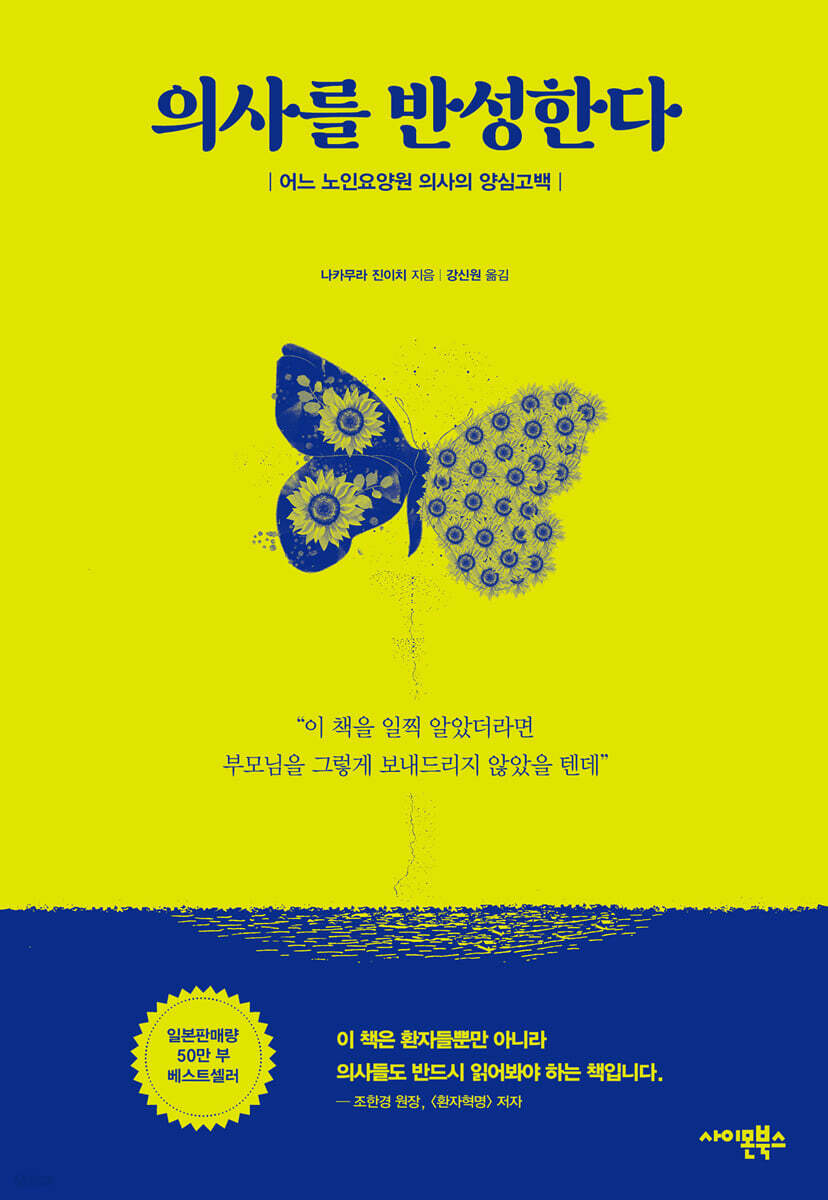
Reflect on your actions
 |
Description
Book Introduction
“I quit my job as the director of a large hospital because
“Because I refused the path of becoming a doctor to make money.”
There is a doctor here.
He was born to an illiterate mother and a visually impaired father.
After experiencing his father's death in his second year of high school, he decided to become a doctor and graduated from the prestigious Kyoto University School of Medicine.
He rose to high positions as director and chairman of a large hospital, but resigned when he turned 60 and started a new life as a general doctor at a nursing home.
Why did he reject money and fame? Why, after witnessing the deaths of elderly people with tubes stuck in their noses and holes drilled in their bellies, did he cry out, "This is not right!"? Why did this book, which gained the reputation of "a book that deals with the true meaning of death and how to live today," become a sensational bestseller in Japan, selling over 500,000 copies?
According to research, all older adults want to end their lives naturally at home or in a nursing home (80%), but most end their lives in hospitals (80%), equipped with all kinds of medical equipment.
Then, they undergo the predictable process of being moved to a funeral parlor, an annex of the hospital, showing a poignant reflection on the fact that we are all trapped in the commercial capitalist system called the hospital.
But here are some completely different people.
The elderly people in the 'Self-Death Thinking Group' hosted by the author have all refused to die in a hospital and are dying peaceful natural deaths after undergoing practical training such as entering a coffin.
It explains true death with abundant examples such as bird burial, where Tibetans give their bodies to birds, and Scott Nearing's natural death at age 100.
So, where will you choose?
“Because I refused the path of becoming a doctor to make money.”
There is a doctor here.
He was born to an illiterate mother and a visually impaired father.
After experiencing his father's death in his second year of high school, he decided to become a doctor and graduated from the prestigious Kyoto University School of Medicine.
He rose to high positions as director and chairman of a large hospital, but resigned when he turned 60 and started a new life as a general doctor at a nursing home.
Why did he reject money and fame? Why, after witnessing the deaths of elderly people with tubes stuck in their noses and holes drilled in their bellies, did he cry out, "This is not right!"? Why did this book, which gained the reputation of "a book that deals with the true meaning of death and how to live today," become a sensational bestseller in Japan, selling over 500,000 copies?
According to research, all older adults want to end their lives naturally at home or in a nursing home (80%), but most end their lives in hospitals (80%), equipped with all kinds of medical equipment.
Then, they undergo the predictable process of being moved to a funeral parlor, an annex of the hospital, showing a poignant reflection on the fact that we are all trapped in the commercial capitalist system called the hospital.
But here are some completely different people.
The elderly people in the 'Self-Death Thinking Group' hosted by the author have all refused to die in a hospital and are dying peaceful natural deaths after undergoing practical training such as entering a coffin.
It explains true death with abundant examples such as bird burial, where Tibetans give their bodies to birds, and Scott Nearing's natural death at age 100.
So, where will you choose?
- You can preview some of the book's contents.
Preview
index
Recommendation - Director Cho Han-kyung, author of "Patient Revolution"
introduction
Chapter 1: Do you trust hospitals?
- I would like you to give me an honest answer.
- Get out of the illusion of being a doctor.
- If you can't fix it yourself, a doctor can't fix it.
- Is high blood pressure in the elderly really a disease?
- Vaccines are as dangerous as Russian roulette.
- The body already knows how to heal.
- The longer you suppress symptoms with medication, the later true healing will be.
- Life-sustaining treatment is like abuse of natural death.
- Torture or nursing?
Chapter 2: The Body Knows the Answer
- I recommend becoming friendly with death.
- The body is always prepared in any situation.
- Natural death is not accompanied by pain.
- Is life-sustaining treatment really for the patient's benefit?
- Don't decorate the last moments of your life with misery.
- Humans use up the water in their bodies and die.
- Dying can be so peaceful.
- Should we send them off with dignity, or hold them in misery?
- It is courageous love to send off someone who is about to leave.
- Hospitals are interfering unnecessarily with human birth.
- There is no elderly person who lives to be 100 years old by relying on drugs.
- Talk to your body before asking the doctor.
- The old man's last mission is to show a happy death.
- Final training for a beautiful death
- How Indians and Tibetans end their lives
Chapter 3: Cancer Doesn't Hurt Even If Left Alone
- The more you hit cancer, the more ferocious it becomes.
- Surgery, chemotherapy, and radiation hasten death.
- Cancer is the best way to die.
- Can cancer really be prevented?
- Is it absolutely necessary to get a cancer screening?
- 5,000 cancer cells are created every day.
- Cancer in the elderly is not a misfortune.
- People die not because of cancer, but because of cancer treatment.
- What does cancer mean to someone who has lived a long life?
- The story of a terminally ill cancer patient who chose natural death.
- Even if you miss the time, you can leave without pain.
- Follow the laws of nature, not the laws of medicine.
- Why have hospice facilities become a 'neglected tool'?
- Would you leave the ending of your life to others?
- The longer cancer is left untreated in the elderly, the better.
- Psychotherapy is a psychiatrist's bread and butter.
Chapter 4: If you fear death, you will also fear life.
- About dying in a hospital
- 'A group to think about one's own death'
- If you go into the coffin in advance, the direction of your life will change.
- You can't be calm if you take an ambulance.
- My father was blind and had no vision.
- Reconstruct your present life with a funeral while you are alive.
- Prepare to die well in order to live better.
- Thinking about death is an act of examining life.
13 Specific Actions to Prepare for Your Own Death
- 'Advance Medical Directive' for when you are unable to express your wishes
- The Beautiful Death of 100-Year-Old Scott Nearing
Chapter 5: The Illusion of Health Leads to Disease
- Young at heart? That's where the problem arises.
- For doctors, the elderly are a precious source of income.
- The story of a patient who drinks urine
- Can a hidden disease be cured by finding it through a health checkup?
- Is 'no abnormality' really no abnormality?
- People who are hospitalized for treatment and come back broken
- People die the same way they lived.
Translator's Note
supplement
- Invitation to a funeral while alive
- Ending Note (Advance Medical Directive, Postmortem Directive)
introduction
Chapter 1: Do you trust hospitals?
- I would like you to give me an honest answer.
- Get out of the illusion of being a doctor.
- If you can't fix it yourself, a doctor can't fix it.
- Is high blood pressure in the elderly really a disease?
- Vaccines are as dangerous as Russian roulette.
- The body already knows how to heal.
- The longer you suppress symptoms with medication, the later true healing will be.
- Life-sustaining treatment is like abuse of natural death.
- Torture or nursing?
Chapter 2: The Body Knows the Answer
- I recommend becoming friendly with death.
- The body is always prepared in any situation.
- Natural death is not accompanied by pain.
- Is life-sustaining treatment really for the patient's benefit?
- Don't decorate the last moments of your life with misery.
- Humans use up the water in their bodies and die.
- Dying can be so peaceful.
- Should we send them off with dignity, or hold them in misery?
- It is courageous love to send off someone who is about to leave.
- Hospitals are interfering unnecessarily with human birth.
- There is no elderly person who lives to be 100 years old by relying on drugs.
- Talk to your body before asking the doctor.
- The old man's last mission is to show a happy death.
- Final training for a beautiful death
- How Indians and Tibetans end their lives
Chapter 3: Cancer Doesn't Hurt Even If Left Alone
- The more you hit cancer, the more ferocious it becomes.
- Surgery, chemotherapy, and radiation hasten death.
- Cancer is the best way to die.
- Can cancer really be prevented?
- Is it absolutely necessary to get a cancer screening?
- 5,000 cancer cells are created every day.
- Cancer in the elderly is not a misfortune.
- People die not because of cancer, but because of cancer treatment.
- What does cancer mean to someone who has lived a long life?
- The story of a terminally ill cancer patient who chose natural death.
- Even if you miss the time, you can leave without pain.
- Follow the laws of nature, not the laws of medicine.
- Why have hospice facilities become a 'neglected tool'?
- Would you leave the ending of your life to others?
- The longer cancer is left untreated in the elderly, the better.
- Psychotherapy is a psychiatrist's bread and butter.
Chapter 4: If you fear death, you will also fear life.
- About dying in a hospital
- 'A group to think about one's own death'
- If you go into the coffin in advance, the direction of your life will change.
- You can't be calm if you take an ambulance.
- My father was blind and had no vision.
- Reconstruct your present life with a funeral while you are alive.
- Prepare to die well in order to live better.
- Thinking about death is an act of examining life.
13 Specific Actions to Prepare for Your Own Death
- 'Advance Medical Directive' for when you are unable to express your wishes
- The Beautiful Death of 100-Year-Old Scott Nearing
Chapter 5: The Illusion of Health Leads to Disease
- Young at heart? That's where the problem arises.
- For doctors, the elderly are a precious source of income.
- The story of a patient who drinks urine
- Can a hidden disease be cured by finding it through a health checkup?
- Is 'no abnormality' really no abnormality?
- People who are hospitalized for treatment and come back broken
- People die the same way they lived.
Translator's Note
supplement
- Invitation to a funeral while alive
- Ending Note (Advance Medical Directive, Postmortem Directive)
Into the book
Professor Yoichi Ogushi of Tokai University conducted a study on 40,000 men and women and announced the results.
The world was shocked when it was announced that people taking high blood pressure medication had twice the incidence of cerebral infarction compared to those who did not take the medication.
This is because if you use medication to lower your blood pressure too much, blood will not be supplied to the brain properly.
This is why older people should not take blood pressure medication.
--- p.50
This is the tragedy of modern medicine, repeated millions of times over.
They are sent to their deaths with chemicals injected into their veins, tubes inserted down their throats, and surgically stitched scars in their flesh.
It rarely occurs to you that it shortens your life and worsens your quality of life.
It means becoming a 'lab rat' who obeys the orders of the hospital system and doctors.
--- p.71
As death approaches, breathing also worsens.
Breathing is the process of taking in oxygen from the air and releasing carbon dioxide produced inside the body.
If this process is not smooth, a state of oxygen deficiency occurs, meaning that carbon dioxide is not excreted and builds up in the body.
In a state of oxygen deficiency, a hormone called morphine is secreted in the brain.
Carbon dioxide also has an anesthetic effect, which also helps to prevent the pain of death.
--- p.94
After 14 days, my grandmother quietly passed away.
After the funeral, the family said this to me.
“It’s so peaceful for a human being to die.
“I am no longer afraid of dying.”
--- p.113
“Three of my close relatives passed away from cancer.
However, all three of them died before anything could be done because their cancer was discovered too late.
Thinking back now, I can't tell you how lucky I am.
Because I was able to die quietly, away from the 'hands that promote misery' of doctors and hospitals.
Honestly, I'm not afraid of cancer.
“Because I saw him leave peacefully at home, not in a hospital, and without any of the usual chemotherapy.”
--- p.166
However, as the number of cases of 'untimely cancer' in the elderly increased from five to ten, something came to light.
The fact is that if there is no pain when cancer is first discovered, there will be no pain even if it is left untreated.
If there was pain, the cancer would have been detected sooner.
However, in the case of cancer, cases of people visiting the hospital due to pain were surprisingly rare.
--- p.204
Looking back, I confess that when I was working in a general hospital, I told an elderly patient, “If you don’t get surgery, you’ll die.”
Sometimes, there are people who say, “I don’t mind dying, so I won’t have surgery.”
Then I tried to persuade him in a threatening tone, saying, “What are you saying? If you don’t get the surgery, you’ll be in big trouble.”
It's a scene that makes my face burn when I think about it now.
--- p.218
Unless they have dementia, most older adults can suddenly become aggressive, loud, and violent when their environment changes and they are hospitalized.
So, in hospitals where treatment is the priority, they have no choice but to respond by administering sedatives or tying up the limbs to ensure the patient's stability.
It is a bit tragic that the hospital that has always treated patients with respect is keeping that patient tied up.
--- p.295
I have witnessed many deaths up until I am now over 70 years old.
Those who treated the world as an enemy to be fought and defeated and lived greedily, most of them died in misery, wearing all kinds of equipment.
Those who realized that it was time to leave and let go of their greed, most of them said goodbye to the world on a white bed as if taking a nap, with their family seeing them off.
So, where would you choose?
The world was shocked when it was announced that people taking high blood pressure medication had twice the incidence of cerebral infarction compared to those who did not take the medication.
This is because if you use medication to lower your blood pressure too much, blood will not be supplied to the brain properly.
This is why older people should not take blood pressure medication.
--- p.50
This is the tragedy of modern medicine, repeated millions of times over.
They are sent to their deaths with chemicals injected into their veins, tubes inserted down their throats, and surgically stitched scars in their flesh.
It rarely occurs to you that it shortens your life and worsens your quality of life.
It means becoming a 'lab rat' who obeys the orders of the hospital system and doctors.
--- p.71
As death approaches, breathing also worsens.
Breathing is the process of taking in oxygen from the air and releasing carbon dioxide produced inside the body.
If this process is not smooth, a state of oxygen deficiency occurs, meaning that carbon dioxide is not excreted and builds up in the body.
In a state of oxygen deficiency, a hormone called morphine is secreted in the brain.
Carbon dioxide also has an anesthetic effect, which also helps to prevent the pain of death.
--- p.94
After 14 days, my grandmother quietly passed away.
After the funeral, the family said this to me.
“It’s so peaceful for a human being to die.
“I am no longer afraid of dying.”
--- p.113
“Three of my close relatives passed away from cancer.
However, all three of them died before anything could be done because their cancer was discovered too late.
Thinking back now, I can't tell you how lucky I am.
Because I was able to die quietly, away from the 'hands that promote misery' of doctors and hospitals.
Honestly, I'm not afraid of cancer.
“Because I saw him leave peacefully at home, not in a hospital, and without any of the usual chemotherapy.”
--- p.166
However, as the number of cases of 'untimely cancer' in the elderly increased from five to ten, something came to light.
The fact is that if there is no pain when cancer is first discovered, there will be no pain even if it is left untreated.
If there was pain, the cancer would have been detected sooner.
However, in the case of cancer, cases of people visiting the hospital due to pain were surprisingly rare.
--- p.204
Looking back, I confess that when I was working in a general hospital, I told an elderly patient, “If you don’t get surgery, you’ll die.”
Sometimes, there are people who say, “I don’t mind dying, so I won’t have surgery.”
Then I tried to persuade him in a threatening tone, saying, “What are you saying? If you don’t get the surgery, you’ll be in big trouble.”
It's a scene that makes my face burn when I think about it now.
--- p.218
Unless they have dementia, most older adults can suddenly become aggressive, loud, and violent when their environment changes and they are hospitalized.
So, in hospitals where treatment is the priority, they have no choice but to respond by administering sedatives or tying up the limbs to ensure the patient's stability.
It is a bit tragic that the hospital that has always treated patients with respect is keeping that patient tied up.
--- p.295
I have witnessed many deaths up until I am now over 70 years old.
Those who treated the world as an enemy to be fought and defeated and lived greedily, most of them died in misery, wearing all kinds of equipment.
Those who realized that it was time to leave and let go of their greed, most of them said goodbye to the world on a white bed as if taking a nap, with their family seeing them off.
So, where would you choose?
--- p.298
Publisher's Review
“This book is not only for patients,
This is a book that even doctors must read.
"
- Director Cho Han-kyung, author of "Patient Revolution"
It's already been eight years since I published "Patient Revolution."
In this book, I wrote a poignant reflection on the hospital system.
Although it received a lot of positive feedback from readers, it cannot be denied that it also received some harsh criticism from the medical community.
I also know very well that the truth always meets with countless resistance.
As doctors, there are more doctors than you might think who recognize the problems of modern medicine that relies on symptomatic treatment and feel disillusioned with the existing treatment methods.
Although this is a minority opinion, the absolute numbers are not negligible.
However, there is a big difference between being aware of a problem and speaking it out.
Because it takes courage.
The author of this book is one of those courageous doctors.
He does not spare a scathing rebuke of the modern hospital system, which has patients dying while hooked up to various machines.
If you want a peaceful death, he says, stay away from hospitals.
This book is a must-read not only for patients but also for doctors.
This is a book that even doctors must read.
"
- Director Cho Han-kyung, author of "Patient Revolution"
It's already been eight years since I published "Patient Revolution."
In this book, I wrote a poignant reflection on the hospital system.
Although it received a lot of positive feedback from readers, it cannot be denied that it also received some harsh criticism from the medical community.
I also know very well that the truth always meets with countless resistance.
As doctors, there are more doctors than you might think who recognize the problems of modern medicine that relies on symptomatic treatment and feel disillusioned with the existing treatment methods.
Although this is a minority opinion, the absolute numbers are not negligible.
However, there is a big difference between being aware of a problem and speaking it out.
Because it takes courage.
The author of this book is one of those courageous doctors.
He does not spare a scathing rebuke of the modern hospital system, which has patients dying while hooked up to various machines.
If you want a peaceful death, he says, stay away from hospitals.
This book is a must-read not only for patients but also for doctors.
GOODS SPECIFICS
- Date of issue: January 13, 2025
- Page count, weight, size: 324 pages | 508g | 145*210*20mm
- ISBN13: 9791187330332
- ISBN10: 1187330337
You may also like
카테고리
korean


korean

![ELLE 엘르 스페셜 에디션 A형 : 12월 [2025]](http://librairie.coreenne.fr/cdn/shop/files/b8e27a3de6c9538896439686c6b0e8fb.jpg?v=1766436872&width=3840)


