

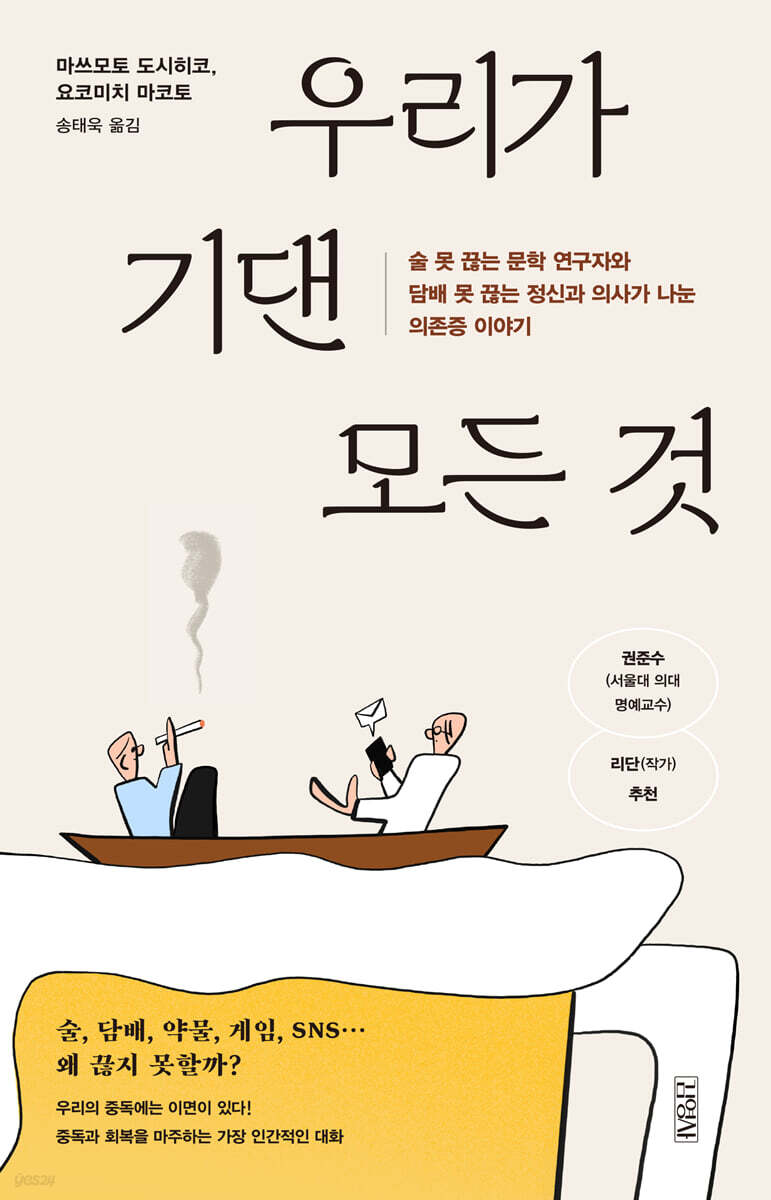
Everything we lean on
 |
Description
Book Introduction
Alcohol, cigarettes, drugs, games, social media...
Why can't I quit?
There's a flip side to our addiction!
The most human conversation about addiction and recovery
This book is a collection of letters exchanged on the topic of addiction between a literature researcher who cannot quit drinking and a psychiatrist who cannot quit smoking.
Toshihiko Matsumoto, a psychiatrist with the highest authority in Japan's addiction treatment field, and Makoto Yokomichi, a literary researcher who has not given up on himself despite his various addictions, including theft, sex, overeating, and alcohol, and developmental disabilities, go beyond the dichotomous doctor-patient relationship and honestly reveal their embarrassing pasts and traumas, telling the 'real story' of addiction and its surroundings.
The book views the essence of addiction as 'pain relief' rather than 'pleasure pursuit'.
He also emphasizes that 'harm reduction', which reduces secondary harm caused by addiction rather than eradicating it itself, is important, and says that in order to recover, it is important to know that 'I am not alone' and to connect with people.
This book raises awareness of addiction by examining the "unstoppable things" that have permeated our daily lives, such as games, shopping, and social media, as well as traditional addictions like alcohol, cigarettes, drugs, and gambling, within a clinical, social, and philosophical context.
Instead of stigmatizing addiction as a pathological condition, it interprets it as a mirror reflecting human life and relationships, opening readers up to deep empathy and new paths of thought.
An appendix includes a conversation between the two authors and a gambling addiction expert.
Why can't I quit?
There's a flip side to our addiction!
The most human conversation about addiction and recovery
This book is a collection of letters exchanged on the topic of addiction between a literature researcher who cannot quit drinking and a psychiatrist who cannot quit smoking.
Toshihiko Matsumoto, a psychiatrist with the highest authority in Japan's addiction treatment field, and Makoto Yokomichi, a literary researcher who has not given up on himself despite his various addictions, including theft, sex, overeating, and alcohol, and developmental disabilities, go beyond the dichotomous doctor-patient relationship and honestly reveal their embarrassing pasts and traumas, telling the 'real story' of addiction and its surroundings.
The book views the essence of addiction as 'pain relief' rather than 'pleasure pursuit'.
He also emphasizes that 'harm reduction', which reduces secondary harm caused by addiction rather than eradicating it itself, is important, and says that in order to recover, it is important to know that 'I am not alone' and to connect with people.
This book raises awareness of addiction by examining the "unstoppable things" that have permeated our daily lives, such as games, shopping, and social media, as well as traditional addictions like alcohol, cigarettes, drugs, and gambling, within a clinical, social, and philosophical context.
Instead of stigmatizing addiction as a pathological condition, it interprets it as a mirror reflecting human life and relationships, opening readers up to deep empathy and new paths of thought.
An appendix includes a conversation between the two authors and a gambling addiction expert.
- You can preview some of the book's contents.
Preview
index
Opening remarks by Toshihiko Matsumoto
1.
Hey, City! (Makoto Yokomichi, April 7, 2023)
Makoto's Dependency Journey: Theft, Sex, Overeating, and Alcohol | "Why is it I'm the only one who's not doing well?" | Meeting a Doctor Specializing in Dependency
2.
Hey, Makoto (Toshihiko Matsumoto, April 9, 2023)
An unwilling personnel assignment and a meeting with a self-help group for those with dependence | What is dependence? - The difference between 'dependence' and 'dependence disorder' | Why do people become dependent? - The self-medication hypothesis
3.
Self-Help Groups and the Time Machine to Hell (Makoto Yokomichi, May 2, 2023)
Meeting with Alcoholics Anonymous (AA) | The Trauma of the "Second Generation Religious" and the Religious Color of Self-Help Groups
4.
"Recovery Community" Rather Than "No, Absolutely Not" (Toshihiko Matsumoto, May 5, 2023)
Doctors' Inferiority Complex About Self-Help Groups | The Origin of the Controversy Over the Religious Overtones of Self-Help Groups | Doubts About the Jellyneck Curve | "No, Absolutely Not" Doesn't Work | "Recovery Community" Rather Than Abstinence
5.
Accepting and Recovering from Helplessness: A Community (Makoto Yokomichi, May 6, 2023)
Accepting Powerlessness and the Disease of Manliness | Self-Help Group Activities - Participant Research and Open Dialogue
6.
Clinical Dependency: A Long-Lost Case (Toshihiko Matsumoto, May 7, 2023)
Recovery Communities Everywhere | Hierarchy and the "Ready Party" Problem in Self-Help Groups | What Is Harm Reduction? | What Recovery Communities Need
7.
The Complexity of the Party's Image and the Search for a New Self-Help Group (Makoto Yokomichi, May 31, 2023)
The Unglamorized Parties | How to Cope with Addiction | Comorbidity and Dependence of Mental Illness
8.
"People Who Make It Hard" Are "People Who Make It Hard" - Self-Healing and Overlapping Disabilities (Toshihiko Matsumoto, June 10, 2023)
Drug Addiction and Developmental Disorders | How Far Should ADHD Be Treated? | 'Self-Healing' Is Everywhere | The Gaps Between Treatment and Support | 'Those Who Make It Hard' Are 'Those Who Are Having a Hard Time'
9.
Hey, City (Again) (Makoto Yokomichi, June 23, 2023)
Makoto's Multiple Disorders and Self-Healing | The Line Between Dependence and Normal Dependence
10.
Why Do People Fall for Things? (Toshihiko Matsumoto, July 19, 2023)
Once again, the question of 'What is the nature of addiction?' | Behavior is more important than substance | Everyone has the seeds of addiction | The addictiveness and therapeutic function of play | What is seen in drug therapy for addiction
11.
How to Enjoy Dopamine as a Gentleman or Lady (Makoto Yokomichi, July 20, 2023)
Substance Dependence and Behavioral Addiction | The Search for Instant Rewards and Relationships | Medication and Self-Help Groups
12.
Marijuana, the Sexual Harm of Boys, and the Disease of Manhood (Toshihiko Matsumoto, September 5, 2023)
Anger over reports of marijuana scandals | The Johnny's problem and stimulants | As a man who has lost his manhood and fallen behind | Smoking to distance oneself from others
13.
Barriers to Self-Disclosure and the Inability to Counseling (Makoto Yokomichi, September 25, 2023)
Reliance on 'productive' activities | Japan's problems from an international perspective | Salute to a city that reveals itself fully | A disease that cannot be consulted
14.
Ordinary Counseling, a Gathering Place for Toyoko Kids (Toshihiko Matsumoto, October 18, 2023)
Treating Drug Addiction Without 'Ordinary Counseling' | Over-the-Counter Drug Abuse: A Psychiatrist's Lost Battle | Regulation and Threats Won't Do It | Hallucinogens, Myths, and New Communities
15.
Dependency and the Expectations of Community and Peer Networks (Makoto Yokomichi, October 21, 2023)
Thoughts on Psychoanalysis | Flow and Community | The Various Medications Makoto Takes | Recovery Rather Than Reporting | Urakawa Bethel's House - "Move Your Mouth, Not Your Hands"
16.
Family Support for Dependents and Not-So-Strong Relationships (Toshihiko Matsumoto, December 1, 2023)
Rethinking Connections | Isolating Dependent Families | The Importance and Challenges of Family Support | Options Beyond 'Letting Go' and 'Cutting Off Relationships' | Whose Side is Your Doctor On? | Bonds Matter, But...
17.
Is Trauma Causing Addiction? ADHD? Or Not? (Makoto Yokomichi, December 3, 2023)
Immersive experiences, addiction, and stories | Support for the person involved begins with family support | Suicidal thoughts and addiction
18.
Staring at Addiction and Death (Toshihiko Matsumoto, December 28, 2023)
Isolation and Suicide | Addiction and Death Are Two Sides | Addiction is the Beginning of Recovery | What's Needed to Restart the Story
Special Talk
Reflecting on Gambling Addiction (Guest: Noriko Tanaka, April 30, 2024)
The Current State of Gambling Addiction | The Kyokujō Hall, a Place of Healing | Why Makoto Doesn't Gamble | Can Gambling Addiction Work Well? | The Problem Is Often Unnoticed | Self-Identification and Recovery | Future Strategies for Addiction | Support for Families of Gambling Addicts
Closing remarks · Makoto Yokomichi
Search
Recommendation
1.
Hey, City! (Makoto Yokomichi, April 7, 2023)
Makoto's Dependency Journey: Theft, Sex, Overeating, and Alcohol | "Why is it I'm the only one who's not doing well?" | Meeting a Doctor Specializing in Dependency
2.
Hey, Makoto (Toshihiko Matsumoto, April 9, 2023)
An unwilling personnel assignment and a meeting with a self-help group for those with dependence | What is dependence? - The difference between 'dependence' and 'dependence disorder' | Why do people become dependent? - The self-medication hypothesis
3.
Self-Help Groups and the Time Machine to Hell (Makoto Yokomichi, May 2, 2023)
Meeting with Alcoholics Anonymous (AA) | The Trauma of the "Second Generation Religious" and the Religious Color of Self-Help Groups
4.
"Recovery Community" Rather Than "No, Absolutely Not" (Toshihiko Matsumoto, May 5, 2023)
Doctors' Inferiority Complex About Self-Help Groups | The Origin of the Controversy Over the Religious Overtones of Self-Help Groups | Doubts About the Jellyneck Curve | "No, Absolutely Not" Doesn't Work | "Recovery Community" Rather Than Abstinence
5.
Accepting and Recovering from Helplessness: A Community (Makoto Yokomichi, May 6, 2023)
Accepting Powerlessness and the Disease of Manliness | Self-Help Group Activities - Participant Research and Open Dialogue
6.
Clinical Dependency: A Long-Lost Case (Toshihiko Matsumoto, May 7, 2023)
Recovery Communities Everywhere | Hierarchy and the "Ready Party" Problem in Self-Help Groups | What Is Harm Reduction? | What Recovery Communities Need
7.
The Complexity of the Party's Image and the Search for a New Self-Help Group (Makoto Yokomichi, May 31, 2023)
The Unglamorized Parties | How to Cope with Addiction | Comorbidity and Dependence of Mental Illness
8.
"People Who Make It Hard" Are "People Who Make It Hard" - Self-Healing and Overlapping Disabilities (Toshihiko Matsumoto, June 10, 2023)
Drug Addiction and Developmental Disorders | How Far Should ADHD Be Treated? | 'Self-Healing' Is Everywhere | The Gaps Between Treatment and Support | 'Those Who Make It Hard' Are 'Those Who Are Having a Hard Time'
9.
Hey, City (Again) (Makoto Yokomichi, June 23, 2023)
Makoto's Multiple Disorders and Self-Healing | The Line Between Dependence and Normal Dependence
10.
Why Do People Fall for Things? (Toshihiko Matsumoto, July 19, 2023)
Once again, the question of 'What is the nature of addiction?' | Behavior is more important than substance | Everyone has the seeds of addiction | The addictiveness and therapeutic function of play | What is seen in drug therapy for addiction
11.
How to Enjoy Dopamine as a Gentleman or Lady (Makoto Yokomichi, July 20, 2023)
Substance Dependence and Behavioral Addiction | The Search for Instant Rewards and Relationships | Medication and Self-Help Groups
12.
Marijuana, the Sexual Harm of Boys, and the Disease of Manhood (Toshihiko Matsumoto, September 5, 2023)
Anger over reports of marijuana scandals | The Johnny's problem and stimulants | As a man who has lost his manhood and fallen behind | Smoking to distance oneself from others
13.
Barriers to Self-Disclosure and the Inability to Counseling (Makoto Yokomichi, September 25, 2023)
Reliance on 'productive' activities | Japan's problems from an international perspective | Salute to a city that reveals itself fully | A disease that cannot be consulted
14.
Ordinary Counseling, a Gathering Place for Toyoko Kids (Toshihiko Matsumoto, October 18, 2023)
Treating Drug Addiction Without 'Ordinary Counseling' | Over-the-Counter Drug Abuse: A Psychiatrist's Lost Battle | Regulation and Threats Won't Do It | Hallucinogens, Myths, and New Communities
15.
Dependency and the Expectations of Community and Peer Networks (Makoto Yokomichi, October 21, 2023)
Thoughts on Psychoanalysis | Flow and Community | The Various Medications Makoto Takes | Recovery Rather Than Reporting | Urakawa Bethel's House - "Move Your Mouth, Not Your Hands"
16.
Family Support for Dependents and Not-So-Strong Relationships (Toshihiko Matsumoto, December 1, 2023)
Rethinking Connections | Isolating Dependent Families | The Importance and Challenges of Family Support | Options Beyond 'Letting Go' and 'Cutting Off Relationships' | Whose Side is Your Doctor On? | Bonds Matter, But...
17.
Is Trauma Causing Addiction? ADHD? Or Not? (Makoto Yokomichi, December 3, 2023)
Immersive experiences, addiction, and stories | Support for the person involved begins with family support | Suicidal thoughts and addiction
18.
Staring at Addiction and Death (Toshihiko Matsumoto, December 28, 2023)
Isolation and Suicide | Addiction and Death Are Two Sides | Addiction is the Beginning of Recovery | What's Needed to Restart the Story
Special Talk
Reflecting on Gambling Addiction (Guest: Noriko Tanaka, April 30, 2024)
The Current State of Gambling Addiction | The Kyokujō Hall, a Place of Healing | Why Makoto Doesn't Gamble | Can Gambling Addiction Work Well? | The Problem Is Often Unnoticed | Self-Identification and Recovery | Future Strategies for Addiction | Support for Families of Gambling Addicts
Closing remarks · Makoto Yokomichi
Search
Recommendation
Into the book
It is unrealistic to limit everything, including the changes in the object of excessive enjoyment, by saying “no, absolutely not” and to treat or support them.
Moreover, a society like that with such an 'addiction crackdown squad' cannot be comfortable to live in.
I, too, often feel like I'm somehow surviving by resorting to self-destructive vices, like smoking and eating extremely spicy curries and noodle soups.
Personally, I want to shout out loud that a certain amount of unhealthy elements are necessary for people to live healthy lives.
--- p.8
The same is true in the treatment setting.
If a doctor unilaterally sets a treatment goal of abstinence, there is a risk that the patient will leave the treatment setting.
This is a pre-treatment problem.
Even if you are lucky enough to continue receiving treatment, there may be situations where you continue to drink but insist in front of the doctor that you "don't drink," which can result in the patient being labeled a liar.
This is not desirable.
If an environment is not created where patients can honestly say, "I want to drink," when they want to drink, and "I drank," when they actually drink, treatment for alcohol dependence is impossible.
--- p.59
In short, the term "partner" in the addiction field does not necessarily represent all addicts.
At least someone who "doesn't want to quit drinking no matter what" is not considered a "party" within this system.
In the case of drug addiction, the situation is even more serious.
Influenced by the "No, Never" campaign, drug users are often labeled as "people who should never do something" and are often denied the opportunity to speak out.
As a result, the reality is that the 'parties' in this field are limited to those who are convenient for our medical professionals.
--- p.76~77
Among the poems of the female poet Misuzu Kaneko, who passed away at the age of 26, there is a famous piece called “Me, the Little Bird, and the Bell.”
“The bell, the little bird, and I, we’re all different, so we’re all good,” he sings.
It's a really great poem, but a colleague I'm close with who also has a developmental disability once laughed and said, "Everyone with a developmental disability is different, and they're all a mess."
But in the end, that's what human existence is all about.
“Everyone is different, and everyone is a mess.”
I wish there was a self-help group where we could accept each other's true selves.
And if possible, I sincerely hope that such gatherings will not remain confined to self-help groups, but will spread throughout the community, so that society can also change along with them.
--- p.89~90
I think that what makes people addicted is not the pharmacological effects of the substance, but the experience of self-efficacy through action, that is, the experience of successfully regulating mood through stimulation of the mind and body and changes in physical sensations.
--- p.123
I think this way.
Certainly, addiction carries the risk of leading a person to death, but it is said that everyone has a seed of it, and that it is because of this that we can survive the 'difficult present'.
--- p.129
It should be more widely known that alcohol is the drug most associated with harmful behavior among all psychoactive substances.
Japan is strangely strict on drugs, but overly lenient on alcohol.
Personally, I believe that alcohol abuse prevention training sessions for parents should take priority over drug abuse prevention classes for students.
--- p.150
In these circumstances, simply regulating sales will not be enough to protect children's lives.
It is much more important to fundamentally address the psychological distress and practical difficulties that lead to excessive use of over-the-counter medications.
Additionally, posters that should be displayed in drugstores should not simply exaggerate the "fear of over-the-counter drug abuse" and threaten people, but should provide information on counseling services for people who are in difficult situations.
--- p.186
Furthermore, there is one thing you must remember.
The truth is that it is difficult for people to be honest with someone they care about, someone they have a strong relationship with.
Because, if you confess, “I want to die,” you might worry that the other person will be sad, or on the contrary, you might receive an unreasonable demand like, “Promise me you will never die.”
Or you might receive threats like, “Next time you say, ‘I want to die,’ I’ll end our relationship.”
In other words, if you are honest about your true feelings, not only will your relationship with someone important to you change, but more seriously, you may risk losing that person.
Moreover, a society like that with such an 'addiction crackdown squad' cannot be comfortable to live in.
I, too, often feel like I'm somehow surviving by resorting to self-destructive vices, like smoking and eating extremely spicy curries and noodle soups.
Personally, I want to shout out loud that a certain amount of unhealthy elements are necessary for people to live healthy lives.
--- p.8
The same is true in the treatment setting.
If a doctor unilaterally sets a treatment goal of abstinence, there is a risk that the patient will leave the treatment setting.
This is a pre-treatment problem.
Even if you are lucky enough to continue receiving treatment, there may be situations where you continue to drink but insist in front of the doctor that you "don't drink," which can result in the patient being labeled a liar.
This is not desirable.
If an environment is not created where patients can honestly say, "I want to drink," when they want to drink, and "I drank," when they actually drink, treatment for alcohol dependence is impossible.
--- p.59
In short, the term "partner" in the addiction field does not necessarily represent all addicts.
At least someone who "doesn't want to quit drinking no matter what" is not considered a "party" within this system.
In the case of drug addiction, the situation is even more serious.
Influenced by the "No, Never" campaign, drug users are often labeled as "people who should never do something" and are often denied the opportunity to speak out.
As a result, the reality is that the 'parties' in this field are limited to those who are convenient for our medical professionals.
--- p.76~77
Among the poems of the female poet Misuzu Kaneko, who passed away at the age of 26, there is a famous piece called “Me, the Little Bird, and the Bell.”
“The bell, the little bird, and I, we’re all different, so we’re all good,” he sings.
It's a really great poem, but a colleague I'm close with who also has a developmental disability once laughed and said, "Everyone with a developmental disability is different, and they're all a mess."
But in the end, that's what human existence is all about.
“Everyone is different, and everyone is a mess.”
I wish there was a self-help group where we could accept each other's true selves.
And if possible, I sincerely hope that such gatherings will not remain confined to self-help groups, but will spread throughout the community, so that society can also change along with them.
--- p.89~90
I think that what makes people addicted is not the pharmacological effects of the substance, but the experience of self-efficacy through action, that is, the experience of successfully regulating mood through stimulation of the mind and body and changes in physical sensations.
--- p.123
I think this way.
Certainly, addiction carries the risk of leading a person to death, but it is said that everyone has a seed of it, and that it is because of this that we can survive the 'difficult present'.
--- p.129
It should be more widely known that alcohol is the drug most associated with harmful behavior among all psychoactive substances.
Japan is strangely strict on drugs, but overly lenient on alcohol.
Personally, I believe that alcohol abuse prevention training sessions for parents should take priority over drug abuse prevention classes for students.
--- p.150
In these circumstances, simply regulating sales will not be enough to protect children's lives.
It is much more important to fundamentally address the psychological distress and practical difficulties that lead to excessive use of over-the-counter medications.
Additionally, posters that should be displayed in drugstores should not simply exaggerate the "fear of over-the-counter drug abuse" and threaten people, but should provide information on counseling services for people who are in difficult situations.
--- p.186
Furthermore, there is one thing you must remember.
The truth is that it is difficult for people to be honest with someone they care about, someone they have a strong relationship with.
Because, if you confess, “I want to die,” you might worry that the other person will be sad, or on the contrary, you might receive an unreasonable demand like, “Promise me you will never die.”
Or you might receive threats like, “Next time you say, ‘I want to die,’ I’ll end our relationship.”
In other words, if you are honest about your true feelings, not only will your relationship with someone important to you change, but more seriously, you may risk losing that person.
--- p.223
Publisher's Review
Alcohol, cigarettes, drugs, games, gambling, social media...
Why can't I quit?
There's a flip side to our addiction!
The most human conversation about addiction and recovery
Recommended by Kwon Jun-su (Professor Emeritus, Seoul National University College of Medicine), Lee Dan (writer), and Dohata Kaito (writer)
Dependence (addiction) refers to a state of being pathologically addicted to or dependent on a substance or behavior and unable to live without it.
In recent years, the target of addiction has expanded and the age of addiction has gotten younger.
Addiction has now invaded every aspect of our daily lives, becoming the most familiar disease and social phenomenon to modern people, not only to alcohol, cigarettes, drugs, and gambling, but also to sex, games, social media, short-form video games, shopping, plastic surgery, exercise, and even food.
The phenomenon of younger addicts is also evident.
The number of teenagers addicted to smartphones, drugs, and gambling is increasing, but few of them receive counseling or treatment.
Why do we become addicted? Is addiction simply a matter of weak willpower, something that can be solved by quitting? How should we approach this issue?
There is a book that answers these questions through honest conversation.
"Everything We Lean On" is a collection of letters about addiction between a literary researcher who can't quit drinking and a psychiatrist who can't quit smoking.
Toshihiko Matsumoto, a psychiatrist with the highest authority in Japan's addiction treatment field, and Makoto Yokomichi, a literary researcher who has not given up on himself despite his various addictions, including theft, sex, overeating, and alcohol, as well as his developmental disability, reveal their embarrassing pasts, inner thoughts, and even traumas, delving into the abyss of addiction and telling the 'true story' of addiction and recovery.
A shallow understanding and prejudice about addiction that is overturned in the face of the experiences of those involved
A brutally honest account of addiction, the disease most familiar to modern people.
The circumstances that led to the creation of this collection of letters are interesting.
A Japanese editor contacted Makoto Yokomichi to request a manuscript for another book he was working on at the time, but he showed up carrying a bottle of alcohol, even though it was his first meeting with the editor in broad daylight.
After witnessing him drinking alcohol in public settings several times, the editor planned a series of correspondence with Toshihiko Matsumoto, the leading authority on addiction treatment in Japan, and this book is the result of that series.
The voices of those 'involved' in addiction are often those of 'prepared parties' who have already returned to the medical field.
In that sense, these letters exchanged between a psychiatrist who “cannot quit smoking and has no desire to quit” and a literary researcher who “has not even had 30 days without drinking alcohol since I was 18 until now in my mid-40s” contain a “voice from the field” that is not easily heard.
This book overturns people's superficial and shallow understanding and prejudice about addiction through honest stories from 'real parties'.
For example, there is the 'Rat Park experiment', which is often mentioned in relation to drug addiction.
The experiment showed that rats that were locked up and left alone became addicted to drugs, while rats that were kept with their peers and played around didn't even try drugs.
This experiment became widely known for revealing that social relationships are a more important factor in addiction than the addictive nature of the drug itself.
However, Toshihiko points out that the families of patients who come across this study may have different feelings.
They may misunderstand that the cause of the problem is that their family members have isolated them, and may feel guilty.
He also said that some people may feel a strong aversion to the 'embracing of helplessness' and 'religious overtones' that are emphasized in standardized anonymous self-help groups.
It is important to emphasize that there is no one-size-fits-all treatment plan that works for everyone with addiction, and that just because a treatment doesn't work for you doesn't mean you can't recover.
The book also covers issues of comorbidity, such as overdose of over-the-counter drugs and ADHD that can occur with addiction, allowing for a three-dimensional and multi-layered understanding of addiction.
Why do people get caught up in something?
The essence of addiction is not the pursuit of pleasure, but the alleviation of pain.
The first letter from literary researcher Makoto Yokomichi is powerful.
He introduces himself as a 'dependent patient' and unfolds his pathological journey of addiction that began with his pathological stealing in elementary school.
Sex addictions, including compulsive masturbation, overeating that led to lifelong obesity, and alcoholism that I have not been able to quit since I became an adult.
He is also a developmentally disabled person, having been diagnosed with autism spectrum disorder and attention deficit hyperactivity disorder (ADHD) only in his forties.
He then reveals the terrible trauma he experienced as a “second generation religious person,” confessing, “Whenever I tried to escape the pain, the problem of addiction was always close by.”
Humans tend to get bored easily, so why do some people become obsessed with certain substances or activities, even to the point of destroying their daily lives, health, and relationships?
Psychiatrist Toshihiko Matsumoto proposes the 'self-treatment hypothesis' as an answer to this question.
The essence of addiction is not in the pursuit of pleasure, but in the alleviation of pain. In the long run, addiction can lead to death, but ironically, in the short run, it helps people temporarily endure the 'present, which is so painful that they want to die.'
He points out that even behaviors that seem far removed from pleasure or intoxication, such as trichotillomania (hair-pulling disorder) or self-harm such as wrist cutting, can be indulged in if they help temporarily distract consciousness from the pain of reality.
In this context, the seeds of addiction are present in everyone, and addiction or self-harm is a much better choice than choosing immediate death, so it is even said that 'addiction is the beginning of recovery.'
Because you have to survive first to be able to recover.
“People do not become addicted to drugs to achieve a thrilling sensation they have never experienced before, but because the pain they have been suffering from for a long time is temporarily relieved or alleviated by the drug.
If it's pleasure, you might get tired of it, but relief from pain doesn't get tired of it.
Rather, I will not be able to let go of the relief of that pain, even if it means existing as myself.” (p. 37)
What should you do if someone you care about is addicted?
A 'recovery community' rather than a 'no, absolutely not'
What does desirable support and recovery look like, specifically? Toshihiko Matsumoto says, "Recovery isn't simply about quitting alcohol or drugs. It's about accepting yourself as you are and learning how to live comfortably without straining or stressing."
The key to true healing and recovery is not to isolate the person.
He emphasizes that addicts should be able to honestly share their problems with their doctors, family members, or colleagues with similar problems, and that doctors should take the patient's side rather than the family's to ensure continued treatment.
If doctors prioritize the family's demands for "something to be done immediately," treatment is likely to flow toward isolation of the patient, such as involuntary hospitalization and quarantine.
So what should families do? It's crucial not to try to solve problems solely within the family.
The key is to connect with a third party or support group with expertise in addiction and a duty of confidentiality to discuss the issue together and find alternatives.
The book presents a variety of scenarios of support and recovery, all of which share a common thread: they don't isolate the person involved.
Self-help groups such as Alcoholics Anonymous (AA) and Narcotics Anonymous (NA), DARC, a private rehabilitation facility run by people who have recovered from drug addiction, Al-Anon, a self-help group for families of patients with addiction, Community Strengthening and Family Training (CRAFT), which was introduced to support families, and Urakawa Bethel House, a community for the mentally disabled, are introduced.
Toshihiko Matsumoto emphasizes that this “place where I know I am not alone” is a “recovery community,” and Makoto Yokomichi, who is directly leading ten self-help groups, also preaches the importance of “connection.”
It can be guessed that Makoto's self-disclosure, which is so bold that it makes the reader feel uneasy, was also part of his effort to avoid being isolated.
“The monster called addiction loves secrets and isolation the most.
And the worst experience in life is not simply experiencing something terrible, but enduring that pain alone.” (p. 219)
Will cutting it off solve the problem?
A Shift in the Addiction Response Paradigm: The Importance of "Risk Reduction"
So, what is our society's current approach to addiction? Specifically, in the area of drug addiction, policies are being implemented on the supply side, focusing on regulation, crackdowns, and increased punishment. On the demand side, policies are being implemented, focusing on prevention, education, and treatment.
However, this type of response can easily result in social isolation by branding drug users as people who have done something they should never do.
Moreover, considering the fact that the target of addiction is constantly changing, quitting alcohol or drugs cannot be a fundamental solution to the problem.
What becomes important here is ‘risk reduction’ and social safety nets.
Rather than eradicating addiction itself, we should focus on reducing the health, social, and economic harm caused by addiction.
For example, in the area of drug dependence, harm reduction policies include distributing clean syringes free of charge to prevent the spread of infectious diseases, setting up injection rooms where drugs can be used safely, and administering alternative medications that are less harmful.
This is actually the core of the drug policy that has been developed and maintained in Switzerland from the early 1990s to the present.
The book also introduces a policy that provides small amounts of alcoholic beverages to homeless people with alcohol dependence if they meet the conditions of eating a nutritious meal at a free food pantry.
As addiction issues become increasingly serious, our society needs a more flexible approach and a warm perspective that goes beyond the simple dichotomy of "quit/don't quit."
Because addiction is not 'someone's problem', it is 'everyone's problem'.
This book questions the meaning of human suffering, recovery, and connection through addiction, and makes us reflect on 'everything we have relied on.'
Why can't I quit?
There's a flip side to our addiction!
The most human conversation about addiction and recovery
Recommended by Kwon Jun-su (Professor Emeritus, Seoul National University College of Medicine), Lee Dan (writer), and Dohata Kaito (writer)
Dependence (addiction) refers to a state of being pathologically addicted to or dependent on a substance or behavior and unable to live without it.
In recent years, the target of addiction has expanded and the age of addiction has gotten younger.
Addiction has now invaded every aspect of our daily lives, becoming the most familiar disease and social phenomenon to modern people, not only to alcohol, cigarettes, drugs, and gambling, but also to sex, games, social media, short-form video games, shopping, plastic surgery, exercise, and even food.
The phenomenon of younger addicts is also evident.
The number of teenagers addicted to smartphones, drugs, and gambling is increasing, but few of them receive counseling or treatment.
Why do we become addicted? Is addiction simply a matter of weak willpower, something that can be solved by quitting? How should we approach this issue?
There is a book that answers these questions through honest conversation.
"Everything We Lean On" is a collection of letters about addiction between a literary researcher who can't quit drinking and a psychiatrist who can't quit smoking.
Toshihiko Matsumoto, a psychiatrist with the highest authority in Japan's addiction treatment field, and Makoto Yokomichi, a literary researcher who has not given up on himself despite his various addictions, including theft, sex, overeating, and alcohol, as well as his developmental disability, reveal their embarrassing pasts, inner thoughts, and even traumas, delving into the abyss of addiction and telling the 'true story' of addiction and recovery.
A shallow understanding and prejudice about addiction that is overturned in the face of the experiences of those involved
A brutally honest account of addiction, the disease most familiar to modern people.
The circumstances that led to the creation of this collection of letters are interesting.
A Japanese editor contacted Makoto Yokomichi to request a manuscript for another book he was working on at the time, but he showed up carrying a bottle of alcohol, even though it was his first meeting with the editor in broad daylight.
After witnessing him drinking alcohol in public settings several times, the editor planned a series of correspondence with Toshihiko Matsumoto, the leading authority on addiction treatment in Japan, and this book is the result of that series.
The voices of those 'involved' in addiction are often those of 'prepared parties' who have already returned to the medical field.
In that sense, these letters exchanged between a psychiatrist who “cannot quit smoking and has no desire to quit” and a literary researcher who “has not even had 30 days without drinking alcohol since I was 18 until now in my mid-40s” contain a “voice from the field” that is not easily heard.
This book overturns people's superficial and shallow understanding and prejudice about addiction through honest stories from 'real parties'.
For example, there is the 'Rat Park experiment', which is often mentioned in relation to drug addiction.
The experiment showed that rats that were locked up and left alone became addicted to drugs, while rats that were kept with their peers and played around didn't even try drugs.
This experiment became widely known for revealing that social relationships are a more important factor in addiction than the addictive nature of the drug itself.
However, Toshihiko points out that the families of patients who come across this study may have different feelings.
They may misunderstand that the cause of the problem is that their family members have isolated them, and may feel guilty.
He also said that some people may feel a strong aversion to the 'embracing of helplessness' and 'religious overtones' that are emphasized in standardized anonymous self-help groups.
It is important to emphasize that there is no one-size-fits-all treatment plan that works for everyone with addiction, and that just because a treatment doesn't work for you doesn't mean you can't recover.
The book also covers issues of comorbidity, such as overdose of over-the-counter drugs and ADHD that can occur with addiction, allowing for a three-dimensional and multi-layered understanding of addiction.
Why do people get caught up in something?
The essence of addiction is not the pursuit of pleasure, but the alleviation of pain.
The first letter from literary researcher Makoto Yokomichi is powerful.
He introduces himself as a 'dependent patient' and unfolds his pathological journey of addiction that began with his pathological stealing in elementary school.
Sex addictions, including compulsive masturbation, overeating that led to lifelong obesity, and alcoholism that I have not been able to quit since I became an adult.
He is also a developmentally disabled person, having been diagnosed with autism spectrum disorder and attention deficit hyperactivity disorder (ADHD) only in his forties.
He then reveals the terrible trauma he experienced as a “second generation religious person,” confessing, “Whenever I tried to escape the pain, the problem of addiction was always close by.”
Humans tend to get bored easily, so why do some people become obsessed with certain substances or activities, even to the point of destroying their daily lives, health, and relationships?
Psychiatrist Toshihiko Matsumoto proposes the 'self-treatment hypothesis' as an answer to this question.
The essence of addiction is not in the pursuit of pleasure, but in the alleviation of pain. In the long run, addiction can lead to death, but ironically, in the short run, it helps people temporarily endure the 'present, which is so painful that they want to die.'
He points out that even behaviors that seem far removed from pleasure or intoxication, such as trichotillomania (hair-pulling disorder) or self-harm such as wrist cutting, can be indulged in if they help temporarily distract consciousness from the pain of reality.
In this context, the seeds of addiction are present in everyone, and addiction or self-harm is a much better choice than choosing immediate death, so it is even said that 'addiction is the beginning of recovery.'
Because you have to survive first to be able to recover.
“People do not become addicted to drugs to achieve a thrilling sensation they have never experienced before, but because the pain they have been suffering from for a long time is temporarily relieved or alleviated by the drug.
If it's pleasure, you might get tired of it, but relief from pain doesn't get tired of it.
Rather, I will not be able to let go of the relief of that pain, even if it means existing as myself.” (p. 37)
What should you do if someone you care about is addicted?
A 'recovery community' rather than a 'no, absolutely not'
What does desirable support and recovery look like, specifically? Toshihiko Matsumoto says, "Recovery isn't simply about quitting alcohol or drugs. It's about accepting yourself as you are and learning how to live comfortably without straining or stressing."
The key to true healing and recovery is not to isolate the person.
He emphasizes that addicts should be able to honestly share their problems with their doctors, family members, or colleagues with similar problems, and that doctors should take the patient's side rather than the family's to ensure continued treatment.
If doctors prioritize the family's demands for "something to be done immediately," treatment is likely to flow toward isolation of the patient, such as involuntary hospitalization and quarantine.
So what should families do? It's crucial not to try to solve problems solely within the family.
The key is to connect with a third party or support group with expertise in addiction and a duty of confidentiality to discuss the issue together and find alternatives.
The book presents a variety of scenarios of support and recovery, all of which share a common thread: they don't isolate the person involved.
Self-help groups such as Alcoholics Anonymous (AA) and Narcotics Anonymous (NA), DARC, a private rehabilitation facility run by people who have recovered from drug addiction, Al-Anon, a self-help group for families of patients with addiction, Community Strengthening and Family Training (CRAFT), which was introduced to support families, and Urakawa Bethel House, a community for the mentally disabled, are introduced.
Toshihiko Matsumoto emphasizes that this “place where I know I am not alone” is a “recovery community,” and Makoto Yokomichi, who is directly leading ten self-help groups, also preaches the importance of “connection.”
It can be guessed that Makoto's self-disclosure, which is so bold that it makes the reader feel uneasy, was also part of his effort to avoid being isolated.
“The monster called addiction loves secrets and isolation the most.
And the worst experience in life is not simply experiencing something terrible, but enduring that pain alone.” (p. 219)
Will cutting it off solve the problem?
A Shift in the Addiction Response Paradigm: The Importance of "Risk Reduction"
So, what is our society's current approach to addiction? Specifically, in the area of drug addiction, policies are being implemented on the supply side, focusing on regulation, crackdowns, and increased punishment. On the demand side, policies are being implemented, focusing on prevention, education, and treatment.
However, this type of response can easily result in social isolation by branding drug users as people who have done something they should never do.
Moreover, considering the fact that the target of addiction is constantly changing, quitting alcohol or drugs cannot be a fundamental solution to the problem.
What becomes important here is ‘risk reduction’ and social safety nets.
Rather than eradicating addiction itself, we should focus on reducing the health, social, and economic harm caused by addiction.
For example, in the area of drug dependence, harm reduction policies include distributing clean syringes free of charge to prevent the spread of infectious diseases, setting up injection rooms where drugs can be used safely, and administering alternative medications that are less harmful.
This is actually the core of the drug policy that has been developed and maintained in Switzerland from the early 1990s to the present.
The book also introduces a policy that provides small amounts of alcoholic beverages to homeless people with alcohol dependence if they meet the conditions of eating a nutritious meal at a free food pantry.
As addiction issues become increasingly serious, our society needs a more flexible approach and a warm perspective that goes beyond the simple dichotomy of "quit/don't quit."
Because addiction is not 'someone's problem', it is 'everyone's problem'.
This book questions the meaning of human suffering, recovery, and connection through addiction, and makes us reflect on 'everything we have relied on.'
GOODS SPECIFICS
- Date of issue: September 23, 2025
- Page count, weight, size: 304 pages | 406g | 135*210*20mm
- ISBN13: 9791173323393
- ISBN10: 1173323392
You may also like
카테고리
korean


korean

![ELLE 엘르 스페셜 에디션 A형 : 12월 [2025]](http://librairie.coreenne.fr/cdn/shop/files/b8e27a3de6c9538896439686c6b0e8fb.jpg?v=1766436872&width=3840)


