

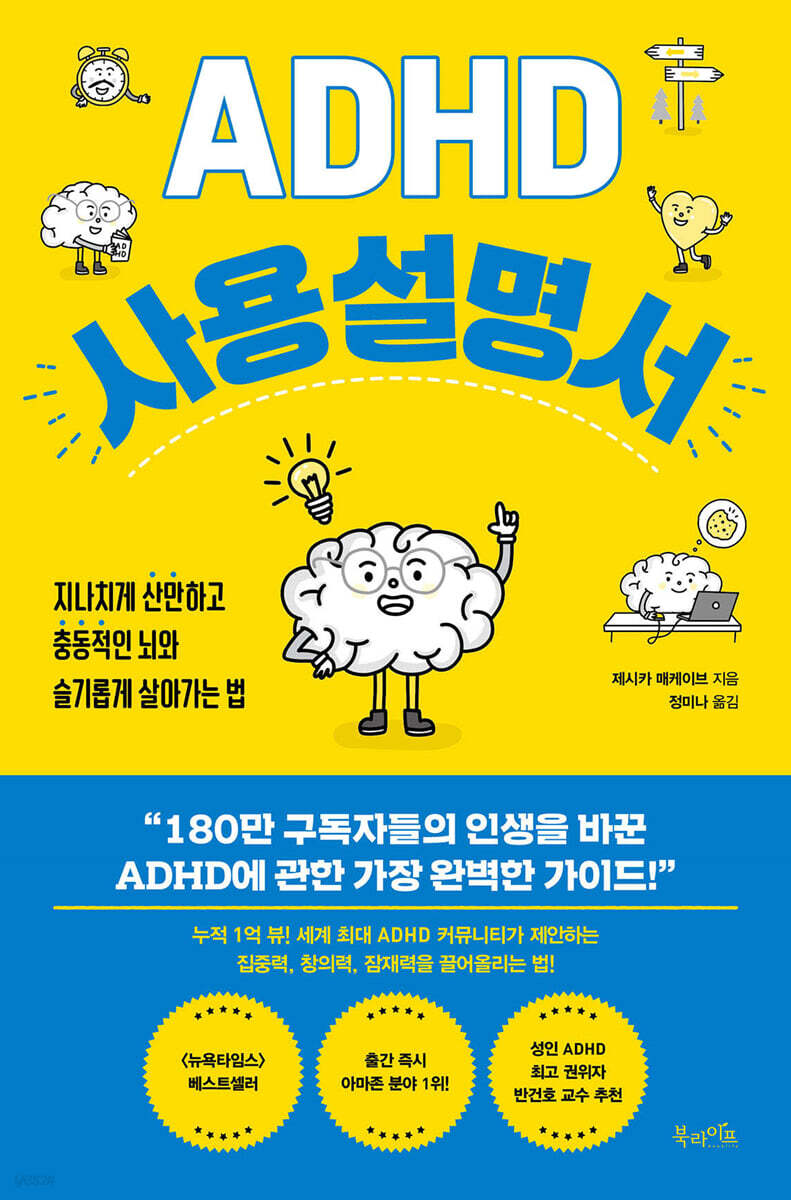
ADHD User Manual
 |
Description
Book Introduction
"Inability to concentrate isn't due to laziness, it's due to a 'different brain.'"
The world's friendliest and most definitive guide to ADHD
"ADHD User Manual" is a book written by a creator and ADHD expert with approximately 7 million TEDx talk views and 1.8 million YouTube subscribers (How to ADHD), for people struggling with ADHD.
The author, Jessica McCabe, also suffered from long-term confusion and impairment after being diagnosed with ADHD, including frequent loss of objects and forgetting important things.
After experiencing college entrance exam failures, recurring job problems, and divorce, the author began to look more deeply into the difficulties caused by ADHD.
Additionally, in order to not forget the ADHD-related knowledge that I have studied and learned, I opened and operated the YouTube channel “How to ADHD,” which helped me understand in detail the invisible obstacles that people with ADHD face and how to overcome them.
This book is a guide to help you better understand and effectively utilize the ADHD brain, which is different from others. The author, who has ADHD, will explain and guide you to accept how our brains work, filled with insight, research, strategies, and empathy based on his own personal experience.
The world's friendliest and most definitive guide to ADHD
"ADHD User Manual" is a book written by a creator and ADHD expert with approximately 7 million TEDx talk views and 1.8 million YouTube subscribers (How to ADHD), for people struggling with ADHD.
The author, Jessica McCabe, also suffered from long-term confusion and impairment after being diagnosed with ADHD, including frequent loss of objects and forgetting important things.
After experiencing college entrance exam failures, recurring job problems, and divorce, the author began to look more deeply into the difficulties caused by ADHD.
Additionally, in order to not forget the ADHD-related knowledge that I have studied and learned, I opened and operated the YouTube channel “How to ADHD,” which helped me understand in detail the invisible obstacles that people with ADHD face and how to overcome them.
This book is a guide to help you better understand and effectively utilize the ADHD brain, which is different from others. The author, who has ADHD, will explain and guide you to accept how our brains work, filled with insight, research, strategies, and empathy based on his own personal experience.
- You can preview some of the book's contents.
Preview
index
Praise poured in for this book
Introduction
Notes on language
Chapter 1: I have ADHD
Living as someone who doesn't live up to expectations
Many expectations toward me
The first things I learned
My first toolbox full of trial and error
The one thing I haven't tried
Chapter 2: Misconceptions and Truths Surrounding ADHD
I don't have ADD
The second thing I learned
Why Many People Hide Their ADHD
A Toolbox for Understanding ADHD
You are doing very well now.
Keep going!
Chapter 3: Taming the Beast Within
The potion of concentration has its limits.
The third thing I learned
Toolbox for Focus Management
Defense against noise
Chapter 4: How to Improve Your Brain's Executive Function
Happy New Year ADHD
The fourth thing I learned
Toolbox for enhancing executive function
How to deal with manual mode
Chapter 5: The Best Sleep Method for Your Sleepless Brain
The Butterfly Effect of Sleep Deprivation
The fifth thing I learned
Toolbox for a Good Night's Sleep
Is it an owl or a lark?
Chapter 6: Time Management for a Balanced Life
Conspiracy of Time
The Sixth Fact I Learned
A toolbox that enhances your sense of time
No more schedule jenga!
Chapter 7: How to Motivate Your Distracted Brain
Me vs.
brain
The Seventh Fact I Learned
A toolbox to brighten your brain
Sometimes you miss the ball
Chapter 8: How to Use Memory for a Blinking Brain
The price of forgetfulness
The Eighth Fact I Learned
A toolbox that expands your working memory space
The joy of forgetting
Chapter 9: How to Save Myself from the Sea of Emotions
be swept away by waves of emotion
The ninth thing I learned
A toolbox for managing emotional signals
Even though emotions sometimes consume us
Chapter 10: How to Build Connected Relationships
We all need friends
The tenth thing I learned
Toolbox for Building Strong Relationships
What good is a friend?
Chapter 11: Things That Make ADHD More Difficult
Living with ADHD
The Eleventh Fact I Learned
It's not just ADHD's problem
A toolbox to follow your inner compass
What the ADHD label gave me
Chapter 12: How to Use Your Heart to Strengthen Each Other
It's all because of ADHD
The Twelfth Fact I Learned
Toolbox for Maintaining Relationships
“What should we do?”
Chapter 13: How We Change the World
I decided to change direction
The thirteenth thing I learned
Open Dialogue on Neurodiversity
As adult ADHD treatment improves,
A toolbox for changing the world
Seeing the world through four eyes
Story and ending
Wait, just one more thing!!!
supplement
References
Glossary
Acknowledgements
Introduction
Notes on language
Chapter 1: I have ADHD
Living as someone who doesn't live up to expectations
Many expectations toward me
The first things I learned
My first toolbox full of trial and error
The one thing I haven't tried
Chapter 2: Misconceptions and Truths Surrounding ADHD
I don't have ADD
The second thing I learned
Why Many People Hide Their ADHD
A Toolbox for Understanding ADHD
You are doing very well now.
Keep going!
Chapter 3: Taming the Beast Within
The potion of concentration has its limits.
The third thing I learned
Toolbox for Focus Management
Defense against noise
Chapter 4: How to Improve Your Brain's Executive Function
Happy New Year ADHD
The fourth thing I learned
Toolbox for enhancing executive function
How to deal with manual mode
Chapter 5: The Best Sleep Method for Your Sleepless Brain
The Butterfly Effect of Sleep Deprivation
The fifth thing I learned
Toolbox for a Good Night's Sleep
Is it an owl or a lark?
Chapter 6: Time Management for a Balanced Life
Conspiracy of Time
The Sixth Fact I Learned
A toolbox that enhances your sense of time
No more schedule jenga!
Chapter 7: How to Motivate Your Distracted Brain
Me vs.
brain
The Seventh Fact I Learned
A toolbox to brighten your brain
Sometimes you miss the ball
Chapter 8: How to Use Memory for a Blinking Brain
The price of forgetfulness
The Eighth Fact I Learned
A toolbox that expands your working memory space
The joy of forgetting
Chapter 9: How to Save Myself from the Sea of Emotions
be swept away by waves of emotion
The ninth thing I learned
A toolbox for managing emotional signals
Even though emotions sometimes consume us
Chapter 10: How to Build Connected Relationships
We all need friends
The tenth thing I learned
Toolbox for Building Strong Relationships
What good is a friend?
Chapter 11: Things That Make ADHD More Difficult
Living with ADHD
The Eleventh Fact I Learned
It's not just ADHD's problem
A toolbox to follow your inner compass
What the ADHD label gave me
Chapter 12: How to Use Your Heart to Strengthen Each Other
It's all because of ADHD
The Twelfth Fact I Learned
Toolbox for Maintaining Relationships
“What should we do?”
Chapter 13: How We Change the World
I decided to change direction
The thirteenth thing I learned
Open Dialogue on Neurodiversity
As adult ADHD treatment improves,
A toolbox for changing the world
Seeing the world through four eyes
Story and ending
Wait, just one more thing!!!
supplement
References
Glossary
Acknowledgements
Into the book
Running my channel has given me a deeper and more concrete understanding of the often unseen obstacles people with ADHD face and how to overcome them.
The videos I share on my channel almost weekly are a record of everything I've discovered or learned at every step of my journey living with ADHD.
Through this, millions of people, including myself, have learned how to work wisely with our own brains.
--- From the "Introductory Note"
When I was little, I had the nickname 'Clumsy Jessie'.
It was well-deserved of that nickname.
My room was a mess, like a bomb had exploded, and my school bag and desk were always in disarray.
I used to spill things all the time and leave stains all over my body.
As an adult, I grew out of this nickname, but I never got rid of the sloppiness.
I didn't want to invite anyone to my house because I didn't want them to see my messy appearance.
When friends asked if I could give them a ride home, my decision-making criteria weren't how far it was or whether I had other commitments.
What mattered was how much stuff was piled up in the car.
--- From "Chapter 1 I have ADHD"
Gaining a wealth of knowledge about my brain from ADHD experts and researchers has given me a newfound strength I never had before.
As I became aware of the specific flaws involved, the invisible obstacles that had been tripping me up became 'visible'.
Now we can name that obstacle and figure out how to overcome it.
My printer was giving me an error code, and I felt like I knew what it meant! I figured it meant it was out of paper, so I could just put some paper in the empty tray. It was a lot more useful than just pounding the printer.
It definitely helped more than just 'trying harder'.
--- From "Chapter 2: Misconceptions and Truths Surrounding ADHD"
I thought I had attention deficit disorder for 20 years.
Anyway, wasn't the initial diagnosis I received attention deficit disorder?
Does this diagnosis mean that the brain needs a sufficiently full attention tank to function properly, but I lack it? No, you'd be mistaken.
In fact, we have enough attention.
What we lack is the ability to control our attention.
Did you know that lizards lack the ability to regulate their internal body temperature and rely on the external environment to do so? ADHD brains have difficulty focusing.
--- From Chapter 3, "How to Tame the Beast Within"
People expect 18-year-olds entering college to have the executive functioning abilities of an 18-year-old.
While they aren't yet expected to excel at running a business, they are expected to excel at managing their academics. People with ADHD typically fall short of these expectations. ADHD can impair executive function by up to 30 percent.
In other words, an 18-year-old ADHD brain may have the executive functioning of a 12-year-old.
For this reason, people with ADHD are sometimes misunderstood as being 'immature' and spoiled.
If we don't follow instructions or meet expectations, it's not because we don't understand the expectations or don't want to meet them.
We simply don't have the executive function (yet or right now) to do those things well.
--- From “Chapter 4: How to Improve the Brain’s Executive Function”
ADHD brains tend to have a much shorter time horizon—the point at which something gets close enough to feel real.
For most of us, a project or task is either "now exists" or "now doesn't exist."
Anything that 'does not exist now' can feel like it doesn't exist at all.
We mostly live in the present, reacting only to what is right in front of us and what we need to do now.
And unless it's something particularly exciting, I don't plan well for the next day.
That's why it's difficult to learn from mistakes.
I've already forgotten that mistake.
It's hard to even plan for the future.
Because it doesn't feel realistic.
--- From Chapter 6: Time Management for a Balanced Life
Consider a situation where a teacher poses a problem to students and asks them to choose three possible answers.
A neurotypical student might be able to answer that question while still thinking about the cute boy sitting in the second row.
However, by the time the teacher gives the third possible answer, the ADHD student will likely have forgotten the problem itself, even if he or she is concentrating hard.
There's no room to store all that information, so it's inevitable. Students with ADHD also have to work harder than others to direct their attention and actions.
Because of the difficulty in regulating attention, information contained in space is much more easily displaced.
Our brains have a hard time retaining memories because they are using up precious working memory space to remember all sorts of instructions like "sit still" and "be quiet."
The videos I share on my channel almost weekly are a record of everything I've discovered or learned at every step of my journey living with ADHD.
Through this, millions of people, including myself, have learned how to work wisely with our own brains.
--- From the "Introductory Note"
When I was little, I had the nickname 'Clumsy Jessie'.
It was well-deserved of that nickname.
My room was a mess, like a bomb had exploded, and my school bag and desk were always in disarray.
I used to spill things all the time and leave stains all over my body.
As an adult, I grew out of this nickname, but I never got rid of the sloppiness.
I didn't want to invite anyone to my house because I didn't want them to see my messy appearance.
When friends asked if I could give them a ride home, my decision-making criteria weren't how far it was or whether I had other commitments.
What mattered was how much stuff was piled up in the car.
--- From "Chapter 1 I have ADHD"
Gaining a wealth of knowledge about my brain from ADHD experts and researchers has given me a newfound strength I never had before.
As I became aware of the specific flaws involved, the invisible obstacles that had been tripping me up became 'visible'.
Now we can name that obstacle and figure out how to overcome it.
My printer was giving me an error code, and I felt like I knew what it meant! I figured it meant it was out of paper, so I could just put some paper in the empty tray. It was a lot more useful than just pounding the printer.
It definitely helped more than just 'trying harder'.
--- From "Chapter 2: Misconceptions and Truths Surrounding ADHD"
I thought I had attention deficit disorder for 20 years.
Anyway, wasn't the initial diagnosis I received attention deficit disorder?
Does this diagnosis mean that the brain needs a sufficiently full attention tank to function properly, but I lack it? No, you'd be mistaken.
In fact, we have enough attention.
What we lack is the ability to control our attention.
Did you know that lizards lack the ability to regulate their internal body temperature and rely on the external environment to do so? ADHD brains have difficulty focusing.
--- From Chapter 3, "How to Tame the Beast Within"
People expect 18-year-olds entering college to have the executive functioning abilities of an 18-year-old.
While they aren't yet expected to excel at running a business, they are expected to excel at managing their academics. People with ADHD typically fall short of these expectations. ADHD can impair executive function by up to 30 percent.
In other words, an 18-year-old ADHD brain may have the executive functioning of a 12-year-old.
For this reason, people with ADHD are sometimes misunderstood as being 'immature' and spoiled.
If we don't follow instructions or meet expectations, it's not because we don't understand the expectations or don't want to meet them.
We simply don't have the executive function (yet or right now) to do those things well.
--- From “Chapter 4: How to Improve the Brain’s Executive Function”
ADHD brains tend to have a much shorter time horizon—the point at which something gets close enough to feel real.
For most of us, a project or task is either "now exists" or "now doesn't exist."
Anything that 'does not exist now' can feel like it doesn't exist at all.
We mostly live in the present, reacting only to what is right in front of us and what we need to do now.
And unless it's something particularly exciting, I don't plan well for the next day.
That's why it's difficult to learn from mistakes.
I've already forgotten that mistake.
It's hard to even plan for the future.
Because it doesn't feel realistic.
--- From Chapter 6: Time Management for a Balanced Life
Consider a situation where a teacher poses a problem to students and asks them to choose three possible answers.
A neurotypical student might be able to answer that question while still thinking about the cute boy sitting in the second row.
However, by the time the teacher gives the third possible answer, the ADHD student will likely have forgotten the problem itself, even if he or she is concentrating hard.
There's no room to store all that information, so it's inevitable. Students with ADHD also have to work harder than others to direct their attention and actions.
Because of the difficulty in regulating attention, information contained in space is much more easily displaced.
Our brains have a hard time retaining memories because they are using up precious working memory space to remember all sorts of instructions like "sit still" and "be quiet."
--- From "Chapter 8: How to Use Memory for a Blinking Brain"
Publisher's Review
“If your brain works differently from other people’s,
“You have to work hard to be different from others!”
A book written by an ADHD brain for an ADHD brain!
About 3-8% of the world's population suffers from attention-deficit/hyperactivity disorder (ADHD), and the number of people diagnosed is increasing every year.
In particular, as the number of people suffering from concentration problems and brain executive function problems due to excessive exposure to the digital environment increases, ADHD is no longer a problem limited to children, but is receiving attention as a brain characteristic that affects all aspects of life.
The ADHD User's Manual is a book filled with the author's personal insights, research findings, and practical strategies for people struggling with ADHD symptoms, their families, and those seeking a deeper understanding of themselves.
The author, who suffered from ADHD to the point where it shook the very foundations of his life, boldly discards the advice to "work harder" and emphasizes that a completely different approach is needed for people whose brains work differently.
The author was diagnosed with ADHD at the age of twelve and struggled for a long time to understand his unique brain.
Although he was always in the spotlight as a top student with great 'potential', he failed the college entrance exams by missing the deadline, and after dropping out of college, he quit or was fired from 15 companies over the 10 years since.
Despite working harder than anyone else, he constantly blamed himself for falling behind, and at the age of 32, after his marriage failed, he went back to living with his mother.
From then on, I began studying ADHD in earnest and started creating and sharing YouTube videos based on my own personal experiences and the professional knowledge and information I gained from experts.
Through this process, I gained a deeper understanding of the invisible obstacles that people with ADHD face and how to overcome them, and I realized that navigating a world that is not well-suited to neurodiverse brains requires understanding and working with the natural tendencies of the neurodiverse brain, not fixing or fighting them.
Based on these thoughts, the author shared specific strategies that helped overcome ADHD, which received enthusiastic sympathy and explosive support from many people and experts.
The author's YouTube channel has grown rapidly, now boasting over 1.8 million subscribers and becoming the world's largest ADHD community.
The most realistic goal to overcome ADHD is
Not a way to 'be normal'
It's about finding a way to 'do my job'!
Practical strategies to take control of your life without being swayed by distracted thoughts.
ADHD profoundly impacts many aspects of daily life. People with ADHD are more likely to be fired, have difficulty in relationships, and even be involved in car accidents. ADHD is a neurodevelopmental disorder.
It's not because you're lazy, don't try hard, or lack training.
This is because the nervous system, including the brain, develops and functions differently from other people.
The fundamental differences in brain development and structure cause differences in behavior.
For example, punishment does not have much effect on children with ADHD.
Rather, immediate positive feedback and clear rewards are more effective.
Because we have a brain that is different from others, we must work in a different way.
Effectiveness must be enhanced through multifaceted treatment methods, including drug therapy, psychological education and treatment, career management, financial management, communication, goal setting, and coaching.
However, many people do not know that they have ADHD or hide it for fear of being discriminated against due to various misconceptions and incorrect beliefs.
When the author shared his story on YouTube, he was surprised by the number of comments from people around the world sharing their struggles with ADHD. ADHD is a much more common condition than we realize, and it's a serious problem that many people struggle with.
This is why the author's YouTube channel has over 1.8 million subscribers.
The author says that to improve ADHD symptoms, you must first acknowledge your ADHD and take it seriously.
And by interacting with a variety of people with ADHD, I advise them to understand how the ADHD brain works and find ways to work with it rather than against it.
Attention and sleep problems, time management, emotional regulation, and even forgetfulness
Contains all the solutions for ADHD!
The ADHD User Manual is full of helpful strategies for people with ADHD, gathered from the community, experts, personal experience, and various research studies.
First of all, it covers almost every topic related to ADHD.
Based on the author's hard-won insights from his experience with ADHD and the latest research, this book provides practical and effective know-how to help those with ADHD, including how to use the brain efficiently, how to control concentration, set goals, and execute them, how to solve time management and sleep problems, how to get motivated for things you don't want to do, how to overcome forgetfulness and regulate emotions, and how to achieve motivation and overall change in life.
We've taken great care with the structure and design of the book to accommodate readers with ADHD. The book features generous margins, short paragraphs, and a structure that makes it easy to hold, making it easy to grasp key concepts even with a quick glance at the subheadings.
Additionally, the author has included voices from various people in his YouTube community, allowing readers to find their own way and apply the strategies.
This book will be a practical tool you can turn to when you feel frustrated and lost due to ADHD symptoms, and a warm guide to help you understand and accept ADHD.
“You have to work hard to be different from others!”
A book written by an ADHD brain for an ADHD brain!
About 3-8% of the world's population suffers from attention-deficit/hyperactivity disorder (ADHD), and the number of people diagnosed is increasing every year.
In particular, as the number of people suffering from concentration problems and brain executive function problems due to excessive exposure to the digital environment increases, ADHD is no longer a problem limited to children, but is receiving attention as a brain characteristic that affects all aspects of life.
The ADHD User's Manual is a book filled with the author's personal insights, research findings, and practical strategies for people struggling with ADHD symptoms, their families, and those seeking a deeper understanding of themselves.
The author, who suffered from ADHD to the point where it shook the very foundations of his life, boldly discards the advice to "work harder" and emphasizes that a completely different approach is needed for people whose brains work differently.
The author was diagnosed with ADHD at the age of twelve and struggled for a long time to understand his unique brain.
Although he was always in the spotlight as a top student with great 'potential', he failed the college entrance exams by missing the deadline, and after dropping out of college, he quit or was fired from 15 companies over the 10 years since.
Despite working harder than anyone else, he constantly blamed himself for falling behind, and at the age of 32, after his marriage failed, he went back to living with his mother.
From then on, I began studying ADHD in earnest and started creating and sharing YouTube videos based on my own personal experiences and the professional knowledge and information I gained from experts.
Through this process, I gained a deeper understanding of the invisible obstacles that people with ADHD face and how to overcome them, and I realized that navigating a world that is not well-suited to neurodiverse brains requires understanding and working with the natural tendencies of the neurodiverse brain, not fixing or fighting them.
Based on these thoughts, the author shared specific strategies that helped overcome ADHD, which received enthusiastic sympathy and explosive support from many people and experts.
The author's YouTube channel has grown rapidly, now boasting over 1.8 million subscribers and becoming the world's largest ADHD community.
The most realistic goal to overcome ADHD is
Not a way to 'be normal'
It's about finding a way to 'do my job'!
Practical strategies to take control of your life without being swayed by distracted thoughts.
ADHD profoundly impacts many aspects of daily life. People with ADHD are more likely to be fired, have difficulty in relationships, and even be involved in car accidents. ADHD is a neurodevelopmental disorder.
It's not because you're lazy, don't try hard, or lack training.
This is because the nervous system, including the brain, develops and functions differently from other people.
The fundamental differences in brain development and structure cause differences in behavior.
For example, punishment does not have much effect on children with ADHD.
Rather, immediate positive feedback and clear rewards are more effective.
Because we have a brain that is different from others, we must work in a different way.
Effectiveness must be enhanced through multifaceted treatment methods, including drug therapy, psychological education and treatment, career management, financial management, communication, goal setting, and coaching.
However, many people do not know that they have ADHD or hide it for fear of being discriminated against due to various misconceptions and incorrect beliefs.
When the author shared his story on YouTube, he was surprised by the number of comments from people around the world sharing their struggles with ADHD. ADHD is a much more common condition than we realize, and it's a serious problem that many people struggle with.
This is why the author's YouTube channel has over 1.8 million subscribers.
The author says that to improve ADHD symptoms, you must first acknowledge your ADHD and take it seriously.
And by interacting with a variety of people with ADHD, I advise them to understand how the ADHD brain works and find ways to work with it rather than against it.
Attention and sleep problems, time management, emotional regulation, and even forgetfulness
Contains all the solutions for ADHD!
The ADHD User Manual is full of helpful strategies for people with ADHD, gathered from the community, experts, personal experience, and various research studies.
First of all, it covers almost every topic related to ADHD.
Based on the author's hard-won insights from his experience with ADHD and the latest research, this book provides practical and effective know-how to help those with ADHD, including how to use the brain efficiently, how to control concentration, set goals, and execute them, how to solve time management and sleep problems, how to get motivated for things you don't want to do, how to overcome forgetfulness and regulate emotions, and how to achieve motivation and overall change in life.
We've taken great care with the structure and design of the book to accommodate readers with ADHD. The book features generous margins, short paragraphs, and a structure that makes it easy to hold, making it easy to grasp key concepts even with a quick glance at the subheadings.
Additionally, the author has included voices from various people in his YouTube community, allowing readers to find their own way and apply the strategies.
This book will be a practical tool you can turn to when you feel frustrated and lost due to ADHD symptoms, and a warm guide to help you understand and accept ADHD.
GOODS SPECIFICS
- Date of issue: May 2, 2025
- Page count, weight, size: 516 pages | 716g | 145*220*35mm
- ISBN13: 9791191013856
- ISBN10: 1191013855
You may also like
카테고리
korean


korean

![ELLE 엘르 스페셜 에디션 A형 : 12월 [2025]](http://librairie.coreenne.fr/cdn/shop/files/b8e27a3de6c9538896439686c6b0e8fb.jpg?v=1766436872&width=3840)


