

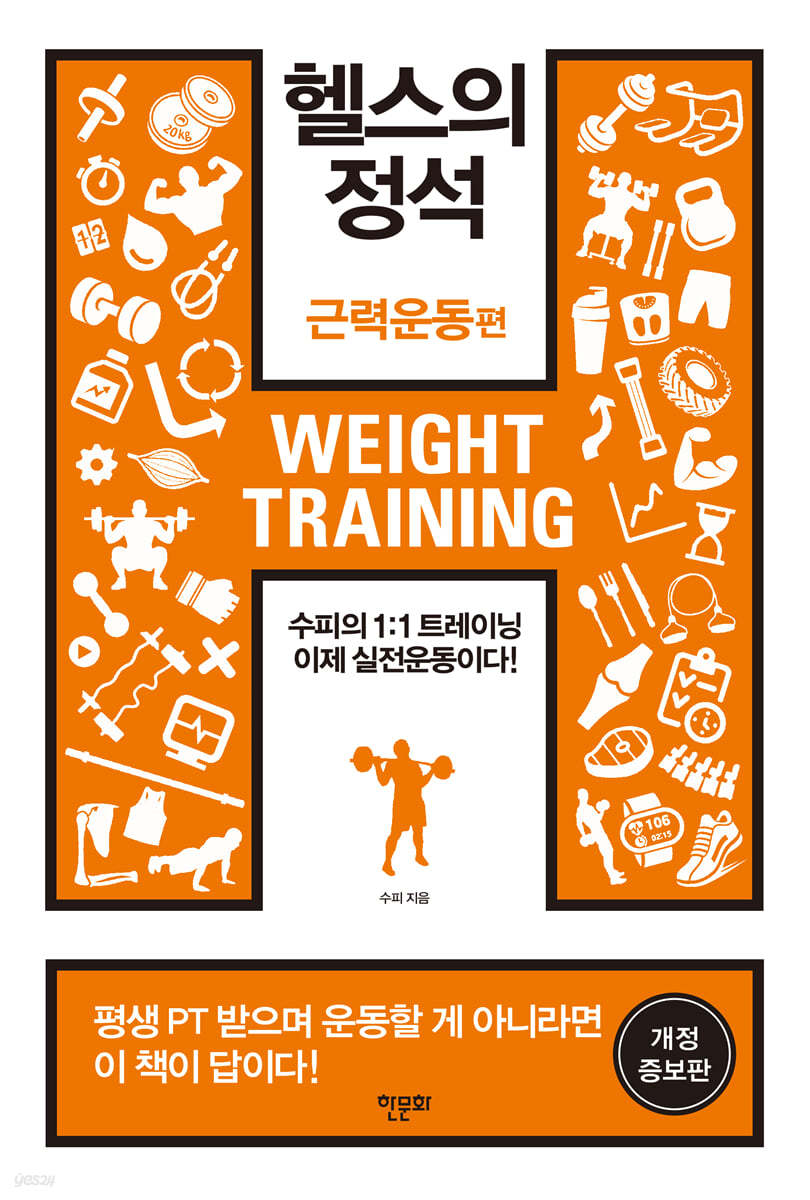
Fitness Essentials: Strength Training
 |
Description
Book Introduction
From beginner to trainer
Everything you need to know about strength training if you're a health person!
For seven years after the publication of 『The Essentials of Fitness: Strength Training』, it has been widely loved as a representative book that comprehensively summarizes the practical application of major fitness disciplines.
In the fitness field, new theories and trends emerge every year. First, with the emergence of many theories on muscle volume growth, the perspective on how and to what extent existing exercises should be performed to achieve faster muscle growth has changed.
Second, as new machines continue to appear, their evaluations also change.
This revised and expanded edition reflects the changes made over the years and adds new organizations and items.
In addition, we have supplemented important parts of the existing content and completely revised the explanations to make them easier to understand.
From understanding muscles, bones, body type, and movement to training for each area and designing a workout program tailored to your body, you'll find a thorough strength training guide that will satisfy everyone from absolute beginners to enthusiasts.
Everything you need to know about strength training if you're a health person!
For seven years after the publication of 『The Essentials of Fitness: Strength Training』, it has been widely loved as a representative book that comprehensively summarizes the practical application of major fitness disciplines.
In the fitness field, new theories and trends emerge every year. First, with the emergence of many theories on muscle volume growth, the perspective on how and to what extent existing exercises should be performed to achieve faster muscle growth has changed.
Second, as new machines continue to appear, their evaluations also change.
This revised and expanded edition reflects the changes made over the years and adds new organizations and items.
In addition, we have supplemented important parts of the existing content and completely revised the explanations to make them easier to understand.
From understanding muscles, bones, body type, and movement to training for each area and designing a workout program tailored to your body, you'll find a thorough strength training guide that will satisfy everyone from absolute beginners to enthusiasts.
- You can preview some of the book's contents.
Preview
index
·Preface to the Revised and Expanded Edition: What Has Changed and What Has Not Changed Over the Past Seven Years
·Preface to the First Edition Exercise is only completed when the body, not the head, remembers it!
Part 1.
Muscle and strength
Chapter 1.
Exercise and Muscles
1.
Muscle structure
Motor Units, Motor Units of the Nerve | Muscles and Connective Tissue | How to Strengthen Muscles
2.
Muscle changes after exercise
How does exercise build muscle? | How quickly do muscles shrink when you stop exercising?
Chapter 2.
How to become strong
1.
What it takes to become strong
Baseline Fitness, Strength, and Power | Strength Training vs. Power Training | Powerlifting, Weightlifting, and Sprinting
2.
Range of motion and strength
When Are Muscles Strongest? | Muscle Teamwork | Maximum Range of Motion vs. Partial Repetition | Lengthening Muscles is Key to Muscle Growth
3.
The Science of Body Chi: The Harmony of Nerves and Muscles
Mirror neurons | Proprioception | Coordination | Reaction speed
4.
The concept of response in strength training
Compound or isolation exercises? | Cheating or functionality? | Free weights? Machines? Bodyweight exercises?
5.
Dynamics of Training
The Principle of Moment and Lever | Where is the Body's Center of Gravity? | Strength Training, the Body's Center of Gravity, and Moment
Part 2.
Anatomy of Training by Body Part
Chapter 3.
Orientation
Barbells and Dumbbells | How many racks are in my gym? | What machines and cables are there? | How to hold exercise equipment | Clothing, shoes, and props | Breathing techniques for strength training | Little useful tips
Chapter 4.
Chest and shoulder exercises
1.
Structure of the shoulder complex
2.
chest exercises
Bench Press Basics | Bench Press: What You Need to Know: Wide or Narrow Grip | Proper Scapula Position | How to Hold the Barbell Properly in the Bench Press | Men's Bench Press, Women's Bench Press | To Lock Out or Not? | Why Does My Bench Press Weight Keep Going Up? | Assisting the Bench Press
Bench press variations: Incline bench press | Decline bench press | Dumbbell bench press | Close-grip bench press | Machine bench press | Powerlifting bench press | Reverse-grip bench press
Push-up Basics | Push-ups, What You Want to Know? How Does the Stimulus Point Change Depending on the Width of Your Hands? | Bare Hands vs. Push-up Bar: Which Is Better? | Effective Ways to Increase Your Push-Up Count | Push-up Variations: Decline and Incline Push-ups | Weighted Push-ups | Plyo Push-ups | Push-ups with One Hand Raised
Basic Dips | Dips Variations | Assisted Dips | Weighted Dips | Ring Dips
Chest Fly Basics | Chest Fly: What You Need to Know | Why Momentum Exercises Are So Difficult | Chest Fly Variations | Machine Chest Fly | Incline Dumbbell Fly | Cable Chest Fly
3.
shoulder exercises
Overhead Press Basics | Overhead Press, What You Need to Know | Shoulder Injuries from Overhead Presses | Why Can't I Straighten My Arms? | Standing vs. Seated | How to Hold a Barbell in an Overhead Press | Overhead Press Variations: Dumbbell Overhead Press | Behind-the-Neck Press | Arnold Press
Shoulder Raise Basics | Shoulder Raise: What's the Priority? Front, Lateral, and Bent-Over | What's the "Pouring Water" Position? | Shoulder Raise Variations: Front Raise | Bent-Over Lateral Raise | Cable and Machine Raise | Face Pull | Raise with a Change of Position
Upright Row Basics
Chapter 5.
back exercises
1.
Structure of the back
2.
back exercises
Basic Row Movement | Row, What You Want to Know | Muscles Acting Differently Depending on Grip Direction | Why Back Muscles Are Hard to Stimulate | Tips for Effective Back Exercise | Row Variations: Bent-Over Dumbbell Row | T-Bar Row | Parallel Row | Inverted Row | Pendlay Row
Basic Pulldown | Pulldown Variations: Behind-the-Neck Pulldown | V-Bar Pulldown | Pullover | Straight-Arm Pulldown
Basic Pull-Up Movement | Pull-Up, What You Want to Know? The Difference Between Pull-Downs and Pull-Ups | Common Pull-Up Mistakes and Cheating | Tips for Pull-Ups That Don't Work | To Dead Hang or Not? | Pull-Up Variations: Variations Based on Grip | Weighted Pull-Ups
Chapter 6.
Arm exercises
1.
Structure of the arm
Muscles that flex the arm | Muscles that extend the arm | Muscles that move the wrist and fingers
2.
Upper arm exercises
Bicep Curl Basics | Bicep Curl Variations | Straight Barbell vs. Curl Bar | Undergrip vs. Neutral vs. Overgrip | Barbell vs. Dumbbell | Preacher Curl, Concentration Curl, Incline Bench Curl | Free Weight vs. Machine, Cable | Drag Curl
Types of Triceps Compound Exercises: Close-grip Bench Press | Triceps Dips | Close-grip Push-ups
Basic Tricep Extension | Tricep Extension Variations | Lying Tricep Extension | Dumbbell Tricep Extension | Machine and Cable Extensions
Triceps Pressdown Basic Movement
Triceps Kickback Basic Movement
3.
Forearm exercises
List Curl | List Extension
Chapter 7.
Waist and abdominal exercises
1.
Structure of the central part of the body
Muscles of the central part of the body Muscles that support the spine from behind: erector spinae | Muscles that support the spine and pelvis from the front: quadratus lumborum, iliopsoas | Muscles surrounding the abdomen: rectus abdominis, obliques, transverse abdominis | Local muscles that hold the space between the vertebrae | When and when a lower back arch is needed Why was the arch emphasized to beginners? | Heavy training and lumbar lordosis | Abdominal exercises and arches
2.
Waist exercises
Deadlift Basics | Deadlift, What You Want to Know | Is Deadlift Really a Back Exercise? | The Correlation Between Deadlift and Body Type | Deadlift Stance | Deadlift Grip | Touch and Go vs. Dead Stop | There's a Bodyweight Squat, Why Isn't There a Bodyweight Deadlift? | Does the Barbell Hit Your Shins? | Deadlift Weight vs. Squat Weight | Women and the Deadlift | Deadlift Variations | Romanian Deadlift | Stiff-Legged Deadlift | Sumo Deadlift | Trap Bar Deadlift | Snatch-Grip Deadlift | Good Morning Exercise
Back Extension Basics | Back Extension, What You Need to Know | How to Adjust the Difficulty of Back Extensions | Things to Watch Out for When Doing Back Extensions | Back Extension Variations: Superman Pose | Front Cobra
3.
Abdominal exercises
Basic Sit-Up Movement | Sit-Up, What You Want to Know | Are Sit-Ups Useful for Abdominal Exercise? | Should I Do Sit-Ups or Not? | Abdominal Exercises and Breathing Techniques | Sit-Up Variations: Crunches | Machine and Cable Crunches | Twisted Sit-Ups, Crunches | Bicycle Maneuvers | Variations Using Posture
Basic Leg Raise | Leg Raise Variations: Hanging Leg Raise | Reverse Crunch
Functional Core Exercises: Plank | Hollow Body Hold | Rollout
Chapter 8.
Lower Body Exercises - Buttocks and Legs
01 Lower body structure
Hips | Thighs | Quadriceps | Hamstrings | Tensor fascia lata, Adductors | Calves
02 Lower body exercise
Squat preparation | Basic movements | Squat, I want to know that. How much should I lower my hips? | High bar and low bar, what's the difference? | I heard that your knees shouldn't go past your toes? | The many reasons why your back bends during a squat | Why do your knees come together at the bottom of a squat? | Should I raise my head or not? | Stance and stimulation areas | How does the barbell move in a squat? | Massage and stretching for squats | Squat speed | Squat variations: Front squat | Dumbbell squat | Box squat | Smith machine squat | V-squat machine
Leg Press Basics | Leg Press: What You Need to Know | Foot Positioning: Targeting Different Areas | Don't Be Fooled by Inflated Weights! | Power Leg Press and Hack Squat
Basic leg extension movements
Basic Lunge | Lunge Variations | Split Squat
Basic Leg Curl | Leg Curl Variations | The Difference Between Lying and Seated Leg Curls | Bodyweight Leg Curls
Hip thrust basic movement
Basic Calf Raise | Calf Raise Variations | Seated Calf Raise | Donkey Calf Raise | Toe Press
Part 3.
exercise program
Chapter 09 How to Create an Exercise Program
01 Basic Principles of Program Design
Principles of Muscle Development | How many days should I train and which part of my body? | Which exercises and in what order? | The equation of weight and reps | High weight: Strength | Medium weight: Muscle mass | Light weight: Muscle mass, endurance | How to increase weight? | Why rest is important | Special cases: Resuming exercise after a long break | If you have a chronic illness
02 Set up
Warm-up sets | How to distribute reps and weight for each main exercise set? Straight sets | Ampreps | Ascending sets | Descending sets | Pyramid sets | How many sets per day, for how many minutes? Number of sets per exercise | Total sets per day | Appropriate daily workout time | Modified sets for increased intensity | Multi-set method | Forced rep method | Other modifications
03 What do I need at my stage?
Guide based on exercise proficiency level: Beginners: Everything works for them | Intermediate: Change is key to success! | Advanced: Stagnant without special measures | Periodization of mid- to long-term programs | Weight management strategies | Examples of mid- to long-term cycle structures
Chapter 10.
Practical program
01 Warm-up and Cool-down
02 Fitness Program
Non-split fitness program for beginners Non-split fitness program for workout adaptation and deloading Pure machine workout | Machine workout level 1 | Machine workout level 2 | Home workout level 1 | Home workout level 2 | Intermediate Full-body non-split fitness program | Full-body circuit training for weight loss Bodyweight workout level 1 | Bodyweight workout level 2 | Machine workout | Split fitness program 2-split fitness program for beginners and intermediates Upper and lower body 2-split machine workout | Intermediate upper and lower body 2-split home workout | 3-split fitness program | 4, 5-split fitness program | Combined split program
03 Strength Program
Characteristics of strength programs Where should a beginner lifter start with weights? | Not all strength training is the same | Structure of a strength program | Beginner strength program Beginner strength level 1 | Beginner strength level 2 | Intermediate strength upper and lower body split program Intermediate strength level 1 | Intermediate strength level 2 | Advanced strength program One exercise per day intensive training program | 12-week powerlifting program | Heavy weight spot program | Representative strength routines from abroad Bill Starr's 5x5 routine | Other 5x5 routines Strength routine | Mark Rippetoe's routine | Texas method | Westside Barbell's variation method | Shaco's routine | Jim Wendler's 5/3/1 routine | Candito's routine
04 Hybrid Program
Daily Add-on Program for Mass Gain | Power/Strength Combination Program | Mass/Strength Combination Program | Monthly Hybrid Program
? Take a break
I want to run well! | Does more body fat make you stronger? | The magic of mirrors | Delicious anatomy with Chi-neunim 1 | What should I do when I get crushed by a barbell on the bench? | Why can't I loosen the screws I tightened? | The balance between outer and inner muscles | Anatomy time at a barbecue restaurant | Abs, what do I want to know about them? | Delicious anatomy with Chi-neunim 2 | Should I do full squats or half squats? | High bar or low bar: which puts more strain on the lower back? | Bodyweight squats are more difficult? | Exercises to avoid on the Smith machine vs. exercises that are actually beneficial | How to get rid of cramps in your hamstrings and calves | It's difficult to get thinner or thicker calves | Should I include deadlifts in my upper body or lower body workout? | Can I build muscle mass with low weights? | The principle of diminishing returns and the principle of marginal utility in exercise | The habit of recording
? Think about it more
The Secret Behind Grip Strength | Hip Roll | What Does 1-3-5-12 Mean in Rep Counts? | How to Determine Rep Count and Set Count in Strength Training
·Weekly exercise log
·main
·Preface to the First Edition Exercise is only completed when the body, not the head, remembers it!
Part 1.
Muscle and strength
Chapter 1.
Exercise and Muscles
1.
Muscle structure
Motor Units, Motor Units of the Nerve | Muscles and Connective Tissue | How to Strengthen Muscles
2.
Muscle changes after exercise
How does exercise build muscle? | How quickly do muscles shrink when you stop exercising?
Chapter 2.
How to become strong
1.
What it takes to become strong
Baseline Fitness, Strength, and Power | Strength Training vs. Power Training | Powerlifting, Weightlifting, and Sprinting
2.
Range of motion and strength
When Are Muscles Strongest? | Muscle Teamwork | Maximum Range of Motion vs. Partial Repetition | Lengthening Muscles is Key to Muscle Growth
3.
The Science of Body Chi: The Harmony of Nerves and Muscles
Mirror neurons | Proprioception | Coordination | Reaction speed
4.
The concept of response in strength training
Compound or isolation exercises? | Cheating or functionality? | Free weights? Machines? Bodyweight exercises?
5.
Dynamics of Training
The Principle of Moment and Lever | Where is the Body's Center of Gravity? | Strength Training, the Body's Center of Gravity, and Moment
Part 2.
Anatomy of Training by Body Part
Chapter 3.
Orientation
Barbells and Dumbbells | How many racks are in my gym? | What machines and cables are there? | How to hold exercise equipment | Clothing, shoes, and props | Breathing techniques for strength training | Little useful tips
Chapter 4.
Chest and shoulder exercises
1.
Structure of the shoulder complex
2.
chest exercises
Bench Press Basics | Bench Press: What You Need to Know: Wide or Narrow Grip | Proper Scapula Position | How to Hold the Barbell Properly in the Bench Press | Men's Bench Press, Women's Bench Press | To Lock Out or Not? | Why Does My Bench Press Weight Keep Going Up? | Assisting the Bench Press
Bench press variations: Incline bench press | Decline bench press | Dumbbell bench press | Close-grip bench press | Machine bench press | Powerlifting bench press | Reverse-grip bench press
Push-up Basics | Push-ups, What You Want to Know? How Does the Stimulus Point Change Depending on the Width of Your Hands? | Bare Hands vs. Push-up Bar: Which Is Better? | Effective Ways to Increase Your Push-Up Count | Push-up Variations: Decline and Incline Push-ups | Weighted Push-ups | Plyo Push-ups | Push-ups with One Hand Raised
Basic Dips | Dips Variations | Assisted Dips | Weighted Dips | Ring Dips
Chest Fly Basics | Chest Fly: What You Need to Know | Why Momentum Exercises Are So Difficult | Chest Fly Variations | Machine Chest Fly | Incline Dumbbell Fly | Cable Chest Fly
3.
shoulder exercises
Overhead Press Basics | Overhead Press, What You Need to Know | Shoulder Injuries from Overhead Presses | Why Can't I Straighten My Arms? | Standing vs. Seated | How to Hold a Barbell in an Overhead Press | Overhead Press Variations: Dumbbell Overhead Press | Behind-the-Neck Press | Arnold Press
Shoulder Raise Basics | Shoulder Raise: What's the Priority? Front, Lateral, and Bent-Over | What's the "Pouring Water" Position? | Shoulder Raise Variations: Front Raise | Bent-Over Lateral Raise | Cable and Machine Raise | Face Pull | Raise with a Change of Position
Upright Row Basics
Chapter 5.
back exercises
1.
Structure of the back
2.
back exercises
Basic Row Movement | Row, What You Want to Know | Muscles Acting Differently Depending on Grip Direction | Why Back Muscles Are Hard to Stimulate | Tips for Effective Back Exercise | Row Variations: Bent-Over Dumbbell Row | T-Bar Row | Parallel Row | Inverted Row | Pendlay Row
Basic Pulldown | Pulldown Variations: Behind-the-Neck Pulldown | V-Bar Pulldown | Pullover | Straight-Arm Pulldown
Basic Pull-Up Movement | Pull-Up, What You Want to Know? The Difference Between Pull-Downs and Pull-Ups | Common Pull-Up Mistakes and Cheating | Tips for Pull-Ups That Don't Work | To Dead Hang or Not? | Pull-Up Variations: Variations Based on Grip | Weighted Pull-Ups
Chapter 6.
Arm exercises
1.
Structure of the arm
Muscles that flex the arm | Muscles that extend the arm | Muscles that move the wrist and fingers
2.
Upper arm exercises
Bicep Curl Basics | Bicep Curl Variations | Straight Barbell vs. Curl Bar | Undergrip vs. Neutral vs. Overgrip | Barbell vs. Dumbbell | Preacher Curl, Concentration Curl, Incline Bench Curl | Free Weight vs. Machine, Cable | Drag Curl
Types of Triceps Compound Exercises: Close-grip Bench Press | Triceps Dips | Close-grip Push-ups
Basic Tricep Extension | Tricep Extension Variations | Lying Tricep Extension | Dumbbell Tricep Extension | Machine and Cable Extensions
Triceps Pressdown Basic Movement
Triceps Kickback Basic Movement
3.
Forearm exercises
List Curl | List Extension
Chapter 7.
Waist and abdominal exercises
1.
Structure of the central part of the body
Muscles of the central part of the body Muscles that support the spine from behind: erector spinae | Muscles that support the spine and pelvis from the front: quadratus lumborum, iliopsoas | Muscles surrounding the abdomen: rectus abdominis, obliques, transverse abdominis | Local muscles that hold the space between the vertebrae | When and when a lower back arch is needed Why was the arch emphasized to beginners? | Heavy training and lumbar lordosis | Abdominal exercises and arches
2.
Waist exercises
Deadlift Basics | Deadlift, What You Want to Know | Is Deadlift Really a Back Exercise? | The Correlation Between Deadlift and Body Type | Deadlift Stance | Deadlift Grip | Touch and Go vs. Dead Stop | There's a Bodyweight Squat, Why Isn't There a Bodyweight Deadlift? | Does the Barbell Hit Your Shins? | Deadlift Weight vs. Squat Weight | Women and the Deadlift | Deadlift Variations | Romanian Deadlift | Stiff-Legged Deadlift | Sumo Deadlift | Trap Bar Deadlift | Snatch-Grip Deadlift | Good Morning Exercise
Back Extension Basics | Back Extension, What You Need to Know | How to Adjust the Difficulty of Back Extensions | Things to Watch Out for When Doing Back Extensions | Back Extension Variations: Superman Pose | Front Cobra
3.
Abdominal exercises
Basic Sit-Up Movement | Sit-Up, What You Want to Know | Are Sit-Ups Useful for Abdominal Exercise? | Should I Do Sit-Ups or Not? | Abdominal Exercises and Breathing Techniques | Sit-Up Variations: Crunches | Machine and Cable Crunches | Twisted Sit-Ups, Crunches | Bicycle Maneuvers | Variations Using Posture
Basic Leg Raise | Leg Raise Variations: Hanging Leg Raise | Reverse Crunch
Functional Core Exercises: Plank | Hollow Body Hold | Rollout
Chapter 8.
Lower Body Exercises - Buttocks and Legs
01 Lower body structure
Hips | Thighs | Quadriceps | Hamstrings | Tensor fascia lata, Adductors | Calves
02 Lower body exercise
Squat preparation | Basic movements | Squat, I want to know that. How much should I lower my hips? | High bar and low bar, what's the difference? | I heard that your knees shouldn't go past your toes? | The many reasons why your back bends during a squat | Why do your knees come together at the bottom of a squat? | Should I raise my head or not? | Stance and stimulation areas | How does the barbell move in a squat? | Massage and stretching for squats | Squat speed | Squat variations: Front squat | Dumbbell squat | Box squat | Smith machine squat | V-squat machine
Leg Press Basics | Leg Press: What You Need to Know | Foot Positioning: Targeting Different Areas | Don't Be Fooled by Inflated Weights! | Power Leg Press and Hack Squat
Basic leg extension movements
Basic Lunge | Lunge Variations | Split Squat
Basic Leg Curl | Leg Curl Variations | The Difference Between Lying and Seated Leg Curls | Bodyweight Leg Curls
Hip thrust basic movement
Basic Calf Raise | Calf Raise Variations | Seated Calf Raise | Donkey Calf Raise | Toe Press
Part 3.
exercise program
Chapter 09 How to Create an Exercise Program
01 Basic Principles of Program Design
Principles of Muscle Development | How many days should I train and which part of my body? | Which exercises and in what order? | The equation of weight and reps | High weight: Strength | Medium weight: Muscle mass | Light weight: Muscle mass, endurance | How to increase weight? | Why rest is important | Special cases: Resuming exercise after a long break | If you have a chronic illness
02 Set up
Warm-up sets | How to distribute reps and weight for each main exercise set? Straight sets | Ampreps | Ascending sets | Descending sets | Pyramid sets | How many sets per day, for how many minutes? Number of sets per exercise | Total sets per day | Appropriate daily workout time | Modified sets for increased intensity | Multi-set method | Forced rep method | Other modifications
03 What do I need at my stage?
Guide based on exercise proficiency level: Beginners: Everything works for them | Intermediate: Change is key to success! | Advanced: Stagnant without special measures | Periodization of mid- to long-term programs | Weight management strategies | Examples of mid- to long-term cycle structures
Chapter 10.
Practical program
01 Warm-up and Cool-down
02 Fitness Program
Non-split fitness program for beginners Non-split fitness program for workout adaptation and deloading Pure machine workout | Machine workout level 1 | Machine workout level 2 | Home workout level 1 | Home workout level 2 | Intermediate Full-body non-split fitness program | Full-body circuit training for weight loss Bodyweight workout level 1 | Bodyweight workout level 2 | Machine workout | Split fitness program 2-split fitness program for beginners and intermediates Upper and lower body 2-split machine workout | Intermediate upper and lower body 2-split home workout | 3-split fitness program | 4, 5-split fitness program | Combined split program
03 Strength Program
Characteristics of strength programs Where should a beginner lifter start with weights? | Not all strength training is the same | Structure of a strength program | Beginner strength program Beginner strength level 1 | Beginner strength level 2 | Intermediate strength upper and lower body split program Intermediate strength level 1 | Intermediate strength level 2 | Advanced strength program One exercise per day intensive training program | 12-week powerlifting program | Heavy weight spot program | Representative strength routines from abroad Bill Starr's 5x5 routine | Other 5x5 routines Strength routine | Mark Rippetoe's routine | Texas method | Westside Barbell's variation method | Shaco's routine | Jim Wendler's 5/3/1 routine | Candito's routine
04 Hybrid Program
Daily Add-on Program for Mass Gain | Power/Strength Combination Program | Mass/Strength Combination Program | Monthly Hybrid Program
? Take a break
I want to run well! | Does more body fat make you stronger? | The magic of mirrors | Delicious anatomy with Chi-neunim 1 | What should I do when I get crushed by a barbell on the bench? | Why can't I loosen the screws I tightened? | The balance between outer and inner muscles | Anatomy time at a barbecue restaurant | Abs, what do I want to know about them? | Delicious anatomy with Chi-neunim 2 | Should I do full squats or half squats? | High bar or low bar: which puts more strain on the lower back? | Bodyweight squats are more difficult? | Exercises to avoid on the Smith machine vs. exercises that are actually beneficial | How to get rid of cramps in your hamstrings and calves | It's difficult to get thinner or thicker calves | Should I include deadlifts in my upper body or lower body workout? | Can I build muscle mass with low weights? | The principle of diminishing returns and the principle of marginal utility in exercise | The habit of recording
? Think about it more
The Secret Behind Grip Strength | Hip Roll | What Does 1-3-5-12 Mean in Rep Counts? | How to Determine Rep Count and Set Count in Strength Training
·Weekly exercise log
·main
Into the book
We tracked the lower body muscles of marathoners and observed the process by which new proteins settle into the muscles and complete adaptation, and found that it took at least 1 to 3 months.
What I'm saying is that the stimulation I'm giving my chest muscles by bench pressing like crazy right now will only show up as muscle after at least a month.
There are tons of crappy photos online of people getting a "2-week body", but in reality, they've only lost some body fat and their muscles have gotten a little bloated from water, so the workout they did on the first day hasn't even turned into muscle yet.
--- From "01 'Exercise and Muscles'"
Even the everyday movement of sitting down and standing up requires numerous individual movements that must be combined with precise timing and intensity: 'strengthening the lower back, stabilizing the ankles, pulling the buttocks, and straightening the knees.'
The nervous system, through trial and error, groups all of these together into a set and remembers it as a 'pattern'.
This is said to be the creation of an engram (memory trace).
(…) If you are not overweight and strong but can't do chin-ups, the reason is simple.
Because I haven't tried it.
The hardware performance is sufficient, but there is no chin-up software.
So when you first try to hang on the horizontal bar, you can only struggle and not climb.
Because the brain has no idea when to use the biceps and when to use the latissimus dorsi and teres major.
The cerebral cortex, which is responsible for cognitive functions, might curse, saying, "Oh, this is really not working!", but another part of the brain analyzes these trial and errors and creates engrams.
--- From "02 'How to Become Strong'"
For pushing exercises like the bench press or overhead press, hold the bar at an angle with your palms.
Holding it this way causes the barbell to rest on the fleshy part of the palm, which is in a vertical line with the forearm, reducing the risk of your wrists bending backwards.
When viewed from the front, the hand may appear slightly tilted toward the thumb, and the little finger may be slightly raised, but this is perfectly normal.
--- From "03 'Orientation'"
Why do people love deadlifts so much, even though they're not the most efficient back exercise? It's because they recruit the most muscle groups, with the highest intensity.
It can instantly train the muscles and nerves of the entire body and the coordination, and also strongly stimulates anabolic hormones.
Although it does not emphasize a specific body part like other isolation exercises, it acts as a tonic that enhances the effects of other exercises.
--- From "07 'Back Exercise and Abdominal Exercise'"
Some people want to have thicker lower bodies, while others want to have thinner lower bodies, but the types of lower body exercises they do don't change accordingly.
However, depending on how you structure your workout, you can either bulk up your leg muscles or create long, slender legs with defined lines.
If you want thick, muscular legs, you'll usually load more weight on your quadriceps, especially the three vasti.
If you want a strong butt and balanced legs, it's better to load your glutes, hamstrings, and rectus femoris.
It is okay for your knees to come out slightly as long as your center of gravity is behind your feet and your knees and toes are pointing in the same direction.
Rather, if you try to force your knees back, your upper body will tilt excessively or your back will bend, causing your posture to collapse.
On the other hand, if your knees are excessively extended during half squats or low bar squats, widen your stance a bit, bend your upper body, and push your hips back so that your knees will naturally fall back.
--- From "08 'Lower Body Exercise - Buttocks and Legs'"
It's easy to believe that light weight training is safe, but in reality, it's easy to lose focus, become too focused on completing reps, and ruin your form.
This is also why injuries are common in sports like CrossFit, which emphasize time and repetitions.
Even beginners can easily ruin their posture with excessive repetitions, so in principle, perform no more than 15 repetitions, and instead, minimize rest periods to increase stimulation.
--- From "09 'How to Create an Exercise Program'"
Strength programs are limited to the three major exercises, their variations, and assistance exercises, so the number of exercises is small.
Accessory exercises are also large compound movements like power cleans, pull-ups, and barbell rows, and isolation exercises are not often performed.
In a strength program, the key is not so much splitting by body part, but rather maximizing weight, volume (total reps), tonnage, and fatigue management.
What I'm saying is that the stimulation I'm giving my chest muscles by bench pressing like crazy right now will only show up as muscle after at least a month.
There are tons of crappy photos online of people getting a "2-week body", but in reality, they've only lost some body fat and their muscles have gotten a little bloated from water, so the workout they did on the first day hasn't even turned into muscle yet.
--- From "01 'Exercise and Muscles'"
Even the everyday movement of sitting down and standing up requires numerous individual movements that must be combined with precise timing and intensity: 'strengthening the lower back, stabilizing the ankles, pulling the buttocks, and straightening the knees.'
The nervous system, through trial and error, groups all of these together into a set and remembers it as a 'pattern'.
This is said to be the creation of an engram (memory trace).
(…) If you are not overweight and strong but can't do chin-ups, the reason is simple.
Because I haven't tried it.
The hardware performance is sufficient, but there is no chin-up software.
So when you first try to hang on the horizontal bar, you can only struggle and not climb.
Because the brain has no idea when to use the biceps and when to use the latissimus dorsi and teres major.
The cerebral cortex, which is responsible for cognitive functions, might curse, saying, "Oh, this is really not working!", but another part of the brain analyzes these trial and errors and creates engrams.
--- From "02 'How to Become Strong'"
For pushing exercises like the bench press or overhead press, hold the bar at an angle with your palms.
Holding it this way causes the barbell to rest on the fleshy part of the palm, which is in a vertical line with the forearm, reducing the risk of your wrists bending backwards.
When viewed from the front, the hand may appear slightly tilted toward the thumb, and the little finger may be slightly raised, but this is perfectly normal.
--- From "03 'Orientation'"
Why do people love deadlifts so much, even though they're not the most efficient back exercise? It's because they recruit the most muscle groups, with the highest intensity.
It can instantly train the muscles and nerves of the entire body and the coordination, and also strongly stimulates anabolic hormones.
Although it does not emphasize a specific body part like other isolation exercises, it acts as a tonic that enhances the effects of other exercises.
--- From "07 'Back Exercise and Abdominal Exercise'"
Some people want to have thicker lower bodies, while others want to have thinner lower bodies, but the types of lower body exercises they do don't change accordingly.
However, depending on how you structure your workout, you can either bulk up your leg muscles or create long, slender legs with defined lines.
If you want thick, muscular legs, you'll usually load more weight on your quadriceps, especially the three vasti.
If you want a strong butt and balanced legs, it's better to load your glutes, hamstrings, and rectus femoris.
It is okay for your knees to come out slightly as long as your center of gravity is behind your feet and your knees and toes are pointing in the same direction.
Rather, if you try to force your knees back, your upper body will tilt excessively or your back will bend, causing your posture to collapse.
On the other hand, if your knees are excessively extended during half squats or low bar squats, widen your stance a bit, bend your upper body, and push your hips back so that your knees will naturally fall back.
--- From "08 'Lower Body Exercise - Buttocks and Legs'"
It's easy to believe that light weight training is safe, but in reality, it's easy to lose focus, become too focused on completing reps, and ruin your form.
This is also why injuries are common in sports like CrossFit, which emphasize time and repetitions.
Even beginners can easily ruin their posture with excessive repetitions, so in principle, perform no more than 15 repetitions, and instead, minimize rest periods to increase stimulation.
--- From "09 'How to Create an Exercise Program'"
Strength programs are limited to the three major exercises, their variations, and assistance exercises, so the number of exercises is small.
Accessory exercises are also large compound movements like power cleans, pull-ups, and barbell rows, and isolation exercises are not often performed.
In a strength program, the key is not so much splitting by body part, but rather maximizing weight, volume (total reps), tonnage, and fatigue management.
--- From "10 'Practical Programs'"
Publisher's Review
Sufi, the master of fitness, is back.
This time it's real exercise!
The more I exercise, the more questions I have, but there's no one to ask, it's hard to fact-check information online, I can't trust everything the "professionals" at the gym say, and each trainer's words are different...
For readers who are 'lost in the world of fitness', 'Fitness Essentials - Theory' clearly shows what real exercise is, one that requires a proper understanding of one's body and the principles of exercise.
This time it's a real exercise.
It is neither a picture book-style exercise book full of only movement photos nor a difficult exercise book full of unfamiliar terms.
"The Essentials of Fitness - Strength Training" is a proper strength training guide that provides specific information on "what kind of exercise, how, and how much" to do for readers who are curious about specific exercise methods and thirsty for an efficient exercise program optimized for their body.
Supi's unique skill of making in-depth content comparable to that of a professional textbook easy for anyone to understand and follow is fully demonstrated in the strength training section.
From beginner to trainer, from theory to practice
Everything you need to know about strength training!
Among people who exercise, the name 'Sufi' alone is enough to make them believe in him and he is a power blogger with great influence and recognition.
The author says he is neither an athlete nor a professional trainer, nor was he even born with a good body.
The "Health Essentials" series, which contains the knowledge and experience the author has gained over 20 years of exercise, is rewriting the history of exercise books.
Anyone who knows anything about Sufi's book knows that there are no secrets to getting in shape in a few weeks or magical diets to lose 10kg in a month.
However, there are effective and surefire ways to build muscle and strength through exercise in a healthy way.
The principle of prioritizing common sense over shortcuts or superstitions remains unchanged in 『The Essentials of Fitness - Strength Training』.
That's why so many readers trust Sufi's books and wait for the next one.
Strength is the basis of all exercise and the basis of physical fitness.
Strength training is essential for building a great body, preventing weight gain, maintaining strength, slowing down aging, and even enduring frequent overtime work and late company dinners.
So, most of the most popular gym exercises are strength training.
However, compared to aerobic exercise, which is easy for beginners to start, strength training is difficult to try without experience.
Moreover, if you exercise with weights without understanding the body or knowledge about exercise, it will only result in injuries and wounds.
If you just go to the gym, you'll get frustrated in front of the countless exercise machines and lose interest before you even get a taste of strength training.
Because everyone has a different body type and ability to follow exercise, strength training requires detailed guidance that goes beyond simple movement explanations.
So, Supi guides you through the basics of strength training, which is difficult to start even though it is necessary.
Beginners can start with a solid foundation, while intermediate and advanced users can overcome plateaus and exercise more efficiently.
With Sufi's 1:1 training
Experience real strength training tailored to your body!
『The Essentials of Fitness - Strength Training』 is divided into three parts.
Part 1, 'Muscle Power', covers the theory of strength training and covers muscles, bones, body shape, and movement from a more practical perspective.
Part 2, "Analysis of Body Part Training," covers specific exercises for each body part: chest, shoulders, back, arms, waist, abs, and lower body.
Part 3, 'Exercise Program', covers the principles and methods of designing a program optimized for your body, as well as specific practical programs.
In particular, Part 3, ‘Exercise Program,’ clearly shows the difference from other exercise books.
It systematically presents everything from the principles and methods of creating exercise programs to examples of exercise programs, dedicating over 100 pages to the program.
It shows the basics of an effective exercise program, encompassing fitness programs, strength programs, and hybrid programs.
People who exercise alone, people who have finished personal training and are now on their own, exercise enthusiasts, and health trainers can all make full use of it according to their exercise level and purpose.
If I were to reveal one of Soo-Pi's workout tips, it would be to advise, "Focus on the quality of your sets rather than the number of sets."
A poorly finished set is nothing more than a waste of energy.
Exercise is only complete when the body remembers it, not the head.
Now it's time to hit it with your body.
Bench press? Deadlift? Squat? Learn them properly from Soupy! Soupy's "Fitness Essentials - Strength Training" will help you perform the most effective exercises you need right now.
If you have any questions about strength training, ask Sufi!
·How long will it take for the exercise I did today to turn into actual muscle?
·Why is it that my friend who looks worse than me is better at sports?
·How quickly do muscles shrink when you stop exercising?
·Why is the bench press weight the only one that doesn't increase?
·Why don't I feel much stimulation from back exercises?
·Is deadlift really a back exercise?
·There are bodyweight squats, so why isn't there a bodyweight deadlift?
·Should I increase the weight or the number of reps?
·What types of sports should I do, in what order, and for how long?
·How are bodybuilder workouts different from powerlifter workouts?
“Exercise should be done with the body, not the head.
When reading, we primarily use the cognitive areas of the cerebral cortex, but the areas that actually control movement are much deeper.
Even if you read this book a hundred times and memorize it, it may not be as good as experiencing it for yourself once.
Even if you have a lot of knowledge about exercise in your head, it is meaningless if your body, that is, your motor nerves, cannot remember it.
There may be parts that you didn't understand when reading the book that you will understand right away when you actually put them into practice.
I hope this book will be a starting point for those who don't even know the names of the equipment, to intermediate and advanced users who 'do it but have no idea if they are doing it right' to 'learn' it through their own experience."
- From the preface
If you're not going to be receiving PT for the rest of your life, this book is the answer!
This time it's real exercise!
The more I exercise, the more questions I have, but there's no one to ask, it's hard to fact-check information online, I can't trust everything the "professionals" at the gym say, and each trainer's words are different...
For readers who are 'lost in the world of fitness', 'Fitness Essentials - Theory' clearly shows what real exercise is, one that requires a proper understanding of one's body and the principles of exercise.
This time it's a real exercise.
It is neither a picture book-style exercise book full of only movement photos nor a difficult exercise book full of unfamiliar terms.
"The Essentials of Fitness - Strength Training" is a proper strength training guide that provides specific information on "what kind of exercise, how, and how much" to do for readers who are curious about specific exercise methods and thirsty for an efficient exercise program optimized for their body.
Supi's unique skill of making in-depth content comparable to that of a professional textbook easy for anyone to understand and follow is fully demonstrated in the strength training section.
From beginner to trainer, from theory to practice
Everything you need to know about strength training!
Among people who exercise, the name 'Sufi' alone is enough to make them believe in him and he is a power blogger with great influence and recognition.
The author says he is neither an athlete nor a professional trainer, nor was he even born with a good body.
The "Health Essentials" series, which contains the knowledge and experience the author has gained over 20 years of exercise, is rewriting the history of exercise books.
Anyone who knows anything about Sufi's book knows that there are no secrets to getting in shape in a few weeks or magical diets to lose 10kg in a month.
However, there are effective and surefire ways to build muscle and strength through exercise in a healthy way.
The principle of prioritizing common sense over shortcuts or superstitions remains unchanged in 『The Essentials of Fitness - Strength Training』.
That's why so many readers trust Sufi's books and wait for the next one.
Strength is the basis of all exercise and the basis of physical fitness.
Strength training is essential for building a great body, preventing weight gain, maintaining strength, slowing down aging, and even enduring frequent overtime work and late company dinners.
So, most of the most popular gym exercises are strength training.
However, compared to aerobic exercise, which is easy for beginners to start, strength training is difficult to try without experience.
Moreover, if you exercise with weights without understanding the body or knowledge about exercise, it will only result in injuries and wounds.
If you just go to the gym, you'll get frustrated in front of the countless exercise machines and lose interest before you even get a taste of strength training.
Because everyone has a different body type and ability to follow exercise, strength training requires detailed guidance that goes beyond simple movement explanations.
So, Supi guides you through the basics of strength training, which is difficult to start even though it is necessary.
Beginners can start with a solid foundation, while intermediate and advanced users can overcome plateaus and exercise more efficiently.
With Sufi's 1:1 training
Experience real strength training tailored to your body!
『The Essentials of Fitness - Strength Training』 is divided into three parts.
Part 1, 'Muscle Power', covers the theory of strength training and covers muscles, bones, body shape, and movement from a more practical perspective.
Part 2, "Analysis of Body Part Training," covers specific exercises for each body part: chest, shoulders, back, arms, waist, abs, and lower body.
Part 3, 'Exercise Program', covers the principles and methods of designing a program optimized for your body, as well as specific practical programs.
In particular, Part 3, ‘Exercise Program,’ clearly shows the difference from other exercise books.
It systematically presents everything from the principles and methods of creating exercise programs to examples of exercise programs, dedicating over 100 pages to the program.
It shows the basics of an effective exercise program, encompassing fitness programs, strength programs, and hybrid programs.
People who exercise alone, people who have finished personal training and are now on their own, exercise enthusiasts, and health trainers can all make full use of it according to their exercise level and purpose.
If I were to reveal one of Soo-Pi's workout tips, it would be to advise, "Focus on the quality of your sets rather than the number of sets."
A poorly finished set is nothing more than a waste of energy.
Exercise is only complete when the body remembers it, not the head.
Now it's time to hit it with your body.
Bench press? Deadlift? Squat? Learn them properly from Soupy! Soupy's "Fitness Essentials - Strength Training" will help you perform the most effective exercises you need right now.
If you have any questions about strength training, ask Sufi!
·How long will it take for the exercise I did today to turn into actual muscle?
·Why is it that my friend who looks worse than me is better at sports?
·How quickly do muscles shrink when you stop exercising?
·Why is the bench press weight the only one that doesn't increase?
·Why don't I feel much stimulation from back exercises?
·Is deadlift really a back exercise?
·There are bodyweight squats, so why isn't there a bodyweight deadlift?
·Should I increase the weight or the number of reps?
·What types of sports should I do, in what order, and for how long?
·How are bodybuilder workouts different from powerlifter workouts?
“Exercise should be done with the body, not the head.
When reading, we primarily use the cognitive areas of the cerebral cortex, but the areas that actually control movement are much deeper.
Even if you read this book a hundred times and memorize it, it may not be as good as experiencing it for yourself once.
Even if you have a lot of knowledge about exercise in your head, it is meaningless if your body, that is, your motor nerves, cannot remember it.
There may be parts that you didn't understand when reading the book that you will understand right away when you actually put them into practice.
I hope this book will be a starting point for those who don't even know the names of the equipment, to intermediate and advanced users who 'do it but have no idea if they are doing it right' to 'learn' it through their own experience."
- From the preface
If you're not going to be receiving PT for the rest of your life, this book is the answer!
GOODS SPECIFICS
- Date of issue: November 10, 2023
- Page count, weight, size: 492 pages | 152*225*30mm
- ISBN13: 9788956994550
- ISBN10: 8956994552
You may also like
카테고리
korean


korean

![ELLE 엘르 스페셜 에디션 A형 : 12월 [2025]](http://librairie.coreenne.fr/cdn/shop/files/b8e27a3de6c9538896439686c6b0e8fb.jpg?v=1766436872&width=3840)


