

Almost everything about cars
 |
Description
Book Introduction
'My hobby is cars.'
Written by a CEO who lives and dies by his cars
The One and Only Car Book
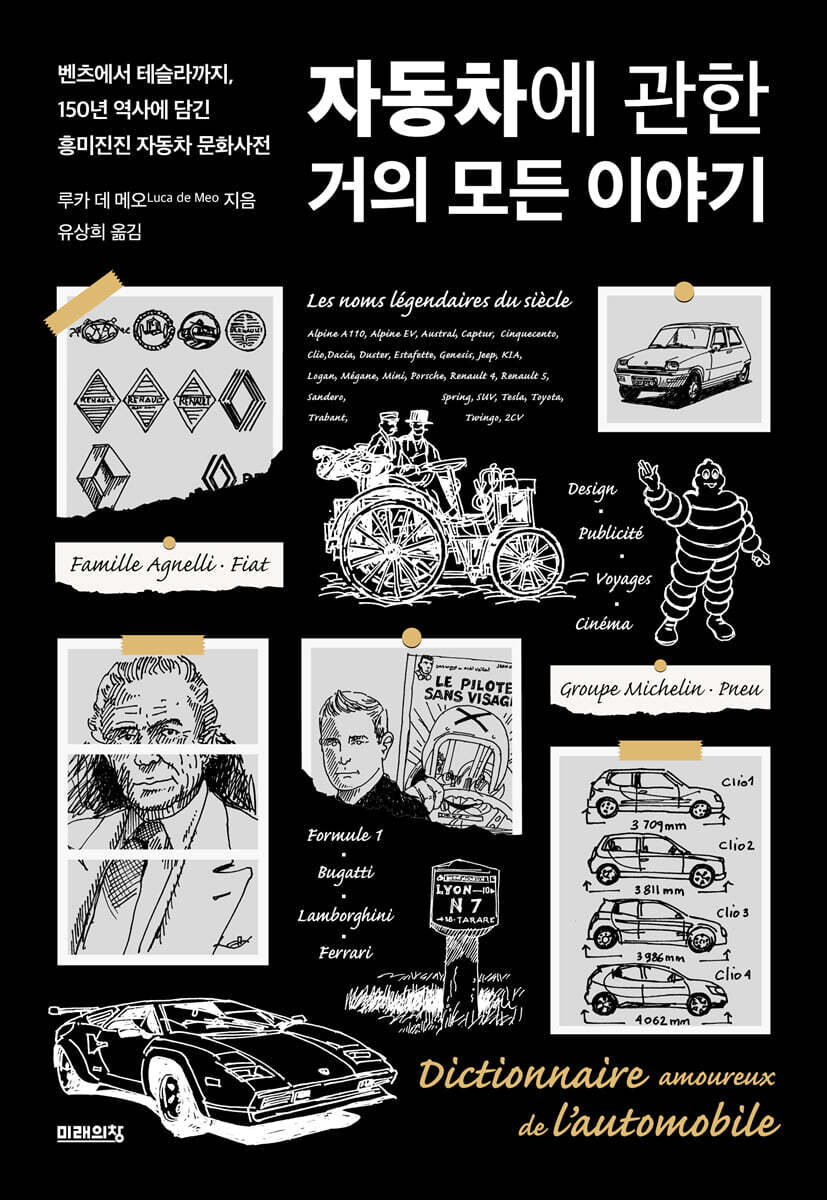
Luca de Meo, CEO of Kering, the French luxury group that owns brands like Gucci, Yves Saint Laurent, and Balenciaga, tells almost everything about cars he has accumulated over the years at Renault, Toyota Europe, Fiat Group, and Volkswagen Group.
As the author's biography suggests, automobiles are not simply a means of transportation, but a mirror reflecting culture, history, industry, and human passion.
It explores the stories of various brands and models, including Renault, Fiat, Volkswagen, and Bugatti, as well as how automobiles have shaped national identity and social change.
This book, a "car humanities dictionary in one volume," includes writings not only from the author but also from executives, designers, and racing drivers from various brands, covering everything from technological innovation and environmental crises to the transition to electric vehicles and the future opened up by autonomous driving. Through this book, readers will gain another perspective on the times, along with automobiles.
Written by a CEO who lives and dies by his cars
The One and Only Car Book
Luca de Meo, CEO of Kering, the French luxury group that owns brands like Gucci, Yves Saint Laurent, and Balenciaga, tells almost everything about cars he has accumulated over the years at Renault, Toyota Europe, Fiat Group, and Volkswagen Group.
As the author's biography suggests, automobiles are not simply a means of transportation, but a mirror reflecting culture, history, industry, and human passion.
It explores the stories of various brands and models, including Renault, Fiat, Volkswagen, and Bugatti, as well as how automobiles have shaped national identity and social change.
This book, a "car humanities dictionary in one volume," includes writings not only from the author but also from executives, designers, and racing drivers from various brands, covering everything from technological innovation and environmental crises to the transition to electric vehicles and the future opened up by autonomous driving. Through this book, readers will gain another perspective on the times, along with automobiles.
index
introduction
Route 66 | Formula 1 | SUVs | Generation Z
Leather | Advertisement | Google | Kia
D_Dacia | Dakar | Germany | Design | Detroit | Tintin
Lamborghini | Robot | Rotary | Rolls-Royce | Louis Renault | Renault | Renault 5 | 24 Hours of Le Mans | Lee Iacocca
ㅁ_Weight | Unlicensed | Mini
B_Semiconductor | Battery | License Plate | Crime | Fine Notice | Wolfsburg | Bugatti | Brand | Beetle
S_color | Circuit | Sergio Marchionne | Hydrogen car | Collector | Circular economy | Watch | Ignition key | Citroën 2CV | Failure
The Agnelli family | Audi | Safety | Alfa Romeo | Alpine | André Citroën | Estafette | Travel | Movies | Squid Game | Ugo Zagato | Uber | Driving | Europe | Music | Chairman Lee Jae-yong | E-Fuel | Artificial Intelligence | Japan
J_Car Dealer | Self-driving Car | Electric Car | Genesis | James Bond | Parking | China | Jeep
Ch_Car Breakdown Method | Cinquecento
ㅋ_Karl Abarth | Karl Benz | Concept Car | Klaxon | Clio
T_Tire | Tesla | Toyota | Trabant | Twingo
Ferrari | Porsche | Peugeot | Quality | Françoise Sagan | Fiat
ㅎ_Hybrid car | Handle | Pretense | Hyundai | Soichiro Honda
Acknowledgements
Route 66 | Formula 1 | SUVs | Generation Z
Leather | Advertisement | Google | Kia
D_Dacia | Dakar | Germany | Design | Detroit | Tintin
Lamborghini | Robot | Rotary | Rolls-Royce | Louis Renault | Renault | Renault 5 | 24 Hours of Le Mans | Lee Iacocca
ㅁ_Weight | Unlicensed | Mini
B_Semiconductor | Battery | License Plate | Crime | Fine Notice | Wolfsburg | Bugatti | Brand | Beetle
S_color | Circuit | Sergio Marchionne | Hydrogen car | Collector | Circular economy | Watch | Ignition key | Citroën 2CV | Failure
The Agnelli family | Audi | Safety | Alfa Romeo | Alpine | André Citroën | Estafette | Travel | Movies | Squid Game | Ugo Zagato | Uber | Driving | Europe | Music | Chairman Lee Jae-yong | E-Fuel | Artificial Intelligence | Japan
J_Car Dealer | Self-driving Car | Electric Car | Genesis | James Bond | Parking | China | Jeep
Ch_Car Breakdown Method | Cinquecento
ㅋ_Karl Abarth | Karl Benz | Concept Car | Klaxon | Clio
T_Tire | Tesla | Toyota | Trabant | Twingo
Ferrari | Porsche | Peugeot | Quality | Françoise Sagan | Fiat
ㅎ_Hybrid car | Handle | Pretense | Hyundai | Soichiro Honda
Acknowledgements
Detailed image

Into the book
The birth of the automobile industry began in the late 19th century, with the unwavering determination of great figures who are still widely remembered today.
Despite countless crises, including war, the Great Depression of the 1930s, and the oil crisis, it has always risen again without giving in.
Countless professions and specialized skills have converged in this industry, fostering collaboration, and even today, automobiles remain a key driving force in our industrial destiny.
For a single car to be mass-produced, the robustness and competitiveness of sophisticated technologies must be proven.
Furthermore, the importance of software and artificial intelligence in vehicle development is increasing.
The shift to electric powertrains is a symbol of technological evolution and proves that the automotive industry is still an industry that embraces the future.
It continues to play a role in leading innovation and sharing the value it creates with other economic entities.
‘Sharing’ – this is why I decided not to write this book alone.
--- p.11
As significant as its growth is, F1 also recognizes its responsibility to leave a positive impact on all the regions where it competes.
One of our core commitments is to achieve Net Zero by 2030.
Sustainable development is now essential to the future of all sports, and it is a core value that is crucial to all aspects of our business.
I believe we can leverage our position as a technology leader to contribute to reducing carbon emissions across society, beyond just the automotive industry.
F1 could have a positive ripple effect across society through its use of 100% sustainable fuels and next-generation hybrid engines, which are expected to be introduced in 2026.
There are currently more than 1.4 billion internal combustion engine vehicles on the road worldwide, and that number is still growing.
The drop-in fuel we are developing is designed to be used in existing internal combustion engine vehicles without any modifications.
The potential impact of this technology on society is truly enormous.
---p.28
The birth of Lamborghini is a story that is incredibly testosterone-fueled.
In the early 1960s, two proud and hot-tempered Italian men engaged in a duel.
One is Enzo Ferrari, a former racing driver and manager for Alfa Romeo who founded the company that bears his name in 1947.
Another was the ambitious Ferruccio Lamborghini, a farmer from Umbria who refused to yield to fate and began building tractors in 1948.
Ferruccio Lamborghini was an avid car racing fan and used his success in business to buy several Ferraris.
He envied Ferrari's fame and elegance, but also harbored a certain sense of competition.
In 1960, when his Ferraris kept breaking down, a disgruntled Lamborghini went to Maranello to complain to Enzo Ferrari in person.
Normally, it is common sense for suppliers to respond politely, especially when a customer raises a complaint.
But this time it was different.
An exchange of words ensued between the two, and Ferrari, known as "Il Commendatore" (the Commander), openly insulted Lamborghini to his face.
“Don’t drive a Ferrari, you know how to drive a tractor!”, “Keep making tractors, you country bumpkin!” There are many versions of this conversation, but the gist is the same.
That day, Lamborghini felt a tremendous sense of humiliation, and that feeling soon turned into a huge driving force.
And that night, he made up his mind.
So, they decided to jump into the sports car manufacturing business.
--- p.96
Just because most consumers prefer dark colors doesn't mean automotive design departments aren't considering bold color trends.
In fact, new cars are often unveiled in bold, distinctive colors, but few customers actually choose those colors.
That's okay though.
Such attempts serve as an opportunity to experiment with color innovation and expand the horizons of possibility.
For example, researchers at BASF, a leader in automotive paints, recently proposed a fluorescent lime green called Electronic Citrus for the Asian market.
This color symbolizes growth and technological advancement.
Meanwhile, for the European market, a bright beige-orange color called Predictor was adopted, conveying the message that the human element is still important even in an era of rapidly developing artificial intelligence.
But a technological innovation may emerge that will completely change this trend.
In the near future, we will be able to freely change the color of our cars in just a few seconds.
E-Ink, best known for its e-book readers, showcased its technology at CES 2023 in Las Vegas.
The subject of the experiment was a BMW vehicle, the body of which was coated with a special film containing numerous microcapsules.
The pigment inside this capsule was structured to change color in response to electrical stimulation.
Is this true progress? Perhaps soon, we'll be faced with another dilemma every morning besides choosing the color of our shirts.
“What color should I drink today?”
--- p.213
The advent of airplanes dramatically increased the speed of travel and completely changed the 'rhythm' of travel, but only the automobile makes travel a 'process'.
A car is a true medium for the journey from dream to reality, and in fact, the journey begins the moment you choose a car.
Whether you're on the edge of a showroom floor, in the middle of a motor show, or in front of an online vehicle configuration page, the landscape in your mind changes depending on which model you're imagining.
When you sit in an Alfa Romeo, you think of the hill roads of Tuscany, and when you sit in a Land Rover, you imagine driving through the sand dunes of the desert.
Everyone must have imagined it at least once.
I envision myself driving my own car to work someday, or going on a weekend trip or long vacation.
This journey is by no means short.
--- p.310
Tesla has grown at a dazzling pace.
Starting from virtually nothing, the brand has emerged as a dominant force in the electric vehicle market in just a few years.
Founded by Elon Musk, the brand has been a shock to the entire automotive industry.
Tesla has proven that profitable new car concepts are still possible.
Meanwhile, we have been stuck with internal combustion engine technology that has remained virtually unchanged for nearly 125 years.
Then, suddenly, boom! A seemingly eccentric figure appears and challenges the entire automotive industry.
When someone tells me that I can't make money with cars anymore, I tell them that one of the richest people in the world is building cars.
In 2023, the Tesla Model Y was the best-selling model of all energy vehicles in Europe.
This remarkable achievement symbolizes Silicon Valley's uniquely disruptive approach to business and demonstrates the power of innovation they can create.
Elon Musk didn't try to force batteries onto existing internal combustion engine vehicles.
He started from a completely blank slate.
Rather than simply porting software to the car, the car was redesigned with the smartphone at the center.
Buying a Tesla isn't just about buying a car; it's about entering a complete ecosystem, like the one Apple created.
--- p.428
Françoise Sagan, who had never even considered a car with less than 200 horsepower, was passionate about high-performance sports cars, starting with the Jaguar XK140 she acquired thanks to the success of her first book, Farewell to Sorrow, and then the Jaguar E-Type, Aston Martin DB2, AC Bristol, Ferrari 250 GT California, and Mercedes SL.
I used to enjoy the thrill of speed, racing freely on the road with my friends from Saint-Germain-des-Prés.
Although she was only 1.65 meters tall, she dominated the road with her heavy, large steering wheel and her firm grip on the stiff gear lever that didn't even have synchronizers in an era before power steering.
And he praised the adrenaline he got from speed.
“Anyone who has never loved speed has never loved life or anyone.”
Despite countless crises, including war, the Great Depression of the 1930s, and the oil crisis, it has always risen again without giving in.
Countless professions and specialized skills have converged in this industry, fostering collaboration, and even today, automobiles remain a key driving force in our industrial destiny.
For a single car to be mass-produced, the robustness and competitiveness of sophisticated technologies must be proven.
Furthermore, the importance of software and artificial intelligence in vehicle development is increasing.
The shift to electric powertrains is a symbol of technological evolution and proves that the automotive industry is still an industry that embraces the future.
It continues to play a role in leading innovation and sharing the value it creates with other economic entities.
‘Sharing’ – this is why I decided not to write this book alone.
--- p.11
As significant as its growth is, F1 also recognizes its responsibility to leave a positive impact on all the regions where it competes.
One of our core commitments is to achieve Net Zero by 2030.
Sustainable development is now essential to the future of all sports, and it is a core value that is crucial to all aspects of our business.
I believe we can leverage our position as a technology leader to contribute to reducing carbon emissions across society, beyond just the automotive industry.
F1 could have a positive ripple effect across society through its use of 100% sustainable fuels and next-generation hybrid engines, which are expected to be introduced in 2026.
There are currently more than 1.4 billion internal combustion engine vehicles on the road worldwide, and that number is still growing.
The drop-in fuel we are developing is designed to be used in existing internal combustion engine vehicles without any modifications.
The potential impact of this technology on society is truly enormous.
---p.28
The birth of Lamborghini is a story that is incredibly testosterone-fueled.
In the early 1960s, two proud and hot-tempered Italian men engaged in a duel.
One is Enzo Ferrari, a former racing driver and manager for Alfa Romeo who founded the company that bears his name in 1947.
Another was the ambitious Ferruccio Lamborghini, a farmer from Umbria who refused to yield to fate and began building tractors in 1948.
Ferruccio Lamborghini was an avid car racing fan and used his success in business to buy several Ferraris.
He envied Ferrari's fame and elegance, but also harbored a certain sense of competition.
In 1960, when his Ferraris kept breaking down, a disgruntled Lamborghini went to Maranello to complain to Enzo Ferrari in person.
Normally, it is common sense for suppliers to respond politely, especially when a customer raises a complaint.
But this time it was different.
An exchange of words ensued between the two, and Ferrari, known as "Il Commendatore" (the Commander), openly insulted Lamborghini to his face.
“Don’t drive a Ferrari, you know how to drive a tractor!”, “Keep making tractors, you country bumpkin!” There are many versions of this conversation, but the gist is the same.
That day, Lamborghini felt a tremendous sense of humiliation, and that feeling soon turned into a huge driving force.
And that night, he made up his mind.
So, they decided to jump into the sports car manufacturing business.
--- p.96
Just because most consumers prefer dark colors doesn't mean automotive design departments aren't considering bold color trends.
In fact, new cars are often unveiled in bold, distinctive colors, but few customers actually choose those colors.
That's okay though.
Such attempts serve as an opportunity to experiment with color innovation and expand the horizons of possibility.
For example, researchers at BASF, a leader in automotive paints, recently proposed a fluorescent lime green called Electronic Citrus for the Asian market.
This color symbolizes growth and technological advancement.
Meanwhile, for the European market, a bright beige-orange color called Predictor was adopted, conveying the message that the human element is still important even in an era of rapidly developing artificial intelligence.
But a technological innovation may emerge that will completely change this trend.
In the near future, we will be able to freely change the color of our cars in just a few seconds.
E-Ink, best known for its e-book readers, showcased its technology at CES 2023 in Las Vegas.
The subject of the experiment was a BMW vehicle, the body of which was coated with a special film containing numerous microcapsules.
The pigment inside this capsule was structured to change color in response to electrical stimulation.
Is this true progress? Perhaps soon, we'll be faced with another dilemma every morning besides choosing the color of our shirts.
“What color should I drink today?”
--- p.213
The advent of airplanes dramatically increased the speed of travel and completely changed the 'rhythm' of travel, but only the automobile makes travel a 'process'.
A car is a true medium for the journey from dream to reality, and in fact, the journey begins the moment you choose a car.
Whether you're on the edge of a showroom floor, in the middle of a motor show, or in front of an online vehicle configuration page, the landscape in your mind changes depending on which model you're imagining.
When you sit in an Alfa Romeo, you think of the hill roads of Tuscany, and when you sit in a Land Rover, you imagine driving through the sand dunes of the desert.
Everyone must have imagined it at least once.
I envision myself driving my own car to work someday, or going on a weekend trip or long vacation.
This journey is by no means short.
--- p.310
Tesla has grown at a dazzling pace.
Starting from virtually nothing, the brand has emerged as a dominant force in the electric vehicle market in just a few years.
Founded by Elon Musk, the brand has been a shock to the entire automotive industry.
Tesla has proven that profitable new car concepts are still possible.
Meanwhile, we have been stuck with internal combustion engine technology that has remained virtually unchanged for nearly 125 years.
Then, suddenly, boom! A seemingly eccentric figure appears and challenges the entire automotive industry.
When someone tells me that I can't make money with cars anymore, I tell them that one of the richest people in the world is building cars.
In 2023, the Tesla Model Y was the best-selling model of all energy vehicles in Europe.
This remarkable achievement symbolizes Silicon Valley's uniquely disruptive approach to business and demonstrates the power of innovation they can create.
Elon Musk didn't try to force batteries onto existing internal combustion engine vehicles.
He started from a completely blank slate.
Rather than simply porting software to the car, the car was redesigned with the smartphone at the center.
Buying a Tesla isn't just about buying a car; it's about entering a complete ecosystem, like the one Apple created.
--- p.428
Françoise Sagan, who had never even considered a car with less than 200 horsepower, was passionate about high-performance sports cars, starting with the Jaguar XK140 she acquired thanks to the success of her first book, Farewell to Sorrow, and then the Jaguar E-Type, Aston Martin DB2, AC Bristol, Ferrari 250 GT California, and Mercedes SL.
I used to enjoy the thrill of speed, racing freely on the road with my friends from Saint-Germain-des-Prés.
Although she was only 1.65 meters tall, she dominated the road with her heavy, large steering wheel and her firm grip on the stiff gear lever that didn't even have synchronizers in an era before power steering.
And he praised the adrenaline he got from speed.
“Anyone who has never loved speed has never loved life or anyone.”
---p.478
Publisher's Review
“More than just a car”
Your car speaks volumes about the times you live in.
From Renault CEO to Luxury Group CEO - Luca De Meo tells the story
A look into the past, present, and future of automobiles
The growing popularity of F1 these days did not come out of nowhere.
As can be seen in statements such as, ‘I will make a car that is more beautiful and faster than Ferrari (Lamborghini)’, ‘I have to be able to drive at 400 km/h during the day and take my wife to the opera in the evening (Bugatti)’, and ‘If I have never fallen, it means I have not been going that fast (F1 driver)’, this is the result of a consistently building spirit of challenge towards motorsports.
The automobile industry that underpins this is also a product of technological innovation, passion, and culture accumulated over a long period of time.
This book unfolds the fascinating history of automotive culture, encompassing F1, history, people, culture, and even the future, in an encyclopedia format, offering the unexpected pleasure of encountering it on a road trip.
History_150 years of automobile history at a glance
Since its birth, when it was called the 'horseless carriage', automobiles have accelerated their development in many ways.
From the days when it was a luxury item to the simple and crude yet affordable compact car that was loved by the public, the 'Citroen 2CV', the 'Volkswagen Beetle' that started out as Hitler's idea but ended up holding the world record for 'the most produced car in history', and the 'Fiat Cinquecento' that symbolized Italy's '30 Glorious Years' of prosperity, automobiles have established themselves as the face of the times and society.
By understanding the automotive industry, which has developed in tandem with the industrial development of each country, from Europe to the United States, China, Japan, and Korea, we can grasp the flow of history and the economy at once.
Characters_A stage for legends and innovators
The automotive industry is a hub of creative minds.
This book vividly conveys the spirit of entrepreneurship through figures who became brands in their own right, such as Karl Benz, André Citroën, Enzo Ferrari, and Louis Renault.
It also contains stories of those who are part of a car, such as leather, tires, watches, and music, but who elevate the class and bring to mind the spirit of craftsmanship.
For example, composer Jean-Michel Jarre considers cars to be his "own concert hall" and focuses on the unique sounds of each brand, while in the era of "silent electric vehicles," he ponders what kind of sounds will gently permeate society for the sake of the environment and safety.
Richard Mille's founder points out that the emphasis on precision, accuracy, and comfort in watches resonates not only with those in the automotive industry who have been improving the car, but also with consumers.
Culture: A mirror reflecting the times and society
Cars are also symbols of popular culture.
Car advertising has captured the images of modernity, adventure, power, glamour, elegance, style, luxury, freedom, and escape, proving that cars are not just vehicles, but a lifestyle in themselves.
If there were no cars, even James Bond wouldn't have been able to save the world from evil 25 times.
Now a collector's item, and the inspiration behind the Tesla Cybertruck, countless Bond cars still evoke a sense of adventure into the future.
Beyond Future Mobility to a Platform
Today, the automobile industry has entered a new phase.
It is at the forefront of technological innovations such as electric vehicles, hydrogen vehicles, and self-driving cars.
Author Luca De Meo, drawing on his experience in successfully launching a leading European automotive brand, explores the future direction of mobility and how the automobile will evolve into a platform encompassing culture, economy, and the environment.
Here, the value of 'sharing', which was the reason and purpose for which he decided to write this book, shines once again.
Just as the automotive industry has developed alongside experts from various fields, along with history, society, and culture, so too will future changes require not only technology companies but also policymakers, gradual changes for consumer safety, and a sense of community to address environmental challenges.
This belief and commitment to practice will provide new insights and inspiration not only to car enthusiasts but also to readers who want to read the times and look to the future.
Your car speaks volumes about the times you live in.
From Renault CEO to Luxury Group CEO - Luca De Meo tells the story
A look into the past, present, and future of automobiles
The growing popularity of F1 these days did not come out of nowhere.
As can be seen in statements such as, ‘I will make a car that is more beautiful and faster than Ferrari (Lamborghini)’, ‘I have to be able to drive at 400 km/h during the day and take my wife to the opera in the evening (Bugatti)’, and ‘If I have never fallen, it means I have not been going that fast (F1 driver)’, this is the result of a consistently building spirit of challenge towards motorsports.
The automobile industry that underpins this is also a product of technological innovation, passion, and culture accumulated over a long period of time.
This book unfolds the fascinating history of automotive culture, encompassing F1, history, people, culture, and even the future, in an encyclopedia format, offering the unexpected pleasure of encountering it on a road trip.
History_150 years of automobile history at a glance
Since its birth, when it was called the 'horseless carriage', automobiles have accelerated their development in many ways.
From the days when it was a luxury item to the simple and crude yet affordable compact car that was loved by the public, the 'Citroen 2CV', the 'Volkswagen Beetle' that started out as Hitler's idea but ended up holding the world record for 'the most produced car in history', and the 'Fiat Cinquecento' that symbolized Italy's '30 Glorious Years' of prosperity, automobiles have established themselves as the face of the times and society.
By understanding the automotive industry, which has developed in tandem with the industrial development of each country, from Europe to the United States, China, Japan, and Korea, we can grasp the flow of history and the economy at once.
Characters_A stage for legends and innovators
The automotive industry is a hub of creative minds.
This book vividly conveys the spirit of entrepreneurship through figures who became brands in their own right, such as Karl Benz, André Citroën, Enzo Ferrari, and Louis Renault.
It also contains stories of those who are part of a car, such as leather, tires, watches, and music, but who elevate the class and bring to mind the spirit of craftsmanship.
For example, composer Jean-Michel Jarre considers cars to be his "own concert hall" and focuses on the unique sounds of each brand, while in the era of "silent electric vehicles," he ponders what kind of sounds will gently permeate society for the sake of the environment and safety.
Richard Mille's founder points out that the emphasis on precision, accuracy, and comfort in watches resonates not only with those in the automotive industry who have been improving the car, but also with consumers.
Culture: A mirror reflecting the times and society
Cars are also symbols of popular culture.
Car advertising has captured the images of modernity, adventure, power, glamour, elegance, style, luxury, freedom, and escape, proving that cars are not just vehicles, but a lifestyle in themselves.
If there were no cars, even James Bond wouldn't have been able to save the world from evil 25 times.
Now a collector's item, and the inspiration behind the Tesla Cybertruck, countless Bond cars still evoke a sense of adventure into the future.
Beyond Future Mobility to a Platform
Today, the automobile industry has entered a new phase.
It is at the forefront of technological innovations such as electric vehicles, hydrogen vehicles, and self-driving cars.
Author Luca De Meo, drawing on his experience in successfully launching a leading European automotive brand, explores the future direction of mobility and how the automobile will evolve into a platform encompassing culture, economy, and the environment.
Here, the value of 'sharing', which was the reason and purpose for which he decided to write this book, shines once again.
Just as the automotive industry has developed alongside experts from various fields, along with history, society, and culture, so too will future changes require not only technology companies but also policymakers, gradual changes for consumer safety, and a sense of community to address environmental challenges.
This belief and commitment to practice will provide new insights and inspiration not only to car enthusiasts but also to readers who want to read the times and look to the future.
GOODS SPECIFICS
- Date of issue: September 29, 2025
- Page count, weight, size: 504 pages | 140*203*35mm
- ISBN13: 9791193638842
- ISBN10: 1193638844
You may also like
카테고리
korean


korean

![ELLE 엘르 스페셜 에디션 A형 : 12월 [2025]](http://librairie.coreenne.fr/cdn/shop/files/b8e27a3de6c9538896439686c6b0e8fb.jpg?v=1766436872&width=3840)


