

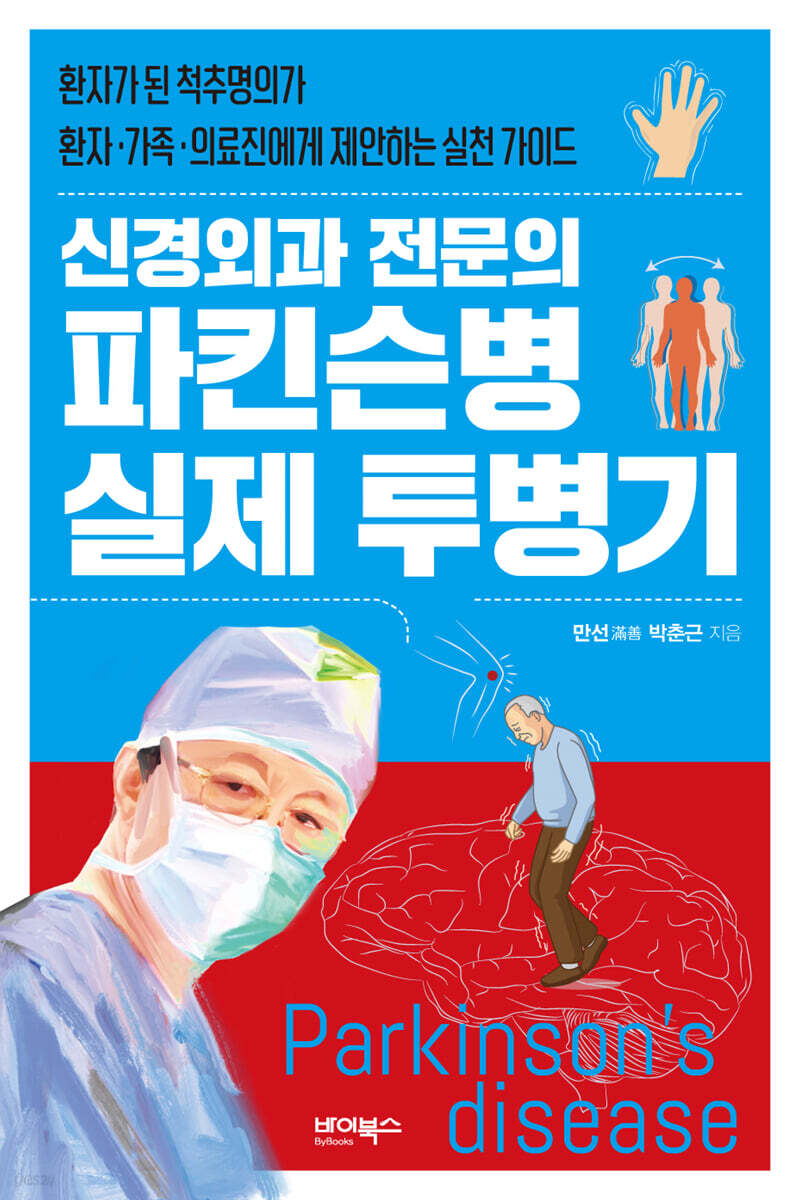
A Neurosurgeon's Real-Life Story of Parkinson's Disease
 |
Description
Book Introduction
The real story of a spinal surgeon who became a patient and fought against Parkinson's disease. Author Park Chun-geun introduced spinal fusion surgery to Korea and treated numerous patients, earning him a reputation that was even featured on EBS's "Myeongui" (a famous doctor). But at the peak of his life, he was faced with the crisis of Parkinson's disease. Nevertheless, I kept a detailed journal of my struggles with the disease, looking at it from both the perspectives of a doctor and a patient. Now, we have compiled it into a book titled “A Neurosurgeon’s Real-Life Story of Parkinson’s Disease” to provide new treatment topics not only to patients and their guardians, but also to the medical community. During the difficult struggle with illness, both the patient and the family have their own joys and sorrows. In addition, there are many tasks that require a paradigm shift in the attitude of medical staff and the country's medical policy. I hope this book will be the first step toward such change. |
- You can preview some of the book's contents.
Preview
index
Recommendation
Preface _ The Mission Given to a Doctor Who Became a Patient with Parkinson's Disease
1.
The doctor who became the patient
The Truth I Came to Realize After Becoming a Patient│I Spread My Wings But I Was Fallen into the Abyss by a Storm│The First to Perform Vertebroplasty in Korea } Becoming a 'Master' through Vertebroplasty
[TIP] If I have a spinal problem, which department should I go to, neurosurgery or orthopedics?
Even though he was a neurosurgeon, he was diagnosed with Parkinson's disease late in life.
[TIP] How can I get an accurate diagnosis?
Parkinson's disease has been around for a long time│Have you been preparing for geriatric diseases?
[TIP] Prodromal symptoms of Parkinson's disease
2.
Rewriting my struggle diary
Rewriting the clinical diary by symptom│Concurrent diseases that affected the clinical course│Symptoms and countermeasures for late-onset Parkinson's disease
[Exercise-related symptoms] Freezing │ Restless legs syndrome, postural instability, and falls │ Tremor │ Rigidity │ Postural deformities │ Striatal limb deformities │ Neck pain │ Dysphagia, hypophonia, dysarthria │ Wearing-off │ Right knee joint pain and hyperextension │ Respiratory disturbance
[Non-exercise related symptoms] Cognitive decline and psychopathology│Depression│Sleep disorder│Sweating│Constipation│Urinary frequency, urgency, urinary incontinence│Fatigue│Pain and pain│Orthostatic hypotension
Symptoms can be alleviated with appropriate treatment.
[TIP] Side Effects of Kinesiology Treatment Medications
The need and requirements for nursing home treatment
3.
How to Fight Parkinson's Disease
There is no cure for Parkinson's disease. │Consider rehabilitation before surgery. │Treatment progress for urinary, swallowing, and vocal disorders. │Treatment effects vary from person to person. │Establish a collaborative treatment system with various departments. │A hospital specializing in Parkinson's disease is needed. │The importance of rehabilitation and individual exercise. │My rehabilitation log - physical therapy. │My rehabilitation log - individual exercise.
[TIP] Rehabilitation Exercises for Parkinson's Disease
Helpful information for those battling illness│People I'm grateful for who shared my pain│It's urgent to find solutions to the suffering my family is experiencing│Things to know to receive help from welfare policies│Let's heal not only the physical burden but also the emotional wounds
Conclusion: Have a dream that you believe will come true.
Appendix 1: The Identity of Parkinson's Disease
Appendix 2: God's Power at Work in My Weakness
brief history
Preface _ The Mission Given to a Doctor Who Became a Patient with Parkinson's Disease
1.
The doctor who became the patient
The Truth I Came to Realize After Becoming a Patient│I Spread My Wings But I Was Fallen into the Abyss by a Storm│The First to Perform Vertebroplasty in Korea } Becoming a 'Master' through Vertebroplasty
[TIP] If I have a spinal problem, which department should I go to, neurosurgery or orthopedics?
Even though he was a neurosurgeon, he was diagnosed with Parkinson's disease late in life.
[TIP] How can I get an accurate diagnosis?
Parkinson's disease has been around for a long time│Have you been preparing for geriatric diseases?
[TIP] Prodromal symptoms of Parkinson's disease
2.
Rewriting my struggle diary
Rewriting the clinical diary by symptom│Concurrent diseases that affected the clinical course│Symptoms and countermeasures for late-onset Parkinson's disease
[Exercise-related symptoms] Freezing │ Restless legs syndrome, postural instability, and falls │ Tremor │ Rigidity │ Postural deformities │ Striatal limb deformities │ Neck pain │ Dysphagia, hypophonia, dysarthria │ Wearing-off │ Right knee joint pain and hyperextension │ Respiratory disturbance
[Non-exercise related symptoms] Cognitive decline and psychopathology│Depression│Sleep disorder│Sweating│Constipation│Urinary frequency, urgency, urinary incontinence│Fatigue│Pain and pain│Orthostatic hypotension
Symptoms can be alleviated with appropriate treatment.
[TIP] Side Effects of Kinesiology Treatment Medications
The need and requirements for nursing home treatment
3.
How to Fight Parkinson's Disease
There is no cure for Parkinson's disease. │Consider rehabilitation before surgery. │Treatment progress for urinary, swallowing, and vocal disorders. │Treatment effects vary from person to person. │Establish a collaborative treatment system with various departments. │A hospital specializing in Parkinson's disease is needed. │The importance of rehabilitation and individual exercise. │My rehabilitation log - physical therapy. │My rehabilitation log - individual exercise.
[TIP] Rehabilitation Exercises for Parkinson's Disease
Helpful information for those battling illness│People I'm grateful for who shared my pain│It's urgent to find solutions to the suffering my family is experiencing│Things to know to receive help from welfare policies│Let's heal not only the physical burden but also the emotional wounds
Conclusion: Have a dream that you believe will come true.
Appendix 1: The Identity of Parkinson's Disease
Appendix 2: God's Power at Work in My Weakness
brief history
Detailed image
.jpg)
Into the book
“Professor Park, please come into room 1.”
It seems like he dozed off for a moment while waiting in front of the rehabilitation medicine outpatient clinic.
I opened my eyes at the sound of being told to come into the examination room and absentmindedly looked at the glass window in front of me.
The image of me reflected there was not that of me in my prime, wearing a pure white gown and proudly leading a dozen or so staff and students.
It was a special feeling because it was room number 1 used by the most recognized doctor in the hospital.
'Oh, I have Parkinson's disease!'
As I returned to reality and entered the rehabilitation room, my long journey from childhood to becoming a doctor flashed before my eyes.
--- p.26
As a doctor and a patient, I was skeptical of medically unproven third-party treatments.
Especially if your doctor doesn't recommend it.
Of course, I have tried non-medical treatments such as acupuncture and other folk remedies several times without any expectation of cure.
However, because there was a preconceived notion that regular rehabilitation treatment was ordinary and difficult to expect dramatic results, it seems that it was not considered as a treatment method, unlike folk remedies.
This narrow-minded preconception led to a significant period of focus on traditional treatments such as medication, botulinum toxin injections, or deep brain electrical stimulation implantation.
On the other hand, treatments that seemed basic and time-consuming, such as rehabilitation therapy, were not considered.
None of the neurosurgery textbooks I've read have described trying rehabilitation therapy before surgery to treat spinal deformities observed in Parkinson's disease, and only performing surgery if there is no improvement in symptoms.
The surprising thing is that, looking back, rehabilitation ultimately contributed significantly to alleviating my most important symptoms, both physically and psychologically.
--- pp.145~146
Before I realized my many unrepentant sins, I diagnosed Parkinson's disease as a doctor rather than as a patient, and because my pride as a doctor took precedence, my subjectivity had a great influence on deciding the direction of treatment.
Above all, my illness, which I had viewed only from a human perspective, made my life increasingly negative and plunged it into darkness.
Lying alone in my dark bedroom, I prayed to God, "What role can I play in building the kingdom of God in my current state? Wouldn't it be better to just call me into the kingdom of God?" and lost my will to live.
However, after this paralysis accident, I realized that I needed to look at Parkinson's disease from a different perspective, and I began to see the disease as a patient, not a doctor.
And I became convinced that there must be a message for me among them from God, who loves me.
It seems like he dozed off for a moment while waiting in front of the rehabilitation medicine outpatient clinic.
I opened my eyes at the sound of being told to come into the examination room and absentmindedly looked at the glass window in front of me.
The image of me reflected there was not that of me in my prime, wearing a pure white gown and proudly leading a dozen or so staff and students.
It was a special feeling because it was room number 1 used by the most recognized doctor in the hospital.
'Oh, I have Parkinson's disease!'
As I returned to reality and entered the rehabilitation room, my long journey from childhood to becoming a doctor flashed before my eyes.
--- p.26
As a doctor and a patient, I was skeptical of medically unproven third-party treatments.
Especially if your doctor doesn't recommend it.
Of course, I have tried non-medical treatments such as acupuncture and other folk remedies several times without any expectation of cure.
However, because there was a preconceived notion that regular rehabilitation treatment was ordinary and difficult to expect dramatic results, it seems that it was not considered as a treatment method, unlike folk remedies.
This narrow-minded preconception led to a significant period of focus on traditional treatments such as medication, botulinum toxin injections, or deep brain electrical stimulation implantation.
On the other hand, treatments that seemed basic and time-consuming, such as rehabilitation therapy, were not considered.
None of the neurosurgery textbooks I've read have described trying rehabilitation therapy before surgery to treat spinal deformities observed in Parkinson's disease, and only performing surgery if there is no improvement in symptoms.
The surprising thing is that, looking back, rehabilitation ultimately contributed significantly to alleviating my most important symptoms, both physically and psychologically.
--- pp.145~146
Before I realized my many unrepentant sins, I diagnosed Parkinson's disease as a doctor rather than as a patient, and because my pride as a doctor took precedence, my subjectivity had a great influence on deciding the direction of treatment.
Above all, my illness, which I had viewed only from a human perspective, made my life increasingly negative and plunged it into darkness.
Lying alone in my dark bedroom, I prayed to God, "What role can I play in building the kingdom of God in my current state? Wouldn't it be better to just call me into the kingdom of God?" and lost my will to live.
However, after this paralysis accident, I realized that I needed to look at Parkinson's disease from a different perspective, and I began to see the disease as a patient, not a doctor.
And I became convinced that there must be a message for me among them from God, who loves me.
--- pp.204~205
Publisher's Review
The mission given to a doctor who became a Parkinson's patient
“Now, I am not a famous doctor, but a famous patient, and I want to provide a sure path to help patients and their families who are suffering from the same disease as me.
Although this is a confessional report from one patient, I believe that the intuition of a veteran doctor who has been practicing neurosurgery for over 30 years can represent the patient's position to some extent."
Author Park Chun-geun introduced spinal fusion surgery to Korea and treated numerous patients, earning him a reputation that was even featured on EBS's "Myeongui" (a famous doctor).
But at the peak of his life, he was faced with the crisis of Parkinson's disease.
Nevertheless, I kept a detailed journal of my struggles with the disease, looking at it from both the perspectives of a doctor and a patient.
Now, we have compiled it into a book titled “A Neurosurgeon’s Real-Life Story of Parkinson’s Disease” to provide new treatment topics not only to patients and their guardians, but also to the medical community.
This book clearly organizes information on surgery and rehabilitation treatment, along with various cases experienced during the course of fighting Parkinson's disease.
It also provides various information necessary for treatment and care, opening the way for patients, families, and medical staff to understand each other.
I hope that patients currently battling illness will not lose hope.
Parkinson's disease caused by stress
“The 2000s, my 50s, were all about work.
During the day, I do surgeries and care for outpatients and inpatients. In the evening, I prepare for the next day's surgeries or attend executive meetings of various academic societies. On Saturdays, I prepare for academic conferences and write papers. On Sundays, I spend all day at church.
“At that time, all I could do was manage my weight, and the stress was building up.”
In Korea, the 40s and 50s are the peak of one's career and the peak of one's career for those who have been working in a professional field their entire lives.
But looking back now, it seems that health management in your 40s and 50s, just before entering old age, is the most important.
Looking back on the author's medical history and past life, it seems likely that if he neglects his health management, such as continuous exercise, during this important period and focuses only on work, the stress may cause pathological changes in the brain.
Therefore, it is expected that appropriate stress relief and continuous physical exercise before reaching middle age can reduce the possibility of developing Parkinson's disease and prevent it.
Early diagnosis of Parkinson's disease is still a challenging task for clinicians.
This book aims to raise awareness not only for patients currently suffering from the disease, but also for those in their middle years to prepare in advance.
A doctor's vivid diary of his struggle with illness
“As a doctor, the clinical diary and as a patient, the circumstances are different, so even if the symptoms are the same, the perspectives on them are bound to be different.
“For me, I wanted to address both perspectives, addressing the questions of those currently battling the disease while also providing new insights to treating doctors by raising awareness of their patients’ circumstances.”
After 10 years, patients typically develop non-motor symptoms that do not respond to effective treatment, such as cognitive dysfunction, dementia, psychiatric disorders, depression, autonomic dysfunction, pain, and sensory abnormalities.
Older age and the presence of dementia are the most reliable predictors of increased mortality.
Parkinson's disease should fundamentally be treated as a chronic disease, like high blood pressure or diabetes.
Therefore, it is necessary to identify in advance the various symptoms that appear over a long period of time and respond appropriately to newly appearing symptoms.
In order to suggest a solution, it is necessary to understand the onset of symptoms and the corresponding treatment process.
To help readers quickly understand each symptom, this book summarizes the symptoms of Parkinson's disease into motor and non-motor symptoms in a table at the end of the description, and also provides a list of medications taken.
Pay attention to the suffering of the family
“If any disease persists for more than 10 years, it cannot but be a great misfortune to everyone.
Patients often begin to speak and act as if their discomfort and pain are caused by those around them rather than themselves under extreme stress.
“The patient’s family, who were doing their best, initially tried to understand, but eventually clashed.”
As the saying goes, “A long illness is not a good one,” we need to pay attention to the suffering experienced not only by the patient but also by the family members who care for the patient.
Once a conflict occurs, the caregiver will no longer feel rewarded for making further sacrifices, and the patient will feel that he or she has lost the foundation that supports his or her will.
To prevent such conflicts, the most important thing is for the patient to first understand the burden and responsibility that the family has been bearing for a long time, and to communicate and work together with the family to prevent the emotional burden from leading to emotional wounds.
Additionally, it is necessary and important for families to understand the patient's long-term suffering and share in their difficulties and emotional wounds.
《A Neurosurgeon's Real-Life Story of Parkinson's Disease》 is a practical guide provided by a spinal specialist who has himself become a patient to patients, their families, and medical staff.
During the difficult struggle with illness, both the patient and the family have their own joys and sorrows.
In addition, there are many tasks that require a paradigm shift in the attitude of medical staff and the country's medical policy.
I hope this book will be the first step toward such change.
“Now, I am not a famous doctor, but a famous patient, and I want to provide a sure path to help patients and their families who are suffering from the same disease as me.
Although this is a confessional report from one patient, I believe that the intuition of a veteran doctor who has been practicing neurosurgery for over 30 years can represent the patient's position to some extent."
Author Park Chun-geun introduced spinal fusion surgery to Korea and treated numerous patients, earning him a reputation that was even featured on EBS's "Myeongui" (a famous doctor).
But at the peak of his life, he was faced with the crisis of Parkinson's disease.
Nevertheless, I kept a detailed journal of my struggles with the disease, looking at it from both the perspectives of a doctor and a patient.
Now, we have compiled it into a book titled “A Neurosurgeon’s Real-Life Story of Parkinson’s Disease” to provide new treatment topics not only to patients and their guardians, but also to the medical community.
This book clearly organizes information on surgery and rehabilitation treatment, along with various cases experienced during the course of fighting Parkinson's disease.
It also provides various information necessary for treatment and care, opening the way for patients, families, and medical staff to understand each other.
I hope that patients currently battling illness will not lose hope.
Parkinson's disease caused by stress
“The 2000s, my 50s, were all about work.
During the day, I do surgeries and care for outpatients and inpatients. In the evening, I prepare for the next day's surgeries or attend executive meetings of various academic societies. On Saturdays, I prepare for academic conferences and write papers. On Sundays, I spend all day at church.
“At that time, all I could do was manage my weight, and the stress was building up.”
In Korea, the 40s and 50s are the peak of one's career and the peak of one's career for those who have been working in a professional field their entire lives.
But looking back now, it seems that health management in your 40s and 50s, just before entering old age, is the most important.
Looking back on the author's medical history and past life, it seems likely that if he neglects his health management, such as continuous exercise, during this important period and focuses only on work, the stress may cause pathological changes in the brain.
Therefore, it is expected that appropriate stress relief and continuous physical exercise before reaching middle age can reduce the possibility of developing Parkinson's disease and prevent it.
Early diagnosis of Parkinson's disease is still a challenging task for clinicians.
This book aims to raise awareness not only for patients currently suffering from the disease, but also for those in their middle years to prepare in advance.
A doctor's vivid diary of his struggle with illness
“As a doctor, the clinical diary and as a patient, the circumstances are different, so even if the symptoms are the same, the perspectives on them are bound to be different.
“For me, I wanted to address both perspectives, addressing the questions of those currently battling the disease while also providing new insights to treating doctors by raising awareness of their patients’ circumstances.”
After 10 years, patients typically develop non-motor symptoms that do not respond to effective treatment, such as cognitive dysfunction, dementia, psychiatric disorders, depression, autonomic dysfunction, pain, and sensory abnormalities.
Older age and the presence of dementia are the most reliable predictors of increased mortality.
Parkinson's disease should fundamentally be treated as a chronic disease, like high blood pressure or diabetes.
Therefore, it is necessary to identify in advance the various symptoms that appear over a long period of time and respond appropriately to newly appearing symptoms.
In order to suggest a solution, it is necessary to understand the onset of symptoms and the corresponding treatment process.
To help readers quickly understand each symptom, this book summarizes the symptoms of Parkinson's disease into motor and non-motor symptoms in a table at the end of the description, and also provides a list of medications taken.
Pay attention to the suffering of the family
“If any disease persists for more than 10 years, it cannot but be a great misfortune to everyone.
Patients often begin to speak and act as if their discomfort and pain are caused by those around them rather than themselves under extreme stress.
“The patient’s family, who were doing their best, initially tried to understand, but eventually clashed.”
As the saying goes, “A long illness is not a good one,” we need to pay attention to the suffering experienced not only by the patient but also by the family members who care for the patient.
Once a conflict occurs, the caregiver will no longer feel rewarded for making further sacrifices, and the patient will feel that he or she has lost the foundation that supports his or her will.
To prevent such conflicts, the most important thing is for the patient to first understand the burden and responsibility that the family has been bearing for a long time, and to communicate and work together with the family to prevent the emotional burden from leading to emotional wounds.
Additionally, it is necessary and important for families to understand the patient's long-term suffering and share in their difficulties and emotional wounds.
《A Neurosurgeon's Real-Life Story of Parkinson's Disease》 is a practical guide provided by a spinal specialist who has himself become a patient to patients, their families, and medical staff.
During the difficult struggle with illness, both the patient and the family have their own joys and sorrows.
In addition, there are many tasks that require a paradigm shift in the attitude of medical staff and the country's medical policy.
I hope this book will be the first step toward such change.
GOODS SPECIFICS
- Date of issue: July 25, 2024
- Page count, weight, size: 212 pages | 290g | 140*210*15mm
- ISBN13: 9791158773779
- ISBN10: 1158773773
You may also like
카테고리
korean


korean

![ELLE 엘르 스페셜 에디션 A형 : 12월 [2025]](http://librairie.coreenne.fr/cdn/shop/files/b8e27a3de6c9538896439686c6b0e8fb.jpg?v=1766436872&width=3840)


