

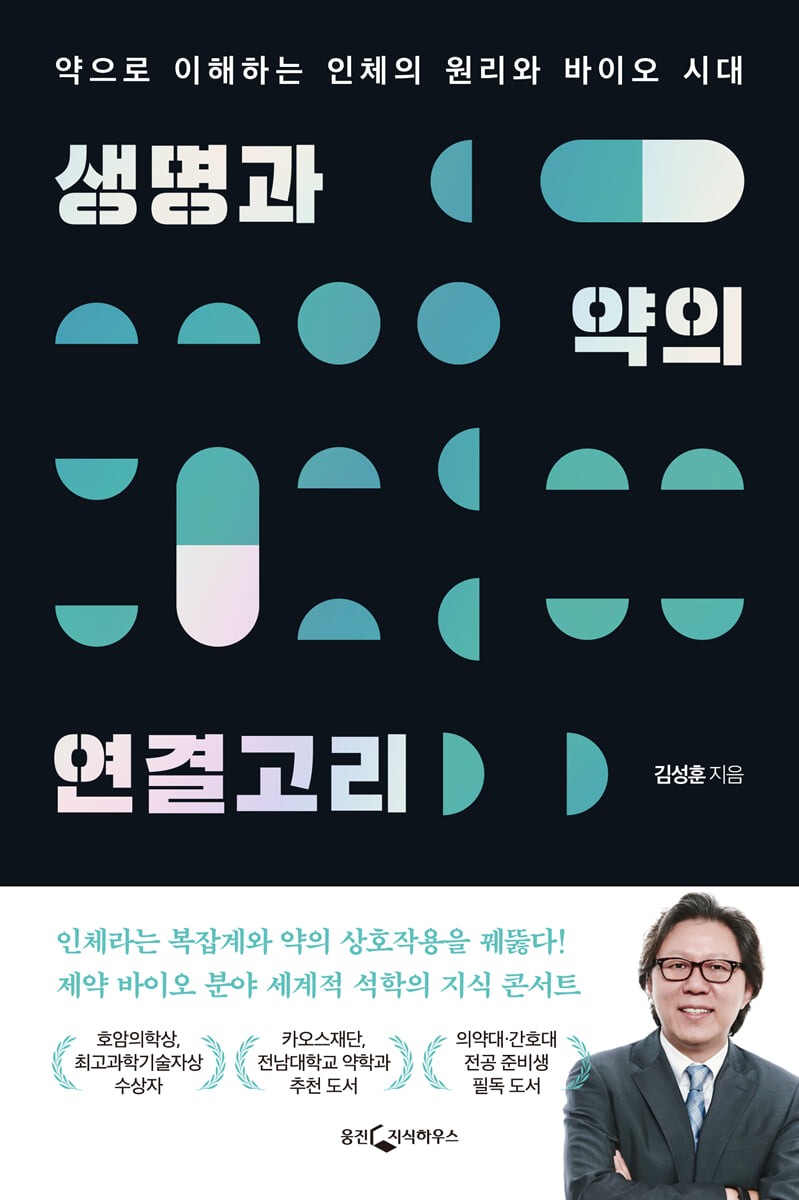
The link between life and medicine
 |
Description
Book Introduction
Pharmacy will be the most important subject of the future.
What butterfly effect do the medicines we take have on the human body?
: The most complete guide to understanding the interaction between the complex system of the human body and drugs.
★ This is the book that has become a must-read for students preparing for medical and nursing school!
★ Ho-Am Medical Prize, Korea's Best Scientist and Engineer Award... General lectures by world-renowned scholars in the fields of medicine and biotechnology
★ Chaos Foundation Recommended Books, Chonnam National University Pharmacy Department Recommended Books
"The Link Between Life and Medicine," which has been gaining popularity as a must-read for medical and nursing school students and has been included on the recommended reading lists of many educational institutions, has been published in a revised and expanded edition.
This book, which has been reprinted continuously since going out of print and sold at high prices in used bookstores, has been of great help to students taking their first steps into the field of knowledge by covering the knowledge of the interaction between our body and medicine in an easy-to-understand manner in one volume.
This book, which explains the complex system of the human body through unpredictable natural phenomena, guides you into the world of medicine with various cases and examples, from why drugs that act on the human body's network cannot be consistently effective to the creation of new drugs and drug addiction.
It also explains the effects of drugs on our bodies and the problems caused by drugs so that anyone can easily understand why we need to know about drugs now.
The author of this book, Professor Kim Seong-hun of Yonsei University College of Pharmacy, discovered various new functional proteins involved in cancer, immunity, and metabolic diseases, and has become a world-renowned authority in the pharmaceutical and bio fields by publishing papers in the scientific journals Cell and Science.
This book, which combines essential knowledge and insights for life science professionals and provides insight into the increasingly important bioindustry, will be an excellent introduction to pharmacy, providing readers with an engaging and engaging educational experience.
What butterfly effect do the medicines we take have on the human body?
: The most complete guide to understanding the interaction between the complex system of the human body and drugs.
★ This is the book that has become a must-read for students preparing for medical and nursing school!
★ Ho-Am Medical Prize, Korea's Best Scientist and Engineer Award... General lectures by world-renowned scholars in the fields of medicine and biotechnology
★ Chaos Foundation Recommended Books, Chonnam National University Pharmacy Department Recommended Books
"The Link Between Life and Medicine," which has been gaining popularity as a must-read for medical and nursing school students and has been included on the recommended reading lists of many educational institutions, has been published in a revised and expanded edition.
This book, which has been reprinted continuously since going out of print and sold at high prices in used bookstores, has been of great help to students taking their first steps into the field of knowledge by covering the knowledge of the interaction between our body and medicine in an easy-to-understand manner in one volume.
This book, which explains the complex system of the human body through unpredictable natural phenomena, guides you into the world of medicine with various cases and examples, from why drugs that act on the human body's network cannot be consistently effective to the creation of new drugs and drug addiction.
It also explains the effects of drugs on our bodies and the problems caused by drugs so that anyone can easily understand why we need to know about drugs now.
The author of this book, Professor Kim Seong-hun of Yonsei University College of Pharmacy, discovered various new functional proteins involved in cancer, immunity, and metabolic diseases, and has become a world-renowned authority in the pharmaceutical and bio fields by publishing papers in the scientific journals Cell and Science.
This book, which combines essential knowledge and insights for life science professionals and provides insight into the increasingly important bioindustry, will be an excellent introduction to pharmacy, providing readers with an engaging and engaging educational experience.
- You can preview some of the book's contents.
Preview
index
prolog
01. Science of Complex Systems and Networks
Complex phenomena around us | Characteristics of complex systems
02.
Human Networks and New Drug Development
The Challenges of New Drug Development | Homeostasis and Flexibility in Living Organisms | From the Era of Hardware Research to the Era of Software Research
03.
Side effects, network rebellion
How did SARS spread globally? | Drug side effects, a headache for pharmaceutical companies | Unusual drug-target combinations and side effects
04.
Unexpected Connections, the Gift of Networking
Drug Repositioning | The Accidental Side Effects of Drugs and the Discovery of New Uses
05.
Introspection, resistance of the network
The Rise of Superviruses | Why Does Drug Resistance Occur? | How Can Drug Resistance Be Minimized?
06.
Addiction, Withdrawal, and the Surrender of the Network
Addiction and Withdrawal | Stars and Drug Addiction | Addiction, Loss of Homeostasis
07.
Combination medicine, network collaboration
Troubleshooting within Network Systems | The Need for Combination Medicine
08.
Western and Oriental medicine, reductionism and holism
Reductionist Studies of Life Phenomena | Prescriptions in Western and Eastern Medicine | Differences in Treatment Perspectives Between Western and Eastern Medicine
09.
What is the right personalized medicine for me?
The Emergence of Personalized Therapy | The Butterfly Effect of the 0.1 Percent Genetic Variation | A New Paradigm for Drug Development
10.
Hidden gems in the network
Development of the Miracle Anticancer Drug Gleevec | Discovery of New Drug Targets | Various Methods for Finding Drug Targets
11.
Find the links in the network
The failure of lung cancer treatment Iressa | The rise of the omics era
Epilogue
01. Science of Complex Systems and Networks
Complex phenomena around us | Characteristics of complex systems
02.
Human Networks and New Drug Development
The Challenges of New Drug Development | Homeostasis and Flexibility in Living Organisms | From the Era of Hardware Research to the Era of Software Research
03.
Side effects, network rebellion
How did SARS spread globally? | Drug side effects, a headache for pharmaceutical companies | Unusual drug-target combinations and side effects
04.
Unexpected Connections, the Gift of Networking
Drug Repositioning | The Accidental Side Effects of Drugs and the Discovery of New Uses
05.
Introspection, resistance of the network
The Rise of Superviruses | Why Does Drug Resistance Occur? | How Can Drug Resistance Be Minimized?
06.
Addiction, Withdrawal, and the Surrender of the Network
Addiction and Withdrawal | Stars and Drug Addiction | Addiction, Loss of Homeostasis
07.
Combination medicine, network collaboration
Troubleshooting within Network Systems | The Need for Combination Medicine
08.
Western and Oriental medicine, reductionism and holism
Reductionist Studies of Life Phenomena | Prescriptions in Western and Eastern Medicine | Differences in Treatment Perspectives Between Western and Eastern Medicine
09.
What is the right personalized medicine for me?
The Emergence of Personalized Therapy | The Butterfly Effect of the 0.1 Percent Genetic Variation | A New Paradigm for Drug Development
10.
Hidden gems in the network
Development of the Miracle Anticancer Drug Gleevec | Discovery of New Drug Targets | Various Methods for Finding Drug Targets
11.
Find the links in the network
The failure of lung cancer treatment Iressa | The rise of the omics era
Epilogue
Detailed image
.jpg)
Into the book
We, living in the 21st century, define the present as an era of advanced science and technology and expect that science will solve all our problems.
Indeed, the average life expectancy of the global population has increased by leaps and bounds, and many scientific and technological challenges seem poised to be solved, such as the discussion of colonizing Mars and commercializing space travel, and the realization of artificial intelligence technology.
But the reality is different.
More than ever before, humanity lives in uncertainty and anxiety.
--- p.5
If we look at the human body from an anatomical perspective, we can see that the various tissues and organs are systematically connected, and it appears to be no different from the highly complex structure of a car or airplane.
But even if babies were born in the same hospital on the same day, we cannot explain or predict their lives and futures any more than we can explain or predict something about cars.
It is impossible to know what kind of life and death process one will go through.
--- pp.26~27
There are countless other cases of weakening caused by unexpected side effects of drugs.
Bayer's Baycol, a cholesterol-lowering drug, has been linked to a muscle cell destruction condition called rhabdomyolysis, and has been linked to 33 deaths in the United States alone since its release in 1997, with over 100 cases reported worldwide.
This led Bayer to decide in 2001 to stop selling and voluntarily recall Bycol.
Bayer had predicted that Bycol would grow to a market size of 900 million euros in 2001 and 27 billion euros in 2002, but failed to attract investment as its stock price fell day after day due to the controversy over side effects.
--- p.59
It is advisable to be cautious when you come across medicines or health foods advertised on the market that have unclear evidence and are a panacea or that have no side effects.
As long as the genes and proteins that make up our bodies are intertwined like a spider's web, and as long as our knowledge remains incomplete, premature confidence can be toxic.
--- p.65
Like Viagra, if you make good use of the side effects that appear from the original intended effect, it can become a motivation to develop new effects.
Just as we cannot predict hidden side effects because we do not yet fully understand the network map between genes and proteins that make up the body, new benefits are also discovered without prior prediction, so they always seem like coincidences.
--- p.78
Addiction can be thought of as the opposite of drug tolerance.
Our bodies have a regulatory network to maintain homeostasis of physiological processes.
However, if a certain stimulus is repeatedly received for a long time, the body eventually adapts to that stimulus.
If we use this in a good way, our body will acquire some special skills or abilities, but on the other hand, if it is a bad habit for our body or especially if it is a stimulus by a certain drug, our body's physiological control network will continue to be out of the normal range for a long time, so it will adapt to the new stimulus.
--- p.109
Just as each person has a different appearance, each person's reaction to medication also varies.
Humans have DNA consisting of approximately 3 billion base pairs, 99.9 percent of which are identical.
A difference of about 0.1 percent can make such a huge difference between individuals.
Therefore, if we can unlock the secrets of the 0.1 percent of DNA sequences, we can find out what types of diseases each individual should be particularly careful of, predict diseases before they occur, and prescribe medications tailored to each individual's characteristics.
Scientists believe that this era of personalized treatment will soon become a reality.
--- pp.151~152
The COVID-19 pandemic, which has plunged the entire human race into a state of panic for the past three years and continues to this day, clearly demonstrates how crucial the ability to develop new drugs is to human survival.
Therefore, no matter how many failures there are and how difficult the path may be, new drug development research must not stop.
A country that gives up on developing new drugs is like giving its citizens' health and lives to foreign pharmaceutical companies.
I still vividly remember how desperately the world scrambled to secure vaccines and treatments during the COVID-19 pandemic.
Indeed, the average life expectancy of the global population has increased by leaps and bounds, and many scientific and technological challenges seem poised to be solved, such as the discussion of colonizing Mars and commercializing space travel, and the realization of artificial intelligence technology.
But the reality is different.
More than ever before, humanity lives in uncertainty and anxiety.
--- p.5
If we look at the human body from an anatomical perspective, we can see that the various tissues and organs are systematically connected, and it appears to be no different from the highly complex structure of a car or airplane.
But even if babies were born in the same hospital on the same day, we cannot explain or predict their lives and futures any more than we can explain or predict something about cars.
It is impossible to know what kind of life and death process one will go through.
--- pp.26~27
There are countless other cases of weakening caused by unexpected side effects of drugs.
Bayer's Baycol, a cholesterol-lowering drug, has been linked to a muscle cell destruction condition called rhabdomyolysis, and has been linked to 33 deaths in the United States alone since its release in 1997, with over 100 cases reported worldwide.
This led Bayer to decide in 2001 to stop selling and voluntarily recall Bycol.
Bayer had predicted that Bycol would grow to a market size of 900 million euros in 2001 and 27 billion euros in 2002, but failed to attract investment as its stock price fell day after day due to the controversy over side effects.
--- p.59
It is advisable to be cautious when you come across medicines or health foods advertised on the market that have unclear evidence and are a panacea or that have no side effects.
As long as the genes and proteins that make up our bodies are intertwined like a spider's web, and as long as our knowledge remains incomplete, premature confidence can be toxic.
--- p.65
Like Viagra, if you make good use of the side effects that appear from the original intended effect, it can become a motivation to develop new effects.
Just as we cannot predict hidden side effects because we do not yet fully understand the network map between genes and proteins that make up the body, new benefits are also discovered without prior prediction, so they always seem like coincidences.
--- p.78
Addiction can be thought of as the opposite of drug tolerance.
Our bodies have a regulatory network to maintain homeostasis of physiological processes.
However, if a certain stimulus is repeatedly received for a long time, the body eventually adapts to that stimulus.
If we use this in a good way, our body will acquire some special skills or abilities, but on the other hand, if it is a bad habit for our body or especially if it is a stimulus by a certain drug, our body's physiological control network will continue to be out of the normal range for a long time, so it will adapt to the new stimulus.
--- p.109
Just as each person has a different appearance, each person's reaction to medication also varies.
Humans have DNA consisting of approximately 3 billion base pairs, 99.9 percent of which are identical.
A difference of about 0.1 percent can make such a huge difference between individuals.
Therefore, if we can unlock the secrets of the 0.1 percent of DNA sequences, we can find out what types of diseases each individual should be particularly careful of, predict diseases before they occur, and prescribe medications tailored to each individual's characteristics.
Scientists believe that this era of personalized treatment will soon become a reality.
--- pp.151~152
The COVID-19 pandemic, which has plunged the entire human race into a state of panic for the past three years and continues to this day, clearly demonstrates how crucial the ability to develop new drugs is to human survival.
Therefore, no matter how many failures there are and how difficult the path may be, new drug development research must not stop.
A country that gives up on developing new drugs is like giving its citizens' health and lives to foreign pharmaceutical companies.
I still vividly remember how desperately the world scrambled to secure vaccines and treatments during the COVID-19 pandemic.
--- p.198
Publisher's Review
An interesting general education lecture written by a world-renowned life scientist.
A must-read for students preparing to enter medical or nursing school!
"The Link Between Life and Medicine," which has been gaining popularity as a must-read for students preparing to enter medical, pharmacy, and nursing schools and has been included on the lists of recommended books by various related organizations, has been published in a revised and expanded edition.
This book, which has been repeatedly requested for republication by readers and sold at high prices in used bookstores, has been of great help to students taking their first steps in learning about the interaction between our bodies and medicine by covering it in an easy-to-understand manner in a single volume.
The author, who discovered various new functional proteins involved in cancer, immunity, and metabolic diseases, published papers in the scientific journals Cell and Science, and became a world-renowned authority in the pharmaceutical and bio fields, has compiled the knowledge and insights essential for experts in life sciences.
This book is an excellent introduction to pharmacy and will guide readers through an engaging and educational course.
What butterfly effect do drugs have on the human body?
A complex world that cutting-edge science cannot solve
From the tsunami that reshaped the Indonesian coast, to Hurricane Katrina, which devastated the southern United States, to the magnitude 7.8 earthquake in Turkey, environmental disasters are increasingly threatening humanity.
And that's not all.
COVID-19, which originated in Wuhan, China, spread across the world in an instant, but it took a long time for a treatment to be developed.
Why can't today's cutting-edge science solve these environmental and disease problems?
The answer to the problem lies in the 'complex' system.
A complex system is a system that requires a comprehensive understanding of the behavior of numerous interacting agents.
Not only is it difficult to infer the result from the simple sum of individual elements, but even a small change within can lead to uncontrollable consequences.
This book, which explains the complex system of the human body through unpredictable natural phenomena, guides you into the world of medicine with various cases and examples, from why drugs that act on the human body's network cannot be consistently effective to the creation of new drugs and drug addiction.
It also explains the effects of drugs on our bodies and the problems caused by drugs so that anyone can easily understand why we need to know about drugs now.
How did that medicine come about?
Understanding Life Phenomena through the History of Medicine
Among the countless drugs developed to cure diseases, some that have gone beyond their original purpose have brought us unintended disasters and gifts.
Viagra, developed as a treatment for high blood pressure, gained explosive popularity among men when its effectiveness in improving erectile dysfunction was discovered, creating a new concept of lifestyle medicine.
On the other hand, thalidomide, which was banned due to its side effects, was once called the devil's drug and caused birth defects, but is now used as an anticancer drug.
When a drug acts on one component of the body, its effects also affect other factors connected to that component.
For this reason, while actions aimed at a specific purpose may produce unexpected side effects, they can also provide opportunities to discover unexpected benefits.
Therefore, in order to identify the cause of a disease and seek appropriate treatment based on the cause, it is very important to identify the various physiological links between the cause and effect of the disease and secure a holistic perspective.
A must-read for students preparing to enter medical or nursing school!
"The Link Between Life and Medicine," which has been gaining popularity as a must-read for students preparing to enter medical, pharmacy, and nursing schools and has been included on the lists of recommended books by various related organizations, has been published in a revised and expanded edition.
This book, which has been repeatedly requested for republication by readers and sold at high prices in used bookstores, has been of great help to students taking their first steps in learning about the interaction between our bodies and medicine by covering it in an easy-to-understand manner in a single volume.
The author, who discovered various new functional proteins involved in cancer, immunity, and metabolic diseases, published papers in the scientific journals Cell and Science, and became a world-renowned authority in the pharmaceutical and bio fields, has compiled the knowledge and insights essential for experts in life sciences.
This book is an excellent introduction to pharmacy and will guide readers through an engaging and educational course.
What butterfly effect do drugs have on the human body?
A complex world that cutting-edge science cannot solve
From the tsunami that reshaped the Indonesian coast, to Hurricane Katrina, which devastated the southern United States, to the magnitude 7.8 earthquake in Turkey, environmental disasters are increasingly threatening humanity.
And that's not all.
COVID-19, which originated in Wuhan, China, spread across the world in an instant, but it took a long time for a treatment to be developed.
Why can't today's cutting-edge science solve these environmental and disease problems?
The answer to the problem lies in the 'complex' system.
A complex system is a system that requires a comprehensive understanding of the behavior of numerous interacting agents.
Not only is it difficult to infer the result from the simple sum of individual elements, but even a small change within can lead to uncontrollable consequences.
This book, which explains the complex system of the human body through unpredictable natural phenomena, guides you into the world of medicine with various cases and examples, from why drugs that act on the human body's network cannot be consistently effective to the creation of new drugs and drug addiction.
It also explains the effects of drugs on our bodies and the problems caused by drugs so that anyone can easily understand why we need to know about drugs now.
How did that medicine come about?
Understanding Life Phenomena through the History of Medicine
Among the countless drugs developed to cure diseases, some that have gone beyond their original purpose have brought us unintended disasters and gifts.
Viagra, developed as a treatment for high blood pressure, gained explosive popularity among men when its effectiveness in improving erectile dysfunction was discovered, creating a new concept of lifestyle medicine.
On the other hand, thalidomide, which was banned due to its side effects, was once called the devil's drug and caused birth defects, but is now used as an anticancer drug.
When a drug acts on one component of the body, its effects also affect other factors connected to that component.
For this reason, while actions aimed at a specific purpose may produce unexpected side effects, they can also provide opportunities to discover unexpected benefits.
Therefore, in order to identify the cause of a disease and seek appropriate treatment based on the cause, it is very important to identify the various physiological links between the cause and effect of the disease and secure a holistic perspective.
GOODS SPECIFICS
- Date of issue: February 28, 2023
- Page count, weight, size: 204 pages | 328g | 148*210*18mm
- ISBN13: 9788901269306
- ISBN10: 8901269309
You may also like
카테고리
korean


korean

![ELLE 엘르 스페셜 에디션 A형 : 12월 [2025]](http://librairie.coreenne.fr/cdn/shop/files/b8e27a3de6c9538896439686c6b0e8fb.jpg?v=1766436872&width=3840)


