

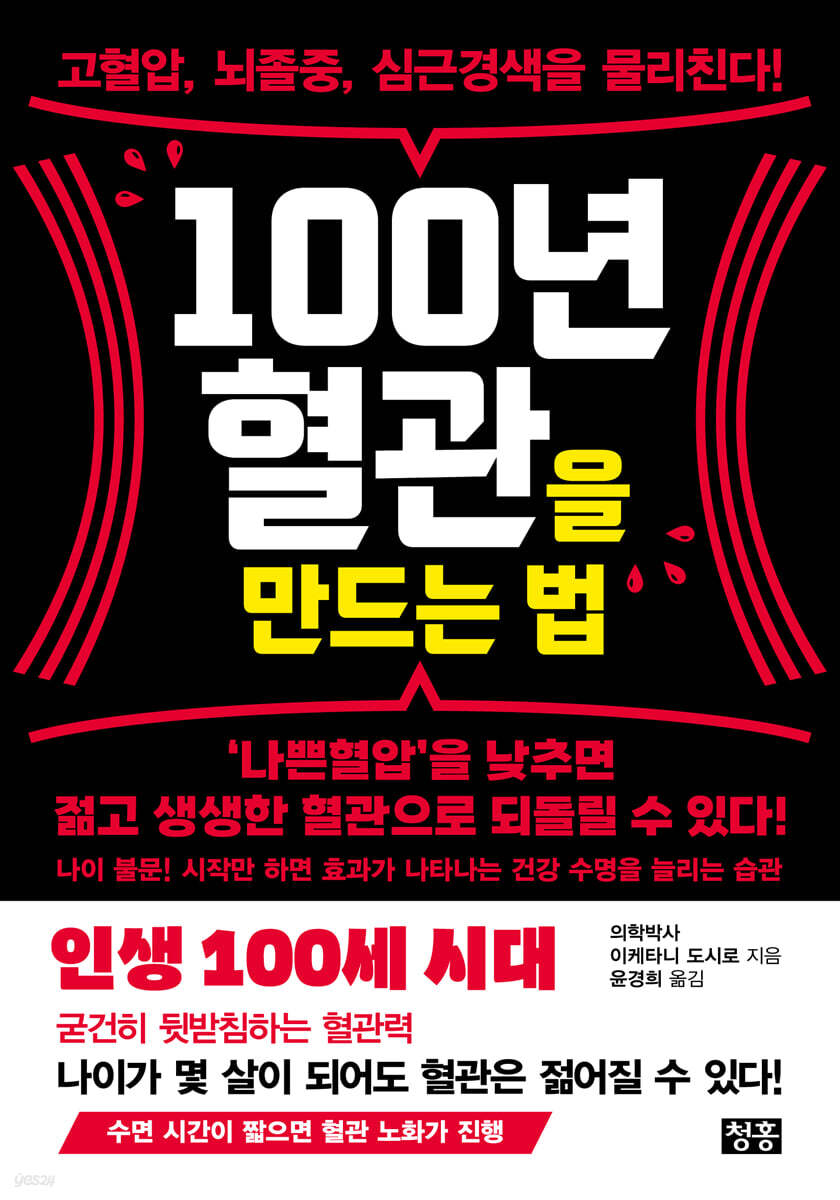
How to Create 100-Year-Old Blood Vessels
 |
Description
Book Introduction
To live a long and healthy life
Let's make it a '100-year blood vessel'
Vascular health is overall health.
People in their 30s and 40s are also susceptible to sudden death.
Creating "100-Year Blood Vessels" Can Help Prevent Cancer
How to Eat Meat to Help Your Blood Vessels Stay Healthy
Healthy Diet for Blood Vessels: How to Use Convenience Store Products
Exercise: When is the best time to do it?
The author has some recommendations for those who aim to live a healthy 100 years, as well as those who are a bit uneasy about living to 100.
It is about making your blood vessels healthy so that you can easily live for 100 years.
In other words, this is how to create a ‘100-year blood vessel.’
If we can keep our blood vessels young, we can all get closer to the hope of living a healthy 100 years, and the health concerns that inevitably arise as we live longer will also be alleviated.
Because ‘vascular health’ is directly linked to ‘body health.’
It is well known that the heart is a very important organ.
Because if your heart stops, you can't live.
But even this important heart is maintained thanks to blood vessels.
The heart is a 'blood pump' that supplies blood to blood vessels that extend to every corner of the body by repeating contraction and relaxation.
Our body can be healthy only when the oxygen and nutrients in the blood are sufficiently absorbed by the organs and cells in our body.
Therefore, it is said that vascular health is directly related to overall health.
The same goes for the heart.
The heart also sends the blood it sends back to itself through blood vessels called coronary arteries to absorb the oxygen and nutrients necessary for survival.
In other words, the heart, which is responsible for pumping blood, maintains its continuity through blood vessels just like other organs.
The heart and blood vessels have a symbiotic relationship.
No matter how hard the heart pumps blood, if the blood vessels that supply it are blocked, the oxygen and nutrients cannot be delivered to the necessary locations.
To use an analogy, it's like a factory working hard to produce goods, but if the distribution network is not good, the products won't be delivered to consumers across the country.
However, what blood vessels carry are essential items that are absolutely necessary for sustaining life.
It is not a necessity of life, but a 'necessity of life'.
If a problem occurs in the blood vessels that are distributed throughout the body (their total length is a whopping 100,000 km!) and blood flow stagnates, the organs connected to them will naturally not be able to function properly.
Likewise, if a problem occurs in the cardiovascular system, the heart cannot function properly.
Let's make it a '100-year blood vessel'
Vascular health is overall health.
People in their 30s and 40s are also susceptible to sudden death.
Creating "100-Year Blood Vessels" Can Help Prevent Cancer
How to Eat Meat to Help Your Blood Vessels Stay Healthy
Healthy Diet for Blood Vessels: How to Use Convenience Store Products
Exercise: When is the best time to do it?
The author has some recommendations for those who aim to live a healthy 100 years, as well as those who are a bit uneasy about living to 100.
It is about making your blood vessels healthy so that you can easily live for 100 years.
In other words, this is how to create a ‘100-year blood vessel.’
If we can keep our blood vessels young, we can all get closer to the hope of living a healthy 100 years, and the health concerns that inevitably arise as we live longer will also be alleviated.
Because ‘vascular health’ is directly linked to ‘body health.’
It is well known that the heart is a very important organ.
Because if your heart stops, you can't live.
But even this important heart is maintained thanks to blood vessels.
The heart is a 'blood pump' that supplies blood to blood vessels that extend to every corner of the body by repeating contraction and relaxation.
Our body can be healthy only when the oxygen and nutrients in the blood are sufficiently absorbed by the organs and cells in our body.
Therefore, it is said that vascular health is directly related to overall health.
The same goes for the heart.
The heart also sends the blood it sends back to itself through blood vessels called coronary arteries to absorb the oxygen and nutrients necessary for survival.
In other words, the heart, which is responsible for pumping blood, maintains its continuity through blood vessels just like other organs.
The heart and blood vessels have a symbiotic relationship.
No matter how hard the heart pumps blood, if the blood vessels that supply it are blocked, the oxygen and nutrients cannot be delivered to the necessary locations.
To use an analogy, it's like a factory working hard to produce goods, but if the distribution network is not good, the products won't be delivered to consumers across the country.
However, what blood vessels carry are essential items that are absolutely necessary for sustaining life.
It is not a necessity of life, but a 'necessity of life'.
If a problem occurs in the blood vessels that are distributed throughout the body (their total length is a whopping 100,000 km!) and blood flow stagnates, the organs connected to them will naturally not be able to function properly.
Likewise, if a problem occurs in the cardiovascular system, the heart cannot function properly.
index
Entering
Let's create '100-year-old blood vessels' to live a long and healthy life.
It is also the blood vessels that provide nutrients to the heart.
Bad blood pressure shortens the lifespan of the heart.
No matter how old you are, your blood vessels can become younger!
Chapter 1
Sudden death is the biggest threat to a 100-year life plan.
It can be blocked by 'blood vessels'
Originally, blood vessels could easily last 100 years.
A 'heart failure pandemic' is occurring due to the increase in the elderly population!
There is no specific cure for heart failure!?
'Bad blood pressure' is the beginning of heart failure.
A surprising number of 'sudden collapse and death' (sudden death) cases
Tracing back to the source of 'sudden death' leads to the blood vessels.
People in their 30s and 40s are also susceptible to sudden death.
Five Evils That Increase the Risk of Vascular Accidents by 243 Times
A reality where even sudden death is not an option
The 'aftereffects' of a vascular accident
What happens if the brain is damaged?
Chapter 2
As a '100-year blood vessel'
Prevents diabetes, dementia, and even cancer!
A life where a person is incapacitated and needs care, and ends up dying in a hospital bed after collapsing.
The higher the rank, the closer it is to 'death after a crash'
Bones and blood vessels were a community of shared destiny!
A serious problem called the 'calcium paradox'
What ages your blood vessels ages your bones too.
Female hormones are a strong ally of bones.
Smoking weakens bones and delays fracture healing.
Protein deficiency shortens lifespan and causes dementia.
Should you eat meat or avoid it?
Vascular aging also affects dementia.
Diabetes, which is also linked to Alzheimer's
Even if you don't have diabetes, you may be at risk for dementia if you have 'hidden hyperglycemia'.
How to Know if You Have Hidden Hyperglycemia
High blood sugar increases the risk of dementia.
The fear of 'hidden heart failure', where symptoms are not clearly evident
Chronic lung disease 'hidden COPD' also requires attention
Vascular care is also beneficial for the lungs.
Creating "100-Year Blood Vessels" Can Help Prevent Cancer
Lifestyle habits that increase the risk of colon cancer
Vascular strength firmly supports the '100-year life era'
Chapter 3
Foods and How to Eat to Create '100-Year Blood Vessels'
The foundation for building "100-year-old blood vessels" is "loose carbohydrate restriction."
Carbohydrates are 'cold rather than warm' and 'brown rather than white'
Make soluble fiber your ally
The start of a meal starts with dietary fiber
Soy First, which prevents rapid blood sugar spikes
How to Choose Oils That Rejuvenate Your Blood Vessels
Recommended oils for cooking
Add flaxseed oil and safflower oil to your diet and add fish oil.
How to Eat Meat Properly to Support Blood Vessel Health
Meats that are good to eat and meats that are good to avoid
Tips for making delicious, low-sodium dishes
The power of vegetables that suppress 'active oxygen species', the greatest threat to our bodies.
Recommended are broccoli and onion
If you have a company dinner tonight, adjust your breakfast and lunch accordingly.
Healthy Diet for Blood Vessels: How to Use Convenience Store Products
Recommended Menu ①
Recommended Menu ②
Recommended Menu ③
Recommended Menu ④
The key to choosing a side dish for dinner is choosing the right one.
Mushroom dishes recommended for a drink after work
A drink that helps create '100-year-old blood vessels'
The more you drink, the longer you live?
Latest research reveals the fat-burning effects of coffee.
How to Turn Your Body into a Fat-Burner
Tips for Choosing Snacks That Consider Vascular Health
Chapter 4
Daily habits that create '100-year-old blood vessels'
Irritation shortens lifespan!?
Heart rate, a barometer of stress
Short sleep duration accelerates vascular aging.
Sleeping pills can sometimes be the cause of nursing care.
Bathing is good for your blood vessels
Blood vessels are sensitive to sudden temperature changes
How to Use a Sauna to Keep Your Blood Vessels Healthy
Hydration saves lives
Heat and cold are fatal to blood vessels.
Chapter 5
5 minutes a day! Exercises that instantly rejuvenate your blood vessels.
The first step to preventing heart failure is walking.
Exercises that create 'NO', a natural remedy that rejuvenates blood vessels
Build muscle to reduce visceral fat and boost immunity
It is effective not only in preventing disease but also in improving symptoms.
Zombie Exercise: The Ultimate Blood Vessel Rejuvenation Exercise
Get the same workout effect as 10 minutes of walking in just 3 minutes
Exercise: When is the best time to do it?
supplement
Let's create '100-year-old blood vessels' to live a long and healthy life.
It is also the blood vessels that provide nutrients to the heart.
Bad blood pressure shortens the lifespan of the heart.
No matter how old you are, your blood vessels can become younger!
Chapter 1
Sudden death is the biggest threat to a 100-year life plan.
It can be blocked by 'blood vessels'
Originally, blood vessels could easily last 100 years.
A 'heart failure pandemic' is occurring due to the increase in the elderly population!
There is no specific cure for heart failure!?
'Bad blood pressure' is the beginning of heart failure.
A surprising number of 'sudden collapse and death' (sudden death) cases
Tracing back to the source of 'sudden death' leads to the blood vessels.
People in their 30s and 40s are also susceptible to sudden death.
Five Evils That Increase the Risk of Vascular Accidents by 243 Times
A reality where even sudden death is not an option
The 'aftereffects' of a vascular accident
What happens if the brain is damaged?
Chapter 2
As a '100-year blood vessel'
Prevents diabetes, dementia, and even cancer!
A life where a person is incapacitated and needs care, and ends up dying in a hospital bed after collapsing.
The higher the rank, the closer it is to 'death after a crash'
Bones and blood vessels were a community of shared destiny!
A serious problem called the 'calcium paradox'
What ages your blood vessels ages your bones too.
Female hormones are a strong ally of bones.
Smoking weakens bones and delays fracture healing.
Protein deficiency shortens lifespan and causes dementia.
Should you eat meat or avoid it?
Vascular aging also affects dementia.
Diabetes, which is also linked to Alzheimer's
Even if you don't have diabetes, you may be at risk for dementia if you have 'hidden hyperglycemia'.
How to Know if You Have Hidden Hyperglycemia
High blood sugar increases the risk of dementia.
The fear of 'hidden heart failure', where symptoms are not clearly evident
Chronic lung disease 'hidden COPD' also requires attention
Vascular care is also beneficial for the lungs.
Creating "100-Year Blood Vessels" Can Help Prevent Cancer
Lifestyle habits that increase the risk of colon cancer
Vascular strength firmly supports the '100-year life era'
Chapter 3
Foods and How to Eat to Create '100-Year Blood Vessels'
The foundation for building "100-year-old blood vessels" is "loose carbohydrate restriction."
Carbohydrates are 'cold rather than warm' and 'brown rather than white'
Make soluble fiber your ally
The start of a meal starts with dietary fiber
Soy First, which prevents rapid blood sugar spikes
How to Choose Oils That Rejuvenate Your Blood Vessels
Recommended oils for cooking
Add flaxseed oil and safflower oil to your diet and add fish oil.
How to Eat Meat Properly to Support Blood Vessel Health
Meats that are good to eat and meats that are good to avoid
Tips for making delicious, low-sodium dishes
The power of vegetables that suppress 'active oxygen species', the greatest threat to our bodies.
Recommended are broccoli and onion
If you have a company dinner tonight, adjust your breakfast and lunch accordingly.
Healthy Diet for Blood Vessels: How to Use Convenience Store Products
Recommended Menu ①
Recommended Menu ②
Recommended Menu ③
Recommended Menu ④
The key to choosing a side dish for dinner is choosing the right one.
Mushroom dishes recommended for a drink after work
A drink that helps create '100-year-old blood vessels'
The more you drink, the longer you live?
Latest research reveals the fat-burning effects of coffee.
How to Turn Your Body into a Fat-Burner
Tips for Choosing Snacks That Consider Vascular Health
Chapter 4
Daily habits that create '100-year-old blood vessels'
Irritation shortens lifespan!?
Heart rate, a barometer of stress
Short sleep duration accelerates vascular aging.
Sleeping pills can sometimes be the cause of nursing care.
Bathing is good for your blood vessels
Blood vessels are sensitive to sudden temperature changes
How to Use a Sauna to Keep Your Blood Vessels Healthy
Hydration saves lives
Heat and cold are fatal to blood vessels.
Chapter 5
5 minutes a day! Exercises that instantly rejuvenate your blood vessels.
The first step to preventing heart failure is walking.
Exercises that create 'NO', a natural remedy that rejuvenates blood vessels
Build muscle to reduce visceral fat and boost immunity
It is effective not only in preventing disease but also in improving symptoms.
Zombie Exercise: The Ultimate Blood Vessel Rejuvenation Exercise
Get the same workout effect as 10 minutes of walking in just 3 minutes
Exercise: When is the best time to do it?
supplement
Detailed image

Into the book
Why does heart failure remain a shocking condition with a five-year survival rate of only 50%? This is the second reason heart failure is so frightening.
That's because there is no fundamental treatment.
In other words, there is no drug that completely cures heart failure.
When heart failure progresses to a severe stage, there is no other way than a heart transplant.
That is precisely why drug therapy is so important for heart failure.
And the drug therapy at this time is only a drug that alleviates symptoms or suppresses progression, and cannot restore a healthy heart.
Once diagnosed with heart failure, it is difficult to restore the heart to its original healthy state, so you have no choice but to live while gently patting the easily tired heart.
Therefore, the ideal is to be alert and properly manage the heart to restore its function even before it reaches heart failure.
--- p.28
High blood pressure means that the walls of your blood vessels are constantly being pressed hard by the blood pumped out by your heart.
When this happens, the originally flexible blood vessels gradually harden to withstand this pressure, and as a result, the space through which blood can pass becomes narrower.
As blood struggles to pass through the narrowed passage, the pressure on the blood vessels increases, which can lead to blood vessel damage.
In such cases, vascular endothelial cells that come into direct contact with the bloodstream are particularly damaged.
When vascular endothelial cells are damaged, lipids in the blood seep into the blood vessel membrane through the gaps, leading to arteriosclerosis.
In the Japanese hypertension guidelines revised in 2019, the target blood pressure level, which is the target value for lowering blood pressure, became somewhat stricter.
However, there are people who think that 'it's okay to have slightly high blood pressure', but high blood pressure definitely increases the risk of developing a vascular accident 10 or 20 years later.
--- p.43
Therefore, the period of time that women need care or are disabled is on average about three years longer than that of men.
Of course, it's not easy to accept this reality, but even if you need care, not everything will fall apart in an instant, so it's best not to think that receiving help from others makes you unhappy.
There are five levels of nursing care, and the most severe level, 'Nursing care level 5', refers to a condition where a person cannot leave bed.
Because he has to lie down most of the time, he is completely unable to carry out daily activities such as eating and going to the bathroom without the help of others.
When faced with this reality, it would be honest to think that no one would want to end up like that.
Currently, there are over 7 million people in Japan who receive support and nursing care.
This means that slightly less than 20% of those aged 65 or older are beneficiaries, and the details are as follows.
--- p.62
When comparing the number of deaths per 100,000 people due to cerebral infarction and cerebral hemorrhage, the number of deaths due to cerebral hemorrhage at that time was 20 to 30 times higher than the number of deaths due to cerebral infarction today.
Until the early 1970s, the number of cerebral hemorrhages always exceeded the number of cerebral infarctions.
Why were cerebral hemorrhages so common back then? The most frequently cited reasons are excessive salt intake and neglected high blood pressure.
At that time, people often consumed foods with high salt content, and it was very common for people with high blood pressure to not be treated.
It is true that these factors increased the mortality rate from cerebral hemorrhage, but if we dig a little deeper, protein deficiency was also a major factor that cannot be ignored.
The walls of the blood vessels themselves were weak due to a lack of protein, the material of blood vessels.
--- p.75
When it comes to 'hidden', heart failure is no exception.
So, although it is not in the top three causes of receiving nursing care support or nursing care protection, heart disease is the second most common after the diseases and disabilities explained so far.
In the previous chapter, it was said that the most common cause of sudden death was heart disease.
Heart failure, where the heart's function declines and it cannot pump enough blood throughout the body, can cause sudden death with strong symptoms, while in other cases, symptoms can develop slowly and chronically.
Acute heart failure is often accompanied by severe pain, so it is difficult to detect it. However, chronic heart failure progresses slowly and symptoms do not appear clearly, so it is easy to overlook it as just feeling unwell.
--- p.88
The reason why cold 'zaru udon' is better than warm 'on (溫) udon' and cold rice is better than freshly cooked rice is because some of the starch in udon or rice turns into resistant starch, which acts like dietary fiber.
So, does that mean dietary fiber is good for you? Yes.
Dietary fiber is an essential nutrient for the '100-year blood vessels'.
There are two types of dietary fiber: ‘insoluble dietary fiber’ and ‘soluble dietary fiber.’
Both are important, but soluble fiber is more important for vascular management.
Soluble dietary fiber, which dissolves in water, absorbs moisture from food and forms a thick, jelly-like substance.
So, it passes through the stomach slowly, so the time it stays in the stomach is…
--- p.115
It exhibits unique properties such as color, smell, spicy taste, or bitter taste.
This phytochemical also has antioxidant properties, so when we consume it, it can suppress free radicals that are involved in aging.
It's been a while since we mentioned active oxygen in Chapter 1. Some of the oxygen that enters the body through breathing becomes active oxygen, which has a very high oxidizing power.
So, not everyone can completely eliminate free radicals.
When expressed this way, it is easy to focus only on the harmful effects of active oxygen, but active oxygen also plays a positive role to some extent, such as being used as a weapon in the immune response to destroy external invaders that enter our body.
However, if it increases too much, it damages the cells in the body.
It is known that active oxygen is involved in the process of arteriosclerosis in blood vessels and also affects skin aging such as cancer development and skin wrinkles.
Our bodies naturally have enzymes that remove active oxygen, but their function declines as we age.
It is natural for aging to progress as we age, but if we want to live a healthier and more energetic life in the 100-year lifespan, it should be reduced.
--- p.139
Brown fat cells are abundant in babies, but decrease with age, and after the age of 40, they decrease rapidly and are said to be almost gone by the age of 60.
Therefore, as we age, our body gradually becomes more and more 'fat-free'.
However, there are large individual differences here.
I'm the type of person who gains weight no matter how much I eat, but my wife doesn't gain much weight no matter how much she eats.
And even when we are in the same space, my wife often says, "It's hot," and when I touch her back, it feels warm.
Brown fat cells are located around the collarbone and shoulder blades, so your wife will definitely have a lot of brown fat cells.
I've always been envious of my wife who doesn't gain much weight even though she eats the same amount of food, but it wasn't until recently that I finally realized that the main reason for this was her brown fat cells.
And what I'm going to say from now on is really important.
Most people lose most of their brown fat cells by the age of 60, but it has been discovered that certain stimuli can cause normal white fat cells to break down and burn fat like brown fat cells.
This transformation is called 'beigeization', and the beigeized white fat cells are called 'beige fat cells'.
In other words, white fat cells that absorb neutral fat transform into beige fat cells that burn fat.
That's because there is no fundamental treatment.
In other words, there is no drug that completely cures heart failure.
When heart failure progresses to a severe stage, there is no other way than a heart transplant.
That is precisely why drug therapy is so important for heart failure.
And the drug therapy at this time is only a drug that alleviates symptoms or suppresses progression, and cannot restore a healthy heart.
Once diagnosed with heart failure, it is difficult to restore the heart to its original healthy state, so you have no choice but to live while gently patting the easily tired heart.
Therefore, the ideal is to be alert and properly manage the heart to restore its function even before it reaches heart failure.
--- p.28
High blood pressure means that the walls of your blood vessels are constantly being pressed hard by the blood pumped out by your heart.
When this happens, the originally flexible blood vessels gradually harden to withstand this pressure, and as a result, the space through which blood can pass becomes narrower.
As blood struggles to pass through the narrowed passage, the pressure on the blood vessels increases, which can lead to blood vessel damage.
In such cases, vascular endothelial cells that come into direct contact with the bloodstream are particularly damaged.
When vascular endothelial cells are damaged, lipids in the blood seep into the blood vessel membrane through the gaps, leading to arteriosclerosis.
In the Japanese hypertension guidelines revised in 2019, the target blood pressure level, which is the target value for lowering blood pressure, became somewhat stricter.
However, there are people who think that 'it's okay to have slightly high blood pressure', but high blood pressure definitely increases the risk of developing a vascular accident 10 or 20 years later.
--- p.43
Therefore, the period of time that women need care or are disabled is on average about three years longer than that of men.
Of course, it's not easy to accept this reality, but even if you need care, not everything will fall apart in an instant, so it's best not to think that receiving help from others makes you unhappy.
There are five levels of nursing care, and the most severe level, 'Nursing care level 5', refers to a condition where a person cannot leave bed.
Because he has to lie down most of the time, he is completely unable to carry out daily activities such as eating and going to the bathroom without the help of others.
When faced with this reality, it would be honest to think that no one would want to end up like that.
Currently, there are over 7 million people in Japan who receive support and nursing care.
This means that slightly less than 20% of those aged 65 or older are beneficiaries, and the details are as follows.
--- p.62
When comparing the number of deaths per 100,000 people due to cerebral infarction and cerebral hemorrhage, the number of deaths due to cerebral hemorrhage at that time was 20 to 30 times higher than the number of deaths due to cerebral infarction today.
Until the early 1970s, the number of cerebral hemorrhages always exceeded the number of cerebral infarctions.
Why were cerebral hemorrhages so common back then? The most frequently cited reasons are excessive salt intake and neglected high blood pressure.
At that time, people often consumed foods with high salt content, and it was very common for people with high blood pressure to not be treated.
It is true that these factors increased the mortality rate from cerebral hemorrhage, but if we dig a little deeper, protein deficiency was also a major factor that cannot be ignored.
The walls of the blood vessels themselves were weak due to a lack of protein, the material of blood vessels.
--- p.75
When it comes to 'hidden', heart failure is no exception.
So, although it is not in the top three causes of receiving nursing care support or nursing care protection, heart disease is the second most common after the diseases and disabilities explained so far.
In the previous chapter, it was said that the most common cause of sudden death was heart disease.
Heart failure, where the heart's function declines and it cannot pump enough blood throughout the body, can cause sudden death with strong symptoms, while in other cases, symptoms can develop slowly and chronically.
Acute heart failure is often accompanied by severe pain, so it is difficult to detect it. However, chronic heart failure progresses slowly and symptoms do not appear clearly, so it is easy to overlook it as just feeling unwell.
--- p.88
The reason why cold 'zaru udon' is better than warm 'on (溫) udon' and cold rice is better than freshly cooked rice is because some of the starch in udon or rice turns into resistant starch, which acts like dietary fiber.
So, does that mean dietary fiber is good for you? Yes.
Dietary fiber is an essential nutrient for the '100-year blood vessels'.
There are two types of dietary fiber: ‘insoluble dietary fiber’ and ‘soluble dietary fiber.’
Both are important, but soluble fiber is more important for vascular management.
Soluble dietary fiber, which dissolves in water, absorbs moisture from food and forms a thick, jelly-like substance.
So, it passes through the stomach slowly, so the time it stays in the stomach is…
--- p.115
It exhibits unique properties such as color, smell, spicy taste, or bitter taste.
This phytochemical also has antioxidant properties, so when we consume it, it can suppress free radicals that are involved in aging.
It's been a while since we mentioned active oxygen in Chapter 1. Some of the oxygen that enters the body through breathing becomes active oxygen, which has a very high oxidizing power.
So, not everyone can completely eliminate free radicals.
When expressed this way, it is easy to focus only on the harmful effects of active oxygen, but active oxygen also plays a positive role to some extent, such as being used as a weapon in the immune response to destroy external invaders that enter our body.
However, if it increases too much, it damages the cells in the body.
It is known that active oxygen is involved in the process of arteriosclerosis in blood vessels and also affects skin aging such as cancer development and skin wrinkles.
Our bodies naturally have enzymes that remove active oxygen, but their function declines as we age.
It is natural for aging to progress as we age, but if we want to live a healthier and more energetic life in the 100-year lifespan, it should be reduced.
--- p.139
Brown fat cells are abundant in babies, but decrease with age, and after the age of 40, they decrease rapidly and are said to be almost gone by the age of 60.
Therefore, as we age, our body gradually becomes more and more 'fat-free'.
However, there are large individual differences here.
I'm the type of person who gains weight no matter how much I eat, but my wife doesn't gain much weight no matter how much she eats.
And even when we are in the same space, my wife often says, "It's hot," and when I touch her back, it feels warm.
Brown fat cells are located around the collarbone and shoulder blades, so your wife will definitely have a lot of brown fat cells.
I've always been envious of my wife who doesn't gain much weight even though she eats the same amount of food, but it wasn't until recently that I finally realized that the main reason for this was her brown fat cells.
And what I'm going to say from now on is really important.
Most people lose most of their brown fat cells by the age of 60, but it has been discovered that certain stimuli can cause normal white fat cells to break down and burn fat like brown fat cells.
This transformation is called 'beigeization', and the beigeized white fat cells are called 'beige fat cells'.
In other words, white fat cells that absorb neutral fat transform into beige fat cells that burn fat.
--- pp.165-166
Publisher's Review
No matter how old you are
Blood vessels can be rejuvenated!
The author of this book, Dr. Toshiro Iketani, is nicknamed “the vascular doctor” in the media.
His areas of expertise are internal medicine and cardiology.
The department of cardiology mainly deals with the heart and blood vessels.
If you are a young person in your 30s or 40s reading this book, you have done well to recognize the importance of health from an early age.
Maybe you're starting to worry a little about your blood pressure, blood sugar, cholesterol, etc.
It's okay.
If you set a goal of '100-year blood vessels' and put it into practice, these lifestyle diseases will gradually improve.
Also, even in people in their 70s, 80s, or 90s, their blood vessels can become younger again, regardless of their actual age.
Blood vessels are something that will definitely show results if managed properly.
No matter how old you are, it's never too early, it's never too late.
In the age of 100-year lifespans, "How to Create 100-Year-Old Blood Vessels," a reliable companion, is filled with methods to reverse the age of blood vessels and keep your entire body young.
The era of '100-year life'
Strong supporting vascular strength
The fact that there are weak points
It's not all bad
In an era where people live to be 100, living to be 100 means that someone who is currently 80 years old will live another 20 years.
If you are 50 years old, it means the next 50 years.
Even after retirement age, our lives still go on.
People who are confident about their health tend to overestimate their physical strength and overwork themselves, so we often see cases where they suddenly become seriously ill one day.
On the contrary, if you have a weak point, you tend to pay more attention to your health.
Therefore, I think it is very important to be aware of the unhealthy parts of yourself.
The author sometimes explains the condition of blood vessels to patients who come to the hospital by comparing them to cherry trees.
The aorta is the 'trunk', and the arteries, veins, and capillaries at the extremities of the body correspond to the 'branches and leaves'.
Each flower is an organ such as the brain, heart, lungs, small intestine, and bone.
The health of the blood vessels of the trunk, branches, leaves, and the entire body is the basis of everything.
When blood vessels are healthy, nutrients are delivered to every cell in our body, allowing all organs to remain healthy.
If we translate this ‘making the stem, branches, and leaves healthy’ into our body, it can be said to be ‘making the blood vessels younger = making blood vessels that last 100 years.’
And creating '100-year blood vessels' means managing blood vessels to keep them young.
Makes the intestines slightly acidic
Strengthening the barrier function of the colon
The start of a meal starts with dietary fiber
There are many benefits of water-soluble dietary fiber, but from a vascular management perspective, it slows down sugar absorption, which helps suppress postprandial hyperglycemia.
Therefore, to maximize its effect, it is best to eat it at the beginning of the meal, which is called 'vegetable first'.
Foods rich in soluble fiber include somewhat sticky foods such as okra, yams, and shiitake mushrooms; seaweeds such as kelp and wakame; vegetables such as onions, garlic, burdock, avocados, and Brussels sprouts; ripe fruits such as ripe kiwis, apples, and tangerines; and dried figs.
It is important to start by eating foods rich in soluble fiber.
So, even if it's not a vegetable salad or a soup with lots of vegetables, soybean paste soup or seaweed soup with just okra is fine.
Avocados, which are rich in soluble dietary fiber, are also good because they are easy to cook.
It's also delicious to cut the avocado in half, drizzle it with a sauce made with olive oil and a little soy sauce, and eat it with a spoon.
The author also eats one kiwi before a meal instead of a vegetable first.
When you're hungry, you'll unconsciously want to eat carbohydrates like rice or bread, but you have to hold back for now.
This is because carbohydrates cause blood sugar levels to suddenly rise.
I want to emphasize that carbohydrates should not be eaten first.
You can only live a long life if you make it a habit to ‘eat dietary fiber first.’
Heart rate, a barometer of stress
People with high heart rates should be cautious about stroke.
If stress persists, the sympathetic nerves continue to be activated, continuously placing excessive strain on the blood vessels and the heart.
Therefore, stress must be managed appropriately.
But isn't there no one who is completely stress-free? Furthermore, moderate stress can actually be beneficial, helping to improve concentration and motivation.
The problem is excessive stress.
So how can you tell if your stress is appropriate or excessive? A simple criterion you can use is your resting heart rate.
If your heart rate is high even when you are doing nothing and just sitting still, it means that your sympathetic nervous system is activated even in normal times.
In other words, it can be thought of as a situation where the balance of the autonomic nervous system is broken due to stress.
The resting heart rate is typically around 60 to 70 beats per minute for adults.
Although there are individual differences, if you are over 70, you may be experiencing excessive stress.
Let's take a moment to reflect on our lives and find the causes of stress.
Heart rate can be measured with a home blood pressure monitor, and recently, the number of people using smartwatches that can measure heart rate has increased.
Even without such a tool, heart rate is almost identical to pulse rate, so you can tell it by feeling the pulse on your wrist.
If you gently press the area from your wrist to your thumb with your other hand, you will feel a bulging pulse.
Let's place your index, middle, and ring fingers side by side here and count how many times your pulse beats in one minute.
Alternatively, you can count to 30 seconds and then double it.
In fact, research has shown that people with higher heart rates have higher rates of stroke, heart disease, and mortality.
First, let's find out your resting heart rate.
And if you're stressed out, it means you're trying too hard right now.
Let's be conscious of this and make time to rest, even if it's only on purpose.
Blood vessels can be rejuvenated!
The author of this book, Dr. Toshiro Iketani, is nicknamed “the vascular doctor” in the media.
His areas of expertise are internal medicine and cardiology.
The department of cardiology mainly deals with the heart and blood vessels.
If you are a young person in your 30s or 40s reading this book, you have done well to recognize the importance of health from an early age.
Maybe you're starting to worry a little about your blood pressure, blood sugar, cholesterol, etc.
It's okay.
If you set a goal of '100-year blood vessels' and put it into practice, these lifestyle diseases will gradually improve.
Also, even in people in their 70s, 80s, or 90s, their blood vessels can become younger again, regardless of their actual age.
Blood vessels are something that will definitely show results if managed properly.
No matter how old you are, it's never too early, it's never too late.
In the age of 100-year lifespans, "How to Create 100-Year-Old Blood Vessels," a reliable companion, is filled with methods to reverse the age of blood vessels and keep your entire body young.
The era of '100-year life'
Strong supporting vascular strength
The fact that there are weak points
It's not all bad
In an era where people live to be 100, living to be 100 means that someone who is currently 80 years old will live another 20 years.
If you are 50 years old, it means the next 50 years.
Even after retirement age, our lives still go on.
People who are confident about their health tend to overestimate their physical strength and overwork themselves, so we often see cases where they suddenly become seriously ill one day.
On the contrary, if you have a weak point, you tend to pay more attention to your health.
Therefore, I think it is very important to be aware of the unhealthy parts of yourself.
The author sometimes explains the condition of blood vessels to patients who come to the hospital by comparing them to cherry trees.
The aorta is the 'trunk', and the arteries, veins, and capillaries at the extremities of the body correspond to the 'branches and leaves'.
Each flower is an organ such as the brain, heart, lungs, small intestine, and bone.
The health of the blood vessels of the trunk, branches, leaves, and the entire body is the basis of everything.
When blood vessels are healthy, nutrients are delivered to every cell in our body, allowing all organs to remain healthy.
If we translate this ‘making the stem, branches, and leaves healthy’ into our body, it can be said to be ‘making the blood vessels younger = making blood vessels that last 100 years.’
And creating '100-year blood vessels' means managing blood vessels to keep them young.
Makes the intestines slightly acidic
Strengthening the barrier function of the colon
The start of a meal starts with dietary fiber
There are many benefits of water-soluble dietary fiber, but from a vascular management perspective, it slows down sugar absorption, which helps suppress postprandial hyperglycemia.
Therefore, to maximize its effect, it is best to eat it at the beginning of the meal, which is called 'vegetable first'.
Foods rich in soluble fiber include somewhat sticky foods such as okra, yams, and shiitake mushrooms; seaweeds such as kelp and wakame; vegetables such as onions, garlic, burdock, avocados, and Brussels sprouts; ripe fruits such as ripe kiwis, apples, and tangerines; and dried figs.
It is important to start by eating foods rich in soluble fiber.
So, even if it's not a vegetable salad or a soup with lots of vegetables, soybean paste soup or seaweed soup with just okra is fine.
Avocados, which are rich in soluble dietary fiber, are also good because they are easy to cook.
It's also delicious to cut the avocado in half, drizzle it with a sauce made with olive oil and a little soy sauce, and eat it with a spoon.
The author also eats one kiwi before a meal instead of a vegetable first.
When you're hungry, you'll unconsciously want to eat carbohydrates like rice or bread, but you have to hold back for now.
This is because carbohydrates cause blood sugar levels to suddenly rise.
I want to emphasize that carbohydrates should not be eaten first.
You can only live a long life if you make it a habit to ‘eat dietary fiber first.’
Heart rate, a barometer of stress
People with high heart rates should be cautious about stroke.
If stress persists, the sympathetic nerves continue to be activated, continuously placing excessive strain on the blood vessels and the heart.
Therefore, stress must be managed appropriately.
But isn't there no one who is completely stress-free? Furthermore, moderate stress can actually be beneficial, helping to improve concentration and motivation.
The problem is excessive stress.
So how can you tell if your stress is appropriate or excessive? A simple criterion you can use is your resting heart rate.
If your heart rate is high even when you are doing nothing and just sitting still, it means that your sympathetic nervous system is activated even in normal times.
In other words, it can be thought of as a situation where the balance of the autonomic nervous system is broken due to stress.
The resting heart rate is typically around 60 to 70 beats per minute for adults.
Although there are individual differences, if you are over 70, you may be experiencing excessive stress.
Let's take a moment to reflect on our lives and find the causes of stress.
Heart rate can be measured with a home blood pressure monitor, and recently, the number of people using smartwatches that can measure heart rate has increased.
Even without such a tool, heart rate is almost identical to pulse rate, so you can tell it by feeling the pulse on your wrist.
If you gently press the area from your wrist to your thumb with your other hand, you will feel a bulging pulse.
Let's place your index, middle, and ring fingers side by side here and count how many times your pulse beats in one minute.
Alternatively, you can count to 30 seconds and then double it.
In fact, research has shown that people with higher heart rates have higher rates of stroke, heart disease, and mortality.
First, let's find out your resting heart rate.
And if you're stressed out, it means you're trying too hard right now.
Let's be conscious of this and make time to rest, even if it's only on purpose.
GOODS SPECIFICS
- Date of issue: September 29, 2025
- Pages, weight, size: 232 pages | 338g | 140*200*14mm
- ISBN13: 9791191136388
- ISBN10: 1191136388
You may also like
카테고리
korean


korean

![GQ KOREA Mark (Monthly): December [2025]](http://librairie.coreenne.fr/cdn/shop/files/8ef265dbbfbf186523ed75ba7319009d.jpg?v=1765340328&width=3840)


