

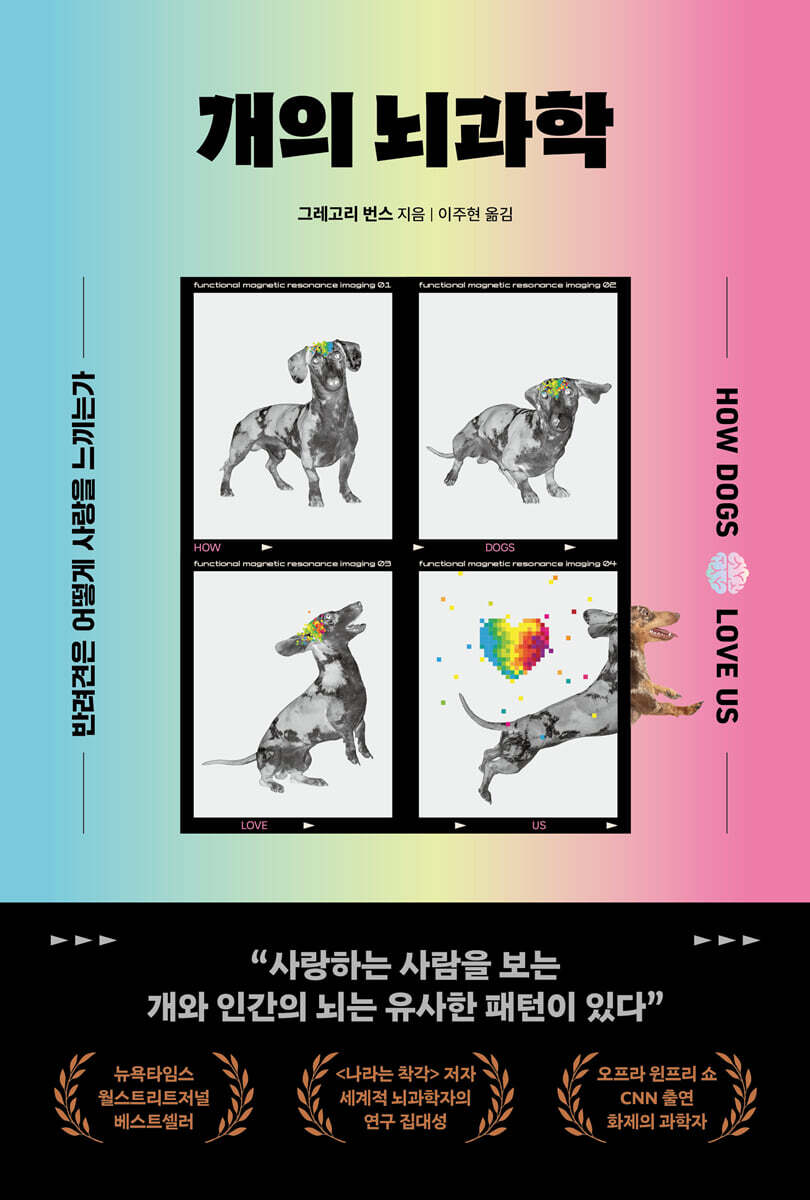
Dog Brain Science
 |
Description
Book Introduction
A New York Times, Wall Street Journal, and Forbes bestseller!
Professor Gregory Burns, America's leading neuroscientist, talks about
Amazing and shocking discoveries about dog love and emotions!
A topic of conversation for companions, asking questions about communication with dogs.
“Will my dog love me as much as I love him?”
Are companion dogs simply creatures who reflexively follow humans, or are they family members who share our emotions? "Canine Neuroscience" is a global bestseller based on the world's first paper to vividly record canine brain activity using fMRI (functional magnetic resonance imaging). It offers a fresh perspective on how companion dogs experience emotions and love.
In this book, author Gregory Burns, a neuroscientist and dog psychologist, scientifically analyzes how similar the brain responses of dogs and humans to love are by studying animal brain science through ethical experiments.
It provides scientific evidence for the bond between humans and their dogs, revealing that brain regions rich in dopamine receptors are activated when dogs respond to human praise, scents, and verbal cues.
The author successfully acquired high-resolution image data by training companion dogs to adapt to MRI equipment without tranquilizers, and based on the experiment, he interestingly unraveled whether dogs have empathy, whether they actually recognize their owners' emotional changes, and how animal social behavior works at the neural circuit level.
Readers will be able to better understand their dogs' emotions by examining the psychological relationship between humans and dogs from a neuroscience perspective.
Professor Gregory Burns, America's leading neuroscientist, talks about
Amazing and shocking discoveries about dog love and emotions!
A topic of conversation for companions, asking questions about communication with dogs.
“Will my dog love me as much as I love him?”
Are companion dogs simply creatures who reflexively follow humans, or are they family members who share our emotions? "Canine Neuroscience" is a global bestseller based on the world's first paper to vividly record canine brain activity using fMRI (functional magnetic resonance imaging). It offers a fresh perspective on how companion dogs experience emotions and love.
In this book, author Gregory Burns, a neuroscientist and dog psychologist, scientifically analyzes how similar the brain responses of dogs and humans to love are by studying animal brain science through ethical experiments.
It provides scientific evidence for the bond between humans and their dogs, revealing that brain regions rich in dopamine receptors are activated when dogs respond to human praise, scents, and verbal cues.
The author successfully acquired high-resolution image data by training companion dogs to adapt to MRI equipment without tranquilizers, and based on the experiment, he interestingly unraveled whether dogs have empathy, whether they actually recognize their owners' emotional changes, and how animal social behavior works at the neural circuit level.
Readers will be able to better understand their dogs' emotions by examining the psychological relationship between humans and dogs from a neuroscience perspective.
- You can preview some of the book's contents.
Preview
index
Entering_ Final Rehearsal
Chapter 1: The Birth of the Dog Project
1.
Day of the Dead
2.
Living as a dog
3.
fishing experiment
4.
Behaviorist theory
5.
monkey experiments
6.
Animal-assisted therapy
7.
Dog consent form
Chapter 2 MRI Scan Simulation
8.
Simulator design
9.
positive reinforcement training
10.
dead sheep brain
11.
Stick instead of carrot
12.
Emotion Dimension Model
13.
Ghosting issue resolved
14.
Hand signal technique
Chapter 3: Facts from the Perspective of Brain Science
15.
brain slice imaging
16.
caudate nucleus activity
17.
reward system
18.
theory of mind
19.
Correction work
20.
Do you love me too?
21.
social cognition
22.
The nature of relationships
Chapter 4: A New Future
23.
Hello, Lyra
24.
Day of the Dead 2012
Epilogue
References
Acknowledgements
Chapter 1: The Birth of the Dog Project
1.
Day of the Dead
2.
Living as a dog
3.
fishing experiment
4.
Behaviorist theory
5.
monkey experiments
6.
Animal-assisted therapy
7.
Dog consent form
Chapter 2 MRI Scan Simulation
8.
Simulator design
9.
positive reinforcement training
10.
dead sheep brain
11.
Stick instead of carrot
12.
Emotion Dimension Model
13.
Ghosting issue resolved
14.
Hand signal technique
Chapter 3: Facts from the Perspective of Brain Science
15.
brain slice imaging
16.
caudate nucleus activity
17.
reward system
18.
theory of mind
19.
Correction work
20.
Do you love me too?
21.
social cognition
22.
The nature of relationships
Chapter 4: A New Future
23.
Hello, Lyra
24.
Day of the Dead 2012
Epilogue
References
Acknowledgements
Detailed image

Into the book
The screen showed a structural imaging image of Callie's brain.
I've seen that image over a hundred times, so much so that I know it better than my own brain, to put it mildly.
An activation map was superimposed over the image.
I've been seeing these images and videos day and night for the past few weeks, so I've become accustomed to seeing red, orange, and yellow activation points overlapping somewhere in the caudate nucleus.
But this time something was different.
Andrew used digital calibration techniques to ensure that Mackenzie and Callie's brains were aligned with each other.
--- p.225
I felt that the relationship between people and dogs might be really true.
If dogs have the ability to observe human behavior and interpret it as dog behavior, wouldn't they be able to sense human emotions as well? With their own unique emotions.
Activation of the caudate nucleus demonstrates the possibility that we can detect and interpret activity occurring in the dog's brain.
Callie and Mackenzie showed that they understood the hand signals for their favorite hot dogs.
But the motor cortex activation suggested that the dogs weren't simply learning by rote, Pavlovian means.
--- p.230
Actually, I was quite shocked when I first saw the brain images of Callie and Mackenzie.
Where humans would have a large frontal lobe, dogs had nothing.
Instead, there was a large, rocket-shaped protrusion extending towards the snout, which was the olfactory bulb.
It is a part that cannot be found at all in the human brain.
Moreover, this area occupied a whopping 10% of the entire brain.
--- p.235
Following the hot dog experiment and the smell experiment, two more experiments have shown that dogs have mentalizing abilities and that they can use them on people.
Perhaps this isn't such a surprising result.
Anyone who has ever raised a dog will tell you that your dog knows you and reciprocates the love you give it.
However, this is the first time that clear evidence has been found that love interacts with dogs in human-dog relationships, and that dogs also have social cognitive abilities.
--- p.245
While much research on dogs ultimately focuses on improving human health and well-being, the findings should also benefit dogs.
Many people truly love and raise dogs, but there are many things they do not know and misunderstand about dogs.
Maybe it's because we tend to think of dogs as just domesticated wolves.
I met with NIH staff to discuss expanding the Dog Project.
Through the project, he said he wanted to find out how dogs can help reduce stress in people.
I've seen that image over a hundred times, so much so that I know it better than my own brain, to put it mildly.
An activation map was superimposed over the image.
I've been seeing these images and videos day and night for the past few weeks, so I've become accustomed to seeing red, orange, and yellow activation points overlapping somewhere in the caudate nucleus.
But this time something was different.
Andrew used digital calibration techniques to ensure that Mackenzie and Callie's brains were aligned with each other.
--- p.225
I felt that the relationship between people and dogs might be really true.
If dogs have the ability to observe human behavior and interpret it as dog behavior, wouldn't they be able to sense human emotions as well? With their own unique emotions.
Activation of the caudate nucleus demonstrates the possibility that we can detect and interpret activity occurring in the dog's brain.
Callie and Mackenzie showed that they understood the hand signals for their favorite hot dogs.
But the motor cortex activation suggested that the dogs weren't simply learning by rote, Pavlovian means.
--- p.230
Actually, I was quite shocked when I first saw the brain images of Callie and Mackenzie.
Where humans would have a large frontal lobe, dogs had nothing.
Instead, there was a large, rocket-shaped protrusion extending towards the snout, which was the olfactory bulb.
It is a part that cannot be found at all in the human brain.
Moreover, this area occupied a whopping 10% of the entire brain.
--- p.235
Following the hot dog experiment and the smell experiment, two more experiments have shown that dogs have mentalizing abilities and that they can use them on people.
Perhaps this isn't such a surprising result.
Anyone who has ever raised a dog will tell you that your dog knows you and reciprocates the love you give it.
However, this is the first time that clear evidence has been found that love interacts with dogs in human-dog relationships, and that dogs also have social cognitive abilities.
--- p.245
While much research on dogs ultimately focuses on improving human health and well-being, the findings should also benefit dogs.
Many people truly love and raise dogs, but there are many things they do not know and misunderstand about dogs.
Maybe it's because we tend to think of dogs as just domesticated wolves.
I met with NIH staff to discuss expanding the Dog Project.
Through the project, he said he wanted to find out how dogs can help reduce stress in people.
--- p.282
Publisher's Review
The world's first analysis of a dog's brain reveals the true nature of emotions and love!
A sensational experiment that caught the attention of CNN, BBC, and the Oprah Winfrey Show.
"The Brain Science of Dogs" is the story of the "Dog Project," in which Gregory Burns, America's leading dog neuroscientist, studied dogs' motivation, emotions, and memory patterns using brain imaging technology (fMRI).
The author is a famous scientist who discovered the self by tracking the human brain with fMRI, and has extended this to animals.
The death of Newton, the first dog I raised after getting married, prompted me to try to understand, from a neuroscientific perspective, whether dogs truly loved us, just like humans.
Many scientists are using MRI to image 'how the dog brain works', which accurately shows the brain activity of a person feeling emotions.
The author says that if we understand brain function, anyone can unlock the secrets of dogs' emotions and how much they love humans.
This book explains how dogs perceive and interpret human emotions and signals, and how the human-dog bond is formed.
At the center of everything is the 'brain'.
This is because we can directly observe how our dogs react to specific stimuli, such as the voices, smells, and gestures of their family members.
Therefore, understanding canine brain science becomes a core value of a relationship that is more important than loving your pet.
In particular, 『Canine Brain Science』 is the world's first study to capture MRI images of a dog's brain without anesthesia, and is considered the most credible source for understanding the emotions and behavior of dogs.
The author, along with his dog, Callie, successfully completed an experiment that many researchers feared might fail.
This expansive journey scientifically reexamines the complex behaviors and emotions of our companion dogs, which we have previously relied solely on intuition to understand.
The Secrets of the Caudate Nucleus: The Circuit That Connects Human and Dog Emotions
A Record Uncovering the Truth About Dopamine, Love, and Interspecies Cognition
Can dogs feel love like humans? Professor Gregory Burns used MRI scans of dog brains to uncover surprising clues to this question.
Dogs use the same part of the brain called the caudate nucleus that is activated when humans feel pleasure and reward.
The caudate nucleus is a region densely populated with dopamine receptors, and is known to respond to stimuli such as food, money, and love in humans.
That is, dogs, like humans, can feel emotions and form bonds.
The authors observed that dogs showed strong emotional responses to their owner's scent and that the caudate nucleus was activated in response to reward cues.
Unlike humans, dogs process emotions and cognition in the inferior temporal lobe instead of the frontal lobe, and the response patterns in this area were similar to those seen in humans when viewing 'photos of loved ones'.
Dogs can emotionally recognize specific objects and interpret emotional states or social cues, suggesting that they possess cognitive abilities similar to those of the human mind.
"The Brain Science of Dogs" takes a fascinating scientific approach to dissecting the emotional circuits shared between humans and dogs, and tells the story of how the minds of companion dogs work.
Through various experiments, we unravel how the reward system works in the process of dogs learning new behaviors, and prove that dogs' cognitive choices and emotional responses are not solely based on reflexive conditions.
The dog's brain reacts delicately to stimuli such as the owner's voice, smell, and hand gestures, emphasizing the fact that dogs are beings with the ability to make emotional judgments and form intimacy.
In particular, the fact that brain response patterns differ for each individual supports the idea that dogs are 'personal beings' with unique emotional tendencies and cognitive characteristics.
This book explores the emotional interactions between dogs and humans through the eyes of a leading American neuroscientist, helping us to understand and empathize more deeply with the inner world of dogs.
How does the dog brain work? How do dogs come to love?
A scientific framework for understanding the emotional interactions between dogs and their owners!
Dogs are known to be animals that remember their owner's scent particularly well.
So, what happens in a dog's brain when it encounters a familiar person? Gregory Burns studied what happens in the brains of dogs when they smell familiar and unfamiliar scents.
He conducted an experiment in which dogs were exposed to the scents of their owners, strangers, and dogs inside a magnetic resonance imaging device.
As a result, they confirmed that the caudate nucleus, located deep inside the brain, was strongly activated when smelling the scent of a 'familiar person', but hardly reacted to the scent of an unfamiliar person or unfamiliar dog.
This experiment suggests that, like people, dogs develop stronger bonds and more positive emotions toward familiar people the more they interact with them, and that these emotions are reflected in brain activation.
"Canine Neuroscience" takes a fresh look at the question, "What is dog love?" through the unknown subject of research, the canine brain.
And it scientifically explains how deep and sophisticated the relationship between humans and animals can be.
The book also includes a memorable scene where Professor Burns and his dog, Callie, conduct an MRI experiment together.
The moment they locked eyes, the caudate nucleus in Callie's brain became activated.
This is not a simple reaction, but clear evidence that social signals such as eye contact are conveyed as 'feel-good emotions' to dogs as well.
In this book, the author, a masterful storyteller, reveals the truth about the bond between dogs and humans with a warm and unique perspective.
Beyond simple training methods, it helps us gain a deeper understanding of the time we spend with our dogs.
For those who truly love and cherish dogs, but sometimes wonder how their feelings are conveyed, "Canine Brain Science" will provide clear answers and warm empathy.
The greatest value of this book lies in Burns' design of the experiments.
Like a catcher and a pitcher, he says that he and his dog have become 'one team', which shows why humans and dogs have lived together.
- The Boston Globe, a leading American daily newspaper
***Reviews from previous readers***
“I realized through Burns’ ‘Dog Project’ that my love and connection with my dog Jackson over many years was scientifically reciprocal.
“This book is a moving and inspiring book that will help you understand the bond and love you have with your pet more deeply and give you the courage to create new memories.” - Jamie, veterinarian
“Gregory Burns’ ‘The Dog Project’ is a fascinating book that scientifically explores whether dogs truly love humans by conducting MRI experiments on companion dogs.” - Ahmed, companion dog trainer
“It also addresses concerns about animal welfare, adoption, and the health of companion dogs, providing deep empathy and reflection for dog lovers.” - Zoology researcher Gregory
A sensational experiment that caught the attention of CNN, BBC, and the Oprah Winfrey Show.
"The Brain Science of Dogs" is the story of the "Dog Project," in which Gregory Burns, America's leading dog neuroscientist, studied dogs' motivation, emotions, and memory patterns using brain imaging technology (fMRI).
The author is a famous scientist who discovered the self by tracking the human brain with fMRI, and has extended this to animals.
The death of Newton, the first dog I raised after getting married, prompted me to try to understand, from a neuroscientific perspective, whether dogs truly loved us, just like humans.
Many scientists are using MRI to image 'how the dog brain works', which accurately shows the brain activity of a person feeling emotions.
The author says that if we understand brain function, anyone can unlock the secrets of dogs' emotions and how much they love humans.
This book explains how dogs perceive and interpret human emotions and signals, and how the human-dog bond is formed.
At the center of everything is the 'brain'.
This is because we can directly observe how our dogs react to specific stimuli, such as the voices, smells, and gestures of their family members.
Therefore, understanding canine brain science becomes a core value of a relationship that is more important than loving your pet.
In particular, 『Canine Brain Science』 is the world's first study to capture MRI images of a dog's brain without anesthesia, and is considered the most credible source for understanding the emotions and behavior of dogs.
The author, along with his dog, Callie, successfully completed an experiment that many researchers feared might fail.
This expansive journey scientifically reexamines the complex behaviors and emotions of our companion dogs, which we have previously relied solely on intuition to understand.
The Secrets of the Caudate Nucleus: The Circuit That Connects Human and Dog Emotions
A Record Uncovering the Truth About Dopamine, Love, and Interspecies Cognition
Can dogs feel love like humans? Professor Gregory Burns used MRI scans of dog brains to uncover surprising clues to this question.
Dogs use the same part of the brain called the caudate nucleus that is activated when humans feel pleasure and reward.
The caudate nucleus is a region densely populated with dopamine receptors, and is known to respond to stimuli such as food, money, and love in humans.
That is, dogs, like humans, can feel emotions and form bonds.
The authors observed that dogs showed strong emotional responses to their owner's scent and that the caudate nucleus was activated in response to reward cues.
Unlike humans, dogs process emotions and cognition in the inferior temporal lobe instead of the frontal lobe, and the response patterns in this area were similar to those seen in humans when viewing 'photos of loved ones'.
Dogs can emotionally recognize specific objects and interpret emotional states or social cues, suggesting that they possess cognitive abilities similar to those of the human mind.
"The Brain Science of Dogs" takes a fascinating scientific approach to dissecting the emotional circuits shared between humans and dogs, and tells the story of how the minds of companion dogs work.
Through various experiments, we unravel how the reward system works in the process of dogs learning new behaviors, and prove that dogs' cognitive choices and emotional responses are not solely based on reflexive conditions.
The dog's brain reacts delicately to stimuli such as the owner's voice, smell, and hand gestures, emphasizing the fact that dogs are beings with the ability to make emotional judgments and form intimacy.
In particular, the fact that brain response patterns differ for each individual supports the idea that dogs are 'personal beings' with unique emotional tendencies and cognitive characteristics.
This book explores the emotional interactions between dogs and humans through the eyes of a leading American neuroscientist, helping us to understand and empathize more deeply with the inner world of dogs.
How does the dog brain work? How do dogs come to love?
A scientific framework for understanding the emotional interactions between dogs and their owners!
Dogs are known to be animals that remember their owner's scent particularly well.
So, what happens in a dog's brain when it encounters a familiar person? Gregory Burns studied what happens in the brains of dogs when they smell familiar and unfamiliar scents.
He conducted an experiment in which dogs were exposed to the scents of their owners, strangers, and dogs inside a magnetic resonance imaging device.
As a result, they confirmed that the caudate nucleus, located deep inside the brain, was strongly activated when smelling the scent of a 'familiar person', but hardly reacted to the scent of an unfamiliar person or unfamiliar dog.
This experiment suggests that, like people, dogs develop stronger bonds and more positive emotions toward familiar people the more they interact with them, and that these emotions are reflected in brain activation.
"Canine Neuroscience" takes a fresh look at the question, "What is dog love?" through the unknown subject of research, the canine brain.
And it scientifically explains how deep and sophisticated the relationship between humans and animals can be.
The book also includes a memorable scene where Professor Burns and his dog, Callie, conduct an MRI experiment together.
The moment they locked eyes, the caudate nucleus in Callie's brain became activated.
This is not a simple reaction, but clear evidence that social signals such as eye contact are conveyed as 'feel-good emotions' to dogs as well.
In this book, the author, a masterful storyteller, reveals the truth about the bond between dogs and humans with a warm and unique perspective.
Beyond simple training methods, it helps us gain a deeper understanding of the time we spend with our dogs.
For those who truly love and cherish dogs, but sometimes wonder how their feelings are conveyed, "Canine Brain Science" will provide clear answers and warm empathy.
The greatest value of this book lies in Burns' design of the experiments.
Like a catcher and a pitcher, he says that he and his dog have become 'one team', which shows why humans and dogs have lived together.
- The Boston Globe, a leading American daily newspaper
***Reviews from previous readers***
“I realized through Burns’ ‘Dog Project’ that my love and connection with my dog Jackson over many years was scientifically reciprocal.
“This book is a moving and inspiring book that will help you understand the bond and love you have with your pet more deeply and give you the courage to create new memories.” - Jamie, veterinarian
“Gregory Burns’ ‘The Dog Project’ is a fascinating book that scientifically explores whether dogs truly love humans by conducting MRI experiments on companion dogs.” - Ahmed, companion dog trainer
“It also addresses concerns about animal welfare, adoption, and the health of companion dogs, providing deep empathy and reflection for dog lovers.” - Zoology researcher Gregory
GOODS SPECIFICS
- Date of issue: July 11, 2025
- Page count, weight, size: 296 pages | 152*225*20mm
- ISBN13: 9791191925289
- ISBN10: 1191925285
You may also like
카테고리
korean


korean

![GQ KOREA Mark (Monthly): December [2025]](http://librairie.coreenne.fr/cdn/shop/files/8ef265dbbfbf186523ed75ba7319009d.jpg?v=1765340328&width=3840)


