

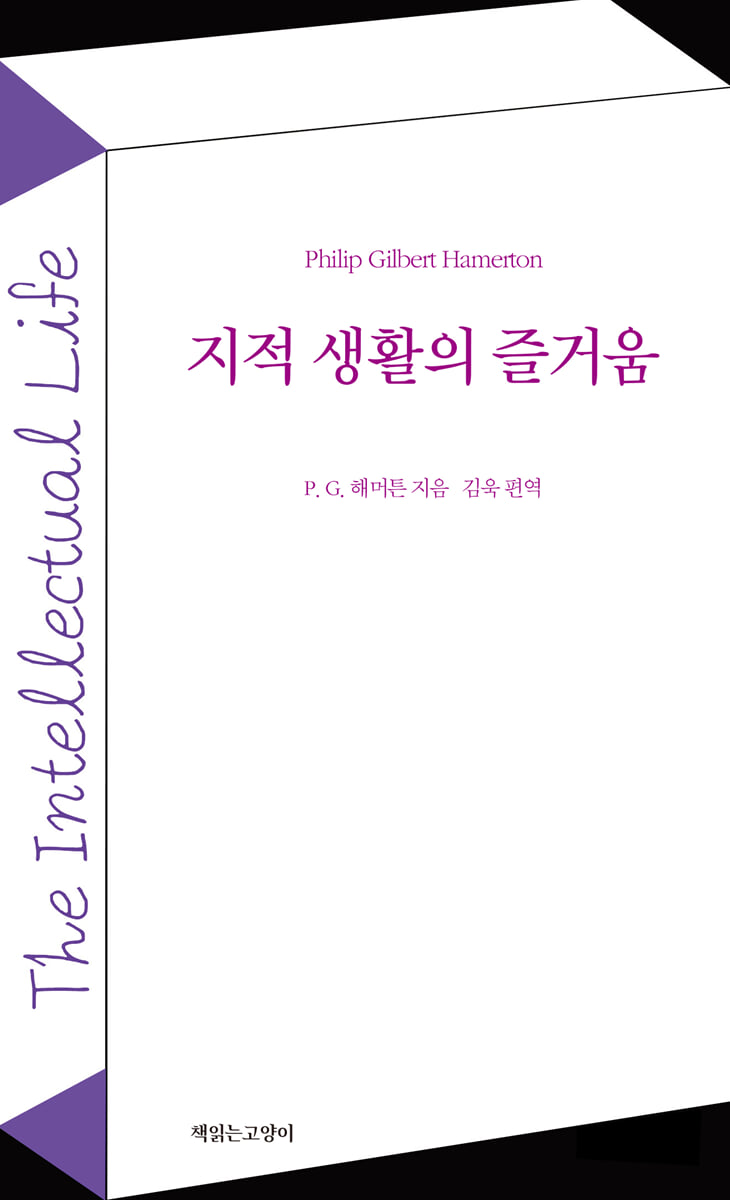
The pleasures of intellectual life
 |
Description
Book Introduction
★A classic read by intellectuals for over 100 years
★A book that will enhance the enjoyment of intellectual life.
★What is the difference between us living in the age of AI and quantum computers and Plato?
"The Pleasures of the Intellectual Life" is a humanistic insight delivered by Philip Gilbert Hammerton, the Victorian intellectual who first used the term "intellectual life," to intellectuals wandering between intellectual instinct and reality.
It awakens the essence of intellectual life to 'tired' intellectuals and 'hard' mental laborers who have chosen an intellectual life but are unable to experience intellectual pleasure, and leads them to true intellectual pleasure.
This book, which consists of three parts, examines the thoughts and habits that hinder intellectual enjoyment and communicates with intellectuals under the themes of Part 1: Physical Training for an Intellectual Life, Part 2: Realistic Concerns of Intellectuals, and Part 3: Happiness of Intellectuals.
Despite being written over a century ago, Hammerton's advice is not only a perfectly valid answer to the concerns of 21st-century intellectuals, but its exceptional insight, transcending our preconceptions, is enough to demonstrate its true value as a classic for intellectuals over many years.
★A book that will enhance the enjoyment of intellectual life.
★What is the difference between us living in the age of AI and quantum computers and Plato?
"The Pleasures of the Intellectual Life" is a humanistic insight delivered by Philip Gilbert Hammerton, the Victorian intellectual who first used the term "intellectual life," to intellectuals wandering between intellectual instinct and reality.
It awakens the essence of intellectual life to 'tired' intellectuals and 'hard' mental laborers who have chosen an intellectual life but are unable to experience intellectual pleasure, and leads them to true intellectual pleasure.
This book, which consists of three parts, examines the thoughts and habits that hinder intellectual enjoyment and communicates with intellectuals under the themes of Part 1: Physical Training for an Intellectual Life, Part 2: Realistic Concerns of Intellectuals, and Part 3: Happiness of Intellectuals.
Despite being written over a century ago, Hammerton's advice is not only a perfectly valid answer to the concerns of 21st-century intellectuals, but its exceptional insight, transcending our preconceptions, is enough to demonstrate its true value as a classic for intellectuals over many years.
- You can preview some of the book's contents.
Preview
index
prolog
Part 1: Physical Training for Intellectual Life
Intellectual desires also require moderation.
Body care for intellectual life
The Life Habits of Kant, the Perfect Intellectual
Regularity / Eating Habits / Wine and Beer / Smoking / Tea and Coffee
The big misconception that exercise time is wasted
Training for an outstanding intellectual
Part 2: The Real Concerns of Intellectuals
A rational way for intellectuals to use their time
Time and quality of intellectual life
Make time to read and read regularly.
Pros and Cons of Expanding Your Knowledge
The obsession with studying multiple fields
The ill effect of judging academics based on the bias of support
A good memory is not about remembering a lot of things.
Intellectual fulfillment has nothing to do with wealth.
Why You Should Read the Newspaper
The dilemma of being attracted to intellectual reason even if it is immoral
Part 3: Happiness for the intellectual
Intellectual life is looking at myself with my own eyes.
Our attitude toward labor
What is art?
Intellectual human relationships
How to Deal with Your Enemies Intellectually
How to Age Intellectually
Happiness for an intellectual
Why we must follow the mission of intelligence despite loneliness
Translator's Note
Part 1: Physical Training for Intellectual Life
Intellectual desires also require moderation.
Body care for intellectual life
The Life Habits of Kant, the Perfect Intellectual
Regularity / Eating Habits / Wine and Beer / Smoking / Tea and Coffee
The big misconception that exercise time is wasted
Training for an outstanding intellectual
Part 2: The Real Concerns of Intellectuals
A rational way for intellectuals to use their time
Time and quality of intellectual life
Make time to read and read regularly.
Pros and Cons of Expanding Your Knowledge
The obsession with studying multiple fields
The ill effect of judging academics based on the bias of support
A good memory is not about remembering a lot of things.
Intellectual fulfillment has nothing to do with wealth.
Why You Should Read the Newspaper
The dilemma of being attracted to intellectual reason even if it is immoral
Part 3: Happiness for the intellectual
Intellectual life is looking at myself with my own eyes.
Our attitude toward labor
What is art?
Intellectual human relationships
How to Deal with Your Enemies Intellectually
How to Age Intellectually
Happiness for an intellectual
Why we must follow the mission of intelligence despite loneliness
Translator's Note
Detailed image

Publisher's Review
Body care for intellectual life
The author emphasizes the physical foundation ahead of the innate talents of the brain as an essential element of intellectual life.
The strong emphasis on physical care as a foundation for developing intellectual abilities is refreshing and interesting.
Through his own research, Hammerton shows how scholars and intellectuals of his time sought and trained their bodies and their own unique lifestyles to sustain their intellectual lives.
In this process, we experience complete persuasion for the strange proposition that “the indispensable element of intellectual life is not innate brain talent, but physical foundation.”
The lives of those who have already proven their intellect with solid results, such as Kant, Goethe, Nietzsche, Wordsworth, and George Sand, are introduced in detail.
For example, Kant, the author of the Critique of Pure Reason, is a person who observed himself for over 30 years and gradually improved himself in order to find the lifestyle that best suited his body and his profession as a philosopher.
He finished breakfast at 5 a.m. with tea and a cigarette, then began preparing lectures and writing, working nonstop for eight hours, and had lunch at 1 p.m. when he finished work.
From then on, I never put food in my mouth again.
Kant shows that a brain worker needs to make sacrifices and exercise self-restraint rather than follow the habits of the world.
W., former president of the London Times.
AF
When Derain was a reporter, he would travel from city to city to find places where circuit courts were being held, always riding a horse instead of taking the train. He also avoided meals served at inns as much as possible and instead went to good restaurants to eat breakfast.
It is said that when he had free time, he would go shopping and cook for himself.
He understood the importance of health and knew that he could not be a good reporter without physical strength.
It is a much more difficult and arduous process to build a healthy body as a journalist than to write good articles.
Most intellectual workers live in conditions that are far from healthy.
I read books all day and write until dawn.
For weeks, I didn't even step out of the house, let alone exercise.
Even when I have a little break, I would like to get some fresh air, but instead, I end up smoking cigarettes during that time.
They also drink alcohol, tea, or coffee, saying that it is a good stimulus for the brain.
While it's true that these patterns have been instrumental in the emergence of intelligence, Hammerton argues that we shouldn't succumb to the temptation to rely too heavily on these stimuli.
Hammerton argues that intellectual life also seeks pleasure, and he emphasizes that the only way to achieve it is through training.
Intellectual training is unique in that there are no correct answers or reference books.
The only way is to follow one's own individuality.
You need to find a unique training method that suits your personality and adapt it to your situation and your growth rate.
Training that is coercive or ignores the feelings of the person being trained is not intellectual training.
Intellectual training gives us a unique pleasure called intellectual pleasure.
If physical training involves enduring pain, then in intellectual training, pain soon becomes joy.
Answers to the things that drive intellectuals to despair
Many people fall into despair during their intellectual lives.
Hammerton argues that there's a reason so many intellectuals repeat the same mistakes, and he examines the misconceptions and errors about the purpose, nature, and effectiveness of intellectual life, leading to clear alternatives to realistic concerns.
We explore how to manage time, the desire to expand knowledge, the obsession with learning, memory, reading methods, poverty, why we should read newspapers, career choices based on the bias of support, and the problem of being attracted to intellectual reason.
Any intellectual person values rational use of time.
As they are time sensitive, it is time that drives them to despair.
Hammerton notes that, surprisingly, most of the time that intellectuals' precious time is wasted is during research.
He points out that this is because we become indifferent to the time called 'today' and 'this moment' as we are crushed by the weight of time that unfolds over decades, and explains the importance of things that are easily overlooked, such as giving up, limits, and setting timeframes.
In addition, it is recommended to carefully examine lifestyle habits such as sleeping late and taking excessively long meals, which are easily overlooked due to the pressure of the cause.
Another trap that intellectuals can easily fall into is 'expanding knowledge'.
Intellectual life is not satisfied with one area.
Since knowledge does not have a single form, an intellectual life is a journey to find that form without even realizing it.
However, Hammerton points out that expanding one's knowledge has not only advantages but also disadvantages.
He warns that excessive knowledge acquisition can lead to the loss of one's own individuality, and asks whether one might become obsessed with the learning process and boast about the past tense of 'learning.'
If you're exploring a new field purely out of intellectual curiosity, I recommend reading at least two hours a day.
However, he cautions that you should increase your work efficiency to secure stable reading time and never stop.
It emphasizes that one can never achieve the intellectual life one hopes for by reading books sporadically only when one has free time.
For intellectuals, memory is always a weakness.
For those who lament their poor memory, Hammerton says it's a bit like having a stomachache.
He rebukes them, saying that it is nothing more than an aversion to knowledge that has been forcibly injected.
The essence of memory lies in ‘connection.’
They say that memory is just a kind of intellectual muscle, and that a good memory is not about remembering a lot of things.
Here's a piece of advice Hammerton received from a famous author:
“Take as many notes as possible.
But when it comes to actually writing it, don't look at the notes.
If what you wrote down is truly valuable, you'll remember it when you need it even if you don't take it out."
Additionally, Hammerton offers comfort and hope based on his own experiences to those who pursue culture but struggle with the practical challenges of poverty.
While it is true that economic wealth is an advantageous condition for intellectual life, it is persuasive to argue that from an intellectual perspective, the lack of freedom that is poverty is not necessarily a bad thing.
Because every human being has limitations and there are limits to the abilities they can acquire.
Anyway, you can't acquire all the knowledge.
Filling your library with great works is useless if you don't read them, and if you read them but don't feel moved, it's just a waste of time.
Hammerton says:
“In the past, I believed in the importance of opportunity.
I thought that effort was only possible if given the opportunity.
But now that I'm at this age, what I really want is time and health.
Opportunities will come to you constantly, as long as time and health permit.
Even if you don't come looking for me, I can find you."
What is happiness to an intellectual?
Through this book, Hammerton guides us to look into ourselves, the most important object for living as an intellectual.
We will examine the core of being an intellectual, the purpose of life, the meaning of work and happiness, enemies and human relationships, art, aging, happiness, and the meaning of solitude.
Hammerton says that true intellectual life is an act of waiting for the voice within me and looking at myself with my own eyes.
You can neither become free nor noble by making yourself what others want you to be.
To be free and noble, you must have your own thoughts.
The reason we call Plato a great philosopher is because he recognized the process of thought, not the result of thought; and the reason we need Plato, Augustine, Hegel, and Schopenhauer is not because of their doctrines, but because of the lives they lived.
Hammerton says that my relationships, whether with friends or enemies, are a reflection of who I am.
So if you're curious about how you've lived and what kind of person you are, I suggest inviting your friends over for dinner tonight.
If you want to date a great person, they advise you to first become a great person.
Any intellectual would have to agree with Hammerton's interpretation of the enemy.
Hammerton quotes the Greek comedian Aristophanes:
“A wise man learns from his enemies.” It was tragedy that taught Aristophanes laughter, and it was his arrogant fellow writers that taught him humility.
Hammerton cautions against making enemies of those you despise.
To acknowledge your enemy means to discover something from him that you lack, so it means to choose an enemy worth learning from.
Hammerton's theory of art discusses art as an indispensable existence for intellectual life.
The author's vivid perspective, especially as an intellectual and artist, adds depth to the emotion.
Hammerton expressed that art exists to elevate human ideals, and is absolutely necessary to develop us into purer, more powerful, and greater beings.
It is said that what makes art greater than any other activity is that it does not disappoint human expectations.
The state has oppressed its people, the economy has created poverty, religion has planted vain delusions, law has created sinners, and philosophy has made people thirstier for truth, but art has consoled the human soul in all dark ages.
Hammerton says:
“I am not Goethe, but I can understand Werther’s sorrows. This joy is the true treasure of art.”
“I am not Beethoven, but the excitement of hearing the birdsong that Beethoven loved is the true treasure of art.”
There is no right answer as to how to age well.
However, Hammerton says that the reason aging is painful is because we don't know how to grow old.
A beautiful old age is ultimately proof that one has lived a beautiful youth, but the reason people cannot age gracefully and fear old age is because they know that they did not do their best in the time that has passed.
It suggests that rather than obsessing over what kind of fruit to harvest, it may be best to enjoy the flowers that are available now.
The Victorian era, in which Hammerton was active, was the period of maturation of the Industrial Revolution and the height of the British Empire.
Hammerton wrote this book for 19th-century British audiences.
Interestingly enough, Hammerton's advice resonates with us living in the 21st century.
The way we struggle and struggle in the midst of the contradictions of material civilization is no different from what it is now.
Perhaps that is why Hammerton's words transcend time and space and give us hope again as a useful teaching.
In today's world, where material civilization dominates, we inevitably yearn for the visible world, so efforts to transform it into an invisible world cannot go smoothly.
In this age where materialism is treated as civilization, following the dictates of the intellect seems foolish.
But if we do not follow the commands of our intellect, we will eventually live as slaves to our instincts.
Hammerton emphasizes that this is why we, living in a materialistic civilization, must lead an intellectual life.
The author emphasizes the physical foundation ahead of the innate talents of the brain as an essential element of intellectual life.
The strong emphasis on physical care as a foundation for developing intellectual abilities is refreshing and interesting.
Through his own research, Hammerton shows how scholars and intellectuals of his time sought and trained their bodies and their own unique lifestyles to sustain their intellectual lives.
In this process, we experience complete persuasion for the strange proposition that “the indispensable element of intellectual life is not innate brain talent, but physical foundation.”
The lives of those who have already proven their intellect with solid results, such as Kant, Goethe, Nietzsche, Wordsworth, and George Sand, are introduced in detail.
For example, Kant, the author of the Critique of Pure Reason, is a person who observed himself for over 30 years and gradually improved himself in order to find the lifestyle that best suited his body and his profession as a philosopher.
He finished breakfast at 5 a.m. with tea and a cigarette, then began preparing lectures and writing, working nonstop for eight hours, and had lunch at 1 p.m. when he finished work.
From then on, I never put food in my mouth again.
Kant shows that a brain worker needs to make sacrifices and exercise self-restraint rather than follow the habits of the world.
W., former president of the London Times.
AF
When Derain was a reporter, he would travel from city to city to find places where circuit courts were being held, always riding a horse instead of taking the train. He also avoided meals served at inns as much as possible and instead went to good restaurants to eat breakfast.
It is said that when he had free time, he would go shopping and cook for himself.
He understood the importance of health and knew that he could not be a good reporter without physical strength.
It is a much more difficult and arduous process to build a healthy body as a journalist than to write good articles.
Most intellectual workers live in conditions that are far from healthy.
I read books all day and write until dawn.
For weeks, I didn't even step out of the house, let alone exercise.
Even when I have a little break, I would like to get some fresh air, but instead, I end up smoking cigarettes during that time.
They also drink alcohol, tea, or coffee, saying that it is a good stimulus for the brain.
While it's true that these patterns have been instrumental in the emergence of intelligence, Hammerton argues that we shouldn't succumb to the temptation to rely too heavily on these stimuli.
Hammerton argues that intellectual life also seeks pleasure, and he emphasizes that the only way to achieve it is through training.
Intellectual training is unique in that there are no correct answers or reference books.
The only way is to follow one's own individuality.
You need to find a unique training method that suits your personality and adapt it to your situation and your growth rate.
Training that is coercive or ignores the feelings of the person being trained is not intellectual training.
Intellectual training gives us a unique pleasure called intellectual pleasure.
If physical training involves enduring pain, then in intellectual training, pain soon becomes joy.
Answers to the things that drive intellectuals to despair
Many people fall into despair during their intellectual lives.
Hammerton argues that there's a reason so many intellectuals repeat the same mistakes, and he examines the misconceptions and errors about the purpose, nature, and effectiveness of intellectual life, leading to clear alternatives to realistic concerns.
We explore how to manage time, the desire to expand knowledge, the obsession with learning, memory, reading methods, poverty, why we should read newspapers, career choices based on the bias of support, and the problem of being attracted to intellectual reason.
Any intellectual person values rational use of time.
As they are time sensitive, it is time that drives them to despair.
Hammerton notes that, surprisingly, most of the time that intellectuals' precious time is wasted is during research.
He points out that this is because we become indifferent to the time called 'today' and 'this moment' as we are crushed by the weight of time that unfolds over decades, and explains the importance of things that are easily overlooked, such as giving up, limits, and setting timeframes.
In addition, it is recommended to carefully examine lifestyle habits such as sleeping late and taking excessively long meals, which are easily overlooked due to the pressure of the cause.
Another trap that intellectuals can easily fall into is 'expanding knowledge'.
Intellectual life is not satisfied with one area.
Since knowledge does not have a single form, an intellectual life is a journey to find that form without even realizing it.
However, Hammerton points out that expanding one's knowledge has not only advantages but also disadvantages.
He warns that excessive knowledge acquisition can lead to the loss of one's own individuality, and asks whether one might become obsessed with the learning process and boast about the past tense of 'learning.'
If you're exploring a new field purely out of intellectual curiosity, I recommend reading at least two hours a day.
However, he cautions that you should increase your work efficiency to secure stable reading time and never stop.
It emphasizes that one can never achieve the intellectual life one hopes for by reading books sporadically only when one has free time.
For intellectuals, memory is always a weakness.
For those who lament their poor memory, Hammerton says it's a bit like having a stomachache.
He rebukes them, saying that it is nothing more than an aversion to knowledge that has been forcibly injected.
The essence of memory lies in ‘connection.’
They say that memory is just a kind of intellectual muscle, and that a good memory is not about remembering a lot of things.
Here's a piece of advice Hammerton received from a famous author:
“Take as many notes as possible.
But when it comes to actually writing it, don't look at the notes.
If what you wrote down is truly valuable, you'll remember it when you need it even if you don't take it out."
Additionally, Hammerton offers comfort and hope based on his own experiences to those who pursue culture but struggle with the practical challenges of poverty.
While it is true that economic wealth is an advantageous condition for intellectual life, it is persuasive to argue that from an intellectual perspective, the lack of freedom that is poverty is not necessarily a bad thing.
Because every human being has limitations and there are limits to the abilities they can acquire.
Anyway, you can't acquire all the knowledge.
Filling your library with great works is useless if you don't read them, and if you read them but don't feel moved, it's just a waste of time.
Hammerton says:
“In the past, I believed in the importance of opportunity.
I thought that effort was only possible if given the opportunity.
But now that I'm at this age, what I really want is time and health.
Opportunities will come to you constantly, as long as time and health permit.
Even if you don't come looking for me, I can find you."
What is happiness to an intellectual?
Through this book, Hammerton guides us to look into ourselves, the most important object for living as an intellectual.
We will examine the core of being an intellectual, the purpose of life, the meaning of work and happiness, enemies and human relationships, art, aging, happiness, and the meaning of solitude.
Hammerton says that true intellectual life is an act of waiting for the voice within me and looking at myself with my own eyes.
You can neither become free nor noble by making yourself what others want you to be.
To be free and noble, you must have your own thoughts.
The reason we call Plato a great philosopher is because he recognized the process of thought, not the result of thought; and the reason we need Plato, Augustine, Hegel, and Schopenhauer is not because of their doctrines, but because of the lives they lived.
Hammerton says that my relationships, whether with friends or enemies, are a reflection of who I am.
So if you're curious about how you've lived and what kind of person you are, I suggest inviting your friends over for dinner tonight.
If you want to date a great person, they advise you to first become a great person.
Any intellectual would have to agree with Hammerton's interpretation of the enemy.
Hammerton quotes the Greek comedian Aristophanes:
“A wise man learns from his enemies.” It was tragedy that taught Aristophanes laughter, and it was his arrogant fellow writers that taught him humility.
Hammerton cautions against making enemies of those you despise.
To acknowledge your enemy means to discover something from him that you lack, so it means to choose an enemy worth learning from.
Hammerton's theory of art discusses art as an indispensable existence for intellectual life.
The author's vivid perspective, especially as an intellectual and artist, adds depth to the emotion.
Hammerton expressed that art exists to elevate human ideals, and is absolutely necessary to develop us into purer, more powerful, and greater beings.
It is said that what makes art greater than any other activity is that it does not disappoint human expectations.
The state has oppressed its people, the economy has created poverty, religion has planted vain delusions, law has created sinners, and philosophy has made people thirstier for truth, but art has consoled the human soul in all dark ages.
Hammerton says:
“I am not Goethe, but I can understand Werther’s sorrows. This joy is the true treasure of art.”
“I am not Beethoven, but the excitement of hearing the birdsong that Beethoven loved is the true treasure of art.”
There is no right answer as to how to age well.
However, Hammerton says that the reason aging is painful is because we don't know how to grow old.
A beautiful old age is ultimately proof that one has lived a beautiful youth, but the reason people cannot age gracefully and fear old age is because they know that they did not do their best in the time that has passed.
It suggests that rather than obsessing over what kind of fruit to harvest, it may be best to enjoy the flowers that are available now.
The Victorian era, in which Hammerton was active, was the period of maturation of the Industrial Revolution and the height of the British Empire.
Hammerton wrote this book for 19th-century British audiences.
Interestingly enough, Hammerton's advice resonates with us living in the 21st century.
The way we struggle and struggle in the midst of the contradictions of material civilization is no different from what it is now.
Perhaps that is why Hammerton's words transcend time and space and give us hope again as a useful teaching.
In today's world, where material civilization dominates, we inevitably yearn for the visible world, so efforts to transform it into an invisible world cannot go smoothly.
In this age where materialism is treated as civilization, following the dictates of the intellect seems foolish.
But if we do not follow the commands of our intellect, we will eventually live as slaves to our instincts.
Hammerton emphasizes that this is why we, living in a materialistic civilization, must lead an intellectual life.
GOODS SPECIFICS
- Date of issue: February 18, 2025
- Page count, weight, size: 312 pages | 300g | 112*184*25mm
- ISBN13: 9791192753355
- ISBN10: 1192753356
You may also like
카테고리
korean


korean

![ELLE 엘르 스페셜 에디션 A형 : 12월 [2025]](http://librairie.coreenne.fr/cdn/shop/files/b8e27a3de6c9538896439686c6b0e8fb.jpg?v=1766436872&width=3840)


