

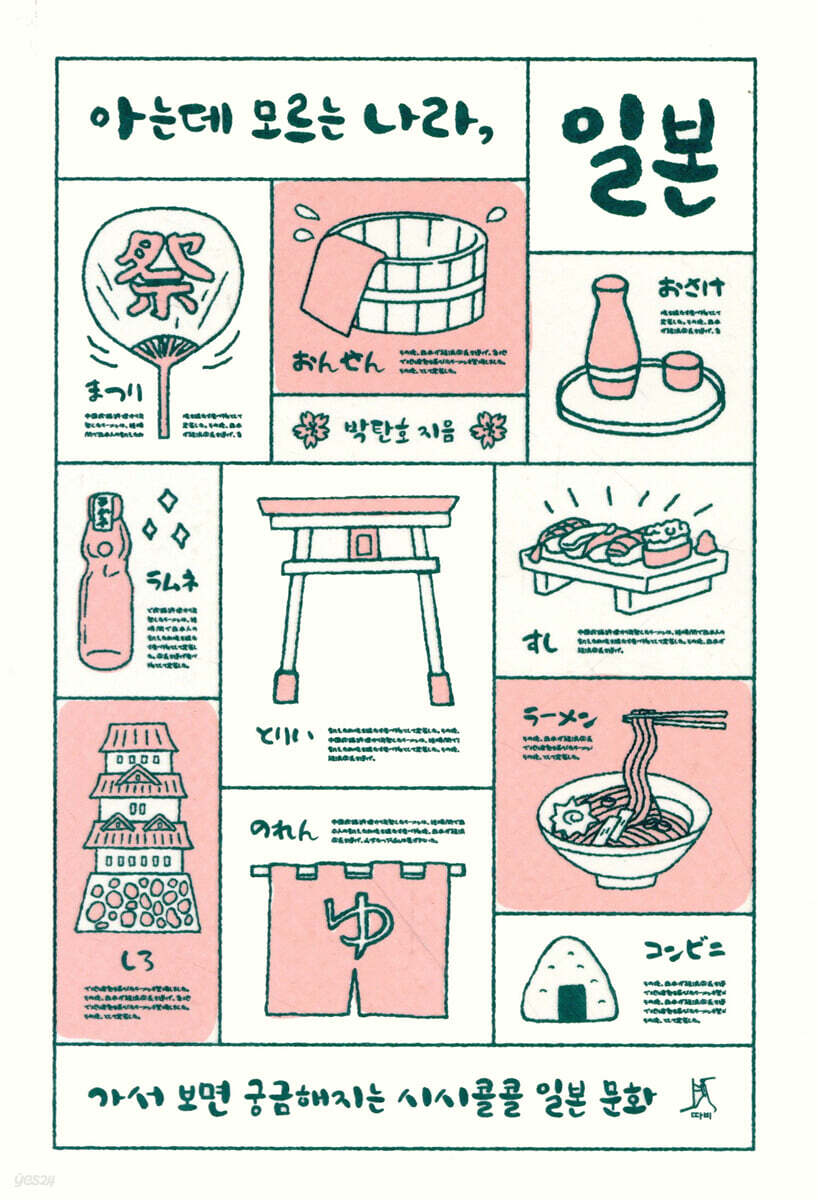
A country I know but don't know, Japan
 |
Description
Book Introduction
A country so close yet so far? A country I know but don't know!
If you go to Japan and see and experience it for yourself,
Thirty-one stories that will satisfy your curiosity
It makes your trip to Japan richer and twice as fun.
The boycott movement following the Japanese government's export ban on South Korea, followed by the COVID-19 pandemic that brought daily life to a standstill around the world, has opened the door to travel to Japan, which had been closed for years.
According to data released by the Japan National Tourism Organization (JNTO), of the 8.63 million foreign visitors to Japan from January to May 2023, Koreans accounted for 29.9%, or 2.58 million, ranking first among all foreign tourists.
If you go to Japan and see and experience it for yourself,
Thirty-one stories that will satisfy your curiosity
It makes your trip to Japan richer and twice as fun.
The boycott movement following the Japanese government's export ban on South Korea, followed by the COVID-19 pandemic that brought daily life to a standstill around the world, has opened the door to travel to Japan, which had been closed for years.
According to data released by the Japan National Tourism Organization (JNTO), of the 8.63 million foreign visitors to Japan from January to May 2023, Koreans accounted for 29.9%, or 2.58 million, ranking first among all foreign tourists.
- You can preview some of the book's contents.
Preview
index
Publishing a book 005
Knowing Part 1 makes it twice as fun!
Cigarette Packs and Water Guns: The Secrets of Shinkansen Design 013
Why Japanese Taxis Have Automatic Doors 024
The Story Behind Ugly Compact Cars Sweeping the Top Sales Rankings 034
Japanese city bus 050, boarding from the back and getting off at the front
Comparing Eastern Japan and Western Japan: Two Regions So Different
Since when have Japanese residential alleys been so clean? 073
The dirtier the store, the more popular it becomes? 092
How many coins can a Japanese vending machine hold? 100
When did the hot springs symbol appear? 113
Narrow as an 'eel bed', traditional Japanese house 129
Is there a castle made of food? 145
Why Geishas Wear Pure White Makeup 161
170 Porcelain Wrapping Papers That Fascinated Western Impressionist Painters
Japanese job seekers wear uniforms 180
A must-have for Japanese elementary school students: the Randoseru 190.
197 Reasons Why People Line Up During the Holiday Season
206 Yume with a picture of Mount Fuji in a Tokyo public bathhouse
216 Japanese Convenience Stores That Grew Up with Triangular Kimbap
If you know the second part, it tastes twice as good!
Train Travel Delicacy Ekiben 239
Ramen 252 is delicious when you slurp it down.
From tonkatsu to croquettes, 261 Japanese people are obsessed with fried foods.
Should I sprinkle it on or eat it plain? The Karaage Debate, No Less Than the Tangsuyuk Debate 272
The Story Behind How I Got Fried Chicken on Christmas Day 280
Japanese people are known for their love of food. (286)
The history of eating alone wasn't built overnight. 293
Japanese Dining Table, Sushi 305
Taste doubles when you drink it with knowledge: Japanese sake 316
If you want to see the real face of Japanese people, go to Kitsaten 333
Why does Japan's national drink, Ramune, have marbles in it? 349
Chopsticks are enough! Japanese dining etiquette 361
8% for takeout, 10% for dine-in? The confusing consumption tax of 368
Reference 375
Image source 382
Knowing Part 1 makes it twice as fun!
Cigarette Packs and Water Guns: The Secrets of Shinkansen Design 013
Why Japanese Taxis Have Automatic Doors 024
The Story Behind Ugly Compact Cars Sweeping the Top Sales Rankings 034
Japanese city bus 050, boarding from the back and getting off at the front
Comparing Eastern Japan and Western Japan: Two Regions So Different
Since when have Japanese residential alleys been so clean? 073
The dirtier the store, the more popular it becomes? 092
How many coins can a Japanese vending machine hold? 100
When did the hot springs symbol appear? 113
Narrow as an 'eel bed', traditional Japanese house 129
Is there a castle made of food? 145
Why Geishas Wear Pure White Makeup 161
170 Porcelain Wrapping Papers That Fascinated Western Impressionist Painters
Japanese job seekers wear uniforms 180
A must-have for Japanese elementary school students: the Randoseru 190.
197 Reasons Why People Line Up During the Holiday Season
206 Yume with a picture of Mount Fuji in a Tokyo public bathhouse
216 Japanese Convenience Stores That Grew Up with Triangular Kimbap
If you know the second part, it tastes twice as good!
Train Travel Delicacy Ekiben 239
Ramen 252 is delicious when you slurp it down.
From tonkatsu to croquettes, 261 Japanese people are obsessed with fried foods.
Should I sprinkle it on or eat it plain? The Karaage Debate, No Less Than the Tangsuyuk Debate 272
The Story Behind How I Got Fried Chicken on Christmas Day 280
Japanese people are known for their love of food. (286)
The history of eating alone wasn't built overnight. 293
Japanese Dining Table, Sushi 305
Taste doubles when you drink it with knowledge: Japanese sake 316
If you want to see the real face of Japanese people, go to Kitsaten 333
Why does Japan's national drink, Ramune, have marbles in it? 349
Chopsticks are enough! Japanese dining etiquette 361
8% for takeout, 10% for dine-in? The confusing consumption tax of 368
Reference 375
Image source 382
Detailed image
.jpg)
Into the book
Meanwhile, many of the passengers during this period were women wearing kimonos.
However, they had a hard time because the hem of their kimonos would get caught in the door every time they opened and closed the taxi door.
To solve this problem, taxi companies hired assistants to help passengers get on and off the bus and collect fares.
Because they sat next to the driver and worked, the seat next to the driver where they sat came to be called the passenger seat.
--- p.25
Kyoto, a city of tranquil traditional houses, bustling shopping streets, and temples, is the spiritual capital of Japan.
The streets, lined with world cultural heritage sites and national treasures, are lined with traditional houses of all sizes, creating a spectacular sight.
However, many of these houses have narrow entrances and long, inward-facing structures.
Because this appearance resembles the narrow crevices in the rocks where eels live, traditional Kyoto houses are also called "eel beds."
--- p.129
In the days when surveying was unheard of, a large workforce would pull long ropes to measure the land area before building a castle.
This measurement method, called "nawabari" (張り) meaning to pull the end of a string, later began to be used to refer to design in general.
--- p.146
In the mid-Edo period, ego-yomi, a calendar decorated with ukiyo-e, became popular among the wealthy.
They would order picture calendars that suited their tastes from ukiyo-e artists, and then distribute the completed calendars to their acquaintances, showing off their wealth and aesthetic sense.
As this kind of display heated up, the ukiyo-e industry also boomed.
--- p.175
Meanwhile, it is said that the kerosene buckets in eastern and western Japanese bathhouses are different in size.
First, the 'Type A' bucket placed in the Kanto region including Tokyo has a diameter of 225 millimeters, a height of 115 millimeters, and a weight of 360 grams, while the 'Type B' bucket distributed in the Kansai region including Osaka has a diameter of 210 millimeters, a height of 100 millimeters, and a weight of 260 grams, making it smaller and lighter than the Type A bucket.
--- p.212
However, until the early 20th century, the main ingredients of karaage eaten by the public were fish and vegetables, and the idea of frying 'chicken' like today was unthinkable.
So when did the Japanese start eating karaage made with chicken?
--- p.275
In "Tougen Shosho" by Bakin Takizawa, a writer of the late Edo period who wrote the best-selling novel "Nan-Ri-Mi-Ken Ha-Ken-Den" and in the periodical "Bunka Bi-Bi-Pil" (author unknown), there is a record that an eating contest called "Yoshiki-Tou-Hai" was held in 1817 at a restaurant called Manpachi-ro in Yanagibashi.
--- p.286
To alleviate the sorrows of these workers, several Gissaten offered morning services at low prices, and as soon as the service was launched, an explosive response was seen.
The workers stopped by Kitsaten without any notice, used the morning service, and then went to work.
Thanks to this craze, a Gisaten was built in every alley.
--- p.344
And that's not all.
The Japanese idea of infusing food with seasonality also contributed to a culture of non-mixing.
In the past, they focused on expressing the sense of season through the composition and color harmony of food, and of course, mixing food was considered to destroy the sense of season (harmony).
However, they had a hard time because the hem of their kimonos would get caught in the door every time they opened and closed the taxi door.
To solve this problem, taxi companies hired assistants to help passengers get on and off the bus and collect fares.
Because they sat next to the driver and worked, the seat next to the driver where they sat came to be called the passenger seat.
--- p.25
Kyoto, a city of tranquil traditional houses, bustling shopping streets, and temples, is the spiritual capital of Japan.
The streets, lined with world cultural heritage sites and national treasures, are lined with traditional houses of all sizes, creating a spectacular sight.
However, many of these houses have narrow entrances and long, inward-facing structures.
Because this appearance resembles the narrow crevices in the rocks where eels live, traditional Kyoto houses are also called "eel beds."
--- p.129
In the days when surveying was unheard of, a large workforce would pull long ropes to measure the land area before building a castle.
This measurement method, called "nawabari" (張り) meaning to pull the end of a string, later began to be used to refer to design in general.
--- p.146
In the mid-Edo period, ego-yomi, a calendar decorated with ukiyo-e, became popular among the wealthy.
They would order picture calendars that suited their tastes from ukiyo-e artists, and then distribute the completed calendars to their acquaintances, showing off their wealth and aesthetic sense.
As this kind of display heated up, the ukiyo-e industry also boomed.
--- p.175
Meanwhile, it is said that the kerosene buckets in eastern and western Japanese bathhouses are different in size.
First, the 'Type A' bucket placed in the Kanto region including Tokyo has a diameter of 225 millimeters, a height of 115 millimeters, and a weight of 360 grams, while the 'Type B' bucket distributed in the Kansai region including Osaka has a diameter of 210 millimeters, a height of 100 millimeters, and a weight of 260 grams, making it smaller and lighter than the Type A bucket.
--- p.212
However, until the early 20th century, the main ingredients of karaage eaten by the public were fish and vegetables, and the idea of frying 'chicken' like today was unthinkable.
So when did the Japanese start eating karaage made with chicken?
--- p.275
In "Tougen Shosho" by Bakin Takizawa, a writer of the late Edo period who wrote the best-selling novel "Nan-Ri-Mi-Ken Ha-Ken-Den" and in the periodical "Bunka Bi-Bi-Pil" (author unknown), there is a record that an eating contest called "Yoshiki-Tou-Hai" was held in 1817 at a restaurant called Manpachi-ro in Yanagibashi.
--- p.286
To alleviate the sorrows of these workers, several Gissaten offered morning services at low prices, and as soon as the service was launched, an explosive response was seen.
The workers stopped by Kitsaten without any notice, used the morning service, and then went to work.
Thanks to this craze, a Gisaten was built in every alley.
--- p.344
And that's not all.
The Japanese idea of infusing food with seasonality also contributed to a culture of non-mixing.
In the past, they focused on expressing the sense of season through the composition and color harmony of food, and of course, mixing food was considered to destroy the sense of season (harmony).
--- p.367
Publisher's Review
A strange Japan that we may not even know we don't know
Japan has always been called a "close yet distant country" due to its close proximity and the resulting close exchanges, issues related to invasion, colonial rule, and reflection on past history.
Nevertheless, one cannot deny the appeal of Japan as a travel destination that is sought after by so many people.
Many Korean travelers visit Japan repeatedly because of its proximity to the country, the similar yet different nature and streetscapes, and the food that suits Korean tastes.
One of the charms of Japan as a travel destination is that, at first glance, it seems to have similar scenery, culture, and food to Korea, but the more you look, the more you discover similar yet different points.
Because of our similar nature, close interaction, and deeply intertwined history, every time I think I know enough about Japan, something unfamiliar suddenly catches my eye.
Why is the lead car of Japan's proud high-speed Shinkansen trains so pointed? Why are the minicars that dot Japan's roads shaped like milk cartons? Why are only Japanese taxis equipped with doors that open and close automatically, of all taxis in the world? Do geishas paint their faces white to look pretty? Why do Japanese elementary school students always carry such large and heavy bags? Why are there pictures of Mount Fuji painted on the walls of public bathhouses? Why has Japan become a paradise for solo diners? What is the difference between a kissaten and a cafe? Why do Japanese restaurants only serve chopsticks?
If you list these trivial curiosities like this, Japan will soon become a country you know but don't know.
Tabi Publishing's new book, "Japan, a Country You Know But Don't Know - The Little Details of Japanese Culture That Will Make You Curious When You Go There," is a book that talks about this unfamiliar Japan that we may not have known about.
For a journey that is as fun as curiosity, and as much as you know.
This book is divided into two parts: Part 1, which deals with the seemingly familiar yet unfamiliar Japanese lifestyle, and Part 2, which deals with the seemingly familiar yet unfamiliar food culture.
The thirty-one questions covered in this book, which have puzzled you at least once while traveling in Japan or watching documentaries or dramas about Japan, but have never been fully answered, were questions the author himself had first posed.
The author, who went to Japan as an exchange student, went on to graduate school to major in international studies, and now teaches Korean language and culture to Japanese students at university and has lived in Japan for over 10 years, said, “It’s good to learn about history and traditions from books, but what I really want to know is why Japanese taxis have automatic doors, why the head of the Shinkansen train is shaped like a kingfisher’s head, the identity of the sad music coming from pedestrian signals in Kyushu, and the circumstances of eating tonkatsu right before an exam. Unfortunately, I haven’t found a book that can completely scratch this itch.”
Eventually, I found myself researching papers and books, asking people, and actually experiencing and feeling my way through them, and I was able to piece together the puzzle of Japan, which was different from ours and different from what I expected.
As you follow the author's guidance and resolve your sometimes trivial and sometimes trivial curiosities, you will soon come into contact with Japanese history and the emotions of the Japanese people.
Then, the Shinkansen doesn't feel like just a fast train, the geiko you meet on the street doesn't seem like just a photo object, and a glass of Japanese sake at an izakaya doesn't just make you drunk.
The more you know, the more you see, and the more you see, the more fun your trip to Japan will be.
Japan has always been called a "close yet distant country" due to its close proximity and the resulting close exchanges, issues related to invasion, colonial rule, and reflection on past history.
Nevertheless, one cannot deny the appeal of Japan as a travel destination that is sought after by so many people.
Many Korean travelers visit Japan repeatedly because of its proximity to the country, the similar yet different nature and streetscapes, and the food that suits Korean tastes.
One of the charms of Japan as a travel destination is that, at first glance, it seems to have similar scenery, culture, and food to Korea, but the more you look, the more you discover similar yet different points.
Because of our similar nature, close interaction, and deeply intertwined history, every time I think I know enough about Japan, something unfamiliar suddenly catches my eye.
Why is the lead car of Japan's proud high-speed Shinkansen trains so pointed? Why are the minicars that dot Japan's roads shaped like milk cartons? Why are only Japanese taxis equipped with doors that open and close automatically, of all taxis in the world? Do geishas paint their faces white to look pretty? Why do Japanese elementary school students always carry such large and heavy bags? Why are there pictures of Mount Fuji painted on the walls of public bathhouses? Why has Japan become a paradise for solo diners? What is the difference between a kissaten and a cafe? Why do Japanese restaurants only serve chopsticks?
If you list these trivial curiosities like this, Japan will soon become a country you know but don't know.
Tabi Publishing's new book, "Japan, a Country You Know But Don't Know - The Little Details of Japanese Culture That Will Make You Curious When You Go There," is a book that talks about this unfamiliar Japan that we may not have known about.
For a journey that is as fun as curiosity, and as much as you know.
This book is divided into two parts: Part 1, which deals with the seemingly familiar yet unfamiliar Japanese lifestyle, and Part 2, which deals with the seemingly familiar yet unfamiliar food culture.
The thirty-one questions covered in this book, which have puzzled you at least once while traveling in Japan or watching documentaries or dramas about Japan, but have never been fully answered, were questions the author himself had first posed.
The author, who went to Japan as an exchange student, went on to graduate school to major in international studies, and now teaches Korean language and culture to Japanese students at university and has lived in Japan for over 10 years, said, “It’s good to learn about history and traditions from books, but what I really want to know is why Japanese taxis have automatic doors, why the head of the Shinkansen train is shaped like a kingfisher’s head, the identity of the sad music coming from pedestrian signals in Kyushu, and the circumstances of eating tonkatsu right before an exam. Unfortunately, I haven’t found a book that can completely scratch this itch.”
Eventually, I found myself researching papers and books, asking people, and actually experiencing and feeling my way through them, and I was able to piece together the puzzle of Japan, which was different from ours and different from what I expected.
As you follow the author's guidance and resolve your sometimes trivial and sometimes trivial curiosities, you will soon come into contact with Japanese history and the emotions of the Japanese people.
Then, the Shinkansen doesn't feel like just a fast train, the geiko you meet on the street doesn't seem like just a photo object, and a glass of Japanese sake at an izakaya doesn't just make you drunk.
The more you know, the more you see, and the more you see, the more fun your trip to Japan will be.
GOODS SPECIFICS
- Date of issue: July 30, 2023
- Page count, weight, size: 384 pages | 474g | 128*188*22mm
- ISBN13: 9791192169279
You may also like
카테고리
korean


korean

![GQ KOREA Mark (Monthly): December [2025]](http://librairie.coreenne.fr/cdn/shop/files/8ef265dbbfbf186523ed75ba7319009d.jpg?v=1765340328&width=3840)


