

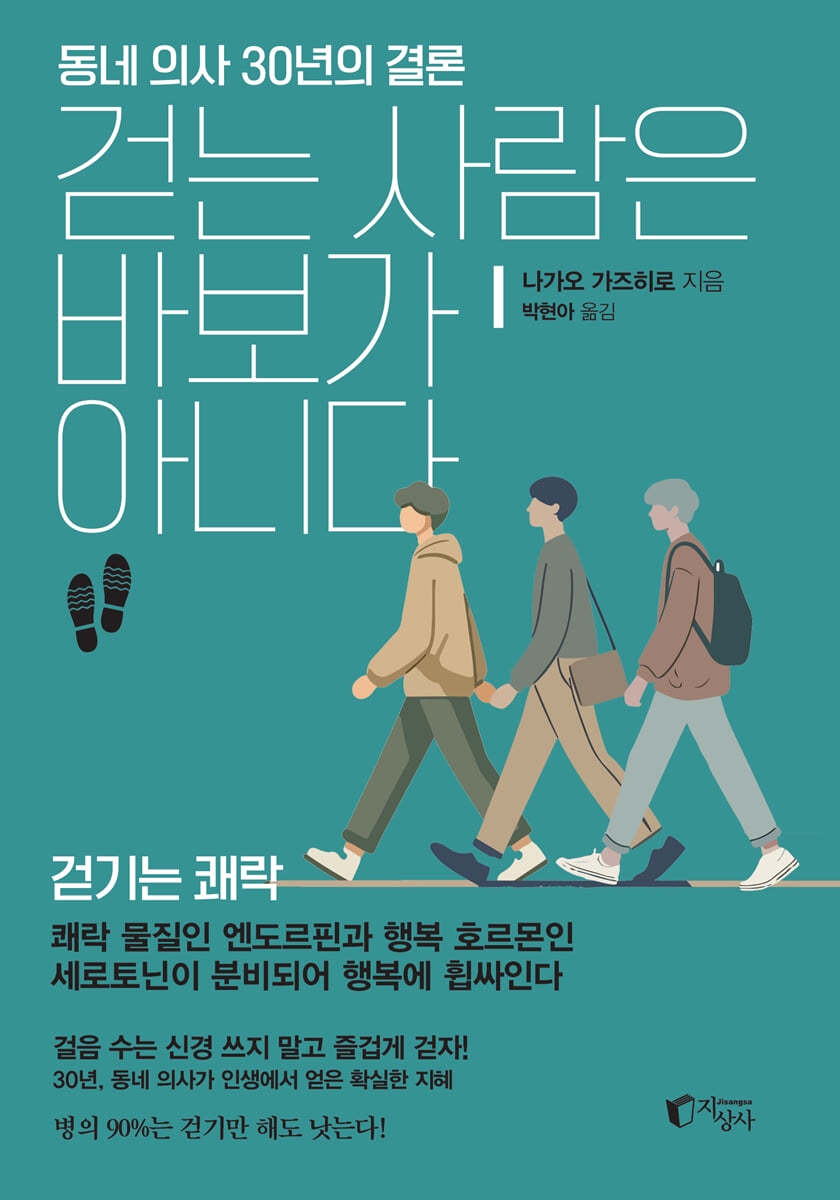
A person who walks is not a fool
 |
Description
Book Introduction
Let's start by walking in our spare time.
Why do ideas come to me when I walk?
Just walking can help prevent dementia.
Walking is said to improve cancer.
Are you healthy because you walk?
Are you walking because you are healthy?
First, start by walking for about 10 minutes when you have time.
At first, some people may find it difficult to do even 10 minutes.
But once you discover the joy and pleasure of walking, you will want to walk more, and before you know it, the time will naturally increase to 15 or 30 minutes.
Of course, physical strength varies from person to person, so 10 minutes is only a guideline.
You should also check your physical condition that day, so you can adjust it according to the situation.
In any case, the author says he hopes you make it a habit to walk often.
For patients who refuse to walk no matter what, “Think of walking as a religion.
He persuades them by saying, “It’s a walking bridge.”
When I tell patients, “You think you’re into some strange religion, try it for a month,” they are often shocked.
But when we met a month later, he said, “Teacher, I feel better.
There were several instances where I expressed my deep gratitude by saying, “It is just as you said, teacher!”
Seeing patients happy was the greatest joy for the author.
We cannot go against birth, aging, sickness, and death.
Anyway, I'm going to get old, get sick, and die.
No matter how long you live, it is really just a moment in the history of the entire Earth.
However, the author says that as long as you are alive, no matter what anyone says, 'walking is important' to keep your body and mind healthy.
It doesn't cost money, but it definitely has benefits in this life.
People feel happy when they eat delicious food.
This is especially true if you eat with family or colleagues.
Even in the evening, I am happiest.
Humans have been savoring this shower of happiness hormones since ancient times.
However, modern medicine is trying to go in the opposite direction.
When they become old or sick, they are isolated in a room surrounded by white walls, fed tasteless food, and are always pickled with medicine.
The author himself used to live in such a place.
However, since becoming a local doctor 30 years ago, I have been interested in medicine that emphasizes natural healing power rather than medication.
Also, in the field of home healthcare, I learned from many patients what happiness is.
After I retired from the clinical field, my stress level was significantly reduced.
My honest opinion, having worked as a doctor for 40 years, is that 'medicine exists for the inherent happiness of human beings.'
And I want to spread the word that 'many diseases can be cured and prevented on their own.'
There is only one thing to do to do that.
Take a walk whenever you have free time.
Why do ideas come to me when I walk?
Just walking can help prevent dementia.
Walking is said to improve cancer.
Are you healthy because you walk?
Are you walking because you are healthy?
First, start by walking for about 10 minutes when you have time.
At first, some people may find it difficult to do even 10 minutes.
But once you discover the joy and pleasure of walking, you will want to walk more, and before you know it, the time will naturally increase to 15 or 30 minutes.
Of course, physical strength varies from person to person, so 10 minutes is only a guideline.
You should also check your physical condition that day, so you can adjust it according to the situation.
In any case, the author says he hopes you make it a habit to walk often.
For patients who refuse to walk no matter what, “Think of walking as a religion.
He persuades them by saying, “It’s a walking bridge.”
When I tell patients, “You think you’re into some strange religion, try it for a month,” they are often shocked.
But when we met a month later, he said, “Teacher, I feel better.
There were several instances where I expressed my deep gratitude by saying, “It is just as you said, teacher!”
Seeing patients happy was the greatest joy for the author.
We cannot go against birth, aging, sickness, and death.
Anyway, I'm going to get old, get sick, and die.
No matter how long you live, it is really just a moment in the history of the entire Earth.
However, the author says that as long as you are alive, no matter what anyone says, 'walking is important' to keep your body and mind healthy.
It doesn't cost money, but it definitely has benefits in this life.
People feel happy when they eat delicious food.
This is especially true if you eat with family or colleagues.
Even in the evening, I am happiest.
Humans have been savoring this shower of happiness hormones since ancient times.
However, modern medicine is trying to go in the opposite direction.
When they become old or sick, they are isolated in a room surrounded by white walls, fed tasteless food, and are always pickled with medicine.
The author himself used to live in such a place.
However, since becoming a local doctor 30 years ago, I have been interested in medicine that emphasizes natural healing power rather than medication.
Also, in the field of home healthcare, I learned from many patients what happiness is.
After I retired from the clinical field, my stress level was significantly reduced.
My honest opinion, having worked as a doctor for 40 years, is that 'medicine exists for the inherent happiness of human beings.'
And I want to spread the word that 'many diseases can be cured and prevented on their own.'
There is only one thing to do to do that.
Take a walk whenever you have free time.
- You can preview some of the book's contents.
Preview
index
To begin with
Just walking can help prevent dementia.
Chapter 1
Why are there so many healthy seniors on golf courses?
A strange sight on the golf course
Are you healthy because you walk, or are you healthy because you walk?
What I Learned from the 90-Year-Olds in the 4-Person Group
Seniors who have never had COVID-19
Chapter 2
The less a person walks, the more
Become frail or sick
Muscle strength decreases without awareness, resulting in frailty
I become a Frailty and just lie down
People who don't walk are more likely to have lower cognitive function and immunity.
He doesn't realize that he's staggering.
For some people, 'frailty' begins in middle age.
Lifestyle diseases, cancer, and dementia all have the same root cause.
The basics of medicine are nutrition and walking alone.
Do dementia medications work?
Drugs and supplements effective for dementia
People who don't walk are prone to constipation.
Exercise therapy is essential for Parkinson's disease.
Chapter 3
Why do people get dementia?
Cognitive decline happens to everyone.
Dementia is now a national issue.
Why do people get dementia?
Amyloid beta, a waste product in the brain, builds up.
Early stages of dementia are difficult to detect and even difficult to talk about.
Is dementia hereditary?
Dementia of adolescence, which occurs in people under 65 years of age
Dementia causes a rapid decline in some cognitive functions.
Dementia is closely related to stress and obesity.
The number of people in their 50s and 60s experiencing cognitive decline has increased due to the COVID-19 pandemic.
Having nothing to do after retirement increases the risk of dementia.
Chapter 4
Walking, obesity, and beauty
Going to the convenience store when you're hungry increases your risk.
We are not accustomed to obesity
Not getting enough sun can have a negative impact on your beauty.
If you are not used to sunlight, you will feel dazzled.
Chapter 5
Walking boosts your natural immunity.
Acquired immunity and natural immunity
Walking outside boosts your natural immunity.
People are a bunch of viruses
Natural immunity is better than vaccines
Let's get some sun to activate vitamin D.
Walking improves cancer!
Chapter 6
Walking is related to the brain
Muscles are sending messages to the brain
Walking habits improve eyesight
It has been discovered that nerve cells can be expanded.
Hippocampal size has little to do with cognitive function.
Cognitive function can be improved even when the hippocampus atrophies.
During sleep, the brain's waste is cleared.
Regular use of sleeping pills increases the risk of dementia.
Walking is important for falling asleep naturally.
Get some sunlight to regulate your body clock.
Chapter 7
Just walking can help prevent dementia.
What I Learned from Watching 2,500 People Die
Running after middle age is dangerous.
Excessive exercise shortens life
Let's limit ourselves to moderately challenging exercise.
It's good to think of walking as 'movement'
You don't have to worry about the number of steps or time.
Whether it's 3 minutes or 1 minute, I recommend 'walking briskly'
It is important to make walking a habit.
Walking is a full-body strength workout.
You don't have to walk 10,000 steps a day.
Just walk at a pace that feels comfortable for you.
Walking with your chest out increases the effectiveness of your walk.
If you wave your hands widely, your stride will increase.
Just reducing the amount of time you sit can be beneficial.
Chapter 8
Enjoy walking
For those who find walking difficult
Walking to the rhythm of a song can make you feel good.
If you do the Thousand-Day Prayer, you will be enveloped in happiness.
Why do ideas come to me when I walk?
I recommend 'walking while doing it'
Chapter 9
Walking is useless if you don't eat well.
Protein intake is important
Excessive carbohydrate intake causes many diseases.
Eating white rice three times a day increases the risk of dementia.
If you don't eat for 24 hours, you lose your appetite.
The Risks of Magnesium Oxide Prescribed for Constipation
Avoid a Western diet and monitor your gut environment.
Vegetable consumption is also important for preventing dementia.
Silica water as a choice
To maintain the functioning of the pineal gland
Let's take care of our bodies with food rather than supplements.
Finally
Let's extend our healthy lifespan as much as possible.
Self-medication is important for self-prevention.
Let's start by walking in our spare time.
Just walking can help prevent dementia.
Chapter 1
Why are there so many healthy seniors on golf courses?
A strange sight on the golf course
Are you healthy because you walk, or are you healthy because you walk?
What I Learned from the 90-Year-Olds in the 4-Person Group
Seniors who have never had COVID-19
Chapter 2
The less a person walks, the more
Become frail or sick
Muscle strength decreases without awareness, resulting in frailty
I become a Frailty and just lie down
People who don't walk are more likely to have lower cognitive function and immunity.
He doesn't realize that he's staggering.
For some people, 'frailty' begins in middle age.
Lifestyle diseases, cancer, and dementia all have the same root cause.
The basics of medicine are nutrition and walking alone.
Do dementia medications work?
Drugs and supplements effective for dementia
People who don't walk are prone to constipation.
Exercise therapy is essential for Parkinson's disease.
Chapter 3
Why do people get dementia?
Cognitive decline happens to everyone.
Dementia is now a national issue.
Why do people get dementia?
Amyloid beta, a waste product in the brain, builds up.
Early stages of dementia are difficult to detect and even difficult to talk about.
Is dementia hereditary?
Dementia of adolescence, which occurs in people under 65 years of age
Dementia causes a rapid decline in some cognitive functions.
Dementia is closely related to stress and obesity.
The number of people in their 50s and 60s experiencing cognitive decline has increased due to the COVID-19 pandemic.
Having nothing to do after retirement increases the risk of dementia.
Chapter 4
Walking, obesity, and beauty
Going to the convenience store when you're hungry increases your risk.
We are not accustomed to obesity
Not getting enough sun can have a negative impact on your beauty.
If you are not used to sunlight, you will feel dazzled.
Chapter 5
Walking boosts your natural immunity.
Acquired immunity and natural immunity
Walking outside boosts your natural immunity.
People are a bunch of viruses
Natural immunity is better than vaccines
Let's get some sun to activate vitamin D.
Walking improves cancer!
Chapter 6
Walking is related to the brain
Muscles are sending messages to the brain
Walking habits improve eyesight
It has been discovered that nerve cells can be expanded.
Hippocampal size has little to do with cognitive function.
Cognitive function can be improved even when the hippocampus atrophies.
During sleep, the brain's waste is cleared.
Regular use of sleeping pills increases the risk of dementia.
Walking is important for falling asleep naturally.
Get some sunlight to regulate your body clock.
Chapter 7
Just walking can help prevent dementia.
What I Learned from Watching 2,500 People Die
Running after middle age is dangerous.
Excessive exercise shortens life
Let's limit ourselves to moderately challenging exercise.
It's good to think of walking as 'movement'
You don't have to worry about the number of steps or time.
Whether it's 3 minutes or 1 minute, I recommend 'walking briskly'
It is important to make walking a habit.
Walking is a full-body strength workout.
You don't have to walk 10,000 steps a day.
Just walk at a pace that feels comfortable for you.
Walking with your chest out increases the effectiveness of your walk.
If you wave your hands widely, your stride will increase.
Just reducing the amount of time you sit can be beneficial.
Chapter 8
Enjoy walking
For those who find walking difficult
Walking to the rhythm of a song can make you feel good.
If you do the Thousand-Day Prayer, you will be enveloped in happiness.
Why do ideas come to me when I walk?
I recommend 'walking while doing it'
Chapter 9
Walking is useless if you don't eat well.
Protein intake is important
Excessive carbohydrate intake causes many diseases.
Eating white rice three times a day increases the risk of dementia.
If you don't eat for 24 hours, you lose your appetite.
The Risks of Magnesium Oxide Prescribed for Constipation
Avoid a Western diet and monitor your gut environment.
Vegetable consumption is also important for preventing dementia.
Silica water as a choice
To maintain the functioning of the pineal gland
Let's take care of our bodies with food rather than supplements.
Finally
Let's extend our healthy lifespan as much as possible.
Self-medication is important for self-prevention.
Let's start by walking in our spare time.
Detailed image

Into the book
When you walk, swing your arms and move your waist.
The neck muscles also move to support the head.
Therefore, people who walk frequently are exercising their entire body without even realizing it, whereas people who don't walk much or who take less than 3,000 steps a day have fewer opportunities to move the muscles of their entire body.
So, naturally, it is easy for the muscle strength of the entire body to decline.
When muscle strength is reduced, the body's stability is reduced and posture worsens.
Your stride becomes shorter and your walking speed slows down.
It also increases the risk of falling.
Some people suffer fractures from falls on small stairs or in the home, requiring long-term hospitalization and nursing care.
As your muscle strength declines, you will start to dislike walking, and you will start to walk less and less, which will lead to a vicious cycle where your muscle strength will decline even further.
--- p.030
The number of people refraining from going out has increased.
However, later, in a verification conducted by Professor Satoshi Fujii of Kyoto University,
According to the report, the declaration of a state of emergency had no effect.
Not only was it ineffective, but the fretiness only increased.
However, even after the coronavirus pandemic has been brought under control, various infectious diseases are still reported daily on TV and in newspapers, and many people continue to refrain from going out for fear of being infected.
Not going out means not walking.
It is possible that you are in the process of becoming a Frailty or are in the pre-Frailty stage.
It is said that the number of people using canes has increased in both urban and rural areas amid the COVID-19 and vaccine turmoil.
Since the coronavirus outbreak, the number of people in their 50s and 60s who are free has increased.
Frailty is a state of not only impaired physical function but also mental frailty.
You lose motivation and become an introvert.
Depression in the elderly is one of them.
Working as a local doctor, I noticed an increase in the number of elderly people experiencing mental frailty since the COVID-19 outbreak.
--- p.032
Even the increase regulations are set.
If you are okay with 3mg, it would be okay to keep it as is, but there is a strange regulation that does not recognize this.
So, we created a general corporate body called the ‘Association for the Realization of Appropriate Dosage Prescription of Anti-Dementia Drugs’ and, through discussion in the National Assembly, abolished the dosage increase regulation.
I'm proud of the fact that I did something great, but the major media outlets didn't report on it.
Local newspapers that use Kyodo News, such as the Shinano Daily Newspaper, reported it prominently on the front page.
Recently, a new dementia drug called recanemab has been introduced.
In Japan, it was approved in 2023 and is currently in use.
It is expensive, costing 3 million yen (with a co-payment of about 140,000 yen) if administered once every two weeks and for about a year.
It is said to only apply to people with MCI, or mild dementia, who have undergone special examinations at a dementia specialty hospital.
But, sadly, the effectiveness of this drug is also unclear.
Many dementia specialists are starting to say that it doesn't work.
--- p.050
Dementia is a condition in which communication between brain cells deteriorates.
A brain scan called amyloid PET-CT can show how much amyloid beta is deposited.
Amyloid beta does not start to deposit as we age.
For some people, the onset of dementia begins in their 30s or 40s. Amyloid beta has also been detected in the brains of people in the preclinical stage, a precursor to MCI.
People in the preclinical stage do not usually have any symptoms, so amyloid PET-CT scans are not usually performed.
Even if you do not meet the criteria for MCI, which is considered a potential dementia risk factor, dementia is already beginning to develop in your brain.
Most of these people are very fond of sugary sweets.
It can be said that eating only sweet foods and snacks since my teens and twenties had a big impact.
--- p.069
When you become aware of it, your brain becomes unable to tolerate it and you end up consuming glucose without even knowing it.
Dementia is a condition in which brain cells become addicted to glucose, similar to nicotine addiction in cigarettes.
When you smoke, nicotine reaches the brain, releasing a pleasure chemical called dopamine, making you feel happy.
Nicotine is a reward to the brain, so it is called the reward circuit.
Once such a circuit is established in the brain, it becomes intolerable when the reward is removed.
This is why it is called addiction.
The same goes for glucose.
Some people develop glucose addiction because their reward system is triggered by glucose.
The proliferation of convenience stores has made it possible to purchase carbohydrates 24 hours a day, making it easier to obtain glucose.
As a result, the number of people addicted to glucose has increased.
This can be considered one of the reasons for the increase in diabetes patients and dementia patients.
--- p.092
Sunlight increases the secretion of serotonin, the 'happiness hormone' in the brain.
People who have a walking habit and walk moderately tend to have a 'serotonin face'.
Although there are some freckles and wrinkles, the 'serotonin face' is more lively and has a younger impression.
For women, many cover up their aging faces with makeup, but while makeup can cover up the face, it cannot hide wrinkles on the neck.
People who don't walk show signs of aging in their necks.
When I examine a patient, I can usually tell how well they walk by looking at their neck.
People who don't walk, whether men or women, have wrinkles on their necks and are aging.
When you walk, you need to support your head properly, so women who don't walk often start to age from the skin on their head and cervical spine.
People who believe that 'you should avoid going outside for beauty purposes' should change their mindset to 'you should go outside and walk for beauty purposes'.
Of course, during seasons with strong UV rays, you should take appropriate UV protection.
--- p.097
During sleep, the brain's waste is cleaned out.
As explained earlier, people with dementia have a buildup of waste called amyloid beta in their brains.
However, the reason why amyloid beta accumulates is not yet fully understood.
As waste accumulates, brain cells shrink and 'atrophy'.
Amyloid beta, which accumulates within brain cells, is released from the cells into the bloodstream during sleep at night.
It's like an image of a household garbage truck.
So it is important to maintain the quality of your sleep.
The quality of sleep mentioned here specifically refers to the sleep rhythm consisting of REM sleep and non-REM sleep repeating 4 to 6 times per night.
There are attempts to develop drugs that prevent amyloid beta from accumulating in the brain or drugs that promote the removal of amyloid beta that has already accumulated in the brain, but none of them seem to be progressing well.
Again, sleep is effective in excreting amyloid beta.
If you use your computer continuously, garbage will accumulate and it will run slowly, so you need to clean it from time to time.
The neck muscles also move to support the head.
Therefore, people who walk frequently are exercising their entire body without even realizing it, whereas people who don't walk much or who take less than 3,000 steps a day have fewer opportunities to move the muscles of their entire body.
So, naturally, it is easy for the muscle strength of the entire body to decline.
When muscle strength is reduced, the body's stability is reduced and posture worsens.
Your stride becomes shorter and your walking speed slows down.
It also increases the risk of falling.
Some people suffer fractures from falls on small stairs or in the home, requiring long-term hospitalization and nursing care.
As your muscle strength declines, you will start to dislike walking, and you will start to walk less and less, which will lead to a vicious cycle where your muscle strength will decline even further.
--- p.030
The number of people refraining from going out has increased.
However, later, in a verification conducted by Professor Satoshi Fujii of Kyoto University,
According to the report, the declaration of a state of emergency had no effect.
Not only was it ineffective, but the fretiness only increased.
However, even after the coronavirus pandemic has been brought under control, various infectious diseases are still reported daily on TV and in newspapers, and many people continue to refrain from going out for fear of being infected.
Not going out means not walking.
It is possible that you are in the process of becoming a Frailty or are in the pre-Frailty stage.
It is said that the number of people using canes has increased in both urban and rural areas amid the COVID-19 and vaccine turmoil.
Since the coronavirus outbreak, the number of people in their 50s and 60s who are free has increased.
Frailty is a state of not only impaired physical function but also mental frailty.
You lose motivation and become an introvert.
Depression in the elderly is one of them.
Working as a local doctor, I noticed an increase in the number of elderly people experiencing mental frailty since the COVID-19 outbreak.
--- p.032
Even the increase regulations are set.
If you are okay with 3mg, it would be okay to keep it as is, but there is a strange regulation that does not recognize this.
So, we created a general corporate body called the ‘Association for the Realization of Appropriate Dosage Prescription of Anti-Dementia Drugs’ and, through discussion in the National Assembly, abolished the dosage increase regulation.
I'm proud of the fact that I did something great, but the major media outlets didn't report on it.
Local newspapers that use Kyodo News, such as the Shinano Daily Newspaper, reported it prominently on the front page.
Recently, a new dementia drug called recanemab has been introduced.
In Japan, it was approved in 2023 and is currently in use.
It is expensive, costing 3 million yen (with a co-payment of about 140,000 yen) if administered once every two weeks and for about a year.
It is said to only apply to people with MCI, or mild dementia, who have undergone special examinations at a dementia specialty hospital.
But, sadly, the effectiveness of this drug is also unclear.
Many dementia specialists are starting to say that it doesn't work.
--- p.050
Dementia is a condition in which communication between brain cells deteriorates.
A brain scan called amyloid PET-CT can show how much amyloid beta is deposited.
Amyloid beta does not start to deposit as we age.
For some people, the onset of dementia begins in their 30s or 40s. Amyloid beta has also been detected in the brains of people in the preclinical stage, a precursor to MCI.
People in the preclinical stage do not usually have any symptoms, so amyloid PET-CT scans are not usually performed.
Even if you do not meet the criteria for MCI, which is considered a potential dementia risk factor, dementia is already beginning to develop in your brain.
Most of these people are very fond of sugary sweets.
It can be said that eating only sweet foods and snacks since my teens and twenties had a big impact.
--- p.069
When you become aware of it, your brain becomes unable to tolerate it and you end up consuming glucose without even knowing it.
Dementia is a condition in which brain cells become addicted to glucose, similar to nicotine addiction in cigarettes.
When you smoke, nicotine reaches the brain, releasing a pleasure chemical called dopamine, making you feel happy.
Nicotine is a reward to the brain, so it is called the reward circuit.
Once such a circuit is established in the brain, it becomes intolerable when the reward is removed.
This is why it is called addiction.
The same goes for glucose.
Some people develop glucose addiction because their reward system is triggered by glucose.
The proliferation of convenience stores has made it possible to purchase carbohydrates 24 hours a day, making it easier to obtain glucose.
As a result, the number of people addicted to glucose has increased.
This can be considered one of the reasons for the increase in diabetes patients and dementia patients.
--- p.092
Sunlight increases the secretion of serotonin, the 'happiness hormone' in the brain.
People who have a walking habit and walk moderately tend to have a 'serotonin face'.
Although there are some freckles and wrinkles, the 'serotonin face' is more lively and has a younger impression.
For women, many cover up their aging faces with makeup, but while makeup can cover up the face, it cannot hide wrinkles on the neck.
People who don't walk show signs of aging in their necks.
When I examine a patient, I can usually tell how well they walk by looking at their neck.
People who don't walk, whether men or women, have wrinkles on their necks and are aging.
When you walk, you need to support your head properly, so women who don't walk often start to age from the skin on their head and cervical spine.
People who believe that 'you should avoid going outside for beauty purposes' should change their mindset to 'you should go outside and walk for beauty purposes'.
Of course, during seasons with strong UV rays, you should take appropriate UV protection.
--- p.097
During sleep, the brain's waste is cleaned out.
As explained earlier, people with dementia have a buildup of waste called amyloid beta in their brains.
However, the reason why amyloid beta accumulates is not yet fully understood.
As waste accumulates, brain cells shrink and 'atrophy'.
Amyloid beta, which accumulates within brain cells, is released from the cells into the bloodstream during sleep at night.
It's like an image of a household garbage truck.
So it is important to maintain the quality of your sleep.
The quality of sleep mentioned here specifically refers to the sleep rhythm consisting of REM sleep and non-REM sleep repeating 4 to 6 times per night.
There are attempts to develop drugs that prevent amyloid beta from accumulating in the brain or drugs that promote the removal of amyloid beta that has already accumulated in the brain, but none of them seem to be progressing well.
Again, sleep is effective in excreting amyloid beta.
If you use your computer continuously, garbage will accumulate and it will run slowly, so you need to clean it from time to time.
--- p.138
Publisher's Review
Step count and time
You don't have to worry about it
Some patients get angry when I tell them to 'walk every day'.
If you say again, "Even a walk is fine," they will take it as, "Oh, so a walk is okay?"
To develop the habit of walking, it is important to think of walking not as being too difficult.
There is no need to worry about the number of steps or time.
There are patients who take out their smartphones and show a line graph showing the number of steps they have taken.
They happily say things like, 'I walked OO steps today' or 'I walked halfway around the world.'
It's also nice to walk while feeling a sense of accomplishment with this data.
I recommend that you walk whenever you have free time without worrying about the number of steps or time.
You don't have to worry about the number of steps, distance, speed, or time, and you don't have to worry about where you walk.
When the weather is bad and you can't go out, walk around your room or down the hallway or stairs.
When you have time to walk, try walking a little.
I call walking frequently, little by little, without being concerned about the number of steps, time, or location, 'walking briskly.'
Lifestyle diseases, cancer, and dementia all have the same root cause.
So if you don't treat the root of the disease,
Disease cannot be prevented or cured
Bottles are not independent, but are inevitably connected and overlap each other.
For example, the intestines and brain influence each other, so there is a saying, 'brain-intestine correlation.'
Muscles and brain also influence each other.
For reference, embryologically, the intestines are higher in rank than the brain.
The heart and kidneys are also connected.
Human organs communicate with each other and cooperate and cooperate.
Each organ is cooperating with the rest of the body by sending messages that say 'it's dangerous' or helping each other.
So, if one organ becomes noticeably worse or out of balance, other organs will inevitably deteriorate in a chain reaction, like dominoes.
Whether it's a lifestyle disease, cancer, or dementia, when one disease develops, it often leads to several complications, like dominoes.
In other words, the root of any disease is the same.
The root of this is biased lifestyle habits.
In most cases, the cause lies in the workplace or home.
That is, stress.
It is the doctor's role to detect this and advise on correction.
However, modern medicine and healthcare are overly specialized by organ.
Even in the same internal medicine department, you go to the endocrinology department to receive treatment for diabetes, and go to the gastroenterology department to receive a diagnosis of reflux esophagitis.
Additionally, if you go to an orthopedic clinic to receive treatment for rheumatoid arthritis, or an oncology clinic to receive treatment for cancer, you can receive treatment at a psychiatric clinic if you suspect dementia.
The less a person walks, the more
It is easy to get sick
He doesn't realize that he's staggering.
Walking habits have a significant impact on your health, so checking how you walk can be very helpful in assessing your health.
So, the author first asks new patients in detail how much they walk in their daily lives.
After hearing the whole story, have them walk around the examination room.
The examination room is usually about 3m x 5m in size.
When you ask patients to walk with words like, “Walk like a fashion model,” “Walk with your back straight,” or “Walk with the posture you think looks best,” they walk with embarrassment.
At this time, there are many people who walk in a posture they think is the coolest, but objectively, they walk unsteadily and stagger.
This is one of the 'walking diagnoses' that the author considers important.
When I look at the reflection in the window on the street and think, 'There's a person walking unsteadily across the street,' I feel like it's me.
In fact, most people don't know how they walk, and most people are unaware that they are becoming frail.
Also, there are many people who don't even know the word "frailty."
When you walk outside
Natural immunity is enhanced
Doctors practicing in the neighborhood and nurses working at the hospital are directly exposed to the coughs and phlegm of dozens of influenza-infected patients every day during the peak influenza season.
But the veteran team is not contagious.
Sometimes I feel like I've caught the flu, but if I take care of myself, like going to bed early, I'm fine the next morning and don't miss work.
Of course, I never got a vaccine or anything like that.
Why is that?
I think the reason is that our immunity is naturally trained because of work.
I always think it's important to expose your body to weak toxins often to teach your immune system, "This guy exists too" and "There's no need to overreact."
Although a state of emergency was declared due to the coronavirus pandemic, people who didn't pay much attention and went out every day, gradually exposed to low-concentration virus on trains and buses, may have strengthened their immune systems.
This is only a hypothesis regarding a weakly virulent virus.
If we add 'strengthening natural immunity through walking' to this kind of 'immune training', I think there is no need to be afraid of weakly virulent viruses.
Let's walk with long strides
If you wave your hands widely, your stride will increase.
If you become conscious of swinging your arms while walking, the way you walk will change significantly.
The author often observes how many people of different ages walk in subway stations or on the street, waving their hands to some extent.
The younger the person, the more likely they are to walk while waving their hands back and forth.
But as we get older, we start waving our hands more.
The difference is also reflected in stride length.
People who swing their arms vigorously have longer strides because each pelvic twist is greater.
Meanwhile, people who swing their hands in small steps have smaller pelvic twists and shorter strides.
Every time you wave your hand, the reaction causes your waist to rotate slightly and your stride to widen.
They say, 'Walk with long strides,' but even if you don't think about your stride, if you swing your hands widely, your stride will naturally increase.
Just sticking out your chest and waving your arms widely will straighten your back, increase the twisting of your pelvis, and lengthen your stride.
Walking efficiency is reduced because you can't wave your hands when carrying luggage.
Luggage should be stored in a backpack or similar device if possible.
It would be a good idea to at least carry a shoulder bag.
It is a good idea to leave your luggage at a coin locker at a subway station or building and then walk.
Even if it costs a little more, walking becomes much easier when you don't have any luggage or backpack on you.
You don't have to worry about it
Some patients get angry when I tell them to 'walk every day'.
If you say again, "Even a walk is fine," they will take it as, "Oh, so a walk is okay?"
To develop the habit of walking, it is important to think of walking not as being too difficult.
There is no need to worry about the number of steps or time.
There are patients who take out their smartphones and show a line graph showing the number of steps they have taken.
They happily say things like, 'I walked OO steps today' or 'I walked halfway around the world.'
It's also nice to walk while feeling a sense of accomplishment with this data.
I recommend that you walk whenever you have free time without worrying about the number of steps or time.
You don't have to worry about the number of steps, distance, speed, or time, and you don't have to worry about where you walk.
When the weather is bad and you can't go out, walk around your room or down the hallway or stairs.
When you have time to walk, try walking a little.
I call walking frequently, little by little, without being concerned about the number of steps, time, or location, 'walking briskly.'
Lifestyle diseases, cancer, and dementia all have the same root cause.
So if you don't treat the root of the disease,
Disease cannot be prevented or cured
Bottles are not independent, but are inevitably connected and overlap each other.
For example, the intestines and brain influence each other, so there is a saying, 'brain-intestine correlation.'
Muscles and brain also influence each other.
For reference, embryologically, the intestines are higher in rank than the brain.
The heart and kidneys are also connected.
Human organs communicate with each other and cooperate and cooperate.
Each organ is cooperating with the rest of the body by sending messages that say 'it's dangerous' or helping each other.
So, if one organ becomes noticeably worse or out of balance, other organs will inevitably deteriorate in a chain reaction, like dominoes.
Whether it's a lifestyle disease, cancer, or dementia, when one disease develops, it often leads to several complications, like dominoes.
In other words, the root of any disease is the same.
The root of this is biased lifestyle habits.
In most cases, the cause lies in the workplace or home.
That is, stress.
It is the doctor's role to detect this and advise on correction.
However, modern medicine and healthcare are overly specialized by organ.
Even in the same internal medicine department, you go to the endocrinology department to receive treatment for diabetes, and go to the gastroenterology department to receive a diagnosis of reflux esophagitis.
Additionally, if you go to an orthopedic clinic to receive treatment for rheumatoid arthritis, or an oncology clinic to receive treatment for cancer, you can receive treatment at a psychiatric clinic if you suspect dementia.
The less a person walks, the more
It is easy to get sick
He doesn't realize that he's staggering.
Walking habits have a significant impact on your health, so checking how you walk can be very helpful in assessing your health.
So, the author first asks new patients in detail how much they walk in their daily lives.
After hearing the whole story, have them walk around the examination room.
The examination room is usually about 3m x 5m in size.
When you ask patients to walk with words like, “Walk like a fashion model,” “Walk with your back straight,” or “Walk with the posture you think looks best,” they walk with embarrassment.
At this time, there are many people who walk in a posture they think is the coolest, but objectively, they walk unsteadily and stagger.
This is one of the 'walking diagnoses' that the author considers important.
When I look at the reflection in the window on the street and think, 'There's a person walking unsteadily across the street,' I feel like it's me.
In fact, most people don't know how they walk, and most people are unaware that they are becoming frail.
Also, there are many people who don't even know the word "frailty."
When you walk outside
Natural immunity is enhanced
Doctors practicing in the neighborhood and nurses working at the hospital are directly exposed to the coughs and phlegm of dozens of influenza-infected patients every day during the peak influenza season.
But the veteran team is not contagious.
Sometimes I feel like I've caught the flu, but if I take care of myself, like going to bed early, I'm fine the next morning and don't miss work.
Of course, I never got a vaccine or anything like that.
Why is that?
I think the reason is that our immunity is naturally trained because of work.
I always think it's important to expose your body to weak toxins often to teach your immune system, "This guy exists too" and "There's no need to overreact."
Although a state of emergency was declared due to the coronavirus pandemic, people who didn't pay much attention and went out every day, gradually exposed to low-concentration virus on trains and buses, may have strengthened their immune systems.
This is only a hypothesis regarding a weakly virulent virus.
If we add 'strengthening natural immunity through walking' to this kind of 'immune training', I think there is no need to be afraid of weakly virulent viruses.
Let's walk with long strides
If you wave your hands widely, your stride will increase.
If you become conscious of swinging your arms while walking, the way you walk will change significantly.
The author often observes how many people of different ages walk in subway stations or on the street, waving their hands to some extent.
The younger the person, the more likely they are to walk while waving their hands back and forth.
But as we get older, we start waving our hands more.
The difference is also reflected in stride length.
People who swing their arms vigorously have longer strides because each pelvic twist is greater.
Meanwhile, people who swing their hands in small steps have smaller pelvic twists and shorter strides.
Every time you wave your hand, the reaction causes your waist to rotate slightly and your stride to widen.
They say, 'Walk with long strides,' but even if you don't think about your stride, if you swing your hands widely, your stride will naturally increase.
Just sticking out your chest and waving your arms widely will straighten your back, increase the twisting of your pelvis, and lengthen your stride.
Walking efficiency is reduced because you can't wave your hands when carrying luggage.
Luggage should be stored in a backpack or similar device if possible.
It would be a good idea to at least carry a shoulder bag.
It is a good idea to leave your luggage at a coin locker at a subway station or building and then walk.
Even if it costs a little more, walking becomes much easier when you don't have any luggage or backpack on you.
GOODS SPECIFICS
- Date of issue: September 3, 2025
- Page count, weight, size: 228 pages | 334g | 148*210*14mm
- ISBN13: 9788965023517
- ISBN10: 8965023513
You may also like
카테고리
korean


korean

![ELLE 엘르 스페셜 에디션 A형 : 12월 [2025]](http://librairie.coreenne.fr/cdn/shop/files/b8e27a3de6c9538896439686c6b0e8fb.jpg?v=1766436872&width=3840)


