

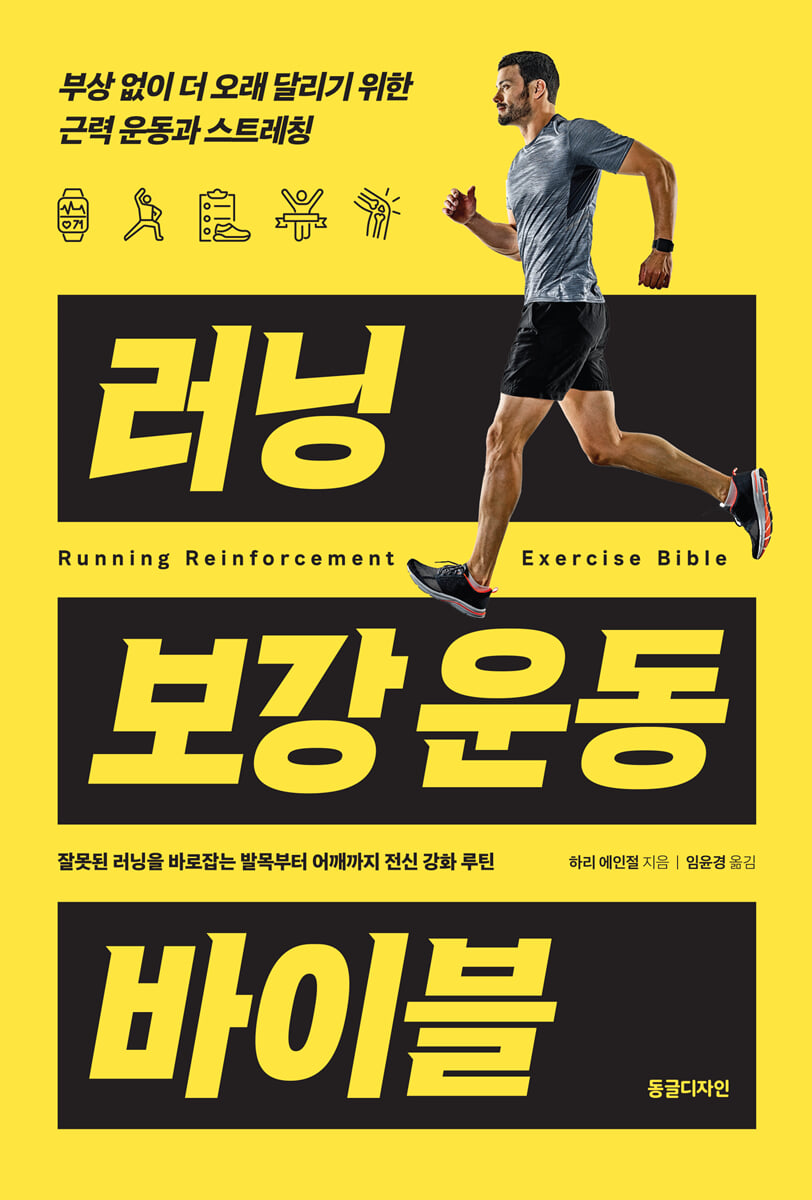
Running Strength Training Bible
 |
Description
Book Introduction
70 Strengthening Exercises for a Healthier Run!
A full-body strengthening routine from ankles to shoulders that you can follow right away.
A special program from the world's best running Pilates experts
Running has now become the most popular sport in Korea and a healthy, cross-generational sport.
It is the most passionate and passionate lifestyle that anyone can easily start without any special equipment or skills, and fully experience growth and achievement through the fight against oneself.
The sense of liberation you feel when you run through the wind, the strength to shake off the weight of life and get back up, the transformation in physical and mental strength are the charms of running that keep us running.
But any runner will feel it at least once.
Your knees start to ache, your ankles start to tingle, your shoulders and back become stiff, your breathing becomes disrupted, your performance plateaus, and your recovery slows.
So many people find running difficult.
All these problems arise from 'just running'.
The Running Reinforcement Exercise Bible was published to solve this very problem.
We systematically explain the strength training and stretching programs essential for running longer without injury.
This is a practical guidebook for runners who are lost in the fragmented information about what exercise to do and how to do it.
It contains a total of 70 Pilates-based strengthening exercises that cover the entire body from the ankles to the shoulders, and provides detailed step-by-step instructions with actual photos to avoid confusion.
It is organized by difficulty level into basic, modified, and advanced movements, so you can choose a routine that suits your level.
Let's relax our muscles, align our bodies, correct our breathing, and wake up our core.
Even if you follow along for just 15 minutes a day, you will not only improve your records, but you will also experience changes in your body's senses.
From beginners running half marathons to seasoned runners preparing for ultra marathons.
This book is dedicated to runners who want to run scientifically.
A full-body strengthening routine from ankles to shoulders that you can follow right away.
A special program from the world's best running Pilates experts
Running has now become the most popular sport in Korea and a healthy, cross-generational sport.
It is the most passionate and passionate lifestyle that anyone can easily start without any special equipment or skills, and fully experience growth and achievement through the fight against oneself.
The sense of liberation you feel when you run through the wind, the strength to shake off the weight of life and get back up, the transformation in physical and mental strength are the charms of running that keep us running.
But any runner will feel it at least once.
Your knees start to ache, your ankles start to tingle, your shoulders and back become stiff, your breathing becomes disrupted, your performance plateaus, and your recovery slows.
So many people find running difficult.
All these problems arise from 'just running'.
The Running Reinforcement Exercise Bible was published to solve this very problem.
We systematically explain the strength training and stretching programs essential for running longer without injury.
This is a practical guidebook for runners who are lost in the fragmented information about what exercise to do and how to do it.
It contains a total of 70 Pilates-based strengthening exercises that cover the entire body from the ankles to the shoulders, and provides detailed step-by-step instructions with actual photos to avoid confusion.
It is organized by difficulty level into basic, modified, and advanced movements, so you can choose a routine that suits your level.
Let's relax our muscles, align our bodies, correct our breathing, and wake up our core.
Even if you follow along for just 15 minutes a day, you will not only improve your records, but you will also experience changes in your body's senses.
From beginners running half marathons to seasoned runners preparing for ultra marathons.
This book is dedicated to runners who want to run scientifically.
index
Chapter 1.
Pilates for Running
Chapter 2.
The founder of Pilates, a former runner
Chapter 3.
Principles of Running Pilates
Chapter 4.
Posture alignment
Chapter 5.
breathing
Chapter 6.
equipment
Chapter 7.
Running reinforcement exercise Pilates
Chapter 8.
Stretching after running
Chapter 9.
15-minute daily program for each level
Chapter 10.
Overtraining Recovery Exercises
Chapter 11.
Exercises for Injury Symptoms
Chapter 12.
Running Mindset
Chapter 13.
Getting Started with Pilates for Running
Acknowledgements
Search
Pilates for Running
Chapter 2.
The founder of Pilates, a former runner
Chapter 3.
Principles of Running Pilates
Chapter 4.
Posture alignment
Chapter 5.
breathing
Chapter 6.
equipment
Chapter 7.
Running reinforcement exercise Pilates
Chapter 8.
Stretching after running
Chapter 9.
15-minute daily program for each level
Chapter 10.
Overtraining Recovery Exercises
Chapter 11.
Exercises for Injury Symptoms
Chapter 12.
Running Mindset
Chapter 13.
Getting Started with Pilates for Running
Acknowledgements
Search
Detailed image

Into the book
Running is a repetitive exercise.
Every time you run, some muscles are overused, while others are barely used.
If only certain muscles are overused like this, muscle imbalances can occur, which can ultimately lead to injury.
The repetitive nature of running forces your body to endure repeated impacts every time your feet touch the ground.
With each step, force is transmitted through the legs to the lumbar (lower back) and thoracic (chest).
If there is a weak spot along the path of the shock, that is where problems can arise.
Therefore, you need to train to strengthen your weak areas so that you can better cope with the stress of running.
---p.11 From “Pilates for Running”
As fatigue builds, it becomes easier to lose this neutral alignment, as the upper body collapses from its center and the spine sags.
In times like these, imagine a bunch of helium balloons hanging above your head, lifting you upward.
You will feel your body become lighter and your steps move forward naturally.
---p.33 From “Posture Alignment”
Beginner runners who are just starting out often want to speed up even though their hearts and lungs are not yet ready.
Then you will quickly become out of breath.
The only way to resolve this situation is to slow down and give your body time to adapt naturally.
Then, your breathing and running will gradually become more comfortable.
The Pilates breathing technique, 'lateral rib cage breathing', strengthens the diaphragm, which is responsible for 80% of breathing activity.
---p.40 From "Breathing"
If you were moving slowly and holding something, gradually let go and practice.
As you do this, your body will learn how to balance itself and your sense of balance will improve.
Exercising in front of a mirror makes it easy to check that your pelvis remains level.
If your pelvis tilts when you lift one leg, it means your gluteal muscles are weak.
---p.57 From "Balance"
The Swan Dive exercise strengthens the middle and upper back and abs.
When you start to get tired while running, your shoulders start to roll forward, which restricts your shoulder movement.
A hunched running posture also interferes with breathing.
The swan dive movement helps open your chest area and strengthen your mid-back, so even if you feel tired, your form and running will not be affected.
---p.62 From "Swan Dive"
The four side kick exercises we'll be introducing below all target your core muscles, particularly your obliques and hip joints.
When you run, your smaller back muscles tire more easily than your larger abdominal muscles.
Strengthening your lower back muscles will reduce the chance of your torso twisting to the side when you tire at the end of a long run.
The stronger your obliques become, the less likely you are to develop problems with your pelvis and hip joints.
---p.90 From "Side Kick"
Another way to avoid overtraining is to keep a running log.
Not only do I record my running time and route, I also record my Pilates practice content and my overall mood.
For example, patterns such as 'heavy legs', 'complete guidance', and 'tired' may appear.
You will be able to detect the warning signs of overtraining before it becomes a worst-case scenario and take control before symptoms worsen.
---p.182 From "Overtraining Recovery Exercise"
Excessive use is the cause.
When running, the iliotibial band and the femur (thigh bone) next to the knee are constantly bent.
Inflammation occurs when the outer surface of the skin is repeatedly rubbed against each other.
It can also occur when running on uneven surfaces or when your running style and posture put stress on this area.
---p.187 From “Exercise by Injury Symptom”
Each person has a different purpose for running.
Some people run for competition, others for health, fitness, or fun.
But the biggest challenge for a runner is getting out the door.
On a rainy day, when you feel like you have an endless amount of work to do, the challenge isn't just a physical one; it's also a mental one.
Even if your body is ready to run, if you suddenly lose the desire to run, your plans may go awry and your training may be disrupted.
Even if you manage to get out of the house and start running, sometimes your mind can get in the way of the joy of running.
Every time you run, some muscles are overused, while others are barely used.
If only certain muscles are overused like this, muscle imbalances can occur, which can ultimately lead to injury.
The repetitive nature of running forces your body to endure repeated impacts every time your feet touch the ground.
With each step, force is transmitted through the legs to the lumbar (lower back) and thoracic (chest).
If there is a weak spot along the path of the shock, that is where problems can arise.
Therefore, you need to train to strengthen your weak areas so that you can better cope with the stress of running.
---p.11 From “Pilates for Running”
As fatigue builds, it becomes easier to lose this neutral alignment, as the upper body collapses from its center and the spine sags.
In times like these, imagine a bunch of helium balloons hanging above your head, lifting you upward.
You will feel your body become lighter and your steps move forward naturally.
---p.33 From “Posture Alignment”
Beginner runners who are just starting out often want to speed up even though their hearts and lungs are not yet ready.
Then you will quickly become out of breath.
The only way to resolve this situation is to slow down and give your body time to adapt naturally.
Then, your breathing and running will gradually become more comfortable.
The Pilates breathing technique, 'lateral rib cage breathing', strengthens the diaphragm, which is responsible for 80% of breathing activity.
---p.40 From "Breathing"
If you were moving slowly and holding something, gradually let go and practice.
As you do this, your body will learn how to balance itself and your sense of balance will improve.
Exercising in front of a mirror makes it easy to check that your pelvis remains level.
If your pelvis tilts when you lift one leg, it means your gluteal muscles are weak.
---p.57 From "Balance"
The Swan Dive exercise strengthens the middle and upper back and abs.
When you start to get tired while running, your shoulders start to roll forward, which restricts your shoulder movement.
A hunched running posture also interferes with breathing.
The swan dive movement helps open your chest area and strengthen your mid-back, so even if you feel tired, your form and running will not be affected.
---p.62 From "Swan Dive"
The four side kick exercises we'll be introducing below all target your core muscles, particularly your obliques and hip joints.
When you run, your smaller back muscles tire more easily than your larger abdominal muscles.
Strengthening your lower back muscles will reduce the chance of your torso twisting to the side when you tire at the end of a long run.
The stronger your obliques become, the less likely you are to develop problems with your pelvis and hip joints.
---p.90 From "Side Kick"
Another way to avoid overtraining is to keep a running log.
Not only do I record my running time and route, I also record my Pilates practice content and my overall mood.
For example, patterns such as 'heavy legs', 'complete guidance', and 'tired' may appear.
You will be able to detect the warning signs of overtraining before it becomes a worst-case scenario and take control before symptoms worsen.
---p.182 From "Overtraining Recovery Exercise"
Excessive use is the cause.
When running, the iliotibial band and the femur (thigh bone) next to the knee are constantly bent.
Inflammation occurs when the outer surface of the skin is repeatedly rubbed against each other.
It can also occur when running on uneven surfaces or when your running style and posture put stress on this area.
---p.187 From “Exercise by Injury Symptom”
Each person has a different purpose for running.
Some people run for competition, others for health, fitness, or fun.
But the biggest challenge for a runner is getting out the door.
On a rainy day, when you feel like you have an endless amount of work to do, the challenge isn't just a physical one; it's also a mental one.
Even if your body is ready to run, if you suddenly lose the desire to run, your plans may go awry and your training may be disrupted.
Even if you manage to get out of the house and start running, sometimes your mind can get in the way of the joy of running.
---p.19 From "Running Mindset"
Publisher's Review
Essential Running Muscles You Must Train
4 Reasons Runners Need Strength Training and Stretching
Why do you need strength and flexibility to run? Many people become interested in running and start running "once".
However, if you run blindly without taking care of your strength and flexibility, the risk of injury only increases.
There are four reasons why runners need strength training and stretching.
First, you can run without getting hurt.
Running is an exercise that causes repeated impacts to accumulate in the legs, knees, ankles, and lower back.
Imbalances and stress on specific muscles can ultimately lead to injury.
Strengthening exercises to increase the stability of your muscles and joints can be a great way to prevent this.
Second, you can run with the correct posture.
Why is posture important when running?
Posture is directly related to running efficiency.
When your shoulders and back are stiff and your butt muscles are weak, your breathing also collapses.
By focusing on the torso (core) that connects the upper and lower body, you can effectively respond to gravity resistance by evenly using the muscles of the entire body.
Third, you can run with stable breathing.
Breathing plays a vital role in supplying our bodies with the oxygen they need while running, but maintaining consistent breathing over long distances requires more than just lung capacity.
The various muscles involved in breathing, including the abdominal muscles, diaphragm, and chest, must work organically.
Strengthening the connecting muscles through strengthening exercises will stabilize your breathing.
Fourth, running performance is ultimately improved.
Strength, coordination, mobility, posture, breathing, and balance improved through strength training and stretching lead to improved performance.
This is why 'strengthening exercises', the key to taking your running skills to the next level, are not an option but a necessity.
Includes 70 strengthening exercises from a running Pilates expert!
Before running, you must follow the warm-up exercises.
After running, stretch for relaxation and recovery!
If you're at a loss as to what, how, and where to start with reinforcement exercises, The Running Strength Training Bible is all you need.
It contains 70 exercises that cover the entire body from the ankles to the shoulders, and each step is explained in detail with actual photos so that you can follow along right away.
If the movement is difficult, start slowly with basic movements, and if the movement is easy, you can expand it to various variations and in-depth movements.
You can choose according to your level.
Even if you don't choose directly, a daily program table by level is provided, so you can just follow it.
Before you lace up your sneakers and go for a run, just 15 minutes is all you need!
It includes stretching for relaxation and recovery after running, as well as strength training, covering the entire process before and after exercise.
Additionally, for pain in frequently injured areas such as ankles, knees, and calves, we have analyzed symptoms, causes, treatment, and prevention from various angles to enable practical responses.
Stop suffering from inexplicable pain and open the fastest response manual.
I started running to get healthy, but the truth is, you need a healthy body to run properly.
Minimize injuries, maximize performance, and achieve your running goals with the most practical and simple full-body strengthening workout guidebook!
4 Reasons Runners Need Strength Training and Stretching
Why do you need strength and flexibility to run? Many people become interested in running and start running "once".
However, if you run blindly without taking care of your strength and flexibility, the risk of injury only increases.
There are four reasons why runners need strength training and stretching.
First, you can run without getting hurt.
Running is an exercise that causes repeated impacts to accumulate in the legs, knees, ankles, and lower back.
Imbalances and stress on specific muscles can ultimately lead to injury.
Strengthening exercises to increase the stability of your muscles and joints can be a great way to prevent this.
Second, you can run with the correct posture.
Why is posture important when running?
Posture is directly related to running efficiency.
When your shoulders and back are stiff and your butt muscles are weak, your breathing also collapses.
By focusing on the torso (core) that connects the upper and lower body, you can effectively respond to gravity resistance by evenly using the muscles of the entire body.
Third, you can run with stable breathing.
Breathing plays a vital role in supplying our bodies with the oxygen they need while running, but maintaining consistent breathing over long distances requires more than just lung capacity.
The various muscles involved in breathing, including the abdominal muscles, diaphragm, and chest, must work organically.
Strengthening the connecting muscles through strengthening exercises will stabilize your breathing.
Fourth, running performance is ultimately improved.
Strength, coordination, mobility, posture, breathing, and balance improved through strength training and stretching lead to improved performance.
This is why 'strengthening exercises', the key to taking your running skills to the next level, are not an option but a necessity.
Includes 70 strengthening exercises from a running Pilates expert!
Before running, you must follow the warm-up exercises.
After running, stretch for relaxation and recovery!
If you're at a loss as to what, how, and where to start with reinforcement exercises, The Running Strength Training Bible is all you need.
It contains 70 exercises that cover the entire body from the ankles to the shoulders, and each step is explained in detail with actual photos so that you can follow along right away.
If the movement is difficult, start slowly with basic movements, and if the movement is easy, you can expand it to various variations and in-depth movements.
You can choose according to your level.
Even if you don't choose directly, a daily program table by level is provided, so you can just follow it.
Before you lace up your sneakers and go for a run, just 15 minutes is all you need!
It includes stretching for relaxation and recovery after running, as well as strength training, covering the entire process before and after exercise.
Additionally, for pain in frequently injured areas such as ankles, knees, and calves, we have analyzed symptoms, causes, treatment, and prevention from various angles to enable practical responses.
Stop suffering from inexplicable pain and open the fastest response manual.
I started running to get healthy, but the truth is, you need a healthy body to run properly.
Minimize injuries, maximize performance, and achieve your running goals with the most practical and simple full-body strengthening workout guidebook!
GOODS SPECIFICS
- Date of issue: June 30, 2025
- Page count, weight, size: 208 pages | 152*225*10mm
- ISBN13: 9791191925272
- ISBN10: 1191925277
You may also like
카테고리
korean


korean

![GQ KOREA Mark (Monthly): December [2025]](http://librairie.coreenne.fr/cdn/shop/files/8ef265dbbfbf186523ed75ba7319009d.jpg?v=1765340328&width=3840)


