

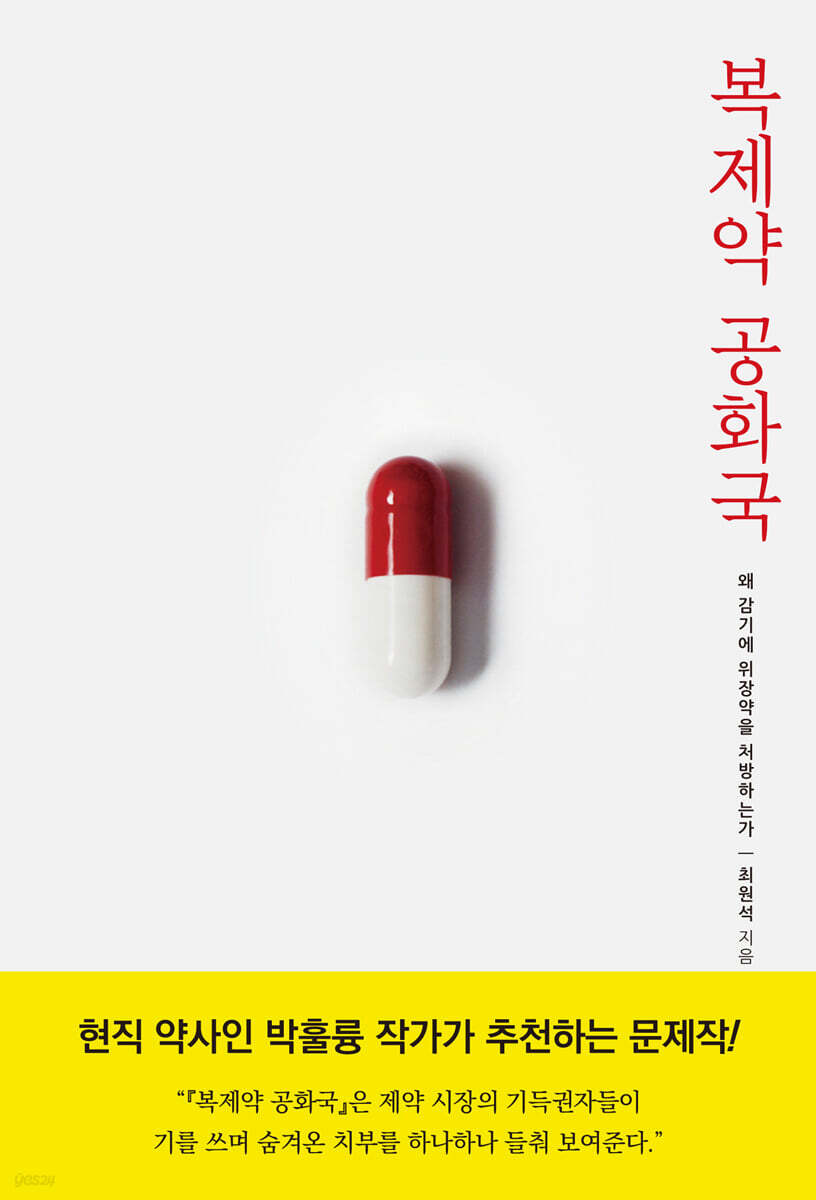
Republic of Generic Drugs
 |
Description
Book Introduction
Threatening the national health and national health insurance finances
A fatal problem in our country's pharmaceutical industry
An investigative reportage that digs deep into every detail!
The author, who has worked as a pharmaceutical journalist for over 10 years, vividly portrays the reality of Korea's pharmaceutical industry based on his field reporting experience and accurate facts.
In particular, it thoroughly diagnoses and presents complex problems such as the proliferation of generic drug manufacturers resulting from the preferential policy for generic drugs, the prevalence of illegal rebates and overprescriptions, the deterioration of national health insurance finances, domestic pharmaceutical companies' reliance on generic drug sales and low investment in new drug research and development, the resulting windfall profits for multinational pharmaceutical companies and the weakening of patients' access to new drugs, and the collusion between pharmaceutical magazines that claim to be the mouthpieces of pharmaceutical companies.
Sometimes with sharp accusations and analyses that reveal the truth, and sometimes with sharp and cynical criticism, he seeks to develop the domestic pharmaceutical industry and improve health insurance.
A fatal problem in our country's pharmaceutical industry
An investigative reportage that digs deep into every detail!
The author, who has worked as a pharmaceutical journalist for over 10 years, vividly portrays the reality of Korea's pharmaceutical industry based on his field reporting experience and accurate facts.
In particular, it thoroughly diagnoses and presents complex problems such as the proliferation of generic drug manufacturers resulting from the preferential policy for generic drugs, the prevalence of illegal rebates and overprescriptions, the deterioration of national health insurance finances, domestic pharmaceutical companies' reliance on generic drug sales and low investment in new drug research and development, the resulting windfall profits for multinational pharmaceutical companies and the weakening of patients' access to new drugs, and the collusion between pharmaceutical magazines that claim to be the mouthpieces of pharmaceutical companies.
Sometimes with sharp accusations and analyses that reveal the truth, and sometimes with sharp and cynical criticism, he seeks to develop the domestic pharmaceutical industry and improve health insurance.
- You can preview some of the book's contents.
Preview
index
Recommendation
preface
Chapter 1.
Pharmaceutical companies and the pharmaceutical press have a family-like relationship.
Chapter 2.
Republic of Generic Drugs
Chapter 3.
The Two Faces of Multinational Pharmaceutical Companies
Chapter 4.
Rebates, overprescribing, and drug abuse
Chapter 5.
Beyond generic drugs to new drugs
Note
preface
Chapter 1.
Pharmaceutical companies and the pharmaceutical press have a family-like relationship.
Chapter 2.
Republic of Generic Drugs
Chapter 3.
The Two Faces of Multinational Pharmaceutical Companies
Chapter 4.
Rebates, overprescribing, and drug abuse
Chapter 5.
Beyond generic drugs to new drugs
Note
Publisher's Review
A problematic work recommended by writer Park Hul-ryung, a practicing pharmacist!
“If you look at the reality the author details in this book, the future of the Republic of Korea without pharmaceutical sovereignty seems dangerous in an aging society where pharmaceuticals are becoming increasingly important.… 『Republic of Generic Drugs』 exposes, one by one, the corruption that the vested interests in the pharmaceutical market have worked hard to hide.
Through this book, we will come to realize both the right to know that we have lost and the right to find it.”
- Park Hul-ryung (pharmacist and writer, from "Recommendation")
The number of doctors caught engaging in illegal rebates in 2024
It's increased by over 100 times compared to the previous year! Why???
“From January to August 2024, 2,758 doctors were reported to the Ministry of Health and Welfare for involvement in illegal rebates.
However, in 2023, there were only 24 people, in 2022, 49 people, and in 2021, 22 people.
What happened in 2024? Why did illegal rebates increase so much that year?… (omitted) … It's clear that the Fair Trade Commission and the police can detect illegal rebates at will.” (pp. 224-225)
Between January and August 2024, the police and the Fair Trade Commission reported seven illegal rebate cases to the Ministry of Health and Welfare, amounting to 10.027 billion won.
In particular, 2,744 doctors were implicated in just one case involving a pharmaceutical company that provided illegal rebates worth 7 billion won.
Even though we only raided one pharmaceutical company as a demonstration, this many cases were discovered.
Of course, it was only a means of government pressure to expand medical school enrollment, and the punishment was minimal.
So why are illegal rebates so prevalent in the medical field? It's because roughly half of sales in Korea's pharmaceutical market are made through doctor's prescriptions.
Since pharmaceuticals are covered by the National Health Insurance based on doctors' prescriptions, pharmaceutical companies stake their lives on hospital sales.
Moreover, Korean pharmaceutical companies do not develop new drugs that can generate large sales globally, but rather focus solely on selling generic drugs. Therefore, in the red ocean market where hundreds or even dozens of generic drugs compete for each ingredient, advertising or lowering drug prices has little effect on increasing sales.
So, we are stuck in a structural problem where we have no choice but to consider rebates as our best sales tool.
Doctors who receive rebates often prescribe incorrect or excessive medications, and patients inevitably suffer side effects from drug abuse or waste money on unnecessary medications.
However, the pharmaceutical media is not actively trying to improve this situation by reporting it, and instead, they are acting as parasites and trumpets for the pharmaceutical companies.
“Our country’s pharmaceutical companies are addicted to generic drugs!
“Only by breaking free from dependence on generic drugs can pharmaceuticals and healthcare survive!”
“The solution to improving the structural problems of our country’s pharmaceutical industry is clear.
It is a complete change to the national health insurance drug coverage policy, which is no different from the sales insurance of pharmaceutical companies.
Compared to the 1980s, when the fostering of domestic pharmaceutical companies was urgent, everything has changed now.… (omitted)… I am not arguing that the policy of preferential treatment for generic drugs has not contributed at all to the development of the domestic pharmaceutical industry over the past several decades.
Because generic drugs could command higher prices, money circulated in the Korean pharmaceutical market and the number of pharmaceutical companies capable of producing generic drugs increased.
But that was it.… (omitted)… Domestic pharmaceutical companies are still focused solely on selling generic drugs.” (p. 243)
In Korea's pharmaceutical market, the price of generic drugs is set at half the price of the original drug, unlike major Western developed countries where the price of generic drugs is set to one-tenth of the price of the original drug when the original drug's patent expires.
This is the price at which national health insurance drug benefits are paid.
Our government has been purchasing generic drugs at high prices for over 40 years to foster domestic pharmaceutical companies.
This has resulted in excessive spending on pharmaceuticals amounting to trillions of won every year.
That too, is financed by the National Health Insurance, which is funded by insurance premiums paid by all citizens like taxes every month.
However, our country's pharmaceutical companies have neglected the research and development of new drugs while being addicted to the sweet sales of generic drugs.
It's only natural, in a way, that you can earn a stable income like a salary just from generic drugs without having to go through the difficult and thorny path of developing new drugs.
The author emphasizes that although the number of workers and sales in our country's pharmaceutical industry have now grown to a point where it cannot be easily tampered with, we can no longer delay in solving the problem.
Above all, the author argues that the price of generic drugs covered by the National Health Insurance Service should be significantly reduced.
We demand that pharmaceutical companies that have been complacently relying solely on generic drugs undergo large-scale and bold reforms, even if it means closing their doors.
They say that only then can all the problems arising from the outdated policy of preferential treatment for generic drugs be resolved or alleviated.
Pharmaceutical companies will no longer rely on generic drugs and will actively develop new drugs. They will not offer illegal rebates to sell generic drugs, and they will also be able to save on health insurance funds drained by sales of original drugs whose patents have expired by multinational pharmaceutical companies.
The author also compares domestic and international examples and suggests financial and institutional measures to reasonably increase patients' access to new drugs.
It is difficult to increase accessibility to new drugs without improving the inherent limitations of our country's national health insurance system: its low-cost, low-coverage structure.
The content of this book may not be new to those working in the medical or pharmaceutical industries, but it can help them realize and improve problems that they may have been too familiar with.
By vividly learning about the previously unknown realities of the pharmaceutical and medical industries through the writings of whistleblowers and reporters, patients and general readers will be able to regain their sovereignty as consumers of medical care and pharmaceuticals and prevent unnecessary harm.
We will also be able to raise our voices together to call for appropriate changes in the pharmaceutical industry, medical community, and health insurance policies.
“If you look at the reality the author details in this book, the future of the Republic of Korea without pharmaceutical sovereignty seems dangerous in an aging society where pharmaceuticals are becoming increasingly important.… 『Republic of Generic Drugs』 exposes, one by one, the corruption that the vested interests in the pharmaceutical market have worked hard to hide.
Through this book, we will come to realize both the right to know that we have lost and the right to find it.”
- Park Hul-ryung (pharmacist and writer, from "Recommendation")
The number of doctors caught engaging in illegal rebates in 2024
It's increased by over 100 times compared to the previous year! Why???
“From January to August 2024, 2,758 doctors were reported to the Ministry of Health and Welfare for involvement in illegal rebates.
However, in 2023, there were only 24 people, in 2022, 49 people, and in 2021, 22 people.
What happened in 2024? Why did illegal rebates increase so much that year?… (omitted) … It's clear that the Fair Trade Commission and the police can detect illegal rebates at will.” (pp. 224-225)
Between January and August 2024, the police and the Fair Trade Commission reported seven illegal rebate cases to the Ministry of Health and Welfare, amounting to 10.027 billion won.
In particular, 2,744 doctors were implicated in just one case involving a pharmaceutical company that provided illegal rebates worth 7 billion won.
Even though we only raided one pharmaceutical company as a demonstration, this many cases were discovered.
Of course, it was only a means of government pressure to expand medical school enrollment, and the punishment was minimal.
So why are illegal rebates so prevalent in the medical field? It's because roughly half of sales in Korea's pharmaceutical market are made through doctor's prescriptions.
Since pharmaceuticals are covered by the National Health Insurance based on doctors' prescriptions, pharmaceutical companies stake their lives on hospital sales.
Moreover, Korean pharmaceutical companies do not develop new drugs that can generate large sales globally, but rather focus solely on selling generic drugs. Therefore, in the red ocean market where hundreds or even dozens of generic drugs compete for each ingredient, advertising or lowering drug prices has little effect on increasing sales.
So, we are stuck in a structural problem where we have no choice but to consider rebates as our best sales tool.
Doctors who receive rebates often prescribe incorrect or excessive medications, and patients inevitably suffer side effects from drug abuse or waste money on unnecessary medications.
However, the pharmaceutical media is not actively trying to improve this situation by reporting it, and instead, they are acting as parasites and trumpets for the pharmaceutical companies.
“Our country’s pharmaceutical companies are addicted to generic drugs!
“Only by breaking free from dependence on generic drugs can pharmaceuticals and healthcare survive!”
“The solution to improving the structural problems of our country’s pharmaceutical industry is clear.
It is a complete change to the national health insurance drug coverage policy, which is no different from the sales insurance of pharmaceutical companies.
Compared to the 1980s, when the fostering of domestic pharmaceutical companies was urgent, everything has changed now.… (omitted)… I am not arguing that the policy of preferential treatment for generic drugs has not contributed at all to the development of the domestic pharmaceutical industry over the past several decades.
Because generic drugs could command higher prices, money circulated in the Korean pharmaceutical market and the number of pharmaceutical companies capable of producing generic drugs increased.
But that was it.… (omitted)… Domestic pharmaceutical companies are still focused solely on selling generic drugs.” (p. 243)
In Korea's pharmaceutical market, the price of generic drugs is set at half the price of the original drug, unlike major Western developed countries where the price of generic drugs is set to one-tenth of the price of the original drug when the original drug's patent expires.
This is the price at which national health insurance drug benefits are paid.
Our government has been purchasing generic drugs at high prices for over 40 years to foster domestic pharmaceutical companies.
This has resulted in excessive spending on pharmaceuticals amounting to trillions of won every year.
That too, is financed by the National Health Insurance, which is funded by insurance premiums paid by all citizens like taxes every month.
However, our country's pharmaceutical companies have neglected the research and development of new drugs while being addicted to the sweet sales of generic drugs.
It's only natural, in a way, that you can earn a stable income like a salary just from generic drugs without having to go through the difficult and thorny path of developing new drugs.
The author emphasizes that although the number of workers and sales in our country's pharmaceutical industry have now grown to a point where it cannot be easily tampered with, we can no longer delay in solving the problem.
Above all, the author argues that the price of generic drugs covered by the National Health Insurance Service should be significantly reduced.
We demand that pharmaceutical companies that have been complacently relying solely on generic drugs undergo large-scale and bold reforms, even if it means closing their doors.
They say that only then can all the problems arising from the outdated policy of preferential treatment for generic drugs be resolved or alleviated.
Pharmaceutical companies will no longer rely on generic drugs and will actively develop new drugs. They will not offer illegal rebates to sell generic drugs, and they will also be able to save on health insurance funds drained by sales of original drugs whose patents have expired by multinational pharmaceutical companies.
The author also compares domestic and international examples and suggests financial and institutional measures to reasonably increase patients' access to new drugs.
It is difficult to increase accessibility to new drugs without improving the inherent limitations of our country's national health insurance system: its low-cost, low-coverage structure.
The content of this book may not be new to those working in the medical or pharmaceutical industries, but it can help them realize and improve problems that they may have been too familiar with.
By vividly learning about the previously unknown realities of the pharmaceutical and medical industries through the writings of whistleblowers and reporters, patients and general readers will be able to regain their sovereignty as consumers of medical care and pharmaceuticals and prevent unnecessary harm.
We will also be able to raise our voices together to call for appropriate changes in the pharmaceutical industry, medical community, and health insurance policies.
GOODS SPECIFICS
- Date of issue: May 1, 2025
- Page count, weight, size: 264 pages | 286g | 150*220*20mm
- ISBN13: 9791197916557
- ISBN10: 1197916555
You may also like
카테고리
korean


korean

![GQ KOREA Mark (Monthly): December [2025]](http://librairie.coreenne.fr/cdn/shop/files/8ef265dbbfbf186523ed75ba7319009d.jpg?v=1765340328&width=3840)


