

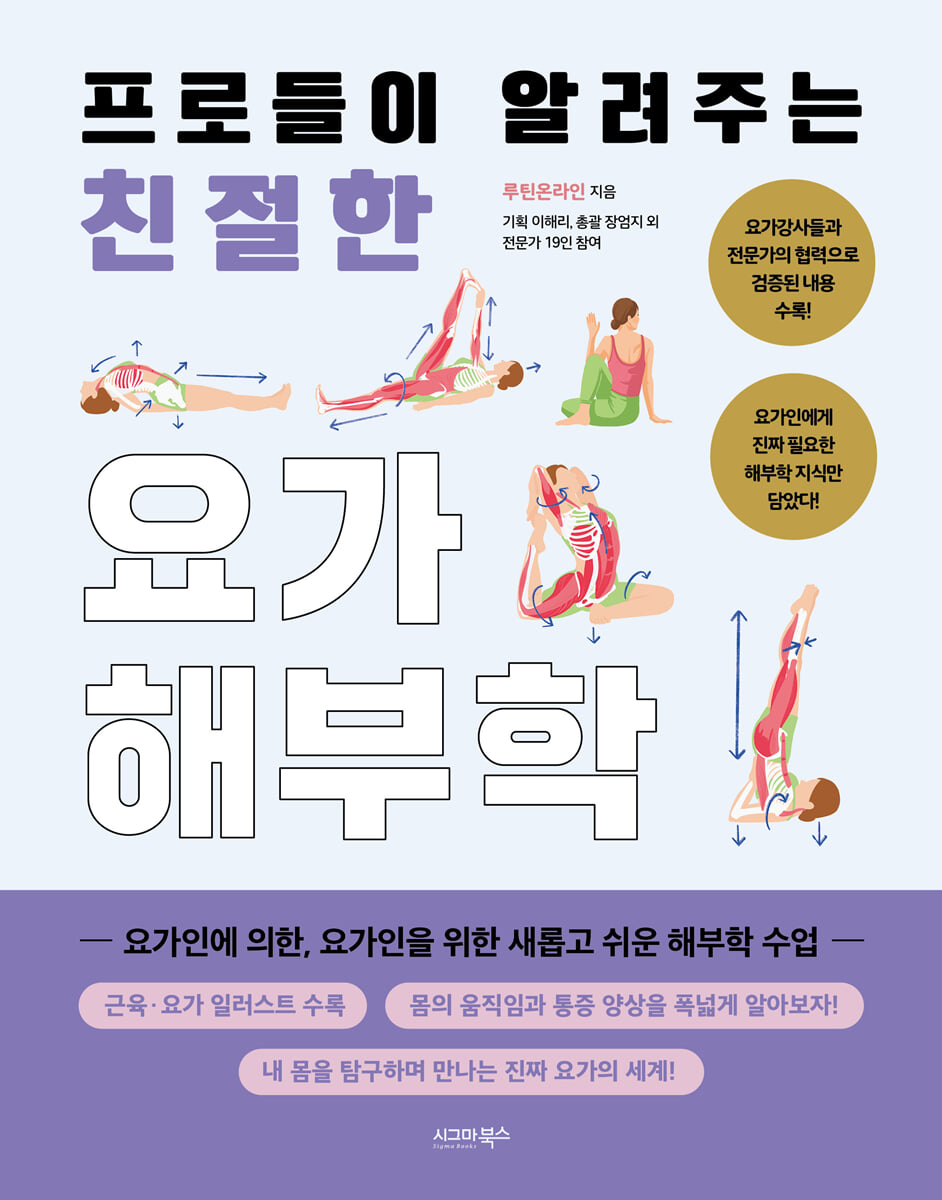
Friendly yoga anatomy taught by professionals
 |
Description
Book Introduction
By yogis, for yogis
A completely new and easy anatomy lesson
Conventional anatomy books are full of simple lists of knowledge and unfamiliar terminology, making it difficult to apply them to yoga classes and actually making studying anatomy intimidating.
《Yoga Anatomy: A Friendly Guide from the Pros》 is a completely new and easy-to-understand anatomy guide by yogis, for yogis.
A total of 21 experts, including current yoga instructors, have joined forces to create a complete book that provides 'basic anatomy knowledge essential for yoga practitioners' and includes various illustrations of human body and asana movements to aid understanding.
From practitioners seeking to explore their bodies more seriously to teachers preparing high-quality yoga classes, I hope this book will bring them closer to anatomy, something they've always felt distant from, and inspire them to love yoga even more.
A completely new and easy anatomy lesson
Conventional anatomy books are full of simple lists of knowledge and unfamiliar terminology, making it difficult to apply them to yoga classes and actually making studying anatomy intimidating.
《Yoga Anatomy: A Friendly Guide from the Pros》 is a completely new and easy-to-understand anatomy guide by yogis, for yogis.
A total of 21 experts, including current yoga instructors, have joined forces to create a complete book that provides 'basic anatomy knowledge essential for yoga practitioners' and includes various illustrations of human body and asana movements to aid understanding.
From practitioners seeking to explore their bodies more seriously to teachers preparing high-quality yoga classes, I hope this book will bring them closer to anatomy, something they've always felt distant from, and inspire them to love yoga even more.
- You can preview some of the book's contents.
Preview
index
Recommended Reading / People Who Made This Book / Introduction
PART 1.
Basic concepts of anatomy
Chapter 1: Understanding Basic Anatomy Terminology
01 Anatomical posture
02 Planes and axes of the human body
03 Terms indicating the position and direction of the human body
04 Chain structure of the human body
Chapter 2 Bones, Joints, and Muscles
01 Understanding Bones
02 Understanding Joints
03 Understanding Muscles
PART 2.
Musculoskeletal System-Upper Limbs
Chapter 1: Understanding the Shoulder
01 Composition of the shoulder complex
02 Shoulder Movement
03 Scapulohumeral Rhythm
Chapter 2 Muscles of the Upper Limbs
01 Supraspinatus (rotator cuff muscle ①)
02 Infraspinatus (rotator cuff muscle ②)
03 Rotator cuff muscle ③
04 Subscapularis (rotator cuff muscle ④)
05 Trapezius scapulae
06 Glottis
07 Daewongeun
08 Levator scapulae
09 Rhomboid Muscle
10 deltoid muscles
11 pectoralis major
12 pectoralis minor
13 Serratus anterior
14 Biceps Brachii
15 Brachialis
16 Triceps brachii
PART 3.
Musculoskeletal System-Spine
Chapter 1: Understanding the Spine
01 Structure and function of the spine
02 Movement of the spine
Chapter 2: Spine, Abdomen, and Respiratory Muscles
01 Sternocleidomastoid muscle
02 Supraspinatus muscle/Supraspinatus muscle
03 Iliocostalis muscle (erector spinae muscle ①)
04 Longissimus dorsi (erector spinae ②)
05 Spinal cord (erector spinae ③)
CHECK 3 erector spinae muscles
06 Semispinatus (Transverse Spinatus ①)
07 Multifidus muscle (transverse spinae muscle ②)
08 Rotator cuff (transverse spinae muscle ③)
09 Interspinous muscle (transverse spinous muscle ④)
10 Transverse interosseous muscle (transverse interosseous muscle ⑤)
CHECK Transverse spinae 5 muscles
11. Quadratus lumborum
12 rectus abdominis
13 External oblique muscles
14 Internal oblique muscle
15 Transverse Abdomen
16 Diaphragm
ADVICE: Breathe with your diaphragm
17 square roots
18 intercostal muscles
19. Serratus anterior superior/inferior serratus anterior inferior
ADVICE Different Types and Methods of Yoga Breathing
PART 4.
Musculoskeletal system-lower extremities
Chapter 1: Understanding the Pelvis and Lower Extremities
01 Structure and function of the pelvis
02 Movement of the pelvis and hip joints
Chapter 2 Muscles of the Lower Extremities
01 Gluteus maximus
02 Gluteus medius
03 Gluteus minimus
04 Tensor fascia lata
05 External Rotator Muscles
06 Jang Yo-geun
07 Quadriceps femoris
08 Hamstrings
09 Bonggonggeun
10. Adductor muscle ①
11. Adductor pubis muscle (adductor ②)
12. Adductor longus/adductor brevis (adductors ③, ④)
13. Adductor magnus (adductor ⑤)
14. Gastrocnemius
15 halibut
PART 5.
Various musculoskeletal diseases
Chapter 1: Correct Body Shape and Body Type Analysis
01 What is the right body shape?
02 Misalignment Syndrome
03 Normal lower limb alignment
04 How to apply body shape analysis
Chapter 2 Representative musculoskeletal diseases
01 Rotator cuff tear
02 Carpal Tunnel Syndrome
03 Turtle neck
04 Herniated disc (lumbar disc)
05 Spondylolysis
06 Spinal stenosis
PART 6.
Asana
Chapter 1: Standing Posture
01 Tadasana
02 Uttanasana
03 Utkatasana
04 Virabhadrasana 1
05 Virabhadrasana 2
06 Natarajasana
07 Utthita Trikonasana
08 Parivrita Trikonasana
09 Vrikshasana
10 Garudasana
Chapter 2 Sitting Posture
01 Receive Konasana
02 Paschimottanasana
03 Purvottanasana
04 Ustrasana
05 Parivrita Janu Sirsasana
06 Ardha Matsyendrasana
07 Paripurna Navasana
08 Hanumana
09 Gomukhasana
10 Eka Pada Rajakapotasana
Chapter 3 Lying Position
01 Savasana
02 Supta Padangusthasana
03 Setu Bandhasana
04 Urdhvadhanurasana
05 Matsyasana
06 Jatara Parivrittasana
07 Supta Virasana
08 Salamba Sirsasana
09 Halasana
10 Salamba Sarvangasana
Chapter 4: Prone Position
01 Bhujangasana
02 Salabhasana
03 Dhanurasana
04 Adho Mukha Svanasana
05 Vasisthasana
06 Bakasana
07 Balasana
08 Chaturanga Dandasana
PART 1.
Basic concepts of anatomy
Chapter 1: Understanding Basic Anatomy Terminology
01 Anatomical posture
02 Planes and axes of the human body
03 Terms indicating the position and direction of the human body
04 Chain structure of the human body
Chapter 2 Bones, Joints, and Muscles
01 Understanding Bones
02 Understanding Joints
03 Understanding Muscles
PART 2.
Musculoskeletal System-Upper Limbs
Chapter 1: Understanding the Shoulder
01 Composition of the shoulder complex
02 Shoulder Movement
03 Scapulohumeral Rhythm
Chapter 2 Muscles of the Upper Limbs
01 Supraspinatus (rotator cuff muscle ①)
02 Infraspinatus (rotator cuff muscle ②)
03 Rotator cuff muscle ③
04 Subscapularis (rotator cuff muscle ④)
05 Trapezius scapulae
06 Glottis
07 Daewongeun
08 Levator scapulae
09 Rhomboid Muscle
10 deltoid muscles
11 pectoralis major
12 pectoralis minor
13 Serratus anterior
14 Biceps Brachii
15 Brachialis
16 Triceps brachii
PART 3.
Musculoskeletal System-Spine
Chapter 1: Understanding the Spine
01 Structure and function of the spine
02 Movement of the spine
Chapter 2: Spine, Abdomen, and Respiratory Muscles
01 Sternocleidomastoid muscle
02 Supraspinatus muscle/Supraspinatus muscle
03 Iliocostalis muscle (erector spinae muscle ①)
04 Longissimus dorsi (erector spinae ②)
05 Spinal cord (erector spinae ③)
CHECK 3 erector spinae muscles
06 Semispinatus (Transverse Spinatus ①)
07 Multifidus muscle (transverse spinae muscle ②)
08 Rotator cuff (transverse spinae muscle ③)
09 Interspinous muscle (transverse spinous muscle ④)
10 Transverse interosseous muscle (transverse interosseous muscle ⑤)
CHECK Transverse spinae 5 muscles
11. Quadratus lumborum
12 rectus abdominis
13 External oblique muscles
14 Internal oblique muscle
15 Transverse Abdomen
16 Diaphragm
ADVICE: Breathe with your diaphragm
17 square roots
18 intercostal muscles
19. Serratus anterior superior/inferior serratus anterior inferior
ADVICE Different Types and Methods of Yoga Breathing
PART 4.
Musculoskeletal system-lower extremities
Chapter 1: Understanding the Pelvis and Lower Extremities
01 Structure and function of the pelvis
02 Movement of the pelvis and hip joints
Chapter 2 Muscles of the Lower Extremities
01 Gluteus maximus
02 Gluteus medius
03 Gluteus minimus
04 Tensor fascia lata
05 External Rotator Muscles
06 Jang Yo-geun
07 Quadriceps femoris
08 Hamstrings
09 Bonggonggeun
10. Adductor muscle ①
11. Adductor pubis muscle (adductor ②)
12. Adductor longus/adductor brevis (adductors ③, ④)
13. Adductor magnus (adductor ⑤)
14. Gastrocnemius
15 halibut
PART 5.
Various musculoskeletal diseases
Chapter 1: Correct Body Shape and Body Type Analysis
01 What is the right body shape?
02 Misalignment Syndrome
03 Normal lower limb alignment
04 How to apply body shape analysis
Chapter 2 Representative musculoskeletal diseases
01 Rotator cuff tear
02 Carpal Tunnel Syndrome
03 Turtle neck
04 Herniated disc (lumbar disc)
05 Spondylolysis
06 Spinal stenosis
PART 6.
Asana
Chapter 1: Standing Posture
01 Tadasana
02 Uttanasana
03 Utkatasana
04 Virabhadrasana 1
05 Virabhadrasana 2
06 Natarajasana
07 Utthita Trikonasana
08 Parivrita Trikonasana
09 Vrikshasana
10 Garudasana
Chapter 2 Sitting Posture
01 Receive Konasana
02 Paschimottanasana
03 Purvottanasana
04 Ustrasana
05 Parivrita Janu Sirsasana
06 Ardha Matsyendrasana
07 Paripurna Navasana
08 Hanumana
09 Gomukhasana
10 Eka Pada Rajakapotasana
Chapter 3 Lying Position
01 Savasana
02 Supta Padangusthasana
03 Setu Bandhasana
04 Urdhvadhanurasana
05 Matsyasana
06 Jatara Parivrittasana
07 Supta Virasana
08 Salamba Sirsasana
09 Halasana
10 Salamba Sarvangasana
Chapter 4: Prone Position
01 Bhujangasana
02 Salabhasana
03 Dhanurasana
04 Adho Mukha Svanasana
05 Vasisthasana
06 Bakasana
07 Balasana
08 Chaturanga Dandasana
Detailed image

Into the book
When indicating the direction of muscle contraction, direction of movement, or location of human body structures, the anatomical posture is used as the basis for explanation.
For example, when encountering the expression "upward" in Virabhadrasana 3, some might interpret it as the direction of the head, while others might interpret it as the direction of the ceiling. Because position and direction are relative, they can be interpreted differently depending on the listener.
To solve this problem, in anatomy, 'upper' was defined as the side closer to the head based on the anatomical position, and this expression is unified in all anatomy textbooks and lectures.
--- 「PART 1.
From "Anatomical Posture"
When the trapezius muscle becomes tense and enlarged, the brachial plexus and subclavian artery passing through it are compressed, causing numbness, paresthesia, and muscle weakness in the arm, including the thumb and index finger.
Most modern people have tense trapezius muscles because they are stressed from poor posture, such as looking down at your smartphone or sitting for long periods of time using a computer.
--- 「PART 3.
From "Square Root"
Salamba means 'to support' and sirsa means 'head'. It is called the king of asanas because it is excellent for controlling the body and mind and awakening the spirit.
The ultimate goal of this practice is to focus on the sensation itself, rather than simply how many minutes you hold it.
However, if you have rhinitis, be careful as it may increase intraocular pressure.
For example, when encountering the expression "upward" in Virabhadrasana 3, some might interpret it as the direction of the head, while others might interpret it as the direction of the ceiling. Because position and direction are relative, they can be interpreted differently depending on the listener.
To solve this problem, in anatomy, 'upper' was defined as the side closer to the head based on the anatomical position, and this expression is unified in all anatomy textbooks and lectures.
--- 「PART 1.
From "Anatomical Posture"
When the trapezius muscle becomes tense and enlarged, the brachial plexus and subclavian artery passing through it are compressed, causing numbness, paresthesia, and muscle weakness in the arm, including the thumb and index finger.
Most modern people have tense trapezius muscles because they are stressed from poor posture, such as looking down at your smartphone or sitting for long periods of time using a computer.
--- 「PART 3.
From "Square Root"
Salamba means 'to support' and sirsa means 'head'. It is called the king of asanas because it is excellent for controlling the body and mind and awakening the spirit.
The ultimate goal of this practice is to focus on the sensation itself, rather than simply how many minutes you hold it.
However, if you have rhinitis, be careful as it may increase intraocular pressure.
--- From "PART 6, 'Salamba Sirsasana'"
Publisher's Review
I'm not trying to be an anatomy expert,
Is there a friendly anatomy book that's perfect for yogis?
Anatomy is the study of the shape and structure of the elements that make up our body.
And yoga is an activity that governs the body and mind through physical and mental practice, and the physical aspect of yoga is to stimulate and stretch the bones and muscles and train the body.
At this point, anatomy and yoga are inseparable.
Knowing anatomy will help you perform asanas (movements) more accurately, maximizing the effectiveness of your workouts and preventing injuries.
But despite the growing number of yoga enthusiasts, anatomy remains largely unknown to the general public.
“I’ve studied for over 10 years and read countless anatomy books, but I always felt disappointed with the difficult or insufficient explanations,” says Haeri Lee, CEO of Routine Online, a yoga instructor with 15 years of experience and the planner of this book.
My doubts about existing anatomy books, which were full of unfamiliar terms and simple lists of knowledge that did not take the reader into consideration, developed into the decision, "If it's going to be like this, I'll just make an anatomy book that's easy and friendly!"
For those of you who love yoga but find anatomy difficult!
Suggested by the online yoga education platform 'Routine Online'
A New Guide to Yoga Anatomy
This book is a guide to yoga anatomy written by 21 experts.
Professionals who have felt similar pain with existing anatomy have gathered together to complete basic anatomy knowledge based on their past curiosity and cases.
We boldly removed content that was unnecessarily difficult or unrelated to yoga classes, and focused on conveying the essential knowledge that every yogi must know in the easiest and most user-friendly way possible.
The writing team, 'Routine Online', is an online education platform for yoga instructors.
We provide high-quality education launched through the planning and participation of instructors, and we cultivate skilled yoga instructors through collaborations with various brands.
This book is divided into six major parts. Part 1 covers the fundamental concepts essential for studying anatomy, including anatomical posture, planes and axes of the human body, and terminology related to bones, joints, and muscles. Parts 2-4 systematically explain the skeleton and muscles that make up our body.
Divided broadly into upper limbs, spine, and lower limbs, it presents the structure and function of each area, and introduces the movement principles of the large and small muscles that make up each area, the types of problems and pain, and helpful asanas and exercise methods. Part 5 covers the ideal body type, body type analysis methods, and common musculoskeletal disorders. Part 6 guides you through the basic and advanced movements of a total of 38 asanas, as well as the causes and treatment of pain.
'I do yoga, but how much do I really know about yoga and my body?' This is a question that every yogi has probably asked themselves at least once.
If you love yoga but still find anatomy overwhelming, put your fears aside and open this book.
From practitioners seeking to explore their bodies more deeply to teachers preparing high-quality classes, the world's easiest and most accessible guide to yoga anatomy will help you discover a deeper and broader world of yoga you never knew existed.
Is there a friendly anatomy book that's perfect for yogis?
Anatomy is the study of the shape and structure of the elements that make up our body.
And yoga is an activity that governs the body and mind through physical and mental practice, and the physical aspect of yoga is to stimulate and stretch the bones and muscles and train the body.
At this point, anatomy and yoga are inseparable.
Knowing anatomy will help you perform asanas (movements) more accurately, maximizing the effectiveness of your workouts and preventing injuries.
But despite the growing number of yoga enthusiasts, anatomy remains largely unknown to the general public.
“I’ve studied for over 10 years and read countless anatomy books, but I always felt disappointed with the difficult or insufficient explanations,” says Haeri Lee, CEO of Routine Online, a yoga instructor with 15 years of experience and the planner of this book.
My doubts about existing anatomy books, which were full of unfamiliar terms and simple lists of knowledge that did not take the reader into consideration, developed into the decision, "If it's going to be like this, I'll just make an anatomy book that's easy and friendly!"
For those of you who love yoga but find anatomy difficult!
Suggested by the online yoga education platform 'Routine Online'
A New Guide to Yoga Anatomy
This book is a guide to yoga anatomy written by 21 experts.
Professionals who have felt similar pain with existing anatomy have gathered together to complete basic anatomy knowledge based on their past curiosity and cases.
We boldly removed content that was unnecessarily difficult or unrelated to yoga classes, and focused on conveying the essential knowledge that every yogi must know in the easiest and most user-friendly way possible.
The writing team, 'Routine Online', is an online education platform for yoga instructors.
We provide high-quality education launched through the planning and participation of instructors, and we cultivate skilled yoga instructors through collaborations with various brands.
This book is divided into six major parts. Part 1 covers the fundamental concepts essential for studying anatomy, including anatomical posture, planes and axes of the human body, and terminology related to bones, joints, and muscles. Parts 2-4 systematically explain the skeleton and muscles that make up our body.
Divided broadly into upper limbs, spine, and lower limbs, it presents the structure and function of each area, and introduces the movement principles of the large and small muscles that make up each area, the types of problems and pain, and helpful asanas and exercise methods. Part 5 covers the ideal body type, body type analysis methods, and common musculoskeletal disorders. Part 6 guides you through the basic and advanced movements of a total of 38 asanas, as well as the causes and treatment of pain.
'I do yoga, but how much do I really know about yoga and my body?' This is a question that every yogi has probably asked themselves at least once.
If you love yoga but still find anatomy overwhelming, put your fears aside and open this book.
From practitioners seeking to explore their bodies more deeply to teachers preparing high-quality classes, the world's easiest and most accessible guide to yoga anatomy will help you discover a deeper and broader world of yoga you never knew existed.
GOODS SPECIFICS
- Date of issue: November 6, 2024
- Page count, weight, size: 376 pages | 782g | 176*224*22mm
- ISBN13: 9791168622838
- ISBN10: 1168622832
You may also like
카테고리
korean


korean

![GQ KOREA Mark (Monthly): December [2025]](http://librairie.coreenne.fr/cdn/shop/files/8ef265dbbfbf186523ed75ba7319009d.jpg?v=1765340328&width=3840)


