

Geography class at a famous restaurant
 |
Description
Book Introduction
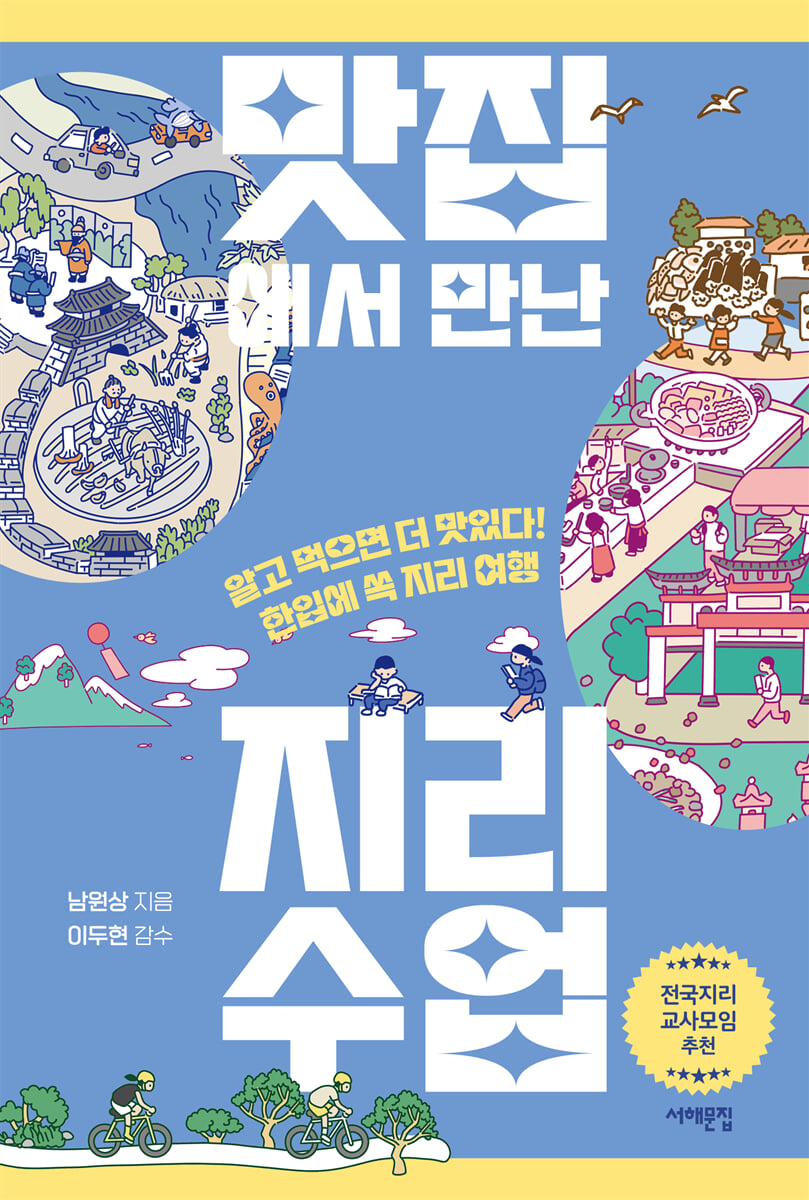
This book allows you to understand both human and physical geography through the geographical origins of famous regional foods such as Chungmu Kimbap, Uijeongbu Budae Jjigae, and Jeonju Bibimbap.
Abundant data and climate, topography, history, culture, politics, and economy are reconstructed into a three-dimensional and flavorful story through the perspective of 'geography.'
Even if you're not interested in geography, if you enjoy exploring delicious restaurants, this geography textbook for young adults will help you learn geography in a fun way, thanks to the author's subtle humor and concise writing style.
As you explore the delicious cuisines of 21 regions across the country and explore why they developed there, you'll naturally realize that geography isn't just about memorizing information displayed on a map.
Artist Bong-Hyeon's illustrations, which incorporate geographical elements into food, pique the reader's curiosity and provide a glimpse into the journey ahead, adding to the enjoyment of travel.
Abundant data and climate, topography, history, culture, politics, and economy are reconstructed into a three-dimensional and flavorful story through the perspective of 'geography.'
Even if you're not interested in geography, if you enjoy exploring delicious restaurants, this geography textbook for young adults will help you learn geography in a fun way, thanks to the author's subtle humor and concise writing style.
As you explore the delicious cuisines of 21 regions across the country and explore why they developed there, you'll naturally realize that geography isn't just about memorizing information displayed on a map.
Artist Bong-Hyeon's illustrations, which incorporate geographical elements into food, pique the reader's curiosity and provide a glimpse into the journey ahead, adding to the enjoyment of travel.
- You can preview some of the book's contents.
Preview
index
Entering
1. The proud protagonist of the festival _ Festival travel
Even though it's strange, it has a strong meaning _ Gangwon Chuncheon Makguksu # Traces of Hwajeon culture
Transforming spicy memories into the ultimate savory flavor - Gyeonggi Uijeongbu Budae Jjigae #Changing the city's impression
A cold wind and heavy snow in the mountains? _Yongdae-ri Hwangtae Jeongsik, Inje, Gangwon Province #Unique Climate Conditions
Mackerel along the mountain path, meeting the queen _ Andong dried mackerel in Gyeongbuk # A tradition created by the basin
130 years of sweet and salty history _ Incheon Chinatown Jjajangmyeon # In the midst of a power struggle over the sea route
2 City Symbols _ City Tour
Do you know the 9th grade civil servant Good Bobby _Gyeongnam Miryang Pork Soup #The key to resolving regional disparity?
The small ball launched by the Gyeongbu Expressway _ Ulsan Eonyang Bulgogi #Changes brought about by the development of transportation
Let's meet at the pier of separation _ Mokpo, Jeollanam-do, three-legged octopus # Between bitter history and the tourism industry
The King of Ribs, Originating from the King _Gyeonggi Suwon Wanggalbi #What a Planned City Needed
Hidden Rice Thief, Keeping the Lineage Alive _ Seoul Namdaemun Grilled Galchi (Grilled Hairtail) #A Slightly Special Street Trip
Traces of a city you can't visit now _ Gyeonggi Yeoncheon Naengmyeon
3 Mountains × Rivers × Seas _ Natural Geography Tour
When the vast plains meet the mountain range _ Jeonju Bibimbap, Jeollabuk-do #5 colors and 5 flavors in knotweed
A plate of yellow earth and sea breeze _ Busan Dongrae Pajeon #Why it's not Busan Pajeon
_Jeonbuk Gochang Pungcheon Eel, caught from a river with a sea breeze #Reclaimed reputation through coexistence with nature
A new home built on a sandbar - Gangwon Sokcho squid sundae #Northern culture brought by war
The Power of a Marketplace that Embraces Both Streams and People _ Byeongcheon Sundae, Cheonan, South Chungcheong Province #MarketFormation and Urban Growth
4 Delicacies Created by Ports and Islands _ Natural Geography Tour II
Watching the beautiful waterway in the warm breeze _ Chungmu Gimbap in Tongyeong, Gyeongnam # A meal perfect for the weather
The black pig protected by the South Sea _ Jeju black pig # Beyond exploitation and industrialization
The Secret of Beopseongpo _ Beopseongpo Oyster Stew in Yeonggwang, Jeollanam-do #No croaker, but the best oyster stew
Do you like sunrises? _Guryeongpo Gwamegi, Pohang, Gyeongbuk #Taste melted in the sunlight on the winter sea
A country that calls out to the departed oysters - Ganwoldo-ori oyster sauce from Seosan, South Chungcheong Province
References
1. The proud protagonist of the festival _ Festival travel
Even though it's strange, it has a strong meaning _ Gangwon Chuncheon Makguksu # Traces of Hwajeon culture
Transforming spicy memories into the ultimate savory flavor - Gyeonggi Uijeongbu Budae Jjigae #Changing the city's impression
A cold wind and heavy snow in the mountains? _Yongdae-ri Hwangtae Jeongsik, Inje, Gangwon Province #Unique Climate Conditions
Mackerel along the mountain path, meeting the queen _ Andong dried mackerel in Gyeongbuk # A tradition created by the basin
130 years of sweet and salty history _ Incheon Chinatown Jjajangmyeon # In the midst of a power struggle over the sea route
2 City Symbols _ City Tour
Do you know the 9th grade civil servant Good Bobby _Gyeongnam Miryang Pork Soup #The key to resolving regional disparity?
The small ball launched by the Gyeongbu Expressway _ Ulsan Eonyang Bulgogi #Changes brought about by the development of transportation
Let's meet at the pier of separation _ Mokpo, Jeollanam-do, three-legged octopus # Between bitter history and the tourism industry
The King of Ribs, Originating from the King _Gyeonggi Suwon Wanggalbi #What a Planned City Needed
Hidden Rice Thief, Keeping the Lineage Alive _ Seoul Namdaemun Grilled Galchi (Grilled Hairtail) #A Slightly Special Street Trip
Traces of a city you can't visit now _ Gyeonggi Yeoncheon Naengmyeon
3 Mountains × Rivers × Seas _ Natural Geography Tour
When the vast plains meet the mountain range _ Jeonju Bibimbap, Jeollabuk-do #5 colors and 5 flavors in knotweed
A plate of yellow earth and sea breeze _ Busan Dongrae Pajeon #Why it's not Busan Pajeon
_Jeonbuk Gochang Pungcheon Eel, caught from a river with a sea breeze #Reclaimed reputation through coexistence with nature
A new home built on a sandbar - Gangwon Sokcho squid sundae #Northern culture brought by war
The Power of a Marketplace that Embraces Both Streams and People _ Byeongcheon Sundae, Cheonan, South Chungcheong Province #MarketFormation and Urban Growth
4 Delicacies Created by Ports and Islands _ Natural Geography Tour II
Watching the beautiful waterway in the warm breeze _ Chungmu Gimbap in Tongyeong, Gyeongnam # A meal perfect for the weather
The black pig protected by the South Sea _ Jeju black pig # Beyond exploitation and industrialization
The Secret of Beopseongpo _ Beopseongpo Oyster Stew in Yeonggwang, Jeollanam-do #No croaker, but the best oyster stew
Do you like sunrises? _Guryeongpo Gwamegi, Pohang, Gyeongbuk #Taste melted in the sunlight on the winter sea
A country that calls out to the departed oysters - Ganwoldo-ori oyster sauce from Seosan, South Chungcheong Province
References
Detailed image
.jpg)
Into the book
You might wonder why I'm just talking nonsense when I ask the question, "Why did Uijeongbu become the home of budaejjigae?", but it's all related.
As explained earlier, the reason why Yi Seong-gye stayed in Uijeongbu on his way back to the palace from Hamheung was because this area was located on the route connecting the north and the capital.
Due to these geographical features, Uijeongbu became extremely important in terms of defending the capital after the division of North and South Korea.
If the North Korean army were to invade central Seoul, the fastest land route from the north would pass through Uijeongbu.
--- p.32
Among local festivals, there are many food festivals.
If you just count the ones registered on the Korea Tourism Organization website, there are a whopping 180 of them.
But if you look closely, there are quite a few overlapping things.
For example, the midwinter ice fishing festival is held in Inje, Yangpyeong, and Ganghwa, which have frozen lakes, and the fall apple festival is held in many apple-producing regions, such as Chungju, Mungyeong, Cheongsong, and Yeongju.
In that respect, the Andong Dried Mackerel Festival (although the name and format change slightly each year) boasts a definite presence.
…Andong dried mackerel is not just seasoned with salt, but is also fermented for a certain period of time.
This is the difference from the regular mackerel.
You'll know when you actually taste it.
It is the best rice thief with a salty liver that stimulates the appetite, the chewy texture of slightly dried fish meat, and the savory taste that comes from the aging process.
This delicacy was created due to Andong's geographical conditions.
Andong is an inland basin surrounded entirely by mountains.
Centered around Andong Lake and the Nakdong River, there are rugged mountain ranges, including the Taebaek Mountains to the east, and the Sobaek Mountains, Hakga Mountain, and Yeongji Mountain to the north.
This area is called the Andong Basin.
The only environments where fish can be caught are lakes and rivers, but mackerel, a saltwater fish, obviously does not live in freshwater.
Now, let's go east of Andong to find the origin of dried mackerel.
--- p.51~53
At that time, the Japanese were obsessed with the idea of 'escaping from Asia and heading towards the West'.
Government offices, schools, banks, and even companies were built in imitation of stone and brick buildings from Europe and the United States.
Their tastes were reflected in Mokpo in colonial Korea.
Representative examples include the Renaissance-style Mokpo Modern History Museum Building 1 (former Mokpo Japanese Consulate) and Building 2 (former Mokpo branch of Oriental Development Company).
You can also see many temples and Japanese-style houses built in the Japanese architectural style (houses of Japanese people who withdrew from the Korean Peninsula after liberation).
Some have been renovated into cafes and pastry shops, becoming popular Instagram spots.
If you look closely, the reason Mokpo Sebal Nakji became famous, surpassing Muan and Sinan, was because of Mokpo Station, which was built for exploitation. In many ways, Mokpo is a city with many traces of Japanese colonial rule.
Opinions are divided over whether it is appropriate to utilize sites of shameful history for tourism.
--- p.105~107
Among the warm-current fish species caught in abundance in the East Sea's landscaped waters during the summer, squid can be counted.
After pollack disappeared from the East Sea, squid also rapidly declined after the 2000s.
This is because North Korea has been selling fishing rights to the East Sea fishing grounds to China for economic reasons, and Chinese fishing boats are sweeping them away.
But before that, squid was common.
In particular, Sokcho developed a fishing industry because fishing boats could be safely anchored in Cheongcho Lake even when there were strong waves, and there were many squid fishing boats.
There was even a saying that squid fed Sokcho.
The displaced people of Abai Village have adapted well to this environment.
He made money by catching squid, using the pollack fishing skills he had honed in his hometown.
Also, I created squid sundae while thinking of the abai sundae and pollack sundae that I used to eat in Hamgyeong-do.
At that time, it was so common that it was cheap. They hollowed out the body of a squid and filled it with various ingredients such as glutinous rice, tofu, chopped vegetables, and seasonings to imitate sundae. It tasted pretty good.
… So to speak, squid sundae is a product of the culture and wisdom of displaced people from Hamgyeong-do and the sea of Sokcho.
As explained earlier, the reason why Yi Seong-gye stayed in Uijeongbu on his way back to the palace from Hamheung was because this area was located on the route connecting the north and the capital.
Due to these geographical features, Uijeongbu became extremely important in terms of defending the capital after the division of North and South Korea.
If the North Korean army were to invade central Seoul, the fastest land route from the north would pass through Uijeongbu.
--- p.32
Among local festivals, there are many food festivals.
If you just count the ones registered on the Korea Tourism Organization website, there are a whopping 180 of them.
But if you look closely, there are quite a few overlapping things.
For example, the midwinter ice fishing festival is held in Inje, Yangpyeong, and Ganghwa, which have frozen lakes, and the fall apple festival is held in many apple-producing regions, such as Chungju, Mungyeong, Cheongsong, and Yeongju.
In that respect, the Andong Dried Mackerel Festival (although the name and format change slightly each year) boasts a definite presence.
…Andong dried mackerel is not just seasoned with salt, but is also fermented for a certain period of time.
This is the difference from the regular mackerel.
You'll know when you actually taste it.
It is the best rice thief with a salty liver that stimulates the appetite, the chewy texture of slightly dried fish meat, and the savory taste that comes from the aging process.
This delicacy was created due to Andong's geographical conditions.
Andong is an inland basin surrounded entirely by mountains.
Centered around Andong Lake and the Nakdong River, there are rugged mountain ranges, including the Taebaek Mountains to the east, and the Sobaek Mountains, Hakga Mountain, and Yeongji Mountain to the north.
This area is called the Andong Basin.
The only environments where fish can be caught are lakes and rivers, but mackerel, a saltwater fish, obviously does not live in freshwater.
Now, let's go east of Andong to find the origin of dried mackerel.
--- p.51~53
At that time, the Japanese were obsessed with the idea of 'escaping from Asia and heading towards the West'.
Government offices, schools, banks, and even companies were built in imitation of stone and brick buildings from Europe and the United States.
Their tastes were reflected in Mokpo in colonial Korea.
Representative examples include the Renaissance-style Mokpo Modern History Museum Building 1 (former Mokpo Japanese Consulate) and Building 2 (former Mokpo branch of Oriental Development Company).
You can also see many temples and Japanese-style houses built in the Japanese architectural style (houses of Japanese people who withdrew from the Korean Peninsula after liberation).
Some have been renovated into cafes and pastry shops, becoming popular Instagram spots.
If you look closely, the reason Mokpo Sebal Nakji became famous, surpassing Muan and Sinan, was because of Mokpo Station, which was built for exploitation. In many ways, Mokpo is a city with many traces of Japanese colonial rule.
Opinions are divided over whether it is appropriate to utilize sites of shameful history for tourism.
--- p.105~107
Among the warm-current fish species caught in abundance in the East Sea's landscaped waters during the summer, squid can be counted.
After pollack disappeared from the East Sea, squid also rapidly declined after the 2000s.
This is because North Korea has been selling fishing rights to the East Sea fishing grounds to China for economic reasons, and Chinese fishing boats are sweeping them away.
But before that, squid was common.
In particular, Sokcho developed a fishing industry because fishing boats could be safely anchored in Cheongcho Lake even when there were strong waves, and there were many squid fishing boats.
There was even a saying that squid fed Sokcho.
The displaced people of Abai Village have adapted well to this environment.
He made money by catching squid, using the pollack fishing skills he had honed in his hometown.
Also, I created squid sundae while thinking of the abai sundae and pollack sundae that I used to eat in Hamgyeong-do.
At that time, it was so common that it was cheap. They hollowed out the body of a squid and filled it with various ingredients such as glutinous rice, tofu, chopped vegetables, and seasonings to imitate sundae. It tasted pretty good.
… So to speak, squid sundae is a product of the culture and wisdom of displaced people from Hamgyeong-do and the sea of Sokcho.
--- p.182~183
Publisher's Review
We live in a time when people are more serious about food than ever before.
New menus are released every day.
But you can't just eat anything.
Finding a good restaurant is essential.
Whether you're searching for a good restaurant for every meal or for an exciting trip, you'll find out about famous dishes in each region.
Uijeongbu is budaejjigae, Chuncheon is dakgalbi and makguksu, and Jeju is black pork.
How did these delicious dishes, so delicious they're worth seeking out, become so uniquely appealing and known nationwide? A careful examination of the reasons, driven by curiosity, leads to the conclusion that it stems from the regional characteristics shaped by differing geographical environments and the lives of the people who adapted to them.
This is the moment when you meet ‘geography’.
This book suggests a geographic tour that anyone who enjoys exploring delicious restaurants can enjoy.
This course explores delicious foods from 21 regions across the country and explores why those foods developed there.
The author, a traveler who has visited 112 cities across 25 countries and consistently writes books on the history and culture of food, uses his subtle humor, extensive knowledge, and concise writing style to guide you into the geographical secrets hidden in delicious restaurants.
The reason for holding the Budaejjigae Festival reveals Uijeongbu's unique location and history of war, and the story of how dried mackerel suddenly became famous in a sealess town allows us to understand Andong's geography and traditions.
Even young people who think of geography as a subject that involves memorizing information displayed on a map will find themselves immersed in the diverse flavors of geography by the end of this trip.
How did it become 'Jeonju' bibim triangle kimbap?
Were Jeju black pigs originally found all over the country?
Why is it called ‘Dongrae’ pajeon and not Busan pajeon?
From the delicious bowl placed before your eyes
Read about climate and topography, history and culture, politics and economy.
Learn geography through a food tour!
"Geography Lessons from a Delicious Restaurant" questions the combination of regional names and food that we often overlook because they are so familiar.
Why Jeonju Bibim Samgak Gimbap? Why is the Chuncheon Makguksu Dakgalbi Festival held even though there are far more restaurants selling dakgalbi? Why are they called Chungmu Gimbap and Dongrae Pajeon when they are also found in Tongyeong and Busan? These questions are answered as we travel through festivals, cities, mountains and rivers, islands, and the sea.
A wealth of material, including films, music, architecture, legends, folk songs, newspapers, and magazines, as well as climate, topography, history, culture, politics, and economy, are reconstructed through the perspective of 'geography' into a three-dimensional and flavorful story that unfolds like flowing water.
Even with the mala-tang and tang-hulu craze, Jjajangmyeon and galbi still captivate our taste buds, and it's fun enough to make us look at foods that are unfamiliar to young people, like gwamegi, in a different light.
This story also provides food for thought that allows us to reflect on how it relates to our lives today.
Young readers can discover the conditions of a port city and traces of Japanese colonial rule in the origins of Mokpo's three-legged octopus, and consider the implications of policies that leverage those painful memories for the tourism industry.
The cute local character that emerged as the promotional ambassador for Miryang Pork Soup allows us to read about the spatial inequality between the metropolitan and non-metropolitan areas, and the history of Gochang Pungcheon eel and Seosan Ganwoldo eel jeot allows us to deeply contemplate coexistence with nature.
The taste of any food is definitely different when you eat it knowing its origins and when you eat it without knowing its origins.
Even if you've already tried a dish, after reading this book, you'll feel like the ingredients, seasonings, and even the way it's presented in the dish are all completely new.
As you can see, the more you know, the more delicious it is.
New menus are released every day.
But you can't just eat anything.
Finding a good restaurant is essential.
Whether you're searching for a good restaurant for every meal or for an exciting trip, you'll find out about famous dishes in each region.
Uijeongbu is budaejjigae, Chuncheon is dakgalbi and makguksu, and Jeju is black pork.
How did these delicious dishes, so delicious they're worth seeking out, become so uniquely appealing and known nationwide? A careful examination of the reasons, driven by curiosity, leads to the conclusion that it stems from the regional characteristics shaped by differing geographical environments and the lives of the people who adapted to them.
This is the moment when you meet ‘geography’.
This book suggests a geographic tour that anyone who enjoys exploring delicious restaurants can enjoy.
This course explores delicious foods from 21 regions across the country and explores why those foods developed there.
The author, a traveler who has visited 112 cities across 25 countries and consistently writes books on the history and culture of food, uses his subtle humor, extensive knowledge, and concise writing style to guide you into the geographical secrets hidden in delicious restaurants.
The reason for holding the Budaejjigae Festival reveals Uijeongbu's unique location and history of war, and the story of how dried mackerel suddenly became famous in a sealess town allows us to understand Andong's geography and traditions.
Even young people who think of geography as a subject that involves memorizing information displayed on a map will find themselves immersed in the diverse flavors of geography by the end of this trip.
How did it become 'Jeonju' bibim triangle kimbap?
Were Jeju black pigs originally found all over the country?
Why is it called ‘Dongrae’ pajeon and not Busan pajeon?
From the delicious bowl placed before your eyes
Read about climate and topography, history and culture, politics and economy.
Learn geography through a food tour!
"Geography Lessons from a Delicious Restaurant" questions the combination of regional names and food that we often overlook because they are so familiar.
Why Jeonju Bibim Samgak Gimbap? Why is the Chuncheon Makguksu Dakgalbi Festival held even though there are far more restaurants selling dakgalbi? Why are they called Chungmu Gimbap and Dongrae Pajeon when they are also found in Tongyeong and Busan? These questions are answered as we travel through festivals, cities, mountains and rivers, islands, and the sea.
A wealth of material, including films, music, architecture, legends, folk songs, newspapers, and magazines, as well as climate, topography, history, culture, politics, and economy, are reconstructed through the perspective of 'geography' into a three-dimensional and flavorful story that unfolds like flowing water.
Even with the mala-tang and tang-hulu craze, Jjajangmyeon and galbi still captivate our taste buds, and it's fun enough to make us look at foods that are unfamiliar to young people, like gwamegi, in a different light.
This story also provides food for thought that allows us to reflect on how it relates to our lives today.
Young readers can discover the conditions of a port city and traces of Japanese colonial rule in the origins of Mokpo's three-legged octopus, and consider the implications of policies that leverage those painful memories for the tourism industry.
The cute local character that emerged as the promotional ambassador for Miryang Pork Soup allows us to read about the spatial inequality between the metropolitan and non-metropolitan areas, and the history of Gochang Pungcheon eel and Seosan Ganwoldo eel jeot allows us to deeply contemplate coexistence with nature.
The taste of any food is definitely different when you eat it knowing its origins and when you eat it without knowing its origins.
Even if you've already tried a dish, after reading this book, you'll feel like the ingredients, seasonings, and even the way it's presented in the dish are all completely new.
As you can see, the more you know, the more delicious it is.
GOODS SPECIFICS
- Date of issue: October 5, 2023
- Page count, weight, size: 256 pages | 312g | 135*200*15mm
- ISBN13: 9791192988320
You may also like
카테고리
korean


korean

![ELLE 엘르 스페셜 에디션 A형 : 12월 [2025]](http://librairie.coreenne.fr/cdn/shop/files/b8e27a3de6c9538896439686c6b0e8fb.jpg?v=1766436872&width=3840)


