

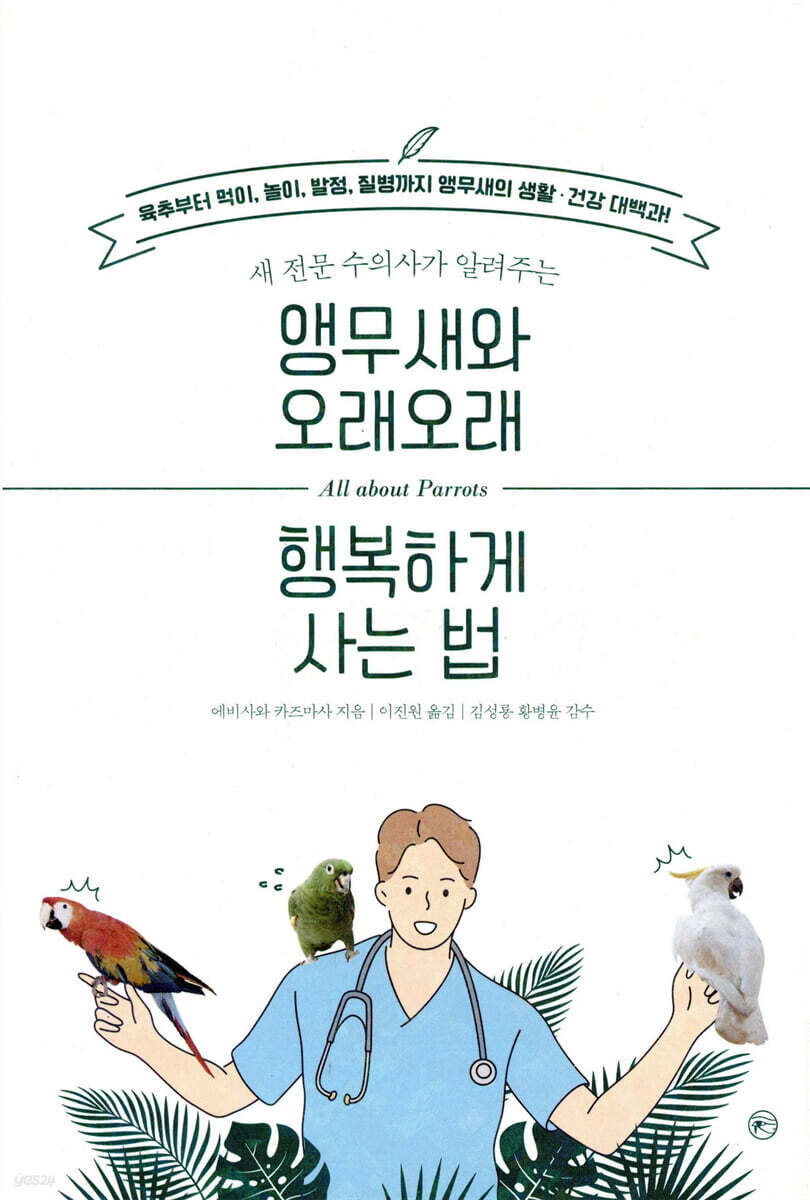
How to Live Happily Ever After with a Parrot
 |
Description
Book Introduction
A comprehensive guide to parrot life and health from a new veterinarian!
The author, who became a veterinarian because he loved birds and currently runs a bird clinic, has compiled into one book the things that parrot breeders need to know and are curious about.
Even if you go to a bookstore, books about parrots are rare, and incorrect information is often spread through social media.
This book provides an easy-to-understand explanation of the mysterious structures hidden within the parrot's small body, and also provides helpful information about the psychology and habits of parrots, which are difficult for humans to understand.
If you've ever wondered why your parrot behaves that way, and you want your parrot to be happy every day, this is the book to keep by your side.
The author, who became a veterinarian because he loved birds and currently runs a bird clinic, has compiled into one book the things that parrot breeders need to know and are curious about.
Even if you go to a bookstore, books about parrots are rare, and incorrect information is often spread through social media.
This book provides an easy-to-understand explanation of the mysterious structures hidden within the parrot's small body, and also provides helpful information about the psychology and habits of parrots, which are difficult for humans to understand.
If you've ever wondered why your parrot behaves that way, and you want your parrot to be happy every day, this is the book to keep by your side.
- You can preview some of the book's contents.
Preview
index
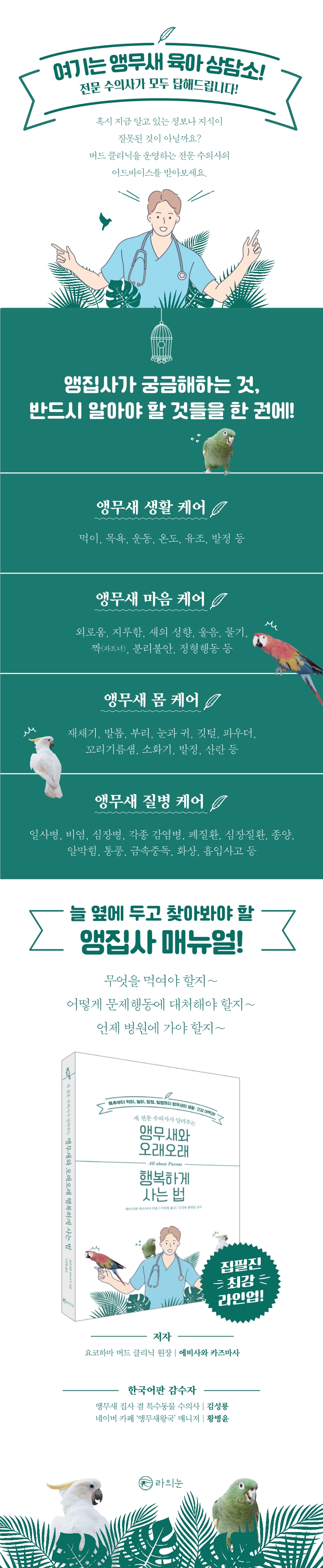
01 Parrot Life and Care
▶Don't overwork your bird by covering its cage / The secret to bathing / The reason for panic / Bird Doctor's advice (Life)
▶Why do birds vomit pellets? / Always check for debris in the mouth when eating pellets. / Pea sprouts are recommended. / Is it okay to eat only grains? / Bird Doctor's advice (food)
▶Even birds gain weight if you eat right after waking up from exercise / Exercise actively!
▶The relationship between temperature management and a healthy body
▶When raising multiple animals, keep them of the same species.
▶The growth period of a baby bird / The secret hidden in the feeding of a mother bird / Formula food for baby birds / After feeding, change to pellets / Transition from 'feeding' to 'eating alone' / Bird Doctor's advice (baby birds and breeding)
▶Let's identify the target of estrus / Bird Doctor's advice (Petros Care)
02 Understanding the Parrot Mind
▶Psychology Parrots understand people / Parrots also have preferences / Do parrots hide their illnesses? / 'Loneliness' and 'boredom' are the two major stressors for birds / Birds also experience stress every day / When people are happy, birds are happy too / Passive birds vs.
Active Birds / Bird Doctor's Advice (Chirping) / Let's Know! Stereotypic Behavior / Bird Doctor's Advice (Psychology)
▶ Habits and Instincts Parrots live in pairs / Pairing is for reproduction and child rearing / Females test males / How to test males' patience / It's better for partners to have similar values / Two types of calls when alert / If you feel separation anxiety / Why do parrots bite human skin?
03 Understanding the Parrot's Body
▶Body Structure: Sneezing to clear the nose / Claws are tools for cleaning the nose / Simple but mysterious ear structure / Detecting light with the skull / The secret of the parrot's eyes, the retinal ganglion / Beak made up of multiple layers / How do feathers grow? / Four types of feather moulting / Structure of feather moulting ① / Structure of feather moulting ② / The relationship between powder and tail oil glands / The secret of the smell during mating season / The parrot's brain sleeps only halfway / The parrot's digestive system / The parrot's feeder is strong / How are eggs made? / Two egg-laying methods / Advice from the bird doctor (body structure) / Yawning during the molting season
04 Parrot Diseases and Hospitals
▶ How to find a good hospital / When to be hospitalized / Why health checkups are important / Do not put water in your carrier when going to the hospital / Second opinion / Keeping warm is important when visiting the hospital in winter
▶Diseases Pathological feather fluffing / Heatstroke and air conditioning / Rhinitis and sinusitis in parrots / Megabacteriosis common in lovebirds / Trichomonas infection caused by parasites / Cryptosporidiosis that causes vomiting / Adenoid ectasia that is difficult to cure / Powder caution! Chronic obstructive pulmonary disease / Heart disease caused by aging and obesity / Testicular tumor ① A special disease in male lovebirds / Testicular tumor ② Observe the color of the lining / Ovarian tumor in small parrots / Egg blockage to watch out for in winter / Oil is ineffective for egg blockage / Abdominal hernia that requires early treatment / Gout that is best delayed / Calluses that cause corns on the feet / Bird doctor's advice (other)
▶Metal poisoning caused by metal curtains
▶ Beware of kitchen smoke inhalation accidents and injuries! / Fatal burns for parrots / Low-temperature burns for cherry-blossom cockatiels
▶Don't overwork your bird by covering its cage / The secret to bathing / The reason for panic / Bird Doctor's advice (Life)
▶Why do birds vomit pellets? / Always check for debris in the mouth when eating pellets. / Pea sprouts are recommended. / Is it okay to eat only grains? / Bird Doctor's advice (food)
▶Even birds gain weight if you eat right after waking up from exercise / Exercise actively!
▶The relationship between temperature management and a healthy body
▶When raising multiple animals, keep them of the same species.
▶The growth period of a baby bird / The secret hidden in the feeding of a mother bird / Formula food for baby birds / After feeding, change to pellets / Transition from 'feeding' to 'eating alone' / Bird Doctor's advice (baby birds and breeding)
▶Let's identify the target of estrus / Bird Doctor's advice (Petros Care)
02 Understanding the Parrot Mind
▶Psychology Parrots understand people / Parrots also have preferences / Do parrots hide their illnesses? / 'Loneliness' and 'boredom' are the two major stressors for birds / Birds also experience stress every day / When people are happy, birds are happy too / Passive birds vs.
Active Birds / Bird Doctor's Advice (Chirping) / Let's Know! Stereotypic Behavior / Bird Doctor's Advice (Psychology)
▶ Habits and Instincts Parrots live in pairs / Pairing is for reproduction and child rearing / Females test males / How to test males' patience / It's better for partners to have similar values / Two types of calls when alert / If you feel separation anxiety / Why do parrots bite human skin?
03 Understanding the Parrot's Body
▶Body Structure: Sneezing to clear the nose / Claws are tools for cleaning the nose / Simple but mysterious ear structure / Detecting light with the skull / The secret of the parrot's eyes, the retinal ganglion / Beak made up of multiple layers / How do feathers grow? / Four types of feather moulting / Structure of feather moulting ① / Structure of feather moulting ② / The relationship between powder and tail oil glands / The secret of the smell during mating season / The parrot's brain sleeps only halfway / The parrot's digestive system / The parrot's feeder is strong / How are eggs made? / Two egg-laying methods / Advice from the bird doctor (body structure) / Yawning during the molting season
04 Parrot Diseases and Hospitals
▶ How to find a good hospital / When to be hospitalized / Why health checkups are important / Do not put water in your carrier when going to the hospital / Second opinion / Keeping warm is important when visiting the hospital in winter
▶Diseases Pathological feather fluffing / Heatstroke and air conditioning / Rhinitis and sinusitis in parrots / Megabacteriosis common in lovebirds / Trichomonas infection caused by parasites / Cryptosporidiosis that causes vomiting / Adenoid ectasia that is difficult to cure / Powder caution! Chronic obstructive pulmonary disease / Heart disease caused by aging and obesity / Testicular tumor ① A special disease in male lovebirds / Testicular tumor ② Observe the color of the lining / Ovarian tumor in small parrots / Egg blockage to watch out for in winter / Oil is ineffective for egg blockage / Abdominal hernia that requires early treatment / Gout that is best delayed / Calluses that cause corns on the feet / Bird doctor's advice (other)
▶Metal poisoning caused by metal curtains
▶ Beware of kitchen smoke inhalation accidents and injuries! / Fatal burns for parrots / Low-temperature burns for cherry-blossom cockatiels
Detailed image
Publisher's Review
“Why is our parrot like that?”
A new expert veterinarian answers.
Encyclopedia of Parrot Life and Health, from Breeding to Feeding, Play, Maturing, and Disease
Recently, the number of people adopting parrots as pets due to their high intelligence, delicate sensibilities, and excellent communication skills has increased significantly.
However, unlike in the case of companion dogs and cats, the reality is that there is a severe lack of information and theories that parrot breeders can refer to.
The author of this book, Kazumasa Ezusa, who is currently the director of the Yokohama Bird Clinic, also says in the preface, "I wrote this book to correct incorrect information circulating through social media, etc."
A small, careless action can have fatal consequences for your parrot's body and mind.
If you want your parrot to be happy and healthy, this book contains all the knowledge and information you need to know.
“Don’t fight the parrot’s instincts!”
Many breeders try to prevent their parrots from biting or making noise.
Every effort is made to prevent parrots from going into heat.
Of course, minimal restrictions are necessary for coexistence, but people who don't know much about parrots sometimes do the wrong thing.
For example, the behavior of nibbling the neck of a breeder may be a type of friendly behavior of preening the feathers of a partner, and excessive crying may be a self-stimulatory behavior to relieve boredom.
Additionally, parrots that perceive their breeder as their partner may become overly clingy or display aggressive behavior toward other family members.
You can't stop a parrot's instinctive behavior.
Appropriate knowledge is essential to accurately identify the cause of problem behavior and find solutions.
“A great mystery hidden in the parrot’s small body!”
Properly caring for your parrot requires understanding its natural instincts and habits, as well as its body structure.
Knowing the basics of the parrot's eyes, nose, and ears, the secrets of its skull, the functions of its beak and claws, feather moulting, digestive system including its feeder pouch, tail oil glands and powder, and its estrus and egg-laying system will make daily care easier and allow you to catch any abnormalities more quickly.
For example, parrots can detect light with their skulls even when their eyes are closed, so even if the parrot is asleep, it perceives it as daytime if the surroundings are bright.
Therefore, even if a parrot sleeps for a long time, it does not mean that the possibility of it going into heat is reduced.
“What should I do about the breeding, feeding, temperature, and bathing?”
When you raise a parrot, you will develop a desire to reproduce on your own.
Hatching eggs laid by a mother parrot and raising the chicks is called brooding.
This book recommends self-breeding, but communal breeding is recommended if self-breeding is desired.
In other words, the mother bird and the breeder jointly raise the chicks.
Also, we recommend pellets rather than grains.
You can get professional advice from your veterinarian on why and how to do it.
Basically, you can refer to the parrot's living temperature and bathing conditions in the wild.
Parrots living in equatorial regions and parrots living in steppe climates are bound to have different needs for appropriate temperature and frequency of bathing.
“I will tell you when to go to the hospital.”
Some breeders often say, “My parrot pretends not to be sick even though he is,” but this is incorrect.
It is accurate to say that the breeder did not notice.
It is relatively more difficult to detect abnormal signals in parrots than in dogs or cats.
It is recommended to check the amount of food, excrement, sleeping time, activity level, foot temperature, feather fluff, etc. every day, and to have a health checkup once a year, just like people.
This book explains common diseases and treatments for parrots, as well as when to seek immediate medical attention.
It treats a variety of diseases, including congestion, rhinitis, heatstroke, burns, poisoning, as well as various infections, tumors, joints, and kidney diseases.
It also tells us that each parrot has its own unique medical conditions.
This is because there are diseases that lovebirds suffer from and diseases that lovebirds suffer from.
Finally, we'll also guide you through finding a good vet and when to switch veterinarians (and when to seek a second opinion).
This is a must-read for parrot owners, filled with tips on how to live a long and happy life with your precious parrot.
A new expert veterinarian answers.
Encyclopedia of Parrot Life and Health, from Breeding to Feeding, Play, Maturing, and Disease
Recently, the number of people adopting parrots as pets due to their high intelligence, delicate sensibilities, and excellent communication skills has increased significantly.
However, unlike in the case of companion dogs and cats, the reality is that there is a severe lack of information and theories that parrot breeders can refer to.
The author of this book, Kazumasa Ezusa, who is currently the director of the Yokohama Bird Clinic, also says in the preface, "I wrote this book to correct incorrect information circulating through social media, etc."
A small, careless action can have fatal consequences for your parrot's body and mind.
If you want your parrot to be happy and healthy, this book contains all the knowledge and information you need to know.
“Don’t fight the parrot’s instincts!”
Many breeders try to prevent their parrots from biting or making noise.
Every effort is made to prevent parrots from going into heat.
Of course, minimal restrictions are necessary for coexistence, but people who don't know much about parrots sometimes do the wrong thing.
For example, the behavior of nibbling the neck of a breeder may be a type of friendly behavior of preening the feathers of a partner, and excessive crying may be a self-stimulatory behavior to relieve boredom.
Additionally, parrots that perceive their breeder as their partner may become overly clingy or display aggressive behavior toward other family members.
You can't stop a parrot's instinctive behavior.
Appropriate knowledge is essential to accurately identify the cause of problem behavior and find solutions.
“A great mystery hidden in the parrot’s small body!”
Properly caring for your parrot requires understanding its natural instincts and habits, as well as its body structure.
Knowing the basics of the parrot's eyes, nose, and ears, the secrets of its skull, the functions of its beak and claws, feather moulting, digestive system including its feeder pouch, tail oil glands and powder, and its estrus and egg-laying system will make daily care easier and allow you to catch any abnormalities more quickly.
For example, parrots can detect light with their skulls even when their eyes are closed, so even if the parrot is asleep, it perceives it as daytime if the surroundings are bright.
Therefore, even if a parrot sleeps for a long time, it does not mean that the possibility of it going into heat is reduced.
“What should I do about the breeding, feeding, temperature, and bathing?”
When you raise a parrot, you will develop a desire to reproduce on your own.
Hatching eggs laid by a mother parrot and raising the chicks is called brooding.
This book recommends self-breeding, but communal breeding is recommended if self-breeding is desired.
In other words, the mother bird and the breeder jointly raise the chicks.
Also, we recommend pellets rather than grains.
You can get professional advice from your veterinarian on why and how to do it.
Basically, you can refer to the parrot's living temperature and bathing conditions in the wild.
Parrots living in equatorial regions and parrots living in steppe climates are bound to have different needs for appropriate temperature and frequency of bathing.
“I will tell you when to go to the hospital.”
Some breeders often say, “My parrot pretends not to be sick even though he is,” but this is incorrect.
It is accurate to say that the breeder did not notice.
It is relatively more difficult to detect abnormal signals in parrots than in dogs or cats.
It is recommended to check the amount of food, excrement, sleeping time, activity level, foot temperature, feather fluff, etc. every day, and to have a health checkup once a year, just like people.
This book explains common diseases and treatments for parrots, as well as when to seek immediate medical attention.
It treats a variety of diseases, including congestion, rhinitis, heatstroke, burns, poisoning, as well as various infections, tumors, joints, and kidney diseases.
It also tells us that each parrot has its own unique medical conditions.
This is because there are diseases that lovebirds suffer from and diseases that lovebirds suffer from.
Finally, we'll also guide you through finding a good vet and when to switch veterinarians (and when to seek a second opinion).
This is a must-read for parrot owners, filled with tips on how to live a long and happy life with your precious parrot.
GOODS SPECIFICS
- Date of issue: August 16, 2022
- Page count, weight, size: 248 pages | 456g | 152*225*15mm
- ISBN13: 9791192151281
- ISBN10: 1192151283
You may also like
카테고리
korean


korean

![GQ KOREA Mark (Monthly): December [2025]](http://librairie.coreenne.fr/cdn/shop/files/8ef265dbbfbf186523ed75ba7319009d.jpg?v=1765340328&width=3840)


