

Archaeology in Everyday Life: Alone at the National Museum of Korea
 |
Description
Book Introduction
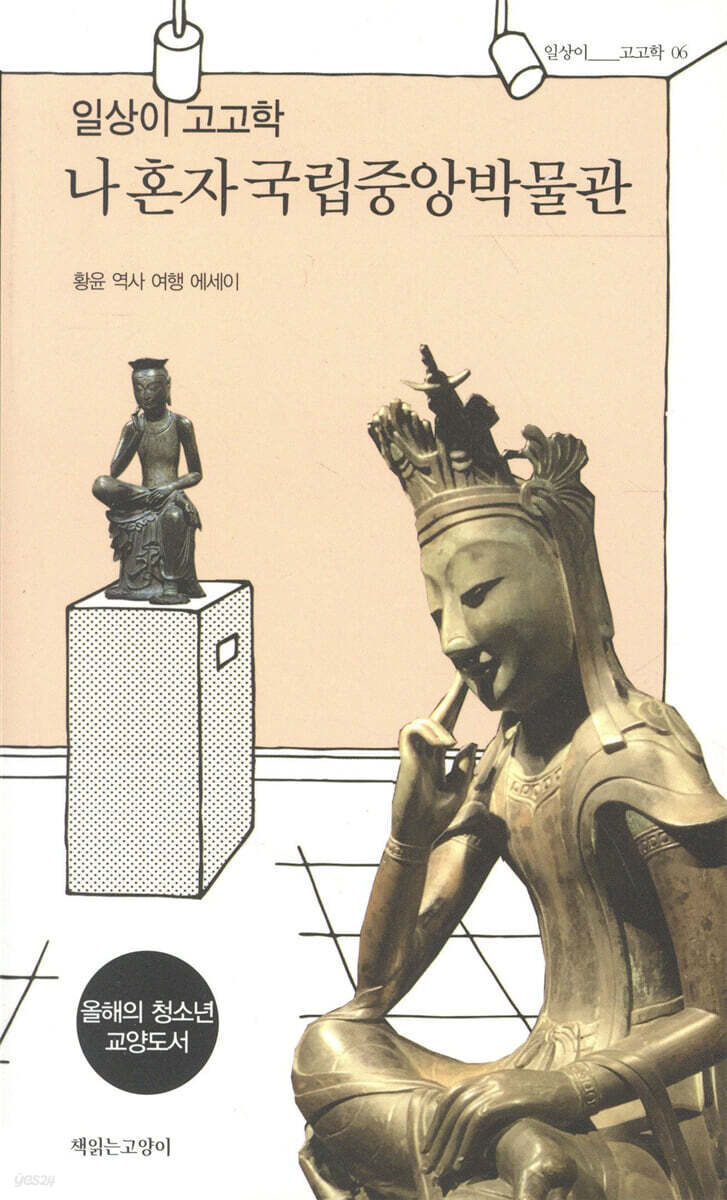
The National Museum of Korea: A Unique Storytelling Experience The main character is a gilt-bronze seated bodhisattva This book is a research guide and guide to help you appreciate more deeply and richly the precious encounter with the two gilt-bronze seated Bodhisattva statues on display in the 'Room of Thought' of the National Museum of Korea. Author Hwang Yoon, a museum enthusiast and history buff, has long enjoyed visiting the National Museum of Korea with the theme of 'gold' through his own storytelling. The reason I thought that if I were to write a book about the National Museum of Korea someday, the main character would naturally be the gilt-bronze Pensive Bodhisattva, is because the gilt-bronze Pensive Bodhisattva displayed in the “Room of Thought” is the epitome of gold, art, and Buddhism. Through this book, we learn that encountering the two statues of the Buddha is not limited to the space called the ‘Room of Thought.’ The process of approaching the 'Room of Thought' is described in a book of over 400 pages as a kind of preparation and courtesy for properly encountering the two gilt-bronze seated Bodhisattva statues. The Bangasayusang Buddha, which appeared over 1,300 years ago! While this book alone may not be enough to trace the countless hours of preparation that went into its creation, it will serve as a companion for visitors invited to the "Room of Thought." We invite you to a more fun and meaningful trip to the National Museum of Korea than ever before. |
- You can preview some of the book's contents.
Preview
index
prolog
1.
Bangasayusang
The meaning of national treasure
The birth of a national treasure
The names of the two Bangasayusang
Combination of gold and bronze
2.
The beginning of the Bronze Age
Neolithic and Paleolithic
Bronze Age farming patterns
Bronze Age
Principles of bronze mixing
Bronze Age Excalibur
3.
The beginning of gold
Gold's appearance in human history
Gold earrings excavated in Gimpo
Gojoseon and Nakrang
Seokam-ri Tomb No. 9
Gold in Chinese History
If you throw a bone to a dog,
After the fall of Nakrang
4.
Goguryeo's golden age
Buyeo Story
Goguryeo, the fighting people
Gangseo Daemyo
Goguryeo relics discovered in Silla
5.
Silla and Goguryeo
Silla Exhibition Hall
Silla gold earrings
The Secret of Hwangnam Daechong's Silver Crown
King Naemul and King Silseong
Succession of the throne to the descendants of King Naemul
The owner of Hwangnam Daechong is
6.
Baekje and Silla
Naje Alliance
Gilt-bronze shoes from the Sikri Tomb
Baekje gold crafts
Hierarchy of decorated designs
7.
Gaya and Geum
From Geumgwan Gaya to Daegaya
Gaya goldsmiths
Gaya's ring-hilted sword
Silla gold crown and Gaya gold crown
8.
Introduction of Buddhism
Shakyamuni
Mahayana Buddhism
Regrets about the Buddhist sculpture exhibition
Gilt-bronze seated Buddha statue inscribed in the 7th year of Yeonga
The era name of Yeonga 7th year
The thousand Buddhas of the present kalpa
Transfer of the Buddha statue
9.
Maitreya thought
Bodhisattva in Gandhara art
Maitreya and Bodhisattva
Buddhism introduced to China
Northern Wei Dynasty and Buddhism
Chinese Maitreya statue
Maitreya thought in China
King Ah-yuk? Yes.
10.
Again, National Treasure Bangasayusang
Gilt-bronze pensive Bodhisattva statues concentrated in Seoul
The appearance of Maitreya on the Korean Peninsula
The Buddha Land of the Wheel-Turning King
Back to the 'Room of Thought'
A statue of a seated Buddha enshrined in a temple
Maitreya of Baekje Mireuksa Temple
An encounter that transcends time and space
Epilogue
References
1.
Bangasayusang
The meaning of national treasure
The birth of a national treasure
The names of the two Bangasayusang
Combination of gold and bronze
2.
The beginning of the Bronze Age
Neolithic and Paleolithic
Bronze Age farming patterns
Bronze Age
Principles of bronze mixing
Bronze Age Excalibur
3.
The beginning of gold
Gold's appearance in human history
Gold earrings excavated in Gimpo
Gojoseon and Nakrang
Seokam-ri Tomb No. 9
Gold in Chinese History
If you throw a bone to a dog,
After the fall of Nakrang
4.
Goguryeo's golden age
Buyeo Story
Goguryeo, the fighting people
Gangseo Daemyo
Goguryeo relics discovered in Silla
5.
Silla and Goguryeo
Silla Exhibition Hall
Silla gold earrings
The Secret of Hwangnam Daechong's Silver Crown
King Naemul and King Silseong
Succession of the throne to the descendants of King Naemul
The owner of Hwangnam Daechong is
6.
Baekje and Silla
Naje Alliance
Gilt-bronze shoes from the Sikri Tomb
Baekje gold crafts
Hierarchy of decorated designs
7.
Gaya and Geum
From Geumgwan Gaya to Daegaya
Gaya goldsmiths
Gaya's ring-hilted sword
Silla gold crown and Gaya gold crown
8.
Introduction of Buddhism
Shakyamuni
Mahayana Buddhism
Regrets about the Buddhist sculpture exhibition
Gilt-bronze seated Buddha statue inscribed in the 7th year of Yeonga
The era name of Yeonga 7th year
The thousand Buddhas of the present kalpa
Transfer of the Buddha statue
9.
Maitreya thought
Bodhisattva in Gandhara art
Maitreya and Bodhisattva
Buddhism introduced to China
Northern Wei Dynasty and Buddhism
Chinese Maitreya statue
Maitreya thought in China
King Ah-yuk? Yes.
10.
Again, National Treasure Bangasayusang
Gilt-bronze pensive Bodhisattva statues concentrated in Seoul
The appearance of Maitreya on the Korean Peninsula
The Buddha Land of the Wheel-Turning King
Back to the 'Room of Thought'
A statue of a seated Buddha enshrined in a temple
Maitreya of Baekje Mireuksa Temple
An encounter that transcends time and space
Epilogue
References
Publisher's Review
Standing in the room of reason
Like the disciples who gathered around Buddha 2500 years ago
Two national treasures representing the Three Kingdoms period, the Gilt-bronze Pensive Bodhisattva, have been on display to much interest in the National Museum of Korea's "Room of Thought" since November 2021.
The sight of a large crowd surrounding the gilt-bronze seated Bodhisattva statue, which stands out in the modern exhibition hall decorated in deep yellow, seems to be a faithful reproduction of the scene of disciples gathered around the Buddha 2,500 years ago.
“I gazed at the two statues of Bangasayu for a while, amazed by the dreamlike, unreal scene, and their smiles touched my heart even more today.
More beautiful than the smile of Mona Lisa at the Louvre Museum.
"Beautiful! A faint smile has already appeared on my lips." - p10
The National Museum of Korea: A Unique Storytelling Experience
The main character is a gilt-bronze seated bodhisattva
This book is a research guide and guide to help you appreciate more deeply and richly the precious encounter with the two gilt-bronze seated Bodhisattva statues on display in the 'Room of Thought' of the National Museum of Korea.
Author Hwang Yoon, a museum enthusiast and history buff, has long enjoyed visiting the National Museum of Korea with the theme of 'gold' through his own storytelling.
The reason I thought that if I were to write a book about the National Museum of Korea someday, the main character would naturally be the gilt-bronze Pensive Bodhisattva, is because the gilt-bronze Pensive Bodhisattva displayed in the “Room of Thought” is the epitome of gold, art, and Buddhism.
Through this book, we learn that encountering the two statues of the Buddha is not limited to the space called the ‘Room of Thought.’
The process of approaching the 'Room of Thought' is described in a book of over 400 pages as a kind of preparation and courtesy for properly encountering the two gilt-bronze seated Bodhisattva statues.
The Bangasayusang Buddha, which appeared over 1,300 years ago! While this book alone may not be enough to trace the countless hours of preparation that went into its creation, it will serve as a companion for visitors invited to the "Room of Thought."
We invite you to a more fun and meaningful trip to the National Museum of Korea than ever before.
To appreciate the Room of Reason is to see the entire National Museum of Korea.
The road to the 'Room of Thought' cannot be a straight one.
It is necessary to go up and down the National Museum of Korea and go around and check and learn about each and every thing.
For museum lovers, this time is not about learning, but about enjoyment.
From the first to the third floor of the National Museum of Korea, you will meticulously navigate the museum, immersing yourself in the pleasure of learning about everything from the flow of bronze and gold to the shifts of power between nations surrounding the Korean Peninsula, and the history and form of Buddhism embedded within the Bangasayusang statue.
It begins in the Paleolithic and Neolithic exhibition hall on the first floor of the National Museum of Korea and continues to the Bronze Age, Gojoseon, and Goguryeo exhibition halls.
To understand the Bangasayusang, a bronze body made of gold, the author shows the flow of bronze and gold within the Korean Peninsula.
Ignoring the museum's path from Goguryeo to Baekje, the guide moves from Goguryeo to the Silla exhibition hall and then back to Baekje and Gaya. By comparing artifacts from Goguryeo, Baekje, and Silla one by one, the guide presents a variety of storytelling, including diplomatic power and power transfer, technology, and aesthetics surrounding the Three Kingdoms and China.
Next, we move through the Buddhist sculpture exhibition hall on the third floor, the India and Southeast Asia exhibition hall, and the Central Asia exhibition hall, and we present comprehensive information on Buddhist statues, including the spread of Buddhism, the meaning of Maitreya Bodhisattva in the Buddhist worldview, the role of Buddhism in national governance, and the design aspects of Buddhist statues.
Finally, the 'Room of Thought'.
We encounter the depth of narrative contained in two gilt-bronze Bodhisattva statues.
Archaeological Questions at the National Museum of Korea
1.
The names of national treasures of the same type have become the same.
As of November 19, 2021, the Enforcement Decree of the Cultural Heritage Protection Act and the Enforcement Rules of the Cultural Heritage Protection Act were implemented, which prevented the designation numbers assigned in the order in which they were designated as national cultural properties from being displayed in the future. As a result, the names National Treasure No. 78 and National Treasure No. 83, which were used to refer to the two Banga Sayu statues enshrined in the Room of Reason, suddenly disappeared, and both ended up becoming National Treasure Banga Sayu statues.
Although the designated number does not indicate the high or low of value but rather the designated order, there was a tendency for it to be mistaken for a ranking according to the hierarchy of value, so it was decided to boldly eliminate it. In this book, in accordance with the government's guidelines, the designated number is not mentioned as much as possible, and the existing National Treasure No. 78 Banga Sayu Sang is called the 'Pagoda-shaped Banga Sayu Sang', and the existing National Treasure No. 83 Banga Sayu Sang is called the 'Samsan-gwan Banga Sayu Sang'.
The National Museum of Korea also held a nickname contest through social media, but was unable to decide on a final winner, to the point where it was unable to decide on a grand prize. A solution must be found so that our relics can be identified and given individual names that are familiar to them.
2.
A splendid jade wall and belt discovered in the Nakrang Exhibition Hall after passing through Gojoseon
Tomb No. 9 in Seokam-ri, where jade walls and various jade artifacts, as well as swords and ornaments made of iron, were excavated.
Among them, the national treasure gold belt called the 'Pyongyang Seokam-ri gold belt' is not only a work of great skill with its detailed carvings that make it look like a living dragon, but also shows a coherent worldview, and is similar to the gold belt buckle excavated from the Xinjiang Uyghur Autonomous Region.
After Nakrang was taken over by Goguryeo, the people of Nakrang migrated to China, but were also incorporated into Goguryeo, or migrated to Baekje or Japan.
King Geunchogo of Baekje used the title of Governor of Nakrang and considered it important, and in the ancient Korean Peninsula, Nakrang was not simply a military district of the Han Dynasty, but rather existed as an image of a cultural bridge connecting with China, so it was not a negative image at all.
If so, isn't the fact that Goguryeo, after expelling Nakrang, modified its image to suit its own tastes, and that Baekje and Silla also adopted the same modified image, a testament to the Korean Peninsula's victorious history? Isn't it time to somewhat dispel the uncomfortable feelings surrounding Nakrang and understand it as a central part of Korean history?
3.
It is possible to infer which king and queen the Hwangnamdaechong tomb belongs to based on the excavated artifacts.
A silver crown and four gilt-bronze crowns were found in the tomb of the Silla king in Hwangnamdaechong, and a gold crown was found in the tomb of the queen in Hwangnamdaechong.
The only silver crown from Silla excavated from the southern tomb of Hwangnamdaechong, a tomb of a married couple, allows for inference through archaeological inference about which king this tomb belongs to.
The gold crown excavated from the tomb of the queen in the northern tomb resembles the engraved design that splendidly decorates the Silla Room of the National Museum of Korea, indicating that there were significant political changes in Silla between the construction of the southern and northern tombs of Hwangnamdaechong.
The silver crown was a design with a strong Goguryeo feel, and was used by the king of Silla. This means that it is highly likely that it was granted from the perspective and standards of Goguryeo, thus showing that Silla was a vassal state of Goguryeo.
4.
The regrets of the Buddhist sculpture exhibition at the National Museum of Korea
To examine the introduction of Buddhism and the Maitreya idea, go to the third floor of the National Museum of Korea's permanent exhibition hall, where you will find the Sculpture and Crafts Hall, which exhibits Korean Buddhist sculptures.
Here, it is possible to observe the Three Kingdoms period when Buddhist culture was introduced through a gilt-bronze Buddha sculpture.
What is important is to view it in conjunction with the World Culture Hall, which exhibits overseas relics from China, Japan, and India. However, one of the regrettable aspects of the National Museum of Korea is that it does not properly collect Class A cultural assets in this field.
For example, when talking about Buddhist sculptures from the Three Kingdoms period, we need to directly observe and see the Indian and Chinese Buddhist sculptures that influenced the Korean Peninsula. However, although there are many Gandhara art pieces on display in the Indian exhibition hall, surprisingly, there are no Buddha sculptures.
So, other than the Buddhas that appear in broken pieces such as heads, torsos, or small pieces, there are no large-scale Buddha sculptures that can properly grasp the overall design.
There are only about three large-scale sculptures of Bodhisattva.
Although Bodhisattvas are important, the flower of Buddhist sculpture is still Buddha. However, the absence of a complete, Grade A Buddha sculpture at the National Museum of Korea, which represents Korea, is a major weakness.
The same goes for Chinese Buddhist sculpture.
In the Chinese exhibition hall, it is difficult to find Buddhist sculptures from the Southern and Northern Dynasties period in China, which directly influenced the design of Buddhist statues on the Korean Peninsula in the 6th century.
Buddhist sculptures from the Sui and Tang Dynasties, which influenced the Unified Silla period from the 7th century, are also almost impossible to find.
There are only a few works collected by the Yi Royal Family Museum during the Japanese colonial period, and even then, with the exception of one or two, important parts are broken or the quality is not very high, making it difficult to properly understand the design of the Buddhist statues.
Conversely, if there are Japanese Buddhist sculptures, we can observe influences from the Korean Peninsula.
By viewing this exhibition, anyone will be able to naturally picture the history of the Korean Peninsula in the context of world history.
The National Museum of Korea is still very lacking in this area.
We must prove the value of Korean relics in world history.
Only when these areas are sufficiently filled can the National Museum of Korea achieve global competitiveness, and furthermore, education that fosters a broader worldview beyond the confines of the Korean Peninsula become possible.
5.
National treasures and treasures concentrated in Seoul
The National Museum of Korea currently has on display two national treasures, gilt-bronze pensive Bodhisattva statues measuring 82 cm and 93.5 cm, in the "Room of Thought" on the second floor, as well as several other gilt-bronze pensive Bodhisattva statues measuring 20 to 30 cm.
The problem is that these gilt-bronze pensive Bodhisattva statues were collected only from across the Korean peninsula, so unlike in Seoul, it is difficult to find top-quality gilt-bronze pensive Bodhisattva statues in local museums.
The National Gyeongju Museum only has four small-sized gilt-bronze statues, including a gilt-bronze pensive Bodhisattva statue excavated from Seonggeon-dong, Gyeongju, and the National Daegu Museum only has two gilt-bronze pensive Bodhisattva statues measuring about 15 cm.
In other words, the reality is that only very small, broken, or cracked Bangasayusang statues exist in the provinces.
The biggest problem with the current situation, where most of the major relics are concentrated in Seoul, is that it is extremely vulnerable to war, which could occur even in the unlikely event of one.
If even a missile were to fall, 60-70% of national treasures and treasures in the form of movable objects could disappear.
It is worth considering whether concentrating most of the Class A artifacts in Seoul, as in the case of the recent Gilt-bronze Seated Bodhisattva, can truly be a way to safely preserve them for the distant future.
By distributing the Annals of the Joseon Dynasty to various regions in advance during times of peace, the history was able to survive even though the entire country, including the capital, suffered devastation during the Imjin War.
Even outside of war, individual destruction of artifacts still occurs frequently.
In 2008, there was the Sungnyemun arson incident, which was considered an important relic by everyone as National Treasure No. 1. Overseas examples include the 1911 theft of the Mona Lisa from the Louvre Museum, the 2022 terrorist incident in which a man in his 30s threw a cake at the Mona Lisa, and in 2011, during protests in Egypt, the National Museum was robbed and the gilded wooden statue of Tutankhamun disappeared, and has not been found yet.
Unconditionally, various preventive measures are the best effort.
Shouldn't our generation be the only ones to enjoy the greatest national treasures representing the Three Kingdoms period? Just as we can see works from over 1,300 years ago, we should ensure that our descendants 1,300 years from now can also enjoy them.
Like the disciples who gathered around Buddha 2500 years ago
Two national treasures representing the Three Kingdoms period, the Gilt-bronze Pensive Bodhisattva, have been on display to much interest in the National Museum of Korea's "Room of Thought" since November 2021.
The sight of a large crowd surrounding the gilt-bronze seated Bodhisattva statue, which stands out in the modern exhibition hall decorated in deep yellow, seems to be a faithful reproduction of the scene of disciples gathered around the Buddha 2,500 years ago.
“I gazed at the two statues of Bangasayu for a while, amazed by the dreamlike, unreal scene, and their smiles touched my heart even more today.
More beautiful than the smile of Mona Lisa at the Louvre Museum.
"Beautiful! A faint smile has already appeared on my lips." - p10
The National Museum of Korea: A Unique Storytelling Experience
The main character is a gilt-bronze seated bodhisattva
This book is a research guide and guide to help you appreciate more deeply and richly the precious encounter with the two gilt-bronze seated Bodhisattva statues on display in the 'Room of Thought' of the National Museum of Korea.
Author Hwang Yoon, a museum enthusiast and history buff, has long enjoyed visiting the National Museum of Korea with the theme of 'gold' through his own storytelling.
The reason I thought that if I were to write a book about the National Museum of Korea someday, the main character would naturally be the gilt-bronze Pensive Bodhisattva, is because the gilt-bronze Pensive Bodhisattva displayed in the “Room of Thought” is the epitome of gold, art, and Buddhism.
Through this book, we learn that encountering the two statues of the Buddha is not limited to the space called the ‘Room of Thought.’
The process of approaching the 'Room of Thought' is described in a book of over 400 pages as a kind of preparation and courtesy for properly encountering the two gilt-bronze seated Bodhisattva statues.
The Bangasayusang Buddha, which appeared over 1,300 years ago! While this book alone may not be enough to trace the countless hours of preparation that went into its creation, it will serve as a companion for visitors invited to the "Room of Thought."
We invite you to a more fun and meaningful trip to the National Museum of Korea than ever before.
To appreciate the Room of Reason is to see the entire National Museum of Korea.
The road to the 'Room of Thought' cannot be a straight one.
It is necessary to go up and down the National Museum of Korea and go around and check and learn about each and every thing.
For museum lovers, this time is not about learning, but about enjoyment.
From the first to the third floor of the National Museum of Korea, you will meticulously navigate the museum, immersing yourself in the pleasure of learning about everything from the flow of bronze and gold to the shifts of power between nations surrounding the Korean Peninsula, and the history and form of Buddhism embedded within the Bangasayusang statue.
It begins in the Paleolithic and Neolithic exhibition hall on the first floor of the National Museum of Korea and continues to the Bronze Age, Gojoseon, and Goguryeo exhibition halls.
To understand the Bangasayusang, a bronze body made of gold, the author shows the flow of bronze and gold within the Korean Peninsula.
Ignoring the museum's path from Goguryeo to Baekje, the guide moves from Goguryeo to the Silla exhibition hall and then back to Baekje and Gaya. By comparing artifacts from Goguryeo, Baekje, and Silla one by one, the guide presents a variety of storytelling, including diplomatic power and power transfer, technology, and aesthetics surrounding the Three Kingdoms and China.
Next, we move through the Buddhist sculpture exhibition hall on the third floor, the India and Southeast Asia exhibition hall, and the Central Asia exhibition hall, and we present comprehensive information on Buddhist statues, including the spread of Buddhism, the meaning of Maitreya Bodhisattva in the Buddhist worldview, the role of Buddhism in national governance, and the design aspects of Buddhist statues.
Finally, the 'Room of Thought'.
We encounter the depth of narrative contained in two gilt-bronze Bodhisattva statues.
Archaeological Questions at the National Museum of Korea
1.
The names of national treasures of the same type have become the same.
As of November 19, 2021, the Enforcement Decree of the Cultural Heritage Protection Act and the Enforcement Rules of the Cultural Heritage Protection Act were implemented, which prevented the designation numbers assigned in the order in which they were designated as national cultural properties from being displayed in the future. As a result, the names National Treasure No. 78 and National Treasure No. 83, which were used to refer to the two Banga Sayu statues enshrined in the Room of Reason, suddenly disappeared, and both ended up becoming National Treasure Banga Sayu statues.
Although the designated number does not indicate the high or low of value but rather the designated order, there was a tendency for it to be mistaken for a ranking according to the hierarchy of value, so it was decided to boldly eliminate it. In this book, in accordance with the government's guidelines, the designated number is not mentioned as much as possible, and the existing National Treasure No. 78 Banga Sayu Sang is called the 'Pagoda-shaped Banga Sayu Sang', and the existing National Treasure No. 83 Banga Sayu Sang is called the 'Samsan-gwan Banga Sayu Sang'.
The National Museum of Korea also held a nickname contest through social media, but was unable to decide on a final winner, to the point where it was unable to decide on a grand prize. A solution must be found so that our relics can be identified and given individual names that are familiar to them.
2.
A splendid jade wall and belt discovered in the Nakrang Exhibition Hall after passing through Gojoseon
Tomb No. 9 in Seokam-ri, where jade walls and various jade artifacts, as well as swords and ornaments made of iron, were excavated.
Among them, the national treasure gold belt called the 'Pyongyang Seokam-ri gold belt' is not only a work of great skill with its detailed carvings that make it look like a living dragon, but also shows a coherent worldview, and is similar to the gold belt buckle excavated from the Xinjiang Uyghur Autonomous Region.
After Nakrang was taken over by Goguryeo, the people of Nakrang migrated to China, but were also incorporated into Goguryeo, or migrated to Baekje or Japan.
King Geunchogo of Baekje used the title of Governor of Nakrang and considered it important, and in the ancient Korean Peninsula, Nakrang was not simply a military district of the Han Dynasty, but rather existed as an image of a cultural bridge connecting with China, so it was not a negative image at all.
If so, isn't the fact that Goguryeo, after expelling Nakrang, modified its image to suit its own tastes, and that Baekje and Silla also adopted the same modified image, a testament to the Korean Peninsula's victorious history? Isn't it time to somewhat dispel the uncomfortable feelings surrounding Nakrang and understand it as a central part of Korean history?
3.
It is possible to infer which king and queen the Hwangnamdaechong tomb belongs to based on the excavated artifacts.
A silver crown and four gilt-bronze crowns were found in the tomb of the Silla king in Hwangnamdaechong, and a gold crown was found in the tomb of the queen in Hwangnamdaechong.
The only silver crown from Silla excavated from the southern tomb of Hwangnamdaechong, a tomb of a married couple, allows for inference through archaeological inference about which king this tomb belongs to.
The gold crown excavated from the tomb of the queen in the northern tomb resembles the engraved design that splendidly decorates the Silla Room of the National Museum of Korea, indicating that there were significant political changes in Silla between the construction of the southern and northern tombs of Hwangnamdaechong.
The silver crown was a design with a strong Goguryeo feel, and was used by the king of Silla. This means that it is highly likely that it was granted from the perspective and standards of Goguryeo, thus showing that Silla was a vassal state of Goguryeo.
4.
The regrets of the Buddhist sculpture exhibition at the National Museum of Korea
To examine the introduction of Buddhism and the Maitreya idea, go to the third floor of the National Museum of Korea's permanent exhibition hall, where you will find the Sculpture and Crafts Hall, which exhibits Korean Buddhist sculptures.
Here, it is possible to observe the Three Kingdoms period when Buddhist culture was introduced through a gilt-bronze Buddha sculpture.
What is important is to view it in conjunction with the World Culture Hall, which exhibits overseas relics from China, Japan, and India. However, one of the regrettable aspects of the National Museum of Korea is that it does not properly collect Class A cultural assets in this field.
For example, when talking about Buddhist sculptures from the Three Kingdoms period, we need to directly observe and see the Indian and Chinese Buddhist sculptures that influenced the Korean Peninsula. However, although there are many Gandhara art pieces on display in the Indian exhibition hall, surprisingly, there are no Buddha sculptures.
So, other than the Buddhas that appear in broken pieces such as heads, torsos, or small pieces, there are no large-scale Buddha sculptures that can properly grasp the overall design.
There are only about three large-scale sculptures of Bodhisattva.
Although Bodhisattvas are important, the flower of Buddhist sculpture is still Buddha. However, the absence of a complete, Grade A Buddha sculpture at the National Museum of Korea, which represents Korea, is a major weakness.
The same goes for Chinese Buddhist sculpture.
In the Chinese exhibition hall, it is difficult to find Buddhist sculptures from the Southern and Northern Dynasties period in China, which directly influenced the design of Buddhist statues on the Korean Peninsula in the 6th century.
Buddhist sculptures from the Sui and Tang Dynasties, which influenced the Unified Silla period from the 7th century, are also almost impossible to find.
There are only a few works collected by the Yi Royal Family Museum during the Japanese colonial period, and even then, with the exception of one or two, important parts are broken or the quality is not very high, making it difficult to properly understand the design of the Buddhist statues.
Conversely, if there are Japanese Buddhist sculptures, we can observe influences from the Korean Peninsula.
By viewing this exhibition, anyone will be able to naturally picture the history of the Korean Peninsula in the context of world history.
The National Museum of Korea is still very lacking in this area.
We must prove the value of Korean relics in world history.
Only when these areas are sufficiently filled can the National Museum of Korea achieve global competitiveness, and furthermore, education that fosters a broader worldview beyond the confines of the Korean Peninsula become possible.
5.
National treasures and treasures concentrated in Seoul
The National Museum of Korea currently has on display two national treasures, gilt-bronze pensive Bodhisattva statues measuring 82 cm and 93.5 cm, in the "Room of Thought" on the second floor, as well as several other gilt-bronze pensive Bodhisattva statues measuring 20 to 30 cm.
The problem is that these gilt-bronze pensive Bodhisattva statues were collected only from across the Korean peninsula, so unlike in Seoul, it is difficult to find top-quality gilt-bronze pensive Bodhisattva statues in local museums.
The National Gyeongju Museum only has four small-sized gilt-bronze statues, including a gilt-bronze pensive Bodhisattva statue excavated from Seonggeon-dong, Gyeongju, and the National Daegu Museum only has two gilt-bronze pensive Bodhisattva statues measuring about 15 cm.
In other words, the reality is that only very small, broken, or cracked Bangasayusang statues exist in the provinces.
The biggest problem with the current situation, where most of the major relics are concentrated in Seoul, is that it is extremely vulnerable to war, which could occur even in the unlikely event of one.
If even a missile were to fall, 60-70% of national treasures and treasures in the form of movable objects could disappear.
It is worth considering whether concentrating most of the Class A artifacts in Seoul, as in the case of the recent Gilt-bronze Seated Bodhisattva, can truly be a way to safely preserve them for the distant future.
By distributing the Annals of the Joseon Dynasty to various regions in advance during times of peace, the history was able to survive even though the entire country, including the capital, suffered devastation during the Imjin War.
Even outside of war, individual destruction of artifacts still occurs frequently.
In 2008, there was the Sungnyemun arson incident, which was considered an important relic by everyone as National Treasure No. 1. Overseas examples include the 1911 theft of the Mona Lisa from the Louvre Museum, the 2022 terrorist incident in which a man in his 30s threw a cake at the Mona Lisa, and in 2011, during protests in Egypt, the National Museum was robbed and the gilded wooden statue of Tutankhamun disappeared, and has not been found yet.
Unconditionally, various preventive measures are the best effort.
Shouldn't our generation be the only ones to enjoy the greatest national treasures representing the Three Kingdoms period? Just as we can see works from over 1,300 years ago, we should ensure that our descendants 1,300 years from now can also enjoy them.
GOODS SPECIFICS
- Date of issue: July 7, 2022
- Page count, weight, size: 416 pages | 335g | 112*184*24mm
- ISBN13: 9791186274897
- ISBN10: 1186274891
You may also like
카테고리
korean


korean

![GQ KOREA Mark (Monthly): December [2025]](http://librairie.coreenne.fr/cdn/shop/files/8ef265dbbfbf186523ed75ba7319009d.jpg?v=1765340328&width=3840)


