

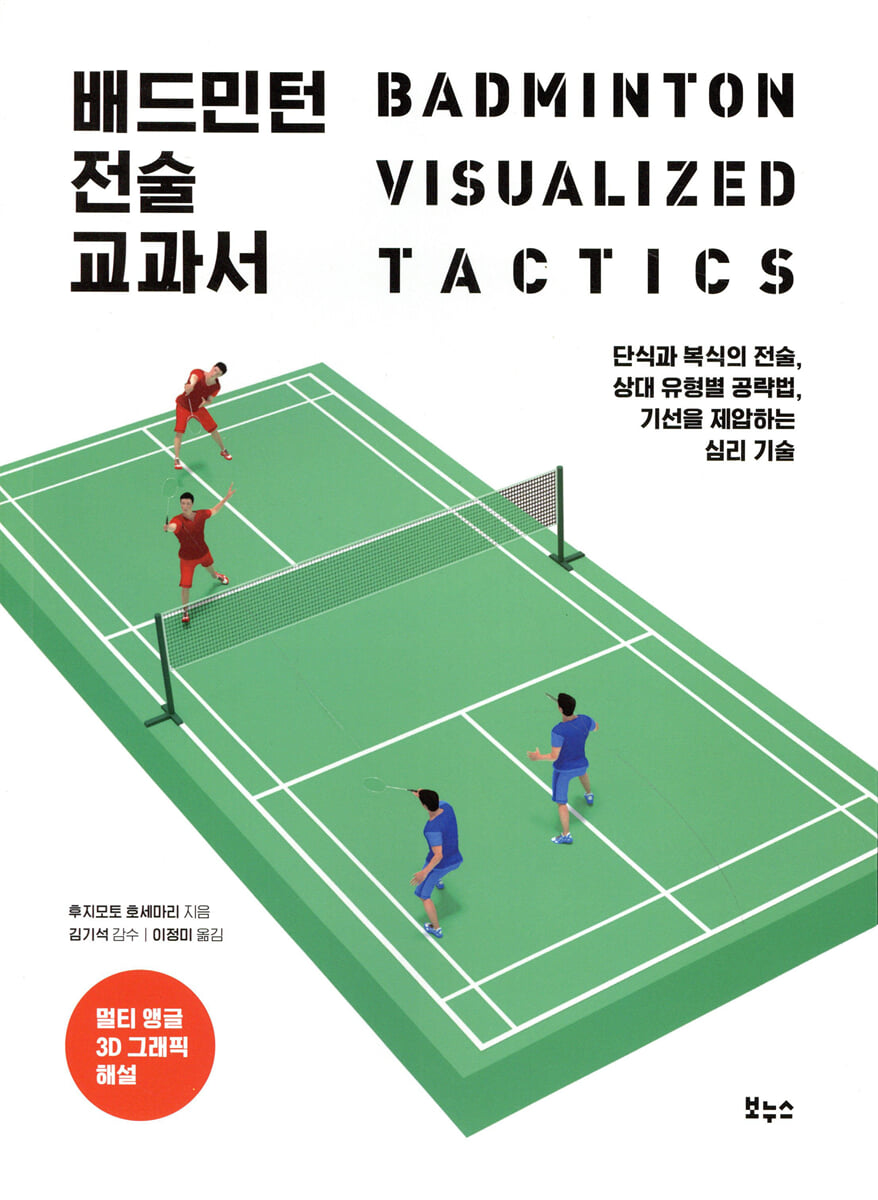
Badminton Tactics Textbook
 |
Description
Book Introduction
Should I smash or send a hairpin?
Core skills and best strategy and tactics lessons to dominate the court!
A strong smash aimed at the ace, a hairpin that induces the opponent's shot.
How to return a shuttlecock flying close to the racket to the opponent.
Badminton is a sport where the winner is decided by passing a shuttlecock back and forth between the players over a net.
Because this is not a fight you fight alone, it is important to understand your opponent and attack them.
To shake your opponent, you need to have the ability to not only hit the shot correctly, but also judge the speed and direction in which to send it.
This is why badminton requires strategy and tactics lessons.
Whether it's singles or doubles, create your own winning formula using the best strategy and tactics.
Core skills and best strategy and tactics lessons to dominate the court!
A strong smash aimed at the ace, a hairpin that induces the opponent's shot.
How to return a shuttlecock flying close to the racket to the opponent.
Badminton is a sport where the winner is decided by passing a shuttlecock back and forth between the players over a net.
Because this is not a fight you fight alone, it is important to understand your opponent and attack them.
To shake your opponent, you need to have the ability to not only hit the shot correctly, but also judge the speed and direction in which to send it.
This is why badminton requires strategy and tactics lessons.
Whether it's singles or doubles, create your own winning formula using the best strategy and tactics.
- You can preview some of the book's contents.
Preview
index
preface
How to use this book
Badminton Terminology Explained
How to Use a Single Shot
01 Basic Shot
02 Types of Clear
03 Types of Drop and Slice Drop
04 Types of Smash
05 Types of Under (Robe)
06 Types of hairpin (net shot)
07 Types of Cross Hairpins
08 Types of Push
09 Types of reception
10 Forehand Shot (Unfavorable Situation)
11 Back Shot (Unfavorable Situation)
12 Types of Half Shots
Chapter 2 Fasting Tactics
Basic tactics
13 Fasting mindset
14. Position on the court
15 Lead the flow with a forehand serve
16. Lead the flow with a backhand serve.
17 Lead the flow with service receive
18 Basic shots according to the situation
Practical tactics
19 Change your attack based on your opponent's posture.
20 Take advantage of the opponent's return habits.
21 Changes the timing of the hit
22 Detecting Poor Paint Underpainting
23 Attack by changing the angle of the smash
24 Not all smashes are full power
25 Shots that look like pushes
26 Hairpin hits the shuttlecock in the direction it is aimed at.
27 Split the hairpins into long hairpins and non-spin hairpins.
28 Drop diagonally
29 Overhead changes the timing
30 Creates a development that leads to a fierce second half scoring
Situational tactics
31. Dealing with doubles-style players
32 Countering Offensive Players
33 Dealing with Tall Players
34 Dealing with Defensive Players
35 Dealing with Left-Handed Players
Chapter 3: Doubles Tactics
Basic tactics
36 Doubles' way of thinking
37 Where the server and service receiver stand
38 Basic formation for 'Attack'
39 Basic Formation of 'Defense'
Leading the flow with 40 short services
41 Leading the flow with long service
42 Leading the flow with service receive: Short
43 Leading the flow with service receive: Long
44 Smash is basically straight
45 What to aim for in a center attack
46 The vanguard makes the match
Practical tactics
47 Focus on the area around the body
48 Attack the vertical line of the shoulder blade
49 Do not hit consecutively in places where there is a rear guard.
50 Cross Receive Practice
51 The vanguard moves in the direction the shuttlecock passes through.
52 I remember the course that received the receive.
Respond to block at 53 push height
54 The important thing about half shots is how they cross the net.
55 Use half to induce under
Situational tactics
56 When you can't form a confident formation
57 When your partner is not good at doubles
58 When the opponent does not hit under
59 When the opponent is left-handed
Chapter 4 Match Environment and Psychological Tactics
Collect information about the 60 coats
61 Reading the flow of the wind
62. The right mindset for the confrontational situation
63 Tactics to control the flow of the match
Use the 64 Game Analysis Sheet
Use the 65 Player Analysis Sheet
Search
How to use this book
Badminton Terminology Explained
How to Use a Single Shot
01 Basic Shot
02 Types of Clear
03 Types of Drop and Slice Drop
04 Types of Smash
05 Types of Under (Robe)
06 Types of hairpin (net shot)
07 Types of Cross Hairpins
08 Types of Push
09 Types of reception
10 Forehand Shot (Unfavorable Situation)
11 Back Shot (Unfavorable Situation)
12 Types of Half Shots
Chapter 2 Fasting Tactics
Basic tactics
13 Fasting mindset
14. Position on the court
15 Lead the flow with a forehand serve
16. Lead the flow with a backhand serve.
17 Lead the flow with service receive
18 Basic shots according to the situation
Practical tactics
19 Change your attack based on your opponent's posture.
20 Take advantage of the opponent's return habits.
21 Changes the timing of the hit
22 Detecting Poor Paint Underpainting
23 Attack by changing the angle of the smash
24 Not all smashes are full power
25 Shots that look like pushes
26 Hairpin hits the shuttlecock in the direction it is aimed at.
27 Split the hairpins into long hairpins and non-spin hairpins.
28 Drop diagonally
29 Overhead changes the timing
30 Creates a development that leads to a fierce second half scoring
Situational tactics
31. Dealing with doubles-style players
32 Countering Offensive Players
33 Dealing with Tall Players
34 Dealing with Defensive Players
35 Dealing with Left-Handed Players
Chapter 3: Doubles Tactics
Basic tactics
36 Doubles' way of thinking
37 Where the server and service receiver stand
38 Basic formation for 'Attack'
39 Basic Formation of 'Defense'
Leading the flow with 40 short services
41 Leading the flow with long service
42 Leading the flow with service receive: Short
43 Leading the flow with service receive: Long
44 Smash is basically straight
45 What to aim for in a center attack
46 The vanguard makes the match
Practical tactics
47 Focus on the area around the body
48 Attack the vertical line of the shoulder blade
49 Do not hit consecutively in places where there is a rear guard.
50 Cross Receive Practice
51 The vanguard moves in the direction the shuttlecock passes through.
52 I remember the course that received the receive.
Respond to block at 53 push height
54 The important thing about half shots is how they cross the net.
55 Use half to induce under
Situational tactics
56 When you can't form a confident formation
57 When your partner is not good at doubles
58 When the opponent does not hit under
59 When the opponent is left-handed
Chapter 4 Match Environment and Psychological Tactics
Collect information about the 60 coats
61 Reading the flow of the wind
62. The right mindset for the confrontational situation
63 Tactics to control the flow of the match
Use the 64 Game Analysis Sheet
Use the 65 Player Analysis Sheet
Search
Detailed image

Publisher's Review
The principles and secrets to leading the flow of winning a match
Shot utilization · Information gathering · Type-specific strategy · Taking the initiative · Flow guidance
Anyone can enjoy badminton, but not everyone can win.
To win a match, you need to understand the position and flow and choose the best shot.
When the momentum is strong and you are pushed to the back of the court, use a 'high clear' to send your opponent to the back of the court and reorganize your stance. When you want to win, use a series of 'pushes' to induce your opponent to make mistakes.
It is also important to know your opponent's information and attack them.
By figuring out your opponent's strong shots, weaknesses, and habits early in the match and using the information you've gathered from the middle of the match, you can control the flow of the match.
Whether it's singles or doubles, let's create our own winning pattern by applying the best strategy and tactics.
You will be able to face any match or opponent with confidence.
Clear, drop, smash, hairpin, push, etc.
You can learn how to use shots according to the situation.
To win a match, you need to understand the position and flow and choose the best shot.
When the momentum is strong and you are pushed to the back of the court, use a 'high clear' to send your opponent to the back of the court and reorganize your position. When you want to decide the outcome, use a series of 'pushes' to induce mistakes from your opponent.
The more shots you can hit, the more strategies and tactics you can utilize.
From the thoughts needed for fasting
Learn how to stand on the court, serve, and attack.
In singles, where you fight one-on-one, you have to guard a large court by yourself.
When developing a fasting strategy, there are three things to consider.
First, I analyze my condition.
The feeling and condition of hitting a shot are different every day, so you have to choose the right shot for each situation.
Second, understand your opponent.
If you know your opponent's strong shots or personality, you can block their special skills.
Finally, when the game is at stake, it brings the flow.
In the beginning of the match, the goal is to check each other's condition, and from the middle of the match, the goal is to push and pull with combined information to determine the winner.
Learn the key tactics to dominate the singles court.
The winning principles of doubles, the strengths and weaknesses of partners,
Understand the positions and roles of the vanguard and rearguard
Doubles, where two players fight against each other, has a much faster rally pace.
It is important to use tactics that shake up the opposing team by cooperating with your partner in each situation.
We need to determine the roles of front and back by understanding our partner's and our own strengths and weaknesses, and we need to communicate smoothly to achieve coordination.
It would be good to discuss not only whether to serve long or short, but also what range to pay attention to and prepare for in the fore or back during the game.
It is also important to create a rotation that does not leave any gaps for the opponent.
Let's understand the winning principles of doubles.
Information about the court needed for the match, wind flow,
Understand your mindset and tactics to match your opponent.
You can't use the same strategies and tactics every time.
This is because court information, such as wind direction, lighting location, and court floor, is different for each match.
If you warm up before the match and learn the court information clearly, you can control the direction and speed of your shots and even use the wind to attack during the match.
Also, if you analyze your opponent and adjust your condition from the day before the match, you will be able to maintain composure and lead the match as planned.
If you record the 'Game Analysis Sheet' and 'Player Analysis Sheet' in this book after the game, you will be able to use them for the next game.
Shot utilization · Information gathering · Type-specific strategy · Taking the initiative · Flow guidance
Anyone can enjoy badminton, but not everyone can win.
To win a match, you need to understand the position and flow and choose the best shot.
When the momentum is strong and you are pushed to the back of the court, use a 'high clear' to send your opponent to the back of the court and reorganize your stance. When you want to win, use a series of 'pushes' to induce your opponent to make mistakes.
It is also important to know your opponent's information and attack them.
By figuring out your opponent's strong shots, weaknesses, and habits early in the match and using the information you've gathered from the middle of the match, you can control the flow of the match.
Whether it's singles or doubles, let's create our own winning pattern by applying the best strategy and tactics.
You will be able to face any match or opponent with confidence.
Clear, drop, smash, hairpin, push, etc.
You can learn how to use shots according to the situation.
To win a match, you need to understand the position and flow and choose the best shot.
When the momentum is strong and you are pushed to the back of the court, use a 'high clear' to send your opponent to the back of the court and reorganize your position. When you want to decide the outcome, use a series of 'pushes' to induce mistakes from your opponent.
The more shots you can hit, the more strategies and tactics you can utilize.
From the thoughts needed for fasting
Learn how to stand on the court, serve, and attack.
In singles, where you fight one-on-one, you have to guard a large court by yourself.
When developing a fasting strategy, there are three things to consider.
First, I analyze my condition.
The feeling and condition of hitting a shot are different every day, so you have to choose the right shot for each situation.
Second, understand your opponent.
If you know your opponent's strong shots or personality, you can block their special skills.
Finally, when the game is at stake, it brings the flow.
In the beginning of the match, the goal is to check each other's condition, and from the middle of the match, the goal is to push and pull with combined information to determine the winner.
Learn the key tactics to dominate the singles court.
The winning principles of doubles, the strengths and weaknesses of partners,
Understand the positions and roles of the vanguard and rearguard
Doubles, where two players fight against each other, has a much faster rally pace.
It is important to use tactics that shake up the opposing team by cooperating with your partner in each situation.
We need to determine the roles of front and back by understanding our partner's and our own strengths and weaknesses, and we need to communicate smoothly to achieve coordination.
It would be good to discuss not only whether to serve long or short, but also what range to pay attention to and prepare for in the fore or back during the game.
It is also important to create a rotation that does not leave any gaps for the opponent.
Let's understand the winning principles of doubles.
Information about the court needed for the match, wind flow,
Understand your mindset and tactics to match your opponent.
You can't use the same strategies and tactics every time.
This is because court information, such as wind direction, lighting location, and court floor, is different for each match.
If you warm up before the match and learn the court information clearly, you can control the direction and speed of your shots and even use the wind to attack during the match.
Also, if you analyze your opponent and adjust your condition from the day before the match, you will be able to maintain composure and lead the match as planned.
If you record the 'Game Analysis Sheet' and 'Player Analysis Sheet' in this book after the game, you will be able to use them for the next game.
GOODS SPECIFICS
- Publication date: April 25, 2022
- Page count, weight, size: 160 pages | 512g | 188*257*13mm
- ISBN13: 9788964945469
- ISBN10: 8964945468
You may also like
카테고리
korean


korean

![GQ KOREA Mark (Monthly): December [2025]](http://librairie.coreenne.fr/cdn/shop/files/8ef265dbbfbf186523ed75ba7319009d.jpg?v=1765340328&width=3840)


