

Anyway, knitting
 |
Description
Book Introduction
I can confidently say that it wasn't books that changed my life, it was knitting!
A Reclusive Translator's Vast Knitting Universe Drift
Anyway, the thirty-seventh book in the series, “Anyway, Knitting,” is translator Serami’s first collection of prose.
The author's unquenchable love of knitting, which translates the value of one page of manuscript paper into a ball of 100% organic cotton yarn or two crochet hooks with silicone handles, is fully captured in this book.
Like a knitting needle that can only be knitted one stitch at a time, the colorful stories woven together meticulously, stitch by stitch, beautifully shatter the prejudices surrounding the act we commonly call “knitting.”
The author begins with the insight that “knitting is a translation done with thread,” and as she unravels the tangled threads, she reflects on the relationships with others that are difficult to untangle, and also contemplates the essence of the frame of “femininity” that is superimposed on knitting.
If you follow the path laid out by the thread and needle from the first stitch to the last, you will find yourself leisurely drifting through the vast universe of 'knitting' and even the vast world of 'life'.
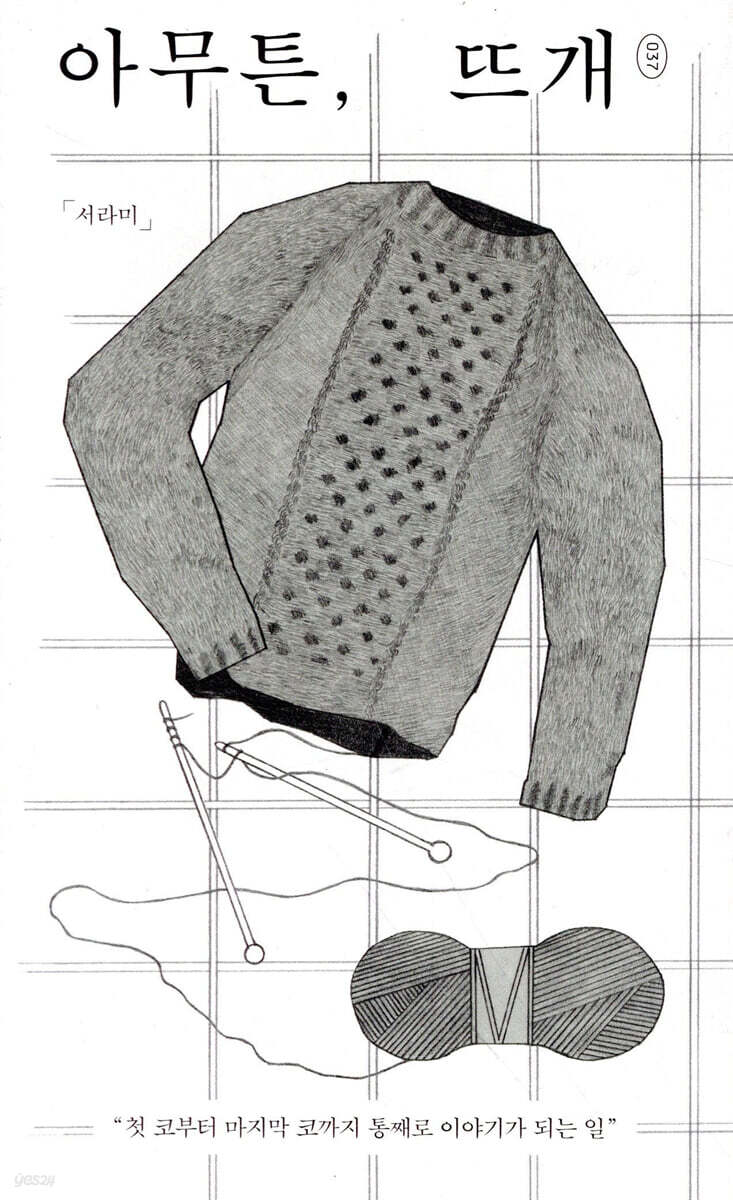
The pattern included at the end of the book, allowing readers to actually knit the Aran patterned raglan sweater featured on the cover, is a loving gift from the author to the knitters of this land.
A Reclusive Translator's Vast Knitting Universe Drift
Anyway, the thirty-seventh book in the series, “Anyway, Knitting,” is translator Serami’s first collection of prose.
The author's unquenchable love of knitting, which translates the value of one page of manuscript paper into a ball of 100% organic cotton yarn or two crochet hooks with silicone handles, is fully captured in this book.
Like a knitting needle that can only be knitted one stitch at a time, the colorful stories woven together meticulously, stitch by stitch, beautifully shatter the prejudices surrounding the act we commonly call “knitting.”
The author begins with the insight that “knitting is a translation done with thread,” and as she unravels the tangled threads, she reflects on the relationships with others that are difficult to untangle, and also contemplates the essence of the frame of “femininity” that is superimposed on knitting.
If you follow the path laid out by the thread and needle from the first stitch to the last, you will find yourself leisurely drifting through the vast universe of 'knitting' and even the vast world of 'life'.
The pattern included at the end of the book, allowing readers to actually knit the Aran patterned raglan sweater featured on the cover, is a loving gift from the author to the knitters of this land.
- You can preview some of the book's contents.
Preview
index
You've never tried knitting before.
Knitting is a translation of yarn.
The universe of knitting
Willingly, carelessly, distractingly
untangling a tangled thread
Self-Divisive Knitting and the Proof of Existence
Unexpected knit
The real name of the donut
Missiles and Knitting
Read Zimmerman
If you have Zico, you will win every battle
knitting men
Monica Craft Shop
knitting class
Knitters of the world, unite!
I wish you could knit
Appendix: Knitting the Aran-patterned Raglan Sweater from the Cover
Knitting is a translation of yarn.
The universe of knitting
Willingly, carelessly, distractingly
untangling a tangled thread
Self-Divisive Knitting and the Proof of Existence
Unexpected knit
The real name of the donut
Missiles and Knitting
Read Zimmerman
If you have Zico, you will win every battle
knitting men
Monica Craft Shop
knitting class
Knitters of the world, unite!
I wish you could knit
Appendix: Knitting the Aran-patterned Raglan Sweater from the Cover
Detailed image

Into the book
So, how has knitting changed my life? In short, thanks to knitting, I've become a more comfortable person.
A person who is easygoing… .
Let me put it a little differently.
I relaxed.
I stopped being impatient and learned how to wait.
Above all, I learned how to live without any effort.
It sounds simple, but it's by no means easy.
We all want to be recognized, and we sway endlessly like autumn cosmos in the face of others' evaluations, yet we pretend to be calm and tense our shoulders, so our trapezius muscles are always tense.
If becoming a more comfortable person were something anyone could do if they just put their mind to it, it would be inexplicable why bookstores are flooded with psychological healing essays and why so many people seek out therapists.
--- From "You've never knitted before"
When I was an aspiring translator, it was very important for me to open a book and look at the translator's profile.
Nowadays, there is a trend to prefer a resume that reveals the translator's personality, but until 10 years ago, it was customary to list the university and department from which the translator graduated, and if they studied abroad, the name of the foreign university, followed by a long list of titles of the books they translated.
Most of the people who translated the books I liked were either from SKY universities, had foreign degrees, or both.
Otherwise, he is a university professor or at least has a PhD.
Just as Keichiro Hirano felt hopeful when he saw famous authors who majored in law, I despaired when I saw the profiles of translators with advanced degrees.
It seemed like I would never be able to overcome the barrier to entry, which seemed as high as the one in the manga "Attack on Titan."
Still, I enjoyed reading foreign languages and felt a love for translating them into Korean.
In 2011, I applied to almost every translator job posting with the mindset of a salesperson, and luckily, I landed a contract for my first book.
However, the translator's name printed on the published book was not mine, but that of an environmental organization.
--- From "Knitting is a translation done with thread"
A person who loves something has his own universe.
There are values and times that can only be known when floating in space.
From Earth, it may seem like we're drifting endlessly, a vast distance beyond our ability to estimate how far we have to go in any particular direction. However, those who traverse the universe in person spend their entire days with the sole goal of approaching their destination according to a meticulously calculated schedule.
Days like that accumulate to become the moon and the sun.
--- From "The Universe of Knitting"
One thing I realized while living in society is that most people don't really care about other people's business, but there were times when I met people who were as nosy as beans in a drought.
I simply told him what I had been doing, and he asked, “So what do you want to do?” and urged me to narrow down my interests, which I had never been able to narrow down in my entire life.
At that time, I didn't know much about the world and naturally blamed my personality.
Why can't I like just one thing like other people?
But now I know.
The problem was his attitude that forced me to choose one thing.
The fact that I had to confidently answer, “I’m currently doing translation work that I’ve wanted to do for a long time, and I’m also preparing to do other things that I like.”
--- From "Willingly, Distractively, Unhesitatingly"
I also had another experience of feeling cognitive dissonance within myself while knitting.
When I first started knitting, the reactions of people around me who found out I knitted were usually similar.
“Why do you do that?” I guess it’s because people know me as being far from feminine, while knitting, as they know it, is a very feminine hobby.
While I was knitting, I often had a strange thought: I wondered if I was even allowed to knit, and the reason for that strange thought was that I was doing something that helped solidify gender bias.
Even if that were the case, I wouldn't stop knitting.
Because it was too much fun to do that.
But the more I knitted, the more curious I became.
Why are there so many guilt-inducing elements to knitting?
No hobby I've ever had has been so self-destructive.
How did knitting become a hobby enjoyed only by women in the first place?
Why can't I just enjoy knitting?
--- From "Self-Divisive Knitting and the Proof of Existence"
That day's episode of "What Do You Do When You Play?" featured the couple Lee Hyo-ri and Lee Sang-soon, who came from Jeju, tasting Yoo Jae-suk's Yoo San-seul Ramen and chatting about various things.
When singer Lee Hyo-ri, known for her straightforward speaking style, responded to Yoo Jae-suk's words warmly, which was unusual for her usual style, Yoo Jae-suk burst into laughter and asked,
“Why is it so warm today?” And Lee Hyo-ri’s answer.
“Wear a knit.” In fact, that day, Hyori Lee was wearing a light oatmeal-colored turtleneck knit, and as she answered awkwardly, the caption “Nothing to say” appeared next to her face.
Hmm… I wonder what he meant.
I thought that perhaps there was no one among the production staff of “What Do You Do When You Play?” who enjoyed knitting.
It seemed clear that at least no one knew the advantages of knitwear.
--- From "Unexpected Knit"
Could the use of symbolic designs in Korea and Japan be related to the female illiteracy rate?
What was the female literacy rate in the East and West in the early 1900s when knitting began to spread in our country?
Although patriarchy was still prevalent in the West at the time, there were recognized female writers like Jane Austen and Virginia Woolf, which means there was a market of female readers who read their novels.
On the other hand, the situation in the East was not easy.
It is said that the female illiteracy rate in Joseon in the 1930s reached 92%.
There would have been no market for female writers, let alone female writers.
At that time, Japan's female illiteracy rate would not have been any different from ours.
--- From "The Real Name of the Donut"
The amount of time you've loved something isn't directly proportional to how much you love it, and there's no standard for how much you need to know to write a book about it. But every time I realize that I've been given the good fortune to write about knitting, I feel ashamed before the countless knitters in front of me.
If you ask someone who has been knitting for a long time what they get out of knitting, what would they say?
He may have gained excellent knitting skills and peace of mind, and through them he may have developed good relationships and achieved business success.
But rather than that, wouldn't it be better to say that knitting is natural and good?
I like the time I get buried in yarn and knitting.
I've never thought about anything other than knitting.
Like George Mallory, who when asked why he climbed Everest said, “Because the mountain was there,” you might simply say, “Because I had a needle and thread.”
Compared to those who have been knitting for a long time in the deep sea, unaffected by sunlight, wind, or buoyancy, my admiration for knitting is like waves crashing and swaying on the surface, making all kinds of noise.
--- From "Reading Zimmerman"
I thought I was a comfortable knitter.
I thought, if your goal is to knit perfectly smooth fabrics that look like they were knitted by a machine, why bother going to the store and buying them instead?
So I overlooked most mistakes and didn't take them off unless they were too bad to wear.
Now I think about it.
Maybe he was wrong and didn't know he was wrong.
Or weren't there times when you knew it couldn't be fixed and deliberately pretended not to know?
Maybe I was rationalizing that I didn't want to be perfect.
Those who strive for perfect knitting are not obsessive, but rather strive to complete a piece that is as close to their intentions as possible.
I now realize that the reason they were able to boldly unravel the knitted fabric they were knitting was because they could pinpoint exactly where the mistakes were and correct them.
--- From "If you are a Zico, you will win every battle"
If the loom had never been invented and knitting had been a gender-neutral activity, if there were still many men who knitted for a living, we might by now have known a few of the world's greatest knitters, or perhaps we'd be spending the year anticipating who would receive the award given annually for their contributions to the advancement of knitting culture.
Each country may have a government department that promotes knitting culture, a research institute that studies the past and future of knitting, and a culture that honors knitters by adding the letters '사' or '가'.
But what can I do?
There are no ifs in history.
--- From "The Knitting Men"
For some time now, whenever I knit, I have one scene in my head.
It is a scene where countless thoughts that were trapped in the brain and causing a commotion come out of the fingertips and walk in a line on a thin needle.
Knitting doesn't solve the problem.
It doesn't even give you an answer to your worries.
It just brings order to the inside.
I think knitting is something that allows you to forget the thoughts that come running through your fingertips, if they are nothing, and gives you the strength to focus on something you need to tackle.
At least that's how it was for me.
The courage to tackle the challenges I had to face, the foolishness to shake off my debilitating doubts, were all possible after I started knitting.
A person who is easygoing… .
Let me put it a little differently.
I relaxed.
I stopped being impatient and learned how to wait.
Above all, I learned how to live without any effort.
It sounds simple, but it's by no means easy.
We all want to be recognized, and we sway endlessly like autumn cosmos in the face of others' evaluations, yet we pretend to be calm and tense our shoulders, so our trapezius muscles are always tense.
If becoming a more comfortable person were something anyone could do if they just put their mind to it, it would be inexplicable why bookstores are flooded with psychological healing essays and why so many people seek out therapists.
--- From "You've never knitted before"
When I was an aspiring translator, it was very important for me to open a book and look at the translator's profile.
Nowadays, there is a trend to prefer a resume that reveals the translator's personality, but until 10 years ago, it was customary to list the university and department from which the translator graduated, and if they studied abroad, the name of the foreign university, followed by a long list of titles of the books they translated.
Most of the people who translated the books I liked were either from SKY universities, had foreign degrees, or both.
Otherwise, he is a university professor or at least has a PhD.
Just as Keichiro Hirano felt hopeful when he saw famous authors who majored in law, I despaired when I saw the profiles of translators with advanced degrees.
It seemed like I would never be able to overcome the barrier to entry, which seemed as high as the one in the manga "Attack on Titan."
Still, I enjoyed reading foreign languages and felt a love for translating them into Korean.
In 2011, I applied to almost every translator job posting with the mindset of a salesperson, and luckily, I landed a contract for my first book.
However, the translator's name printed on the published book was not mine, but that of an environmental organization.
--- From "Knitting is a translation done with thread"
A person who loves something has his own universe.
There are values and times that can only be known when floating in space.
From Earth, it may seem like we're drifting endlessly, a vast distance beyond our ability to estimate how far we have to go in any particular direction. However, those who traverse the universe in person spend their entire days with the sole goal of approaching their destination according to a meticulously calculated schedule.
Days like that accumulate to become the moon and the sun.
--- From "The Universe of Knitting"
One thing I realized while living in society is that most people don't really care about other people's business, but there were times when I met people who were as nosy as beans in a drought.
I simply told him what I had been doing, and he asked, “So what do you want to do?” and urged me to narrow down my interests, which I had never been able to narrow down in my entire life.
At that time, I didn't know much about the world and naturally blamed my personality.
Why can't I like just one thing like other people?
But now I know.
The problem was his attitude that forced me to choose one thing.
The fact that I had to confidently answer, “I’m currently doing translation work that I’ve wanted to do for a long time, and I’m also preparing to do other things that I like.”
--- From "Willingly, Distractively, Unhesitatingly"
I also had another experience of feeling cognitive dissonance within myself while knitting.
When I first started knitting, the reactions of people around me who found out I knitted were usually similar.
“Why do you do that?” I guess it’s because people know me as being far from feminine, while knitting, as they know it, is a very feminine hobby.
While I was knitting, I often had a strange thought: I wondered if I was even allowed to knit, and the reason for that strange thought was that I was doing something that helped solidify gender bias.
Even if that were the case, I wouldn't stop knitting.
Because it was too much fun to do that.
But the more I knitted, the more curious I became.
Why are there so many guilt-inducing elements to knitting?
No hobby I've ever had has been so self-destructive.
How did knitting become a hobby enjoyed only by women in the first place?
Why can't I just enjoy knitting?
--- From "Self-Divisive Knitting and the Proof of Existence"
That day's episode of "What Do You Do When You Play?" featured the couple Lee Hyo-ri and Lee Sang-soon, who came from Jeju, tasting Yoo Jae-suk's Yoo San-seul Ramen and chatting about various things.
When singer Lee Hyo-ri, known for her straightforward speaking style, responded to Yoo Jae-suk's words warmly, which was unusual for her usual style, Yoo Jae-suk burst into laughter and asked,
“Why is it so warm today?” And Lee Hyo-ri’s answer.
“Wear a knit.” In fact, that day, Hyori Lee was wearing a light oatmeal-colored turtleneck knit, and as she answered awkwardly, the caption “Nothing to say” appeared next to her face.
Hmm… I wonder what he meant.
I thought that perhaps there was no one among the production staff of “What Do You Do When You Play?” who enjoyed knitting.
It seemed clear that at least no one knew the advantages of knitwear.
--- From "Unexpected Knit"
Could the use of symbolic designs in Korea and Japan be related to the female illiteracy rate?
What was the female literacy rate in the East and West in the early 1900s when knitting began to spread in our country?
Although patriarchy was still prevalent in the West at the time, there were recognized female writers like Jane Austen and Virginia Woolf, which means there was a market of female readers who read their novels.
On the other hand, the situation in the East was not easy.
It is said that the female illiteracy rate in Joseon in the 1930s reached 92%.
There would have been no market for female writers, let alone female writers.
At that time, Japan's female illiteracy rate would not have been any different from ours.
--- From "The Real Name of the Donut"
The amount of time you've loved something isn't directly proportional to how much you love it, and there's no standard for how much you need to know to write a book about it. But every time I realize that I've been given the good fortune to write about knitting, I feel ashamed before the countless knitters in front of me.
If you ask someone who has been knitting for a long time what they get out of knitting, what would they say?
He may have gained excellent knitting skills and peace of mind, and through them he may have developed good relationships and achieved business success.
But rather than that, wouldn't it be better to say that knitting is natural and good?
I like the time I get buried in yarn and knitting.
I've never thought about anything other than knitting.
Like George Mallory, who when asked why he climbed Everest said, “Because the mountain was there,” you might simply say, “Because I had a needle and thread.”
Compared to those who have been knitting for a long time in the deep sea, unaffected by sunlight, wind, or buoyancy, my admiration for knitting is like waves crashing and swaying on the surface, making all kinds of noise.
--- From "Reading Zimmerman"
I thought I was a comfortable knitter.
I thought, if your goal is to knit perfectly smooth fabrics that look like they were knitted by a machine, why bother going to the store and buying them instead?
So I overlooked most mistakes and didn't take them off unless they were too bad to wear.
Now I think about it.
Maybe he was wrong and didn't know he was wrong.
Or weren't there times when you knew it couldn't be fixed and deliberately pretended not to know?
Maybe I was rationalizing that I didn't want to be perfect.
Those who strive for perfect knitting are not obsessive, but rather strive to complete a piece that is as close to their intentions as possible.
I now realize that the reason they were able to boldly unravel the knitted fabric they were knitting was because they could pinpoint exactly where the mistakes were and correct them.
--- From "If you are a Zico, you will win every battle"
If the loom had never been invented and knitting had been a gender-neutral activity, if there were still many men who knitted for a living, we might by now have known a few of the world's greatest knitters, or perhaps we'd be spending the year anticipating who would receive the award given annually for their contributions to the advancement of knitting culture.
Each country may have a government department that promotes knitting culture, a research institute that studies the past and future of knitting, and a culture that honors knitters by adding the letters '사' or '가'.
But what can I do?
There are no ifs in history.
--- From "The Knitting Men"
For some time now, whenever I knit, I have one scene in my head.
It is a scene where countless thoughts that were trapped in the brain and causing a commotion come out of the fingertips and walk in a line on a thin needle.
Knitting doesn't solve the problem.
It doesn't even give you an answer to your worries.
It just brings order to the inside.
I think knitting is something that allows you to forget the thoughts that come running through your fingertips, if they are nothing, and gives you the strength to focus on something you need to tackle.
At least that's how it was for me.
The courage to tackle the challenges I had to face, the foolishness to shake off my debilitating doubts, were all possible after I started knitting.
--- From "I wish you could knit"
GOODS SPECIFICS
- Publication date: November 27, 2020
- Page count, weight, size: 208 pages | 182g | 110*178*12mm
- ISBN13: 9791188343379
- ISBN10: 1188343378
You may also like
카테고리
korean


korean

![ELLE 엘르 스페셜 에디션 A형 : 12월 [2025]](http://librairie.coreenne.fr/cdn/shop/files/b8e27a3de6c9538896439686c6b0e8fb.jpg?v=1766436872&width=3840)


