

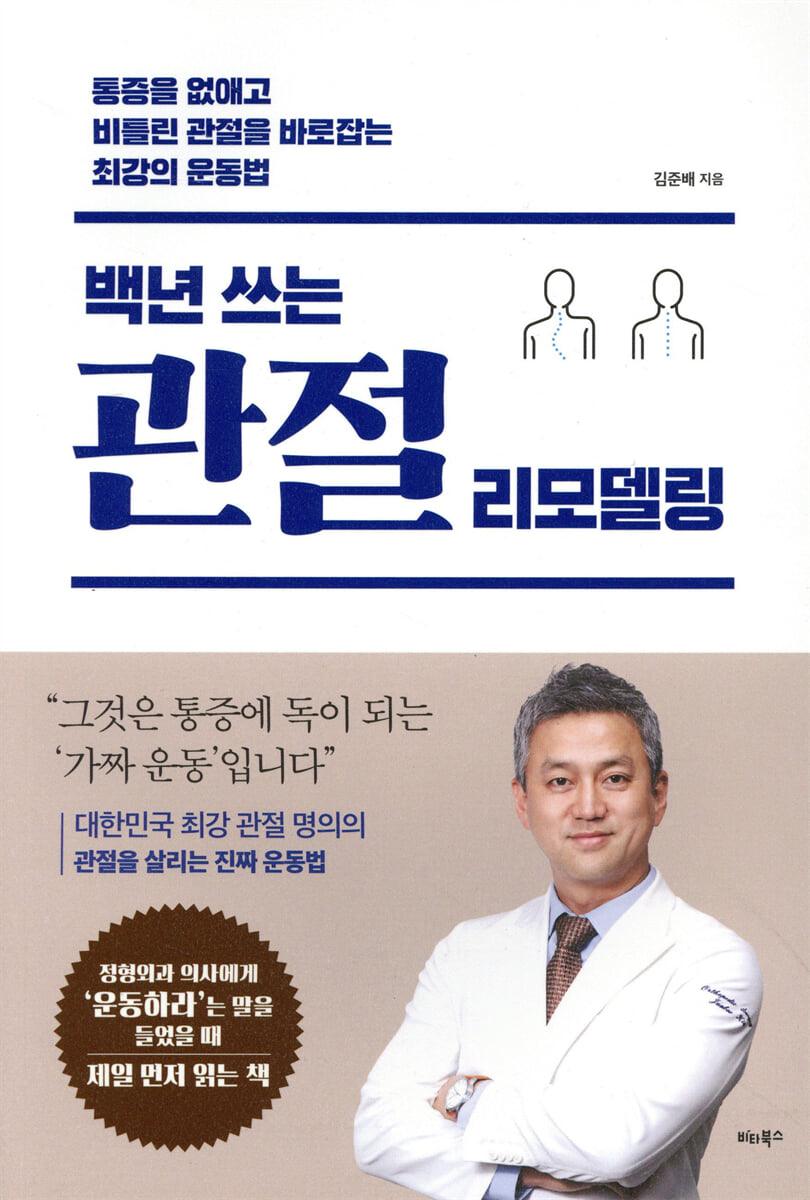
Remodeling joints that last a century
 |
Description
Book Introduction
“It’s a ‘fake workout’ that’s poisonous to pain!”
The 'real' joint-saving exercise method from Korea's best joint specialist
This book is a national guide to joint health that tells countless patients who have been told by their doctors to "exercise" but have no idea what to do, "what," "when," "how," and "why" to do exercise.
In fact, many patients with joint disease suffer from greater pain or develop a vague hostility toward exercise because they started exercising blindly based only on the advice of those around them or recommendations from TV programs.
Even though everyone tells us to exercise and we know it's necessary, we end up waiting for the doctor's prescription as our distrust of exercise grows.
Director Kim Jun-bae says that you need to move your body directly to restore the proper joint condition and build muscle strength through consistent training.
It is emphasized that exercise is the most important treatment, and that true cure can be achieved only when you do 'real' exercise that suits your symptoms.
The exercise doesn't necessarily have to be difficult or complicated.
In fact, all of the joint exercises the author introduces are very easy and simple enough for anyone to follow.
But the effect is certain.
This is because, based on all the know-how gained through countless experiences treating and encountering various patients in the field for over 30 years, only the simplest yet most effective movements were selected.
The book explains all the joints that make up the entire body, from the knees, which are the most common area for arthritis, to the neck and back that everyone in the modern world has problems with, to the ankles and feet that everyone has sprained at least once, to the pelvis, which is responsible for the center of the entire body, to the shoulders, which account for a significant portion of geriatric diseases, and to the elbows, wrists, and hand joints that have a fatal impact on simple daily life, and introduces frequently occurring diseases in each area and methods to prevent and treat them.
Above all, it is noteworthy that the correct exercise method is introduced in detail according to the disease and the presence or absence of pain, as it points out that exercise that does not match the symptoms can actually be toxic to joint health.
It helps readers select and practice movements that fit their own situations.
Additionally, a page has been created to address the public's questions about orthopedic treatment, further helping to increase public understanding of joint health.
This book addresses various questions that readers have been unable to ask the hospital, such as what does the diagnosis of "going to physical therapy" from an orthopedic surgeon mean, and how long does "rest" mean when a doctor says to rest? This book resolves readers' curiosity.
If just one joint in our body is out of alignment, our entire body will collapse.
This is why ‘joint remodeling’ to correct misaligned joints is absolutely necessary.
Anyone can return to a healthy state before getting sick by consistently practicing the simple but accurate 'real' exercises introduced in "Joint Remodeling for a Hundred Years."
The 'real' joint-saving exercise method from Korea's best joint specialist
This book is a national guide to joint health that tells countless patients who have been told by their doctors to "exercise" but have no idea what to do, "what," "when," "how," and "why" to do exercise.
In fact, many patients with joint disease suffer from greater pain or develop a vague hostility toward exercise because they started exercising blindly based only on the advice of those around them or recommendations from TV programs.
Even though everyone tells us to exercise and we know it's necessary, we end up waiting for the doctor's prescription as our distrust of exercise grows.
Director Kim Jun-bae says that you need to move your body directly to restore the proper joint condition and build muscle strength through consistent training.
It is emphasized that exercise is the most important treatment, and that true cure can be achieved only when you do 'real' exercise that suits your symptoms.
The exercise doesn't necessarily have to be difficult or complicated.
In fact, all of the joint exercises the author introduces are very easy and simple enough for anyone to follow.
But the effect is certain.
This is because, based on all the know-how gained through countless experiences treating and encountering various patients in the field for over 30 years, only the simplest yet most effective movements were selected.
The book explains all the joints that make up the entire body, from the knees, which are the most common area for arthritis, to the neck and back that everyone in the modern world has problems with, to the ankles and feet that everyone has sprained at least once, to the pelvis, which is responsible for the center of the entire body, to the shoulders, which account for a significant portion of geriatric diseases, and to the elbows, wrists, and hand joints that have a fatal impact on simple daily life, and introduces frequently occurring diseases in each area and methods to prevent and treat them.
Above all, it is noteworthy that the correct exercise method is introduced in detail according to the disease and the presence or absence of pain, as it points out that exercise that does not match the symptoms can actually be toxic to joint health.
It helps readers select and practice movements that fit their own situations.
Additionally, a page has been created to address the public's questions about orthopedic treatment, further helping to increase public understanding of joint health.
This book addresses various questions that readers have been unable to ask the hospital, such as what does the diagnosis of "going to physical therapy" from an orthopedic surgeon mean, and how long does "rest" mean when a doctor says to rest? This book resolves readers' curiosity.
If just one joint in our body is out of alignment, our entire body will collapse.
This is why ‘joint remodeling’ to correct misaligned joints is absolutely necessary.
Anyone can return to a healthy state before getting sick by consistently practicing the simple but accurate 'real' exercises introduced in "Joint Remodeling for a Hundred Years."
- You can preview some of the book's contents.
Preview
index
Prologue ∥ Exercise is the best medicine
PART1.
How did pain become a chronic disease?
: Are you still self-diagnosing and self-treating today?
: A world that recommends unnecessary surgery
: Orthopedic medicines and injections are not poisonous.
: I don't want to get shots vs.
Give me a shot!
: Does artificial joint surgery create a new joint?
: Knowing what hurts you and not fixing it
: Joints are gradually damaged in daily life.
: What efforts did you make after leaving the hospital and going home?
-Q&A: Misconceptions and Truths About Orthopedic Treatment
Q_What does 'Please go get some physical therapy' mean?
Q_How much rest should I take when the doctor tells me to rest?
Q_Is the treatment I am receiving over-treatment?
Q_Why do doctors prescribe different medications?
Q_How many weeks of taking medication is it okay for my health?
-PLUS PAGE_When you're sick, be like a baby, and when you don't want to be sick, be like an adult!
PART2.
Joint remodeling that lasts a lifetime
: Why do orthopedic surgeons always tell us to exercise?
: The most important treatment is exercise.
: You must overcome your congenital 'dislike of exercise'.
: “If you’re not going to exercise, don’t come to the hospital!”
: “It’s a fake movement”
-PLUS PAGE_3 Principles of Exercise According to an Orthopedic Surgeon
: Exercises that are bad for your joints vs.
Exercises that benefit your joints
: Weakened muscles do not grow back on their own.
: Be sure to ask your orthopedic surgeon about when and how to exercise.
: The best exercise is the easy one that everyone knows.
-PLUS PAGE_An Orthopedic Surgeon's Acute Back Pain Recovery Story
-PLUS PAGE_Misunderstood Exercise Stories
PART3.
Knee joint remodeling
: 3 safety devices to protect your knee joints
: The deeper you bend, the more poisonous it is to your joints!
: Strong thighs protect the knee joints.
: Knee joint disease
_Anterior pain syndrome
_Degenerative osteoarthritis
Tendinitis (quadriceps tendonitis, goose heel tendonitis, patellar tendonitis, iliotibial band syndrome)
_Meniscus tear
_Damage and rupture of knee ligaments
-PLUS PAGE_What if there is a noise from the knee?!
: Knee joint remodeling
_Sit on a chair and stretch your legs
_Crack an egg with your forearm while sitting down
_Lift one leg while lying down
_Lying on your side and lifting your legs
_Sitting on a transparent chair (squat)
PART4.
Neck and waist joint remodeling
: The S-curve of the spine is the lifeline
: The longer you sit, the more your spine becomes sick.
: Bending back and walking are key to spinal health.
: Neck and back joint diseases
_Degenerative disc
_Cervical disc (herniated disc)
_Herniated disc (disk herniation)
_Spinal stenosis
: Neck and waist joint remodeling
_Neck stretch in all directions
_Stretching while leaning back
_Holding on with your neck stretched out in all directions
Strengthening your hip muscles
_Stand upright with your back against the wall
PART5.
Shoulder joint remodeling
: The moment you let your guard down, your shoulder becomes a general hospital.
: Correct posture is essential for the shoulder joint.
: Stand with angel wings!
: Shoulder joint disease
_Frozen shoulder (adhesive capsulitis)
Rotator Cuff Injuries: From Shoulder Impingement Syndrome to Tendon Ruptures
_Calcific tendonitis
_Myofascial pain syndrome
_CHECK BOX_Is it your shoulder or your neck that hurts?
: Shoulder joint remodeling
_Front shoulder stretch
_Shoulder external rotation stretching
_Shoulder internal rotation stretching
Stretching using the corner of a wall
Strengthening the rotator cuff
_Angel Wings Exercise
PART6.
Elbow, Wrist, and Hand Joint Remodeling
: Most of the time, overuse is the problem.
: Elbow, wrist, and hand joint diseases
_Wrist tendonitis (De Quervain's disease), trigger finger, carpal tunnel syndrome
_Elbow: Tennis elbow, golf elbow
_Degenerative osteoarthritis
: Elbow, wrist, and hand joint remodeling
_Tennis elbow
_Golf Elbow
_Bend your fingers
_Spread your fingers
_Holding the rubber ball
PART7.
Ankle and foot joint remodeling
: The foot and ankle are structurally strong joints
: First of all, walk with correct posture!
: Ankle and foot joint diseases
Ankle Ligament Injuries: From Sprains to Ankle Instability Syndrome
_Plantar fasciitis, Achilles tendonitis
_Hallux valgus
: Ankle and foot joint remodeling
_Calf Stretch
_Calf muscle strengthening exercises
_Stretching the muscles of the soles of the feet
_Foot plantar muscle strengthening exercises
PART8.
Pelvic joint remodeling
: The center of our body that connects the spine and legs
: Pelvic position affects spinal health
: Pelvic joint disease
_Hip bursitis
_Myofascial pain syndrome
_Calcific tendonitis
: Pelvic joint remodeling
Stretching the front psoas muscle of the pelvis
Stretching the piriformis muscle
_Hip abductor stretch
_Releasing the butt muscles with a tennis ball
_ Exercises to strengthen the muscles around the hip joint
PART1.
How did pain become a chronic disease?
: Are you still self-diagnosing and self-treating today?
: A world that recommends unnecessary surgery
: Orthopedic medicines and injections are not poisonous.
: I don't want to get shots vs.
Give me a shot!
: Does artificial joint surgery create a new joint?
: Knowing what hurts you and not fixing it
: Joints are gradually damaged in daily life.
: What efforts did you make after leaving the hospital and going home?
-Q&A: Misconceptions and Truths About Orthopedic Treatment
Q_What does 'Please go get some physical therapy' mean?
Q_How much rest should I take when the doctor tells me to rest?
Q_Is the treatment I am receiving over-treatment?
Q_Why do doctors prescribe different medications?
Q_How many weeks of taking medication is it okay for my health?
-PLUS PAGE_When you're sick, be like a baby, and when you don't want to be sick, be like an adult!
PART2.
Joint remodeling that lasts a lifetime
: Why do orthopedic surgeons always tell us to exercise?
: The most important treatment is exercise.
: You must overcome your congenital 'dislike of exercise'.
: “If you’re not going to exercise, don’t come to the hospital!”
: “It’s a fake movement”
-PLUS PAGE_3 Principles of Exercise According to an Orthopedic Surgeon
: Exercises that are bad for your joints vs.
Exercises that benefit your joints
: Weakened muscles do not grow back on their own.
: Be sure to ask your orthopedic surgeon about when and how to exercise.
: The best exercise is the easy one that everyone knows.
-PLUS PAGE_An Orthopedic Surgeon's Acute Back Pain Recovery Story
-PLUS PAGE_Misunderstood Exercise Stories
PART3.
Knee joint remodeling
: 3 safety devices to protect your knee joints
: The deeper you bend, the more poisonous it is to your joints!
: Strong thighs protect the knee joints.
: Knee joint disease
_Anterior pain syndrome
_Degenerative osteoarthritis
Tendinitis (quadriceps tendonitis, goose heel tendonitis, patellar tendonitis, iliotibial band syndrome)
_Meniscus tear
_Damage and rupture of knee ligaments
-PLUS PAGE_What if there is a noise from the knee?!
: Knee joint remodeling
_Sit on a chair and stretch your legs
_Crack an egg with your forearm while sitting down
_Lift one leg while lying down
_Lying on your side and lifting your legs
_Sitting on a transparent chair (squat)
PART4.
Neck and waist joint remodeling
: The S-curve of the spine is the lifeline
: The longer you sit, the more your spine becomes sick.
: Bending back and walking are key to spinal health.
: Neck and back joint diseases
_Degenerative disc
_Cervical disc (herniated disc)
_Herniated disc (disk herniation)
_Spinal stenosis
: Neck and waist joint remodeling
_Neck stretch in all directions
_Stretching while leaning back
_Holding on with your neck stretched out in all directions
Strengthening your hip muscles
_Stand upright with your back against the wall
PART5.
Shoulder joint remodeling
: The moment you let your guard down, your shoulder becomes a general hospital.
: Correct posture is essential for the shoulder joint.
: Stand with angel wings!
: Shoulder joint disease
_Frozen shoulder (adhesive capsulitis)
Rotator Cuff Injuries: From Shoulder Impingement Syndrome to Tendon Ruptures
_Calcific tendonitis
_Myofascial pain syndrome
_CHECK BOX_Is it your shoulder or your neck that hurts?
: Shoulder joint remodeling
_Front shoulder stretch
_Shoulder external rotation stretching
_Shoulder internal rotation stretching
Stretching using the corner of a wall
Strengthening the rotator cuff
_Angel Wings Exercise
PART6.
Elbow, Wrist, and Hand Joint Remodeling
: Most of the time, overuse is the problem.
: Elbow, wrist, and hand joint diseases
_Wrist tendonitis (De Quervain's disease), trigger finger, carpal tunnel syndrome
_Elbow: Tennis elbow, golf elbow
_Degenerative osteoarthritis
: Elbow, wrist, and hand joint remodeling
_Tennis elbow
_Golf Elbow
_Bend your fingers
_Spread your fingers
_Holding the rubber ball
PART7.
Ankle and foot joint remodeling
: The foot and ankle are structurally strong joints
: First of all, walk with correct posture!
: Ankle and foot joint diseases
Ankle Ligament Injuries: From Sprains to Ankle Instability Syndrome
_Plantar fasciitis, Achilles tendonitis
_Hallux valgus
: Ankle and foot joint remodeling
_Calf Stretch
_Calf muscle strengthening exercises
_Stretching the muscles of the soles of the feet
_Foot plantar muscle strengthening exercises
PART8.
Pelvic joint remodeling
: The center of our body that connects the spine and legs
: Pelvic position affects spinal health
: Pelvic joint disease
_Hip bursitis
_Myofascial pain syndrome
_Calcific tendonitis
: Pelvic joint remodeling
Stretching the front psoas muscle of the pelvis
Stretching the piriformis muscle
_Hip abductor stretch
_Releasing the butt muscles with a tennis ball
_ Exercises to strengthen the muscles around the hip joint
Detailed image

Into the book
PART1.
How did pain become a chronic disease?
Treatment methods vary depending on the disease, and the basic orthopedic treatment method is to first try conservative treatment such as medication or physical therapy, and then proceed with injections, procedures, or surgery if the condition does not improve.
(…) The more important thing is not whether you get a shot or not.
Rather than relying solely on injections, manage your joints through regular exercise and lifestyle improvements.
--- p.
30
PART2.
Joint remodeling that lasts a lifetime
When an orthopedic surgeon says, "You need to exercise," it's not because they have nothing else to say.
It's not that there's no way to treat it at the hospital.
Because we already know from experience that anyone can enjoy a happy and pain-free old age by exercising.
--- p.
62
PART3.
Knee joint remodeling
The three safety devices introduced earlier, such as the meniscus, ligaments, and surrounding muscles, help the knee function healthily.
Conversely, if there is a problem in this area, pain will occur in the knee, and if this condition persists, degenerative changes will begin to progress.
Now, you should understand how to remodel your knee joint.
--- p.
101
PART4.
Neck and waist joint remodeling
The starting point of spinal disease is ultimately the collapse of the S-shaped line of the spine, which is said to be caused by our hunched posture.
In other words, the solution to relieving pain and diseases in the neck and back also lies in restoring the S-shaped curve of the spine.
--- p.
140
PART5.
Shoulder joint remodeling
Many people do not know the importance of shoulder stretching, and because they do not know, they do not do it well.
However, shoulder problems can often be solved with stretching in the early stages.
Therefore, if you don't miss the timing, you can reduce the number of times you have to go to the hospital due to illness just by stretching.
--- p.
188
PART6.
Elbow, Wrist, and Hand Joint Remodeling
In fact, pain can be said to be a kind of alarm to protect our body.
So, there is something I always tell patients who come to the hospital with pain.
“If you feel pain, rest for a while.”
--- p.
240
PART7.
Ankle and foot joint remodeling
If you have ever injured a joint or suffered from pain due to inflammation for a long time and have been receiving treatment for it, the muscles that move that joint will naturally be weak and degenerate.
(…) The inflammation in the joints is treated and the pain is gone, but the weakened muscles do not become strong again on their own.
--- p.
272
PART8.
Pelvic joint remodeling
If the pelvis is tilted to the left or right, scoliosis may become more severe.
Ultimately, when the pelvis is out of its normal position, it affects all areas as it moves up through the lumbar, thoracic, cervical, and head, which can result in the shoulders being rounded forward, a straight neck, or turtle neck.
Proper pelvic posture is a very important factor for spinal health.
How did pain become a chronic disease?
Treatment methods vary depending on the disease, and the basic orthopedic treatment method is to first try conservative treatment such as medication or physical therapy, and then proceed with injections, procedures, or surgery if the condition does not improve.
(…) The more important thing is not whether you get a shot or not.
Rather than relying solely on injections, manage your joints through regular exercise and lifestyle improvements.
--- p.
30
PART2.
Joint remodeling that lasts a lifetime
When an orthopedic surgeon says, "You need to exercise," it's not because they have nothing else to say.
It's not that there's no way to treat it at the hospital.
Because we already know from experience that anyone can enjoy a happy and pain-free old age by exercising.
--- p.
62
PART3.
Knee joint remodeling
The three safety devices introduced earlier, such as the meniscus, ligaments, and surrounding muscles, help the knee function healthily.
Conversely, if there is a problem in this area, pain will occur in the knee, and if this condition persists, degenerative changes will begin to progress.
Now, you should understand how to remodel your knee joint.
--- p.
101
PART4.
Neck and waist joint remodeling
The starting point of spinal disease is ultimately the collapse of the S-shaped line of the spine, which is said to be caused by our hunched posture.
In other words, the solution to relieving pain and diseases in the neck and back also lies in restoring the S-shaped curve of the spine.
--- p.
140
PART5.
Shoulder joint remodeling
Many people do not know the importance of shoulder stretching, and because they do not know, they do not do it well.
However, shoulder problems can often be solved with stretching in the early stages.
Therefore, if you don't miss the timing, you can reduce the number of times you have to go to the hospital due to illness just by stretching.
--- p.
188
PART6.
Elbow, Wrist, and Hand Joint Remodeling
In fact, pain can be said to be a kind of alarm to protect our body.
So, there is something I always tell patients who come to the hospital with pain.
“If you feel pain, rest for a while.”
--- p.
240
PART7.
Ankle and foot joint remodeling
If you have ever injured a joint or suffered from pain due to inflammation for a long time and have been receiving treatment for it, the muscles that move that joint will naturally be weak and degenerate.
(…) The inflammation in the joints is treated and the pain is gone, but the weakened muscles do not become strong again on their own.
--- p.
272
PART8.
Pelvic joint remodeling
If the pelvis is tilted to the left or right, scoliosis may become more severe.
Ultimately, when the pelvis is out of its normal position, it affects all areas as it moves up through the lumbar, thoracic, cervical, and head, which can result in the shoulders being rounded forward, a straight neck, or turtle neck.
Proper pelvic posture is a very important factor for spinal health.
--- p.
304
304
Publisher's Review
Why do orthopedic surgeons always tell us to exercise?
“I need to exercise because I’m sick!”
Anyone who has visited an orthopedic surgeon has probably heard the words, "Exercise!" Many people agree on the necessity and effectiveness of exercise, but not many know "why" they should exercise, or "what" exercise they should do, "when," "how much," and "how" to do it.
Moreover, when pain occurs due to joint disease, many patients are anxious about whether it is really okay to exercise and whether unnecessary movement will actually worsen the pain, so they stop all movement and just sit still to protect their joints.
However, Director Kim Jun-bae says, "You must exercise because it hurts."
They even emphasize the necessity of exercise to the point of saying, "If you're not going to exercise, don't come to the hospital."
This is because patients who are receiving treatment for joint disease and are in the recovery stage, as well as those who are just beginning to feel pain, must consistently perform appropriate exercises tailored to their symptoms to reach a truly cured stage.
No disease can be overcome with passive treatments such as procedures or surgeries recommended by hospitals without the patient's continued efforts, such as exercise or lifestyle modifications, even after leaving the hospital.
If you avoid exercising under the pretext of being sick or bothered, you may experience discomfort in normal daily movements even after the recovery period, and you may end up having to undergo unnecessary surgery due to pain that does not go away.
The best joint specialist in Korea
The 'real' exercise that will save your joints!
Director Kim Jun-bae says that the standard for proper treatment is to visit a hospital immediately when you start feeling pain, receive an accurate diagnosis, receive appropriate treatment, and then train and recover the joints through exercises tailored to the symptoms.
The secret to a complete recovery is to consistently practice the exercise that suits you.
However, it is pointed out that blindly following incorrect movements introduced by acquaintances or on the Internet can actually worsen symptoms or pain.
It is imperative to distinguish between the 'real' exercises that will reduce pain and correct misaligned joints.
The reason he speaks like this is because he has developed a firm belief in the correct way to exercise, gained through countless experiences from treating and encountering patients in the field for over 30 years, including his time at Seoul National University Medical School and his training in the United States.
In fact, Director Kim Jun-bae is a doctor who emphasizes more than anyone else the importance of patients' willingness to exercise in his clinic.
He has personally researched and developed exercise equipment for the effective rehabilitation of patients and has even received a patent for it. Director Kim Jun-bae's hospital has developed a mobile phone application to help surgical patients check and practice exercises suited to their condition wherever they are every day, and he is working harder than anyone else to help patients develop active exercise habits.
In particular, the author emphasizes that exercise movements for joint health do not have to be complex or difficult.
In fact, all the movements introduced in the book are very easy and simple.
It's so simple that anyone can follow it.
But the effect is outstanding.
I know very well that exercise is the most important treatment, and I know better than anyone through extensive experience that anyone can return to a healthy state before becoming ill by consistently practicing simple but accurate movements.
From head to toe,
A 'remodeling' exercise habit that will revive your twisted joints!
* Recover through exercise without surgery.
* The only treatment I haven't tried yet, exercise!
* Correct your joints with exercise instead of supplements or diet.
* There is no cure without exercise!
The book contains all the information for joint health, including descriptions of all the joints that make up our body, diseases that frequently occur in each joint, as well as preventative methods and appropriate treatments to prevent these diseases, and even exercises that are perfect for them.
Starting with the knees, which are the most common site of difficult-to-treat arthritis, the book introduces every joint in our body, including the neck and waist, which not only the elderly but also young students cannot avoid, the shoulders, which are always stiff and tense, causing geriatric joint disease, the elbows, wrists, and hand joints that can have a fatal impact on even simple daily activities, the pelvis, which is responsible for the center of the entire body, and the ankle and foot joints that are responsible for healthy walking and movement.
In particular, it is noteworthy that it provides a detailed breakdown of which exercises are good for the joints and which are bad for the joints, depending on the disease and symptoms.
As previously mentioned, exercise that does not match your symptoms can actually worsen pain and illness.
We have organized the information so that readers can easily understand whether stretching is appropriate for each disease, whether strengthening the surrounding muscles to protect the joints is necessary, and whether walking is helpful.
Even when introducing exercise methods, the author did not neglect the details, indicating whether each exercise was appropriate depending on whether it caused pain or not, so that readers could select and practice the movements that were right for their condition.
The part that introduces real information that has never been heard before, which can help dispel the vague hostility that the public has toward orthopedic treatment, is also interesting.
This book thoroughly answers various questions that anyone who has ever visited an orthopedic clinic would have, such as what exactly does the diagnosis of "go for physical therapy" in orthopedic surgery really mean, why do different hospitals and different doctors prescribe different prescriptions, and whether it is okay to take the prescribed medication for a long time.
Our body has about 200 joints, and if just one of them is out of alignment, the whole body will collapse.
However, if you consistently practice the simple but effective exercises introduced in the book, you can relieve pain and even correct twisted joints.
Anyone can succeed in 'joint remodeling' to have strong joints.
“I need to exercise because I’m sick!”
Anyone who has visited an orthopedic surgeon has probably heard the words, "Exercise!" Many people agree on the necessity and effectiveness of exercise, but not many know "why" they should exercise, or "what" exercise they should do, "when," "how much," and "how" to do it.
Moreover, when pain occurs due to joint disease, many patients are anxious about whether it is really okay to exercise and whether unnecessary movement will actually worsen the pain, so they stop all movement and just sit still to protect their joints.
However, Director Kim Jun-bae says, "You must exercise because it hurts."
They even emphasize the necessity of exercise to the point of saying, "If you're not going to exercise, don't come to the hospital."
This is because patients who are receiving treatment for joint disease and are in the recovery stage, as well as those who are just beginning to feel pain, must consistently perform appropriate exercises tailored to their symptoms to reach a truly cured stage.
No disease can be overcome with passive treatments such as procedures or surgeries recommended by hospitals without the patient's continued efforts, such as exercise or lifestyle modifications, even after leaving the hospital.
If you avoid exercising under the pretext of being sick or bothered, you may experience discomfort in normal daily movements even after the recovery period, and you may end up having to undergo unnecessary surgery due to pain that does not go away.
The best joint specialist in Korea
The 'real' exercise that will save your joints!
Director Kim Jun-bae says that the standard for proper treatment is to visit a hospital immediately when you start feeling pain, receive an accurate diagnosis, receive appropriate treatment, and then train and recover the joints through exercises tailored to the symptoms.
The secret to a complete recovery is to consistently practice the exercise that suits you.
However, it is pointed out that blindly following incorrect movements introduced by acquaintances or on the Internet can actually worsen symptoms or pain.
It is imperative to distinguish between the 'real' exercises that will reduce pain and correct misaligned joints.
The reason he speaks like this is because he has developed a firm belief in the correct way to exercise, gained through countless experiences from treating and encountering patients in the field for over 30 years, including his time at Seoul National University Medical School and his training in the United States.
In fact, Director Kim Jun-bae is a doctor who emphasizes more than anyone else the importance of patients' willingness to exercise in his clinic.
He has personally researched and developed exercise equipment for the effective rehabilitation of patients and has even received a patent for it. Director Kim Jun-bae's hospital has developed a mobile phone application to help surgical patients check and practice exercises suited to their condition wherever they are every day, and he is working harder than anyone else to help patients develop active exercise habits.
In particular, the author emphasizes that exercise movements for joint health do not have to be complex or difficult.
In fact, all the movements introduced in the book are very easy and simple.
It's so simple that anyone can follow it.
But the effect is outstanding.
I know very well that exercise is the most important treatment, and I know better than anyone through extensive experience that anyone can return to a healthy state before becoming ill by consistently practicing simple but accurate movements.
From head to toe,
A 'remodeling' exercise habit that will revive your twisted joints!
* Recover through exercise without surgery.
* The only treatment I haven't tried yet, exercise!
* Correct your joints with exercise instead of supplements or diet.
* There is no cure without exercise!
The book contains all the information for joint health, including descriptions of all the joints that make up our body, diseases that frequently occur in each joint, as well as preventative methods and appropriate treatments to prevent these diseases, and even exercises that are perfect for them.
Starting with the knees, which are the most common site of difficult-to-treat arthritis, the book introduces every joint in our body, including the neck and waist, which not only the elderly but also young students cannot avoid, the shoulders, which are always stiff and tense, causing geriatric joint disease, the elbows, wrists, and hand joints that can have a fatal impact on even simple daily activities, the pelvis, which is responsible for the center of the entire body, and the ankle and foot joints that are responsible for healthy walking and movement.
In particular, it is noteworthy that it provides a detailed breakdown of which exercises are good for the joints and which are bad for the joints, depending on the disease and symptoms.
As previously mentioned, exercise that does not match your symptoms can actually worsen pain and illness.
We have organized the information so that readers can easily understand whether stretching is appropriate for each disease, whether strengthening the surrounding muscles to protect the joints is necessary, and whether walking is helpful.
Even when introducing exercise methods, the author did not neglect the details, indicating whether each exercise was appropriate depending on whether it caused pain or not, so that readers could select and practice the movements that were right for their condition.
The part that introduces real information that has never been heard before, which can help dispel the vague hostility that the public has toward orthopedic treatment, is also interesting.
This book thoroughly answers various questions that anyone who has ever visited an orthopedic clinic would have, such as what exactly does the diagnosis of "go for physical therapy" in orthopedic surgery really mean, why do different hospitals and different doctors prescribe different prescriptions, and whether it is okay to take the prescribed medication for a long time.
Our body has about 200 joints, and if just one of them is out of alignment, the whole body will collapse.
However, if you consistently practice the simple but effective exercises introduced in the book, you can relieve pain and even correct twisted joints.
Anyone can succeed in 'joint remodeling' to have strong joints.
GOODS SPECIFICS
- Date of issue: March 2, 2020
- Page count, weight, size: 324 pages | 586g | 152*225*18mm
- ISBN13: 9791158463212
- ISBN10: 1158463219
You may also like
카테고리
korean


korean

![ELLE 엘르 스페셜 에디션 A형 : 12월 [2025]](http://librairie.coreenne.fr/cdn/shop/files/b8e27a3de6c9538896439686c6b0e8fb.jpg?v=1766436872&width=3840)


