

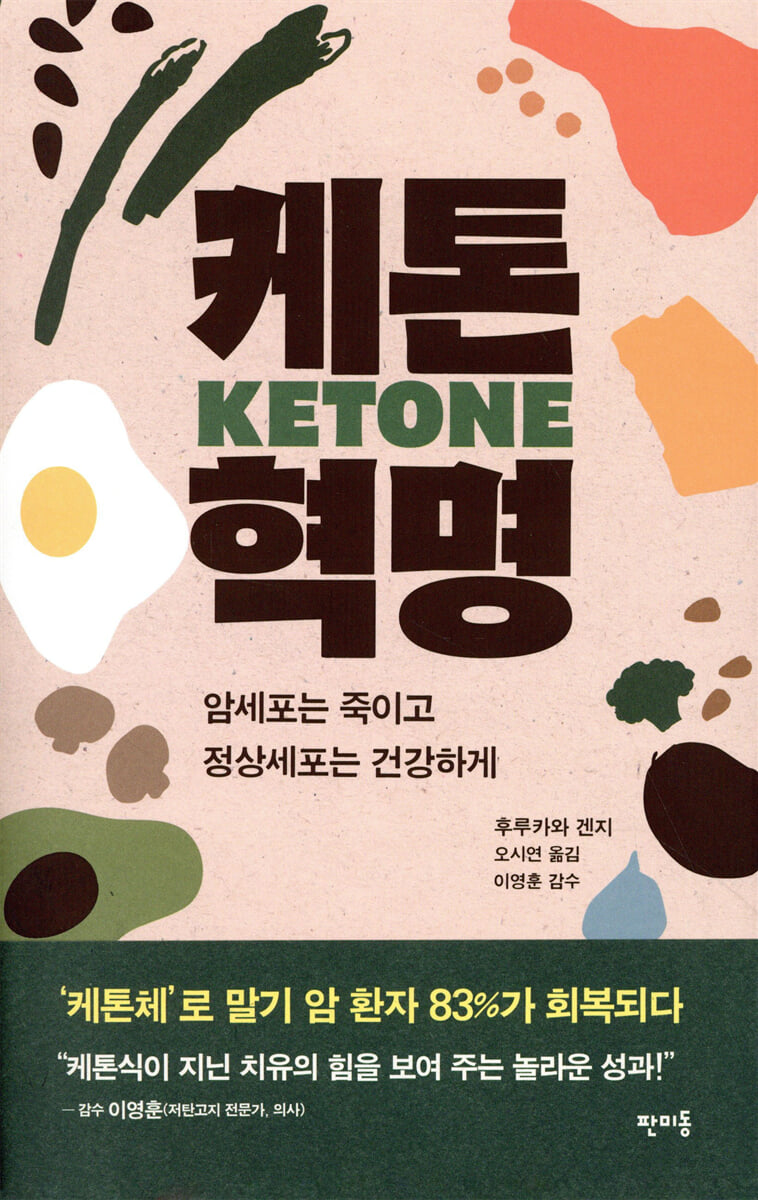
Ketone Revolution
 |
Description
Book Introduction
83% of terminally ill cancer patients recover with ketone bodies.
“Amazing results that demonstrate the healing power of the ketogenic diet!”
- Supervised by Lee Young-hoon (low-carb, high-fat diet expert, physician)
“A disease that cannot be cured with food cannot be cured with medicine.
“Let food be your medicine.”
-Hippocrates
Dr. Kenji Furukawa, who successfully improved the condition of 83% of terminal cancer patients with the world's first carbohydrate-restricted diet tailored to cancer patients, has published "Ketone Revolution" by Panmidong.
Ketone bodies are emergency energy sources used when glucose is not supplied to the body due to carbohydrate restriction or fasting. It has been a well-known medical theory that higher ketone levels are bad for your health.
Only recently has ketone bodies been cleared of their false reputation and are gaining attention as a key substance for treating chronic diseases and illnesses prevalent in society.
Dr. Furukawa developed a customized “Immuno-nutritional Ketogenic Diet” for cancer patients, taking note of the fact that cancer cells use glucose as their primary energy source.
The immune-nutritional ketogenic diet is a diet that pursues extreme carbohydrate restriction of 95% to kill cancer cells. Through clinical research, it was proven for the first time in the world that the combination of high protein, high fat, and low carbohydrates helped 83% of terminal cancer patients recover.
Existing cancer treatments have a blind spot in that they damage not only cancer cells but also normal cells.
However, the ketogenic diet, which boosts patients' immunity through rich food ingredients, can be considered a groundbreaking discovery that can help existing cancer treatments because it kills cancer cells and keeps normal cells healthy.
“Amazing results that demonstrate the healing power of the ketogenic diet!”
- Supervised by Lee Young-hoon (low-carb, high-fat diet expert, physician)
“A disease that cannot be cured with food cannot be cured with medicine.
“Let food be your medicine.”
-Hippocrates
Dr. Kenji Furukawa, who successfully improved the condition of 83% of terminal cancer patients with the world's first carbohydrate-restricted diet tailored to cancer patients, has published "Ketone Revolution" by Panmidong.
Ketone bodies are emergency energy sources used when glucose is not supplied to the body due to carbohydrate restriction or fasting. It has been a well-known medical theory that higher ketone levels are bad for your health.
Only recently has ketone bodies been cleared of their false reputation and are gaining attention as a key substance for treating chronic diseases and illnesses prevalent in society.
Dr. Furukawa developed a customized “Immuno-nutritional Ketogenic Diet” for cancer patients, taking note of the fact that cancer cells use glucose as their primary energy source.
The immune-nutritional ketogenic diet is a diet that pursues extreme carbohydrate restriction of 95% to kill cancer cells. Through clinical research, it was proven for the first time in the world that the combination of high protein, high fat, and low carbohydrates helped 83% of terminal cancer patients recover.
Existing cancer treatments have a blind spot in that they damage not only cancer cells but also normal cells.
However, the ketogenic diet, which boosts patients' immunity through rich food ingredients, can be considered a groundbreaking discovery that can help existing cancer treatments because it kills cancer cells and keeps normal cells healthy.
- You can preview some of the book's contents.
Preview
index
A Review | Revolutionary Results from the Power of Ketones · 4
Prologue | The Ketogenic Diet: A Cancer-Curing Immune-Boosting Diet · 14
Part 1.
Why Does the Ketogenic Diet Fight Cancer? · 27
1.
Nutrition, Cells, and Energy · 29
Cancer cells die when deprived of nutrients | Energy-generating structures | How cancer cells produce energy | Cancer cells absorb 3-8 times more glucose than normal cells | How much does the ketogenic diet kill cancer stem cells? | The benefits of PET scans | Cancer incidence in diabetics | The headache of insulin | Why we deliberately consume carbohydrates
2.
Another energy source: ketone bodies · 44
What are ketone bodies? | The fuel-efficient 'ketone engine' | The anti-cancer properties of ketone bodies | Ketone bodies awaken longevity genes | Ketone bodies, treated as a villain | Treatments for childhood epilepsy | 'Ketosis' and 'ketoacidosis' | Ketone bodies, the energy source for brain cells
3.
The Effects of the Ketogenic Diet on Cancer · 59
Ketogenic Diet Enhances Chemotherapy | Osaka University's Ketogenic Diet Clinical Study | A Case Study of a "Hopeless" Patient | A Dietary Therapy That's Been Underestimated | High Total Ketone Levels Link Cancer to Remission | Fetuses Survive on Ketones
Part 2.
What Nutrients Are Needed for Cancer Treatment? · 75
1.
The Correlation Between Nutritional Status and Cancer Treatment · 77
If your nutritional status is poor, your prognosis is poor.
2.
Important Indicators for Cancer Screening · 81
Albumin and CRP: Powerful Indicators of Cancer Progression
3.
Tips for Consuming Fat · 88
Limit your intake of saturated animal fats | The effects of EPA | EPA destroys cancer cells | How to get 4 grams of EPA a day | Two things to watch out for when taking EPA | Medium-chain fatty acids | How much will 'MCT oil' raise ketone levels? | The surprising ketone index
Part 3.
What is the Immune-Nutritional Ketogenic Diet? · 107
1.
Cancer Treatment and Diet · 109
The Pioneering Gerson Therapy | The Problems of the Gerson Therapy | Should You Limit Your Salt Intake? | Should You Avoid Meat If You Have Cancer? | Cancer Prevention and Treatment | Fat Is Not the Villain
2.
What is the Immune-Nutritional Ketogenic Diet? · 125
Three Levels of Ketogenic Immunonutritional Diets | Semi-Ketogenic Immunonutritional Diet | Ketogenic Immunonutritional Diet | Daily Protein Intake | Daily Fat Intake | Choose Foods High in Fiber | Super Ketogenic Immunonutritional Diet | How to Take MCT Oil | Avocado and Coffee | How to Take Flaxseed Oil
3.
Effective Ingredients for Cancer Treatment · 147
Fucoidan and beta-glucan | The benefits of garlic | The benefits of onions | Precautions when taking vitamin C and health supplements | Vitamin E, polyphenols, and selenium to boost antioxidant power | Zinc | Vitamin D | Vitamin A | Broccoli and cauliflower | Hydroxy radical protection | The antioxidant power of mushrooms and seaweed | Fucoidan and lactic acid bacteria | Precautions for seasoning | Homemade mirin and homemade dressing | Low-carb sauces | The benefits of miso | Other seasonings
4.
Foods Effective in Treating Cancer · 175
Side Dishes and Fruit | Snacks and Drinks | The Importance of Alternative Foods | Bran Bread, Bran Bread | White Rice
Part 4.
How to Boost the Effectiveness of a Ketogenic Diet · 189
1.
Drug Resistance and Carbohydrate Resistance in Cancer Cells · 191
Cancer cells use lactic acid for energy | Cancer cells that feed on ketone bodies | Fighting with statins | The case of a patient with a one-month life expectancy | Autophagy in cancer cells
2.
How to Increase Your Basal Body Temperature · 199
Benefits of Foot Baths | Local Heat Therapy
3.
How to Deal with Chemotherapy Side Effects · 205
The Effects of Hydrogen Water | Commercially Available Hydrogen Water Has a Low Concentration | The Effects of Vitamin C
4.
Mitochondria Kill Cancer Cells · 212
Starvation Increases Mitochondria | Djokovic's Hybrid Body | A Patient's Hybridized Body | Mr. A's Workout | Mini-Fasting + High-Intensity Workout | Improves Sleep Quality
5.
A Stage 4 Cancer Patient's Ketogenic Diet: A Post-Trip Story · 224
Case of a 50-year-old woman | Case of a 60-year-old woman | Case of a 69-year-old man | Case of a 66-year-old man | Case of a 57-year-old man
Male Case | 73-Year-Old Male Case | 72-Year-Old Female Case | 70-Year-Old Female Case
A 55-Year-Old Woman's Case | Supportive Care for Transition Surgery
Part 5.
Immune-boosting Ketogenic Diet · 239
1.
One Week Ketogenic Diet · 241
A patient's weekly diet
2.
Ketogenic Stock Recipes · 252
Sushi Tofu Rice | Curry Udon | Ketogenic Homemade Burger | Tofu Seafood Porridge | Chicken and Mushroom Pasta
Pork cutlet rice bowl
3.
Ketogenic Side Dish Recipes · 261
Chicken Breast Stew | Coconut Chicken Curry | Soy Sauce Mackerel | Soybean Flour Fried Mackerel
4.
Ketogenic Salad Recipe · 266
Mushroom Tuna Salad | Chicken and Ham Stir-fry | Broccoli Sprout and Avocado Salad | Avocado and Mackerel
Mayonnaise Salad | Shrimp and Broccoli Salad | Broccoli and Avocado Salad with Soft-Boiled Egg
Broccoli Consomme Sauté
Epilogue | Ketogenic Diet: Immuno-Nutritional Support for Healthy Cells · 275
References · 279
Prologue | The Ketogenic Diet: A Cancer-Curing Immune-Boosting Diet · 14
Part 1.
Why Does the Ketogenic Diet Fight Cancer? · 27
1.
Nutrition, Cells, and Energy · 29
Cancer cells die when deprived of nutrients | Energy-generating structures | How cancer cells produce energy | Cancer cells absorb 3-8 times more glucose than normal cells | How much does the ketogenic diet kill cancer stem cells? | The benefits of PET scans | Cancer incidence in diabetics | The headache of insulin | Why we deliberately consume carbohydrates
2.
Another energy source: ketone bodies · 44
What are ketone bodies? | The fuel-efficient 'ketone engine' | The anti-cancer properties of ketone bodies | Ketone bodies awaken longevity genes | Ketone bodies, treated as a villain | Treatments for childhood epilepsy | 'Ketosis' and 'ketoacidosis' | Ketone bodies, the energy source for brain cells
3.
The Effects of the Ketogenic Diet on Cancer · 59
Ketogenic Diet Enhances Chemotherapy | Osaka University's Ketogenic Diet Clinical Study | A Case Study of a "Hopeless" Patient | A Dietary Therapy That's Been Underestimated | High Total Ketone Levels Link Cancer to Remission | Fetuses Survive on Ketones
Part 2.
What Nutrients Are Needed for Cancer Treatment? · 75
1.
The Correlation Between Nutritional Status and Cancer Treatment · 77
If your nutritional status is poor, your prognosis is poor.
2.
Important Indicators for Cancer Screening · 81
Albumin and CRP: Powerful Indicators of Cancer Progression
3.
Tips for Consuming Fat · 88
Limit your intake of saturated animal fats | The effects of EPA | EPA destroys cancer cells | How to get 4 grams of EPA a day | Two things to watch out for when taking EPA | Medium-chain fatty acids | How much will 'MCT oil' raise ketone levels? | The surprising ketone index
Part 3.
What is the Immune-Nutritional Ketogenic Diet? · 107
1.
Cancer Treatment and Diet · 109
The Pioneering Gerson Therapy | The Problems of the Gerson Therapy | Should You Limit Your Salt Intake? | Should You Avoid Meat If You Have Cancer? | Cancer Prevention and Treatment | Fat Is Not the Villain
2.
What is the Immune-Nutritional Ketogenic Diet? · 125
Three Levels of Ketogenic Immunonutritional Diets | Semi-Ketogenic Immunonutritional Diet | Ketogenic Immunonutritional Diet | Daily Protein Intake | Daily Fat Intake | Choose Foods High in Fiber | Super Ketogenic Immunonutritional Diet | How to Take MCT Oil | Avocado and Coffee | How to Take Flaxseed Oil
3.
Effective Ingredients for Cancer Treatment · 147
Fucoidan and beta-glucan | The benefits of garlic | The benefits of onions | Precautions when taking vitamin C and health supplements | Vitamin E, polyphenols, and selenium to boost antioxidant power | Zinc | Vitamin D | Vitamin A | Broccoli and cauliflower | Hydroxy radical protection | The antioxidant power of mushrooms and seaweed | Fucoidan and lactic acid bacteria | Precautions for seasoning | Homemade mirin and homemade dressing | Low-carb sauces | The benefits of miso | Other seasonings
4.
Foods Effective in Treating Cancer · 175
Side Dishes and Fruit | Snacks and Drinks | The Importance of Alternative Foods | Bran Bread, Bran Bread | White Rice
Part 4.
How to Boost the Effectiveness of a Ketogenic Diet · 189
1.
Drug Resistance and Carbohydrate Resistance in Cancer Cells · 191
Cancer cells use lactic acid for energy | Cancer cells that feed on ketone bodies | Fighting with statins | The case of a patient with a one-month life expectancy | Autophagy in cancer cells
2.
How to Increase Your Basal Body Temperature · 199
Benefits of Foot Baths | Local Heat Therapy
3.
How to Deal with Chemotherapy Side Effects · 205
The Effects of Hydrogen Water | Commercially Available Hydrogen Water Has a Low Concentration | The Effects of Vitamin C
4.
Mitochondria Kill Cancer Cells · 212
Starvation Increases Mitochondria | Djokovic's Hybrid Body | A Patient's Hybridized Body | Mr. A's Workout | Mini-Fasting + High-Intensity Workout | Improves Sleep Quality
5.
A Stage 4 Cancer Patient's Ketogenic Diet: A Post-Trip Story · 224
Case of a 50-year-old woman | Case of a 60-year-old woman | Case of a 69-year-old man | Case of a 66-year-old man | Case of a 57-year-old man
Male Case | 73-Year-Old Male Case | 72-Year-Old Female Case | 70-Year-Old Female Case
A 55-Year-Old Woman's Case | Supportive Care for Transition Surgery
Part 5.
Immune-boosting Ketogenic Diet · 239
1.
One Week Ketogenic Diet · 241
A patient's weekly diet
2.
Ketogenic Stock Recipes · 252
Sushi Tofu Rice | Curry Udon | Ketogenic Homemade Burger | Tofu Seafood Porridge | Chicken and Mushroom Pasta
Pork cutlet rice bowl
3.
Ketogenic Side Dish Recipes · 261
Chicken Breast Stew | Coconut Chicken Curry | Soy Sauce Mackerel | Soybean Flour Fried Mackerel
4.
Ketogenic Salad Recipe · 266
Mushroom Tuna Salad | Chicken and Ham Stir-fry | Broccoli Sprout and Avocado Salad | Avocado and Mackerel
Mayonnaise Salad | Shrimp and Broccoli Salad | Broccoli and Avocado Salad with Soft-Boiled Egg
Broccoli Consomme Sauté
Epilogue | Ketogenic Diet: Immuno-Nutritional Support for Healthy Cells · 275
References · 279
Detailed image

Into the book
A significant number of the participants were stage 4 cancer patients.
Stage 4 refers to a condition where distant metastasis has occurred beyond the original site of cancer (primary site), making surgery impossible.
This is the so-called 'terminal' stage, and at this point, many doctors give up on treatment, saying 'there is nothing we can do now.'
Considering that, it is no exaggeration to say that the 39% cure rate and 83% disease control rate are figures that overturn conventional wisdom in the medical community.
This clearly indicates that dietary therapy, namely the immunonutritional ketogenic diet, has the potential to be a supportive therapy in cancer treatment.
--- p.15~16
To capture an enemy who has locked down the castle gates and is sieging, simply block all escape routes and cut off their food supply lines.
However, if you try to use the above-mentioned operation in cancer treatment, the story is a bit different.
This is because both enemies (cancer cells) and allies (normal cells) exist within the castle.
When attacking an enemy, it is meaningless if your allies are also affected.
If you try to strengthen your allies but end up boosting the enemy's morale, that too is a waste of time.
In this case, you should deploy a tactic of striking only the enemy and providing covering fire to your allies.
The carbohydrate restriction diet I introduced also follows this tactic.
--- p.21
Cancer is a Chinese character that is created by adding the radical '어(?)', which means disease, to the variant '?' of '암(岩)', which means rock.
In other words, 'cancer' can be interpreted as a disease in which 'food' exists like a 'mountain'.
Just as overeating and gluttony in modern society cause chronic diseases such as diabetes, gout, and high blood pressure, our ancestors also knew from experience that overeating causes 'a disease that causes hard lumps like rocks.'
An important hint about cancer treatment is hidden right here.
--- p.30
Cancer cells use glucose, which is synthesized from carbohydrates, as their main source of nutrition.
They also need to absorb 3 to 8 times more glucose than normal cells to sustain life.
Meanwhile, normal cells can generate emergency energy from subcutaneous fat when glucose is not supplied.
The emergency energy source that replaces this glucose is a substance called 'ketone bodies', which this book considers a key element in cancer treatment.
--- p.30
Normal cells, except for the liver and red blood cells, can use ketone bodies for energy, but cancer cells are basically unable to use ketone bodies for energy.
This is because there are very few enzymes that convert ketone bodies into energy.
Therefore, by switching the energy production system of cancer patients from glucose dependence to ketone body dependence, it is possible to inhibit cancer cell division, shrink the cancer, and in some cases even kill it.
--- p.49
It is known that the increase in total ketone body index peaks 3 to 4 hours after consuming MCT oil, and the reason Mr. A's ketone body level continued to rise after that is because his body was using ketone bodies as its main energy source rather than relying on energy production through sugar production.
This shows that after MCT oil was consumed in the body, Mr. A's body started the ketone engine by burning his subcutaneous fat or visceral fat.
So how did Mr. A, who was battling cancer, achieve such a high total ketone index? How much did his condition improve?
--- p.103~104
I can't help but think of Steve Jobs, who died in October 2011 from pancreatic cancer that metastasized to his liver.
After being diagnosed with cancer, he refused Western medical treatment and opted for Eastern medical approaches such as protein restriction and vegetarianism.
After that, the pancreatic cancer grew and he had surgery to remove it and survived for nearly 10 years.
Considering that Jobs' pancreatic cancer was a slow-growing neuroendocrine tumor, a protein boost to improve nutrition and immunity would have been absolutely necessary.
It is regrettable that if Jobs had not restricted protein and followed an immune-nutritional ketogenic diet, his post-surgery prognosis might have been much improved.
--- p.122~123
Mitochondria produce energy from carbohydrates, fats, and oxygen.
This 'energy-generating factory' exists in all cells except red blood cells and has a powerful effect in inducing cancer cells to apoptosis.
Mitochondria also have a metabolic pathway that converts ketone bodies, which cancer hates, into energy.
This means that the stronger the mitochondria, the less likely cancer cells are to survive.
Stage 4 refers to a condition where distant metastasis has occurred beyond the original site of cancer (primary site), making surgery impossible.
This is the so-called 'terminal' stage, and at this point, many doctors give up on treatment, saying 'there is nothing we can do now.'
Considering that, it is no exaggeration to say that the 39% cure rate and 83% disease control rate are figures that overturn conventional wisdom in the medical community.
This clearly indicates that dietary therapy, namely the immunonutritional ketogenic diet, has the potential to be a supportive therapy in cancer treatment.
--- p.15~16
To capture an enemy who has locked down the castle gates and is sieging, simply block all escape routes and cut off their food supply lines.
However, if you try to use the above-mentioned operation in cancer treatment, the story is a bit different.
This is because both enemies (cancer cells) and allies (normal cells) exist within the castle.
When attacking an enemy, it is meaningless if your allies are also affected.
If you try to strengthen your allies but end up boosting the enemy's morale, that too is a waste of time.
In this case, you should deploy a tactic of striking only the enemy and providing covering fire to your allies.
The carbohydrate restriction diet I introduced also follows this tactic.
--- p.21
Cancer is a Chinese character that is created by adding the radical '어(?)', which means disease, to the variant '?' of '암(岩)', which means rock.
In other words, 'cancer' can be interpreted as a disease in which 'food' exists like a 'mountain'.
Just as overeating and gluttony in modern society cause chronic diseases such as diabetes, gout, and high blood pressure, our ancestors also knew from experience that overeating causes 'a disease that causes hard lumps like rocks.'
An important hint about cancer treatment is hidden right here.
--- p.30
Cancer cells use glucose, which is synthesized from carbohydrates, as their main source of nutrition.
They also need to absorb 3 to 8 times more glucose than normal cells to sustain life.
Meanwhile, normal cells can generate emergency energy from subcutaneous fat when glucose is not supplied.
The emergency energy source that replaces this glucose is a substance called 'ketone bodies', which this book considers a key element in cancer treatment.
--- p.30
Normal cells, except for the liver and red blood cells, can use ketone bodies for energy, but cancer cells are basically unable to use ketone bodies for energy.
This is because there are very few enzymes that convert ketone bodies into energy.
Therefore, by switching the energy production system of cancer patients from glucose dependence to ketone body dependence, it is possible to inhibit cancer cell division, shrink the cancer, and in some cases even kill it.
--- p.49
It is known that the increase in total ketone body index peaks 3 to 4 hours after consuming MCT oil, and the reason Mr. A's ketone body level continued to rise after that is because his body was using ketone bodies as its main energy source rather than relying on energy production through sugar production.
This shows that after MCT oil was consumed in the body, Mr. A's body started the ketone engine by burning his subcutaneous fat or visceral fat.
So how did Mr. A, who was battling cancer, achieve such a high total ketone index? How much did his condition improve?
--- p.103~104
I can't help but think of Steve Jobs, who died in October 2011 from pancreatic cancer that metastasized to his liver.
After being diagnosed with cancer, he refused Western medical treatment and opted for Eastern medical approaches such as protein restriction and vegetarianism.
After that, the pancreatic cancer grew and he had surgery to remove it and survived for nearly 10 years.
Considering that Jobs' pancreatic cancer was a slow-growing neuroendocrine tumor, a protein boost to improve nutrition and immunity would have been absolutely necessary.
It is regrettable that if Jobs had not restricted protein and followed an immune-nutritional ketogenic diet, his post-surgery prognosis might have been much improved.
--- p.122~123
Mitochondria produce energy from carbohydrates, fats, and oxygen.
This 'energy-generating factory' exists in all cells except red blood cells and has a powerful effect in inducing cancer cells to apoptosis.
Mitochondria also have a metabolic pathway that converts ketone bodies, which cancer hates, into energy.
This means that the stronger the mitochondria, the less likely cancer cells are to survive.
--- p.212~213
Publisher's Review
Not only diet, but also cancer treatment?
The Key Principle of How Ketone Bodies Eliminate Cancer
Following the craze for high-fat, low-carbohydrate diets, mimicked fasting (FMD), which simulates fasting while consuming food, has become a huge craze.
As it was discovered that 'ketone bodies' were at the center of it, 'ketone bodies' quickly emerged as a topic of interest to modern people.
Ketone bodies are substances produced when fat is broken down, and their levels improve when carbohydrate intake is restricted and fat intake is increased.
But the power of ketone bodies isn't limited to dieting.
It is used to improve metabolic diseases such as diabetes, and recently, it has begun to be applied to the treatment of cancer, one of the most serious diseases.
However, it was not enough to dispel the doubts of 'no matter how great ketone bodies are, can they really cure cancer?'
Cancer is a very serious disease, and because it is still in its early stages of application, there is not enough reliable data to prove that ketone bodies can treat cancer.
"The Ketone Revolution" shows the process of recovering 83% of terminal cancer patients through clinical trials and focuses on the "key principle of how ketone bodies eliminate cancer."
This is a world-first discovery and an incredible achievement that demonstrates the power of the ketogenic diet.
Carbohydrates cause cancer?
Carbohydrate-restricted ketogenic diet that fights cancer
Cancer is a Chinese character that is created by adding the radical '엄' meaning disease to the variant form of '암(岩)', and '암(癌)' is a disease in which '식(食品)' is like '산(山)'.
An important hint about cancer treatment is hidden right here.
Cancer cells use glucose, which is synthesized from carbohydrates, as their main source of nutrition.
They also need to absorb 3 to 8 times more glucose than normal cells to sustain life.
Dr. Furukawa, noting this point, developed a customized "Immuno-nutritional Ketogenic Diet" for cancer patients. The Immuno-nutritional Ketogenic Diet is a diet that pursues extreme carbohydrate restriction, limiting carbohydrates by 95%, thereby increasing ketone levels and killing cancer cells.
The author compares the fact that existing cancer treatments damage not only cancer cells but also normal cells to the reality that "there are enemies (cancer cells) and allies (normal cells) inside a castle, so we have no choice but to lock the castle gates and launch an attack."
Dr. Furukawa suggests that since attacking the enemy would be meaningless if allies were also affected, we should adopt a tactic of only striking the enemy and protecting allies.
The immune-nutritional ketogenic diet aims to kill cancer cells and keep normal cells healthy by strategically excluding sugars that cancer likes and starving only the cancer cells to death.
This is the crucial reason why ketone bodies have emerged as a key substance in treating cancer.
If you knew the power of ketones
Now it's time to focus on 'mitochondria'!
This book emphasizes that changing the patient's energy production system from a 'glucose engine type' to a 'ketone body engine type' is a critical factor in determining the success or failure of cancer treatment.
The key force here is the 'mitochondria'.
Mitochondria, also called "energy factories" because they produce energy from carbohydrates, fats, and oxygen, are present in all cells except red blood cells and induce cancer cells to undergo "apoptosis," a process that causes them to die on their own.
This means that the stronger the mitochondria, the lower the chance of cancer cells surviving.
The authors advise that to strengthen mitochondria, you need an immune-nutritious ketogenic diet that limits total calories by about 25%, as well as high-intensity aerobic exercise.
Mitochondria induce DNA repair, gradually returning the cancer-affected body to a normal state.
In that respect, it is essential not only for cancer patients undergoing treatment but also for patients entering the recovery phase.
It is also an essential substance for modern people suffering from obesity and metabolic diseases.
This is why we need to focus on mitochondria after ketone bodies.
Can cancer patients enjoy the pleasure of sweet desserts?
A Delicious Diet Tailored to Cancer Patients Revealed
Until now, healthy diets for cancer patients have been good for the body, but they have not been pleasing to the eyes or mouth.
Dr. Kenji Furukawa emphasizes that food should be enjoyed to the fullest extent possible, and cancer patients should not be an exception to this.
If you focus only on health, you will not be able to maintain your diet for long because you will be attacked by a strong enemy called stress.
This book introduces over 400 foods containing carbohydrates, proteins, and fats essential for cancer patients, and presents various recipes using these foods.
From chicken, pasta, and pork cutlet, which may seem distant to cancer patients, to sweet dessert jelly, we help patients experience not only the pleasure of eating but also the pleasure of seeing.
We also reveal the weekly diet plan of Mr. A, who overcame multiple liver cancers with the immune system booster ketogenic diet, and provide realistic and specific methods of implementation.
Although "The Ketogenic Revolution" provides various food groups and recipes necessary for cancer patients, it does not necessarily emphasize that diet is the only important factor in cancer treatment.
Rather, the significance lies in having one more weapon to conquer cancer while combining it with various treatments.
In that sense, it can be said that this book is like a friend accompanying cancer patients.
The Key Principle of How Ketone Bodies Eliminate Cancer
Following the craze for high-fat, low-carbohydrate diets, mimicked fasting (FMD), which simulates fasting while consuming food, has become a huge craze.
As it was discovered that 'ketone bodies' were at the center of it, 'ketone bodies' quickly emerged as a topic of interest to modern people.
Ketone bodies are substances produced when fat is broken down, and their levels improve when carbohydrate intake is restricted and fat intake is increased.
But the power of ketone bodies isn't limited to dieting.
It is used to improve metabolic diseases such as diabetes, and recently, it has begun to be applied to the treatment of cancer, one of the most serious diseases.
However, it was not enough to dispel the doubts of 'no matter how great ketone bodies are, can they really cure cancer?'
Cancer is a very serious disease, and because it is still in its early stages of application, there is not enough reliable data to prove that ketone bodies can treat cancer.
"The Ketone Revolution" shows the process of recovering 83% of terminal cancer patients through clinical trials and focuses on the "key principle of how ketone bodies eliminate cancer."
This is a world-first discovery and an incredible achievement that demonstrates the power of the ketogenic diet.
Carbohydrates cause cancer?
Carbohydrate-restricted ketogenic diet that fights cancer
Cancer is a Chinese character that is created by adding the radical '엄' meaning disease to the variant form of '암(岩)', and '암(癌)' is a disease in which '식(食品)' is like '산(山)'.
An important hint about cancer treatment is hidden right here.
Cancer cells use glucose, which is synthesized from carbohydrates, as their main source of nutrition.
They also need to absorb 3 to 8 times more glucose than normal cells to sustain life.
Dr. Furukawa, noting this point, developed a customized "Immuno-nutritional Ketogenic Diet" for cancer patients. The Immuno-nutritional Ketogenic Diet is a diet that pursues extreme carbohydrate restriction, limiting carbohydrates by 95%, thereby increasing ketone levels and killing cancer cells.
The author compares the fact that existing cancer treatments damage not only cancer cells but also normal cells to the reality that "there are enemies (cancer cells) and allies (normal cells) inside a castle, so we have no choice but to lock the castle gates and launch an attack."
Dr. Furukawa suggests that since attacking the enemy would be meaningless if allies were also affected, we should adopt a tactic of only striking the enemy and protecting allies.
The immune-nutritional ketogenic diet aims to kill cancer cells and keep normal cells healthy by strategically excluding sugars that cancer likes and starving only the cancer cells to death.
This is the crucial reason why ketone bodies have emerged as a key substance in treating cancer.
If you knew the power of ketones
Now it's time to focus on 'mitochondria'!
This book emphasizes that changing the patient's energy production system from a 'glucose engine type' to a 'ketone body engine type' is a critical factor in determining the success or failure of cancer treatment.
The key force here is the 'mitochondria'.
Mitochondria, also called "energy factories" because they produce energy from carbohydrates, fats, and oxygen, are present in all cells except red blood cells and induce cancer cells to undergo "apoptosis," a process that causes them to die on their own.
This means that the stronger the mitochondria, the lower the chance of cancer cells surviving.
The authors advise that to strengthen mitochondria, you need an immune-nutritious ketogenic diet that limits total calories by about 25%, as well as high-intensity aerobic exercise.
Mitochondria induce DNA repair, gradually returning the cancer-affected body to a normal state.
In that respect, it is essential not only for cancer patients undergoing treatment but also for patients entering the recovery phase.
It is also an essential substance for modern people suffering from obesity and metabolic diseases.
This is why we need to focus on mitochondria after ketone bodies.
Can cancer patients enjoy the pleasure of sweet desserts?
A Delicious Diet Tailored to Cancer Patients Revealed
Until now, healthy diets for cancer patients have been good for the body, but they have not been pleasing to the eyes or mouth.
Dr. Kenji Furukawa emphasizes that food should be enjoyed to the fullest extent possible, and cancer patients should not be an exception to this.
If you focus only on health, you will not be able to maintain your diet for long because you will be attacked by a strong enemy called stress.
This book introduces over 400 foods containing carbohydrates, proteins, and fats essential for cancer patients, and presents various recipes using these foods.
From chicken, pasta, and pork cutlet, which may seem distant to cancer patients, to sweet dessert jelly, we help patients experience not only the pleasure of eating but also the pleasure of seeing.
We also reveal the weekly diet plan of Mr. A, who overcame multiple liver cancers with the immune system booster ketogenic diet, and provide realistic and specific methods of implementation.
Although "The Ketogenic Revolution" provides various food groups and recipes necessary for cancer patients, it does not necessarily emphasize that diet is the only important factor in cancer treatment.
Rather, the significance lies in having one more weapon to conquer cancer while combining it with various treatments.
In that sense, it can be said that this book is like a friend accompanying cancer patients.
GOODS SPECIFICS
- Date of publication: August 23, 2019
- Page count, weight, size: 280 pages | 388g | 140*220*20mm
- ISBN13: 9791158885571
- ISBN10: 1158885571
You may also like
카테고리
korean


korean

![ELLE 엘르 스페셜 에디션 A형 : 12월 [2025]](http://librairie.coreenne.fr/cdn/shop/files/b8e27a3de6c9538896439686c6b0e8fb.jpg?v=1766436872&width=3840)


