

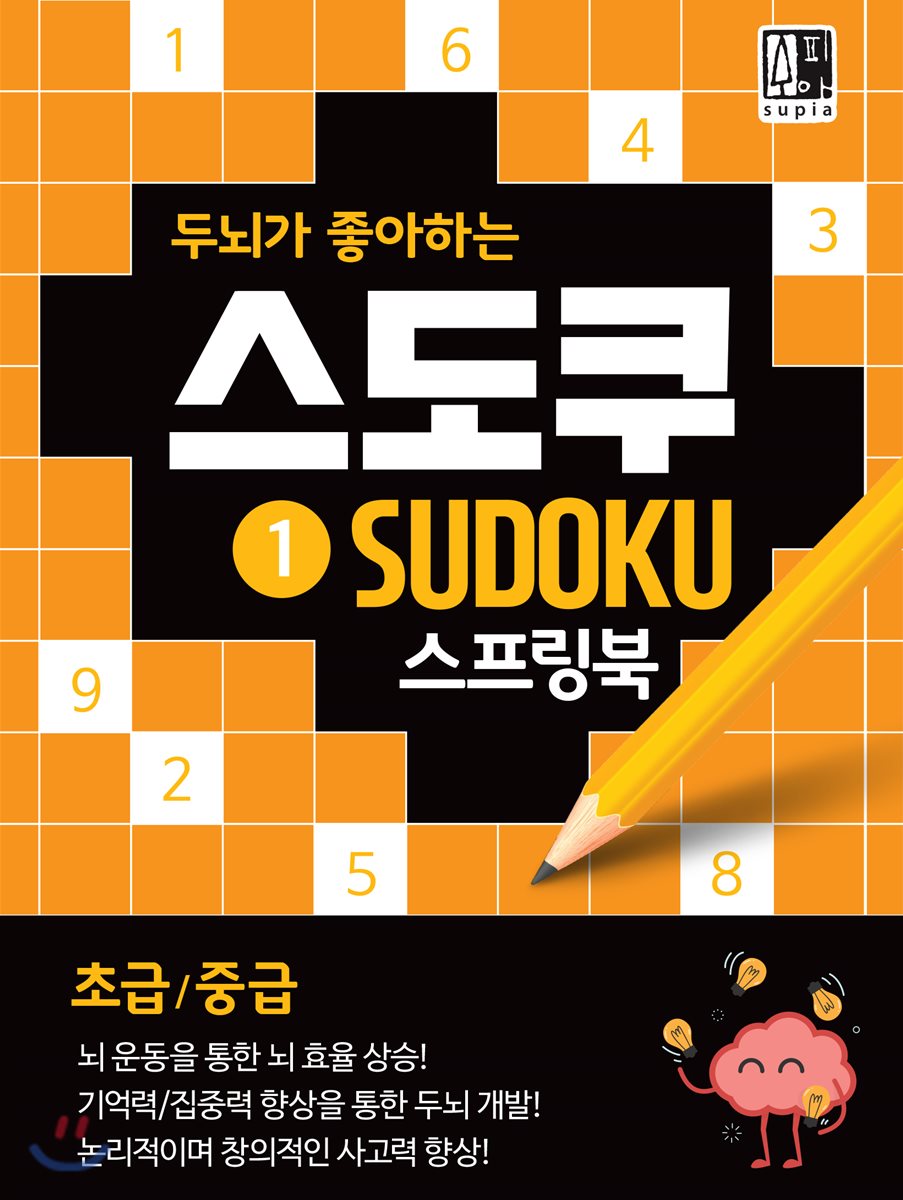
Sudoku 1 Springbook, a brain-friendly puzzle
 |
Description
Book Introduction
Sudoku, the brain's favorite.
1 Spring Book (Beginner/Intermediate) is easy to turn the pages with its spring binding, and it is convenient to tear off each page and solve the problems.
Additionally, since this is a book that requires taking notes while solving problems, ample space for notes is secured by including one problem per page.
For those who are new to Sudoku, 4*4 Sudoku and 6*6 Sudoku are included in the beginning, and advanced problems are also included at the end of the book so that you can experience problems of various difficulty levels.
*Sudoku, the brain's favorite.
1 Springbook (Beginner/Intermediate) is printed using green to minimize eye fatigue for readers.
1 Spring Book (Beginner/Intermediate) is easy to turn the pages with its spring binding, and it is convenient to tear off each page and solve the problems.
Additionally, since this is a book that requires taking notes while solving problems, ample space for notes is secured by including one problem per page.
For those who are new to Sudoku, 4*4 Sudoku and 6*6 Sudoku are included in the beginning, and advanced problems are also included at the end of the book so that you can experience problems of various difficulty levels.
*Sudoku, the brain's favorite.
1 Springbook (Beginner/Intermediate) is printed using green to minimize eye fatigue for readers.
- You can preview some of the book's contents.
Preview
index
This book has no table of contents.
Detailed image

Publisher's Review
*What is Sudoku?
Sudoku was created by mathematician and physicist Leonhard Euler in 1707.
4. 15 ~ 1783.
9. It is said to have originated from a puzzle that arranged numbers according to a special rule called the Latin square or Latin square created by 18).
It first became known in 1979 when it was printed in the American puzzle magazine Del in the title Number Place, and in Japan in 1984 it became known under the name Sudoku (pronounced Sudoku in Japanese), and in November 2004 it appeared in The Times of England and gained popularity as a popular pastime.
Even now, it is still published in newspapers in many countries, including the UK, the US, and Japan, and with the development of the internet and smartphones, it is also available as an app, making it a puzzle that can be accessed at any time.
Sudoku, or Sudoku (數獨), means a number that stands alone. It is known as Sudoku in Japanese pronunciation and has many fans in Korea as well.
Sudoku was created by mathematician and physicist Leonhard Euler in 1707.
4. 15 ~ 1783.
9. It is said to have originated from a puzzle that arranged numbers according to a special rule called the Latin square or Latin square created by 18).
It first became known in 1979 when it was printed in the American puzzle magazine Del in the title Number Place, and in Japan in 1984 it became known under the name Sudoku (pronounced Sudoku in Japanese), and in November 2004 it appeared in The Times of England and gained popularity as a popular pastime.
Even now, it is still published in newspapers in many countries, including the UK, the US, and Japan, and with the development of the internet and smartphones, it is also available as an app, making it a puzzle that can be accessed at any time.
Sudoku, or Sudoku (數獨), means a number that stands alone. It is known as Sudoku in Japanese pronunciation and has many fans in Korea as well.
GOODS SPECIFICS
- Date of issue: May 18, 2019
- Format: Springbook book binding method guide
- Page count, weight, size: 208 pages | 266g | 137*185*20mm
- ISBN13: 9791196535032
- ISBN10: 1196535035
You may also like
카테고리
korean


korean

![ELLE 엘르 스페셜 에디션 A형 : 12월 [2025]](http://librairie.coreenne.fr/cdn/shop/files/b8e27a3de6c9538896439686c6b0e8fb.jpg?v=1766436872&width=3840)


