

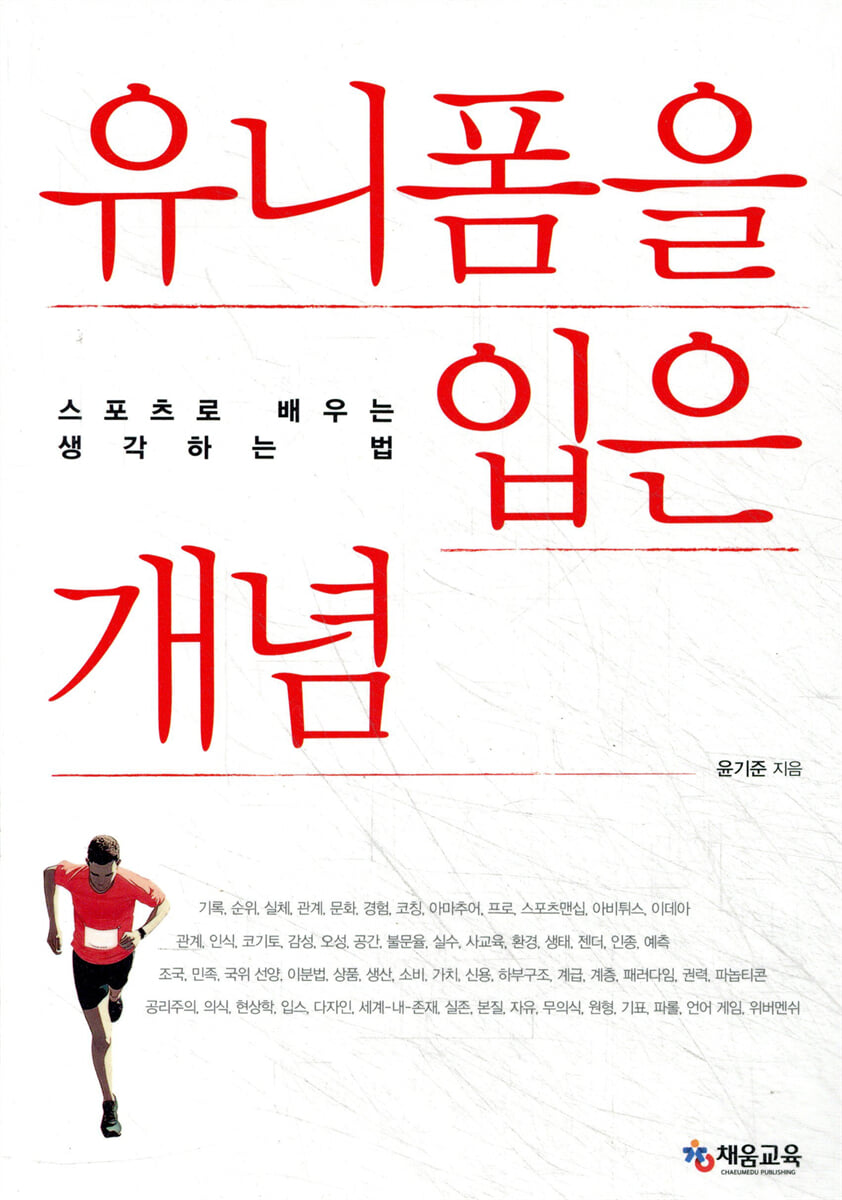
The concept of wearing a uniform
 |
Description
Book Introduction
Understanding Life, Society, Power and Structure, and Existence through Sports
And here's a guide to making you chew on it and think about it.
Yoon Ki-jun's "Concepts in Uniform"
141 concepts found in sports settings
Experience, space, time, record, rank, existence, substance, emotion, reason, idea, relationship, value, happiness, multiculturalism, relativism, class, hierarchy, nation, ethnicity, race, sex, gender, sportsmanship, doping, unwritten rules, unforced errors, unwritten rules, yips, etc.
Concepts in Uniform: 40 stories that carefully explain 141 concepts we find in television news and broadcasts at stadiums.
Why should we understand the concept?
This book explores 141 concepts within specific case studies from actual sports settings. By understanding and putting these concepts into practice, we can communicate smoothly with our neighbors and gain a deeper understanding and perspective on the world.
If we do this, our lives can become more enriched.
Why do we have to look for concepts in sports?
As the saying goes, 'sports is a microcosm of life', sports is a space and another concept where our lives and society are intertwined.
Moreover, sports venues such as professional baseball, the FIFA World Cup, and the Olympics, where our joys and sorrows conflict with each game and each action, are the most familiar and easiest places to discuss concepts because various concepts pour out like a waterfall.
“Sports is a place to learn concepts and a way to understand life.
The specific way I understand the concepts in this book comes from my own experiences and concerns about participating in sports.
I believe that the concept of learning through sports makes a crucial contribution to enriching our lives.
“Let’s welcome various concepts while paying attention to the connection between ‘sports, concepts, and life.’ - From the prologue
And here's a guide to making you chew on it and think about it.
Yoon Ki-jun's "Concepts in Uniform"
141 concepts found in sports settings
Experience, space, time, record, rank, existence, substance, emotion, reason, idea, relationship, value, happiness, multiculturalism, relativism, class, hierarchy, nation, ethnicity, race, sex, gender, sportsmanship, doping, unwritten rules, unforced errors, unwritten rules, yips, etc.
Concepts in Uniform: 40 stories that carefully explain 141 concepts we find in television news and broadcasts at stadiums.
Why should we understand the concept?
This book explores 141 concepts within specific case studies from actual sports settings. By understanding and putting these concepts into practice, we can communicate smoothly with our neighbors and gain a deeper understanding and perspective on the world.
If we do this, our lives can become more enriched.
Why do we have to look for concepts in sports?
As the saying goes, 'sports is a microcosm of life', sports is a space and another concept where our lives and society are intertwined.
Moreover, sports venues such as professional baseball, the FIFA World Cup, and the Olympics, where our joys and sorrows conflict with each game and each action, are the most familiar and easiest places to discuss concepts because various concepts pour out like a waterfall.
“Sports is a place to learn concepts and a way to understand life.
The specific way I understand the concepts in this book comes from my own experiences and concerns about participating in sports.
I believe that the concept of learning through sports makes a crucial contribution to enriching our lives.
“Let’s welcome various concepts while paying attention to the connection between ‘sports, concepts, and life.’ - From the prologue
- You can preview some of the book's contents.
Preview
index
preface
Prologue Why Concepts and Sports?
Part Ⅰ: Reading Life Through Sports
Chapter 01 Three Ways to Gain Wisdom
Chapter 02 Gold Medals and World Records
Chapter 03 Iran, the Marathon Hater
Chapter 04 Every experience is different
Chapter 05 Coaching to Help You Learn
Chapter 06: Anthem of the Amateur
Chapter 07 Sportsmanship makes the man
Chapter 08 Sports Fandom and Habitus
Chapter 09 What is the origin of the jump shot?
Chapter 10 Sports and Happiness
Part II: Reading Society through Sports
Chapter 11 Sports that Know Me
Chapter 12 I Exercise, Therefore I Am
Chapter 13 Understanding the World Through the Senses
Chapter 14 Park Ji-sung and Spatial Understanding
Chapter 15: The True Unwritten Rules of Understanding and Practicing Through Questions
Chapter 16 Hand-Hand Learning
Chapter 17 Sports Lessons and Private Education
Chapter 18 The Shuttlecock and the White Elephant
Chapter 19 A Sports Ecosystem Without Discrimination
Chapter 20: The Limits of Prediction and Knowing Yourself
Part III: Reading Power and Structure through Sports
Chapter 21: Sports and Nationality? Homeland? Borders
Chapter 22: The Taegeuk Warriors and National Prestige
Chapter 23: Crossing the Line Between Offense and Defense
Chapter 24 The Best Products
Chapter 25 Sports and Values
Chapter 26: The Sports of Faith
Chapter 27: Football of the Rich vs. Football of the Prestigious
Chapter 28 Fairness of Weight Classes, Inequality of Classes
Chapter 29: A Sport of Coexistence of Speed and Slowness
Chapter 30 Visible Lines, Invisible Power
Part IV: Reading Existence through Sports
Chapter 31 Mr. Jinji's Pleasure
Chapter 32 The Day I Kicked the Ball, the Day I Sat on the Bench
Chapter 33: The Meaning of a Marathon with Family
Chapter 34 Lips, Choking, and the Cracks of Existence
Chapter 35: Seeing the ball precedes predicting its trajectory.
Chapter 36 Freedom and Responsibility in Free Throws
Chapter 37 The unconscious that moves the body and passes through clothes
Chapter 38 The word soccer ball is not round
Chapter 39 Language on the Court
Chapter 40: Throw alone like a rhinoceros horn
Epilogue The concept never stops
Prologue Why Concepts and Sports?
Part Ⅰ: Reading Life Through Sports
Chapter 01 Three Ways to Gain Wisdom
Chapter 02 Gold Medals and World Records
Chapter 03 Iran, the Marathon Hater
Chapter 04 Every experience is different
Chapter 05 Coaching to Help You Learn
Chapter 06: Anthem of the Amateur
Chapter 07 Sportsmanship makes the man
Chapter 08 Sports Fandom and Habitus
Chapter 09 What is the origin of the jump shot?
Chapter 10 Sports and Happiness
Part II: Reading Society through Sports
Chapter 11 Sports that Know Me
Chapter 12 I Exercise, Therefore I Am
Chapter 13 Understanding the World Through the Senses
Chapter 14 Park Ji-sung and Spatial Understanding
Chapter 15: The True Unwritten Rules of Understanding and Practicing Through Questions
Chapter 16 Hand-Hand Learning
Chapter 17 Sports Lessons and Private Education
Chapter 18 The Shuttlecock and the White Elephant
Chapter 19 A Sports Ecosystem Without Discrimination
Chapter 20: The Limits of Prediction and Knowing Yourself
Part III: Reading Power and Structure through Sports
Chapter 21: Sports and Nationality? Homeland? Borders
Chapter 22: The Taegeuk Warriors and National Prestige
Chapter 23: Crossing the Line Between Offense and Defense
Chapter 24 The Best Products
Chapter 25 Sports and Values
Chapter 26: The Sports of Faith
Chapter 27: Football of the Rich vs. Football of the Prestigious
Chapter 28 Fairness of Weight Classes, Inequality of Classes
Chapter 29: A Sport of Coexistence of Speed and Slowness
Chapter 30 Visible Lines, Invisible Power
Part IV: Reading Existence through Sports
Chapter 31 Mr. Jinji's Pleasure
Chapter 32 The Day I Kicked the Ball, the Day I Sat on the Bench
Chapter 33: The Meaning of a Marathon with Family
Chapter 34 Lips, Choking, and the Cracks of Existence
Chapter 35: Seeing the ball precedes predicting its trajectory.
Chapter 36 Freedom and Responsibility in Free Throws
Chapter 37 The unconscious that moves the body and passes through clothes
Chapter 38 The word soccer ball is not round
Chapter 39 Language on the Court
Chapter 40: Throw alone like a rhinoceros horn
Epilogue The concept never stops
Detailed image

Into the book
The world of life we experience every day is concrete.
On the other hand, the concept does not actually exist.
It is represented by symbols such as letters and is abstract.
Although their personalities are polar opposites, they complement each other and work together.
We recognize the beautiful azaleas blooming in the park through the concept of flowers, and we can understand and complement the concept of flowers by viewing cherry blossoms.
--- p.14, from “Why Concepts and Sports”
Sports can greatly contribute to understanding and deepening concepts.
The expression 'sports is a microcosm of life' means that we can experience and learn various concepts we encounter in life through sports.
Through rules that apply equally to both you and your opponents, and strict doping tests, you can understand 'fairness', and by cheering on your national team and becoming a fan of a professional sports club, you can learn 'identity' and 'a sense of belonging'.
--- p.16, from “Why Concepts and Sports”
Another way to properly understand a concept is to look at its opposite concept.
The concept that contrasts with culture is nature.
As we have seen, culture is the result of artificial processing of something untouched.
The English word nature comes from the Latin word natura, which means 'as is'.
The untamed wilderness discovered by our ancestors, who first began farming, was nature, but with the addition of various human touches, culture was born.
--- p.38, from “Iran, the Marathon Hater”
The hierarchical function of habitus is also confirmed in sports.
Traditionally, rowing and rugby were sports enjoyed by the British upper classes.
Rowing and rugby, which are effective in fostering strong teamwork, self-control, leadership, and manliness, are sports taught at prestigious private schools such as Eton.
Students develop habitus related to upper-class lifestyles and attitudes toward sport through their participation in rowing and rugby.
On the other hand, soccer, which established itself as a representative sport of the early urban working class, played a key role in forming the habitus of the common people.
With its rough-and-tumble combat, relatively simple rules, and spectator culture, the football field became a place where working-class sentiments and a sense of community were shared and habitus formed.
In this respect, preference for a particular sport is not determined solely by taste.
It is formed through one's overall life, including hierarchical position.
--- p.77~78, from “Sports Fandom and Habitus”
Descartes proves existence through thought, and Haruki vividly experiences existence through running.
Each is an act of doubt and a recognition of existence in a runner's high.
In this respect, existence can be said to be not a static concept, but something that is constructed together with certain actions.
When do we feel most present? This question questions the reality of "being alive," a sense we often miss in our daily lives.
I feel more alive in every moment of basketball, where I collide violently with my opponent, tennis, where I watch the spinning of the incoming ball until the very end, and running, where I experience the runner's high.
Let's make another parody.
“I exercise.
Therefore, it exists.”
--- p.113, from “I Exercise, Therefore I Am”
The line between offense and defense is never clear.
Sports are full of scenes where offense and defense are intertwined, such as blocking in volleyball, tiki-taka in soccer, and full-court press in basketball.
The same goes for our living world.
The world is not divided into two.
Dichotomy may be a starting point for understanding, but it should not itself be the destination.
What matters is not which side you are on.
It is an attitude to understand how vague boundaries were formed and how they operate now.
A perspective that crosses boundaries provides us with the opportunity to view the world in a more three-dimensional and flexible way.
--- p.194, from “Breaking the Boundaries of Offense and Defense”
I think the third stage, 'enjoyment', is when the attitude and posture that can be learned from every scene are formed.
We can learn from every scene in tennis.
Every moment can lead to learning: reflecting on a stroke you made a mistake on, thinking of good manners from your opponent congratulating you on a victory, examining your own attitude by observing a partner who constantly points out your mistakes, learning the value of community through joining and participating in a club, understanding what you can gain from a losing match, understanding the importance of flow and focusing more during a crucial moment.
For those who have finally reached the point of enjoying themselves, every moment of playing tennis is literally enjoyable, regardless of the outcome.
Because the more you hit, the broader and deeper your learning becomes.
--- p.251, from “Mr. Happy Jinji”
Sports is one of the arenas where the collective unconscious is clearly revealed.
Teamwork, in which team members work together to subdue the opposing team, is largely no different from past experiences of inter-tribal warfare or cooperation in hunting wild beasts.
Street cheering during the 2002 Korea-Japan World Cup can be said to be a form of collective unconsciousness in which the public, sharing homogeneous characteristics and culture, responds with the same emotions.
In addition, the reverence felt during the national anthem and the unique feelings toward sports heroes such as Michael Jordan can be said to be collective unconsciousness that signifies group identity and hope for heroes, respectively.
On the other hand, the concept does not actually exist.
It is represented by symbols such as letters and is abstract.
Although their personalities are polar opposites, they complement each other and work together.
We recognize the beautiful azaleas blooming in the park through the concept of flowers, and we can understand and complement the concept of flowers by viewing cherry blossoms.
--- p.14, from “Why Concepts and Sports”
Sports can greatly contribute to understanding and deepening concepts.
The expression 'sports is a microcosm of life' means that we can experience and learn various concepts we encounter in life through sports.
Through rules that apply equally to both you and your opponents, and strict doping tests, you can understand 'fairness', and by cheering on your national team and becoming a fan of a professional sports club, you can learn 'identity' and 'a sense of belonging'.
--- p.16, from “Why Concepts and Sports”
Another way to properly understand a concept is to look at its opposite concept.
The concept that contrasts with culture is nature.
As we have seen, culture is the result of artificial processing of something untouched.
The English word nature comes from the Latin word natura, which means 'as is'.
The untamed wilderness discovered by our ancestors, who first began farming, was nature, but with the addition of various human touches, culture was born.
--- p.38, from “Iran, the Marathon Hater”
The hierarchical function of habitus is also confirmed in sports.
Traditionally, rowing and rugby were sports enjoyed by the British upper classes.
Rowing and rugby, which are effective in fostering strong teamwork, self-control, leadership, and manliness, are sports taught at prestigious private schools such as Eton.
Students develop habitus related to upper-class lifestyles and attitudes toward sport through their participation in rowing and rugby.
On the other hand, soccer, which established itself as a representative sport of the early urban working class, played a key role in forming the habitus of the common people.
With its rough-and-tumble combat, relatively simple rules, and spectator culture, the football field became a place where working-class sentiments and a sense of community were shared and habitus formed.
In this respect, preference for a particular sport is not determined solely by taste.
It is formed through one's overall life, including hierarchical position.
--- p.77~78, from “Sports Fandom and Habitus”
Descartes proves existence through thought, and Haruki vividly experiences existence through running.
Each is an act of doubt and a recognition of existence in a runner's high.
In this respect, existence can be said to be not a static concept, but something that is constructed together with certain actions.
When do we feel most present? This question questions the reality of "being alive," a sense we often miss in our daily lives.
I feel more alive in every moment of basketball, where I collide violently with my opponent, tennis, where I watch the spinning of the incoming ball until the very end, and running, where I experience the runner's high.
Let's make another parody.
“I exercise.
Therefore, it exists.”
--- p.113, from “I Exercise, Therefore I Am”
The line between offense and defense is never clear.
Sports are full of scenes where offense and defense are intertwined, such as blocking in volleyball, tiki-taka in soccer, and full-court press in basketball.
The same goes for our living world.
The world is not divided into two.
Dichotomy may be a starting point for understanding, but it should not itself be the destination.
What matters is not which side you are on.
It is an attitude to understand how vague boundaries were formed and how they operate now.
A perspective that crosses boundaries provides us with the opportunity to view the world in a more three-dimensional and flexible way.
--- p.194, from “Breaking the Boundaries of Offense and Defense”
I think the third stage, 'enjoyment', is when the attitude and posture that can be learned from every scene are formed.
We can learn from every scene in tennis.
Every moment can lead to learning: reflecting on a stroke you made a mistake on, thinking of good manners from your opponent congratulating you on a victory, examining your own attitude by observing a partner who constantly points out your mistakes, learning the value of community through joining and participating in a club, understanding what you can gain from a losing match, understanding the importance of flow and focusing more during a crucial moment.
For those who have finally reached the point of enjoying themselves, every moment of playing tennis is literally enjoyable, regardless of the outcome.
Because the more you hit, the broader and deeper your learning becomes.
--- p.251, from “Mr. Happy Jinji”
Sports is one of the arenas where the collective unconscious is clearly revealed.
Teamwork, in which team members work together to subdue the opposing team, is largely no different from past experiences of inter-tribal warfare or cooperation in hunting wild beasts.
Street cheering during the 2002 Korea-Japan World Cup can be said to be a form of collective unconsciousness in which the public, sharing homogeneous characteristics and culture, responds with the same emotions.
In addition, the reverence felt during the national anthem and the unique feelings toward sports heroes such as Michael Jordan can be said to be collective unconsciousness that signifies group identity and hope for heroes, respectively.
--- p.293, from “The Unconscious That Moves the Body and Passes Through Clothes”
Publisher's Review
Concept? What is a concept?
A: Why does C, who has learned enough, act like that?
B said, "People are talking."
There is no concept, no concept.
A: Doesn't a concept mean something?
B: What are you talking about?
You really have no sense.
In the above conversation, the 'concept' that B is talking about could be the basic 'common sense' that a person should have, or it could be the basic 'etiquette' that a person should have.
If you look up the concept in the dictionary, it is defined as follows:
Concept
1.
General knowledge about something or a phenomenon.
2.
In the social sciences, abstract human ideas that are generalized by induction from concrete social facts.
3.
A universal idea obtained by extracting common elements from various ideas and synthesizing them.
It is expressed in language, and is usually obtained by judgment or it may establish judgment.
We live always encountering ‘concepts’.
Even when we look closely at everyday words like contract, credit, experience, and mistake, we can often find that they are not limited to words used simply for common sense, but are used differently or in a more in-depth way depending on the situation.
This is especially true for academic terms such as philosophical concepts like substance, existence, and sense, or sociological concepts like relativism, gender, and class.
Concepts discovered within sports
《Concepts in Uniform》explains various concepts used in sports games or various situations related to sports in relation to sports.
For example, it explains the concepts of ‘record’ and ‘ranking’, which are frequently found in sports, and explains the concepts of ‘professional’ and ‘amateur’ through the example of Yuki Kawauchi, a former Japanese civil servant who won the Boston Marathon.
Before explaining the concept in detail, "Concept in Uniform" provides a clue to the concept in the world of sports that we commonly encounter.
Starting with a conversation between Chan-Ho Park and Young-Pyo Lee on a broadcast program, we consider the concepts of 'offense' and 'defense' from a different perspective, and based on the controversies over sex, gender, race, and religion that arose in actual sports events such as the 2024 Paris Olympics, we illuminate discrimination based on 'sex', 'gender', race, and religion, and the context in which they are used.
In particular, by introducing real-life sports cases related to the concept, we provide QR codes for YouTube videos to make it easier to access real-life sports situations where the concept is embedded by watching various audiovisual materials such as news reports, broadcast programs, sports game clips, and short-form videos.
What concepts can you find in this book?
《Concepts in Uniform》 explains a total of 141 concepts through forty stories, ten of which deal with life, society, power and structure, and existence.
This book explains a variety of concepts we encounter in everyday life through sports, including concepts frequently found in sports such as tanking, sportsmanship, doping, unwritten rules, and the yips, as well as philosophical concepts such as substance, existence, ideas, perception, sensation, and reason, sociological concepts such as multiculturalism, ethnicity, nation, class, and gender, and pedagogical concepts such as experience, professor, class, enjoyment, and liking.
But why should we care about concepts?
Professor Ki-Jun Yoon of the Department of Sports Science at Incheon University, author of “Concepts in Uniform,” presents the following reasons in his book.
First, for smooth communication
Second, to understand the world more deeply and see it in three dimensions.
Because it can further enrich our lives!
The author states that “we can learn various concepts we encounter in life through sports” and that participating in various sports “can be used to understand concepts we have already acquired in new ways.”
In other words, since “sports is a place for learning concepts and a way to understand life,” I believe that if we carefully understand and deepen the concepts, our lives will become richer before we know it.
Additionally, he emphasizes that “concepts should not remain merely as knowledge in the head,” but “must be understood through experience and put into practice.”
Through the learning and practice of these concepts, I hope that they will “come alive again” in the lives of all who read this book, and I look forward to the concept being reborn in all sports settings.
A: Why does C, who has learned enough, act like that?
B said, "People are talking."
There is no concept, no concept.
A: Doesn't a concept mean something?
B: What are you talking about?
You really have no sense.
In the above conversation, the 'concept' that B is talking about could be the basic 'common sense' that a person should have, or it could be the basic 'etiquette' that a person should have.
If you look up the concept in the dictionary, it is defined as follows:
Concept
1.
General knowledge about something or a phenomenon.
2.
In the social sciences, abstract human ideas that are generalized by induction from concrete social facts.
3.
A universal idea obtained by extracting common elements from various ideas and synthesizing them.
It is expressed in language, and is usually obtained by judgment or it may establish judgment.
We live always encountering ‘concepts’.
Even when we look closely at everyday words like contract, credit, experience, and mistake, we can often find that they are not limited to words used simply for common sense, but are used differently or in a more in-depth way depending on the situation.
This is especially true for academic terms such as philosophical concepts like substance, existence, and sense, or sociological concepts like relativism, gender, and class.
Concepts discovered within sports
《Concepts in Uniform》explains various concepts used in sports games or various situations related to sports in relation to sports.
For example, it explains the concepts of ‘record’ and ‘ranking’, which are frequently found in sports, and explains the concepts of ‘professional’ and ‘amateur’ through the example of Yuki Kawauchi, a former Japanese civil servant who won the Boston Marathon.
Before explaining the concept in detail, "Concept in Uniform" provides a clue to the concept in the world of sports that we commonly encounter.
Starting with a conversation between Chan-Ho Park and Young-Pyo Lee on a broadcast program, we consider the concepts of 'offense' and 'defense' from a different perspective, and based on the controversies over sex, gender, race, and religion that arose in actual sports events such as the 2024 Paris Olympics, we illuminate discrimination based on 'sex', 'gender', race, and religion, and the context in which they are used.
In particular, by introducing real-life sports cases related to the concept, we provide QR codes for YouTube videos to make it easier to access real-life sports situations where the concept is embedded by watching various audiovisual materials such as news reports, broadcast programs, sports game clips, and short-form videos.
What concepts can you find in this book?
《Concepts in Uniform》 explains a total of 141 concepts through forty stories, ten of which deal with life, society, power and structure, and existence.
This book explains a variety of concepts we encounter in everyday life through sports, including concepts frequently found in sports such as tanking, sportsmanship, doping, unwritten rules, and the yips, as well as philosophical concepts such as substance, existence, ideas, perception, sensation, and reason, sociological concepts such as multiculturalism, ethnicity, nation, class, and gender, and pedagogical concepts such as experience, professor, class, enjoyment, and liking.
But why should we care about concepts?
Professor Ki-Jun Yoon of the Department of Sports Science at Incheon University, author of “Concepts in Uniform,” presents the following reasons in his book.
First, for smooth communication
Second, to understand the world more deeply and see it in three dimensions.
Because it can further enrich our lives!
The author states that “we can learn various concepts we encounter in life through sports” and that participating in various sports “can be used to understand concepts we have already acquired in new ways.”
In other words, since “sports is a place for learning concepts and a way to understand life,” I believe that if we carefully understand and deepen the concepts, our lives will become richer before we know it.
Additionally, he emphasizes that “concepts should not remain merely as knowledge in the head,” but “must be understood through experience and put into practice.”
Through the learning and practice of these concepts, I hope that they will “come alive again” in the lives of all who read this book, and I look forward to the concept being reborn in all sports settings.
GOODS SPECIFICS
- Date of issue: September 1, 2025
- Page count, weight, size: 328 pages | 149*210*30mm
- ISBN13: 9791198928757
- ISBN10: 1198928751
You may also like
카테고리
korean


korean

![ELLE 엘르 스페셜 에디션 A형 : 12월 [2025]](http://librairie.coreenne.fr/cdn/shop/files/b8e27a3de6c9538896439686c6b0e8fb.jpg?v=1766436872&width=3840)


