

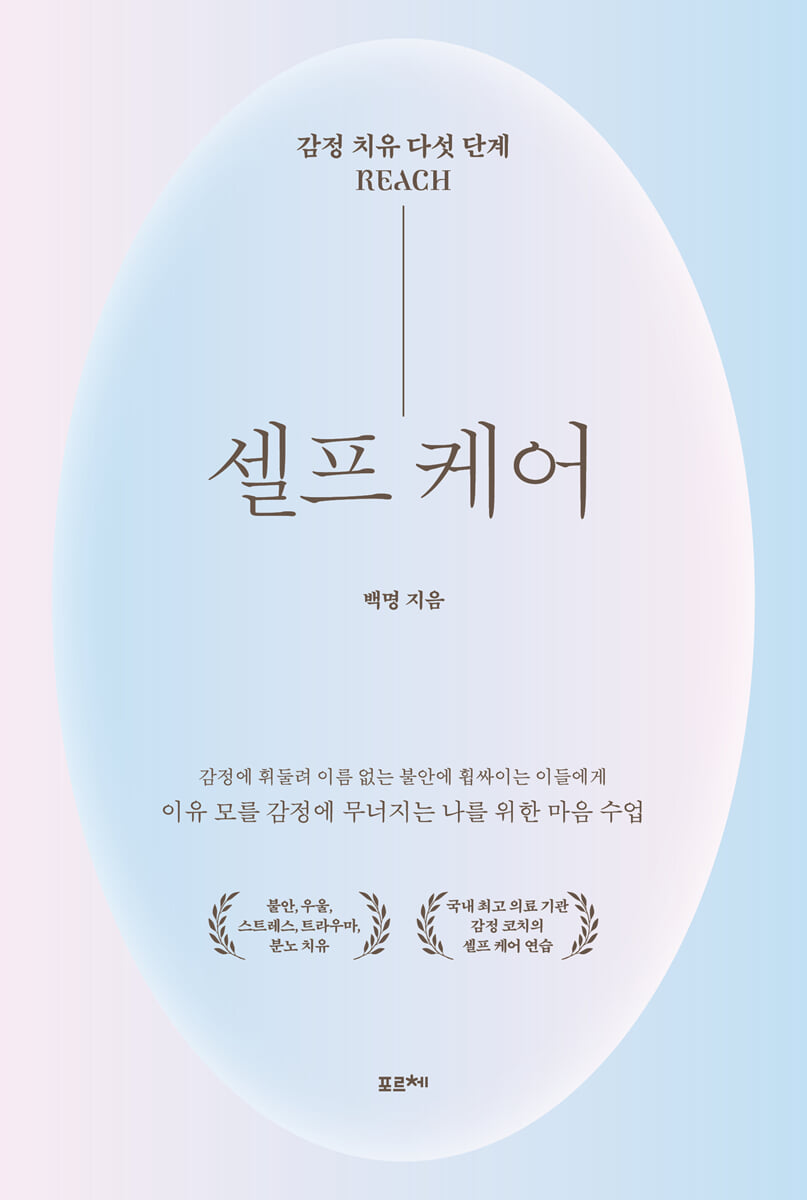
Self-care
 |
Description
Book Introduction
An emotional coach with over 20 years of experience tells you
How to Read Emotional Signals with Brain Science and Psychology
A process of clearing one's mind to restore relationships and protect oneself.
Why can't we recognize our emotions in time? Why do we pour out our hurt feelings on those closest to us, only to be trapped in a cycle of self-blame? "Self-Care" is an emotional healing guide that teaches us how to understand and break this vicious cycle of repetitive emotions.
The author, a former nursing professor who has practiced emotional coaching in numerous corporate, hospital, and educational settings, views emotions not as a part of the mind, but as signals and pain that the body and nervous system react to.
Ignoring or suppressing emotions is like neglecting the pain, which ultimately leads to greater emotional damage.
This book introduces 'REACH', a self-healing routine that can help you recognize and recover from the 'signals' of such emotions.
This is a practical emotional recovery training model developed by the author over 20 years of clinical and lecture experience, helping anyone develop emotional independence through self-training in their daily lives.
How to Read Emotional Signals with Brain Science and Psychology
A process of clearing one's mind to restore relationships and protect oneself.
Why can't we recognize our emotions in time? Why do we pour out our hurt feelings on those closest to us, only to be trapped in a cycle of self-blame? "Self-Care" is an emotional healing guide that teaches us how to understand and break this vicious cycle of repetitive emotions.
The author, a former nursing professor who has practiced emotional coaching in numerous corporate, hospital, and educational settings, views emotions not as a part of the mind, but as signals and pain that the body and nervous system react to.
Ignoring or suppressing emotions is like neglecting the pain, which ultimately leads to greater emotional damage.
This book introduces 'REACH', a self-healing routine that can help you recognize and recover from the 'signals' of such emotions.
This is a practical emotional recovery training model developed by the author over 20 years of clinical and lecture experience, helping anyone develop emotional independence through self-training in their daily lives.
- You can preview some of the book's contents.
Preview
index
Prologue 4
Preview Story: 10 Self-Care Stories from a Nurse
Chapter 1: A Story of Confronting My Heart
1 Facing the Anxiety Hidden Deep in Your Heart 22
2 Warm care that protects me 29
3 It's okay, it can happen 39
4 Breaking Repetitive Emotional Patterns 49
5 Healthy Emotions Create a Healthy Lifestyle 55
Chapter 2: REACH: Five Steps to Taking Care of Your Emotions
1 Recognize: 71
2 Empathize: 134
3 Accept: Accept 188
4 Change: Change 221
5 Heal: Become Stronger 259
Epilogue 291
Americas 294
Preview Story: 10 Self-Care Stories from a Nurse
Chapter 1: A Story of Confronting My Heart
1 Facing the Anxiety Hidden Deep in Your Heart 22
2 Warm care that protects me 29
3 It's okay, it can happen 39
4 Breaking Repetitive Emotional Patterns 49
5 Healthy Emotions Create a Healthy Lifestyle 55
Chapter 2: REACH: Five Steps to Taking Care of Your Emotions
1 Recognize: 71
2 Empathize: 134
3 Accept: Accept 188
4 Change: Change 221
5 Heal: Become Stronger 259
Epilogue 291
Americas 294
Detailed image

Into the book
The person who hurts and torments you the most is no one but yourself.
Because you know better than anyone else which part is the vital point and which part needs to be hurt to really hurt.
And then, they always look for a target to attack in order to project everything onto that painful spot, and that target is their closest family member, such as their spouse or children.
They become angry at them, attack them, and rationalize their pain by saying, 'It's because of you that I'm in so much pain, it's because of you that I'm in so much pain.'
--- From the "Prologue"
I wrote down in detail all the hurt my father gave me.
The wound was so great that even when I first studied 'forgiveness' in emotional healing, I thought it would be difficult to forgive my father.
In my diary from my third year of high school, I wrote that I would never forgive my dad.
But one day, as I was closing my diary, I suddenly thought, 'Dad, what a pitiful person.'
And then, little by little, I began to feel like I could understand my father.
--- From "Breaking Repetitive Emotional Patterns"
After that, when I expressed my feelings to someone while talking, I started to wonder about the other person.
“I realized that when I became aware of my own emotions, I was able to see and understand the emotions of others. This was empathy!”
As I listened to his story, I was able to read his emotions while also noticing my own.
I used to think that focusing on and respecting my own feelings would alienate others, but it was surprising how it actually allowed me to listen to others with more sincerity and build relationships more comfortably.
--- From "Healthy Emotions Create a Healthy Daily Life"
In particular, anxiety and anger, which are representative negative emotions, tend to be suppressed or ignored if not recognized.
The more you pretend not to know and run away, the more those feelings will hide and coil deep in your heart.
It coils up like that and then pops out at unexpected moments in unimaginable ways, causing us trouble.
We think we've suppressed our emotions and sealed them off perfectly, but like air leaking out through a tiny hole that's too small to be seen, emotions leak out and suffocate us like a toxic gas.
Because it happened unconsciously, we don't even know what caused it and just get consumed by it.
--- From "Recognize"
A person's unconscious mind makes them feel certain emotions continuously and repeatedly.
As a result, every conversation is bound to include that particular emotion, and the wounded mind in the unconscious works to make it easier to feel the emotion associated with it.
These operations serve to rationalize and defend oneself, thereby making one's beliefs and attitudes more solid.
Therefore, if we become aware of these unconscious emotions, we can identify the root desires.
“Honey, I need your attention.
“Be mindful of what I do and be there for me.” “I need your praise.
“I worked hard, but I’m upset because no one acknowledges it,” is the inner voice that says.
--- From "Empathize"
If I'm saying, 'I know that person very well,' I need to ask myself what I know about him and what I want to know more about him.
The idea that I already know everything about the other person has become my prejudice and stereotype, so when the other person does something, I dismiss it with my subjective interpretation and judgment based on my preconceived notions.
As a result, “I knew you would do that.
Then, I say, “Well, that’s just like you,” and lock the other person in my thoughts.
There is no room for further understanding or expansion of thought, and the criticism that only blames the other party grows.
--- From "Empathize"
In particular, when we are overcome with feelings of unforgiveness, anger, and hatred, let us not focus on the object of our anger, but remember only surrender so that we do not fall into sorrow.
Let us forgive and surrender to myself for denying my emotions, for criticizing my thoughts, for trying to distinguish between right and wrong and like and dislike, for dwelling in the past instead of the present and obscuring it, and for no longer illuminating my present self.
There are plenty of reasons to forgive.
Because I have to stop throwing the hot coals I'm holding in my hands to throw at my opponent.
So that my hands don't get hurt anymore.
--- From "Accept"
But what we must remember is that 'wounds heal'.
Our bodies have an amazing recovery mechanism called 'homeostasis'.
No matter how big or deep the wound may seem on the outside, the body constantly exerts its own power to heal itself and restore balance.
While physical wounds require medical help to heal, emotional wounds are even more hopeful in that the door to change can begin with the simple will to care for oneself.
--- From 「Change: Change」
Shame tends to be difficult to express, so we tend to try to hide it, suppress it, ignore it, and it leads to self-loathing and depression.
Or, they express their anger aggressively toward the other person by blaming them.
Depression deepens due to the emptiness caused by lack of desire or loss, and in an attempt to escape painful emotions such as humiliation or anger, one projects and blames oneself for this devalued self on others.
So, we try to compensate for the pain by hurting others with our hurt memories.
Because you know better than anyone else which part is the vital point and which part needs to be hurt to really hurt.
And then, they always look for a target to attack in order to project everything onto that painful spot, and that target is their closest family member, such as their spouse or children.
They become angry at them, attack them, and rationalize their pain by saying, 'It's because of you that I'm in so much pain, it's because of you that I'm in so much pain.'
--- From the "Prologue"
I wrote down in detail all the hurt my father gave me.
The wound was so great that even when I first studied 'forgiveness' in emotional healing, I thought it would be difficult to forgive my father.
In my diary from my third year of high school, I wrote that I would never forgive my dad.
But one day, as I was closing my diary, I suddenly thought, 'Dad, what a pitiful person.'
And then, little by little, I began to feel like I could understand my father.
--- From "Breaking Repetitive Emotional Patterns"
After that, when I expressed my feelings to someone while talking, I started to wonder about the other person.
“I realized that when I became aware of my own emotions, I was able to see and understand the emotions of others. This was empathy!”
As I listened to his story, I was able to read his emotions while also noticing my own.
I used to think that focusing on and respecting my own feelings would alienate others, but it was surprising how it actually allowed me to listen to others with more sincerity and build relationships more comfortably.
--- From "Healthy Emotions Create a Healthy Daily Life"
In particular, anxiety and anger, which are representative negative emotions, tend to be suppressed or ignored if not recognized.
The more you pretend not to know and run away, the more those feelings will hide and coil deep in your heart.
It coils up like that and then pops out at unexpected moments in unimaginable ways, causing us trouble.
We think we've suppressed our emotions and sealed them off perfectly, but like air leaking out through a tiny hole that's too small to be seen, emotions leak out and suffocate us like a toxic gas.
Because it happened unconsciously, we don't even know what caused it and just get consumed by it.
--- From "Recognize"
A person's unconscious mind makes them feel certain emotions continuously and repeatedly.
As a result, every conversation is bound to include that particular emotion, and the wounded mind in the unconscious works to make it easier to feel the emotion associated with it.
These operations serve to rationalize and defend oneself, thereby making one's beliefs and attitudes more solid.
Therefore, if we become aware of these unconscious emotions, we can identify the root desires.
“Honey, I need your attention.
“Be mindful of what I do and be there for me.” “I need your praise.
“I worked hard, but I’m upset because no one acknowledges it,” is the inner voice that says.
--- From "Empathize"
If I'm saying, 'I know that person very well,' I need to ask myself what I know about him and what I want to know more about him.
The idea that I already know everything about the other person has become my prejudice and stereotype, so when the other person does something, I dismiss it with my subjective interpretation and judgment based on my preconceived notions.
As a result, “I knew you would do that.
Then, I say, “Well, that’s just like you,” and lock the other person in my thoughts.
There is no room for further understanding or expansion of thought, and the criticism that only blames the other party grows.
--- From "Empathize"
In particular, when we are overcome with feelings of unforgiveness, anger, and hatred, let us not focus on the object of our anger, but remember only surrender so that we do not fall into sorrow.
Let us forgive and surrender to myself for denying my emotions, for criticizing my thoughts, for trying to distinguish between right and wrong and like and dislike, for dwelling in the past instead of the present and obscuring it, and for no longer illuminating my present self.
There are plenty of reasons to forgive.
Because I have to stop throwing the hot coals I'm holding in my hands to throw at my opponent.
So that my hands don't get hurt anymore.
--- From "Accept"
But what we must remember is that 'wounds heal'.
Our bodies have an amazing recovery mechanism called 'homeostasis'.
No matter how big or deep the wound may seem on the outside, the body constantly exerts its own power to heal itself and restore balance.
While physical wounds require medical help to heal, emotional wounds are even more hopeful in that the door to change can begin with the simple will to care for oneself.
--- From 「Change: Change」
Shame tends to be difficult to express, so we tend to try to hide it, suppress it, ignore it, and it leads to self-loathing and depression.
Or, they express their anger aggressively toward the other person by blaming them.
Depression deepens due to the emptiness caused by lack of desire or loss, and in an attempt to escape painful emotions such as humiliation or anger, one projects and blames oneself for this devalued self on others.
So, we try to compensate for the pain by hurting others with our hurt memories.
--- From "Heal: Becoming Stronger"
Publisher's Review
Five Steps to Emotional Training: 'REACH'
Persistent anxiety and mood swings can be overcome through training.
Self-care - a healing method for the mind that begins with looking into oneself
The core of “Self-Care” is the understanding that “emotions are objects of care.”
Everyone has emotions, but not everyone can express them in words and respond to them.
In this book, the author provides specific training methods for various emotional problems such as anxiety, anger, self-blame, avoidance, and conflict with others through a practical tool called 'REACH (Recognize, Empathize, Accept, Change, Heal),' a five-step training for organizing emotions.
Especially for readers who engage in emotional writing, such as keeping an emotional diary or drawing an empathy map, deeper inner exploration and recovery are possible.
For parents suffering from recurring conflicts, employees exhausted by emotional labor, and sensitive individuals hesitant to visit a counseling center, this book serves as an emotional repair shop before psychological counseling.
For those who are anxious and unstable, but still feel burdened by going to the hospital, this will be the most practical stepping stone to establishing an 'emotional routine for yourself.'
Stop pretending everything is okay and understand your own feelings first.
A self-care routine to escape the hustle and bustle of your mind
Emotional muscles are not innate, they are cultivated.
When we lose control of our emotions, the person who gets hurt the most is not others, but ourselves.
In particular, emotional instability destroys relationships with those closest to us, such as our spouse, children, and colleagues, and repeated frustrations ultimately destroy the foundation of our self-esteem.
However, people who are 'good at handling emotions' are not born with it, but rather acquire the ability to organize their emotions and objectify themselves through repeated and specific training.
Self-Care teaches you how to cultivate that emotional resilience.
The beginning is ‘self-empathy.’
All recovery begins with observing what emotions you are feeling, why they arise, and how you are responding.
Once you have developed self-empathy, it is time to slowly acquire the mindfulness skills you need.
This book explains how ordinary people can put into practice in their daily lives the ideas advocated by leading figures in psychology and meditation, such as Kabat-Zinn and Thich Nhat Hanh.
It explains, with credible evidence, a variety of tools that can be used in real life, including setting up a small meditation space at home and why 'journaling' is neuroscientifically effective in regulating emotions.
As a "self-healing tool" that dissects and heals the mind, this book offers readers a warm and practical language for understanding emotions, relationships, and themselves.
This emotional training method of stopping 'pretending to be okay' and taking care of the 'real me' is a survival skill that everyone needs.
Persistent anxiety and mood swings can be overcome through training.
Self-care - a healing method for the mind that begins with looking into oneself
The core of “Self-Care” is the understanding that “emotions are objects of care.”
Everyone has emotions, but not everyone can express them in words and respond to them.
In this book, the author provides specific training methods for various emotional problems such as anxiety, anger, self-blame, avoidance, and conflict with others through a practical tool called 'REACH (Recognize, Empathize, Accept, Change, Heal),' a five-step training for organizing emotions.
Especially for readers who engage in emotional writing, such as keeping an emotional diary or drawing an empathy map, deeper inner exploration and recovery are possible.
For parents suffering from recurring conflicts, employees exhausted by emotional labor, and sensitive individuals hesitant to visit a counseling center, this book serves as an emotional repair shop before psychological counseling.
For those who are anxious and unstable, but still feel burdened by going to the hospital, this will be the most practical stepping stone to establishing an 'emotional routine for yourself.'
Stop pretending everything is okay and understand your own feelings first.
A self-care routine to escape the hustle and bustle of your mind
Emotional muscles are not innate, they are cultivated.
When we lose control of our emotions, the person who gets hurt the most is not others, but ourselves.
In particular, emotional instability destroys relationships with those closest to us, such as our spouse, children, and colleagues, and repeated frustrations ultimately destroy the foundation of our self-esteem.
However, people who are 'good at handling emotions' are not born with it, but rather acquire the ability to organize their emotions and objectify themselves through repeated and specific training.
Self-Care teaches you how to cultivate that emotional resilience.
The beginning is ‘self-empathy.’
All recovery begins with observing what emotions you are feeling, why they arise, and how you are responding.
Once you have developed self-empathy, it is time to slowly acquire the mindfulness skills you need.
This book explains how ordinary people can put into practice in their daily lives the ideas advocated by leading figures in psychology and meditation, such as Kabat-Zinn and Thich Nhat Hanh.
It explains, with credible evidence, a variety of tools that can be used in real life, including setting up a small meditation space at home and why 'journaling' is neuroscientifically effective in regulating emotions.
As a "self-healing tool" that dissects and heals the mind, this book offers readers a warm and practical language for understanding emotions, relationships, and themselves.
This emotional training method of stopping 'pretending to be okay' and taking care of the 'real me' is a survival skill that everyone needs.
GOODS SPECIFICS
- Date of issue: August 6, 2025
- Page count, weight, size: 308 pages | 540g | 150*223*20mm
- ISBN13: 9791194634409
- ISBN10: 1194634400
You may also like
카테고리
korean


korean

![ELLE 엘르 스페셜 에디션 A형 : 12월 [2025]](http://librairie.coreenne.fr/cdn/shop/files/b8e27a3de6c9538896439686c6b0e8fb.jpg?v=1766436872&width=3840)


