

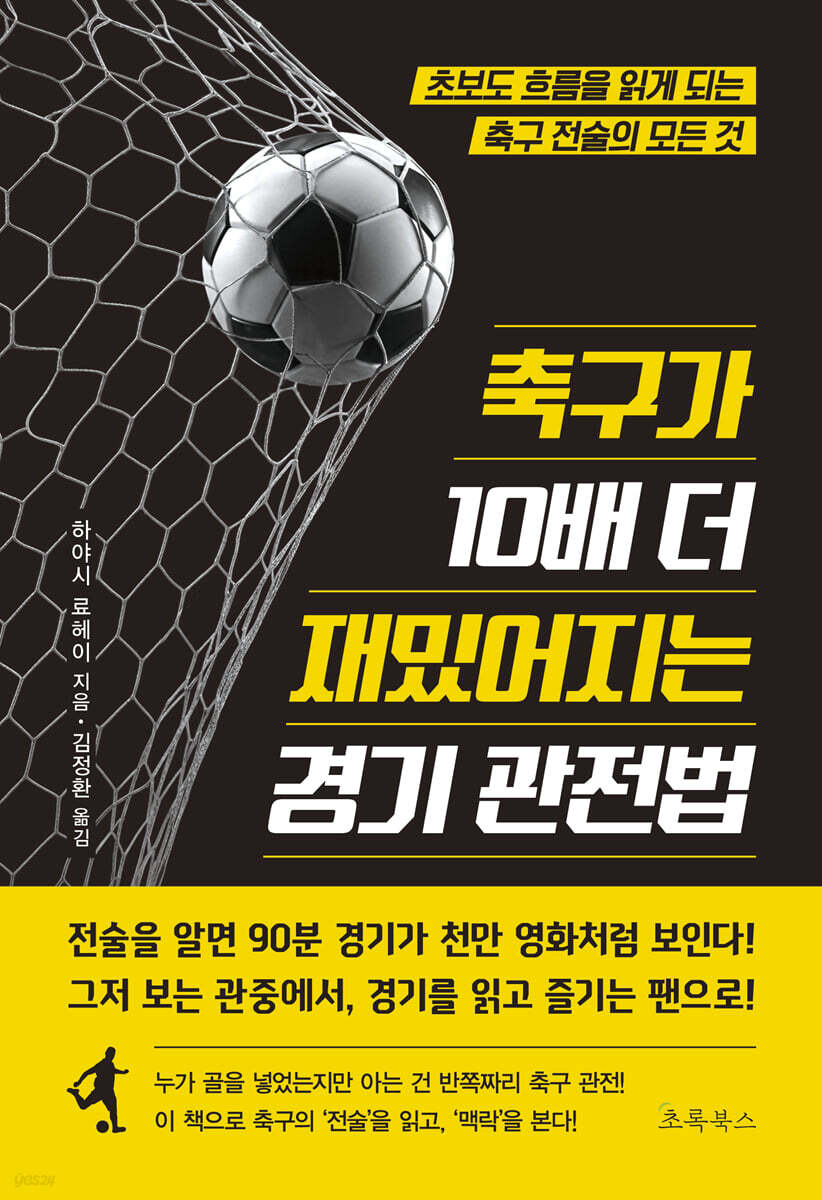
How to Watch Soccer: 10 Times More Fun
 |
Description
Book Introduction
If you know the tactics
Soccer just got a lot more fun!
The more familiar I become with soccer, the more I want to know.
You want to understand why players were substituted in this scene, why this formation was chosen, why it feels like a completely different game when the same team has a different manager.
This book is the best introduction to soccer tactics to quench that thirst.
Rather than complex theories, it starts with the basics of tactics such as positions and formations, and helps develop an eye for reading the flow and context.
The biggest advantage is that even ordinary fans who do not major in 'tactics' can easily follow along.
The moment the scenes you see on the field or on broadcast are connected to tactical concepts, soccer enters a whole new world.
Beyond simply conveying information, this book enhances the enjoyment of watching and the depth of interpretation.
For fans who thought tactics were their own language, this book will be an opportunity to experience both the commentator's perspective and the manager's judgment side by side for the first time.
This is a highly recommended introductory book not only for soccer beginners, but also for fans who have been fans of soccer for a long time but have felt that 'tactics are difficult.'
The author, who has been active as an overseas soccer commentator and columnist, cultivates the ability to interpret games based on the premise that 'soccer is a sport of flow.'
It provides not only the tactics of famous managers but also various examples of how actual managers used which players and which tactics, allowing you to see the game with a deeper perspective.
In a tactical context, it is very useful to link the manager's decisions with the player's movements to explain them.
After reading this book, you will go beyond evaluating “who did well” and understand “why they moved that way.”
When you start looking at soccer analytically, you start to notice tactical changes during the game.
If you change your perspective on soccer, the game will inevitably become much more enjoyable.
Soccer just got a lot more fun!
The more familiar I become with soccer, the more I want to know.
You want to understand why players were substituted in this scene, why this formation was chosen, why it feels like a completely different game when the same team has a different manager.
This book is the best introduction to soccer tactics to quench that thirst.
Rather than complex theories, it starts with the basics of tactics such as positions and formations, and helps develop an eye for reading the flow and context.
The biggest advantage is that even ordinary fans who do not major in 'tactics' can easily follow along.
The moment the scenes you see on the field or on broadcast are connected to tactical concepts, soccer enters a whole new world.
Beyond simply conveying information, this book enhances the enjoyment of watching and the depth of interpretation.
For fans who thought tactics were their own language, this book will be an opportunity to experience both the commentator's perspective and the manager's judgment side by side for the first time.
This is a highly recommended introductory book not only for soccer beginners, but also for fans who have been fans of soccer for a long time but have felt that 'tactics are difficult.'
The author, who has been active as an overseas soccer commentator and columnist, cultivates the ability to interpret games based on the premise that 'soccer is a sport of flow.'
It provides not only the tactics of famous managers but also various examples of how actual managers used which players and which tactics, allowing you to see the game with a deeper perspective.
In a tactical context, it is very useful to link the manager's decisions with the player's movements to explain them.
After reading this book, you will go beyond evaluating “who did well” and understand “why they moved that way.”
When you start looking at soccer analytically, you start to notice tactical changes during the game.
If you change your perspective on soccer, the game will inevitably become much more enjoyable.
- You can preview some of the book's contents.
Preview
index
| Dedicated to the Korean edition | A book that broadens the horizons of what it means to "watch" a soccer game
| Introduction | Soccer becomes more fun when you increase your 'soccer watching power'!
CHAPTER 1 Preparation and mindset for enjoying soccer
I watch my favorite team's game at least once a week.
Make the most of your scouting reports
Athletes' social media accounts are a treasure trove of information.
Things to know before the game starts
CHAPTER 2: Key Points to Watch in a 90-Minute Match, Time-By-Time
Determine the initial positioning and team's aggressiveness at kickoff.
Be sure to check the 'stats' during halftime after the first half.
The importance of player substitutions as seen through a comeback victory
Watch the second half with awareness of 'response to the opponent'
What's noteworthy about the 60-minute mark is the tug-of-war between the two directors.
After the game, we check to see how effective the strategy was.
CHAPTER 3 Main Roles and Iconic Players for Each Position
[Center Forward (CF)] Not only scoring, but also linking up and applying pressure.
[Winger and Second Striker] The position is becoming less and less distinct.
[Attacking Midfielder] Play vision and judgment are key skills.
Defensive Midfielder: The Hidden Worker Who Balances Offense and Defense
[Center Back (CB)] The growing importance of speed
[Fullback (FB) and Wingback (WB)] Classified into balanced and ultra-attacking types.
[Goalkeeper (GK)] The goalkeeper's transformation into a field player is in progress.
CHAPTER 4: Understanding the Flow of the Game at a Glance with Formations
You should have an initial layout in mind.
[4-4-2] A classic formation with good balance
[4-2-3-1] The role of the attacking midfielder is important.
[4-3-3] The most popular formation right now
[4-3-1-2] It is easy to take the initiative in the midfield.
[3-4-2-1] One solution to a 5-lane attack
[3-1-4-2 and 3-4-1-2] Requires considerable exercise
[Variable Formation] Now the Tactical Default
CHAPTER 5: Great Managers Who Changed the Flow of Modern Football
[Joseph Guardiola] Endless curiosity and desire for improvement
Jurgen Klopp: The Master Who Evolved Gegenpressing
[Mikel Arteta] Carrying out the heavy responsibility of 'Arsenal rebuilding'
Roberto De Zerbi: The ultra-attacking football that captivates fans
[Carlo Ancelotti] Establishing a 'player-first' tactic
[Diego Simeone] Values fighting spirit and strong perseverance.
[Topic: Mourinho] A representative realist in modern football
CHAPTER 6 Players and coaches I personally watch
[Pedro Neto] Sharp dribbling breakthrough is the highlight.
[Morgan Gibbs-White] The Rise of the Modern Fantasy Star
[Alex Scott] A talent highly praised by Pep Guardiola
[Brian Zaragoza] Amazing dribbling ability
[Giorgi Mamardashvili] Unrivaled Saving Ability
[Mika Marmol] A textbook on center-back build-up
[Tijani Lijnders] The Ideal Central Midfielder
[Joshua Zirkzey] A player who reminds me of Zlatan Ibrahimovic
Benjamin Sesco, the goal scorer dubbed "the second Holland."
Warren Jair-Emery: A regular at a big club at 17
Santiago Jimenez: A top-tier goal scorer who has caught the attention of Europe.
[Arne Slot] Clear directionality combined with flexibility
CHAPTER 7 My Longtime Partner, 'Soccer Notes'
My own soccer notes that I've been writing for about 30 years
I also use notes to preview the commentary.
Let's make a soccer notebook for the cheering team.
| And | You will be able to enjoy soccer more through this book!
| Introduction | Soccer becomes more fun when you increase your 'soccer watching power'!
CHAPTER 1 Preparation and mindset for enjoying soccer
I watch my favorite team's game at least once a week.
Make the most of your scouting reports
Athletes' social media accounts are a treasure trove of information.
Things to know before the game starts
CHAPTER 2: Key Points to Watch in a 90-Minute Match, Time-By-Time
Determine the initial positioning and team's aggressiveness at kickoff.
Be sure to check the 'stats' during halftime after the first half.
The importance of player substitutions as seen through a comeback victory
Watch the second half with awareness of 'response to the opponent'
What's noteworthy about the 60-minute mark is the tug-of-war between the two directors.
After the game, we check to see how effective the strategy was.
CHAPTER 3 Main Roles and Iconic Players for Each Position
[Center Forward (CF)] Not only scoring, but also linking up and applying pressure.
[Winger and Second Striker] The position is becoming less and less distinct.
[Attacking Midfielder] Play vision and judgment are key skills.
Defensive Midfielder: The Hidden Worker Who Balances Offense and Defense
[Center Back (CB)] The growing importance of speed
[Fullback (FB) and Wingback (WB)] Classified into balanced and ultra-attacking types.
[Goalkeeper (GK)] The goalkeeper's transformation into a field player is in progress.
CHAPTER 4: Understanding the Flow of the Game at a Glance with Formations
You should have an initial layout in mind.
[4-4-2] A classic formation with good balance
[4-2-3-1] The role of the attacking midfielder is important.
[4-3-3] The most popular formation right now
[4-3-1-2] It is easy to take the initiative in the midfield.
[3-4-2-1] One solution to a 5-lane attack
[3-1-4-2 and 3-4-1-2] Requires considerable exercise
[Variable Formation] Now the Tactical Default
CHAPTER 5: Great Managers Who Changed the Flow of Modern Football
[Joseph Guardiola] Endless curiosity and desire for improvement
Jurgen Klopp: The Master Who Evolved Gegenpressing
[Mikel Arteta] Carrying out the heavy responsibility of 'Arsenal rebuilding'
Roberto De Zerbi: The ultra-attacking football that captivates fans
[Carlo Ancelotti] Establishing a 'player-first' tactic
[Diego Simeone] Values fighting spirit and strong perseverance.
[Topic: Mourinho] A representative realist in modern football
CHAPTER 6 Players and coaches I personally watch
[Pedro Neto] Sharp dribbling breakthrough is the highlight.
[Morgan Gibbs-White] The Rise of the Modern Fantasy Star
[Alex Scott] A talent highly praised by Pep Guardiola
[Brian Zaragoza] Amazing dribbling ability
[Giorgi Mamardashvili] Unrivaled Saving Ability
[Mika Marmol] A textbook on center-back build-up
[Tijani Lijnders] The Ideal Central Midfielder
[Joshua Zirkzey] A player who reminds me of Zlatan Ibrahimovic
Benjamin Sesco, the goal scorer dubbed "the second Holland."
Warren Jair-Emery: A regular at a big club at 17
Santiago Jimenez: A top-tier goal scorer who has caught the attention of Europe.
[Arne Slot] Clear directionality combined with flexibility
CHAPTER 7 My Longtime Partner, 'Soccer Notes'
My own soccer notes that I've been writing for about 30 years
I also use notes to preview the commentary.
Let's make a soccer notebook for the cheering team.
| And | You will be able to enjoy soccer more through this book!
Detailed image
.jpg)
Into the book
For those who are thinking about watching overseas soccer in the future, I recommend first creating a 'cheerleading team'.
I think it doesn't matter what the trigger is.
It could be a little reason like you like a player, a coach, a cool team color, or just because they look strong.
If you keep watching the games for whatever reason, you will be able to tell if they are a good team or a bad team, and you will also be more likely to develop an attachment to them.
--- From "CHAPTER 1: A mindset for enjoying soccer more"
When I'm commentating, I look at my soccer notes, scouting reports, and social media once more when the starting lineup is announced to get information about both teams into my head.
Then, imagine how the game will unfold, and draw in your mind the qualitative superiority and even the formation compatibility.
Viewers will also be able to enjoy the soccer from this point on, even before the game begins.
For example, if a fan of Team A keeps information about the opposing team, Team B, in their head, it will help them recall the image of the entire game.
For example, 'Our team's (Team A) right back is slow on his feet, but Team B's left winger is fast on his feet.
You can do a simulation, saying, 'I don't know if it will be a classic.'
--- From "CHAPTER 1: A mindset for enjoying soccer more"
Once I've confirmed the starting lineup, I can roughly predict the initial deployment of both teams and the formation changes during offense and defense.
However, since many managers change their formations depending on the situation or opponent, I check how accurate my predictions were after the actual game started, just like checking an answer sheet.
I thought, 'With these members, the initial formation would be 4-3-3, 3-2-5 when attacking, and 4-4-2 when defending,' but there are times when different formations are used during offense and defense, or when the way the formation is changed is different.
At times like that, I think, 'Oh, is this how it's going to be done today?' 'I see.
As you will make new discoveries such as 'there was also this method', I recommend watching the game, paying special attention to player placement for about 5 minutes after kick-off.
--- From "CHAPTER 2: Must-Check Points to Watch During a 90-Minute Match"
Substitutions are becoming increasingly important in modern football.
The maximum number of substitutes allowed was increased from three to five following the COVID-19 pandemic (it was gradually introduced in each country's league starting in 2020 when the COVID-19 pandemic began, and was officially established as a rule by the International Football Association Board (IFAB) in 2022).
These changes have significantly changed football itself.
In the past, it was standard to use a substitution card once every halftime, 60 minutes, and 80 minutes, but now bold measures such as simultaneous substitutions of 2 or 3 players are possible.
It has become possible to 'change the game' by changing formations or tactics in an instant.
--- From "CHAPTER 2: Must-Check Points to Watch During a 90-Minute Match"
After the match, supporters will naturally be happy or sad about the result.
However, as a commentator, after the game, I check the final stats, review the content, analyze the good and bad parts, and try to express them in appropriate words.
Soccer is a sport where the content and the result do not necessarily match.
There are times when the game wasn't that great but we won, and on the other hand, there are times when the game was good but we lost.
Of course, winning is the biggest goal, but if you win by luck, there's no guarantee that you'll continue to win in the future.
Therefore, in preparation for the next match, it is very important to check how well the team's 'football philosophy', 'four-phase strategy', and 'game plan' that is conscious of responding to the opponent worked in this match.
--- From "CHAPTER 2: Must-Check Points to Watch During a 90-Minute Match"
We can also learn the importance of concentration from Holland.
In particular, he is a so-called classic number 9* type, and his number of touches during a game is the lowest on the team in most games.
Yet, the fact that he boasts the world's best goal completion rate is the greatest proof of his ability to play without losing focus even when he does not have the ball.
I know this all too well, having played center forward during my playing days, but maintaining focus while being severely restricted from the greatest joy and pleasure in soccer – kicking the ball – is not as easy as it sounds.
With many center forwards becoming impatient and irritated when the ball doesn't come to them, it's worth noting that Haaland remains calm in such situations.
--- From "CHAPTER 3: Roles and Symbolic Players of Each Position"
When it comes to the mental aspect, resilience is also very important for a goalkeeper in addition to composure.
There is not a single goalkeeper in the world who never concedes a goal and never makes a mistake.
Everyone concedes goals dozens of times a season, so it's crucial to maintain a positive mindset and motivate yourself and your teammates.
Even during commentary, I carefully observe the goalkeeper's expression and actions immediately after conceding a goal. I really like goalkeepers who have a cheerful expression and gestures that say, "Let's cheer up and get back at it!"
Although it is a scene that is briefly shown during the broadcast, I hope you all will pay attention and take a look.
--- From "CHAPTER 3: Roles and Symbolic Players of Each Position"
Recently, formations are sometimes referred to as 'initial deployments'.
This is because the so-called 'variable formation', in which players' positions and roles change depending on the game situation and formation changes, has spread worldwide, making it difficult to see a team maintaining the same formation for the entire 90 minutes.
More and more teams are changing their formations, starting with a 3-4-3, then a 3-2-5 for build-up and a 4-4-2 for defense.
But even if formations keep changing, there is always a basic formation (initial arrangement) that exists for any team.
As I briefly mentioned in Chapter 2, I have a rough idea of what the initial lineup will be like when the starting lineup is announced, and then I check it after kickoff.
First, let's look at the easiest-to-understand 'number of people in the final line' and understand whether it's 400 or 300. Then, if we look at the deployment of the midfield and front line, we'll be able to see the overall picture well.
--- From "CHAPTER 4: You can see the game just by knowing the formation"
Variable formations are a risky tactic with both advantages and disadvantages.
However, I believe the reason there has been a surge in managers trying variable formations at the top level of Europe in recent years is because of Guardiola's success and the subsequent trend towards attacking football.
This will be a welcome trend for football lovers, as it will naturally lead to an increase in attacking, goal-scoring matches.
--- From "CHAPTER 4: You can see the game just by knowing the formation"
Josep Guardiola, who has been leading Manchester City since 2016, is arguably the world's best manager.
What I admire most about Pep (Guardiola's nickname) is his endless curiosity and desire to improve.
He creates new concepts such as 'positional play', 'fake center forward', 'fake full back', and even 'fake center back', and also updates existing tactics to a modern style.
Instilling such innovative ideas in players and making them function as a team is not only fascinating, but also very educational for both the coach and the commentator.
--- From "CHAPTER 5: Great Managers Who Changed Modern Football"
It can be said that Klopp is a manager with a fundamentally different ideology from Pep, who values 'dominating space and the game through ball possession'.
To put it more simply, it goes like this.
When they do manage to win the ball back, Pep's team prioritises securing possession first, whereas Klopp's team tries to get the ball vertically and reach the opposition's goal as quickly as possible.
Moreover, Liverpool, led by Klopp, has perfected a pattern play that allows them to finish with only the three central lanes without going through the outside lanes on the left and right.
The core of this intense style and the one that has become synonymous with Klopp is 'Gegenpressing' (German for counterpressing).
It refers to a play that aims to immediately recover the ball by applying pressure to the opposing team player who has the ball from the moment of negative transition (change from 'offense to defense').
--- From "CHAPTER 5: Great Managers Who Changed Modern Football"
Neto's greatest weapon is his 'dribble breakthrough'.
In particular, his greatest strength is his ability to break through to either the left or right after a step-over, allowing him to break down the opposing defender's stance and break through vertically in one go, or even show a sharp cut-in (a dribbling or movement pattern in which he cuts in from the side with the ball).
The acceleration time to top speed is also very fast, so you can connect the counterattack and finish on your own.
I think a winger with such a high level of physical ability and technique is quite valuable in modern football.
--- From "CHAPTER 6 Players and Managers I 'Personally Pay Attention to"
It is no exaggeration to say that having a clear play model while also being flexible enough to change tactics according to the opponent and situation is the most required element for a manager in modern football.
In that sense, I feel there is great potential in Manager Slot, and it would not be surprising at all if he were to take charge of a big club someday.
I hope you all will also watch Feyenoord's match.
(The slot manager was appointed as the manager of Premier League club Liverpool in May 2024, succeeding Jurgen Klopp.
The organized and aggressive style of football he displayed at Feyenoord is also considered to fit well with Liverpool's next-generation direction. (Translator)
--- From "CHAPTER 6 Players and Managers I 'Personally Pay Attention to"
Even after I retired from active duty, I continued to write football notes to become a good commentator and coach.
Even if I just watch the game to prepare for commentary, a lot of information remains vaguely in my head, but that information doesn't come to mind right away when I'm commentating the game.
However, if I write down notes in my own soccer notebook, they will be imprinted on my memory more clearly and I will be able to express them in words immediately when needed.
The things I write in my soccer notes for previewing the commentary are the members (the faces and names must match), formation, offense and defense mechanisms, characteristics (is the offense possession-based or counter-attacking, is the defense high-pressing or blocking, etc.), and changes during the game (formation changes or player substitutions).
Because this prior information is firmly in my head, I can immediately discuss the game's characteristics and changes during live commentary without much difficulty.
--- From "CHAPTER 7 My Longtime Partner, 'Soccer Notes'"
Recently, I met with a soccer official and we started talking about the 'development of the soccer world'.
The players are growing steadily.
At the same time, if the media and supporters can understand soccer more deeply, the level of soccer will rise even higher.
This was the conclusion of the conversation we had then.
As a commentator through the media, I strive to convey the charm and mystery of soccer with all my might.
So, I hope that soccer fans will also grow together.
To that end, I hope you develop the habit of writing down soccer notes to further enhance your ability to watch soccer games.
I think it doesn't matter what the trigger is.
It could be a little reason like you like a player, a coach, a cool team color, or just because they look strong.
If you keep watching the games for whatever reason, you will be able to tell if they are a good team or a bad team, and you will also be more likely to develop an attachment to them.
--- From "CHAPTER 1: A mindset for enjoying soccer more"
When I'm commentating, I look at my soccer notes, scouting reports, and social media once more when the starting lineup is announced to get information about both teams into my head.
Then, imagine how the game will unfold, and draw in your mind the qualitative superiority and even the formation compatibility.
Viewers will also be able to enjoy the soccer from this point on, even before the game begins.
For example, if a fan of Team A keeps information about the opposing team, Team B, in their head, it will help them recall the image of the entire game.
For example, 'Our team's (Team A) right back is slow on his feet, but Team B's left winger is fast on his feet.
You can do a simulation, saying, 'I don't know if it will be a classic.'
--- From "CHAPTER 1: A mindset for enjoying soccer more"
Once I've confirmed the starting lineup, I can roughly predict the initial deployment of both teams and the formation changes during offense and defense.
However, since many managers change their formations depending on the situation or opponent, I check how accurate my predictions were after the actual game started, just like checking an answer sheet.
I thought, 'With these members, the initial formation would be 4-3-3, 3-2-5 when attacking, and 4-4-2 when defending,' but there are times when different formations are used during offense and defense, or when the way the formation is changed is different.
At times like that, I think, 'Oh, is this how it's going to be done today?' 'I see.
As you will make new discoveries such as 'there was also this method', I recommend watching the game, paying special attention to player placement for about 5 minutes after kick-off.
--- From "CHAPTER 2: Must-Check Points to Watch During a 90-Minute Match"
Substitutions are becoming increasingly important in modern football.
The maximum number of substitutes allowed was increased from three to five following the COVID-19 pandemic (it was gradually introduced in each country's league starting in 2020 when the COVID-19 pandemic began, and was officially established as a rule by the International Football Association Board (IFAB) in 2022).
These changes have significantly changed football itself.
In the past, it was standard to use a substitution card once every halftime, 60 minutes, and 80 minutes, but now bold measures such as simultaneous substitutions of 2 or 3 players are possible.
It has become possible to 'change the game' by changing formations or tactics in an instant.
--- From "CHAPTER 2: Must-Check Points to Watch During a 90-Minute Match"
After the match, supporters will naturally be happy or sad about the result.
However, as a commentator, after the game, I check the final stats, review the content, analyze the good and bad parts, and try to express them in appropriate words.
Soccer is a sport where the content and the result do not necessarily match.
There are times when the game wasn't that great but we won, and on the other hand, there are times when the game was good but we lost.
Of course, winning is the biggest goal, but if you win by luck, there's no guarantee that you'll continue to win in the future.
Therefore, in preparation for the next match, it is very important to check how well the team's 'football philosophy', 'four-phase strategy', and 'game plan' that is conscious of responding to the opponent worked in this match.
--- From "CHAPTER 2: Must-Check Points to Watch During a 90-Minute Match"
We can also learn the importance of concentration from Holland.
In particular, he is a so-called classic number 9* type, and his number of touches during a game is the lowest on the team in most games.
Yet, the fact that he boasts the world's best goal completion rate is the greatest proof of his ability to play without losing focus even when he does not have the ball.
I know this all too well, having played center forward during my playing days, but maintaining focus while being severely restricted from the greatest joy and pleasure in soccer – kicking the ball – is not as easy as it sounds.
With many center forwards becoming impatient and irritated when the ball doesn't come to them, it's worth noting that Haaland remains calm in such situations.
--- From "CHAPTER 3: Roles and Symbolic Players of Each Position"
When it comes to the mental aspect, resilience is also very important for a goalkeeper in addition to composure.
There is not a single goalkeeper in the world who never concedes a goal and never makes a mistake.
Everyone concedes goals dozens of times a season, so it's crucial to maintain a positive mindset and motivate yourself and your teammates.
Even during commentary, I carefully observe the goalkeeper's expression and actions immediately after conceding a goal. I really like goalkeepers who have a cheerful expression and gestures that say, "Let's cheer up and get back at it!"
Although it is a scene that is briefly shown during the broadcast, I hope you all will pay attention and take a look.
--- From "CHAPTER 3: Roles and Symbolic Players of Each Position"
Recently, formations are sometimes referred to as 'initial deployments'.
This is because the so-called 'variable formation', in which players' positions and roles change depending on the game situation and formation changes, has spread worldwide, making it difficult to see a team maintaining the same formation for the entire 90 minutes.
More and more teams are changing their formations, starting with a 3-4-3, then a 3-2-5 for build-up and a 4-4-2 for defense.
But even if formations keep changing, there is always a basic formation (initial arrangement) that exists for any team.
As I briefly mentioned in Chapter 2, I have a rough idea of what the initial lineup will be like when the starting lineup is announced, and then I check it after kickoff.
First, let's look at the easiest-to-understand 'number of people in the final line' and understand whether it's 400 or 300. Then, if we look at the deployment of the midfield and front line, we'll be able to see the overall picture well.
--- From "CHAPTER 4: You can see the game just by knowing the formation"
Variable formations are a risky tactic with both advantages and disadvantages.
However, I believe the reason there has been a surge in managers trying variable formations at the top level of Europe in recent years is because of Guardiola's success and the subsequent trend towards attacking football.
This will be a welcome trend for football lovers, as it will naturally lead to an increase in attacking, goal-scoring matches.
--- From "CHAPTER 4: You can see the game just by knowing the formation"
Josep Guardiola, who has been leading Manchester City since 2016, is arguably the world's best manager.
What I admire most about Pep (Guardiola's nickname) is his endless curiosity and desire to improve.
He creates new concepts such as 'positional play', 'fake center forward', 'fake full back', and even 'fake center back', and also updates existing tactics to a modern style.
Instilling such innovative ideas in players and making them function as a team is not only fascinating, but also very educational for both the coach and the commentator.
--- From "CHAPTER 5: Great Managers Who Changed Modern Football"
It can be said that Klopp is a manager with a fundamentally different ideology from Pep, who values 'dominating space and the game through ball possession'.
To put it more simply, it goes like this.
When they do manage to win the ball back, Pep's team prioritises securing possession first, whereas Klopp's team tries to get the ball vertically and reach the opposition's goal as quickly as possible.
Moreover, Liverpool, led by Klopp, has perfected a pattern play that allows them to finish with only the three central lanes without going through the outside lanes on the left and right.
The core of this intense style and the one that has become synonymous with Klopp is 'Gegenpressing' (German for counterpressing).
It refers to a play that aims to immediately recover the ball by applying pressure to the opposing team player who has the ball from the moment of negative transition (change from 'offense to defense').
--- From "CHAPTER 5: Great Managers Who Changed Modern Football"
Neto's greatest weapon is his 'dribble breakthrough'.
In particular, his greatest strength is his ability to break through to either the left or right after a step-over, allowing him to break down the opposing defender's stance and break through vertically in one go, or even show a sharp cut-in (a dribbling or movement pattern in which he cuts in from the side with the ball).
The acceleration time to top speed is also very fast, so you can connect the counterattack and finish on your own.
I think a winger with such a high level of physical ability and technique is quite valuable in modern football.
--- From "CHAPTER 6 Players and Managers I 'Personally Pay Attention to"
It is no exaggeration to say that having a clear play model while also being flexible enough to change tactics according to the opponent and situation is the most required element for a manager in modern football.
In that sense, I feel there is great potential in Manager Slot, and it would not be surprising at all if he were to take charge of a big club someday.
I hope you all will also watch Feyenoord's match.
(The slot manager was appointed as the manager of Premier League club Liverpool in May 2024, succeeding Jurgen Klopp.
The organized and aggressive style of football he displayed at Feyenoord is also considered to fit well with Liverpool's next-generation direction. (Translator)
--- From "CHAPTER 6 Players and Managers I 'Personally Pay Attention to"
Even after I retired from active duty, I continued to write football notes to become a good commentator and coach.
Even if I just watch the game to prepare for commentary, a lot of information remains vaguely in my head, but that information doesn't come to mind right away when I'm commentating the game.
However, if I write down notes in my own soccer notebook, they will be imprinted on my memory more clearly and I will be able to express them in words immediately when needed.
The things I write in my soccer notes for previewing the commentary are the members (the faces and names must match), formation, offense and defense mechanisms, characteristics (is the offense possession-based or counter-attacking, is the defense high-pressing or blocking, etc.), and changes during the game (formation changes or player substitutions).
Because this prior information is firmly in my head, I can immediately discuss the game's characteristics and changes during live commentary without much difficulty.
--- From "CHAPTER 7 My Longtime Partner, 'Soccer Notes'"
Recently, I met with a soccer official and we started talking about the 'development of the soccer world'.
The players are growing steadily.
At the same time, if the media and supporters can understand soccer more deeply, the level of soccer will rise even higher.
This was the conclusion of the conversation we had then.
As a commentator through the media, I strive to convey the charm and mystery of soccer with all my might.
So, I hope that soccer fans will also grow together.
To that end, I hope you develop the habit of writing down soccer notes to further enhance your ability to watch soccer games.
--- From "CHAPTER 7 My Longtime Partner, 'Soccer Notes'"
Publisher's Review
For beginner viewers
The most practical soccer tactics book!
This book consists of seven chapters and focuses on increasing 'practical observation skills' rather than theory.
Chapter 1 introduces how to observe and gather information about your favorite team's game, and Chapter 2 provides the techniques of spectating by interpreting the 90-minute game by time slot.
Chapter 3 provides a deeper understanding of each position through its main role and iconic players, while Chapter 4 outlines the basic structure of modern tactics, from the 4-4-2 formation to variable formations based on a three-back formation.
Chapter 5, which follows, explores the flow of tactics through the philosophies of renowned managers such as Guardiola, Klopp, and Ancelotti, and Chapter 6 broadens the perspective of spectators by introducing new players and managers that the author has noticed.
In the final seven chapters, the author uses his "football notes" from decades of writing to help readers develop their own routine for analyzing games as if they were preparing their own commentary.
Each chapter is structured around short, clear paragraphs, making it easy to follow even for readers without tactical background.
Unfamiliar tactical terms are explained in detail in the text, and 36 video QR codes containing actual match scenes allow you to see and experience tactical concepts firsthand.
The great advantage of this book is that it allows for observational training through observation, comparison, and learning, rather than simply reading.
For soccer fans who regularly watch matches, this can add a strategic perspective to their viewing habits, and for coaches who need analytical and communication skills, it can also help with practical coaching.
Furthermore, training to read the game in a tactical context is beneficial for active players as it helps them 'verbalize their senses' and greatly helps them understand team tactics more quickly and accurately.
This book, which encourages people to view soccer not as something to simply cheer for, but as something to understand, is a practical tactical guide recommended to anyone who wants to take their spectatorship and tactical sense to the next level.
The most practical soccer tactics book!
This book consists of seven chapters and focuses on increasing 'practical observation skills' rather than theory.
Chapter 1 introduces how to observe and gather information about your favorite team's game, and Chapter 2 provides the techniques of spectating by interpreting the 90-minute game by time slot.
Chapter 3 provides a deeper understanding of each position through its main role and iconic players, while Chapter 4 outlines the basic structure of modern tactics, from the 4-4-2 formation to variable formations based on a three-back formation.
Chapter 5, which follows, explores the flow of tactics through the philosophies of renowned managers such as Guardiola, Klopp, and Ancelotti, and Chapter 6 broadens the perspective of spectators by introducing new players and managers that the author has noticed.
In the final seven chapters, the author uses his "football notes" from decades of writing to help readers develop their own routine for analyzing games as if they were preparing their own commentary.
Each chapter is structured around short, clear paragraphs, making it easy to follow even for readers without tactical background.
Unfamiliar tactical terms are explained in detail in the text, and 36 video QR codes containing actual match scenes allow you to see and experience tactical concepts firsthand.
The great advantage of this book is that it allows for observational training through observation, comparison, and learning, rather than simply reading.
For soccer fans who regularly watch matches, this can add a strategic perspective to their viewing habits, and for coaches who need analytical and communication skills, it can also help with practical coaching.
Furthermore, training to read the game in a tactical context is beneficial for active players as it helps them 'verbalize their senses' and greatly helps them understand team tactics more quickly and accurately.
This book, which encourages people to view soccer not as something to simply cheer for, but as something to understand, is a practical tactical guide recommended to anyone who wants to take their spectatorship and tactical sense to the next level.
GOODS SPECIFICS
- Date of issue: August 5, 2025
- Page count, weight, size: 276 pages | 388g | 144*210*17mm
- ISBN13: 9791160029567
- ISBN10: 1160029563
You may also like
카테고리
korean


korean

![GQ KOREA Mark (Monthly): December [2025]](http://librairie.coreenne.fr/cdn/shop/files/8ef265dbbfbf186523ed75ba7319009d.jpg?v=1765340328&width=3840)


